
Although few (except the NPC Observer) outside the Supreme People’s Court (SPC) likely have noticed, earlier this year it was agreed between the National People’s Congress (NPC) Standing Committee and the SPC that this year’s SPC specialized report to the NPC Standing Committee will focus on administrative litigation. (For those who need a refresher on SPC specialized reports to the NPC Standing Committee, see this blogpost). This blogpost argues that the SPC is promoting ( the Chinese phrase is “倒逼 “) significant changes to resolving administrative disputes, that is disputes between individuals or enterprises and government agencies, by agreeing to report on administrative litigation. Related official press reports ground this conclusion.
As explained below, the SPC is working with the Ministry of Justice (MOJ) and coordinating with provincial-level high courts. The MOJ houses both the former State Council Legislative Affairs Office and the Office of the Party’s Commission for Comprehensive Law-based Governance (依法治国办). The goals are to improve how administrative agencies consider and deal with administrative disputes so that they “resolve disputes at their source,” slowing the flood of administrative cases that enter the court system. More specific goals are for government agencies to resolve disputes at the reconsideration stage (administrative appeal/administrative adjudication), respond to litigation when they are sued, and comply with mediation agreements and unfavorable judgments. It also means changing how local courts hear administrative cases and the SPC providing better rules on which local courts can rely.
These changes implement current SPC policies promoted by President Zhang Jun, the goals of the recently amended Administrative Reconsideration Law, and policies promoted by the Party leadership. This post provides a discrete example of judicial monitoring of government action, the unique operation of the SPC, and the skills required of its judges.
Background: The Thematic Education Campaign
As briefly mentioned in my 2023 article published in New York University’s US-Asia Law Institute’s Perspectives series, during last year’s thematic education campaign the SPC’s Administrative Division identified a large percentage of appeals and retrial applications as a long-standing issue in administrative disputes, as well as an upward trend in five types of administrative cases. The press release published in People’s Court Daily in 2023 summarizing the Administrative Division’s report diagnosed the reasons and proposed solutions. While some other jurisdictions might publish the full text of such reports, understanding SPC developments requires unpacking the report’s terse summary.
The Administrative Division pointed to a long list of problems with administrative divisions in the lower courts, such as a mechanical approach to hearing cases, badly reasoned judgments, disbanding of administrative divisions in some courts, departure of experienced administrative judges, case filing divisions that did not filter out cases that did not meet filing standards, unhelpful judicial suggestions, and higher courts that did not supervise lower courts.
The Administrative Division identified other problems with parties to administrative litigation, particularly local government. It described some administrative organs as unenthusiastic about coordinating and resolving administrative disputes, noting that administrative reconsideration was generally a failure [at the time of the report]. The report described administrative organs waiting for courts to decide cases, presumably rather than compromise with the plaintiff or change problematic procedures. Some local authorities (in a minority of cases) interfere with court review. Losing administrative organs often choose to appeal or file a retrial application rather than comply with a court judgment. Because courts can only review the legality of the administrative behavior, and cannot replace the administrative organs in exercising their powers, courts cannot resolve the substantive disputes.
Implementing the SPC’s Proposed Solutions
This year, the SPC is implementing the solutions proposed by the Administrative Division, with the cooperation of the MOJ. Those solutions involve both inter-institutional efforts and measures specific to the courts. The State Council and the Party’s Office of the Commission for Comprehensive Law-based Governance are also involved in inter-institutional efforts to promote the newly amended Administrative Reconsideration Law, for which the MOJ has issued more specific regulations and policy documents. The underlying goal is to achieve progress in resolving administrative disputes by October.
-
Inter-institutional measures
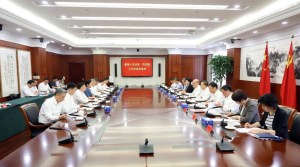
More specific measures involving inter-institutional cooperation involving the courts appear to have been finalized in two official meetings between SPC President Zhang Jun and Minister of Justice He Rong. It can only be imagined the hundreds of hours of staff-level meetings that must have preceded the meeting between the two senior officials, that eventuated in agreements on joint measures (not made public).
One of those measures involves joint training sessions at the national and provincial level, the first of which was held by the SPC and MOJ in November, 2023. These sessions have been replicated at the provincial level. These national and provincial sessions have multiple goals. Provincial high courts are working with the provincial departments of justice to improve administrative agency handling of administrative reconsideration cases under the amended Administrative Reconsideration Law and for those departments to better understand the standards by which courts review administrative action.
These joint training sessions and smoother cooperation between the courts, departments of justice, and Party authorities, also have other goals related to resolving administrative disputes. One of those is encouraging mediation of administrative disputes, as the amended Administrative Reconsideration Law provides. The SPC and provincial courts are involved with related measures to promote mediation, such as what is entitled “fault-tolerant ” and self-correcting” mechanisms. One example of the self-correcting mechanism is one promoted by a Guangdong court, sending a “pre-judgment mediation suggestion letter”(判前调解建议) to the defendant agency, suggesting an administrative agency self-correct, for cases where administrative agencies are likely to lose. Additionally, the courts seek to change cadre and institutional performance indicators related to administrative disputes, so that an institution and officials involved are not assessed negatively for agreeing to a mediated solution or change problematic measures. Additionally, the SPC and provincial courts want to incorporate administrative litigation-related performance indicators in governmental and cadre assessments. Those include administrative agencies’ execution of judgments, the frequency of agencies losing cases, the appearance of responsible persons in court to respond to lawsuits, feedback on judicial suggestions, a reduction in the litigation rate of administrative cases per 10,000 people, and the mediation or conciliation of administrative disputes into the government assessment systems, such as safe (Pingan) China and law-based government (法治政府).
2. Improving the administrative litigation system
The SPC’s Administrative Division is promoting several measures to promote better administrative dispute resolution. One aspect is better involving specialist administrative judges at the case filing phase to ensure that only cases that meet statutory standards are accepted. This type of measure is not unusual, as other SPC specialist divisions require the same.
Second, the SPC leadership has agreed to more guidance on administrative cases of the lower courts. They have agreed to the drafting or the amendment of current judicial interpretations on some of the most important administrative issues–the incidental review of normative documents (when a court is reviewing the legality of a specific administrative act), compensation for the expropriation of buildings on state-owned land, compensation for expropriation of collective land, and government information disclosure. Additionally, the SPC is issuing more administrative-related typical cases and appears to have encouraged local high courts to do the same, some with provincial departments of justice.
Concluding Comments
This post provides another discrete example of the unique operation of the SPC and indirectly highlights the skills required of its judges. It has illustrated another aspect of the SPC’s judicial activism, in addition to those about which I wrote in my China Law and Society Review article. Through unpacking official press reports, the careful reader can glimpse some of the understated ways that the Administrative Division of the SPC uses its specialist knowledge in administrative cases to engage in legal oversight of administrative authority outside of the courtroom. Underlying last year’s proposals and this year’s implementation are the skills of designing policies, actions, initiatives, and other decisions that hit the target of being politically correct (post-19th and 20th Party Congresses) while being “problem-oriented” (坚持问题导向) that is, addressing relevant practical issues.
 Supreme People's Court Monitor
You must be logged in to post a comment.