
I am a Distinguished Scholar in Residence at the School of Transnational Law of Peking University (Shenzhen). I teach two courses related to the judiciary: comparative courts and Chinese judicial reform from a comparative perspective. In both classes, students have been able to interact with judges from both the Chinese and Hong Kong systems. I also teach an academic writing class, in which I help students with (usually) their first experience writing a research article in English.
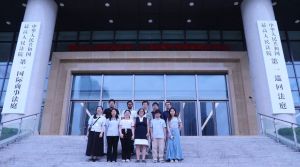
In the judicial reform class, students hear from participants in China’s complicated and poorly understood judicial reform process. We have been privileged to take field trips to the SPC’s First Circuit Court and the Hong Kong High Court.
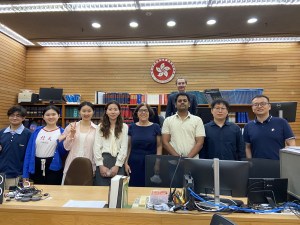
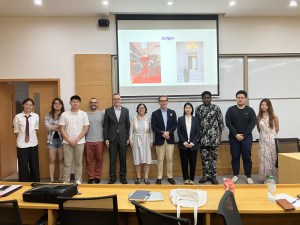
The third photo was taken in my comparative courts class, when Justice Jonathan Harris, President of the Competition Tribunal and Hong Kong High Court judge (pictured in the second photo, with my students and me), and Dr. Min Kyung Kim, formerly a judge on the International Commercial List at the Seoul Central Court, spoke in my classroom.
I am one of the faculty advisers to the reinvigorated Peking University School of Transnational Law Review and edit the Peking University School of Transnational Law Review Blog.
I have maintained a connection with the Faculty of Law of the University of Hong Kong for many years. I am currently a visiting fellow at the Centre for Comparative and Public Law and was previously a visiting fellow at the Centre for Chinese Law. In 2021, I was a Faculty Fellow of the Faculty of Law of the University of Hong Kong for a two-year term.
Why this blog? I have been observing China’s Supreme People’s Court for over 30 years, starting in the early 1990s, when most foreign observers I contacted doubted that it was worth researching.
Why research the Supreme People’s Court? People who know me say it is my fate in life (缘分). My interest in the institution was triggered when I purchased a set of judicial handbooks published by the Supreme People’s Court, as recommended by a then-junior SPC judge. I wanted to understand the purpose of the documents published in those handbooks.
 I started this blog in 2013. Although it should not be necessary to write this, unless others are credited in some way, all articles are researched and written by me. I am the person who has read the Chinese documents and had discussions (or correspondence) with “knowledgeable persons” and “experienced judges.” Many people who cannot be credited for certain reasons have been helpful to me during the 13 years I have written this blog. Many others were helpful when I wrote about the Supreme People’s Court 30 years ago.
In August 2018, I was appointed a member of the international commercial expert committee of the China International Commercial Court (CICC) of the Supreme People’s Court and was reappointed in August 2022 and again in September 2026. In June, 2026, I was appointed a member of the international commercial expert committee of the Shanghai International Commercial Court. That commercial court/tribunal is affiliated with Shanghai’s #1 Intermediate People’s Court. I am also on the committee of the Shanghai International Arbitration Center. All views expressed on this blog are my own and none should be attributed to the CICC, the Supreme People’s Court, the Shanghai International Commercial Court, or the Shanghai International Arbitration Center.
I speak from time to time on Chinese legal issues in Hong Kong, mainland China (sometimes in English and sometimes in Chinese), the United States, Australia, and Europe. Occasionally, I write for The Diplomat, the South China Morning Post, and the Global Military Justice Reform blog. I occasionally publish articles in academic journals. My writings have also been published in China, including in several prominent WeChat public accounts. Major media that have asked me for comments on Chinese legal developments include: New York Times, Wall Street Journal, The Economist, Financial Times and Reuters.
Earlier in my career, I taught Chinese law and other subjects in what was then the Law Department of the City University of Hong Kong. My research on the Supreme People’s Court dates back to that period. That early research resulted in the first close analysis of its operations, downloadable here. I then put my knowledge of Chinese law to work in the China practice group of the international law firm Freshfields, Bruckhaus Deringer and several other law firms and institutions before joining STL.
I had the good fortune to study with three of the early pioneers of Chinese legal studies (in the United States): Jerome Cohen, R. Randle Edwards, and Stanley Lubman and to have many leading practitioners and legal academics among my classmates at Harvard Law School (J.D.) and Columbia Law School (LL.M).
Please contact me through the comment function or at supremepeoplescourtmonitor@gmail.com and let me know if you come across broken links in blog posts.


I look forward to following your blog!
Your “About Me” is if anything too modest and is refreshingly devoid of salesman’s puffery! I will read your blog with interest.
Thank you very much!
Your blog is very helpful, thank you for your effort!
Thank you and I look forward to hearing more about research and study about Chinese law in the Czech Republic, especially at your university, which I understand to be the leading one in your country.
Well, I’m working on my PhD thesis related to the Chinese law, but even though the Chinese language courses are becoming more and more popular at my university, there are not many students interested in the Chinese law, especially modern law. I’ll be happy to discuss more with you via email!
Dear Ms Finder,
I am trying to find out whether the chinese maritime courts are funded by the central government or the local governments where the courts are located. Would you know the answer or know a good source on this area?
Thank you for your help.
Benedict Connors
I am an Italian lawyer, and I took a master degree in Chinese Business Law at The Open University of Hong Kong.
Thank you very much for your help, your blog is great!
Thank you! I have studied Chinese in China and at University since ’80…and now I usually write in Italy, about China legislation, Hong Kong, rule of the law….geopolitics…so on…my blog is:
Auroraborealeorientale.wordpress.com…many thanks for your wonderful blog, very very interesting !
Thank you for your wonderful site. I’m very new in this area but I’m looking for a Fuqing People’s Court case from 2011. Civil division. Do I have any hope of finding a record of it online?
you can try searching their website or alternatively databases such as Chinalawinfo or Westlaw China. No assurance of finding a case from 2011 because those did not need to be published.
Dear Ms. Finder, I thoroughly enjoy reading your posts, which have been thought-provoking and provided constructive direction. Many thanks for your devotion and persistence. Todd L. Platek, Esq.
Indeed, a great piece that highlights the PRC world wide trade ambitions under the CPC’s one belt one road project.It raises two fundamental questions. Does the Chinese communist legal system pose a direct challenge to the capitalistic global maritime practices? And does the one belt one road vision aim at Chinese plans to monoplise the entire shipping business? Maqbool Malik at maqboolkp15@gmail.com
This is an excellent and insightful live view of legal developments in China which are so important to trade in the current challenging environment.
Many thanks! If there are particular issues you are interested in, please comment again.