
In June 2025 the China International Commercial Court (CICC) mediated a case brought by a Swiss company against several Chinese companies. Two months later, the Supreme People’s Court (SPC) published it as a typical case. This case itself merits more attention than it has received thus far because of the facts of the case and the differing signals it sends to the domestic and foreign audience. It also implicitly draws attention to two newly prominent priorities of the CICC and the SPC in foreign-related commercial cases–mediation and resolving the substance of disputes (实质性化解矛盾纠纷). It also shows how the SPC (including the CICC) implements its “judicial responsibility to foster a first-class business environment characterized by market orientation, rule of law and internationalization.”
Facts of the case
According to information released by the SPC in June, 2025, the CICC has mediated approximately 20% of its cases, so resolving this case through mediation is typical. As a mediation settlement, the original documents are not available on the CICC website, but some of the facts are set out in the “basic facts “(基本案情) section of the August, 2025 typical case.
The case involves liability for liquidation, in this case related to a foreign arbitral award. This press report states that liquidation liability cases have been increasing in recent years. A Swiss company was successful in London Metal Exchange arbitrations against a Shenzhen trading company and apparently sought to enforce the awards totaling over US $10 million in the Shenzhen courts. However, a shareholder of Shenzhen trading company, a Henan Trading Company and the general manager of the Shenzhen trading company (one assumes related to the Henan company) deregistered the Shenzhen trading company without informing the Swiss company (which appears to be some type of fraud), following which the Swiss company filed suit in the CICC against the the Henan Trading Company, that company’s parent, a Henan Coal-Fired Power Company, and others, demanding the Henan Trading Company pay the debts owing under the arbitration awards and the parent company be jointly and severally liable.
The five judge panel, headed by Shen Hongyu, Chief Judge of the #4 Civil Division, used the pre-trial meeting procedure to identify the core issues through evidence exchange and came up with a settlement plan after multiple discussions with the parties. It appears that for the Chinese parties, a major stumbling block was foreign exchange risks. The court organized a hearing of the case in court to engage in final mediation arrangements and sign the settlement agreement, with the Chinese parties performing the settlement agreement within a week.
Differing signals
This case sends two different signals to the domestic and foreign audience. On the one hand, it sends a signal to other Chinese parties about their legal obligations under the law and legally valid arbitration agreements, and on the other hand, illustrates to the foreign legal and business community the pro-arbitration stance of the SPC by upholding the ability of the foreign award creditor to recover against the shareholder (and shareholder’s parent) of the liquidated award debtor, with mediation an option that best enables voluntary and prompt recovery. The case also demonstrates the strategic use foreign parties can make of the CICC. It shows that the CICC is fulfilling its judicial responsibility to “foster a first-class business environment characterized by market orientation, rule of law and internationalization” in its cases.
Mediation
As to mediation in this case, the Chinese media and typical case reports have stated that the CICC “has consistently integrated mediation, an “Eastern experience,” into its case handling and has introduced measures to support mediation” (一直坚持将调解这项“东方经验”融于办案,并推出支持调解的举措). This understates the subtle role of the CICC in mediating the case and accelerating internal (state-owned) company approvals for paying significant amounts of foreign currency abroad. This outcome was advantageous to the foreign award creditor because it better assured it would received what was owing under the arbitral awards. With CICC holding the settlement signing at the court hearing and issuing documents to the parties immediately, it assured the foreign party of prompt payment.
More broadly, it signals that the SPC mediation policy extends to foreign-related commercial cases. Documents and typical cases issued in 2025 and January, 2026 include:
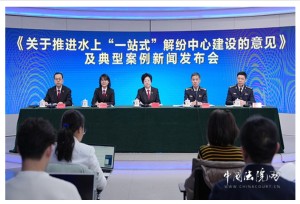
- Opinions of the General Office of the Supreme People’s Court and the General Office of the Ministry of Transport on Promoting the Construction of “One-Stop” Dispute Resolution Centers on Waterways最高人民法院办公厅、交通运输部办公厅关于推进水上“一站式”解纷中心建设的意见 and the related typical Cases of one-stop dispute resolution on the water (水上“一站式”解纷典型案例) (see the photo above of the press conference);
- Opinions of the Supreme People’s Court on Advancing the High-Quality Development of International Commercial Courts to Serve and Safeguard a High Level of Opening Up (最高人民法院关于推进国际商事法庭高质量发展 服务保障高水平对外开放的意见), which contains a provision promoting mediation (as will be highlighted in one of my forthcoming articles;
- First Group of Typical Cases Involving Foreign Commercial and Maritime Mediation Issued by the Supreme People’s Court (最高法发布首批涉外商事海事调解典型案例;
- Second Group of Typical Cases Involving Foreign Commercial and Maritime Mediation (最高法发布第二批涉外商事海事调解典型案例), one of which is the CICC case.
Resolving the substance of disputes
Resolving the substance of disputes has been an SPC policy for some time, as illustrated in recent typical cases and many SPC documents and reports, such as:
- the SPC’s report on administrative litigation work;
- Guiding Opinions on Improving the Quality and Efficiency of Trial Work and Promoting the Substantial Resolution of Contradictions and Disputes (关于在审判工作中促进提质增效 推动实质性化解矛盾纠纷的指导意见;
- the 3+N Mechanism for resolving administrative disputes, mentioned in the SPC’s report.
The typical case stresses the importance of actually resolving disputes by using the phrase (定分止争) (one of the SPC’s top keywords of 2024) several times. That phrase is derived from Xi Jinping guidance, and according to this, from originally from Legalist thought.
Concluding Comment
For those monitoring the evolution of the CICC, this case also illustrates the way that the CICC implements SPC current policy in an understated way.
 Supreme People's Court Monitor