
Category Archives: Political-legal committee

Guide to Finding Supreme People’s Court Materials: Selected Journals of SPC Divisions (1)

Late last year, some followers asked me to describe some of the principal sources for Supreme People’s Court’s (SPC) research. I’ll do this in several posts,  as few (particularly outside of China) seem to be aware of the range of publicly available publications of the SPC and its many affiliated entities.
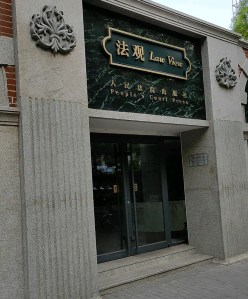
People’s Court Press Bookshop, Beijing, Zhengyi Lu 正义路#10


The first set of publications I’ll introduce are the journals edited and written (at least in part) by the trial divisions and other offices of the SPC.   As far as I know, they are only in printed form. That means that those outside of China are not aware of their existence. The readers of these journals are specialists in the particular field.  Many, but not all of them are published by the People’s Court Press (人民法院出版社), which has a retail bookshop near the SPC (see the photo above). I have a special fondness for that bookshop because I purchased judicial handbooks in its predecessor over thirty years ago, triggering my interest in the SPC.  Editing these publications is one of the (unrecognized) responsibilities of SPC judges and for that reason, the publication schedule seems to vary widely,

Considering the functions of the SPC, these journals should be best classified as a form of lower court guidance. For local judges, participating in editing or having an article included in one of these journals is considered an accomplishment for performance indicator purposes.

The publications flag new issues facing the judiciary in the specialized area involved, typical cases, and sometimes analysis of foreign laws or regulations.  Each journal has a slightly different format.

  1. 金融法治前沿(Frontier(s) of Financial Law)

This publication should be of interest to those who read Professor Mark Jia’s Special Courts, Global China, and are interested in researching the latest developments concerning China’s financial courts and related financial regulatory issues. The domestic readers of this journal are likely to be judges in the three financial courts or in the financial division of other courts,  legal personnel in the financial regulators, interested academics, lawyers focusing on financial law and regulations, as well as in-house counsel in banks and other financial institutions.

Unlike most other journals in this group,  this one is a collaboration between the courts and the regulators. The principal members of this collaboration are the SPC’s #2 Civil Division (which focuses on domestic commercial law issues), the legal department of the People’s Bank of China (人民银行条法司), the National Financial Regulatory Administration, related departments of the China Securities Regulatory Commission (CSRC),  and the Shanghai, Beijing, and Chengdu-Chongqing Financial Courts.  One of the related courts takes responsibility for editing each issue.  When I was last in Beijing, I purchased issue #2, dated April, 2024. The court that took responsibility for editing was the Shanghai Financial Court, The content  includes:

  1. “frontier issues,” with contributions from all the regulators, on such topics as the application of Chinese financial regulations abroad: coordination between the Insurance Law and Civil Code; and internet finance disputes;
  2. Typical cases;
  3.  Discussion of Specialized Questions
  4.  Foreign and Hong Kong [and Macau ] finance law issues.  Issue #2 includes an article comparing EU and Chinese insurance company recovery and resolution issues, the author of which is an official of a provincial-level bureau of the National Financial Regulatory Administration.  The author notes that “the operations of some small and medium-sized insurance are possibly facing difficulties” and the EU and British frameworks provide useful regulatory models for China to consider in designing a recovery and resolution system for insurance companies.

Guidance on the Trial of Duty-Related Crime (职务犯罪审判指导)

This publication should be of interest to those who are interested in legal issues (and the broad range of factual situations) related to bribery and corruption in China. Judging from announcements on WeChat, the readers of this journal appear to include procurators (prosecutors), criminal division judges, criminal defense lawyers, and public security officials.

Although none of the introductory essays have mentioned this, I surmise that this journal was founded because the distinctive issues relating to duty crimes “outgrew” the journal of the five SPC criminal divisions,  Reference to Criminal Trial (刑事审判参考). So far, only two issues have been published, #1, published in 2022, and #2, published in the last month or two.  The SPC’s #2 Criminal Division edits the journal.  The content  of issue #1 includes:

  1. Analysis of the application of law (法律适用分析), providing analysis of typical issues in the determination of facts, acceptance of evidence, application of law and the determination of sentencing, providing insights into the thinking and reasoning of judges.  This WeChat article provides a quick summary of many of the cases in this section in issues #1 and #2, but without the colorful detail, such as the case involving the lovers Mr. and Ms. Wang, one a deputy department head in a Central state-owned enterprise, the other the assistant to the head of a state-controlled bank in city T (presumably Tianjin).
  2. [Professional ] judges meeting summaries. Many SPC divisions  (civil or administrative) have published collections of meeting summaries, but this is the first time I have noticed them being made public on criminal law issues.  The first summary involves a 2021 case in which the local Party discipline/supervision authorities investigated the personnel in the courts,  prison, and procuracy for issues relating to the crime of bending the law for selfish ends or twisting the law for a favor. That involved a case in which a criminal was sentenced in 1992 to 15 years for intentional homicide, but was released in 1996,  after several sentence reductions and but who committed the crime of false accusation in 2019 (no details).  The disputed issue was whether the statute of limitations had lapsed.
  3. Difficult issues in practice–two articles, including one by Judge Wang Xiaodong, the now-retired head of the #2 criminal division on issues related to anti-corruption legislation in the New Era (pointing out problems with the substantive and procedural law);
  4. Exchange of experience–this provides a proposed outline (and explanation) for the courts to hear duty crimes in the first instance (人民法院审理职务犯罪案件刑事第一审普通程序庭审提纲(建议稿)(the link has the text of the outline). The explanation mentions it was issued to provide more consistency in the trial of these cases;
  5. Legal regulation (the Supervision Law and Supervision Law Implementing Regulations);
  6. Criminal policy–summary of a policy document (not full text) and press release issued by the Central Commission for Disciplinary Inspection (CCDI)/Supervision Commission, Central Organization Department, Central United Front Department, the Central Political-Legal Commission, the SPC and the Supreme People’s Procuratorate on Opinions on Further Promoting the Investigation of the Giving and Acceptance of Bribes” (the linked article provides the same content).  The summary mentions the possible establishment of a joint punishment mechanism and the implementation of a “blacklist” system for bribers.
  7. Theoretical disputes
  8. Practical Research
  9. Selected Typical Judgments (the last three sections had no content in issue #1.)

______________________________________

Many thanks to a knowledgeable person for his perceptive comments on an earlier draft of this blogpost.
Supreme People’s Court wields the Criminal Law “Big Stick” in the Anti-Coronavirus Battle

Screenshot 2020-02-12 at 4.28.12 PM
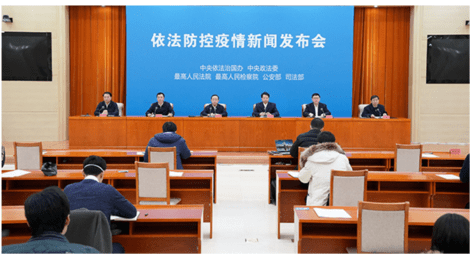
Press conference at the Central-Political Legal Commission announcing the Opinions

As this blog has often commented, the Supreme People’s Court (SPC) must serve the greater situation and deal with practical legal issues, so that the SPC itself and its senior leadership are correct, politically and professionally. One of those ways is by providing properly calibrated guidance to subordinates at the SPC, the lower courts and other related authorities that provide appropriate political signals.  Some guidance is politically more important than others. In recent days (early February 2020), the SPC has done so through the following documents:

This blogpost will give a quick introduction to the first document.  Its importance can be seen from the photo above, of the press conference at the Central Political-Legal Commission on 10 February, at which the Punishing Crimes and Violations of Obstruction Opinions was released and explained to select members of the press. That document was issued with the participation of the Commission on Comprehensive Governance of the Country by Law (Comprehensive Governance Commission, further explained here), Party Central Political-Legal Committee, SPC, Supreme People’s Procuratorate (SPP), Ministry of Public Security (MPS), and Ministry of Justice (MOJ). Fu Zhenghua, Minister of Justice and deputy head of the Comprehensive Governance Commission spoke first. Representatives from the other institutions also spoke.

The National Health Commission, SPC, SPP, and MPS issued the second document.

Both of them guide those in the criminal justice system to properly wield the “Big Stick” of the criminal law (and related administrative offenses) in the anti-coronavirus battle. The first document sends signals to the political leadership that the political-legal institutions are doing their part to fulfill the objectives that General Secretary Xi Jinping set in his 3 February speech

It is necessary to maintain a high-pressure situation, severely crackdown on illegal and criminal activities that disrupt social order, such as using the epidemic to drive up prices, hoarding, and looting, and severely crack down on the production and sale of counterfeit drugs, medical equipment, and medical and health materials. It is necessary to pay close attention to and resolve promptly all kinds of emerging problems, and to prevent all kinds of contradictions from overlapping and forming a chain reaction. (要保持严打高压态势,依法严厉打击利用疫情哄抬物价、囤积居奇、趁火打劫等扰乱社会秩序的违法犯罪行为,严厉打击制售假劣药品、医疗器械、医用卫生材料等违法犯罪行为。对各种苗头性问题,要密切关注、及时化解,严防各类矛盾交织叠加、形成连锁反应。)

What these documents are

The Punishing Crimes and Violations of Obstruction Opinions and the Ensuring Positive Medical Order are intended to provide guidance on certain violations of the criminal law and other related administrative offenses.  They do not create new legal rules but signal to the lower criminal justice institutions how the relevant criminal (and public security administration penalty) laws should be applied in the politically sensitive anti-coronavirus battle.  As a technical matter, both documents are classified as judicial document/judicial regulatory documents /judicial normative documents/judicial policy documents (司法文件, 司法规范性文件, 司法指导性文件, 司法正常性文件)(which I have written about previously).

As I have mentioned before, the SPC editors of a collection of those documents commented that “although judicial guidance documents are not judicial interpretations and cannot be cited in a court judgment document as the basis of a judgment, it is generally recognized that they have an important guiding impact on the trial and enforcement work of the courts at every level.” Titles included in the collection include “Opinions” (意见), “Decisions” (决定), Summaries” (纪要), “Notifications” (通知) Speeches (讲话), etc..

Some local high courts are starting to issue complimentary local guidance, with more detailed provisions, with the Jiangsu Higher People’s Court one of the early movers.

Section 1

The document is divided into several sections.  The first one, analogous to the opinion I analyzed recently, gives the political background, calling for the raising of the readers’ political stance, the strengthening of their “four consciousnesses,” the upholding of “four self-confidences,” and the implementation of the spirit of General Secretary Xi Jinping’s important instructions and Party central policies and arrangements.

Section 2

The second section of the Punishing Crimes and Violations of Obstruction Opinions (which appears to have been primarily drafted by the SPC, judging by the document reference 法发〔2020〕7号, indicating it is from the SPC), is the substantive part of the document. It is further divided into 10 subsections, nine of which describes a particular type of crime that is to be strictly punished according to law. They include:

  • crimes of resisting epidemic prevention and control measures; violence against medical personnel,
  • making or selling fake protective goods, supplies, or medicines;
  • fabricating or spreading rumors etc.

The first nine subsections describe one or more illegal acts that may occur. One example is subsection three, on the production or sale of shoddy prevention and protection goods or supplies or the production or sale of fake or shoddy medicines used in preventing the coronavirus. The Opinions state that where the requirements of the Criminal Law are met, the act should be punished as the crimes of production and sale of shoddy goods or medicines.  So it is giving prosecutors and judges a steer on how the Criminal Law should be applied but does not in itself create new law.

Subsection 10 gives guidance on how the law is to be applied. If the acts listed in subsections 1-9 do not constitute a crime (based on existing criteria), the public security authorities are to impose public security administrative punishments under the Public Security Administration Penalties Law.  The Opinions point to the following provisions:

false information disrupting public order; disrupting order at a unit or public venue; provocation; refusing to implement decisions and orders in an emergency; obstructing the performance of public affairs; breaking through police lines or instruments; striking others; intentional harm, insulting others, fraud, illegally digging or gathering gravel near railways, stealing or destroying public facilities near roads, destroying railway facilities and equipment, intentionally destroying property, looting public or property, and so forth; or the relevant departments are to give administrative punishments.

Importantly, when crimes or violations of the Public Security Administration Penalties Law occur during the period of epidemic prevention and control, it should be considered as an aggravating factor )(for punishment purposes). The stated purpose is to deter bad conduct  “to lawfully embody the requirements of the crackdown policy, to forcefully punish and deter violations and crimes, to preserve the authority of the law, to preserve social order, and to preserve the security of the people’s lives and their physical health.”

For those in the criminal justice charged with enforcing these provisions, they need to refer to relevant judicial interpretations and other guidance (or in the case of public security officials, their regulations and other relevant documents)–the Opinions do not set out the elements of the relevant crimes.

Since this document was issued, some of the professional Wechat accounts on criminal law issues have published authoritative commentary pointing out practical problems with the legislation (law and judicial interpretations). The deputy head of the SPP’s research office published this (on the crime of obstructing contagious disease efforts), while a local procurator (nationally recognized) wrote this on several of the crimes (including refusal to comply with quarantine or leaving quarantine without permission). Judges and prosecutors (procurators) are concerned about making “mistakes,” as the responsibility system imposes expansive responsibility (described by two judges as “the sword of Damocles” over judges’ heads).

Section 3

The third section relates to the relationship among the institutions involved, principles to be followed and gives apparently mixed signals which need to be understood together.

  • Promptly investigate cases;
  • Strengthen communication and coordination;
  • Safeguard procedural rights;
  • Strengthen publicity and education;
  • Emphasize safety in handling cases.

The first is directed to the public security authorities, directing them to promptly investigate cases but also be civil, while the last subsection concerns the personal safety of those in the criminal justice system. The second subsection encourages the criminal justice authorities to communicate and coordinate better but cautions the public security organs to pay attention to the comments and recommendations by the procuratorate. It requires the authorities to focus on public opinion guidance in cases that have caught the attention of the public.  Subsection three is one that contains apparently mixed signals, on the one hand emphasizing that defendants have the right to legal counsel, but at the same time,  all levels of judicial administrative organs should strengthen guidance and oversight of lawyers’ defense representation. The fourth subsection illustrates some ongoing techniques of the Chinese justice system, in using typical/model cases to educate the public and deter them from criminal or illegal behavior, and voluntarily comply with the law and the authorities. The document says explicitly: “the broader public should be guided to obey discipline and law, to not believe and spread rumors, and to lawfully support and cooperate with epidemic control work.”