
As most readers of this blog know, developing foreign-related rule of law is a priority for the Chinese government. President Zhang Jun told Supreme People’s Court (SPC) leaders at the beginning of 2025 that the Party Center places a great deal of importance on the construction (development) of foreign-related rule of law (党中央高度重视涉外法治建设). What does that mean for the SPC? What has the SPC done lately? This post briefly notes some of those developments.
- The SPC’s #4 Civil Division has recently established a WeChat public account entitled 中国涉外商事海事审判, as a way of better conveying developments to the Chinese professional and academic legal world. The link is to the April 30 report on the China International Commercial Court’s circuit visit to Shanghai on 10-11 April.
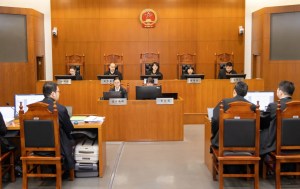
- The China International Commercial Court (CICC) held a hearing in Shanghai’s #1 Intermediate Court on 10 April in a joint venture shareholder dispute (see the photo above). I could attend because I was scheduled to participate in a workshop at NYU Shanghai on 12 April and several people bound by protocol to remain anonymous helped workshop participants and me with the required formalities. Many from Shanghai’s “foreign-related” legal community attended the hearing, including several foreign lawyers, senior members from the Shanghai International Arbitration Center, Shanghai Commercial Mediation Center, and academics from Shanghai’s law schools specializing in foreign-related matters. Official reports on the event included the SPC’s official website, the Shanghai #1 Intermediate People’s Court WeChat account (bilingual), and the #4 Civil Division’s WeChat account. I have my views on the performance of the lawyers, but will withhold them until I know more about the length of time they had for preparation.
Unbeknownst to most, the hearing in Shanghai evidenced that the CICC was implementing part of Article 33 of the sixth judicial reform plan:
Deepen the reform of the circuit trial mechanism. Deepen the reform of the circuit court work mechanism of the Supreme People’s Court, strengthen the functions and roles of the Supreme People’s Court’s trial organs in shifting their focus downward, resolving disputes on the spot, and facilitating litigation for the parties. 强化最高人民法院审判机关重心下移、就地解决纠纷、方便当事人诉讼的功能作用。
Holding a hearing in Shanghai would be considered to be “shifting the focus of the SPC downward,” resolving disputes on the spot, and facilitating litigation for the parties.
- The SPC issued 《最高人民法院关于人民法院为西部陆海新通道建设提供司法服务和保障的意见” Opinions of the Supreme People’s Court on the People’s Court Providing Judicial Services and Guarantees for the Construction of the Western Land-Sea New Corridor” along with related typical cases. An explanation of the Western Land-Sea New Corridor is here. The document designates the Chongqing High People’s Court to take the lead in establishing a “13+2” judicial cooperation mechanism among thirteen high people’s courts and two intermediate people’s courts along the corridor to cooperate in litigation services, substantive dispute resolution, enforcement linkage, application of law, talent training, etc.
- SPC Justice Wang Shumei published an article in China Trial (中国审判) on foreign related matters in late 2024. Her article is a useful summary of current SPC policy on foreign-related commercial and maritime matters. One part includes:
improve the rules for jurisdiction over foreign-related cases, and properly handle international conflicts of jurisdiction arising from parallel litigation involving multiple countries in the same dispute in accordance with the law; we must firmly maintain the international order based on international law, actively participate in the formulation of international rules, carry out in-depth international judicial exchanges and cooperation, strengthen confidence in the rule of law, actively explain to the world the concepts, propositions and successful practices of foreign-related rule of law with Chinese characteristics, promote the progress of international rule of law, promote global governance in a more just and reasonable direction, and help build a community with a shared future for mankind.
The above quotation summarizes what has been said in earlier documents: resolving parallel litigation is on the agenda; the Chinese courts should tell China’s story well; the SPC should actively participate in formulating international rules (actively participating in the negotiation of the Hague Judgments Convention as an example), and all is linked to the Chinese government’s vision of global governance and the international legal order.
3. Typical cases
- In late April 2025, the SPC issued a group of typical cases linked to the Western Land-Sea Corridor and the policy document mentioned above, signaling the importance of mediation, unifying standards, promoting the application of international treaties and conventions, etc.
- In March 2025, the SPC issued a second group of typical free trade zone cases第二批服务保障自由贸易试验区建设典型案例
- As I mentioned in an earlier post, the SPC issued typical cases protecting the rights and interests of foreign investors.
- As mentioned in an earlier post, in March, 2025, the SPC issued procedures to implement the Foreign State Sovereign Immunity Law.
Forthcoming attractions
Among the forthcoming attractions of which I am aware:
- The #4 Civil Division is drafting a judicial interpretation of the foreign-related part of the Civil Procedure Law, as reported in official media. Judge Guo Zaiyu, who was one of the judges of the CICC panel hearing the case at the #1 Intermediate People’s Court, chaired a meeting with scholars and experts, hosted by East China University of Political Science and Law, including some (domestic) CICC experts in Shanghai on April 11. I surmise the judicial interpretation will be issued sometime this year and it is unclear whether a draft will be released for public consultation.
2. As mentioned earlier, the 6th judicial reform five-year plan outline was issued in late December. Point 12 relates to foreign-related rule of law:
Improve the judicial guarantee mechanism for high-level opening up. Improve the foreign-related trial mechanism, strengthen international commercial trial work, and improve the connection mechanism with international commercial mediation and arbitration. Improve the judicial trial system in which the parties in foreign-related civil legal relations agree on jurisdiction and choose to apply foreign laws in accordance with the law. Improve the mechanism for accurate application of international treaties and international practices, and improve the mechanism for ascertaining foreign laws. Improve the maritime trial mechanism, promote the improvement of the maritime legal system, improve the rules for adjudicating disputes such as ship repair, cross-border logistics, shipping insurance, maritime finance, and compensation for damage to the marine ecological environment, and improve the coordination and linkage mechanism with maritime administrative law enforcement agencies. Improve the mechanism for mutual recognition and enforcement of cross-border arbitration awards and civil and commercial judgments. Improve the judicial protection mechanism for overseas interests and investments. Improve the judicial protection mechanism for overseas Chinese interests. Improve the talent training mechanism for foreign-related trials. Strengthen international exchanges and cooperation in the judicial field, and actively participate in the formulation of international rules.
It appears most of the content here is not new and has been incorporated in the policy documents previously analyzed on this blog. The major exception is the detailed stress on certain maritime case principles. Why has this paragraph been incorporated in the judicial reform plan outline, when previously this type of content would more likely have appeared in a specialized policy document? As I will comment in a future article, it is representative of many articles in this judicial reform plan outline, signaling that the Party and SPC leadership attach importance to those matters.
 Supreme People's Court Monitor