
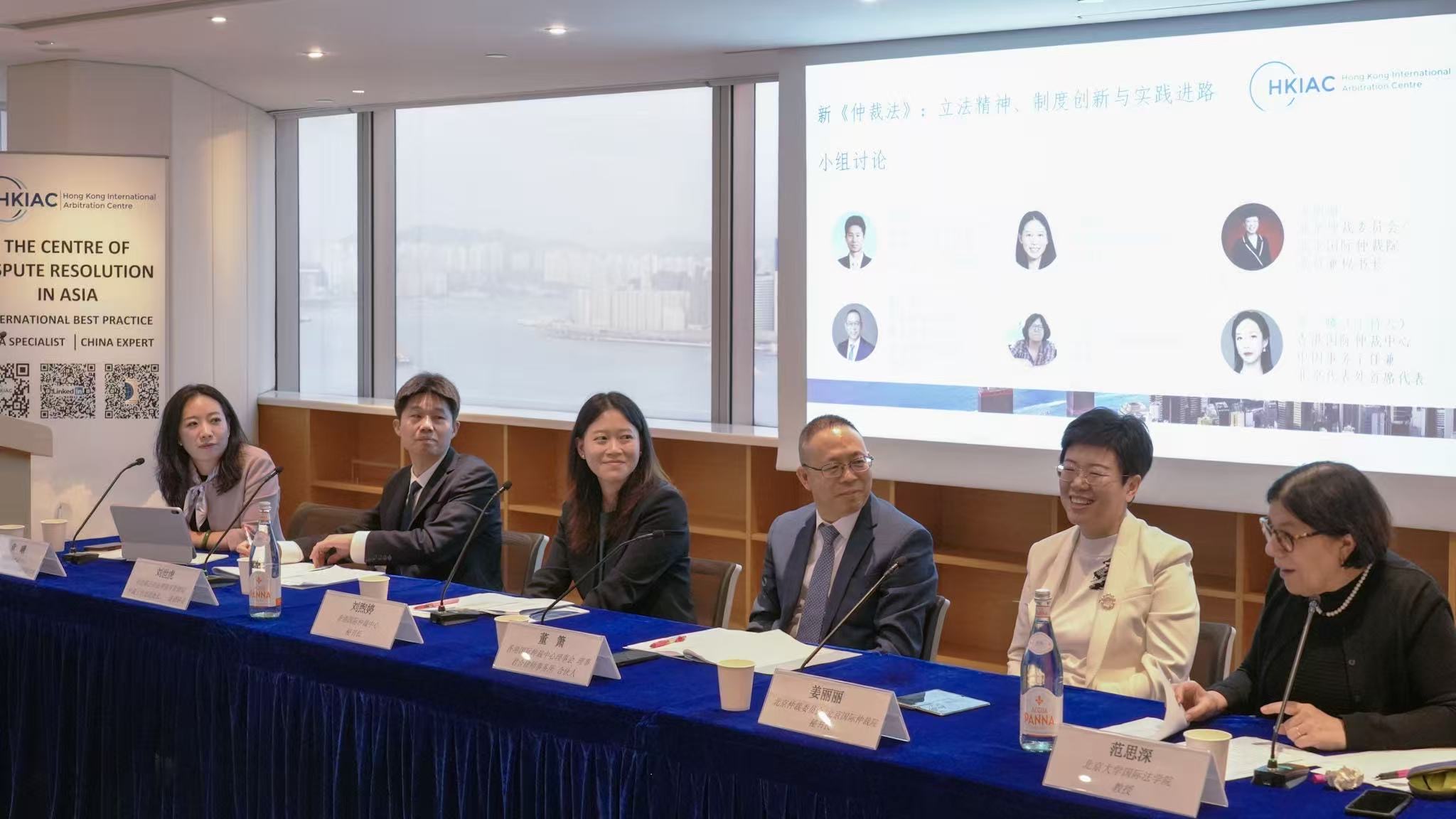
At a 25 March 2026 Hong Kong International Arbitration Centre (HKIAC) event on the amended Arbitration Law, featuring a keynote speech by Director Shi Hong (石宏), Director of the Civil Law Department of the Legislative Affairs Commission, Standing Committee of the National People’s Congress (not pictured). My fellow panelists were: Zhang Xi (章曦) , head of the HKIAC Beijing representative office, Mr. Liu Shihu (刘世虎), of the Ministry of Justice, Joanne Lau, Secretary-General, HKIAC, Arthur Dong (董箫), partner with Jun He Law Offices, and Secretary General Jiang Lili (姜丽丽) , Beijing Arbitration Commission. I gave an abbreviated version of the Chinese speech below, which I originally drafted in English.
Many thanks for the kind invitation to make some remarks about the amended Arbitration Law. Because the Supreme People’s Court did not send an official representative to speak, I will focus my comments on what the amended Arbitration Law means for the work of the Supreme People’s Court and lower courts.
Why am I talking about this? For those who do not know me, I have been a member of the Supreme People’s Court’s China International Commercial Court’s International Commercial Expert Committee since 2018 and a long-term observer of the work of the Supreme People’s Court. So how I discuss this will be different from an official spokesperson, but based on their official statements and my own work.
The focus of my presentation will be on the implications of the amended Arbitration Law for the Supreme People’s Court and lower courts. I’ll use a minute or two to give a bit of background.
On the drafting of the Arbitration Law, as was stated in a recent press report, “The Supreme People’s Court has been deeply involved in the legislation and amendment work of major foreign-related laws such as the Foreign Relations Law, the Anti-Foreign Sanctions Law, the Foreign State Immunities Law, the Civil Procedure Law, the Arbitration Law, and the Maritime Law.” Additionally, the Supreme People’s Court issues judicial interpretations and guidance in other forms for the lower courts, to enable them to apply the law more consistently. Judicial interpretations, as I previously wrote, are not linked with a specific case but draw on many previous cases. They are a critically important way that the SPC unifies the application of law by the courts, although the extent to which they are binding outside the court system is unclear. The Legislative Affairs Commission of the National People’s Congress Standing Committee reviews them and may require amendments.
At a joint press conference with the Legislative Affairs Commission, hosted by the Ministry of Justice, the Chief Judge of the Supreme People’s Court #4 Civil Division said that the “Supreme People’s Court will conduct thorough research, widely solicit opinions from all sectors, and, with the strong support of the Legislative Affairs Commission of the National People’s Congress and the Ministry of Justice, comprehensively review existing judicial interpretations and normative documents related to the Arbitration Law to ensure the drafting and formulation of supporting judicial interpretations for the newly revised Arbitration Law, guaranteeing that the revised content of the Arbitration Law is effectively implemented in judicial practice.” So the future judicial interpretation will reflect the views of multiple institutions.
The “thorough research” (认真调研) will involve combing through hundreds of pages of judicial interpretations and other judicial documents linked to the Arbitration Law, the Foreign-Related Part of the Civil Procedure Law, plus the current draft interpretation of the foreign-related part of the Civil Procedure Law. The work involved, which will be invisible to those of us outside the Supreme People’s Court, will be to determine which interpretations or documents remain valid in whole or part, and what amendments are necessary. It was reported that the Supreme People’s Court as a next step, would conduct research on the Arbitration Law and other legislation (下一步开展仲裁法、外国国家豁免法司法解释调研工作). The Legislative Affairs Commission of the Standing Committee of the National People’s Congress and the Ministry of Justice will review that comprehensive draft carefully and give detailed comments for the Supreme People’s Court to consider.
So, my understanding is that the judicial interpretation will be issued sometime in 2027. That is normal timing. The judicial interpretation drafting process is lengthy. The Supreme People’s Court needs time to review the old interpretations , and intends the interpretation to address issues that are unclear in practice and be effective for a considerable period.
In the meantime, the Supreme People’s Court is/will be monitoring issues that confuse the lower courts. Those lower courts are more knowledgeable than they were ten years ago. That is linked to measures that the Supreme People’s Court has taken in recent years to encourage local courts to establish international commercial tribunals 国际商事法庭, to handle foreign-related matters, including judicial review of arbitration more competently.
How does the Supreme People’s Court monitor what issues confuse the lower courts? It has several ways to do that. One way is to convene a judicial review of arbitration internal conference (会商会), as was done last year for maritime matters. Second, questions that confuse lower courts will also come through the 法答网 system to the Supreme People’s Court’s #4 Civil Division, or possibly through a request for instructions (请示).
How might the Supreme People’s Court provide guidance, pending the issuance of the judicial interpretation, and how could you follow it? Those guidance methods mirror the ways that it monitors the lower courts. One would be for the Supreme People’s Court to issue meeting minutes (会议纪要), as it has done after other internal conferences 会商会. These cannot be cited as the basis for a judgment, but lower court judges generally follow its provisions, as it expresses the position of the Supreme People’s Court. I am not sure whether those meeting minutes will be made public, as it does not always do so, but I expect a related press report. Because the current judicial reform plan outline(六五纲要 ) provides that the People’s Court Database (人民法院案例库) and the Court Answers Platform (法答网) will create an integrated guidance product, I recommend monitoring whether amended Arbitration Law-related questions will be answered through the 法答网 system. Recently, the Supreme People’s Court published two sets of questions and answers on judicial review of arbitration raised on the Answers Platform (法答网 ) in People’s Court Daily (人民法院报). The People’s Court Case Database (人民法院案例库) contains reference cases related to arbitration, including judicial review of arbitration. That database should be monitored too, as well as typical cases issued by the Supreme People’s Court or lower courts. I note that recently, the Xinjiang Higher People’s Court issued typical arbitration cases.
As to the reaction of the lower courts to the amended law, my understanding is that the most knowledgeable and experienced judges are not fazed by the amendments to the Arbitration Law, because the amendments do not change the standard of judicial review. As to what I expect could be some of those hot issues,–the first one to mention is the new provision permitting preservative measures for assets or evidence in an emergency situation before an arbitration case is filed, as was mentioned in a recent article in People’s Court Daily (人民法院报). However, in 2024, the Supreme People’s Court issued detailed guidance on pre-litigation preservative measures, entitled Opinions on Standardizing and Strengthening the Handling of Pre-litigation Preservation Cases (关于规范和加强办理诉前保全案件工作的意见), which mentions arbitration, so I surmise local courts will apply the provisions in this document pending specific guidance. Will the adoption of the concept of “seat” create major issues? I believe not, as it will not make a difference for the vast majority of cases.
Although the People’s Court Daily article mentioned some uncertainties connected with ad hoc arbitration , I believe, as a practical matter it will not be a major issue.
I hope my remarks are helpful. I look forward to your comments.
_____________________________________________
Chinese version
鉴于最高人民法院未安排代表出席本次研讨会,我想从法院的视角,重点剖析新《仲裁法》对最高人民法院及全国各级地方法院工作的意义,这也是我今天发言的核心。
有人可能会感到好奇:我为什么选择谈这个问题?事实上,从2018年起,我和在座的几位同仁一样担任最高人民法院国际商事法庭专家委员会委员。我长期研究最高人民法院的司法实践与涉外司法工作,对最高人民法院有所了解。需要说明的是,我今天并不是替官方发声。我只是基于最高人民法院已公开的权威信息并结合我自己的研究谈几点个人看法。我引用的材料与最高人民法院正式公开的官方信息保持一致。
我的发言围绕新《仲裁法》对最高人民法院及下级法院的影响展开。在进入核心议题前,我先简单谈一下相关背景。
关于《仲裁法》修订,最近有一家媒体报道称:“最高人民法院深度参与《对外关系法》《反外国制裁法》《外国国家豁免法》《民事诉讼法》《仲裁法》《海商法》等重大涉外法律的立法修法工作。”此外,最高人民法院还通过制定司法解释、发布规范性文件等多种形式为下级法院提供指导,确保法律适用的统一。正如我此前在相关研究中提到的,最高人民法院制定的司法解释并非依托单一个案,而是基于对大量司法案例的研究与总结,是最高人民法院统一法律适用的关键途径。不过,对于司法解释在法院系统之外有多大约束力,仍没有定论。全国人大常委会法工委依法审查最高人民法院的司法解释,并有权依法提出修改意见。
此前在司法部主办、全国人大常委会法工委共同参与的新闻发布会上,最高人民法院民四庭庭长表示:“最高人民法院将认真调研、广泛听取各界意见,在全面梳理既有仲裁法相关司法解释和规范性文件的基础上,在全国人大法工委、司法部的大力支持下,做好新修订仲裁法配套司法解释的起草制定工作,确保《仲裁法》修订内容在司法实践中落地落细。”“最高人民法院将进一步完善仲裁司法审查机制,尤其是细化司法审查的规范和工作流程,优化仲裁保全机制,以及审执衔接机制,也就是撤裁的审查机制和裁决执行机制相衔接,加大仲裁法培训力度,确保法律适用统一,不断提升仲裁司法审查工作质效和专业化水平。”可以预见,后续出台的仲裁法司法解释,将反映多家机构的意见。
这里提到的“认真调研”涉及对现行与仲裁法相关的大量司法解释、司法规范性文件、和民事诉讼法涉外编及其在起草当中的司法解释的梳理。最高人民法院系统外的人不清楚这项工作。这项工作的目的在于,辨别现行司法解释或规范性文件中的哪些是有效的,是全部有效,还是部分有效,哪些地方需要修订。据公开报道,最高人民法院下一步将推进《仲裁法》司法解释调研工作,全国人大常委会法工委和司法部也将细致审查《仲裁法》司法解释草案,并提出详细修改意见供最高人民法院参考。我预计,相关配套司法解释将2027年某个时间点出台。这很正常,因为司法解释起草工作非常耗时。第一,最高人民法院需要时间来审查旧的司法解释,第二,想法是司法解释比较稳定,在较长时期内持续有效,又能够应对司法实践中的疑难复杂问题。
与此同时,最高人民法院正在或未来将持续关注困扰下级法院的法律适用难题。相较于十年前,现在全国各地方法院涉外业务水平总体上提高了。这与最高人民法院近年来大力推动地方法院设立国际商事法庭、高标准办理仲裁司法审查等各类涉外案件密不可分(我曾就此写过一篇短文)。最高人民法院是如何掌握下级法院的实务困惑的呢?
这里有几种方法,我建议对此感兴趣的人关注一下:一是召开全国仲裁司法审查会商会,去年海事审判领域曾运用这一机制;二是下级法院面临的疑难问题可以通过“法答网”反映给最高人民法院民四庭,或者在某些情况下也可以按程序请示最高人民法院。
在配套司法解释正式出台前,最高人民法院如何为下级法院提供实务指引?我们又如何对其进行跟踪?相关路径与最高人民法院掌握下级法院实务困惑的渠道基本对应。
一是会议纪要。比如,最高人民法院在会商会结束后会发布会议纪要。此类会议纪要虽不能直接作为裁判依据,但下级法院的法官通常会参照适用,因为它表达了最高人民法院的立场。我不确定这些会议纪要是否会公开,因为这不是最高人民法院的一贯做法,但我预计相关媒体会报道。
二是法答网上面与仲裁相关的问答。现行的《人民法院第六个五年改革纲要》(六五纲要)明确提出,要“加强“库网”融合发展。“。我建议各位关注法答网上面有关仲裁疑难问题的答复。最近,最高人民法院在《人民法院报》上刊登了两批涉及仲裁司法审查的法答网问答。
三是人民法院案例库。人民法院案例库收录了涉及仲裁的参考案例,包括仲裁司法审查案例,也值得关注。
四是典型案例。 最高人民法院和地方法院会出典型案例。最近, 新疆高院发了仲裁典型案例。
至于地方法院对修订《仲裁法》的反应,根据我了解到的情况,见识最广、资历最深的那些法官并不为本次《仲裁法》修订感到忧虑,因为新《仲裁法》并未改变中国仲裁司法审查标准。
至于新《仲裁法》可能带来的热点,我认为,首先是新增的仲裁前保全制度,其明确当事人在紧急情况下,可在申请仲裁前依法向人民法院申请财产保全或证据保全。《人民法院报》刊登的一篇文章提到了这点。不过,最高人民法院在2024年发布的《关于规范和加强办理诉前保全案件工作的意见》已经提到仲裁,因此,我推测,在详细配套指引出台前,地方法院将参照该文件处理仲裁前保全申请。至于“仲裁地”概念引入新《新仲裁法》是否会引发重大问题?我认为不会,因为这对绝大多数案件不会产生实质影响。至于临时仲裁,尽管《人民法院报》相关文章提到了一些有待厘清的问题,包括临时仲裁的性质、程序管理(送达、仲裁记录、费用支付等)等人民法院仍需谨慎处理的实践难题,但我相信,这在实践中并不是什么大问题。
最后,希望我的发言没浪费大家的时间,也期待听到大家的评论。
——————————————————————————————————————
Many thanks to Peking University School of Transnational Law 2L student Duan Kun ( 段昆, Daniel) and China Academy of Social Sciences Assistant Researcher Fu Panfeng (傅攀峰) for their work in translating and transposing the spirit of the English version of this presentation into Chinese under time pressure. Without their work, the presentation would not have been possible. A special thanks to Duan Kun for traveling from Shenzhen to Hong Kong to attend the HKIAC event.
 Supreme People's Court Monitor
You must be logged in to post a comment.