
Category Archives: NPC Reports

2026 Supreme People’s Court Work Report, Part II


By Zhu Xinyue, edited and with further comments in italics by Susan Finder.  Unless otherwise indicated, references to “I” and “my” in this article refer to Susan Finder.

This is Part 2. It covers the following sections of the Report:

  • Promoting High-Level Opening-Up Through High-Quality Justice” (Foreign-Related Rule of Law);
  • Regulating the Exercise of Judicial Power;
  • Accepting Oversight from All Quarters; and
  • 2026 Work Plan.

Part 1 is here and covers:

  • What is New
  • Safeguarding High-Level Security with High-Quality Judicial Services
  • Supporting High-Quality Development Through High-Quality Judicial Services
  • Safeguarding a High Quality of Life Through High-Quality Justice.

The Report provides insights into the multifaceted role and operations of the Chinese courts.

IV. Foreign-Related Chapter

As noted above, the Report contains a separate chapter on foreign-related matters (涉外法治). This is a first and signals the growing importance of the foreign-related work of the SPC It emphasizes four themes: safeguarding national and people’s interests, ensuring equal protection for Chinese and foreign parties, making China a “preferred destination for international dispute resolution,” and shaping global norms. All of these are evergreen themes for foreign-related adjudication, as evidenced by the SPC’s 2022 specialized report to the NPC Standing Committee and other articles on this blog.

These themes track the Plan’s goals of aligning with high-standard international trade rules, expanding opening-up, and improving compatibility between domestic and international rules. Ch. 58 calls for accelerating China’s foreign-related rule-of-law system and capacity. The January 2026 Central Political-Legal Work Conference calls for a dedicated foreign-related rule-of-law plan as part of the Plan (编制法治保障体系和涉外法治能力建设“十五五”规划).  It is unclear whether this would be made public.

In the section on “resolutely safeguarding national and people’s interests,” courts concluded 159,000 foreign-related cases during the 14th Five-Year Plan period, a 66% increase over the 13th Five Year period. These included 49,000 foreign-related IP cases and 12,000 maritime cases, up 115.9% and 84.6% respectively.  The latter links to the more robust assertion of jurisdiction by the Chinese maritime courts. The Report stresses full implementation of the Anti-Foreign Sanctions Law, countering unlawful unilateral sanctions and “long-arm jurisdiction” (foreign extraterritorial jurisdiction), guiding outbound Chinese companies on compliance and risk management.  The latter phrase is a reminder of the unique role of the Chinese courts.  As one experienced judge told me: “It is part of our work to ‘serve the greater situation,’ and courts have performance indicators concerning judicial suggestions/advice. “So we take away a lot of business from lawyers by providing free legal advice.”

In the section on “equally protecting the lawful rights and interests of Chinese and foreign parties,” the Report invokes WTO-consistent principles, including national treatment.  This is intended to signal to foreign investors and international disputants that Chinese courts will apply internationally recognized norms despite geopolitical tensions.  The Report mentions that courts protected trade secrets developed abroad and accepted supplementary data in a pharmaceutical patent case (see Mark Cohen’s commentary). Beijing and Shanghai courts ranked among the world’s best for judicial fairness and credibility in the World Bank’s Business Ready benchmarking. This is linked to special action plans by the Shanghai government (here is the 2026 version) and an implementing special action plan by the Shanghai Higher People’s Court.

In the section on making “preferred place for international commercial dispute resolution,” the Report notes that the SPC issued Opinions on the High Quality Development of the International Commercial Courts. As that policy document flagged, the Chinese courts , including the Shanghai Maritime Court  (and Financial Court) have standard jurisdiction clauses on their websites. In 2025, a tiny number (23) cases with no substantial connection to China were submitted to courts based on parties’ jurisdiction agreements. Courts mediated 155 foreign-related cases through the one-stop international commercial dispute-resolution platform. In arbitration and international judicial assistance, courts handled 21,000 judicial review of arbitration, up 12.8%, (most domestic) and approved the recognition and enforcement of 108 foreign arbitral awards. Hainan courts supported Free Trade Port reforms and handled the first foreign-related ad hoc arbitration case. Courts processed 6,061 requests under treaties or reciprocity in 2025, up 7.4%, reducing civil and commercial service time by 12 days. Courts recognized and enforced 972 foreign judgments, doubling year on year. Chinese civil and commercial judgments gained recognition in more foreign courts.

In the section on “actively participating in global governance,” the Report highlights China’s contribution to international rulemaking, supporting Ch. 23 on Belt and Road co-construction and Ch. 24 on a shared future for mankind. Although the SPC has done so for many years, this work has become more important since the 2014 “Rule of Law Plenum. I found that the Report reiterated points I have made in recent presentations,  such as SPC participation in the drafting of the Beijing Convention on the Judicial Sale of Ships and Chinese courts training judges and judicial officials from 38 jurisdictions and hosting large-scale events, including the Shanghai Cooperation Organization Chief Justices’ Conference.

V. Upholding Fairness and Justice: Regulating the Exercise of Judicial Power

This section focuses on internal court operations: judicial training; internal supervision and management; technology; and Party supervision.

As mentioned earlier,  the Report highlights the [ongoing] publication of the Unified National Training Textbooks for Judges, edited by senior SPC judges and academics, with the participation of 413 experienced SPC personnel (审判骨干).  (Those further interested can follow the link to a detailed description of the textbook series’ content.  President Zhang described the textbook series as distilling Xi Jinping Thought on the Rule of Law, embedding 9,955 practical Q&As to “consolidate theoretical foundations and resolve practical dilemmas” for judges, or as I have said elsewhere,  intended to be politically correct and practically oriented.

In the Report, internal supervision and management incorporates a broad range of topics.  This section first addresses a notable concern of President Zhang Jun — senior court leaders’ supervision through the 阅核 (review) system.  (This article contains a video of him explaining the difference between the review system and the pre-form administrative review of cases.  The section then addresses SPC guidance of the lower courts in different forms. It issued 15 judicial interpretations in 2025 (note lower courts are not permitted to issue them), 20 guiding cases, and 641 typical cases in 101 groups.  As I wrote here, President Zhang Jun favors guiding the lower courts through typical cases. He has also created new forms of guidance.  The People’s Court Case Database (人民法院案例库) added over 5,300 entries (up from 4,700); the “FaDaWang  Court Answers Platform (法答网)” Q&A platform recorded over 890,000 responses (most not made public) (up from 694,000) and almost 11 million judgments were published online (+13.3%).

This section briefly addresses “empowering justice with technology,” highlighting another of President Zhang Jun’s initiatives, the establishment of 一张网 (unified platform for the courts,  enabling “full-process” supervision of each case.  The Report emphasizes that artificial intelligence remains auxiliary: judges retain sole judicial responsibility.

On court discipline, inspection teams audited eight high people’s courts. Nine SPC staff (干警) and 995 local court staff members were investigated and disciplined (the internal euphemism is “出了事情).

On grassroots capacity, the Report focuses on internal resource reallocation. The Report emphasizes the recent policy of hiring of retired judges as mediators. Over 3,700 retired judges now contribute “silver-haired” expertise to dispute resolution. A second batch of “weak courts” was strengthened and 100 “Fengqiao-style” tribunals serve as models.  The Report notes that the courts implement Party policies designed to support the development of  Western regions,  such as Fujian–Ningxia cadre exchanges and judicial secondments to frontier regions.

VI. Upholding Fairness and Justice: Consciously Accepting Oversight from All Quarters

This section highlights how multiple institutions, particularly the NPC and its Standing Committee, supervise the SPC and lower courts and how the SPC coordinates with other institutions.  This discussion is limited to the NPC (and its Standing Committee)  and the procuratorate

This section leads with a summary of how the SPC both accepts supervision by the NPC and its Standing Committee and seeks NPC support (about which my forthcoming article contains a more detailed overview) such as: the recording and review mechanism for judicial interpretations and normative documents; specialized reports, implementation of NPC Standing Committee views, and delegate suggestions, and involves NPC delegates in a variety of court activities.

Regarding prosecutorial supervision, courts heard 8,728 protest cases and revised 3,992 judgments, down 15.3% and 5.2% year on year and the two institutions jointly analyzed civil cases subject to prosecutorial supervision.  Procuratorial supervision of enforcement cases is next on the agenda.

VII. Work Plan for 2026

The Report provides a three-paragraph overview of the 2026 work plan, stressing implementation of Xi Jinping Rule of Law Thought, the spirit of recent Party Plenums, Party Center arrangements, and the Plan. This is consistent with the Reform Outline.

The first paragraph summarizes how the courts plan to “serve the greater situation” and “provide justice for the people.”   A broad range matters are emphasized: implementing the state security and social stability maintenance responsibility system; cyberspace governance; juvenile delinquency (although few juvenile cases go into the court system); and judicial protection of human rights (presumably in the criminal process). It reiterates supervising and supporting law-based administration (see the 2024 specialized report); and collaborating (with Party and administrative authorities) to promote comprehensive governance centers  Professor Wang Yuedan has a forthcoming paper on these centers, as does Liu Zhixing (who presented his findings in my class this spring).   This paragraph section reiterates resolving petitions and complaints and promoting the substantive resolution of conflicts and disputes.  As expected, the summary emphasizes judicial protection of intellectual property rights to support innovation-driven development and artificial intelligence-related developments,  anti-monopoly and anti-unfair competition, further implementing the Law on Promoting the Private Economy by improving the long-term mechanism for regulating law enforcement and judicial work involving enterprises.

In a series of phrases, this paragraph flags many priorities for the courts, of which we mention a selection:  linking enforcement procedures with the bankruptcy system; improving judicial protection of the ecological environment (details released in a recent press release) improving the protection of the rights and interests of those from Hong Kong, Macao, Taiwan, and overseas Chinese (see 2024-2025 developments);  issues involving the interests of women, children, the elderly, and people with disabilities.  Employment matters are flagged as well, as signalled last year.

The second paragraph focuses on implementing the Sixth Five-Year Reform Outline (see my related analysis)  by, among other matters, strengthening foreign-related and maritime adjudication, optimizing specialized courts, improving case management and litigation services, strengthening grassroots courts and tribunals, and deepening digital courts.

The third paragraph emphasizes how the courts will build a “steel army”  (铁军) of judges. This term has its roots in Party discourse and is also applied to the procuratorate. It otherwise continues familiar themes: strict Party governance, whole-process people’s democracy, supervision, capacity building, and work-style improvement. It also mentions cooperation with law schools in training specialists in foreign-related, finance, and environmental matters, specialized adjudication training, and the role of retired judges (particularly in mediation).

VIII. Concluding Remarks

The Report is a masterpiece of Chinese political-legal discourse, conveying how the SPC, under strengthened Party leadership, supports national and Party strategies and policies to better serve the dynamic needs of the Party and nation. Although the Chinese political and constitutional system considers the courts a subsidiary constituent institution in the Party and state’s governance system, the transformation of China domestically and internationally over the past 30 years, plus the greater importance of law in governance means that the SPC has an increasingly important, unique, multifaceted, and dynamic role domestically and internationally.  _____________________________________________

Many thanks to an anonymous peer reviewer for comments on an earlier draft of this article.
2026 Supreme People’s Court Work Report: Part I


By Zhu Xinyue, edited and with further comments in italics by Susan Finder.  Unless otherwise indicated, references to “I” and “my” in this article refer to Susan Finder.

This article reviews the Supreme People’s Court’s (SPC) 2026 Work Report (the “2026 Report” or the “Report”), delivered by President Zhang Jun. The Report has been carefully drafted and reviewed, first within the SPC and by multiple stakeholders, including by the senior Party leadership, to ensure that the apparently formulaic report summarizes SPC accomplishments in the previous year and goals for the upcoming year. It links to the Sixth People’s Courts Five-Year Plan Reform Plan Outline (2024-2028) (Reform Plan Outline 人民法院第六个五年改革纲要(2024—2028年)), the 15th Five-Year Plan for 2026–2030 (the Plan), and an 18 March 2026 article by SPC President Zhang Jun on providing judicial services for the Plan. The Report connects to the Reform Plan Outline and Plan in a way that harmonizes perfectly with the vision of the current SPC President (and Party Secretary), current Party and state policies, and issues current in Chinese society. Each example has been carefully considered. For these reasons, it uses a great deal of current political-legal terminology. For those not fluent in this language, decoding is challenging.

The Report incorporates comments from General Secretary Xi Jinping and other Party leaders on an earlier draft, who had reviewed the draft reports of the SPC and other major state institutions.  The Plan sets out the central leadership’s medium‑ to long‑term institutional design and strategic blueprint for the legal system, including the judiciary.  The Reform Plan Outline signals new or existing Party leadership and SPC priorities (see my (Susan Finder’s) analysis published in February).

This is Part 1 of 2 Parts and covers:

  • [What is New, our addition], the original is a brief review of the work of the courts in 2025;
  • Safeguarding High-Level Security with High-Quality Judicial Services
  • Supporting High-Quality Development Through High-Quality Judicial Services
  • Safeguarding a High Quality of Life Through High-Quality Justice.

Part 2 covers:

  • “Promoting High-Level Opening-Up Through High-Quality Justice” (Foreign-Related Rule of Law);
  • Regulating the Exercise of Judicial Power;
  • Accepting Oversight from All Quarters; and
  • 2026 Work Plan.

The title of each section of the Report highlights how the courts, as led by the SPC, “implement the spirit” of Party strategies and policies.  What that means is that the SPC and lower courts (within the outlines of SPC policies) consider the implications of Party strategies and policies and make or implement them within the framework of current law, sometimes for specific areas of law and other times for specific geographical areas.  Each section provides more details on what the courts have done. The Report provides insights into the multifaceted role and operations of the Chinese courts and the nature of Party leadership.

II.  What is new in the 2026 Report?

What is most strikingly new in the 2026 Report is a special chapter on foreign-related rule of law (涉外法治)–Chapter IV “Promoting High-Level Opening-Up Through High-Quality Justice.”  Other new content includes an independent section on “digital courts” (数字法院–the same terminology as in the Reform Plan Outline).  Although mentioned only once,  the highlighting of the Unified National Training Textbooks for Judges (全国法官培训统编教材), which must have been a major time commitment for 413 SPC judges and prominent academics,  is significant.

Other notable changes include:

  • a renewed emphasis on mediation;
  •  a new subsection on “law-based punishment of new types of crimes;”
  • a shift from a  “Beautiful China” framing to “serving a comprehensive green transition;” and an
  • Emphasis on SPC normative documents being incorporated into the NPC Standing Committee’s recording-and-review system.

Review of the work of the courts in 2025

This section leads with the 2025 Party Center issuance of the “Opinions on Strengthening New Era Judicial Work” ( New Era Judicial Work Opinions 中共中央关于加强新时代审判工作的意见).  President Zhang Jun described the New Era Judicial Work Opinions as fully demonstrating the great importance the Party Center attaches to the work of the people‘s courts (充分体现了党中央对人民法院工作的高度重视) and implementing it is a major political responsibility for the people’s courts now and in the near term  (当前和今后一个时期人民法院的重大政治任务).   The New Era Judicial Work Opinions is more authoritative than the Reform Plan Outline, but for the lower courts, the Reform Plan Outline is more detailed.

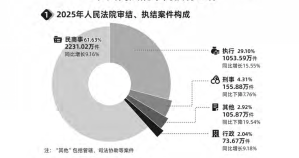
In 2025, the SPC accepted 29,154 new cases and concluded 31,958, down 16.5% and 1.8% year‑on‑year, respectively.  The Report does not provide a further breakdown.  The subsequent work report by the Supreme People’s Court’s Intellectual Property Court reveals that it accepted 4,679 cases in 2025 (see Mark Cohen’s analysis).   I surmise that a significant number of the cases that the SPC accepted are applications for retrial in administrative cases. According to my earlier research, the SPC accepts a small percentage of those applications for rehearing or other procedures. Liang Fengyun, the now-retired deputy head of the SPC’s Administrative Division, described the administrative caseload as an “inverted pyramid (“倒金字塔”),” one of the consequences of the failure of the reform of the four levels of the courts.  By contrast, courts nationwide accepted 37.486 million trial and enforcement matters and concluded or enforced 36.2 million, an increase of 10.8% and 8.9% over the previous year, see this chart.

2025 Distribution of types of cases in the Chinese courts: 61% are civil/commercial cases, with 29% enforcement cases. Criminal cases constitute 4%, while administrative cases constitute 2%.

II.  “Upholding Fairness and Justice, Safeguarding High-Level Security with High-Quality Judicial Services”

Although criminal cases constitute a small percentage of cases in Chinese courts, it is usual for matters relating to national security and criminal matters to take a prominent place.

For the first time, the 2026 Report introduces a dedicated section on “law‑based punishment of new types of crimes,” grouping cyber security, money laundering using virtual currencies, and online abuse. It links to Ch. 52, Section 4 of the Plan. The Plan sets out the larger political-legal framework, which includes improving national cybersecurity defense architecture, critical information infrastructure protection, ongoing clean internet campaigns, and deeper participation in global cyberspace governance. The Report cites a 158.9% cybersecurity-related cases concluded in the past five years and increased enforcement against money laundering and illegal foreign‑exchange evasion conducted using virtual currencies, likely reflecting Party and government policy concerns as well as the evolving nature of crimes committed in China. The mention of participation in global cyberspace governance is consistent with other sections of the Report, which contains a paragraph on participating in global governance.

On organized crime (sao e 扫黑除恶), the Report continues to stress the “normalization” of the campaign.  Defense counsel often post WeChat articles on how to deal with this normalization. On drug offenses, the Report notes a continued decline in traditional drug crimes while calling for tougher measures against new psychoactive substances and for clear distinctions between illegal trafficking in narcotic and psychotropic drugs and legitimate medical use.

The Report expands “financial security” to “preventing and defusing major risks in key areas,” extending beyond finance to real estate and other critical sectors, and “data‑chain‑based coordinated regulation (数据链条式协同监管).” This links to the Plan (Part XIV, Ch. 52, Sec. 3 ), which calls for a long-term mechanism to prevent and resolve major risks in key areas, i.e., real estate, local government debt, and small and medium‑sized financial institutions.

On what is described as human rights protection in the criminal process, the Report notes that 294 individuals were declared not guilty, and prosecutors withdrew charges against 1,235 individuals. The low number of persons declared not guilty has led to discussions among Chinese academics and defense counsel, such as this recent symposium by the well-known Hongfan Institute of Legal and Economic Studies. Courts disbursed 850 million yuan in judicial assistance to 38,000 litigants in hardship. (See related research by Wu Yuhao, my part-time colleague.) The Report cited a Henan case, previously selected as an SPC typical case mentioned on this blog,  in which a Henan court extended judicial assistance to three siblings whose parents had been killed and coordinated social assistance and tuition waivers. President Zhang frames this as improving relief-fund effectiveness and linking judicial and social assistance to maximize aid and defuse social conflicts.

III. Upholding Fairness and Justice: Supporting High-Quality Development Through High-Quality Judicial Services

This section of the Report illustrates, through seven examples, how the judiciary provides services and safeguards for national development priorities.

The chapter opens with the familiar call to fully and accurately apply the new development philosophy and build a “law-based” and “credit-based” economy. This is not new but echoes the 2025 Report’s plan to “Promote the development of a law-based and credit-based economy” (促推法治经济、信用经济建设). That policy is “codified” in Part I, Ch. 2, Sec. 2 of the Plan, which sets out the principle of “integrating an effective market with a proactive, capable government (有效市场和有为政府).”

(1) Supporting High‑Level Science & Technology Self‑Reliance

The Report contains dedicated segments on high‑level science and technology self‑reliance and the digital economy (数字经济).  The Plan elevates these areas to strategic priorities.  High-level science and technology self-reliance links to the Reform Plan Outline’s provision on “improving the judicial guarantee mechanism for the development of ‘new quality productive forces.'”   The Reform Plan Outline flags that the internet court rules will be amended to support digital economy developments. Because the Reform Plan Outline was issued to the lower courts, it provides more specific information about forthcoming technology-related rules that the SPC plans to issue in comparison to the Report.

This section on “serving high‑level self‑reliance and strength in science and technology” aligns with Part II, Ch. 5, Sec. 3 of the Plan, on building an institutional ecosystem for high-level scientific and technological self-reliance. The Plan covers stronger IP protection in emerging sectors, launching a “standardization pilot program” for new industries, efficient market entry for new business models, and tools such as “regulatory sandboxes” and “trigger-based regulation.” President Zhang Jun links this to macro‑policy and sectoral coordination. Courts are expected not only to strengthen IP protection but also to support the deeper integration of technology and industrial innovation. Reflecting the policy focus on mediation (see this related post), the SPC emphasizes that for disputes involving cooperative research and development (R & D)  and talent mobility, courts should combine mediation and adjudication to resolve disputes, facilitate transformation, and promote “win-win, multi-win” compliance-oriented outcomes.

In 2025, courts concluded 496,000 IP cases, with growth slowing to 0.3%; convicted 19,000 individuals for IP-related criminal offenses, up 6.2%; issued an updated policy document, entitled Opinions on Judicial Services and Safeguards for Scientific and Technological Innovation; and adopted mediation guidelines for technology-related IP disputes (full text is difficult to locate). The Report signals that courts hearing non-compete disputes should balance trade-secret protection concerns with talent mobility —using examples to signal that courts should penalize trade-secret misappropriation while confirming that reasonable employee mobility does not, by itself, breach non-compete obligations.

In cases involving artificial intelligence, courts pursued dual objectives: encouraging innovation while defining the boundaries of liability. One case introduced a “margin for error (“容错”空间)” standard: where a generative AI system produced inaccurate output, but the developer exercised due care and caused no harm, no tort liability attached.

(2) Building a Unified National Market

The second segment focuses on the evergreen issue of creating a unified national market.  The Report emphasizes the work of the courts in serving this policy by controlling administrative power.  The provisions in the Report are consistent with the themes emphasized in the 2022 SPC policy document on the unified national market,  align with the Reform Plan Outline’s provisions on constraining administrative/criminal intervention in economic disputes as well as the Plan’s unified market agenda. The Report presents judicial support for national unified-market policy as being implemented mainly through corrective, case-based adjudication, while Ch. 17 of the Plan goes further by seeking to remove barriers hindering the unified national market (破除阻碍全国统一大市场建设卡点堵点) and building ex ante frameworks on property rights, market access, credit systems, negative-list governance, fair-competition compliance guidelines in key sectors, lists of encouraged/prohibited local investment practices, dynamic updating of barriers, and accountability.

Courts in 2025 concluded 25,000 cases involving administrative licensing and administrative agreements affecting market players, up 4.7% year-on -year, likely reflecting national policy priorities. The Report targets “involution‑style” competition (“内卷式”竞争) and “pick/choose‑one‑of‑two” exclusivity in e‑commerce (the latter analyzed here). The Report also highlights personal bankruptcy pilots, consistent with the Reform Plan Outline and aligning with Part V, Ch. 17, Sec. 1 of the Plan on equal protection of property rights and “equal responsibility, equal offenses, equal punishment.”

(3) Stimulating the Vitality of All Types of Market Entities

This section links the courts’ work to broader economic developments.  The Report focuses on the accomplishments of the courts in adjudication and case-based protection, while Ch. 18 of the Plan assigns structural tasks outside the courts.

The Report mentioned that the SPC had issued 25 measures to implement the Private Economy Promotion Law. Some of those 25 measures include some of the typical cases mentioned in this blogpost. The Plan calls for full implementation of the Law, improving supporting regulations and equal access to factors, competition, and rights protection. See Yale Paul Tsai China Center’s Jamie Horsley’s 2025 analysis of that law.

On corporate governance, courts concluded 151,000 disputes involving capital contributions and equity transfers in 2025 (+39.5%), likely linked to changes in the Company Law, which imposes heightened requirements.

(4) Ensuring the Healthy Development of the Digital Economy

The 2026 Report consolidates data, personal information, and platform algorithm issues into a brief digital-economy section. The Plan situates digital economy issues within a broader framework spanning Digital China (Part IV), high‑level science and technology self‑reliance (Part III) and the socialist market economy (Part VI).  In 2025, courts adjudicated fewer than 1000 (908) disputes over data ownership and data transactions (+25.6%) and approximately the same number of  (915) personal information protection cases (+65%).

(5) Supporting a Comprehensive Green Transition

This section broadens the earlier “Beautiful China” narrative to incorporate carbon finance, carbon‑tax mechanisms and green industrial restructuring.  The Report makes explicit what has been the case: in the environmental area, the courts act as norm-generators when legislation lags behind.  Ch. 50 of the Plan expands on them to include green taxation, green finance and green certificate trading. The Report states that judicial practice “provided rich models” for the Ecological and Environmental Code: My forthcoming article, “The Evolving Relationship Between the National People’s Congress and the Supreme People’s Court in the Xi Jinping Era” provides more information about the SPC’s contribution to the drafting of the Ecological and Environmental Code.

Courts heard 115 carbon‑related cases in 2025 (+6.5%),  giving carbon-related adjudication greater visibility. This tracks Part XIII, Ch. 47 of the Plan on expanding the national carbon market and voluntary emissions-reduction market, and Ch. 48 on implementing the Ecological and Environmental Code, improving environmental accountability, and building environmental credit supervision. President Zhang further noted that disputes involving natural resources, biodiversity protection, and carbon‑emissions trading are increasingly policy‑ and expertise‑intensive.

(6) Improving law‑based administration

The 2026 Report highlights themes emphasized in the 2024 specialized report to the NPC Standing Committee on administrative litigation work, such as reducing and preventing administrative disputes through the 3+ N mechanism. Lawsuits challenging administrative compulsory enforcement dropped by 17.2% year on year. Among cases subject to administrative reconsideration, the losing rate of administrative agencies fell by 0.7%, while appeal and retrial application rates in administrative cases dropped by 3.6% and 2.6%, respectively.

(7) Serving National Defense and Military Development

The Report contains a brief section on serving national defense and military development, mentioning that the courts heard over 8000 military-related cases, both criminal and civil cases, but no breakdown between the two. It also signals that civil cases are increasing by mentioning that relevant jurisdictional rules between the military and local courts were improved, updating rules previously issued in 2020.  Those rules shed light on the variety of civil cases that frequently arise, such as medical malpractice involving military hospitals, employment disputes between civilian employees of military entities, and military-civilian divorces. The section also mentions the protection of “red” historic sites.

III. Upholding Fairness and Justice: Safeguarding a High Quality of Life Through High-Quality Justice

This section of the Report focuses on cases related to the lives of ordinary people (涉民生案件). A large variety of cases fall under this rubric.

The Report summarizes five years of civil adjudication under the Civil Code, linking to Ch. 58 and other chapters of the Plan. Over this period, courts concluded 1.752 million property‑rights disputes, 960,000 personality‑rights cases and 5.566 million tort liability disputes, with average growth rates of 0.7%, 5.1% and 7.1%, respectively. Under new Civil Code procedures, courts granted 33,000 personal safety protection orders, appointed 1,680 estate administrators, and resolved 1,743 disputes over virtual property, with average annual growth of 20%, 181.2% and 69.9%.  Courts have continued curbing exorbitant betrothal gifts, marriage-related extortion and abusive profit‑seeking by matchmaking agencies.

The Report also highlights harsher domestic violence penalties.  As this blog flagged earlier, the SPC issued domestic violence-related typical cases. In the area of the protection of the elderly, courts have targeted bogus cut-price tours and illegal health‑product promotions, with much more work required to provide appropriate protection, as this blog has discussed. Protection of post-retirement-age workers’ rights has finally received official attention, and is mentioned in the Report. In the consumer sphere, courts aim to foster “confident consumption (放心消费) ” by protecting rights to information, choice and fair transactions, and by targeting fake orders, fabricated reviews and other deceptive online merchants. On the practice of knowingly purchasing counterfeit goods, courts distinguish legitimate rights protection from abusive profit‑seeking and continue to punish extortion carried out under the banner of “anti‑counterfeiting.”   See my former colleague Lu Yi’s (Claudia Lu’s) related article. In 2025, the SPC issued a judicial interpretation on pre‑paid consumption addressing absconding with prepaid funds (卷款跑路) and unconscionable standard-form terms (霸王条款).

On “serving high‑quality and sufficient employment,” courts concluded 674,000 labor disputes in 2025, up 9.8%, heard 75,000 wage‑recovery cases and helped workers recover 24.12 billion yuan in unpaid remuneration. The SPC issued an interpretation on open‑ended labor contracts and liability in subcontracting and labor outsourcing.

On crimes against juveniles, courts maintain a “zero tolerance” stance. In 2025, they concluded 40,000 such cases involving 44,000 defendants, down 1.8% year on year.  The courts imposed occupational bans on 1,199 offenders. 2,356 juvenile offenders involved in serious violent crimes were sentenced to more than five years, while 5,822 juveniles in less serious offenses were treated leniently. In family and guardianship matters, courts revoked the guardianship rights of 997 severely neglectful parents and issued 435 civil protection orders against child abduction or concealment by parents.

On enforcement, courts handled 5.837 million preservation and enforcement cases, with the voluntary compliance rate for civil judgments rising by 2.7%, and total enforced amounts reaching 2.2 trillion reminbi. Cross-regional or hierarchical enforcement covered 268,000 cases. Courts convicted 4,461 individuals for refusing to comply with judgments or enforcement orders, and the national judgment-debtor list — after falling for the first time in 2024 — shrunk by another 5.2% in 2025.

In matters involving Hong Kong, Macao, Taiwan and overseas Chinese, courts concluded 31,000 cases, up 15.6% year‑on‑year.

THIS IS PART 1 OF TWO PARTS

_____________________________________________

Many thanks to an anonymous peer reviewer for comments on an earlier draft of this article.