
By Susan Finder, with research assistance by Sun Jinping (孙金萍)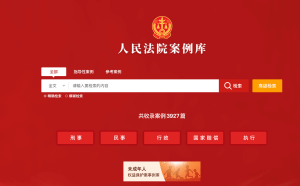
What do we know now about the People’s Court Case Database (Case Database, 人民法院案例库) that we did not know when in launched in late February 2024? What insights do 10 months of operation of this case database provide? This blogpost provides a consolidated analysis of the Case Database, incorporating the work procedures for the Case Database (Case Database Work Procedures, 人民法院案例库建设运行工作规程), issued in May 2024, the analysis previously published on this blog in March 2024, and observations of practice, summarizing what the Case Database is, why it was established, some historical background, how cases are incorporated into the database, comments from local judges on its usability, and my own comments on its significance.
What is the Case Database?
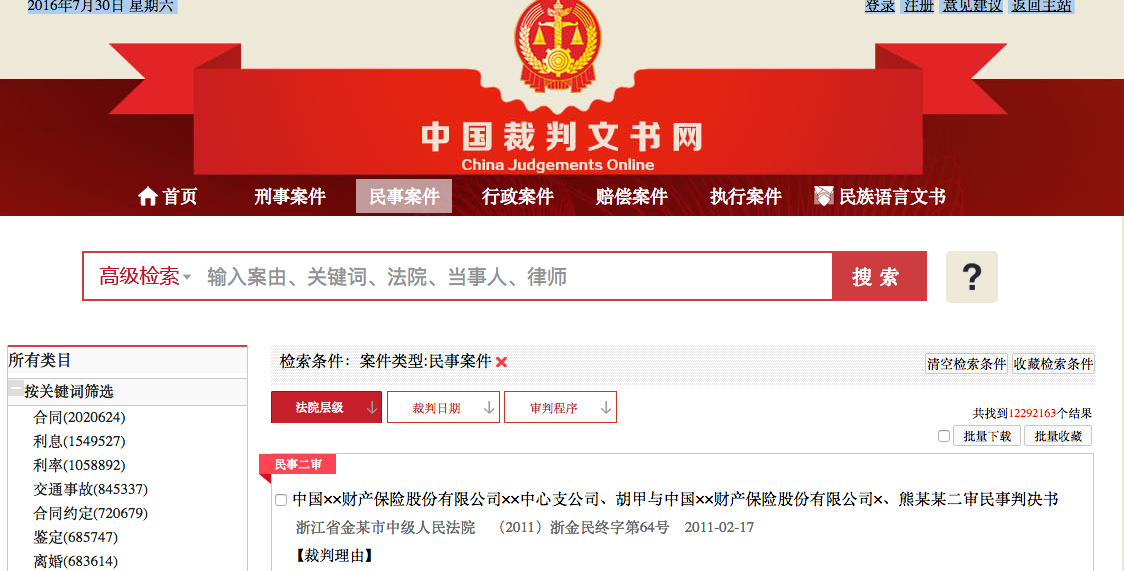
The Case Database (人民法院案例库) provides a collection of 4338 edited cases (案例) rather than original judgments, rulings, or other judicial documents as collected in China Judgements Online (裁判文书网). According to the Case Database Work Procedures, the Case Database incorporates guiding cases and certain “reference cases” (参考案例) which have been reviewed and approved by the SPC. The judgments in the reference cases must have come into force and have referential and exemplary value for the trial of similar cases. However, the Case Database Work Procedures do not define “reference cases,” or clearly situate them compared to guiding or typical (exemplary, model) cases. The “Understanding and Application” article written by the principal drafters of the Case Database Work Procedures clarifies that “reference cases” “are a new type of edited case created by the Case Database system. Their effectiveness is higher than other cases except for guiding cases.” This is consistent with my earlier analysis that the selection process appeared to involve more reviews than typical cases, but fewer approvals than guiding cases.
To provide an example for this article, I undertook a full-text search of the term “性骚扰“ (sexual harassment). It returned three cases, one guiding case, and two reference cases: Guiding Case No. 181: Zheng v. Honeywell Automation Control (China) Co., Ltd. (dispute over an employment contract); 黄某诉重庆某公司劳动争议案 (Labor Dispute, Huang v. A Chongqing Company); and a dispute over a right to reputation, Gong v. a Beijing Internet Technology Company 龚某某诉北京某网络技术有限公司名誉权纠纷案. (I have posted the full text of the reference cases, for those interested).
The Case Database is accessible from the SPC’s homepage, which is, the last time I checked, not accessible for those with a US IP address. I trust it can be accessed directly through the link provided above. It is intended to be accessible outside of China and appears to be hosted by the same platform as China Judgements Online. Similar to the China Judgements Online Platform, it requires the user to register and provide personal information. Even after such information is provided, the login process is not smooth for those without a mainland China identification card.
Why this New Case Database?

The large number of model/typical/exemplary cases that the SPC has issued in the past year makes it clear that President Zhang Jun favors those to guide the lower courts, rather than large numbers of policy documents. So the decision for the Chinese Courts Case Database to serve as a database for various types of edited and specially selected cases for their persuasive or exemplary value is consistent with the views of President Zhang Jun on the use of cases. It is also consistent with the views of General Secretary Xi Jinping, who has stressed that “one case is better than a dozen documents (习近平总书记强调, “一个案例胜过一打文件”),
The SPC has described it as a new public legal service product (公共法律服务产品). It was launched before the Two Meetings ( National People’s Congress and Chinese People’s Political Consultative Conference meetings) in March (2024) and therefore it was featured in the SPC’s NPC Report. The principal drafters of the Case Database Work Procedures describe it as useful for promoting the unified application of law and a tool for enhancing resolving disputes at source, that is oriented to both judges and the general public. It is the latest in a series of SPC platforms designed to promote the unified application of law.
The Case Database Work Procedures require a judge to undertake search when undertaking a similar case search (see my former student’s description of the process). However, the reference case may not be used as the basis of a judgment, but a judge may use it in considering a case and the reasoning of a judgment or ruling, apparently without citation.
Background
The Case Database is yet another product of last year’s thematic education campaign (主题教育). As described in my article published in US Asia Law Institute’s Perspectives, during the campaign, President Zhang required SPC divisions, offices, circuit courts, and affiliated institutions to undertake research focusing on current significant problems or issues in their area of law or responsibility and write reports proposing practical solutions. One of the problems brought to the surface during that campaign was that [edited] cases issued for guidance (案例指导) were not standardized, timely, comprehensive, or consistent. Followers of this blog would have known that.
The Case Database Work Procedures provide that the database is the primary responsibility of the Research Office, also involving other divisions and offices.
Case Selection Process
The Case Database Work Procedures contains a lengthy section setting out the procedure by which reference cases are incorporated into the Case Database. They can be recommended by lower courts, universities, other institutions, or the general public. The details of the process for selecting typical [foreign-related] cases contained in my article are consistent with the process described in the Case Database Work Procedures. It is a bureaucratic process involving multiple levels of review.
Depending upon the entity that has submitted the case, the proposed edited cases are reviewed by members of the relevant operational division of the SPC. The Case Database Work Procedures provides that an SPC division (sitting as the professional judges meeting) reviews and discusses a group of cases for proper application of law, reasoning, and ethical orientation (value orientation 价值导向). If the judges in the relevant operational division consider that certain cases are suitable for inclusion in the database, the division will report the case selectionto the relevant SPC leader for approval. I surmise that an explanatory report accompanies the selected cases. The cases are thereafter sent to the Research Office for review. During the review process, the Research Office reviews the format and substance of the selected cases, involving experts in the review. As part of the formatting process, each case is labeled with a special number (see the attached cases). I surmise the initial approval by the SPC leader is subject to final clearance by the Research Office. Otherwise, the Research Office could be in the awkward position of negating a decision by a leader. This procedure highlights the unique role of the Research Office at the SPC.
The Case Database Work Procedures also contain a procedure for updating or deleting reference cases that are no longer appropriate.

The Case Database Work Procedures specify that the application of Case Database cases in the hearing of cases should be incorporated into a judge’s performance evaluation. From the number of WeChat articles on local court websites announcing the good news that one or more of their cases had been incorporated into the database, it must be useful for court key performance indicators (KPIs).
Comments from judges
I surveyed an unscientific sample of judges on the Case Database, all highly experienced(资深) and located in major cities. All said that they will refer to the Case Database, as it is required and found helpful when dealing with similar cases. One judge found that access to the database was not convenient. Several judges commented that the number of cases in the database is still small and the cases do not form a whole case group (that is, there are not a sufficient number of cases in a particular area of law), making it difficult for judges to undertake a case comparison. One judge remarked that the case descriptions are overly abstract, with too many facts about the case omitted. That same judge noted that the names of the parties and case numbers are omitted, making it difficult to track down the original case.
Comments
As I wrote earlier, although the SPC describes the Case Database as providing more authoritative, standardized, and comprehensive guidance, with such a small number of cases in the database and such a large number of specialized issues that face Chinese courts daily, as a practical matter it is not a “one-stop platform” for Chinese judges or lawyers. The insufficient number of details may reflect the designers’ desire to reach ordinary citizens as well as judges. Although the drafters mentioned that they sought comments on their product, none of the judges I surveyed (from among the busier courts) had commented on the draft version of the product. So it appears another example of a reform that could have benefited from more input from users, as I discussed in a recent presentation. In my view, it would also make sense to incorporate SPC-approved typical cases into the database, to make searching easier for judges, lawyers, and others interested in Chinese cases.
I surmise from the procedures in the Case Database Work Procedures that discussing the selection of Case Database cases now occupies a good portion of the work-week of SPC judges. This would be consistent with earlier reforms seeking to focus the work of the SPC on guiding the lower courts.
The Case Database appears to be reshaping case law with Chinese characteristics. However, as I wrote earlier, this also signals the dynamic nature of Chinese judicial policy, as the forms of SPC guidance of the lower courts have further evolved during 2024. If an updated version of the 2020 rules on similar case search are issued, those would incorporate the Case Database and the Court Answers Database.
Finally, although one aspect of the Fourth Five-Year Court Reform Plan Outline stressed reducing the administrative-type operation of the courts (去行政化), the establishment and operation of the Case Database evidences that times have changed.
_______________________________________________
Many thanks to an anonymous peer reviewer for reviewing this blogpost.


 I recently published an
  What few recognize is that the millions of non-guiding cases on the Supreme People’s Court’s
  Supreme People's Court Monitor
You must be logged in to post a comment.