
Tag Archives: foreign-related legal personnel

What’s New in SPC Support for Foreign-Related Rule of Law?

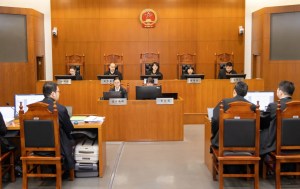
CICC hearing in Shanghai

As most readers of this blog know, developing foreign-related rule of law is a priority for the Chinese government.  President Zhang Jun told Supreme People’s Court (SPC) leaders at the beginning of 2025 that the Party Center places a great deal of importance on the construction (development) of foreign-related rule of law (党中央高度重视涉外法治建设). What does that mean for the SPC?  What has the SPC done lately? This post briefly notes some of those developments.

  1. The SPC’s #4 Civil Division has recently established a WeChat public account entitled 中国涉外商事海事审判,  as a way of better conveying developments to the Chinese professional and academic legal world. The link is to the April 30 report on the China International Commercial Court’s circuit visit to Shanghai on 10-11 April.
  2. The China International Commercial Court (CICC) held a hearing in Shanghai’s #1 Intermediate Court on 10 April in a joint venture shareholder dispute (see the photo above). I could attend because I was scheduled to participate in a workshop at NYU Shanghai on 12 April and several people bound by protocol to remain anonymous helped workshop participants and me with the required formalities.   Many from Shanghai’s “foreign-related” legal community attended the hearing, including several foreign lawyers, senior members from the Shanghai International Arbitration Center, Shanghai Commercial Mediation Center, and academics from Shanghai’s law schools specializing in foreign-related matters.  Official reports on the event included the SPC’s official website, the Shanghai #1 Intermediate People’s Court WeChat account (bilingual), and the #4 Civil Division’s WeChat account. I have my views on the performance of the lawyers, but will withhold them until I know more about the length of time they had for preparation.

Unbeknownst to most, the hearing in Shanghai evidenced that the CICC was implementing part of Article 33 of the sixth judicial reform plan:

Deepen the reform of the circuit trial mechanism. Deepen the reform of the circuit court work mechanism of the Supreme People’s Court, strengthen the functions and roles of the Supreme People’s Court’s trial organs in shifting their focus downward, resolving disputes on the spot, and facilitating litigation for the parties. 强化最高人民法院审判机关重心下移、就地解决纠纷、方便当事人诉讼的功能作用。

Holding a hearing in Shanghai would be considered to be “shifting the focus of the SPC downward,” resolving disputes on the spot, and facilitating litigation for the parties.

  1. The SPC issued 《最高人民法院关于人民法院为西部陆海新通道建设提供司法服务和保障的意见” Opinions of the Supreme People’s Court on the People’s Court Providing Judicial Services and Guarantees for the Construction of the Western Land-Sea New Corridor”  along with related typical cases. An explanation of the Western Land-Sea New Corridor is here.  The document designates the Chongqing High People’s Court to take the lead in establishing a “13+2” judicial cooperation mechanism among thirteen high people’s courts and two intermediate people’s courts along the corridor to cooperate in litigation services, substantive dispute resolution, enforcement linkage, application of law, talent training, etc.
  2. SPC Justice Wang Shumei published an article in China Trial (中国审判)  on foreign related matters in late 2024. Her article is a useful summary of current SPC policy on foreign-related commercial and maritime matters.   One part includes:

improve the rules for jurisdiction over foreign-related cases, and properly handle international conflicts of jurisdiction arising from parallel litigation involving multiple countries in the same dispute in accordance with the law; we must firmly maintain the international order based on international law, actively participate in the formulation of international rules, carry out in-depth international judicial exchanges and cooperation, strengthen confidence in the rule of law, actively explain to the world the concepts, propositions and successful practices of foreign-related rule of law with Chinese characteristics, promote the progress of international rule of law, promote global governance in a more just and reasonable direction, and help build a community with a shared future for mankind.

The above quotation summarizes what has been said in earlier documents: resolving parallel litigation is on the agenda; the Chinese courts should tell China’s story well; the SPC should actively participate in formulating international rules (actively participating in the negotiation of the Hague Judgments Convention as an example), and all is linked to the Chinese government’s vision of global governance and the international legal order.

3.  Typical cases

  1. In late April 2025,  the SPC issued a group of typical cases linked to the Western Land-Sea Corridor and the policy document mentioned above, signaling the importance of mediation, unifying standards, promoting the application of international treaties and conventions, etc.
  2. In March 2025, the SPC issued a second group of typical free trade zone cases第二批服务保障自由贸易试验区建设典型案例
  3. As I mentioned in an earlier post, the SPC issued typical cases protecting the rights and interests of foreign investors.
  4. As mentioned in an earlier post, in March, 2025, the SPC issued procedures to implement the Foreign State Sovereign Immunity Law.

Forthcoming attractions

Among the forthcoming attractions of which I am aware:

  1. The #4 Civil Division is drafting a judicial interpretation of the foreign-related part of the Civil Procedure Law, as reported in official media. Judge Guo Zaiyu, who was one of the judges of the CICC panel hearing the case at the #1 Intermediate People’s Court, chaired a meeting with scholars and experts, hosted by East China University of Political Science and Law, including some (domestic) CICC experts in Shanghai on April 11. I surmise the judicial interpretation will be issued sometime this year and it is unclear whether a draft will be released for public consultation.

2.   As mentioned earlier, the 6th judicial reform five-year plan outline was issued in late December.  Point 12 relates to foreign-related rule of law:

Improve the judicial guarantee mechanism for high-level opening up. Improve the foreign-related trial mechanism, strengthen international commercial trial work, and improve the connection mechanism with international commercial mediation and arbitration. Improve the judicial trial system in which the parties in foreign-related civil legal relations agree on jurisdiction and choose to apply foreign laws in accordance with the law. Improve the mechanism for accurate application of international treaties and international practices, and improve the mechanism for ascertaining foreign laws. Improve the maritime trial mechanism, promote the improvement of the maritime legal system, improve the rules for adjudicating disputes such as ship repair, cross-border logistics, shipping insurance, maritime finance, and compensation for damage to the marine ecological environment, and improve the coordination and linkage mechanism with maritime administrative law enforcement agencies. Improve the mechanism for mutual recognition and enforcement of cross-border arbitration awards and civil and commercial judgments. Improve the judicial protection mechanism for overseas interests and investments. Improve the judicial protection mechanism for overseas Chinese interests. Improve the talent training mechanism for foreign-related trials. Strengthen international exchanges and cooperation in the judicial field, and actively participate in the formulation of international rules.

It appears most of the content here is not new and has been incorporated in the policy documents previously analyzed on this blog. The major exception is the detailed stress on certain maritime case principles.  Why has this paragraph been incorporated in the judicial reform plan outline, when previously this type of content would more likely have appeared in a specialized policy document?  As I will comment in a future article, it is representative of many articles in this judicial reform plan outline, signaling that the Party and SPC leadership attach importance to those matters.

Training foreign-related legal personnel for the Chinese courts

President Zhou Qiang visiting the University of International Business & Economics

Since the Fourth Plenum of the 19th Party Congress, and especially since President Xi Jinping spoke about the need for China to train foreign-related legal personnel  (涉外法治人才), the Supreme People’s Court (SPC) press, SPC leadership, and others important to the SPC leadership, such as Shen Deyong, former executive vice president of the SPC and current leaders of the CPPCC have reiterated the importance of “foreign-related legal personnel” to China and the people’s courts.  Training “foreign-related legal personnel” is incorporated into the Party’s Plan for Building the Rule of Law (2020-2025), an indication of its importance.  Shen Deyong  criticized the way that “foreign-related legal personnel” is used within government institutions– “team is too small, their numbers are too few, they are scattered and the market is chaotic.””涉外法律服务人才队伍建设还存在一些问题和不足,主要呈现队伍“小”、人才“少”、分布“散”、市场“乱”的特点.  I would add to the issues that he flagged that policies directed towards attracting  “foreign-related legal personnel” to the courts inevitably encounter the special characteristics of the courts’ personnel system as it has evolved since the quota judge reform was implemented, both the training system and especially career advancement from judges assistant to quota judge.

Foreign-related legal personnel policy

The language about increasing “foreign-related legal personnel” in the courts is not new but dates back to at least 2015 and the  Opinion of the Supreme People’s Court on Providing Judicial Services and Safeguards for the Construction of the “Belt and Road” by People’s Courts (BRI Opinion #1). It was reiterated in the 2019  Opinions of the Supreme People’s Court on Further Providing Judicial Services and Guarantees by the People’s Courts for the “Belt and Road” Initiative (BRI Opinion #2) and the 2020 Guiding Opinions of the Supreme People’s Court on the People’s Courts Serving and Guaranteeing the Further Opening Up to the Outside World (Open Economy Guiding Opinion). Article 15 of BRI Opinion #1 calls for improving training for Chinese judges on their professional capacity (业务能力) and improving overall judicial quality. Article 38 of BRI Opinion #2 and Article 16 of the Open Economy Guiding Opinion both have language about cooperating with universities to develop training and teaching plans so as to train and prepare a pool of international legal practitioners….”  A knowledgeable person has reminded me that repetition in consecutive documents is an indication of importance (and I would add the difficulty of resolving the problem).

As readers of this blog know, the Chinese courts need “foreign-related legal personnel” in many areas. Those include working on cross-border cases across a broad range of procedural and substantive areas,  undertaking research related to cross-border judicial policy and cross-border legal issues that have an impact on the judiciary, as well as working on a range of issues related to the SPC’s and lower courts’ interactions with the outside world.

Court cooperation with universities

The SPC has designated a number of China’s leading law schools and legal research institutions as Belt & Road research bases, including: the International Law Institute of the China Academy of Social Sciences; Tsinghua University School of Law; Wuhan University School of Law, Southwest University of Political Science and Law; China University of Political Science and Law, Shanghai University of Political Science and Law; Dalian Maritime University, and East China University of Political Science and Law. The SPC is thus able to draw on the research capacities of China’s law schools and involve law students in the legal issues facing the Chinese courts. Participating in this research can also motivate students to enter the courts after graduation.

Law students apply to become judges assistants after graduation for a variety of reasons. Some become further interested after internships (see this blogpost on SPC interns–a version with more data may appear later).  Other law school graduates are motivated by presentations by outstanding judges at their law school (SPC Judge Gao Xiaoli’s 2015 talk at the Peking University School of Transnational Law earned her many new fans), while still others recognized that a job “in the system” would resolve their hukou problems and enable them to live in Beijing, Shanghai, or other major cities. Yet others are motivated to use their education in the service of the public. I can say with authority that law graduates with knowledge of transnational law, fluency in English (and other foreign languages) are working as legal assistants in courts all over China.  Recruitment of legal assistants is a local matter, so the #4 Civil Division of the SPC (in charge of foreign commercial matters) and likely the Political Department of the SPC (in charge of personnel) lacks statistics on the number of “foreign-related legal personnel” working in the local courts.

Special characteristics of the courts’ personnel system

I write about the judiciary’s personnel system with some trepidation as I am well aware that my knowledge of the regulatory system is incomplete. (Some of the relevant regulations cited in analyses of the personnel reforms are not accessible to those outside the court system.)   On the issue of placement of junior “foreign-related legal personnel,”  I have not heard from either knowledgeable persons, former students, or other junior personnel in the Chinese court system that specific policies have been implemented within the court system (the Political Department of the SPC is responsible at the national level, and locally, political departments of local courts are responsible) to channel judges assistants recruited from China’s law schools with transnational training and experience into roles in which their academic background can be used and their “foreign-related” legal skills can be developed. In the absence of specific policy, too many local court leaders appear to see the young people with a transnational legal background and experience merely as workers that can be put to work in the national judicial machine (司法民工). Judges assistants from higher courts are sometimes sent down to the local level to work for two years, in line with young cadre development policy.

Training

If the three documents cited above have language about training, it seems likely that a training plan is somewhere in the approval pipeline.  My guess is that this is yet another matter that requires coordination among multiple institutions within the SPC, including the #4 Civil Division–the ones asking for the training to be done, with the Political Division and the National Judges College.  As I wrote last year, a new national court training plan (2019—2023年全国法院教育培训规划)) is underway.  As senior leadership has called for cultivating  “foreign-related legal personnel,” it seems likely that the SPC will eventually issue (perhaps not publicly) a training plan for judges handling all sorts of foreign-related issues, both civil-commercial and criminal.

Career advancement

Another issue for foreign-related legal personnel in the courts is career advancement for judges assistants.  As I mentioned in passing in an earlier blogpost, career advancement from judges assistant to quota judge has slowed. Specific promotion criteria are set locally.   Local studies have been done on the role of the judges assistant but have not surmounted the language barrier (see this one from one of the Chongqing Intermediate People’s Courts)  that provide specific data and specific analysis deriving from local conditions.  From my observations, fixed quotas on the number of judges in a court can mean a talented, educated judges assistant in one court may wait significantly longer than a similarly qualified person in another court to become a judge.

Concluding thoughts

Unless the SPC can evolve better national policy directed towards a career for “foreign-related legal personnel,”  some of them will leave, disappointed with the failure of the judicial system to use their talents, despite the official publicity. There will be many companies and law firms, some dealing with the issues I described previously, that will value them.