
Tag Archives: NPC Legislative Affairs Commission

2025 Labor Dispute Interpretation II and the Work of the Supreme People’s Court

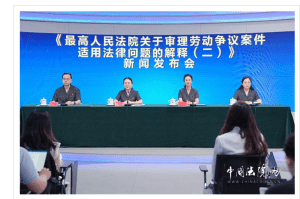
Labor Dispute Interpretation II press conference

The August (2025) Supreme People’s Court (SPC) Judicial Interpretation on Labor Dispute Cases (II)  (Labor Dispute Interpretation II 最高人民法院关于审理劳动争议案件适用法律问题的解释(二) is one of the few SPC judicial interpretations to attract significant public and press attention in and out of China.  As the institution’s usual practice, the SPC also released a set of typical cases.  Rather than duplicate commentary on the substance of the judicial interpretation, which law firms and others are providing, this post focuses on three aspects of this interpretation that provide examples of the work and functioning of the SPC:

  • the link between Labor Dispute Interpretation II and the harmonization of administrative and judicial standards;
  •  Labor Dispute Interpretation II and SPC support for the work of the National People’s Congress (Standing Committee);
  • the role of typical cases (典型案例) (also translated as exemplary or model or representative)

(Each is linked to my ongoing research.)

1.  The harmonization of administrative and judicial standards

During the press conference announcing Labor Dispute Interpretation II, #1 Civil Division Chief Judge Chen Yifang 陈宜芳stated:

在多次征求立法机关、行政机关、有关社会团体等意见,并向社会公开征求意见后,对基本达成共识的问题作出规定…(After repeatedly soliciting opinions from legislative bodies, administrative organs, relevant social groups, and publicly soliciting opinions from society, it [the SPC] has made stipulations for issues on which consensus has been basically reached)

This bureaucratic language needs decoding.  It means that the legal positions taken by the SPC in Labor Dispute Interpretation II represent not only the views of the SPC, but also the relevant institutions regulating labor matters.  What “soliciting opinions from legislative bodies (立法机关)” means is that the SPC drafters sought comments on their draft multiple times from institutions of the National People’s Congress  (NPC) Standing Committee.  The Legislative Work Committee must have been one of the institutions with which the SPC discussed the draft. It is possible that the NPC’s Social Affairs Development Committee also commented. Additionally, the SPC solicited opinions multiple times from administrative agencies (行政机关)-likely referring to the Ministry of Human Resources and Social Security and I surmise other administrative organs, such as the Ministry of Finance and the Ministry of Justice.  “Relevant social groups” is likely to mean the All-China Federation of Trade Unions and the China Association for Small and Medium Enterprises.  If the #1 Civil Division publishes an “understanding and application” article on this interpretation, it will provide more details on the institutions that commented on this interpretation.

This also illustrates one of the principles underlying the SPC’s work on labor law issues, harmonizing administrative and judicial standards, as shown in several policy documents, such as the Opinions of the Ministry of Human Resources and Social Security and the Supreme People’s Court on Strengthening the Building of a Mechanism of Connection between Arbitration and Litigation of Labor and Personnel Disputes  (人力资源社会保障部最高人民法院关于加强劳动人事争议仲裁与诉讼衔接机制建设的意见), which states “standards for application of law in [labor] arbitration and litigation shall be gradually unified” (逐步统一裁审法律适用标准).

It is also consistent with rules governing the drafting of judicial interpretations. Those require the SPC’s Research Office, which reviews drafts before they are submitted to the judicial (adjudication) committee for approval to review whether the draft  “has sufficiently and objectively reflected the major opinions of the parties concerned” (是否充分、客观反映有关方面的主要意见). ”

2.  SPC support for the work of the National People’s Congress Standing Committee

Labor Dispute Resolution II also indirectly illustrates a poorly understood aspect of the SPC’s work–supporting the work of the NPC (and its Standing Committee), including in the NPC’s law enforcement inspection work, which, as the NPC Observer has pointed out, is emphasizing integrating oversight with legislation.  The relevant legislation is the Social Insurance Law, which is now on the legislative agenda.

As could be surmised from the NPC Observer’s overview of NPC Standing Committee law enforcement inspections, it is normal practice for the SPC to report to NPC Standing Committee law enforcement inspection groups.   The one related to Labor Dispute Resolution II was revealed at the November 2024 meeting of the NPC Standing Committee,  when the agenda included the Report of the Law Enforcement Inspection Group of the Standing Committee of the National People’s Congress Regarding the Inspection of the Implementation of the Social Insurance Law of the People’s Republic of China (全国人民代表大会常务委员会执法检查组关于检查《中华人民共和国社会保险法》实施情况的报告).  This report contained one sentence that touched on the SPC.  It stated that at the first meeting of the Law Enforcement Inspection Group, responsible comrades (officials) from the SPC and other relevant institutions reported on the implementation of the Social Insurance Law  (6月4日,执法检查组召开第一次全体会议,王东明副委员长作讲话,部署执法检查工作;人力资源社会保障部、财政部、税务总局、国家医保局、最高人民法院负责同志汇报社会保险法的实施情况).

When preparing Labor Dispute Interpretation II, the drafters would have been aware of the serious problems with implementing the Social Insurance Law.  Some observers anticipate that the provisions in Labor Dispute Interpretation II relating to social insurance signal positions that will be incorporated into amendments to the Social Insurance Law.  If so, that would provide another example of the codification in legislation of a provision in a judicial interpretation (as discussed in my 2024 article).

3. Typical Cases

The SPC often issues a set of typical cases to accompany a judicial interpretation, as highlighted in previous posts, but their role appears to be underappreciated.  Analysis of these cases can be found here and elsewhere. At the SPC’s press conference, following the phrase quoted above, Judge Chen Yifang 陈宜芳 said:

对争议较大的问题将继续加强调研,通过发布典型案例等方式指导司法实践 we will continue to strengthen research on controversial issues and guide judicial practice by publishing typical cases and other means.

This bureaucratic phrase can be decoded to provide additional insights about the work of the SPC.  The first part signals that certain unspecified issues were omitted from the final draft of the interpretation because they were “controversial,” meaning the SPC did not reach a consensus with other institutions on those topics. The second phrase illustrates that the SPC uses typical cases as one of its tools to guide the lower courts, including on “controversial issues.”

Conclusion

The first two aspects provide discrete examples of the nuanced relationships between the SPC and other institutions, particularly the NPC Standing Committee (the subject of one forthcoming article) and administrative agencies (the subject of another forthcoming article), while the third is another example of those nuanced relationships as well as the use the SPC makes of “typical cases” (典型案例).

_______________________________________

Many many thanks to Dr. Ren Rongqing (任容庆) of Meituan’s legal department (and former post-doc at the China Institute of Applied Jurisprudence of the SPC) for her insightful comments on several drafts of this blogpost! A second thank you is due to a highly knowledgeable commentator for his post-publication contribution.
 

“Same Life, Different Values:” An Example of How Judicial Interpretations Are Reviewed in China

Written by Dongyu Sun.  Edited by Susan Finder and Changhao Wei.

This post also appears on the NPC Observer.

On December 15, 2005, a loaded truck rolled over on a mountain road in Chongqing, crushing a trishaw carrying He Yuan and her two friends to school. All three perished in the accident. What thrust this tragedy into the national spotlight, however, was the drastically different amounts of compensation their families received. The trucker’s employer settled with the families of Yuan’s friends for over 200,000 RMB each, but was willing to pay hers only 80,000 RMB—because she, unlike her classmates, had a rural hukou (or household registration).[1] The company cited a 2003 Supreme People’s Court (SPC) interpretation on the application of law in personal injury cases (2003 Interpretation), which created two separate standards for compensating the deaths of urban and rural residents.

As a result of this effectively hukou-based rule, countless victims’ families have found themselves in the same position as Yuan’s. The Chinese public has dubbed this phenomenon “same life, different values” [同命不同价] and has persistently criticized the 2003 Interpretation. Some citizens have requested that the NPC Standing Committee (NPCSC) conduct a constitutional review of the Interpretation.

It was not until 2020 that the NPCSC’s Legislative Affairs Commission publicly addressed these requests in its annual report on “recording and review” (R&R) [备案审查]. This report’s timing and content are significant. Below, we will first take a closer look at the 2003 Interpretation and the controversy surrounding hukou-based compensation standards, before returning to the Commission’s report.

The SPC’s 2003 Interpretation

Under article 15 of the 2003 Interpretation, in a civil case where the deceased victim was an urban resident, the defendant must generally pay twenty times the previous year’s per capita disposable income of urban residents of the relevant province for the victim’s death. For a victim who was a rural resident, the previous year’s per capita disposable income of rural residents[2] is used as the base instead. The urban per capita disposable income is consistently several times higher than its rural counterpart across China. In practice, courts mainly used the victim’s hukou to determine the applicable standard. Article 12 of the 2003 Interpretation contains similar residence- (hence hukou-) based compensation standards when the victim has been permanently disabled. At the time, the standards in the 2003 Interpretation were considered appropriate for China and in line with official policy that made distinctions based on hukou.

Within a few years, the SPC publicly acknowledged that the dual standards created inequities between urban and rural victims. Then-SPC President Xiao Yang told media in 2007 that the SPC had already formed “a preliminary view” on “same life, different values,” and would issue new rules after that year’s NPC session. But in 2008, an SPC vice president disclosed that it was not possible for the SPC to reach a consensus on a replacement standard.[3] Instead, the SPC issued measures in 2006 and 2011 directing the lower courts to consider factors in addition to hukou (such as a victim’s “habitual residence”) in applying the 2003 compensation standards. Basic level courts encountered many difficulties in implementing this guidance, however, so hukou largely remained the determining factor.

The issue of the dual compensation standards arose during the drafting of China’s Tort Liability Law [侵权责任法].[4] One draft would have set a uniform national standard for death compensations, based on the average annual salaries of urban employees nationwide, while another would have provided an individual-based rule.[5] The NPCSC in the end did not adopt either provision and left the rules in the 2003 Interpretation intact. The Tort Liability Law did make one limited change in response to cases like He Yuan’s: under article 17 (now codified as article 1180 of the Civil Code [民法典]), if multiple people died because of the same tort, a court could award their families the same amount of death compensation without regard to their individual circumstances.

From these developments, it is clear that the authorities considered that the hukou-based rules fit the reality of unequal development of China’s urban and rural regions.[6] They thought that an individual-based rule would give judges too much discretion, but that uniform rules would either create too much burden for rural tortfeasors (if based on urban income level), or be unfair to urban victims (if tied to rural income level). So the 2003 Interpretation, plus the SPC’s flexible measures, were considered the least worst.

Fang Shimin’s Request for Review

Over the years, Chinese citizens have requested the NPCSC to review the validity of the 2003 Interpretation through its R&R process, explained here in more detail. In sum, that process is an oversight tool that empowers the NPCSC Legislative Affairs Commission (LAC) to reject a sub-statutory legal document if it deems the document unconstitutional, unlawful, contrary to the Communist Party’s major policies, or otherwise “clearly inappropriate.”

The Southern Metropolis in January 2021 reported on such a citizen request and the LAC’s reply. Mr. Fang Shimin, a retired manager of an Anhui mine company with an interest in the law, wrote to the LAC in mid-2018, arguing that the 2003 Interpretation’s hukou-based rules violated the guarantee in Article 33 of the Constitution that all citizens are “equal before the law.”

The LAC (specifically, its Office for Recording and Reviewing Regulations) disagreed with Mr. Fang. It responded to him in December 2018, after having consulted with the SPC and its own Office for Civil Law. The LAC explained that the differential compensations were constitutional because they did not in fact make up for the victims’ disabilities or lost lives, but were instead economic relief to the victims or their families. The LAC’s reply did also acknowledge that there were some issues with the 2003 Interpretation that need to be “studied and resolved,” including how to define the compensation more reasonably so that “most citizens would accept them.”

Recent Policy Change & Reform Pilots

The turning point for the hukou-based compensation rules came in late 2013, when the Communist Party decided to “accelerate” hukou reform. A few months later, the State Council issued a major policy document that called for abolishing the distinction between urban and rural hukou and replacing both with “resident hukou” [居民户口]. By February 2017, all mainland provinces had implemented this reform. The State Council also ordered companion reforms to other institutions (e.g., social welfare programs) consistent with the uniform “resident hukou” system, but one government researcher said at the time that there would be “a long way to go” before the urban-rural disparity in social benefits disappears.

After a few years of development, in April 2019, the Party Central Committee and the State Council issued a joint policy document to further hukou reform and to promote integrated development of urban and rural areas. The document specifically requires “reforming the personal injury compensation system and equalizing compensation standards for urban and rural residents.”

To implement this directive, the SPC soon required provincial-level courts to initiate pilot programs to equalize compensation standards. According to our research, almost all courts have decided to conduct the pilots within the whole province, while a few limited their scope to a few designated cities. The majority of provinces are experimenting with uniform compensation standards in all civil cases involving personal injury, but a few are testing them in only a subset of tort cases, for instance, those arising from traffic accidents. As for the new compensation standards, most provinces are now applying the urban standards under the 2003 Interpretation to all victims, whereas some are trying out new formulae, such as the per capita disposable income of all residents of a province.

The pilots are still underway as of this writing. The SPC has not indicated when they would end.

The LAC’s Report

It was against this backdrop that the LAC again responded to citizens’ requests to review the SPC’s 2003 Interpretation. According to its 2020 R&R report, some citizens (like Mr. Fang before them) argued that “the inequalities in judicial trial practices that have resulted from the [2003 Interpretation’s] different calculation standards were inconsistent with the relevant constitutional spirit”—namely, the equality principle.

The LAC responded:

After review, we think that as the society develops and makes progress, the State has proposed the integrated development of urban and rural areas, and the gaps between urban and rural development and the residents’ living standards will gradually narrow, so the differences between standards for calculating compensations for personal injury to urban and rural residents should accordingly be abolished.

我们审查认为,随着社会发展进步,国家提出城乡融合发展,城乡发展差距和居民生活水平差距将逐步缩小,城乡居民人身损害赔偿计算标准的差异也应当随之取消。

The LAC then mentioned the ongoing pilot programs to equalize the compensation standards as authorized by the SPC and reported that it had “advised” the SPC to “timely” amend its 2003 Interpretation after “summarizing lessons learned from the pilots.”

It thus appears that the LAC dodged the constitutional question raised by the citizens’ requests. Instead, it relied on two other grounds under the R&R’s governing rules—new state policies and changed realities—to disapprove the hukou-based rules in the 2003 Interpretation. Yet, curiously, Liang Ying, head of the LAC’s Office for Recording and Reviewing Regulations, affirmed the constitutional nature of the LAC’s review of the 2003 Interpretation in an interview with the Legal Daily. If so, then why did the LAC was not more forthcoming about its true reasoning in its official report?

It might have concerns for the ramifications of using the Constitution to invalidate the SPC’s hukou-based standards. Although the post-2014 hukou reforms have removed the urban-rural classification, they have neither ended the hukou system nor instantly improved the urban-rural inequality created by the prior classification. Most citizens continue to obtain critical social services and benefits—compulsory education, healthcare, affordable housing, unemployment benefits, pension, veterans’ benefits, among many others—from the local government at the place of their hukou. (Rural migrants may access urban benefits, but only if they meet the often-stringent residency requirements, especially in megacities.[7]) Except under a few now-integrated welfare programs, rural residents in general still receive social entitlements of inferior quality. For instance, the State Council maintains separate rules for the urban and rural subsistence allowance programs. And by end of 2020, only 7 of 31 mainland provinces had achieved (rough) parity of subsistence allowances between urban and rural residents; in all other provinces, eligible urban residents received at least 20 percent (and up to 130 percent) more allowances than rural residents.

Were the LAC to reject officially the 2003 Interpretation’s dual compensation standards on constitutional grounds, it would render other hukou-based rules—rules that disfavor rural residents—susceptible to the same constitutional challenge. By contrast, relying on policy and societal changes that are specific to personal injury compensation would give the LAC more leeway to turn away constitutional attacks on other hukou-based rules. By framing the controversy over the 2003 Interpretation as one of policy, therefore, the LAC can signal that other hukou-based rules are open to change, but also make clear that the changes will come only at the authorities’ discretion.

_____________________________________________

SUN Dongyu graduated from the School of Transnational Law of Peking University in 2018, with a Juris Doctor degree in American law and a Juris Master degree in Chinese law. He was recently awarded a German Chancellor Fellowship by the Alexander von Humboldt Foundation in Germany for the year 2021–22. He currently works as a research assistant to Professor Susan Finder. 

Changhao Wei is a Postdoctoral Fellow at Yale Law School’s Paul Tsai China Center, where he focuses on China’s legislative process and constitutional enforcement mechanisms. He is the founder, manager, and editor of NPC Observer, a website that covers China’s national legislature, the National People’s Congress.

_    _    ___-

[1] Rural hukou was officially “agricultural hukou” [农业户口], and urban hukou “non-agricultural hukou” [非农业户口].

[2] The Interpretation uses the term “per capita net income of rural residents” [农村居民人均纯收入], but the National Bureau of Statistics has stopped using that metric since 2016 and has replaced it with the “per capita disposable income of rural residents” [农村居民人均可支配收入].

[3] See Zhang Xudong [张旭东], The Theoretical Paths to Solving the Conundrum of “Same Life, Different Values” [破解“同命不同价” 难题的理论路径], Mod. L. Sci. [现代法学], no. 6, 2008, at 97, 98.

[4] See Zhang Xinbao [张新宝], An Interpretation of the Death Compensation System in the Tort Liability Law [《侵权责任法》死亡赔偿制度解读], China Legal Sci. [中国法学], no. 3, 2010, at 22, 23.

[5] Id.

[6] Zhang, supra note 4, at 98.

[7] See, e.g., Kam Wing Chan, China’s Hukou System at 60: Continuity and Reform, in Handbook on Urban Development in China 59, 73–74 (Ray Yep et al. eds., 2019).

Arrangements and the Supreme People’s Court

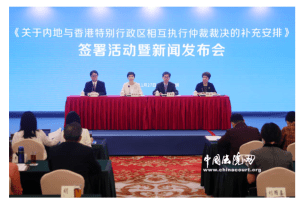
SPC Press conference following the Supplemental Arrangement signing, Judge Si 2nd from left

On 27 November, the Supreme People’s Court and the Hong Kong SAR Government held a ceremony in Shenzhen at which the two sides signed the Supplemental Arrangement Concerning Mutual Enforcement of Arbitral Awards between the Mainland and the Hong Kong Special Administrative Region” (the Supplemental Arrangement (关于内地与香港特别行政区相互执行仲裁裁决的补充安排). It supplements the original Arrangement Concerning Mutual Enforcement of Arbitral Awards between the Mainland and the HKSAR which was signed on 21 June 1999 and came into effect on 1 February 2000 (1999 Arrangement). The SPC also issued 10 related typical cases (典型案例) in both Chinese and English versions, the first time the SPC has done so for an arrangement.

SPC arrangements with the Hong Kong SAR are considered  judicial assistance documents.  As Hong Kong is part of China (one country-two systems),  the view is that judicial assistance between the Mainland and Hong Kong can be broader and closer (and so differs from international judicial assistance).

After the Supplemental Arrangement becomes fully effective, it will ease the implementation of a number of arbitration-related matters between the Hong Kong SAR and the (mainland) Chinese courts.  Herbert Smith Freehills and other law firms and barristers’ chambers) have published insightful summaries of the Supplemental Arrangement. 

This blogpost discusses some issues related to SPC arrangements (with the Hong Kong and Macao SARs), drawing on the remarks made by Judge Si Yanli, one of the deputy heads of the SPC’s Research Office at the press conference following the ceremony.  The Research Office is a unique institution of the SPC.  It does not directly hear cases, but is often involved in a broad range of issues.  A 1995 SPC document describes it as a  “comprehensive operational department.”

Judge Si is responsible for handling Hong Kong and Macau related matters , who would have headed the team negotiating with the HKSAR Department of Justice on these arrangement Judge Si is well-known to the Hong Kong international arbitration community.  She has spoken at Hong Kong Arbitration Week events in recent years, impressing all who have heard her speak with her insightful presentations.

Legal Framework for Arrangements

The legal framework for this arrangement, and the other previous ones concluded between the two jurisdictions is Article 95 of the Hong Kong Basic Law:

Article 95
The Hong Kong Special Administrative Region may, through consultations and in accordance with law, maintain juridical relations with the judicial organs of other parts of the country, and they may render assistance to each other.

Fitting Arrangements into the Chinese legal landscape

A single sentence in Judge Si’s press conference called attention to a procedure that is rarely discussed, at least in English–fitting arrangements into the Chinese legal landscape.  Judge Si mentioned that for the Supplementary Arrangement to be effectively implemented on the mainland, it must be transformed into a judicial interpretation. Although Judge Si did not set out the reasons that the SPC does so, it is understood that if implemented in this way,  judges in local Chinese courts who need to implement an arrangement can issue rulings or judgments  that cite the relevant provisions of an arrangement that have been transformed into a judicial interpretation.  

The effective implementation of the Supplementary Arrangement in the Mainland needs to be transformed into judicial interpretation, and for its effective implementation in Hong Kong, it needs to be transformed into local legislation. In the Mainland, on November 9, the 1815th meeting of the judicial committee of the SPC passed the “Supplementary Arrangement” and agreed to transform it into a judicial interpretation;补充安排》在内地的生效实施需要转化为司法解释,在香港的生效实施需要转化为本地立法。在内地,11月9日,最高人民法院审判委员第1815次会议已审议通过《补充安排》,并同意将其转化为司法解释;

Drafting 

The drafting of the Supplemental Arrangement involved input from relevant authorities, among them the Legislative Affairs Commission (LAC) of the National People’s Congress.  That is clear from this statement in Judge Si’s press conference. 

The successful signing of the “Supplementary Arrangement” is due to  the strong guidance of the Legislative Affairs Commission, of the Standing Committee of the National People’s Congress, the Hong Kong Basic Law Committee, the Hong Kong and Macao Affairs Office of the State Council and other relevant central authorities, as well as the strong support of the judicial and legal circles in the two places.《补充安排》的成功签署离不开全国人大常委会法制工作委员会、香港基本法委员会,国务院港澳事务办公室等中央有关部门的大力指导以及两地司法法律界的有力支持.

Soliciting views from relevant authorities is usual practice when the SPC drafts judicial interpretations. In this way the judicial interpretation that the SPC issues draws on specialist knowledge in the relevant authorities and enables the judicial interpretation to reflect a harmonized approach.  As to the importance of the SPC consulting the LAC of the National People’s Congress, that institution will review the final version of a judicial interpretation after the judicial committee of the SPC approves it and files it with the Standing Committee of the National People’s Congress. Again, it enables the judicial interpretation to reflect an approach harmonized between the SPC and the LAC.

Further thoughts

As the Chinese court system evolves to become increasingly integrated with international treaties and conventions, we are likely to see aspects of international conventions or bilateral judicial cooperation documents converted into or implemented through judicial interpretations, and the strong guidance of the LAC, the Ministry of Foreign Affairs, and other relevant central authorities making it possible.