
Benchbooks (Judicial Handbooks) for the New Era

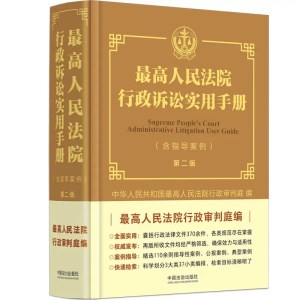
A recent message in the WeChat public account of the Supreme People’s Court (SPC)’s Administrative Division was devoted to promoting its new book,  Supreme People’s Court Administrative Litigation User’s Guide (Administrative Litigation User’s Guide (2nd edition), 最高人民法院行政诉讼实用手册), shown in the photo above.   Had the SPC’s #4 Civil Division had a WeChat public account last year when they published 涉外涉港澳台民商事审判业务手册( Foreign-Related, Hong Kong, Macao and Taiwan Related Commercial Trial Work Guide — “Foreign-Related Judicial Handbook”), I am sure that I would have received a similar message.  I had previously thought that judicial handbooks were a historical artifact of the days before electronic databases.   In my 1993 article, I discussed the phenomenon of judicial handbooks:

..A …problem is presented when the lack of consistency in issuance and authority makes it difficult for the lower courts to know when an interpretation is no longer valid…The [SPC] tries to cure these problems by issuing handbooks for adjudication in various subject areas….The Research Office and other divisions of the Court compile adjudication handbooks such as Sifa Shouce [司法手册] (Judicial Handbook), many of which are internal publications.

Some of those historical handbooks can be found in my research library of Supreme People’s Court publications–see here and below:
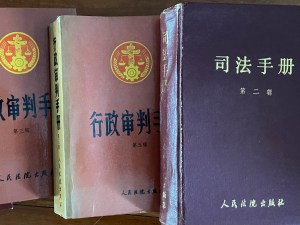
Two Administrative Litigation Judicial Handbooks and the second volume of the Judicial Handbook

Why would specific divisions of the SPC return to the practice of issuing judicial handbooks in printed form?  How does it link with the role of the SPC? What sources have the editors included, and what could students, scholars, and practitioners learn from that?

Official reasons for publishing these print books

The authors of the  Administrative Litigation User’s Guide describe the reasons for publishing the book as follows:

the Supreme People’s Court, on the one hand, provides professional guidance (业务指导) by formulating judicial policies 司法政策), issuing guiding cases, and making judicial replies (司法答复); on the other hand, it strengthens research and collects problems, and formulates judicial interpretations based on the accumulation and maturity of judicial practice. At present, the comprehensive judicial interpretation of the Administrative Litigation Law, the judicial interpretation of administrative agreements, and the judicial interpretation of the appearance of administrative agency heads in court to respond to lawsuits have been formulated and issued…, and there are more and more normative documents and guiding cases related to administrative litigation. In addition, with the increase in the number of administrative cases, more judges have joined the administrative trial team. In the process of gradually becoming familiar with administrative litigation, they urgently need to master the  relevant provisions that have been issued and learn the relevant guiding cases. However, judicial replies are internal in nature, with a large volume and lack of a unified release mechanism. The channels for obtaining them from the outside world are limited, which is time-consuming and laborious.

According to the announcement, the audience for the Administrative Litigation User’s Guide is staff in administrative agencies, judicial practitioners, and researchers of administrative law [students and academics].  The editors note that to provide readers with reference materials and to make the book more practical, they have included guiding cases, SPC Gazette Cases, and typical cases from the last 10 years.

The #4 Civil Division authors/editors say their handbook is urgently needed by front-line judges and as a reference book for judges, arbitrators, lawyers, and other practitioners, and, I would add, to students and scholars seeking to decode the foreign-related and Hong Kong, Macau, and Taiwan-related operations of China’s judiciary.

Legal basis for publishing these books

Publishing these books is linked to Article 10 of the Organic Law of the People’s Courts and related documents, which authorize the SPC to supervise and guide(监督指导) the lower courts.

Comments on the content

Both books contain judicial interpretations and a range of SPC guidance documents such as meeting minutes/conference summaries (会议纪要), notices, and replies to requests for instructions, signaling to the reader that they are important sources of reference for judges and that “soft law” may understate the way that meeting minutes are understood within the Chinese court system.

The authors/editors of the Foreign-Related Handbook included many other types of legal provisions they considered relevant for hearing cross-border cases, such as relevant national legislation, administrative regulations, such as foreign exchange regulations, Chinese versions of international commercial rules (Incoterms, ICC Uniform Rules for Demand Guarantees (URDG 758), ISP 98) ), Hague Conventions to which China has acceeded,  and civil judicial assistance treaties, as well as some of the National People’s Congress Standing Committee decisions related to some of the international conventions.  The #4 Civil Division did not include guiding, typical cases, and other types of cases it issues for reference.  In my view, it was a practical decision that does not imply that those types of cases are irrelevant to judges hearing cross-border commercial cases, but rather that including cases would make the book too long to be published as a single volume.

Comment

The underlying rationale for publishing these judicial handbooks has not changed much in the past 30 years.  Judges responsible for processing cases efficiently and correctly face similar challenges:  sorting out the current legal position on an issue quickly despite the piecemeal way that the SPC develops the law, locating and assessing the validity of historical documents, easily identifying special arrangements, and for cross-border cases, understanding how to correctly implement international conventions, treaties and practices and correspondingly arrangements or related provisions concerning cases involving Hong Kong, Macau and Taiwan parties.

One experienced senior judge in a local court noted that judges are often asked to rotate among divisions (tribunals) periodically.  Senior judges recommend that new joiners read these handbooks to familiarize themselves quickly with a different (and complicated) area of law.
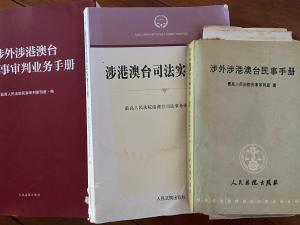
From the left, the 2024 Foreign-Related Handbook, a 2013 Hong Kong, Macau, Taiwan Related Judicial Handbook, and the 1992 Foreign, Hong Kong, Taiwan-Related Civil Matters predecessor volume


 The Supreme People’s Court and the 2025 plan for Promoting the Building of a Powerful Intellectual Property Nation

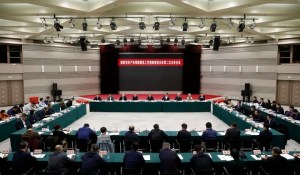
Meeting of the Inter-Ministerial Joint Committee at which the Plan was approved

On 7 May 2025, the  Office of the Inter-Ministerial Joint Conference for the Building of a Powerful Intellectual Property Nation ( Inter-Ministerial IP Office) issued this year’s plan (Chinese /English) for promoting the building of a powerful intellectual property nation. (Many thanks to Adam Wininger and his colleagues affiliated with the China IP Law blog for the English translation of the plan itself.) The Inter-Ministerial IP Office circulated the plan with the following notice:

Notice of the Office of the Inter-Ministerial Joint Conference for the Building of a Powerful Intellectual Property Nationon the Issuance of the 2025 Plan for Promoting the Building of a Powerful Intellectual Property Nation
(National Intellectual Property Joint Office [2025] No. 5)

To all member units of the Inter-Ministerial Joint Conference for the Building of a Powerful Intellectual Property Nation, the Central Political and Legal Affairs Commission, the Cyberspace Administration of China, the State Administration of Taxation, the Financial Regulatory Administration, the China Securities Regulatory Commission, the National International Development Cooperation Agency, the State Administration of State Administration of State Administration of Traditional Chinese Medicine, the National Medical Products Administration, the China Association for Science and Technology, and the National Natural Science Foundation of China:
With the approval of the Inter-Ministerial Joint Conference on Building a Powerful Intellectual Property Nation, the ” 2025 Intellectual Property Rights Promotion Plan ” is now issued. Please organize its implementation conscientiously.

Office of the Inter-Ministerial Joint Conference on Building an a Powerful Intellectual Property Nation
April 29, 2025

The issuance of this plan gives me an opportunity to revisit one aspect of formal interactions between the Supreme People’s Court (SPC) and other institutions that I discussed in this blog post in 2021–inter-ministerial joint conferences.  As I mentioned in the post, the intellectual property inter-ministerial joint conference system is quite transparent.  In contrast to other inter-ministerial joint conferences, it has its own website.  This brief post will highlight a few recent developments before analyzing what the plan means for the SPC.

Development #1–Since 2021, the membership of the joint conference has expanded and its name has changed, linked with the issuance of the Outline for Building a Powerful Intellectual Property Nation (2021-2035).  The Party Center and State Council approved the expansion of the joint conference to 29 members.  Previously, the State Council had approved the expansion of joint conference members.  Perhaps the Party Center (党中央) and State Council approved the notice together because several Party institutions are involved.  This notice on the establishment of the expanded joint conference is likely derived from the official approval, specifying that the joint conference’s responsibilities are to :

coordinate the national efforts to build a strong country in intellectual property rights, and organize the implementation of the strategy of building a strong country in intellectual property rights. Strengthen macro-guidance on the work of building a strong country in intellectual property rights; study major policies and guidelines for strengthening the building of a strong country in intellectual property rights, and formulate an annual promotion plan for the building of a strong country in intellectual property rights; guide, supervise, and inspect the implementation of relevant policies and measures, monitor and evaluate the effectiveness of work; coordinate and resolve major issues in the building of a strong country in intellectual property rights; and complete other matters assigned by the CPC Central Committee and the State Council.

The SPC is a member of the joint conference, which is convened by the head of the National Intellectual Property Administration and the person in charge of copyright work at the Central Propaganda (Publicity) Department. The approval provides that the joint conference has an office located in the National Intellectual Property Administration to administer the work of the Joint Conference.  The head of the National Intellectual Property Administration directs the office, with two deputies, one from that administration and the other from the Central Publicity Department.   Justice Tao Kaiyuan is the designated liaison person from the SPC.   My understanding is that normal liaison work occurs at the staff level, with some staff members of the SPC’s #3 Civil Division meeting with their counterparts at other member institutions to coordinate and promote policies as well as to establish related mechanisms, subject to relevant leadership approval. The plan provides insights into near-term developments in intellectual property law.

Implications for the SPC

The plan allocates 13 specific tasks to the SPC, among which are:

9. Promote the revision of relevant judicial interpretations of the Trademark Law and Copyright Law. (Supreme People’s Court is responsible);…

23. Explore and improve the intellectual property protection rules for new fields and new formats such as big data, artificial intelligence, and blockchain. Improve the intellectual property protection rules in the Internet field. (The Central Propaganda Department, the Central Cyberspace Affairs Commission, the Supreme People’s Court, the Ministry of Industry and Information Technology, the State Administration for Market Regulation, and the National Intellectual Property Administration are responsible for their respective duties)
24. Accelerate the improvement of judicial judgment rules for intellectual property rights in new technologies, new fields, and new formats, and judgment rules for e-commerce platform competition cases, and explore judicial rules for big data competition protection. (Supreme People’s Court is responsible)…

II. Strengthen intellectual property protection
(I) Strengthen judicial protection of intellectual property
30. Issue the “Opinions of the Supreme People’s Court on Serving and Safeguarding Scientific and Technological Innovation with High-quality Trials” and publish typical cases. (The Supreme People’s Court is responsible) [mentioned in this post]
31. Improve the national level intellectual property case appeal mechanism and strengthen the construction of a professional trial system. (The Supreme People’s Court is responsible)
32. Adhere to strict protection, improve and fully implement the punitive compensation system for infringement. Strengthen the overall coordination of batch litigation and increase the crackdown on manufacturers and other sources of infringement. (The Supreme People’s Court is responsible)
33. Formulate the “Interpretation on Several Issues Concerning the Application of Laws in Handling Criminal Cases of Intellectual Property Rights Infringement”. (The Supreme People’s Court and the Supreme People’s Procuratorate are responsible)….

I understand this document to have multiple implications for the SPC.  First, the matters for which the SPC listed are targets that the SPC has agreed with the other constituent institutions, after inter-institutional discussions and coordination at a staff level and related approval within the SPC.  Second, I surmise that the targets are binding on the SPC through inter-institutional agreement, as reported here.  Therefore, the ones that are listed in this document are on the work plan of the SPC for this year and will involve multiple institutions within the SPC.   Third, it can be seen that for some matters, the SPC is solely responsible, while for others, the SPC works with the SPP or multiple institutions.  Third, it is likely that the SPC will be involved in other matters in which the SPC is not listed as a responsible institution. One of many examples is item 45, “continue to strengthen the protection of seed industry intellectual property rights,” for which the Ministry of Agriculture and Rural Affairs is responsible. As I wrote in a recent post, the SPC has a memorandum of understanding with that ministry to improve the protection of seed intellectual property rights.  Finally, this document provides insights into the complex and poorly understood topic of inter-institutional arrangements in China, their operation, and the role of the SPC in them.  As the introductory notice flags, multiple non-members of the inter-ministerial joint committee are notified so that their work can be harmonized with this plan.

_______________________________________________

Many thanks to a knowledgeable person for his comments on an earlier draft of this post.