
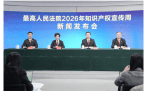
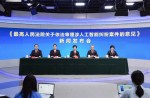
In an historic first, the Supreme People’s Court’s (SPC) initial policy document devoted to adjudicating AI-related disputes, entitled Opinions on Adjudicating Disputes Involving Artificial Intelligence in Accordance with the Law (最高人民法院关于依法审理涉人工智能纠纷案件的意见), has become the focus of international attention. (See Jeremy Daum’s summary here). At a press conference held during the 2026 Intellectual Property Week (on April 20, pictured), the SPC’s leading intellectual property judges revealed that the institution was drafting an artificial intelligence policy document (意见) (“The Supreme People’s Court is currently focusing on drafting opinions concerning properly handling disputes involving artificial intelligence in accordance with the law, striving to promote the healthy and orderly development of artificial intelligence in a beneficial, safe, and fair direction” 最高人民法院正在抓紧起草关于依法妥善审理涉人工智能纠纷案件的意见,努力推动人工智能朝着有益、安全、公平的方向健康有序发展). For those not familiar with the taxonomy of SPC documents, “opinions” (意见) are generally a type of policy document, as I further discussed here. The “backstory” to the AI Policy Document, that is why and how it was drafted, is typical of other SPC policy documents about which I have written, but is not well known and provides insights into the operation of the SPC.
Impetus for the AI Policy
There were both political and practical reasons for drafting the AI Policy document. The political reasons are anchored by guidance from Xi Jinping.
“The more rapidly artificial intelligence technology develops, the more correctly we must anchor it in the direction of being positive, benevolent, and beneficial to mankind; the more precisely we must grasp the scale of supervision and governance; and the more promptly we must improve measures to prevent it from getting out of control.” General Secretary Xi Jinping
The political imperative for the drafting of the AI Policy Document includes the quotation above, other guidance by Xi, and the importance placed by the Party Center on the healthy development of artificial intelligence. Accordingly, . Accordingly, the Outline of the 15th Five-Year Plan (国民经济和社会发展第十五个五年规划纲要) states that it is necessary to “improve the laws, regulations, policies, application standards, and ethical guidelines in the field of artificial intelligence.”
The practical imperative was the increasing number of cases involving the use of artificial intelligence and the need to provide consistent guidance, in the absence of comprehensive legislation on artificial intelligence.
SPC’s Drafting Group
The decision to draft the AI Policy Document, as I wrote previously, would have been based on the following analysis: “if the impact [of a new strategy or initiative] is broad-ranging and significant enough, SPC leaders might take the view that it is appropriate to issue a policy document (about which more is said below), to clarify related new policies and provide various types of guidance and information.” As for why the SPC leaders did not recommend the drafting of a judicial interpretation (司法解释), as I have previously commented, those documents are intended to remain in place for an extended period, and therefore the process of drafting them is often slow. Therefore, a policy document (意见) was deemed more appropriate.
The SPC established a drafting group for the AI Policy Document in 2025, led by several senior staff in the SPC’s Research Office, with a major contribution from the #3 Civil Division, which focuses on intellectual property. The Research Office led the drafting because the issues addressed in the AI Policy Document are broader than intellectual property. The identity of the leaders of the drafting group can be surmised from the participants in the press conference releasing the AI Policy Document (in the photo above) as well as the named authors of the “understanding and application” article. This practice is consistent with the drafting of other policy documents that involved multiple institutions within the SPC, as mentioned earlier. Their approach is typical of the drafting process for policy documents that I have described elsewhere.
The drafters first engaged in desk research and then sought views from local courts, relevant government institutions, industry, and selected experts and scholars, but not the general public, as is consistent with my earlier detailed description. One of the articles in SPC official media provided the following details:
Building on a review of policy documents (涉人工智能政策文件) and laws and regulations related to artificial intelligence, the group conducted systematic and in-depth research on key and difficult issues related to artificial intelligence in judicial practice. The group systematically reviewed frequently asked questions about artificial intelligence on the Court Answers Platform (法答网), as well as the judgment rules of relevant cases in the People’s Court Case Database(人民法院案例库. The group also tracked and analyzed foreign legislation and judicial practices related to artificial intelligence and widely and fully solicited opinions from local courts, industry representatives, experts and scholars, and relevant government departments.
Inter-ministerial Joint Conference on Building a Powerful Nation of Intellectual Property Rights and AI
The drafting of the AI Policy Document was likely coordinated with certain members of the Inter-ministerial Joint Conference on Building a Powerful Nation of Intellectual Property Rights. The 2026 and 2025 Plans for Promoting the Building of a Powerful Intellectual Property Nation, which are usually issued during China’s IP Week, contain nearly identical language relating to AI:
2026: 19. Explore and refine intellectual property protection rules for new fields and business formats—such as big data, artificial intelligence, and blockchain—and improve rules regarding open-source intellectual property. The Central Propaganda Department, the Central Cyberspace Affairs Commission, the Supreme People’s Court, the Ministry of Industry and Information Technology, the State Administration for Market Regulation, and the National Intellectual Property Administration are responsible for their respective duties.
2025: 23. Explore and improve the intellectual property protection rules for new fields and new formats such as big data, artificial intelligence, and blockchain. Improve the intellectual property protection rules in the Internet field. (The Central Propaganda Department, the Central Cyberspace Affairs Commission, the Supreme People’s Court, the Ministry of Industry and Information Technology, the State Administration for Market Regulation, and the National Intellectual Property Administration are responsible for their respective duties)
As I wrote over a year ago, the Inter-ministerial Joint Conference on Building a Powerful Intellectual Property Rights Nation (Inter-ministerial Joint IP Conference), of which the SPC is a member, coordinates national efforts to build a strong country in intellectual property rights and organizes the implementation of the strategy of building a strong country in intellectual property rights.
The quotations above are from the annual plan for building a powerful nation in intellectual property rights that the Inter-ministerial Joint IP Conference formulates. Those annual plans contain targets that the SPC has agreed with the other constituent institutions, after inter-institutional discussions and coordination at a staff level and related approval within the SPC. The SPC is committed to those targets through inter-institutional agreement, as reported here.
So it seems likely that the other member institutions of the Inter-ministerial Joint IP Conference had been informed that the SPC was drafting the AI Policy document and that the relevant departments that the SPC consulted included the Central Propaganda [Publicity] Department (中央宣传部), the Central Cyberspace Commission, the Ministry of Industry and Information Technology, the State Administration for Market Regulation, and the National Intellectual Property Administration. I surmise that the SPC also consulted with the Legislative Affairs Commission of the National People’s Congress, to ensure that the institutions shared common views.
Review and Approval of the AI Policy Document
After repeated revisions, the draft of the AI Policy Document was submitted to the SPC judicial committee (审判委员会 adjudication committee) for review and approval, leaving aside certain issues on which internal consensus had not been reached, including the copyrightability of AI-generated content and the fair use of training data.
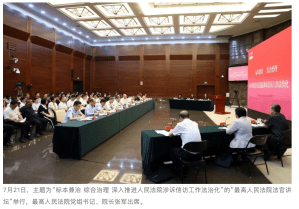
While some policy documents are approved by the SPC’s Party Group, others are approved by the judicial committee. As this policy document focuses on substantive legal issues rather than broader policy, the decision was presumably taken to route approval to the judicial committee. As I have written previously, the usual practice is that an accompanying background paper/explanation (说明) is submitted, to enable committee members to understand the implications of each provision from a policy (political) and legal viewpoint. It can be surmised from an official article that the judicial committee approved the document in principle but required the drafters to address certain issues, such as the protection of the personal rights of the deceased and the punishment of crimes committed using artificial intelligence. The latter provision does not create a new crime but refers to situations in which existing legislation permits such punishment. The final version addressed those issues and left open room for additional guidance through the People’s Court Case Database and the Court Answers Platform. As I have previously written, official SPC policy is for those to provide an integrated guidance product.
Timing of the Release of the AI Policy Document
Although none of the official commentary so said, I surmise that the release of the AI Policy Document on 7 September 2026 was intended to coordinate with General Secretary Xi Jinping’s official visit to the United States, where one of the topics under discussion was the regulation of artificial intelligence.
_______________________________________________
Many thanks to a highly knowledgeable person for his comments on an earlier draft of this post.


You must be logged in to post a comment.