
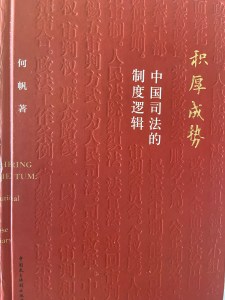
 For those researching the Supreme People’s Court (SPC) and able to read Chinese, Judge He Fan’s 2023 book (pictured above) 积厚成势——中国司法的制度逻辑 (“Accumulating Strength: The Institutional Logic of Chinese Judiciary”) provides insights available nowhere else, or at least nowhere accessible to most of us outside of the System. The book, which focuses on the courts (小司法) has a unique background and the writing is unusual for an academic book, for reasons with special characteristics. For those interested in the perspective of domestic reviewers, please see here and here.
Judge He’s Tsinghua Class
The book, which focuses on the court system and judges, draws on the lectures Judge He gave when he taught the class “Chinese Judicial System and Judicial Reform” at Tsinghua University, from the fall of 2014 until the pandemic. His class had an ever-expanding number of students, although he taught it according to a schedule that fit his work schedule– eight four-hour-long sessions over one semester.
The book is divided into twelve lectures, plus an introduction and an afterword. The afterward provides glimpses of some of the personalities involved in judicial reform. Most of the book focuses on the court system.
- Lecture 1: How the People’s Court System was formed (pre-Cultural Revolution;
- Lecture 2: Judicial Reform (Part 1): Force of the times and historical stages
- Lecture 3: Judicial Reform (Part 2) Political Logic and Decision-Making Mechanism;
- Lecture 4: People’s Courts in the Political-Legal System
- Lecture 5: State Organs of Power and the People’s Courts
- Lecture 6: Judicial Hierarchy and the Four Levels Two-Instance System
- Lecture 7: Specialized Courts and Specialized Tribunals
- Lecture 8: Trial Organization (1): sole judge, collegial panels, and (state) compensation committees
- Lecture 9: Trial Organization (2) Judicial (Adjudication) Committees
- Lecture 10: Judicial power operation mechanism and the judicial accountability (responsibility) system
- Lecture 11: Judges System (1): Judges Law and the Quota Judge System
- Lecture 12: Judges System (2): Selection of Judges and Career Progression
Selected New Insights
Judge He’s book provides many details that may change what most people outside of China understand about the operation of the SPC and its interactions with other institutions. The apparently minor details also provide insights to those wanting to decode how the System works.
On the operation of the SPC, for example, Judge He provides a detailed backstory to the Second Five-Year Judicial Reform Plan Outline, describing the interactions between the SPC and the Party hierarchy. He states that from 2003, reform measures could no longer be determined by the courts (i.e. the SPC) or the procuratorate (i.e., the SPP) themselves. Having established that point, he describes the major steps leading to the approval of the Second Five-Year Judicial Reform Plan Outline.
The framework approval was linked to an April, 2003 request for instructions from the Central Political-Legal Committee to the Party Center concerning the promotion of judicial reform. The following month, the Politburo decided to establish a central-level judicial reform leading small group (中央司法体制改革领导小组) to lead judicial reform measures, following which the SPC established the Judicial Reform Research Leading Small Group, headed by SPC President Xiao Yang. Confirming the facts in my earlier blogpost, that leading small group was later renamed the Judicial Reform Leading Small Group. In July, 2004, the Judicial Reform Research Leading Small Group (with SPC Party Group approval) submitted a proposal for judicial reform along with an implementing plan to the central judicial reform leading small group, for the first time, systematically describing their proposed reforms. Those reforms were partially, but not entirely adopted because there was no consensus about some of them, plus a significant number touched on personnel (组织 organization) and administrative matters, but the related analysis was useful for later reforms. Issues included: SPC regional branches; promoting death penalty approval; differentiated trial levels; retrial litigation procedures; enforcement structural reforms; labor reeducation; specialized courts; cadre administration; and funding reforms.
At the end of 2004, the Party Center issued its approval of the central judicial reform leading group’s policy document on judicial reform, setting out 35 reform matters, on which basis the SPC issued the Second Five-Year Judicial Reform Plan. The approval document issued by the Party Center had only some overlap with the SPC’s original proposal. Judge He’s descriptions of the drafting of the Third, Fourth, and Fifth Five-Year Judicial Reform plans lack such details. It could be surmised that the SPC’s Judicial Reform Office (linked to the leading small grouop) coordinated ahead of time with the Central Political-Legal Committee to ensure that such mismatches did not occur, but at any rate, those details remain confidential.
Why No Clear Argument?
The casual reader might be mystified as to why Judge He does not set out a clear argument about the institutional logic of China’s judicial system. It contrasts with the writings of Judge Richard Posner, some of whose books Judge He has translated into Chinese. However, Judge Posner wrote his books when working in a very different system, which does not have such strict demands on writings by judges. I recall seeing relevant regulations that detail these requirements, but they escaped me when writing this post.
 Supreme People's Court Monitor
You must be logged in to post a comment.