This post highlights judicial interpretations, policy documents, and guiding or typical cases issued since the middle of September (2025).
Judicial interpretations and policy or other judicial documents
For an explanation of judicial interpretations, see this post; for an explanation of policy documents, see theseposts or my 2024 article.
Title
Type
Analysis
Supreme People’s Court Interpretation on Some Issues Related to the Application of the PRC Company Law《最高人民法院关于适用〈中华人民共和国公司法〉若干问题的解释(征求意见稿)》, issued evening of 30 September, open for comment until 20 October
Judicial interpretation (draft)
Draft interpretation has 90 articles, not yet aware of translation or analysis in English. SPC has “already engaged in extensive preliminary research and preliminary consultation with experts, scholars, and relevant departments.” Provisions include ones related to liquidation and dissolution of companies; disregarding legal personality of related companies; 10 draft provisions related to listed companies, including VAM agreements. This article comments on the General Provisions, more to come.
Opinions On Promoting the High-Quality Development of the International Commercial Court
and Serving and Ensuring High-Level Opening Up, Issued 25 September (关于推进国际商事法庭高质量发展
服务保障高水平对外开放的意见) link is to text & press release
Policy document
Also known as a “judicial document” ( 司法文件) or “judicial normative
document” (司法规范性文件), “judicial
policy document” or “judicial regulatory documents” 司法政策性文件).
Not yet aware of analysis in English, see quasi-official analysis on the WeChat public account of the SPC’s #4 Civil Division. My own analysis is forthcoming. Provisions include promoting the use of international commercial courts; standardizing translations; further provisions on parallel proceedings; etc. China Daily report here
Notice on Issuing Matters Concerning the Jurisdiction of First-Instance Civil and Administrative Intellectual Property Cases by Basic-Level People’s Courts 最高人民法院
关于印发基层人民法院管辖第一审知识产权民事、行政案件有关事项的通知In effect from 1 October
Judicial normative document
Not yet aware of analysis in English; the notice designates courts to hear civil and administrative intellectual property cases in the first instance. Note that many courts have limited jurisdiction in civil cases, depending on the amount in dispute. This could be seen as an assessment of the quality of that court. Shanghai and Beijing courts do not have amount in dispute limitations
Title
Type
Analysis
Supreme People’s Court Interpretation on Some Issues Related to the Application of the PRC Company Law《最高人民法院关于适用〈中华人民共和国公司法〉若干问题的解释(征求意见稿)》, issued evening of 30 September, open for comment until 20 October
Judicial interpretation (draft)
Draft interpretation has 90 articles, not yet aware of translation or analysis in English. SPC has “already engaged in extensive preliminary research and preliminary consultation with experts, scholars, and relevant departments.” Provisions include ones related to liquidation and dissolution of companies; disregarding legal personality of related companies; 10 draft provisions related to listed companies, including VAM agreements
On Promoting the High-Quality Development of the International Commercial Court
Opinions on Serving and Ensuring High-Level Opening UpIssued 25 September (关于推进国际商事法庭高质量发展
服务保障高水平对外开放的意见) link is to text & press release
Policy document
Also known as a “judicial document” ( 司法文件) or “judicial normative
document” (司法规范性文件), “judicial
policy document” or “judicial regulatory documents” 司法政策性文件).
Not yet aware of analysis in English, see quasi-official analysis on the WeChat public account of the SPC’s #4 Civil Division. My own analysis is forthcoming. Provisions include promoting the use of international commercial courts; standardizing translations; further provisions on parallel proceedings; etc. China Daily report here
Notice on Issuing Matters Concerning the Jurisdiction of First-Instance Civil and Administrative Intellectual Property Cases by Basic-Level People’s Courts 最高人民法院
关于印发基层人民法院管辖第一审知识产权民事、行政案件有关事项的通知In effect from 1 October
Judicial normative document
Not yet aware of analysis in English; the notice designates courts to hear civil and administrative intellectual property cases in the first instance
2. Typical (典型 example, exemplary, model) cases
For an explanation of typical (model, exemplary, example) cases, seetheseposts.
Title
Type
Analysis
Ninth Batch of Cases on the Construction of People’s Tribunals in the New Era (2)新时代人民法庭建设案例(九)
Typical cases
Subtitle is “Building Fengqiao-style People’s Courts and Strengthening the Guidance of Professional and Industry-Specific Mediation Functions”—related to resolving enterprise-related and labor-related disputes [providing insights into SPC policies on the role of the local courts]
The Supreme People’s Court and the Ministry of Justice jointly issued typical cases on standardizing enterprise-related law enforcement, judicial administrative reconsideration, and administrative litigation最高人民法院、司法部联合发布规范涉企执法司法行政复议、行政诉讼典型案例
Typical cases
Cases have multiple targets: promoting the “Private Economy Promotion Law”, special actions to standardize administrative law enforcement and judicial work involving enterprises, administrative reconsideration and administrative litigation in serving high quality economic and social development
Fifth batch of typical cases involving the construction of the “Belt and Road”第五批涉“一带一路”建设典型案例
Typical cases
See my earlier comments on Belt & Road typical cases; SPC states its hope that the cases not only provide exemplary guidance for the Chinese courts, but also provide regulatory guidance for the joint construction of the Belt and Road Initiative with the wisdom of Chinese judicial practice, injecting new legal momentum into promoting a fairer, more open, and more inclusive new international economic order; my own commentary forthcoming
________________________________
I’m focusing on preparing a long article for publication and several other long writing projects, therefore this abbreviated post.
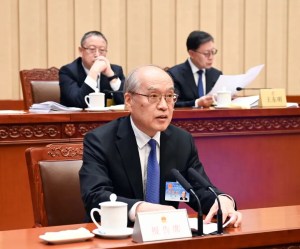
Zhang Jun delivering the specialized report
In November 2024, Supreme People’s Court (SPC) President Zhang Jun delivered a specialized report on the court system’s administrative litigation work (关于人民法院行政审判工作情况的报告) to the National People’s Congress Standing Committee (NPC Standing Committee). The report showcases the accomplishments of the courts in administrative litigation and related administrative dispute resolution over the past 10 years. This blog post provides a detailed summary of the most significant points of the specialized report. My comments are italicized for the most part.
Why this report?
As I wrote last year, I surmise that the NPC Standing Committee requested the SPC submit a specialized report on administrative litigation to promote (the Chinese phrase is “倒逼 “) significant changes to resolving administrative disputes, that is, disputes between individuals or enterprises and government agencies, by agreeing to report on administrative litigation. Administrative cases are more sensitive because as President Zhang Jun reported: “administrative cases are connected to administrative organs on one end and the people on the other, and are directly related to the people’s trust in the Party and the government and their confidence in the socialist rule of law.”
The introduction to the report captures the themes of administrative litigation work of the court system in this excerpt from one anodyne sentence:
New era administrative adjudication work…tried administrative cases impartially and promptly, resolved administrative disputes, supported administration according to law, protected the legitimate rights and interests of citizens, legal persons and other organizations, and supervised administrative organs in performing their duties in accordance with the law, making positive contributions to the integrated construction of a country ruled by law, a government ruled by law, and a society ruled by law.
This group of slogans (提法)signals themes seen in the rest of the report: courts do only part of their work through hearing cases; they are encouraged to resolve the substance of an administrative dispute; the judiciary supports and supervises administrative agencies; they protect the rights of individuals, legal persons and others; and these all actively contribute to the Party and state’s goal of a country governed by law, a government governed by law, and a society governed by law (为一体建设法治国家、法治政府、法治社会作出积极贡献).
Overview and drafting
The report covers all types of administrative cases the Chinese courts hear. Underlying this report are hundreds of hours of drafting, soliciting data and comments from related offices and institutions. The Administrative Division of the SPC took the lead in drafting the report and must have solicited contributions from the Intellectual Property Court (Tribunal), #3 Civil Division (intellectual property), and the Natural Resources and Environmental Division. Administrative divisions of Chinese courts, including the SPC, hear or consider a substantial portion of, but not all, administrative cases and matters. For intellectual property (including anti-monopoly) and environmental and natural resources cases or matters, the relevant specialized divisions of the SPC (and local counterparts) are responsible. The report incorporates the SPC’s response to a research report on administrative adjudication work prepared by the NPC Standing Committee’s Supervisory and Judicial Affairs Committee (as it would follow the requirements discussed in this earlier blog post). In a forthcoming article, I will have more to say about specialized reports as a form of NPC Standing Committee oversight.
Summary of the Report
The report’s structure is the usual one for specialized reports: highlights of the accomplishments of the Chinese courts in administrative cases since 2015, when the SPC last reported to the NPC Standing Committee on the hearing of administrative cases, followed by a summary of outstanding challenges and suggestions to the NPC Standing Committee for future work.
A single sentence in the introduction reveals information about the relationship between the Party leadership and the SPC in reporting to the NPC Standing Committee. “In April 2024, the Party Leadership Group of the Supreme People’s Court submitted a special written report to the Party Center for the first time on the administrative trial work of the people’s courts.” What this signals is that submitting a written report to the Party Center is now part of the SPC’s procedure in preparing such specialized reports but was not required in 2015, when the SPC last reported to the NPC Standing Committee on administrative litigation. It would have been part of the drafting process of the 2022 specialized report on foreign-related litigation work as well as the 2023 one on environmental and natural resources litigation work.
Similar to the foreign-related adjudication report, the introduction takes an inclusive view of accomplishments: judicial interpretations, policy documents, typical and guiding cases, as well as correctly deciding important cases. My summary has omitted most case summaries included in the report.
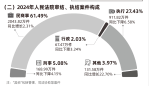
The first part of the report provides overall statistics. From 2016 to September 2024, people’s courts at all levels heard a total of 2.421 million first-instance administrative cases and handled 1.841 million administrative non-litigation enforcement cases (see below for an explanation of these cases) (so many more than foreign-related cases (384,000 from 2013-2022)). Administrative cases account for a small proportion of the cases in the Chinese courts. See this excerpt from this year’s SPC report to the NPC, showing that only 2% of the cases in the Chinese courts were administrative.
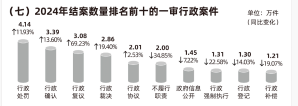
The causes of action that accounted for a relatively high proportion of the concluded first-instance cases were administrative penalties such as fines and administrative detention, administrative confirmation such as social security qualifications or work-related injury recognition, administrative rulings such as confirmation of natural resource ownership, and “non-performance of duties” such as requests for administrative agencies to perform their statutory duties. See this excerpt from the NPC report providing this information as a graph.
SPC Accomplishments
1. Serving the overall situation and promoting high-quality development with fair justice
This section first highlights improving the business environment. It reiterates one of the themes of the report: “we supervise and correct illegal administrative behaviors that infringe on the legitimate rights and interests of various business entities, and strongly support administrative agencies in performing their regulatory duties and maintaining market order according to law.” Accomplishments include:
issuing typical cases on unified market administrative litigation; hearing 316,000 first-instance administrative cases related to business, such as administrative licenses, administrative agreements, administrative promises, and administrative penalties with an average annual growth of 23.3%. The report does not explain the high growth rate.
serving the innovation-driven development strategy according to law (intellectual property and related issues). This section flags that the courts heard 138,000 first instance intellectual property administrative cases involving intellectual property rights with an average annual growth of 20.3%, also with no explanation. The remainder of this part flags the work of the SPC outside the courtroom (about which I am writing more):
regularly met with the Ministry of Agriculture and Rural Affairs to discuss the protection of seed industry intellectual property rights [and concluded a memorandum of understanding and held joint training, not mentioned];
regularly met with the National Anti-Monopoly Bureau, etc., to discuss prohibiting the abuse of intellectual property rights to exclude and restrict competition.
On administrative cases in specialized areas, such as environmental and natural resource protection and real estate expropriation cases: 118,000 first-instance environmental and natural resource administrative cases, with an average annual increase of 14.9%, also without explanation; 425,000 first-instance administrative cases involving house and land expropriation and demolition, with an average annual growth of 8.8%, also with no explanation as to reasons.
2. Justice for the people and safeguarding the well-being of the people with fair justice
This section focuses on cases related to people’s livelihood (“民生”). Again, it reiterates the themes of support vs. supervision and substantive resolution of administrative disputes to maintain social stability. Useful information in this section:
The number of first-instance administrative cases has increased by an average of 5.3% annually since 2016.
The SPC will improve its mechanisms for dealing with applications for the retrial of administrative cases, including pre-retrial resolution. It can be surmised that the number of applications for the retrial of administrative cases at the SPC is close to pre-Covid numbers, but statistics are not available. Jiangsu will pilot legal aid in administrative litigation. This signals the importance of legal advice for both efficient case resolution and better communication with litigants.
The SPC emphasizes that it supports administrative agencies in punishing illegal acts such as endangering food and drug safety, damaging the ecological environment, and withholding wages for migrant workers. It also signals that the courts will supervise those with the occasional [common?] problem of “heavy penalties for minor offenses” [likely linked to profit-making administration]. The SPC signals that those issues should be handled outside the courtroom, through outreach to law enforcement, to promote fairness and openness, commensurate penalties, and combining penalties with education.
On the substantive resolution of disputes, the report uses as an example a case handled by the SPC and later provides an example of an analogous case handled by the military courts. For the outside observer, the SPC case provides an example of the SPC’s unique role. The cases involved three brothers surnamed Sun who filed 137 administrative lawsuits and applications for retrials related to social insurance and were long-term petitioners. The original trial court dismissed the cases because the statute of limitations had expired. After review [it is not explained how their case came before the SPC], the SPC took the view that the brothers’ demands were basically reasonable and could be resolved according to the current social security system, although the ruling by the trial court was not wrong. The SPC notes that the dispute was unresolved and might even intensify. Therefore, mediation was organized together with the administrative authorities, and a package solution was reached. The case demonstrates the importance of substantive resolution of administrative disputes and for litigants, making a fuss to resolve a dispute.
As an example of developing the “Fengqiao Experience” in the new era, 1,966 administrative dispute resolution centers were established. (At least two have been established in Shenzhen, and I hope that they welcome foreign visitors.)
3. Organic Link Between Law Enforcement and the Judiciary
This section emphasizes that the courts have a statutory duty to supervise government action and that “supervision means support and support means supervision.” Examples of supervision include:
A limited number of cases (2664) in which courts engaged in an incidental review of normative documents. That is consistent with academic research.
2. Court supervision of administrative action by refusing to enforce certain non-litigation enforcement cases. As explained in this academic article, when administrative agencies apply to courts to enforce an agency decision when the persons involved do not voluntarily fulfil the obligations required, a court will review the legality of the administrative decision. The report states that 368,000 administrative non-litigation enforcement cases were handled by courts ruling either not to enforce or not to accept the enforcement case, accounting for 20% of the total number of administrative agencies’ applications for enforcement. This number is larger than what I have seen elsewhere.
3. The SPC, the Supreme People’s Procuratorate, and the Ministry of Justice established a “3+N” working mechanism with the National Development and Reform Commission, the Ministry of Finance, and the Ministry of Natural Resources. The goal of the mechanism to analyze and evolve measures to deal with frequently arising administrative disputes. [These disputes are presumably related to housing demolition].
4. Eight courts in Beijing have established an administrative law training base for officials using case-based law teaching. Courts in several provinces have established a regular consultation mechanism with administrative agencies.
5. The rate of administrative agency heads appearing in court to respond to lawsuits in the first instance has steadily increased year by year. For more on this system with Chinese characteristics, see theseacademic articles for more details.
6. As I wrote last year, the SPC works with the Ministry of Justice (and correspondingly, lower courts do the same with justice authorities) to encourage litigants to seek administrative reconsideration before going to court. 102,000 first-instance cases that have been reviewed after administrative reconsideration were heard. Last year the number of administrative reconsideration cases exceeded administrative litigation cases for the first time.
Administrative Litigation-Related Judicial Reform
This section, among other content, summarizes the administrative litigation reform measures the SPC has undertaken and the expansion of its “guidance toolbox” (监督指导的“工具箱”). I will have more to say about the SPC’s guidance toolbox in an article to be published later this spring.
The SPC has implemented the arrangements of the Party Center on jurisdiction in administrative cases and has established courts with cross-administrative jurisdiction, such as the Beijing No. 4 Intermediate People’s Court and the Shanghai No. 3 Intermediate People’s Court. See related academic research (but behind the paywall). The SPC issued procedures on simplified procedures, used in 149,000 first instance cases. The military courts have implemented administrative litigation–see this summary of the authorizing notice issued by the Central Military Commmission’s Political-Legal Commission. However, related information is scarce.
On trial supervision, 1.209 million administrative cases of second instance were heard in accordance with the law, with a retrial rate of 7.2%; 327,000 cases of various types of retrial applications were handled (unclear how many at the SPC), and 1,604 cases of protest by the procuratorate were heard.
I’m personally glad to see the SPC use the phrase “guidance toolbox,” as that is how I have visualized it. That toolbox includes the platforms Court Answers Platform and the People’s Court Case Library, as well as the more traditional guiding and typical cases.
President Zhang Jun thanked the NPC Standing Committee for supporting the administrative litigation work of the courts through promulgating legislation and authorizing pilot projects.
Challenges
Law-based governance needs to be improved. The large number of cases in some areas (unspecified) is not only linked to the interests of ordinary people but also reflects that the link between administrative enforcement and the judiciary needs to be improved. Some judges deal with cases mechanically and are not easily able to resolve administrative disputes from the source by communicating with administrative agencies on solutions to avoid future cases.
The courts need to improve joint efforts to resolve administrative disputes in substance. This is reflected in the high appeal rate and the high rate of application for retrial. However, some [unnamed] administrative agencies are unwilling to resolve administrative disputes on their own initiative or correct illegal administrative behavior and do not implement court decisions adequately or in a timely manner. Problems still remain with agency leaders appearing in court.
The smooth connection between pre-litigation mediation, administrative reconsideration, and the administrative litigation of administrative disputes is lacking.
Some disputes involve multiple regulators, and therefore, a plaintiff needs to sue each regulator separately rather than bringing a consolidated procedure.
Improvements Needed
Uphold Party leadership of the judiciary. This implies local people’s courts regularly reporting to local party committees, informing the government about administrative judicial work in their jurisdictions, closely relying on the leadership of the Party, and actively seeking government support to promote the resolution of complex contradictions and problems involved in administrative cases. Zhang Jun stated: we must look at these cases from a political perspective and handle them according to the rule of law, and act “if I were suing.”
Better serve the high-quality development of the economy and society. This means correcting agencies using administrative power to exclude and restrict market competition and to serve the strategy of constructing a unified national market. On the topic of profit-seeking administration, it calls for local courts to supervise the illegal use of administrative means to intervene in economic disputes and protect property rights and strengthen judicial supervision of administrative measures such as sealing, seizure, freezing, and administrative compulsory execution. This was mentioned just as “deep-sea fishing” by administrative agencies came to national attention. Finance, land, and employment administrative cases were highlighted.
The report reiterates the organic connection between administrative cases and other related procedures such as administrative reconsideration, procuratorate oversight of administrative matters, pre-litigation mediation of administrative disputes, and legalization of petition work. This includes: improving legal aid for administrative litigation (as mentioned above), requiring judges to clarify and guide litigants in administrative cases; implementing a pre-trial meeting system and other measures. This section stresses the role of mediation and emphasizes improving the reasoning of decisions. On the trial quality management indicator system, the SPC calls for implementing related trial management measures suitable for administrative cases and shifting the focus of trial work from “whether the case is closed” to “whether the dispute is resolved”. Any reader who has made it thus far in this summary would not be surprised.
On supervision and support, the SPC has several suggestions:
regarding areas where analogous cases frequently arise, create an analysis and notification system to report to the local Party Committee cases that administrative agencies lose and their implementation of effective judgments [presumably those that they lose]; report typical cases to administrative agencies, and strengthen coordination.
further promote the increase in the rate of administrative agency leaders appearing in court to respond to lawsuits, encourage administrative agency leaders to “appear in court and speak out.”
On future SPC administrative litigation judicial interpretations and policies, the report mentions the drafting of judicial interpretations and judicial policies such on housing expropriation and compensation on state-owned land; regulatory documents for the review of administrative documents in the course of administrative litigation, and joint trial of civil disputes, and other measures for unifying legal standards in similar cases. Another issue that the SPC is considering is identifying and regulating abusive administrative litigation, similar to other areas of the law.
Concluding Remarks
President Zhang Jun concludes by suggesting the reform of the jurisdiction system of administrative cases, in which intermediate courts hear major and complex cases; basic level courts hear simple cases through centralized jurisdiction (concentrating them in one basic level court); and the role of the mediation system in resolving administrative disputes is improved. He also suggests amending the Administrative Litigation Law to improve the linkage between administrative reconsideration and administrative litigation and improve alternative methods to resolve administrative disputes.
A Few Comments
This specialized report provides a useful glimpse into Chinese administrative dispute resolution in the New Era. For the outside observer, many elements of administrative justice/administrative dispute resolution with Chinese characteristics are visible. Among those, as stressed in the summary above, are the multiple mechanisms for supervising administrative agencies outside the courtroom and the growing importance of mediating administrative disputes.
_______________________________
Many thanks to Professor Chen Tianhao of the Tsinghua University School of Public Policy and Management for his comments on an earlier draft of this blogpost!
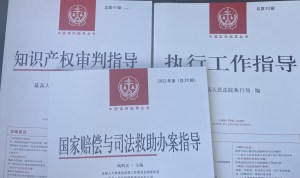
Late last year, some followers asked me to describe some of the principal sources for Supreme People’s Court’s (SPC) research. I’m doing this in several posts, as few (particularly outside of China) seem to be aware of the range of publicly available publications of the SPC and its many affiliated entities–see here and here for earlier posts. This post summarizes the journals (actually periodic publications–each has an ISBN number) edited and written (at least in part) by the trial divisions and other offices of the SPC. As far as I know, they are only in printed form, although sometimes some parts of the content can be found on WeChat. That means that those outside of China are rarely aware of their existence. I assume that they are available through Taobao or Jingdong.
The readers of these publications are judges and practitioners. The publications are specialized, in contrast to the Supreme People’s Court Gazette, and each one contains normative provisions and guidance related to the specific area of law.
A quick guide to the content listed: the judicial interpretations are normative, of course, and the “understanding and application” articles provide further explanation and background about judicial interpretations and sometimes policy documents. “Leaders’ speeches” are a statement of policy, substantive & political; relevant policy documents (such as the SPC/National Intellectual Property Administration policy document of February, 2023 contain policy and related political signals; the research & local documents are all related to current issues in the relevant area of law; and the typical cases/outstanding judgments provide guidance to judges & are useful reference materials for lawyers/in-house counsel because the results in the cases reflect the views of the Supreme People’s Court. The publications flag new issues facing the judiciary in the specialized area involved and sometimes include analysis of foreign laws or regulations or an account of a foreign court visit or symposium. Each journal has a slightly different format. It may be possible to find electronic compilations of these journals on WeChat.
These journals are mostly published by the People’s Court Press (人民法院出版社). Some journals have local correspondents reporting on local developments. It can be surmised from how frequently a journal is updated how useful the relevant SPC division sees it as a platform for guidance and publicity of their views. Cases from these journals can often be seen reposted on WeChat.
Title
Sponsoring Institution
Content
Photo/Other Comments
行政执法与行政审判 Administrative Law Enforcement and Administrative Adjudication
SPC’s Administrative Division
A section entitled: Authoritative viewpoint” (#96 contained Administrative Division Deputy Head Liang Fengyun on how to implement XJP Legal Thought in the courts’ administrative trial work); Research on Specialized topics; Theory & practice; Case analysis;
One of the six-in-one guidance mechanisms mentioned by the head of the SPC Administrative Division, Geng Baojian
执行工作指导 Guidance on Enforcement Work/ Guide to Enforcement
SPC’s Enforcement Bureau 最高人民法院执行居
The most recent edition is #84, published in July, 2024. Some issues contain discussion by enforcement bureau chiefs; hot topics; empirical study; report on pilot reform; analysis of SPC case; analysis of local court cases; resolving enforcement cases at source.
Volume #3 contains: SPC IP Court Annual Report 2021; judgment digests summary; typical cases; law & judicial interpretations; judicial scholarship; research report; window on the world; SPC IP Court 2021 Major Events
民事审判指导与参考 Reference and Guide to Civil Trial
SPC’s #1 Civil Division (w’ local correspondents)
Latest volume is from 2023: special section on people’s tribunal work; special section on resolving disputes at source (诉源治理); special section on family disputes trials; frontier theoretical issues; special section on dowry issues; typical cases on food safety punitive damages; special section on wage arrears; typical cases on agriculture; local case analysis; research report; #1 civil division judicial conferences
涉外商事海事审判指导 Guide on Foreign-Related Commercial and Maritime Trial
SPC’s #4 Civil Division
Last volume apparently published in 2020, but dated 2018; sections included leaders’ speeches; judicial documents; requests & responses (per Prior Approval system); case analysis; research report; new information
SPC’s Research Office, but appears not to have been updated for some time. Zhang Jun was listed as the editor in one of the early volumes
includes leaders’ speeches (policy & guidance); judicial exchanges/cooperation; theory & practice; cases; investigation & research
perhaps the office is focusing on other matters and this journal is therefore not a priority
环保资源审判指导 Guide on Environment and Resource Trial
SPC’s Environmental & Natural Resources Division
Seems to have been rarely updated, perhaps using reports or white papers to show their accomplishments
first volume published in 2015
商事审判指导 Guide on Commercial Trial
SPC’s #2 Civil Division
latest volume is #57, this has the index for #53 (2021)
perhaps the division is focusing on other methods to provide guidance
审判监督指导 Guide on Adjudication Supervision
SPC’s Adjudication Supervision Division
#71 published in April, 2024; special section on property-related issues (i.e. private business); outstanding judgments; case analysis; judges’ conference related issues; outstanding judgments; outstanding research reports
知识产权审判指导 Guide on Intellectual Property Trial
SPC’s #3 Civil Division (Intellectual Property)
Content of #41, 2023, published at the end of 2023: Trial Policy and Spirit: three speeches by SPC leaders (Tao Kaiyuan and Lin Guanghai): Judicial policy document: a joint document issued by the SPC and State Intellectual Property Administration, on strengthening coordination in intellectual property protection; Intellectual Property Week Specialized Issues; Local experience, with two local court guidelines on the application of punitive damages, and one on the hearing of intellectual property small claims; Research reports, all by local courts, one on the protection of new plant varieties, and the other two on competition law issues in the digital and network economy; Typical cases: republishing the third batch of intellectual property protection for new plant variety, and 2021-22 typical cases of mediation of intellectual property disputes;
中国少年司法 Chinese Juvenile Justice
SPC’s Office of Juvenile Tribunal Work 最高人民法院少年法庭工作办公室 (under the Research Office)
quarterly; #54, labelled #4 2022 published end 2023;leader’s speeches; judicial normative documents; local documents & work; selection of prize-winning essays from the 7th National Juvenile Justice Work Conference; typical cases; foreign experience
立案工作指导 Guide on Case Filing
SPC’s Case Filing Division (has local correspondents)
2014 volume includes leaders’ speeches; work situation; theory & practice (w’ local court experience); investigation & research (local court experience); experience exchange (also w’local court experience); jurisdiction; model case analysis; understanding and application of judicial interpretation; SPC judicial interpretations & normative documents
刑事审判参考 Reference to Criminal Trial
the SPC’s five criminal divisions, established in 1999
guidance cases (指导案例), not to be confused with guiding cases 指导性案例 that have been approved by the SPC’s judicial committee; legislation & judicial norms, including judicial interpretations;multi-institutional policy documents; difficult issues; frontier theoretical issues; experience exchange (local courts); outstanding judgments
some compilations of typical cases published can be found on Wechat; this journal mentioned on this blog here, here, and here
金融法治前沿 Frontier(s) of Financial Law
Collaboration between the courts and the regulators. The principal members of this collaboration are the SPC’s #2 Civil Division (which focuses on domestic commercial law issues), the legal department of the People’s Bank of China (人民银行条法司), the National Financial Regulatory Administration, related departments of the China Securities Regulatory Commission (CSRC), and the Shanghai, Beijing, and Chengdu-Chongqing Financial Courts. One of the related courts takes responsibility for editing each issue.
Guide on State Compensation & Judicial Assistance国家赔偿与司法求助办案指导
collaboration between the following institutions: NPC Legislative Affairs Commission State Law Office, SPC’s Compensation Committee Office; Supreme People’s Procuratorate #10 Procuratorial Office; Ministry of Justice Administrative Enforcement Coordination and Oversight Bureau; Ministry of Justice Legal Division (司法部条法司
#26 dated 2022, but published at the end of 2023, contains: judicial interpretations, “understanding and application” of two of the interpretations; a section on theoretical research, with some outstanding scholars contributing, including Yang Lixin and Shen Kui; case analysis; outstanding judgments
Professor Shen’s article also appeared in the National Judges College journal Application of Law, linked here

 Supreme People's Court Monitor
You must be logged in to post a comment.