
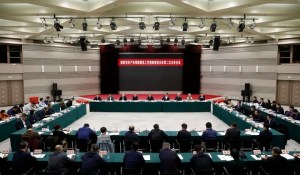
On 7 May 2025, the Office of the Inter-Ministerial Joint Conference for the Building of a Powerful Intellectual Property Nation ( Inter-Ministerial IP Office) issued this year’s plan (Chinese /English) for promoting the building of a powerful intellectual property nation. (Many thanks to Adam Wininger and his colleagues affiliated with the China IP Law blog for the English translation of the plan itself.) The Inter-Ministerial IP Office circulated the plan with the following notice:
Notice of the Office of the Inter-Ministerial Joint Conference for the Building of a Powerful Intellectual Property Nationon the Issuance of the 2025 Plan for Promoting the Building of a Powerful Intellectual Property Nation
(National Intellectual Property Joint Office [2025] No. 5)To all member units of the Inter-Ministerial Joint Conference for the Building of a Powerful Intellectual Property Nation, the Central Political and Legal Affairs Commission, the Cyberspace Administration of China, the State Administration of Taxation, the Financial Regulatory Administration, the China Securities Regulatory Commission, the National International Development Cooperation Agency, the State Administration of State Administration of State Administration of Traditional Chinese Medicine, the National Medical Products Administration, the China Association for Science and Technology, and the National Natural Science Foundation of China:
With the approval of the Inter-Ministerial Joint Conference on Building a Powerful Intellectual Property Nation, the ” 2025 Intellectual Property Rights Promotion Plan ” is now issued. Please organize its implementation conscientiously.Office of the Inter-Ministerial Joint Conference on Building an a Powerful Intellectual Property Nation
April 29, 2025
The issuance of this plan gives me an opportunity to revisit one aspect of formal interactions between the Supreme People’s Court (SPC) and other institutions that I discussed in this blog post in 2021–inter-ministerial joint conferences. As I mentioned in the post, the intellectual property inter-ministerial joint conference system is quite transparent. In contrast to other inter-ministerial joint conferences, it has its own website. This brief post will highlight a few recent developments before analyzing what the plan means for the SPC.
Development #1–Since 2021, the membership of the joint conference has expanded and its name has changed, linked with the issuance of the Outline for Building a Powerful Intellectual Property Nation (2021-2035). The Party Center and State Council approved the expansion of the joint conference to 29 members. Previously, the State Council had approved the expansion of joint conference members. Perhaps the Party Center (党中央) and State Council approved the notice together because several Party institutions are involved. This notice on the establishment of the expanded joint conference is likely derived from the official approval, specifying that the joint conference’s responsibilities are to :
coordinate the national efforts to build a strong country in intellectual property rights, and organize the implementation of the strategy of building a strong country in intellectual property rights. Strengthen macro-guidance on the work of building a strong country in intellectual property rights; study major policies and guidelines for strengthening the building of a strong country in intellectual property rights, and formulate an annual promotion plan for the building of a strong country in intellectual property rights; guide, supervise, and inspect the implementation of relevant policies and measures, monitor and evaluate the effectiveness of work; coordinate and resolve major issues in the building of a strong country in intellectual property rights; and complete other matters assigned by the CPC Central Committee and the State Council.
The SPC is a member of the joint conference, which is convened by the head of the National Intellectual Property Administration and the person in charge of copyright work at the Central Propaganda (Publicity) Department. The approval provides that the joint conference has an office located in the National Intellectual Property Administration to administer the work of the Joint Conference. The head of the National Intellectual Property Administration directs the office, with two deputies, one from that administration and the other from the Central Publicity Department. Justice Tao Kaiyuan is the designated liaison person from the SPC. My understanding is that normal liaison work occurs at the staff level, with some staff members of the SPC’s #3 Civil Division meeting with their counterparts at other member institutions to coordinate and promote policies as well as to establish related mechanisms, subject to relevant leadership approval. The plan provides insights into near-term developments in intellectual property law.
Implications for the SPC
The plan allocates 13 specific tasks to the SPC, among which are:
9. Promote the revision of relevant judicial interpretations of the Trademark Law and Copyright Law. (Supreme People’s Court is responsible);…
23. Explore and improve the intellectual property protection rules for new fields and new formats such as big data, artificial intelligence, and blockchain. Improve the intellectual property protection rules in the Internet field. (The Central Propaganda Department, the Central Cyberspace Affairs Commission, the Supreme People’s Court, the Ministry of Industry and Information Technology, the State Administration for Market Regulation, and the National Intellectual Property Administration are responsible for their respective duties)
24. Accelerate the improvement of judicial judgment rules for intellectual property rights in new technologies, new fields, and new formats, and judgment rules for e-commerce platform competition cases, and explore judicial rules for big data competition protection. (Supreme People’s Court is responsible)…II. Strengthen intellectual property protection
(I) Strengthen judicial protection of intellectual property
30. Issue the “Opinions of the Supreme People’s Court on Serving and Safeguarding Scientific and Technological Innovation with High-quality Trials” and publish typical cases. (The Supreme People’s Court is responsible) [mentioned in this post]
31. Improve the national level intellectual property case appeal mechanism and strengthen the construction of a professional trial system. (The Supreme People’s Court is responsible)
32. Adhere to strict protection, improve and fully implement the punitive compensation system for infringement. Strengthen the overall coordination of batch litigation and increase the crackdown on manufacturers and other sources of infringement. (The Supreme People’s Court is responsible)
33. Formulate the “Interpretation on Several Issues Concerning the Application of Laws in Handling Criminal Cases of Intellectual Property Rights Infringement”. (The Supreme People’s Court and the Supreme People’s Procuratorate are responsible)….
I understand this document to have multiple implications for the SPC. First, the matters for which the SPC listed are targets that the SPC has agreed with the other constituent institutions, after inter-institutional discussions and coordination at a staff level and related approval within the SPC. Second, I surmise that the targets are binding on the SPC through inter-institutional agreement, as reported here. Therefore, the ones that are listed in this document are on the work plan of the SPC for this year and will involve multiple institutions within the SPC. Third, it can be seen that for some matters, the SPC is solely responsible, while for others, the SPC works with the SPP or multiple institutions. Third, it is likely that the SPC will be involved in other matters in which the SPC is not listed as a responsible institution. One of many examples is item 45, “continue to strengthen the protection of seed industry intellectual property rights,” for which the Ministry of Agriculture and Rural Affairs is responsible. As I wrote in a recent post, the SPC has a memorandum of understanding with that ministry to improve the protection of seed intellectual property rights. Finally, this document provides insights into the complex and poorly understood topic of inter-institutional arrangements in China, their operation, and the role of the SPC in them. As the introductory notice flags, multiple non-members of the inter-ministerial joint committee are notified so that their work can be harmonized with this plan.
_______________________________________________
Many thanks to a knowledgeable person for his comments on an earlier draft of this post.
 Supreme People's Court Monitor
You must be logged in to post a comment.