
Tag Archives: active justice

Supreme People’s Court’s Top Keywords in 2023 and Their Impact in 2024

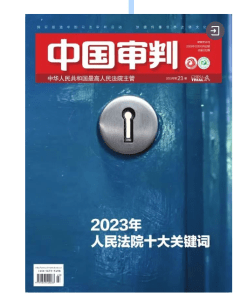
In December, 2023, the Supreme People’s Court (SPC)’s glossy magazine China Trial (中国审判) featured the top 10  keywords of the people’s courts for 2023 (人民法院十大关键词). Provincial high court WeChat public accounts republished the article in a way that enabled those courts to incorporate examples from courts under their jurisdiction and to link to further commentary on the Xuexi Qiangguo (学习强国) platform.  As the followers of this blog could anticipate, each keyword is illustrated with Xi Jinping quotations, important speeches by SPC President Zhang Jun, illustrations of model court practice, and commentary by leading academics.  “For the avoidance of doubt,”  the invited commentary by leading academics is not meant as scholarly analysis. The article itself and the invited commentary are worded in New Era official discourse.  The intent is to weave these phrases into a summary of 2023 and forward-looking SPC policy. These keywords (or at least their spirit) are found in the report on the recently concluded National Conference of Higher Court Presidents. That report (2024 National Court Presidents Conference report) focuses on 2024 goals.

Who is the audience for this China Trial article?  I surmise it is those in political and court leadership positions.  Line judges are more pragmatic.  They have learned the significance of these keywords through Party meetings but are more focused on their cases.

I. Take a Political View and Handle Matters According to the Rule of Law (从政治上看 从法治上办)

 

The readers of this blog could anticipate a version of this phrase would rank first. Dean Xu Shenjian of the China University of Political Science and Law explained what this means.  (Among Dean Xu’s many writings is a forthcoming book with one of my colleagues at the Peking University School of Transnational Law on legal ethics in Greater China.)

Dean Xu said that this phrase has become the core concept of the work of the courts. This concept not only emphasizes the unity of political responsibility and legal responsibility but also highlights the important position of judicial work within the framework of the comprehensive rule of law. This requires that the court’s work be integrated into the country’s major political principles and social governance. Court work is professional work with a strong political nature, and it is also political work with a strong professional nature.  He said that courts should strive to organically unify political thinking and adhere to the rule of law in specific judicial practices.

Comment: This principle has been stressed by SPC President Zhang Jun since he assumed office and post 19th Party Congress, by former SPC President Zhou Qiang. This principle can be expected to be incorporated into the forthcoming sixth five-year court reform plan and underlies court practice at all levels.  This blog has previously mentioned this (see here, here, and here, for example) and my forthcoming article in China Law & Society Review will also discuss this. It is emphasized in the 2024 National Court Presidents Conference report.

II. Active Justice (能动司法)

The second-ranking keyword is “active justice.” Professor Zhang Qi, retired Peking University law professor of legal theory, was invited to explain this phrase.  He said active justice means that in the New Era, courts will implement the central government’s decision-making and deployment, based on its judicial functions, transform judicial concepts, adhere to a proactive judiciary that actively assumes its responsibilities, and provide powerful judicial services and guarantees for Chinese-style modernization.

Comment: I flagged this keyword in several blogposts in 2023 and my forthcoming article also discusses this.  As Judge Liu Shude recently gave a long presentation on active justice and reasoning in judicial documents, I surmise that this phrase will be further developed during President Zhang Jun’s tenure.  This principle can be expected to be incorporated into the forthcoming SPC report to the National People’s Congress and in the new judicial reform outline plan. It is mentioned several times in the 2024 National Court Presidents Conference report.

III. Grasp the Front End and Engage in Preventative Treatment (“抓前端、治未病”)

According to the explanation of this keyword,  the core concept is that the rule of law must not only focus on the back end to treat existing diseases but also focus on the front end to engage in preventative treament…”   To solve this problem, the people’s courts must actively integrate into national and social governance, insist on handling one case and resolving a group.

Comment:  As several blogposts have identified, these principles have been stressed by SPC President Zhang Jun, particularly using typical cases to resolve multiple cases. Post-19th Party Congress, former SPC President Zhou Qiang stressed these as well, as they are part of Xi Jinping legal thought. 

IV.  Win-win (both parties winning), Win-win (multiple parties winning), Winning Together (双赢多赢共赢)

This blog has not used this phrase, although it has identified aspects of linked policies. Professor Wang Kai of Beihang University Law School explained this as follows. Under the unified leadership of the Party, administrative and judicial powers are designed to protect the fundamental interests of the people. Therefore, in judicial work, the judiciary must form a positive and working relationship with administrative organs, jointly promote strict law enforcement, and fair administration of justice.

Comment:  Cooperation and harmonization of approaches between the judiciary and administrative authorities have been stressed since 2022, if not earlier.  The fact that it is included as a top keyword signals that this will be further developed. Although I haven’t written about this yet, I have pointed this trend to those working in specific regulatory areas, such as intellectual property law (see this joint policy document issued by the SPC and the Intellectual Property Administration and the  2022  Opinions on Providing Judicial Services and Safeguards for Accelerating the Construction of a Unified National Market.

V. If I were suing (如我在诉)

The core of this phrase is to encourage judges to put themselves in the shoes of litigants. The comments of Professor Xiong Qiuhong of the China University of Political Science and Law (previously seconded to the SPC’s judicial reform office, and almost 20 years ago, a Yale Law School visiting scholar), provided further analysis that provides a glimpse into official assessments of public perceptions about the judicial system.  She said that “litigants often file lawsuits out of necessity and sometimes have doubts about whether judicial officers can administer justice impartially. If judicial personnel can put themselves in others’ shoes and engage in judicial trials with the concept of “if I am suing”, listen carefully to the demands of the parties, take their views seriously, and patiently watch every word and deed of the parties so that the parties can feel the process of participating in the litigation. When they feel that they are taken seriously and that their active participation can effectively affect the outcome of litigation, they can reduce or even eliminate the doubts of the parties and build trust in judicial fairness.”

Comment:  Professor Xiong’s comments provide a semi-official assessment of public perceptions of the judiciary. This phrase is mentioned in the 2024 National Court Presidents Conference report.

VI Judicial Administration (审判管理)

Professor Xiong Yuemin (熊跃敏) of Beijing Normal University’s law school focused on the revision of the judicial performance indicator system when explaining the significance of this phrase.  She said that establishing an improved set of trial management indicator systems that are consistent with requirements for the people’s courts to thoroughly implement Xi Jinping’s thought on the rule of law and is important to promote the modernization of trial work through the modernization of trial management.

Comment:  I had flagged this in my NYU article. When I raised this reform with a well-known scholar of China’s court system, he responded with a link to Goodhart’s Law:  “when a measure becomes a target, it ceases to be a good measure.”  As explained in this article: “In other words, when we use a measure to reward performance, we provide an incentive to manipulate the measure in order to receive the reward. This can sometimes result in actions that actually reduce the effectiveness of the measured system while paradoxically improving the measurement of system performance.” 

This phrase is further expanded in the 2024 National Court Presidents Conference report to incorporate both political and substantive aspects.

VII. All Letters (and visits) Must Be Answered (有信必复)

Based on discussions with judges in local courts (and research), letters and visits work has become much more important in the local courts, with the stress on resolving the underlying issue (linking to the ongoing theme of “resolving disputes at source” (see keyword #3) and the greater importance of letters and visits (Xinfang) work nationally. The experience of some friends (and former students) who are working or have worked in local courts is that petitioners can be very strategic in how they petition, with keen sensibilities about extracting the maximum benefits from petitioning.

The spirit of this phrase can be found in the 2024 National Court Presidents Conference report.

VIII One Network一张网

The explanation of “one network” links to a national conference at the National Judges College, at which President Zhang Jun spoke. The intent appears to create a unified network for the courts, planned and implemented by the SPC, which will enable unified data collection.  One of the provincial court presidents revealed in national court media what has been said in scholarship, that digitalization of the courts is insufficiently coordinated, leading to inconsistencies, duplication, and wasted resources.

This section mentioned that the SPC will proactively strengthen cooperation with other law enforcement and judicial agencies to open up “data islands” and achieve information sharing.

Comment:  It is unclear what the single network to which President Zhang Jun referred in that speech incorporates a single network for judicial decisions much discussed in both the domestic and international press. The lack of coordination and wasted resources in the digitalization of the courts is not surprising.  I would be surprised if the increased data sharing with other institutions goes smoothly, based on the SPC’s experience in linking its system with the Ministry of Justice for dealing with international judicial assistance matters.

The 2024 National Court Presidents Conference report contains a summary of the latest policy on China Judgments Online, further developed in this notice:

持续深化司法公开,加大裁判文书上网力度,妥善解决文书网使用效果不佳等问题,平衡好文书公开与当事人合法权利、隐私保护之间的关系,加强人民法院案例库建设,更优更实为司法审判优质高效服务,为社会公众学法、专家学者科研、律师办案服务。Continue to deepen judicial disclosure, increase efforts to make judgment documents online, properly solve problems such as poor usability of the Judgments website, balance the relationship between disclosing court documents and the parties’ legal rights and privacy protection, strengthen the construction of the people’s court case database, and make it better and more practical to provide high-quality and efficient services for judicial trials, as well as legal services for the public, scientific research by experts and scholars, and case handling by lawyers.

IX  Line Guidance (条线指导)

The explanation of this phrase links to two of the important SPC events in 2023–the conclusion of the pilot on the reform of the four levels of the Chinese courts and a related notice specifying the types of cases that lower courts should transfer to higher-level courts and a new system of guidance by court leaders that SPC President Zhang Jun unveiled in early September 2023, entitled “review (阅核)” piloted in some courts.  (For those who understand Chinese, I recommend the four-minute video of President Zhang embedded in this WeChat article, in which he explains the difference between review and approval (审批).  For those who do not, a brief glimpse of the video may reveal some differences between Chinese official judgecraft and that elsewhere in the world.)

Comment: Both events are linked to evolving policies under President Zhang Jun promoting guidance by higher-level courts of lower-level courts and guidance by senior judges of ordinary judges. One of the important reforms of the 4th Five-Year Judicial Reform Plan Outline was increasing the scope of judicial autonomy, while significantly increasing judicial accountability/responsibility. The fact that a senior academic published an article in People’s Court Daily to promote the review system in late November 2023 may signal a repurposed approval system for judicial decisions, in the forthcoming Sixth Five-Year Judicial Reform Plan Outline.

Comment: Although I have not previously written about this, I have been monitoring the development of the review system since that WeChat post was made public.  This phrase is developed in one sentence in the 2024 National Court Presidents Conference report and is characterized as a policy requirement of the SPC (最高法关于阅核工作的意见要求),  focusing on the supervisory responsibilities of senior judges.

X. Investigation and Research 调查研究

Investigation and research is a phrase that has its roots in Mao Zedong thought, but which Xi Jinping has further developed (see this webpage with his important remarks).  As explained in this section, it is not only about deeply understanding problems but rather coming up with “prescriptions” to solve them, therefore linking with keyword #3.

Comment: I have an extended discussion of this in my NYU article.

Concluding comments

These ten keywords provide signals concerning the reshaping of the Chinese judiciary under the leadership of President Zhang Jun.  It can be expected that the forthcoming sixth five-year judicial reform plan will reflect these keywords and their related themes.  As can be seen, for the most part, they are incorporated into the goals for 2024. From these ten keywords and the 2024 National Court Presidents Conference report, further details concerning President Zhang Jun’s policies can be seen.  The repurposing of the phrase “four modernization” is highlighted in that report: “promote the formation of the “four modernizations” work layout of trial concepts, mechanisms, systems, and management (推进形成审判理念、机制、体系、管理“四个现代化”的工作布局).

From these ten keywords and the National Court President Conference report, we can see one aspect of the ongoing complex evolution of China’s judicial system.  When Dean Jiang Huiling spoke to my class in 2022, he commented that “in the current arrangement–in the Zhengfa (政法) reforms, Chinese characteristics have a great deal of weight and also in the reconstruction of the legal system.  Although China has learned a great deal from other countries, China has to go on its own way, since it has its own history, political situation, and historical stage and there is a change in the international situation.”  We are gradually seeing where China is “going its own way” and where developments are harmonized internationally.

_____________________________________________________

Many thanks to my readers for their patience these past several months while I have focused on finalizing my “neverending article” for publication and packing up several decades of books housed in my (former) office at Hong Kong University. A special thank you is due to those at Hong Kong University Law Faculty who made that office possible.

A separate special thank you is due to the two anonymous peer reviewers of this blogpost, particularly the person who called my attention to the repurposing of “four modernizations.”

If any readers have alternative translation suggestions, please contact me through the comment function or by email.
New Judicial Interpretation on Judicial Suggestions (Advice)

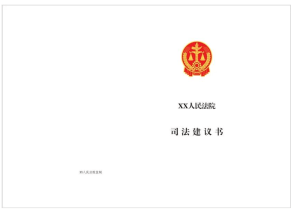
New standardized format for judicial advice/suggestions

In November 2023, the Supreme People’s Court (SPC) issued a judicial interpretation intended to encourage and standardize the way that the courts issue judicial suggestions (advice) (司法建议), entitled Provisions of the SPC on Several Issues Concerning Comprehensive Judicial Advice Work (Judicial Advice Work Judicial Interpretation) (最高人民法院关于综合治理类司法建议工作若干问题的规定).   For those in jurisdictions in which the SPC’s official website is inaccessible, see this link.  When a translation becomes available, I will post it. As a judicial interpretation, its provisions are binding on the lower courts, unlike its predecessor 2012 and 2007 documents.   Judicial suggestions (advice), the subject of this recent law review article (with detailed historical background),  and promoted in these model cases about which I wrote this summer, are often issued in the context of litigation or after a court reviews a group of disputes.   As illustrated by those model cases, it is a function being reinvigorated under President Zhang Jun. It is mentioned briefly in the Civil Procedure and Administrative Litigation Laws but not in the Organic Law of the People’s Courts.   Now, as in the era of the Wang Shengjun presidency of the SPC, it is linked to active justice. It is also linked with resolving disputes at source, and the courts participating in social governance.  As previously mentioned, resolving disputes at source appears to be derived from Chinese medicine philosophy in seeking to resolve the root cause of disputes by using the data, insights, and multiple functions of the courts to that end.  For those interested in comparisons and the possible impact of President Zhang Jun’s Supreme People’s Procuratorate (SPP) experience on the SPC, the Supreme People’s Procuratorate updated its regulations on procuratorial suggestions in 2018.   It is yet another function of the Chinese courts that has its roots in the Soviet system.

This quick blogpost flags what is new, the issues to which the new judicial interpretation responds, and places the interpretation in its larger context.

What is New?

The Judicial Advice Judicial Interpretation recasts its content in the language of Xi Jinping New Era political-legal jargon, in contrast to its predecessor document, which dates from 2012 and reflects the political-legal jargon of the period.  However, in my view, that would be insufficient to merit a judicial interpretation. Given that judicial advice of a particular type has become a priority under President Zhang Jun, the judicial interpretation is intended to guide other divisions and entities within the SPC and the lower courts to provide judicial advice that better reflects SPC leadership priorities.  It therefore:

  • addresses judicial advice work on “comprehensive” matters, that is outstanding problems in the field of social governance that cause frequent conflicts and disputes and affect economic and social development and the protection of the people’s rights and interests. It should propose improvements and improvements to the relevant competent authorities or other relevant units.
  • specifies that when judicial advice is submitted to a government authority, it shall generally be submitted to the competent authority at the same level within the jurisdiction of the court, and not issued to an authority at a bureaucratic level above the court issuing the advice.  The judicial interpretation does not permit cross-jurisdictional judicial advice.  If the issues require measures to be taken by a relevant authority in another place,  the court in question must report the matter to the corresponding superior people’s court for decision. This was  stressed by several local judges whom I contacted.  I note that according to a report that the Shanghai Financial Court in the summer of 2023,  issued 35 items of judicial advice, including to certain central departments (People’s Bank of China and the State Administration of State-Owned Assets, but presumably that court coordinated with the SPC when doing so;  
  • it requires the court to contact the entity that is proposed to receive the advice, to listen to their views;
  • imposes a two-month deadline for the entity receiving the advice to respond (and the advising court to chase up the advised);
  • more strongly stresses the “principle of necessity,” i.e., is it necessary to issue this judicial advice, to avoid judicial advice being issued for its own sake (or more properly, to meet  internal performance indicators of courts);
  • requires judicial advice to be discussed and approved by a court’s judicial committee, rather than the responsible court leader, as in the 2012 document;
  • specifies when judicial advice should be copied (抄送) to superior institutions;
  • does not specifically cancel the 2012 document, but provides that the provisions in interpretation supersede ones in the earlier document if they are inconsistent. 
  • requires a court to report on its judicial suggestions as part of its report to the corresponding people’s congress; and
  • standardizes format.

There is no requirement of greater transparency but some local courts have posted some information about their judicial advice. The Shanghai Maritime Court is one court that posts judicial advice and responses, some other courts issue more limited information.

Surmising from the article published by the drafters of the interpretation recently in the SPC journal Journal of Applied Jurisprudence (the understanding and application), all of whom are affiliated with the SPC’s Research Office, that office took the lead in drafting this interpretation.  It is to be expected that the Research Office took the lead because it often deals with cross-institutional issues.

Ongoing issues

I derive the comments in this section from Ms. Dou Xiaohong’s recent article in the National Judges College academic journal Journal of Law Application (法律适用). She did a deep dive into several thousand items of judicial advice issued in province “S” over the  last several years and a more limited number from other provinces and did some cross-jurisdiction comparison.  Some of the comparisons work better than others, but it does not take away from the main focus of the article. She works in the Research Office of the Sichuan Provincial Higher People’s Court so “S” likely refers to Sichuan.  Presumably, the drafters of the judicial interpretation were aware of her article.  She characterizes judicial advice as a form of soft law governance.  She found (among other points):

  • most judicial advice related to a single case or similar cases, with comprehensive advice accounting for 14%, with most case suggestions relating to typos and omissions in documents (performative judicial advice);
  • almost half of the judicial advice “disappears” (is ignored by the recipient of the advice;
  • staff of the recipient administrative departments that the author surveyed were unaware that the recipient department was obliged to respond;
  • Under the current pressure of cases, it is difficult for judges to have “extra” time and energy to allocate to giving judicial advice.

Ms. Dou makes a number of suggestions, not all of which the drafters of the judicial interpretation incorporated:

  • incorporate better reporting to the relevant people’s congress
  • incorporate a “comply or explain” principle;
  • involve the supervision/Party disciplinary authorities if the matter involves the violation of law or discipline;
  • promote greater transparency of judicial advice by the courts and the recipients of the advice, so that there is greater awareness of judicial advice.

Greater significance

The promotion of higher quality judicial advice (suggestions) through the issuance of this judicial interpretation is another example of the development of the Chinese courts in the Xi Jinping New Era, post the 2019 Zhengfa (political-legal) reforms, stressing the role of the courts in social governance.  Unlike some of the other aspects of “active justice,” judicial advice has its roots in legislation, although it is not mentioned in the Organic Law of the People’s Courts.  This interpretation highlights a function of the Chinese courts that has existed for many years but has more recently become more important to SPC leadership.  Transparency concerning judicial advice is uneven throughout the courts, and it is unclear the extent to which the SPC itself provides judicial suggestions. Lower court practice appears to vary. It appears from Ms. Dou’s article that many lower court judges are more focused on closing cases than issuing soft law judicial advice and providing advice for the sake of meeting a performance target.  However, it may also depend on the subject of the judicial advice and whether the recipient perceives the advice provided by the courts as useful, as some local judges have mentioned to me that well-targeted judicial advice has led to inter-institutional discussions.  The requirement of  “listening to the views” of the entity that is to receive the advice (i.e. receiving their assent) is likely to result in fewer items of judicial advice issued, as courts are likely to consider the procedure too troublesome.  However, we will need to wait for the revamped performance indicators under discussion to be released to understand better what the longer-term implications of this judicial interpretation are likely to be.

_____________________________

Many thanks to those who commented on an earlier draft of this blogpost.


Active Justice: Resolving Real Estate and Construction Disputes at Source

6th Circuit press conference announcing the typical cases

In late May of this year (2023), the Supreme People’s Court (SPC) issued a set of typical cases on resolving real estate and construction disputes at their source provided by the SPC’s #6 Circuit Court (the circuit court covering the northwest provinces and autonomous regions), entitled “Typical Cases of Litigation Source Governance in the field of Real Estate and Construction Projects in the Circuit Courts area (巡回区房地产及建设工程领域诉源治理典型案例).   These typical cases have not received their due attention outside the Chinese court system. They are helpful for understanding how the Chinese court system is evolving under the leadership of SPC President Zhang Jun. These ten typical cases are examples of court practices that the SPC has provided to lower courts for guidance.  The guidance focuses on two principal areas:  how to implement properly the requirements of President Zhang Jun and the SPC’s Party group to serve national and social governance by resolving disputes at their source (linking to the General Secretary’s important instructions and related documents; and second, how to use “active justice” (能动司法) to achieve these objectives. 

As I flagged in May of this year, President Zhang Jun has revived the concept of “active justice.”  In that same blogpost and in earlier ones, I mentioned that resolving disputes at their source has become an important task for the Chinese courts. The cases weave together these policies in one perfectly designed package.

These cases also tell a story about how active justice and resolving disputes at their source can involve the courts undertaking some functions that should be left to the lawyers.  

Typical cases that are not cases

These ten cases are not accounts of specific court cases but rather are examples of exemplary practices. This is not the first time that the SPC has issued “typical cases” that are exemplary practices.  Since 2017, the judicial reform leading group of the SPC has issued typical cases that illustrate judicial reform practices that provide useful reference materials for other courts.   

Resolving disputes at source

Resolving disputes at source is a Party policy mentioned briefly in the 2019 fourth plenum of the 19th Party Congress decision, the  SPC document implementing that Party Congress decision, and the 5th judicial reform plan document. It was further developed in subsequent documents.  It links to the Party’s (and SPC’s) diversified dispute resolution policies. An academic article recently published unfortunately does an inadequate job of defining the policy and describing the policy’s development. Moreover, it incorporates some translation errors.  Although both authors are affiliated with prominent academic institutions with serious scholars of the Chinese courts, it appears to this reader that they failed to seek the perspective of some persons with a greater historical perspective on SPC developments.  It is another instance in which peer review did not catch inadequacies.

According to several  SPC press releases and articles related to these cases, the foundational document for recent SPC and other legal institution policies is a February 2021 Central Committee document (never publicly released)  entitled Opinions on Strengthening the Governance of Sources of Litigation and Promoting the Resolution of Sources of Contradictions and Disputes” (关于加强诉源治理推动矛盾纠纷源头化解的意见).  I surmise that the document includes the phrase “promote basic level social governance”  (促进基层社会治理) and likely “national governance.” 

The SPC issued a long and detailed document implementing that Central Committee document in September 2021, entitled Implementing Opinions on Deepening the Building of the One-stop Diversified Dispute Resolution Mechanism of the People’s Courts to Promote the Resolution of Conflicts and Disputes at Their Source (Implementing Opinions on Promoting the Resolution of Disputes at Source)(最高人民法院关于深化人民法院一站式多元解纷机制建设推动矛盾纠 纷源头化解的实施意见 that the authors of the above article missed in their research. One of the many objectives listed in this document is reducing the per capita rate of litigation. 

Why Select Real Estate and Construction Disputes?

Judge Wu Zhaoxiang, deputy head of the #6 Circuit Court (and also deputy head of the SPC’s Research Office, whom I quoted in my book chapter on the drafting of criminal procedure judicial interpretations), explained why they focused on real estate and construction disputes.  He said it is because these disputes are important. 

Within the jurisdiction of the 6th Circuit, “there are tens of thousands of lawsuits flooding into the courts every year, with huge amounts of ‘real money’ worth billions at every turn. It involves the development of business of tens of thousands of enterprises and the well-being of the people, and it is related to the country’s economic development, financial security, and social stability.” Judge Wu mentioned that some small, medium-sized, and even large real estate companies have encountered difficulties such as in funding, resulting in failure to hand over buildings in time, causing home buyers to stop paying mortgages, which has attracted a great deal of public attention. Many of the construction cases involve unpaid contractors and actual constructors. [“Actual constructors” (实际施工人) refers to companies /other entities that to which contractors have improperly subcontracted, although they may not have the proper certificates, etc. to do so]. The problem of wage arrears to migrant workers has not been completely resolved, and “collective rights protection incidents of migrant workers” still occur from time to time.

Statistics provided in one report bear this out.  Shaanxi courts accepted 13,900 construction dispute cases in 2020,  17,800 cases, in 2021 and 18,400 cases in 2022. The Qinghai courts heard more than 8,400 real estate-related cases and 10,300 construction disputes,  the Ningxia courts accepted 36,600  cases in the fields of real estate and construction since 2020, and the courts of the Xinjiang Corps accepted 15,300  real estate and construction cases in the past three years. The same report signaled that real estate and construction disputes are on the rise nationally.

Lessons from the cases

The 6th Circuit labeled the ten typical cases with the lessons to be learned (which I have italicized), similarly to the judicial reform typical cases mentioned above.  I further describe the first one, because the points in the typical cases repeat one another:

  1. Adhere to the leadership of the Party to build a new pattern of governance of sources of litigation: The exemplary practice was the Shaanxi Party Committee’s Implementing Opinions on Strengthening the Governance of the Sources of Litigation and Promoting the Prevention and Resolution of the Sources of Conflicts and Disputes” (关于加强诉源治理推动矛盾纠纷源头预防化解的实施意见), which apparently assigned to provincial institutions responsibilities related to the goal of promoting the prevention of conflicts and disputes at the source.  The SPC identified three specific examples: “optimizing top-level design” and building a pattern of “government-institution linkage” by the provincial Higher People’s Court and  Housing and Construction Department jointly issuing a document aimed at promoting mediation of real estate and engineering disputes by creating a database of experts to mediate these disputes; and improving non-litigation mechanisms through a document that the provincial Higher People’s Court and Provincial Construction Cost Association jointly issued to establish a group of experts to mediate construction cost disputes; and third, the Shaanxi Higher People’s Court promoting “active justice” through reviewing typical cases and communicating with the regulators, including providing them with typical cases concerning problems discovered in the course of litigation, issuing compliance advice to large construction companies, and as well as judicial advice to administrative departments.
  2. Track and pay attention to key projects to ensure zero disputes in construction projects;
  3.  Work together to solve the “difficulty in obtaining certificates” to solve the difficulties and worries of the masses;
  4.  Collaborative linkage revitalizes projects to achieve “three guarantees” to resolve public concerns;
  5. Expanding the scope of notarization to participate in judicial assistance and adding “new troops” to pre-litigation mediation;
  6. Innovate the pre-litigation identification model to promote the quality and efficiency of dispute resolution;
  7.  Judicial recommendations are implemented and effective, and targeted policies are implemented for precise governance;
  8.  Give full play to the exemplary role of judgments and rulings and promote the resolution of the source of conflicts;
  9. Formulating and issuing compliance management suggestions to help enterprises prevent disputes; and
  10. Do a good job of risk reminders to ensure the healthy development of enterprises.

Comments

SPC Vice President Yang Linping, the head of the #6 Circuit Court, repeatedly used the phrase “active justice (能动司法) in her speech announcing the significance of these cases, which was reprinted as an article published in People’s Justice (人民司法). By doing this she is promoting the new spirit of the SPC leadership under President Zhang Jun.   Some of that new spirit is putting a new spin on earlier policies, such as resolving disputes at source by promoting mediation, thereby transmitting the Fengqiao Experience.  Active justice is another old policy receiving a new spin.  “Active justice” appears to be a flexible concept and since  President Zhang Jun has started to mention it, those in various levels of courts and substantive areas have used it, generally without a specific definition. From these cases and other sources, it involves the use of less prominent functions of the courts (such as coordination with administrative authorities and liaison with the local Party committee to resolve the core problems of a dispute. Resolving disputes at source appears to be derived from Chinese medicine philosophy in seeking to resolve the root cause of disputes by using the data, insights, and multiple functions of the courts to that end.  It also is a flexible concept.

What is little discussed in articles about “active justice” thus far is why the courts are taking on some of the roles they are.  For example, one of the exemplary methods promoted in these cases and praised highly was the courts analyzing and summarizing the compliance management risks of large construction companies as derived from relevant litigation and the courts issuing suggestions for corporate compliance management as well as providing judicial suggestions to administrative agencies on how they might better exercise their regulatory authority.   

It occurred to me that in many other jurisdictions  (I don’t believe the civil or common law distinction makes a difference), it would be either law firms or events sponsored by bar associations (lawyer associations) that would host events aimed at real estate or construction counsel (in law firms, in-house, or with government) to convey their insights about recent litigation.  My initial reaction was that the situation might be different in first-tier areas of China, given that lawyers are better educated in those areas and companies have better counsel, and so the courts might be less “active” in providing advice. I, therefore, checked my initial reaction with a highly experienced judge in a first-tier city.  He said that no, courts in his municipality also issue judicial suggestions (link is to a related academic article) to enterprises and administrative agencies requiring them to improve some aspect of their operations. It is part of their work to “serve the greater situation” and courts have performance indicators concerning judicial suggestions/advice.  “So we take away a lot of business from lawyers by providing free legal advice.”