
Tag Archives: requests for instructions

Benchbooks (Judicial Handbooks) for the New Era

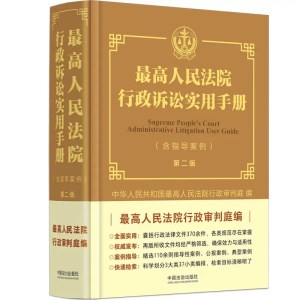
A recent message in the WeChat public account of the Supreme People’s Court (SPC)’s Administrative Division was devoted to promoting its new book,  Supreme People’s Court Administrative Litigation User’s Guide (Administrative Litigation User’s Guide (2nd edition), 最高人民法院行政诉讼实用手册), shown in the photo above.   Had the SPC’s #4 Civil Division had a WeChat public account last year when they published 涉外涉港澳台民商事审判业务手册( Foreign-Related, Hong Kong, Macao and Taiwan Related Commercial Trial Work Guide — “Foreign-Related Judicial Handbook”), I am sure that I would have received a similar message.  I had previously thought that judicial handbooks were a historical artifact of the days before electronic databases.   In my 1993 article, I discussed the phenomenon of judicial handbooks:

..A …problem is presented when the lack of consistency in issuance and authority makes it difficult for the lower courts to know when an interpretation is no longer valid…The [SPC] tries to cure these problems by issuing handbooks for adjudication in various subject areas….The Research Office and other divisions of the Court compile adjudication handbooks such as Sifa Shouce [司法手册] (Judicial Handbook), many of which are internal publications.

Some of those historical handbooks can be found in my research library of Supreme People’s Court publications–see here and below:
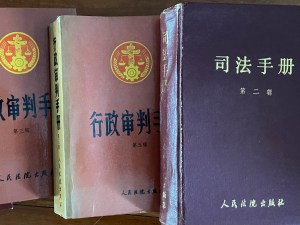
Two Administrative Litigation Judicial Handbooks and the second volume of the Judicial Handbook

Why would specific divisions of the SPC return to the practice of issuing judicial handbooks in printed form?  How does it link with the role of the SPC? What sources have the editors included, and what could students, scholars, and practitioners learn from that?

Official reasons for publishing these print books

The authors of the  Administrative Litigation User’s Guide describe the reasons for publishing the book as follows:

the Supreme People’s Court, on the one hand, provides professional guidance (业务指导) by formulating judicial policies 司法政策), issuing guiding cases, and making judicial replies (司法答复); on the other hand, it strengthens research and collects problems, and formulates judicial interpretations based on the accumulation and maturity of judicial practice. At present, the comprehensive judicial interpretation of the Administrative Litigation Law, the judicial interpretation of administrative agreements, and the judicial interpretation of the appearance of administrative agency heads in court to respond to lawsuits have been formulated and issued…, and there are more and more normative documents and guiding cases related to administrative litigation. In addition, with the increase in the number of administrative cases, more judges have joined the administrative trial team. In the process of gradually becoming familiar with administrative litigation, they urgently need to master the  relevant provisions that have been issued and learn the relevant guiding cases. However, judicial replies are internal in nature, with a large volume and lack of a unified release mechanism. The channels for obtaining them from the outside world are limited, which is time-consuming and laborious.

According to the announcement, the audience for the Administrative Litigation User’s Guide is staff in administrative agencies, judicial practitioners, and researchers of administrative law [students and academics].  The editors note that to provide readers with reference materials and to make the book more practical, they have included guiding cases, SPC Gazette Cases, and typical cases from the last 10 years.

The #4 Civil Division authors/editors say their handbook is urgently needed by front-line judges and as a reference book for judges, arbitrators, lawyers, and other practitioners, and, I would add, to students and scholars seeking to decode the foreign-related and Hong Kong, Macau, and Taiwan-related operations of China’s judiciary.

Legal basis for publishing these books

Publishing these books is linked to Article 10 of the Organic Law of the People’s Courts and related documents, which authorize the SPC to supervise and guide(监督指导) the lower courts.

Comments on the content

Both books contain judicial interpretations and a range of SPC guidance documents such as meeting minutes/conference summaries (会议纪要), notices, and replies to requests for instructions, signaling to the reader that they are important sources of reference for judges and that “soft law” may understate the way that meeting minutes are understood within the Chinese court system.

The authors/editors of the Foreign-Related Handbook included many other types of legal provisions they considered relevant for hearing cross-border cases, such as relevant national legislation, administrative regulations, such as foreign exchange regulations, Chinese versions of international commercial rules (Incoterms, ICC Uniform Rules for Demand Guarantees (URDG 758), ISP 98) ), Hague Conventions to which China has acceeded,  and civil judicial assistance treaties, as well as some of the National People’s Congress Standing Committee decisions related to some of the international conventions.  The #4 Civil Division did not include guiding, typical cases, and other types of cases it issues for reference.  In my view, it was a practical decision that does not imply that those types of cases are irrelevant to judges hearing cross-border commercial cases, but rather that including cases would make the book too long to be published as a single volume.

Comment

The underlying rationale for publishing these judicial handbooks has not changed much in the past 30 years.  Judges responsible for processing cases efficiently and correctly face similar challenges:  sorting out the current legal position on an issue quickly despite the piecemeal way that the SPC develops the law, locating and assessing the validity of historical documents, easily identifying special arrangements, and for cross-border cases, understanding how to correctly implement international conventions, treaties and practices and correspondingly arrangements or related provisions concerning cases involving Hong Kong, Macau and Taiwan parties.

One experienced senior judge in a local court noted that judges are often asked to rotate among divisions (tribunals) periodically.  Senior judges recommend that new joiners read these handbooks to familiarize themselves quickly with a different (and complicated) area of law.
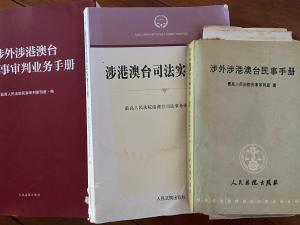
From the left, the 2024 Foreign-Related Handbook, a 2013 Hong Kong, Macau, Taiwan Related Judicial Handbook, and the 1992 Foreign, Hong Kong, Taiwan-Related Civil Matters predecessor volume


Supreme People’s Court Updates Its Request for Instructions Procedures Concerning the Application of Law

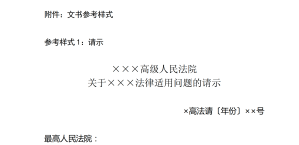
Standard Form for a Request for Instructions

Like all Chinese Party and state organs, the Supreme People’s Court (SPC) handles requests for instructions (请示), (also translated as requests for advisory opinions). A request for instructions is a type of document submitted by a subordinate to a superior state or Party organ to request instructions or approval. It is one of many discrete matters that reveals the SPC’s bureaucratic operations.

Requests for instructions are incorporated into the 2012 SPC measures on official documents of the people’s courts (人民法院公文处理办法), which implement the Party and government’s regulations on official documents (党政机关公文处理工作条例) (an English translation of the latter can be found here).

This system has existed for many years and has been controversial for at least 40 years, if not longer.   When I wrote about the SPC 30 years ago, I devoted several pages to describing the practices concerning requests for instructions, including telephone requests, as they were understood at the time, and also mentioned controversies about the practice. At the time, I was not aware that old regulations concerning the practice existed.

In early June, the SPC released updated procedures on requests for instructions concerning the application of law (Provisions of the Supreme People’s Court on Responding to Requests for Instructions on the Application of Law (Provisions on Requests for Instructions) 最高人民法院关于法律适用问题请示答复的规定), to be implemented from 1 September.  The Provisions on Requests for Instructions themselves further reveal some of the details of the SPC’s bureaucratic operations and relate to formal requests, not to informal versions.  The Provisions on Requests for Instructions also attach form documents for the lower courts to use, to standardize formats. They are not a judicial interpretation (as can be seen by the document number–fa (法), but a judicial document (司法文件), but the lower courts will implement its provisions.  This post will address what is new or different, the matters to which it applies and does not, the Monitor’s views about the reasons for issuing this guidance,  and other insights the Provisions provide.

What does it say?

The Provisions on Requests for Instructions apply to requests for instructions on legal issues, not factual issues submitted to the SPC.  In general, the requests must be submitted by Higher People’s Court, although for intellectual property cases, first-instance courts may directly submit them to the SPC, which I surmise intended to refer to the SPC’s Intellectual Property Court. These Provisions are related to the reform of the four levels of the Chinese courts and are part of larger reforms focusing more of the work of the SPC on questions of law rather than fact and law.

Article 2 defines the scope of cases that can be submitted:

  1.  no clear provisions in laws, regulations, judicial interpretations, normative documents, etc., and there are major disputes over the application of law;
  2.  a major dispute exists over the understanding of the specific meaning of laws, regulations, judicial interpretations, normative documents, etc.;
  3. Significant changes have taken place in the objective circumstances concerning which judicial interpretations and normative documents were formulated, and the continued application of relevant provisions is obviously contrary to fairness and justice;
  4. Judgment rules for similar cases are obviously not uniform;
  5.  Other major disputes over the application of law.

Formalities

The Provisions on Requests for Instructions require the judicial (adjudication) committee of the requesting court to have considered the issue and to provide relevant information about that discussion, consistent with requirements relating to retrial cases, discussed here. Additionally, the court must prepare a package of documents, including a search of prior cases,  and a report on the issues and reason for the request, the views of the collegial panel that heard the case, and related reports from the lower court, if the request originated below.  The standard form document provides guidance to the lower courts on format.

The SPC’s case filing division is designated as the SPC entity to receive the requests and dispatch them.  They are required to review the requests within three days and inform the requesting court whether or not the request is accepted or rejected and whether additional materials are needed.

If the issue relates to a judicial interpretation or a judicial regulatory  document (规范性文件) etc., the Provisions on  Requests for Instructions require that the matter should be sent to the drafting department, the principal department if relevant, or otherwise the apparently relevant division or office. If the relevant division or office does not want to review it, it can negotiate with the case-filing division to take the matter back and cannot request another division or office to take on the matter without case-filing division clearance. The vice president of the SPC in charge of these matters will resolve any disputes.

The division that takes on the request is required to designate one person to be in charge of the request, which is then to be reviewed collectively, in a professional judges meeting, as provided in a  2017 SPC opinion.  Several divisions or offices can handle a request together, or views from institutions or experts outside the SPC can be sought if needed. Responses should be in writing and in the name of the SPC itself, but may also be provided over the phone, with a record kept of the response. The requesting court should (must) implement its provisions but not cite the response as the basis for its decision.

The draft response needs to be reviewed by the Research Office before it is submitted to the relevant vice president in charge for approval, and if necessary, the SPC president or judicial committee may consider it.  The Provisions on Requests for Instructions impose a two-month deadline on responses, which can be extended.

Transparency is permissive, and if a case is significant, the SPC can request that the case be transferred for a hearing, or otherwise the case be reworked as a guiding case or judicial opinion.

To what cases does it apply?

The procedures apply to ordinary requests for instructions concerning legal issues, but not requests for instructions that may arise when a lower court considers one of the four types of cases. Those cases are those that are politically sensitive, difficult, or involve mass cases.  The objective is to protect front-line judges from deciding “Four Types of Cases” autonomously in a way that is considered wrong or inconsistent with policy and legal provisions as well as the court leaders above them.  The guidance for those cases authorizes court leaders, in those cases, to seek guidance from higher-level courts on the handling of those cases.

The 2017 Opinion mentioned above also provides for other exceptions for requests for instructions in certain major criminal cases.

These Provisions do not apply to the Prior Reporting of the judicial review of arbitration cases, under a separate judicial interpretation.

Why this guidance?

On why this guidance was issued, I surmise that the SPC leadership has seen many such requests for instructions but judges have delayed responding to them, have forwarded them to other divisions for response, and different parts of the SPC have issued conflicting responses. Additionally, the SPC may have seen many requests involving determinations of facts as well as law. Therefore, I surmise, the SPC leadership charged case-filing and trial management divisions with drafting updated regulations.

Statistics on the number of requests for instructions  (either formal or informal) at either the SPC or below are unavailable. A highly experienced Chinese judge commented to me that an important reason for lower court judges to request instructions is to avoid “making mistakes” that may have negative consequences on the individual judges or panel of judges involved or may lead a higher court to reverse the lower court.  My own earlier research and that of Professor He Xin found other reasons as well (in the lower-level courts).

What other insights are there?

As  I wrote previously,  fifteen or more years ago, there had been proposals even within  the SPC for the system to be “proceduralized” or “judicialized–see Dean Jiang’s 2007 article.  The second judicial reform plan (see the original Chinese and an English translation) under the late SPC President Xiao Yang), called for reform to the system of reporting and seeking approval/request for instructions system.  However, times have changed. The SPC leadership is required to seek instructions on certain matters.

The Provisions require a reply database to be established and higher courts to report the replies they have given on an annual basis to the SPC. Presumably, the higher courts will impose the same requirement on the intermediate courts within their jurisdiction.  This is part of the SPC leadership’s push to extend its supervision of the many entities within the SPC  and the lower courts.  At the level of the SPC, this is one part of leadership efforts to impose more uniformity in the application of law by SPC divisions, offices, and circuit courts.  It is one aspect of strengthening the firm guiding hand of the SPC.