
How well do the official English language websites of the Supreme People’s Court (SPC) convey an understanding of the SPC and the Chinese court system? I last addressed this question in 2017, when I assessed the English-language versions of Chinese court websites. Since then, the SPC has established new institutions, with new English-language websites and has issued several policy documents calling for better foreign-language publicity about the SPC itself, the Chinese court system, and lower courts. Among those policy documents are the following:
- the 2018 document, about which I wrote at the time, “Opinions of the Supreme People’s Court on Further Deepening Judicial Openness (最高人民法院关于进一步深化司法公开的意见),” which contains language on translating important white papers and improving foreign language websites:
white papers shall be solidly and effectively prepared, produced, released and publicized, and the authority, normalization and readability of white papers shall be effectively enhanced. For white papers having an important impact, publicity and promotion efforts shall be increased, and multilanguage translation work shall be advanced, so as to heighten the dissemination and influence of the white papers of people’s courts….
The construction of foreign language versions of judicial openness platforms such as the websites of the Supreme People’s Court and international commercial courts shall be strengthened, and the function of foreign publicity services shall be enhanced.
- the 2020 Guiding Opinions on Services and Guarantees of the People’s Courts for Further Expanding Opening-up to the Outside World contains the following:
Strengthen external publicity on China’s judicial system, judicial culture, judicial reform, and smart court construction, tell [good] stories about the rule of law in China, and spread the voice of the rule of law in China..
The question is, how well has the spirit of these documents been implemented? The SPC is clearly concerned about its image and that of the Chinese courts outside of China because senior SPC officials regularly provide training on the Chinese judicial system for foreign judges, primarily from the Global South. Rather than focus on training, as some others have done, I will look at the three SPC official websites:
- the English language version of the SPC’s official website: https://english.court.gov.cn/. Note the Chinese version (https://www.court.gov.cn/index.html) is geoblocked in some parts of the world.
- the China International Commercial Court’s English language version: https://cicc.court.gov.cn/html/1/219/index.html
- the SPC’s Intellectual Property Court’s English language version: https://ipc.court.gov.cn/en-us/index.html
I am drawing on a paper by the OECD (as well as other websites) that stresses that official websites should be authoritative, comprehensive, fit-for-purpose, and easily navigated. Additionally, I will make comments on translation issues.
1. SPC’s official website
 As to whether this site is authoritative, comprehensive, fit-for-purpose, and easily navigated–my quick response is that “it needs improvement.” A significant proportion of the information linked to the landing page of the website is out- of-date. Below are a few of the many problems with the website.
- Moving to the “About” tab, the Introduction combines an incomplete description of the SPC with an overview of the court system. The two topics should be split. Moreover, both desperately require a structure chart so that the foreign reader can visualize the internal structure of the SPC and separately, the complicated structure of the Chinese court system.
- The section on Resources, which does not clearly signal what is within that tab, is mostly out-of-date. The section on white papers has not been updated in many years. The last white paper posted is the judicial reform white paper (2013-2018), but in fact a judicial reform white paper(2013-2022) was published in 2023 and other SPC white papers with English translations have been published since 2018. It is mystifying why hundreds of hours of professional time have been spent translating SPC white papers into English but they are not made easily available to the foreign audience for whom they are intended. I surmise that those operating the webpage do not coordinate with the drafters of white papers.
- The section on Resources has a pull-down menu with buzzwords, but (I surmise) the foreign audience would prefer a glossary defining specialized court terms. Those are often used on the SPC website and in China Daily articles on the courts, but many are unfamiliar to the legal community outside of China.
- Instead of a brief summary of the various procedural laws, it would be helpful to provide a flowchart to illustrate how a Chinese court case progresses. A lower court judge specializing in foreign-related matters (or an expert from a university with which the SPC cooperates) could narrate a video explaining court procedure.
- The videos on the website now date from the Covid era.
- Although the websites of most apex courts worldwide explain how it is possible to visit, the SPC site does not. The SPC might want to explain whether it is possible, with required conditions. It would be interesting for foreign visitors to the website if a video of an SPC court hearing (with English subtitles) could be posted. No English translations of SPC court decisions or rulings are posted on the website, or even guiding or typical cases. The SPC has translated and published some of its guiding and typical cases elsewhere and it could select a few examples from existing resources. By comparison, some civil law apex courts post selected translations of decisions.
- The landing page lacks links to all other English-language SPC court websites.
- Much of the content on the website is sourced from China Daily. However, the translations that China Daily uses for specialized court terminology are quite often different from those in SPC white papers and from the document (English that the SPC issued on the English translation of Chinese court terms.
My impression is that despite the language of the policy documents quoted above, this website is not anyone’s (or any group’s) primary responsibility. It appears no one has considered its readability. SPC should also reach out to China Daily to harmonize translations of specialized court terminology.
2. China International Commercial Court (CICC)

As to whether this website is authoritative, comprehensive, fit-for-purpose, and easily navigated, it is definitely better than the SPC site, but I am suggesting some improvements, some similar to those for the SPC site:
- it would be helpful to provide a flowchart to illustrate how a CICC case progresses. I note that the website has a flowchart for the one-stop system, which could be usefully expanded to cover the entire litigation process at the CICC.
- The CICC English website has notices of CICC case hearings. There is no point in publishing these notices in English if it is not possible to attend either in person or online. If the intention is to make CICC hearings open to the English-reading public, procedures should be put in place to make it possible for non-Chinese to attend hearings. Additionally, it would be interesting if videos of CICC case hearings (or even excerpts, with English subtitles) could be posted on either the SPC’s main case hearing website (China Court Trial On Line) or directly on the CICC website.
- The last judgments and rulings posted on the website date from almost a year ago. It is unclear whether the CICC has issued any judgments or ruling since then.
- Several pull-down menus under Resources have not been updated for extended periods of time: the typical cases have not been updated since 2017, the judicial interpretations, not since 2022, judicial documents , not since 2022, laws and regulations, not since 2023.
- Under the tab “What’s New, it isn’t clear what is classified as “official release” vs. news & articles. The translated reports and white papers should have a more prominent place.
It appears that keeping this website current is not anyone’s primary responsibility.
SPC’s Intellectual Property Court
 The SPC’s Intellectual Property Court English website appears to be only partially cared for.
- It contains usefully presented information, such as lists of local courts with first-instance jurisdiction, but the labeling should be better.
- The English website lacks links to the main SPC website and the CICC website. The SPC should be considered the three websites as a whole.
- The summaries of the case digests and typical cases have not been updated.
- The tab under “scheduled hearing” is empty. It should be either deleted or information provided on upcoming hearings and how an interested person could attend either online or in person.
- The introductory materials should be made more readable.
It appears that keeping this website current and readable is not anyone’s primary responsibility.
Concluding Comments
The CICC website is more current than the other two websites, but even it should be kept more current if communication with the world outside of China is a priority. The three websites should be better interconnected. Someone with good English and the ability to put him or herself in the shoes of a foreign reader should take on the responsibility for the websites. Liaising with one or more foreigners to assess readability to the target audience would be useful. For the SPC and IPC, it appears no one has considered the site’s readability or resources that would interest the foreign visitor to the website. Translations of specialized court terminology should be harmonized across the three websites.


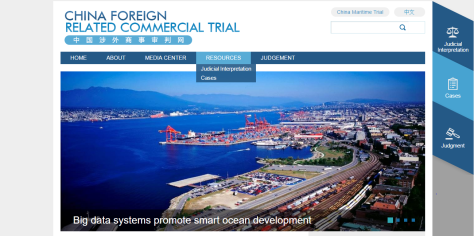
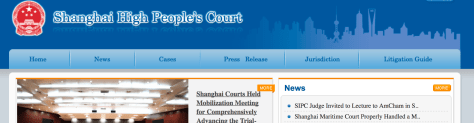
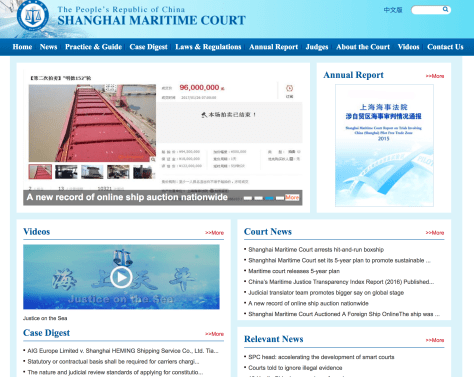 The Shanghai maritime court’s bilingual white paper for 2014 and 2015 is downloadable in PDF (under the Annual Report tab), the Court News is relatively timely, The case digests are useful and calendar lists upcoming court hearings (however without information concerning how an interested person could attend them). Unusually for a Chinese court website, the Judges tab has photos of judges other than the senior leadership. The Contact Us tab (unusual for a Chinese court) has only telephone numbers for the court and affiliated tribunals, rather than an email (or Wechat account). Of course the information on the Chinese side of the website is more detailed (under the white paper tab, for example, a detailed analysis of annual judicial statistics can be found), and the laws & regulations tab might usefully set out maritime-related judicial interpretations, but most of the information is well organized and relevant. Similar comments can be made about the Guangzhou maritime court’s website (
 Supreme People's Court Monitor
You must be logged in to post a comment.