On December 28, 2025, the Supreme People’s Court (SPC) issued its 2024 annual report on judicial review of commercial arbitration. I am attaching the report in both PDF and its original Word format to enable readers outside to download the report easily. The report includes 16 typical cases (典型案例). This report is Chinese only, and an English version is likely to be forthcoming.
The Chinese courts accepted 19422 judicial review of arbitration cases in 2024, the vast majority of which were domestic. Only 121 of those cases involved awards from outside China. Most of those cases were applications to set aside arbitral awards (11576) , 5768 cases were applications to confirm the validity of an arbitration agreement.
The number of cases reported to the SPC under its prior reporting system was 28, while 2023 was 29. Of that number, three were Hong Kong, Macau, and Taiwan awards, while two were foreign awards.
For anyone interested in the role of the SPC in legislation (as I wrote about in my article on how the SPC supports the development of foreign-related rule of law (long/short version), the report mentions that in 2024, the SPC was deeply involved in the work to amend the Arbitration Law (2024年,最高人民法院深度参与《中华人民共和国仲裁法》(以下简称《仲裁法》)立法修订工作).
There is a great deal of interesting information for practitioners and academics, but competing obligations do not permit me to analyze the report in detail at this point.
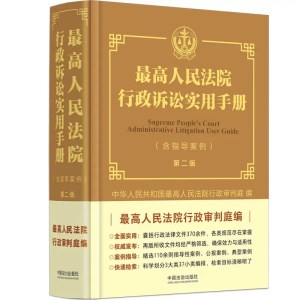
A recent message in the WeChat public account of the Supreme People’s Court (SPC)’s Administrative Division was devoted to promoting its new book, Supreme People’s Court Administrative Litigation User’s Guide (Administrative Litigation User’s Guide (2nd edition), 最高人民法院行政诉讼实用手册), shown in the photo above. Had the SPC’s #4 Civil Division had a WeChat public account last year when they published 涉外涉港澳台民商事审判业务手册( Foreign-Related, Hong Kong, Macao and Taiwan Related Commercial Trial Work Guide — “Foreign-Related Judicial Handbook”), I am sure that I would have received a similar message. I had previously thought that judicial handbooks were a historical artifact of the days before electronic databases. In my 1993 article, I discussed the phenomenon of judicial handbooks:
..A …problem is presented when the lack of consistency in issuance and authority makes it difficult for the lower courts to know when an interpretation is no longer valid…The [SPC] tries to cure these problems by issuing handbooks for adjudication in various subject areas….The Research Office and other divisions of the Court compile adjudication handbooks such as Sifa Shouce [司法手册] (Judicial Handbook), many of which are internal publications.
Some of those historical handbooks can be found in my research library of Supreme People’s Court publications–see here and below:
Two Administrative Litigation Judicial Handbooks and the second volume of the Judicial Handbook
Why would specific divisions of the SPC return to the practice of issuing judicial handbooks in printed form? How does it link with the role of the SPC? What sources have the editors included, and what could students, scholars, and practitioners learn from that?
Official reasons for publishing these print books
The authors of the Administrative Litigation User’s Guide describe the reasons for publishing the book as follows:
the Supreme People’s Court, on the one hand, provides professional guidance (业务指导) by formulating judicial policies 司法政策), issuing guiding cases, and making judicial replies (司法答复); on the other hand, it strengthens research and collects problems, and formulates judicial interpretations based on the accumulation and maturity of judicial practice. At present, the comprehensive judicial interpretation of the Administrative Litigation Law, the judicial interpretation of administrative agreements, and the judicial interpretation of the appearance of administrative agency heads in court to respond to lawsuits have been formulated and issued…, and there are more and more normative documents and guiding cases related to administrative litigation. In addition, with the increase in the number of administrative cases, more judges have joined the administrative trial team. In the process of gradually becoming familiar with administrative litigation, they urgently need to master the relevant provisions that have been issued and learn the relevant guiding cases. However, judicial replies are internal in nature, with a large volume and lack of a unified release mechanism. The channels for obtaining them from the outside world are limited, which is time-consuming and laborious.
According to the announcement, the audience for the Administrative Litigation User’s Guide is staff in administrative agencies, judicial practitioners, and researchers of administrative law [students and academics]. The editors note that to provide readers with reference materials and to make the book more practical, they have included guiding cases, SPC Gazette Cases, and typical cases from the last 10 years.
The #4 Civil Division authors/editors say their handbook is urgently needed by front-line judges and as a reference book for judges, arbitrators, lawyers, and other practitioners, and, I would add, to students and scholars seeking to decode the foreign-related and Hong Kong, Macau, and Taiwan-related operations of China’s judiciary.
Legal basis for publishing these books
Publishing these books is linked to Article 10 of the Organic Law of the People’s Courts and relateddocuments, which authorize the SPC to supervise and guide(监督指导) the lower courts.
Comments on the content
Both books contain judicial interpretations and a range of SPC guidance documents such as meeting minutes/conference summaries (会议纪要), notices, and replies to requests for instructions, signaling to the reader that they are important sources of reference for judges and that “soft law” may understate the way that meeting minutes are understood within the Chinese court system.
The authors/editors of the Foreign-Related Handbook included many other types of legal provisions they considered relevant for hearing cross-border cases, such as relevant national legislation, administrative regulations, such as foreign exchange regulations, Chinese versions of international commercial rules (Incoterms, ICC Uniform Rules for Demand Guarantees (URDG 758), ISP 98) ), Hague Conventions to which China has acceeded, and civil judicial assistance treaties, as well as some of the National People’s Congress Standing Committee decisions related to some of the international conventions. The #4 Civil Division did not include guiding, typical cases, and other types of cases it issues for reference. In my view, it was a practical decision that does not imply that those types of cases are irrelevant to judges hearing cross-border commercial cases, but rather that including cases would make the book too long to be published as a single volume.
Comment
The underlying rationale for publishing these judicial handbooks has not changed much in the past 30 years. Judges responsible for processing cases efficiently and correctly face similar challenges: sorting out the current legal position on an issue quickly despite the piecemeal way that the SPC develops the law, locating and assessing the validity of historical documents, easily identifying special arrangements, and for cross-border cases, understanding how to correctly implement international conventions, treaties and practices and correspondingly arrangements or related provisions concerning cases involving Hong Kong, Macau and Taiwan parties.
One experienced senior judge in a local court noted that judges are often asked to rotate among divisions (tribunals) periodically. Senior judges recommend that new joiners read these handbooks to familiarize themselves quickly with a different (and complicated) area of law.
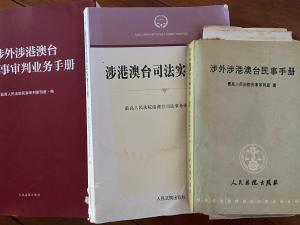
From the left, the 2024 Foreign-Related Handbook, a 2013 Hong Kong, Macau, Taiwan Related Judicial Handbook, and the 1992 Foreign, Hong Kong, Taiwan-Related Civil Matters predecessor volume
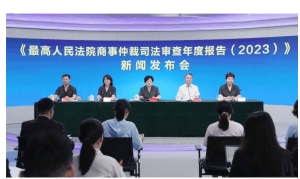
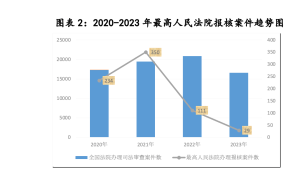
The Supreme People’s Court (SPC), along with the Ministry of Justice, held a press conference on 9 September, reported here, to announce the publication of the 2023 annual report of judicial review of commercial arbitration. It was written by the SPC’s #4 Civil Division in collaboration with the Capital University of Economics and Business. I have attached the report as a PDF to enable readers in the United States and any other jurisdictions where the SPC’s official website is unavailable to download the report. This report is Chinese only, and an English version is understood to be forthcoming. There is a great deal of interesting information for practitioners and academics, but competing obligations do not permit me to analyze the report in detail. The number of cases reported to the SPC under its prior reporting system was reduced enormously (29 in 2023, compared to 350 in 2021, related to an amendment of the 2017 judicial interpretation on reporting procedures ). See the statistics from the report:
Trends in SPC Prior Review of Arbitration, 2020-2023 (yellow), blue columns are the total number of judicial review of arbitration cases
An infographic summarizing the results is in this report.
For anyone interested in the role of the SPC in legislation (as I wrote about in my article on how the SPC supports the development of foreign-related rule of law (long/short version), the report has a section describing in detail the SPC’s contribution to the drafting of amendments to the Civil Procedure Law, amendments to Arbitration Law, the drafting of Foreign State Immunity Law, etc.)
President Zhou Qiang visiting the University of International Business & Economics
Since the Fourth Plenum of the 19th Party Congress, and especially since President Xi Jinping spoke about the need for China to train foreign-related legal personnel (涉外法治人才), the Supreme People’s Court (SPC) press, SPC leadership, and others important to the SPC leadership, such as Shen Deyong, former executive vice president of the SPC and current leaders of the CPPCC have reiterated the importance of “foreign-related legal personnel” to China and the people’s courts. Training “foreign-related legal personnel” is incorporated into the Party’s Plan for Building the Rule of Law (2020-2025), an indication of its importance. Shen Deyong criticized the way that “foreign-related legal personnel” is used within government institutions– “team is too small, their numbers are too few, they are scattered and the market is chaotic.””涉外法律服务人才队伍建设还存在一些问题和不足,主要呈现队伍“小”、人才“少”、分布“散”、市场“乱”的特点. I would add to the issues that he flagged that policies directed towards attracting “foreign-related legal personnel” to the courts inevitably encounter the special characteristics of the courts’ personnel system as it has evolved since the quota judge reform was implemented, both the training system and especially career advancement from judges assistant to quota judge.
As readers of this blog know, the Chinese courts need “foreign-related legal personnel” in many areas. Those include working on cross-border cases across a broad range of procedural and substantive areas, undertaking research related to cross-border judicial policy and cross-border legal issues that have an impact on the judiciary, as well as working on a range of issues related to the SPC’s and lower courts’ interactions with the outside world.
Law students apply to become judges assistants after graduation for a variety of reasons. Some become further interested after internships (see this blogpost on SPC interns–a version with more data may appear later). Other law school graduates are motivated by presentations by outstanding judges at their law school (SPC Judge Gao Xiaoli’s 2015 talk at the Peking University School of Transnational Law earned her many new fans), while still others recognized that a job “in the system” would resolve their hukou problems and enable them to live in Beijing, Shanghai, or other major cities. Yet others are motivated to use their education in the service of the public. I can say with authority that law graduates with knowledge of transnational law, fluency in English (and other foreign languages) are working as legal assistants in courts all over China. Recruitment of legal assistants is a local matter, so the #4 Civil Division of the SPC (in charge of foreign commercial matters) and likely the Political Department of the SPC (in charge of personnel) lacks statistics on the number of “foreign-related legal personnel” working in the local courts.
Special characteristics of the courts’ personnel system
I write about the judiciary’s personnel system with some trepidation as I am well aware that my knowledge of the regulatory system is incomplete. (Some of the relevant regulations cited in analyses of the personnel reforms are not accessible to those outside the court system.) On the issue of placement of junior “foreign-related legal personnel,” I have not heard from either knowledgeable persons, former students, or other junior personnel in the Chinese court system that specific policies have been implemented within the court system (the Political Department of the SPC is responsible at the national level, and locally, political departments of local courts are responsible) to channel judges assistants recruited from China’s law schools with transnational training and experience into roles in which their academic background can be used and their “foreign-related” legal skills can be developed. In the absence of specific policy, too many local court leaders appear to see the young people with a transnational legal background and experience merely as workers that can be put to work in the national judicial machine (司法民工). Judges assistants from higher courts are sometimes sent down to the local level to work for two years, in line with young cadre development policy.
Training
If the three documents cited above have language about training, it seems likely that a training plan is somewhere in the approval pipeline. My guess is that this is yet another matter that requires coordination among multiple institutions within the SPC, including the #4 Civil Division–the ones asking for the training to be done, with the Political Division and the National Judges College. As I wrote last year, a new national court training plan (2019—2023年全国法院教育培训规划)) is underway. As senior leadership has called for cultivating “foreign-related legal personnel,” it seems likely that the SPC will eventually issue (perhaps not publicly) a training plan for judges handling all sorts of foreign-related issues, both civil-commercial and criminal.
Career advancement
Another issue for foreign-related legal personnel in the courts is career advancement for judges assistants. As I mentioned in passing in an earlier blogpost, career advancement from judges assistant to quota judge has slowed. Specific promotion criteria are set locally. Local studies have been done on the role of the judges assistant but have not surmounted the language barrier (see this one from one of the Chongqing Intermediate People’s Courts) that provide specific data and specific analysis deriving from local conditions. From my observations, fixed quotas on the number of judges in a court can mean a talented, educated judges assistant in one court may wait significantly longer than a similarly qualified person in another court to become a judge.
Concluding thoughts
Unless the SPC can evolve better national policy directed towards a career for “foreign-related legal personnel,” some of them will leave, disappointed with the failure of the judicial system to use their talents, despite the official publicity. There will be many companies and law firms, some dealing with the issues I described previously, that will value them.
For those for whom the timing is right, tomorrow’s (14 May afternoon) event gives the interested person an opportunity to watch a discussion in real-time concerning a new hard-law legal “Arrangement” (it is now clear that the document is not so entitled) between the Mainland (presumably the Supreme People’s Court (SPC) and the Hong Kong Special Administrative Region (Hong Kong SAR) on bankruptcy (insolvency) law and learn about relevant recent updates. The document is the Conference Summary [Meeting Minutes] on Procedures for the Mutual Recognition of and Assistance in Insolvency Procedures by the Courts of the Mainland and the Hong Kong SAR (内地与香港特别行政区法院相互认可和协助破产程序的会谈纪要). At the same time, the SPC is releasing an Opinion approving pilot projects to implement the Conference Summary 最高人民法院关于开展认可和协助香港特别行政区破产程序试点工作的意见. A pilot project approach is usual when the SPC wants to test whether procedures are workable before implementing them nationwide.
A social media posting by one of Hong Kong’s leading barristers chambers describes it as the “most momentous cross-border insolvency development in a generation. ” Although it is not so stated, I surmise (by reviewing the press conference announcing the Supplemental Arrangement Concerning Mutual Enforcement of Arbitral Awards between the Mainland and the Hong Kong Special Administrative Region” (the Supplemental Arrangement (关于内地与香港特别行政区相互执行仲裁裁决的补充安排), that the official signing of the new insolvency Arrangement will be held in the morning, after which a press conference will be held. My guess, based on that press conference, is that SPC Vice President Yang Wanming (杨万明副院长) will sign on behalf of the SPC and that Hong Kong SAR Secretary for Justice Teresa Cheng will sign on behalf of the Hong Kong SAR Government. The link to the SPC’s press conference indicates that Vice President Yang Wanming will in fact sign and that Judge Si Yanli will participate in the signing ceremony and the press conference.
According to the social media posting above, Mr. Justice Jonathan Harris, current Companies and Insolvency Judge of Hong Kong’s High Court, will be delivering a keynote speech during the afternoon Forum announced above. My guess (without any factual basis) is that Judge Si Yanli will give a keynote as well. The Arrangement is likely to have involved a great deal of hard work on the part of all involved in the drafting.
Justice Harris’s judgments contain valuable insights into some of Hong Kong’s cross-border insolvency-related issues, such as the intersection between stock exchange listings and insolvency. His decision in the Winding-Up Proceedings of China Huiyuan Juice Group is a good example:
As I explained at the outset of this decision the court is hearing many petitions to wind-up listed companies whose businesses are in the Mainland. Since the court resumed hearings in May more than half the petitions I have heard have involved listed companies. Remarkably petitions to wind-up Hong Kong incorporated companies operating domestic businesses are currently a minority… What is now quite clear is that the use of the group structures I have described present difficulties. It will be useful if I describe these and what I anticipate will be their impact for creditors and shareholders in Hong Kong and other jurisdictions….
As will be apparent from this decision the practice has developed of Mainland businesses listing in Hong Kong using corporate vehicles which have no connection with the Mainland, which is commonly the COMI [Center of Main Interest], , or Hong Kong where the business is to be listed. The structure is made more complicated by group architecture which involves inserting between the listed company and the mainland companies at least one, and my impression is commonly more than one, intermediate subsidiary incorporated in a different offshore jurisdiction. As this decision demonstrates this structure creates a significant barrier to steps being taken by creditors and shareholders to enforce rights using the courts of Hong Kong, which is the legal system that they have probably assumed they will be able to access if they need to take steps to enforce their legal rights against a company listed here.
As I have previously written, cross-border bankruptcy (insolvency) law is an area of particular focus of the SPC. Phrases in two 2020 SPC Opinions signal this Arrangement. Article 16 of the November 2020 SPC Opinion on Providing Support and Guarantees for Shenzhen to Build Itself into a Pilot Demonstration Zone for Socialism with Chinese Characteristics (最高人民法院关于支持和保障深圳建设中国特色社会主义先行示范区的意见) states:
Promote the establishment of a cross-border bankruptcy recognition and assistance mechanism推动建立跨境破产认可与协助机制.
12. Properly handle cross-border bankruptcy [insolvency], financial, and enforcement cases.Adhere to the principle of equal protection for similar claims, actively participate in and promote the formulation of international treaties on cross-border bankruptcy [insolvency], improve the coordination mechanisms for cross-border bankruptcy [insolvency] and protect the rights and interests of creditors and investors in accordance with the law…12.妥善处理跨境破产、金融、执行案件。坚持同类债权平等保护原则,积极参与和推动跨境破产国际条约的制定,完善跨境破产协调机制,依法保护债权人和投资人权益。
This single issue illustrates the close reading skills needed to understand SPC Opinions.
Further analysis of the implications of the Arrangement will need to follow its release.
1st Joint conference meeting on the Hong Kong BRI Arrangement
If you have never heard of hard and soft law Arrangements (安排) and other agreements between Mainland authorities and the Hong Kong and Macau Special Administrative Region (SAR) governments, do not be surprised. The classification is my own and I see it as useful to capture the types of Arrangements and other soft law agreements that have been signed between certain Mainland authorities and the Hong Kong SAR and the Macau SAR, as well as Arrangements between the two SARs. This blogpost highlights several of the more important soft law Arrangements and other agreements between the mainland authorities and the SAR governments.
This classification harmonizes with the analysis of Professor Wang Heng of the University of New South Wales concerning Belt & Road Initiative Agreements.
Definition of Arrangements
Although I have written previously aboutArrangements between the Supreme People’s Court (SPC) and the Hong Kong Special Administrative Region (SAR) Government, I have not seen an official definition of “Arrangement.” It appears to be used as a form of agreement between certain Mainland authorities (intended to include institutions such as the Supreme People’s Court and the Standing Committee of the National People’s Congress as well as ministries and commissions under the State Council ( and it seems some counterparts at the provincial level) and the government of the Hong Kong or Macau SAR. Some are between the two SARs. I have not seen an equivalent to the Law on the Procedure for the Conclusion of Treaties. Perhaps guidance exists internally. I surmise (from my blogpost on the recent SPC Arrangement) that the Hong Kong and Macau Affairs Office supervises Arrangements.
What I had not realized until recently that Arrangements are far more numerous and cover a broader range of areas than most legal professionals outside of China (including me) are generally aware of. Both types of Arrangements can include affiliated measures, such as joint [steering] conferences 联席会议 (related to one of my recent posts ) and yearly implementation measures, such as agreed areas for cooperation.
Hard and Soft Law Arrangements
The “Hard Law Arrangements” often have content that is somewhat analogous to a treaty between sovereigns-that is, they have normative content, while the “Soft Law Arrangements” have more soft law content, some more analogous to the ones Professor Wang Heng discussed in the BRI context, while others have language found in domestic Chinese government documents. I will borrow the definition that Professor Wang Heng uses in his article: soft law refers to quasi-legal obligations or law-like promises that are not legally binding but may affect state behavior. His definition draws on earlier work, such as that of my colleague Professor Francis Snyder. (My colleague has a forthcoming book chapter on soft law.)
Professor Wang Heng describes Belt & Road Initiative (BRI) primary agreements (soft law agreements) as largely emphasizing project development rather than rule development. This is also seen to some extent with “soft law Arrangements.”
“Hard Law” Arrangements
“Hard Law Arrangements” and other “hard law” agreements between mainland authorities and the Hong Kong and Macau SARS are well-known, so this section only mentions a few of the most prominent:
Professor Henry Gao noted in an article that during the negotiations leading to the conclusion of the CEPAs, it had been suggested that they should be called free trade agreements (FTAs) but they were named “Closer Economic Partnership Arrangements” instead. He commented that in substance, the two CEPAs are no different from the other FTAs around the world.
For those interested, the Ministry of Commerce (MOFCOM) has a webpage that consolidates the related Macau supplemental agreements.
Dispute Resolution Arrangements
Hong Kong’s Department of Justice has a webpage (available in multiple languages) with links to arbitration-related Arrangements as well as recognition and enforcement of civil and commercial judgments Arrangements. The webpage also links to Arrangements involving other Hong Kong SAR government departments. It appears that some agreements mentioned on that webpage may be soft law documents, but I have not seen the full text of some of these documents so cannot confirm.
An Arrangement on the Mutual Recognition and Enforcement of Arbitral Awards between the Supreme People’s Court and the Macau SAR Government also exists.
Many other hard law Arrangements have been signed, but I have not seen a single repository of these documents. It is my hope that the Hong Kong Government can do so.
Soft Law Arrangements and Other Soft Law Agreements
It appears that less attention has been paid to soft law Arrangements and other soft law agreements. There are also memoranda of understanding (MOU), with analogous usage to those in BRI projects. A number of the important ones are highlighted below.
July, 2017 National Development and Reform Commission, People’s Government of Guangdong Province, Government of the Hong Kong Special Administrative Region, Government of the Macao Special Administrative Region Framework Agreement on Deepening Guangdong-Hong Kong-Macao Cooperation in the Development of the Greater Bay Area Greater Bay Area (GBA Framework Agreement)
This Framework Agreement is a soft law agreement that links hard and soft law content. In discussing BRI soft law agreements, Professor Wang Heng mentions Project-Linked Agreements and Mechanism-Creating Agreements and mentions that some combine both. The GBA Framework Agreement mentions some of the above hard law Arrangements, with a great deal of new soft law content aimed at promoting the development of the GBA. It flags what was then forthcoming BRI Arrangements. Among the goals cited:
deepen co-operation between the Bay Area and related countries and regions in… legal and dispute resolution services… and to build an important support area for pursuing the Belt and Road Initiative.for Hong Kong…
establish a centre for international legal and dispute resolution services in the Asia-Pacific Region…
This is the document that attracted my interest in “soft law Arrangements.” Several articles relate to developing Hong Kong’s role in dispute resolution, such as:
2.To support Hong Kong in developing high value-added maritime services, including…maritime law and dispute resolution,
26. To support Hong Kong in establishing itself as a centre for international legal and dispute resolution services in the Asia-Pacific region to provide relevant services for the Belt and Road Initiative.
The development of the regional legal service and dispute resolution center of the Hong Kong Special Administrative Region (“Hong Kong SAR”) shall be further supported, the cooperation between arbitration institutions in Hong Kong such as Hong Kong International Arbitration Centre and arbitration institutions in the Mainland, the arbitration institutions in the Hong Kong SAR shall be introduced to the construction of the “one-stop” dispute resolution platform of international commercial courts… and the Hong Kong SAR shall play a more important role in the joint development of the “Belt and Road” Initiative. 进一步支持香港特别行政区区域法 律服务和纠纷解决中心的建设,支持 香港国际仲裁中心等仲裁机构与内地 仲裁机构的合作,在国际商事法庭 “一站式”纠纷解决平台建设中适当 引入香港特别行政区仲裁机构…不断发挥 香港特别行政区在共建“一带一路” 中的重要作用。
The Arrangement establishes a joint conference mechanism (that features in several Arrangements) comprising responsible officials from the National Development and Reform Commission (NDRC), the Hong Kong and Macao Affairs Office of the State Council and other relevant departments as well as senior representatives of the HKSAR. The SPC has participated in at least two of these meetings, but from the reports on the meetings, does not appear to be a joint conference member institution.
Under the Arrangement, the two sides have agreed, in related documents, upon major areas of work and in 2020, allocation of responsibilities and have established an annual joint conference. It is unclear whether a similar set of documents exist for the Hong Kong BRI Arrangement.
The Macau and Hong Kong BRI Arrangements are quite different from one another and deserve further analysis. Under the Macau BRI Arrangement, for example, the Macau SAR Government undertakes to be a platform for liaison with Lusophone countries.
It is unclear why there is no courtesy English translation of this Arrangement (as there is for the Hong Kong BRI Arrangement). The content of this Arrangement provides insights into plans for Hong Kong and the Mainland to cooperate in the area of science and technology, but time does not permit further analysis.
A final comment is that it appears to be difficult to locate the full text of some of the soft law Arrangements reported.
More to Come?
I surmise that the Hong Kong and Macau SARs’ futures will involve more hard and soft law Arrangements and other agreements with the Mainland. The topic of these agreements deserves closer attention. I hope that someone with an interest, the time, and the language skills can take this research forward.

 A recent message in the WeChat public account of the Supreme People’s Court (SPC)’s Administrative Division was devoted to promoting its new book, S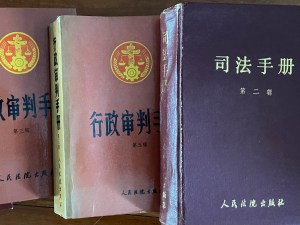

 For those for whom the timing is right, tomorrow’s (14 May afternoon) event gives the interested person an opportunity to watch a discussion in real-time concerning a new
 Supreme People's Court Monitor
You must be logged in to post a comment.