Category Archives: conference summary

Benchbooks (Judicial Handbooks) for the New Era

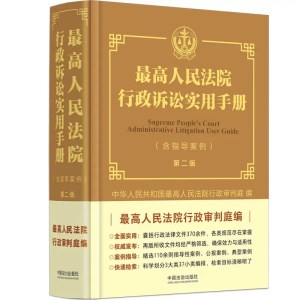
A recent message in the WeChat public account of the Supreme People’s Court (SPC)’s Administrative Division was devoted to promoting its new book,  Supreme People’s Court Administrative Litigation User’s Guide (Administrative Litigation User’s Guide (2nd edition), 最高人民法院行政诉讼实用手册), shown in the photo above.   Had the SPC’s #4 Civil Division had a WeChat public account last year when they published 涉外涉港澳台民商事审判业务手册( Foreign-Related, Hong Kong, Macao and Taiwan Related Commercial Trial Work Guide — “Foreign-Related Judicial Handbook”), I am sure that I would have received a similar message.  I had previously thought that judicial handbooks were a historical artifact of the days before electronic databases.   In my 1993 article, I discussed the phenomenon of judicial handbooks:

..A …problem is presented when the lack of consistency in issuance and authority makes it difficult for the lower courts to know when an interpretation is no longer valid…The [SPC] tries to cure these problems by issuing handbooks for adjudication in various subject areas….The Research Office and other divisions of the Court compile adjudication handbooks such as Sifa Shouce [司法手册] (Judicial Handbook), many of which are internal publications.

Some of those historical handbooks can be found in my research library of Supreme People’s Court publications–see here and below:
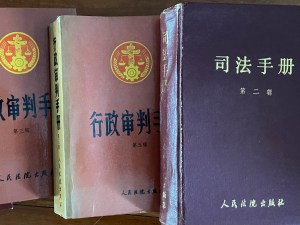
Two Administrative Litigation Judicial Handbooks and the second volume of the Judicial Handbook

Why would specific divisions of the SPC return to the practice of issuing judicial handbooks in printed form?  How does it link with the role of the SPC? What sources have the editors included, and what could students, scholars, and practitioners learn from that?

Official reasons for publishing these print books

The authors of the  Administrative Litigation User’s Guide describe the reasons for publishing the book as follows:

the Supreme People’s Court, on the one hand, provides professional guidance (业务指导) by formulating judicial policies 司法政策), issuing guiding cases, and making judicial replies (司法答复); on the other hand, it strengthens research and collects problems, and formulates judicial interpretations based on the accumulation and maturity of judicial practice. At present, the comprehensive judicial interpretation of the Administrative Litigation Law, the judicial interpretation of administrative agreements, and the judicial interpretation of the appearance of administrative agency heads in court to respond to lawsuits have been formulated and issued…, and there are more and more normative documents and guiding cases related to administrative litigation. In addition, with the increase in the number of administrative cases, more judges have joined the administrative trial team. In the process of gradually becoming familiar with administrative litigation, they urgently need to master the  relevant provisions that have been issued and learn the relevant guiding cases. However, judicial replies are internal in nature, with a large volume and lack of a unified release mechanism. The channels for obtaining them from the outside world are limited, which is time-consuming and laborious.

According to the announcement, the audience for the Administrative Litigation User’s Guide is staff in administrative agencies, judicial practitioners, and researchers of administrative law [students and academics].  The editors note that to provide readers with reference materials and to make the book more practical, they have included guiding cases, SPC Gazette Cases, and typical cases from the last 10 years.

The #4 Civil Division authors/editors say their handbook is urgently needed by front-line judges and as a reference book for judges, arbitrators, lawyers, and other practitioners, and, I would add, to students and scholars seeking to decode the foreign-related and Hong Kong, Macau, and Taiwan-related operations of China’s judiciary.

Legal basis for publishing these books

Publishing these books is linked to Article 10 of the Organic Law of the People’s Courts and related documents, which authorize the SPC to supervise and guide(监督指导) the lower courts.

Comments on the content

Both books contain judicial interpretations and a range of SPC guidance documents such as meeting minutes/conference summaries (会议纪要), notices, and replies to requests for instructions, signaling to the reader that they are important sources of reference for judges and that “soft law” may understate the way that meeting minutes are understood within the Chinese court system.

The authors/editors of the Foreign-Related Handbook included many other types of legal provisions they considered relevant for hearing cross-border cases, such as relevant national legislation, administrative regulations, such as foreign exchange regulations, Chinese versions of international commercial rules (Incoterms, ICC Uniform Rules for Demand Guarantees (URDG 758), ISP 98) ), Hague Conventions to which China has acceeded,  and civil judicial assistance treaties, as well as some of the National People’s Congress Standing Committee decisions related to some of the international conventions.  The #4 Civil Division did not include guiding, typical cases, and other types of cases it issues for reference.  In my view, it was a practical decision that does not imply that those types of cases are irrelevant to judges hearing cross-border commercial cases, but rather that including cases would make the book too long to be published as a single volume.

Comment

The underlying rationale for publishing these judicial handbooks has not changed much in the past 30 years.  Judges responsible for processing cases efficiently and correctly face similar challenges:  sorting out the current legal position on an issue quickly despite the piecemeal way that the SPC develops the law, locating and assessing the validity of historical documents, easily identifying special arrangements, and for cross-border cases, understanding how to correctly implement international conventions, treaties and practices and correspondingly arrangements or related provisions concerning cases involving Hong Kong, Macau and Taiwan parties.

One experienced senior judge in a local court noted that judges are often asked to rotate among divisions (tribunals) periodically.  Senior judges recommend that new joiners read these handbooks to familiarize themselves quickly with a different (and complicated) area of law.
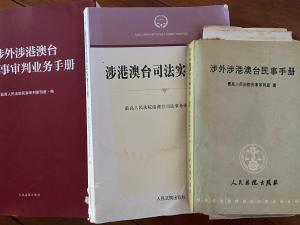

From the left, the 2024 Foreign-Related Handbook, a 2013 Hong Kong, Macau, Taiwan Related Judicial Handbook, and the 1992 Foreign, Hong Kong, Taiwan-Related Civil Matters predecessor volume


Supreme People’s Court Developments, December 2024-January 2025

from the report on the 2025 Central Political-Legal Work Conference on one of the SPC’s websites

See below a brief summary of recent developments  (or at least the principal recent developments) at the Supreme People’s Court (SPC) in January 2025 (as of January 19, the date of publication of this post) and December 2024.

January 2025

  1. On January 8th, the Party leadership heard the SPC Party Group’s report on the SPC’s work, along with those of other institutions.  I mention the requirement for this report in my 2024 article;

certain phrases (such as “report to a superior on their work” [shuzhi 述职] imply a hierarchical relationship between the SPC and the Central Political-Legal Committee and the Party Center. The fact that the SPC reports to the Party leadership can be seen in public reports on the leadership of the political-legal institutions meeting with Xi Jinping and other senior leaders before the annual sessions of the National People’s Congress and Chinese People’s Political Consultative Congress, although the materials actually submitted to the Party leadership are not publicly accessible.)

2.  January is when many important conferences are held that have an impact on the work of the courts: the Central Political-Legal Work Conference (中央政法工作会议) and the National Conference of Higher Court Presidents (Higher Court Presidents Conference 全国高级法院院长会议),  at which the spirit of the Political-Legal Work Conference is transmitted and the goals for judicial work in 2025 are announced. The SPC has held this conference annually for many years. In the recent historical past (the early 1990’s, for example), the Higher Court Presidents Conference was called the National Court Work Conference.

3. Policy documents: 

a. In early January, the SPC and the All-China Federation of Overseas Chinese (Overseas Chinese Federation 中国侨联权益保障部) issued a joint policy document on the strengthening the judicial protection work of the interests of overseas Chinese and returned overseas Chinese and their families in the New Era (关于加强新时代侨益司法保护工作的意见), and related reference cases.  The document seeks to ease litigation formalities for these groups and promote resolving disputes through mediation, among other matters, such as improving research on Overseas Chinese-related issues, such as through establishing a research base, as has been done with other issues.  The title of this document differs from Zhou Qiang era policy documents, but the goal of providing judicial support for an important national policy goal is the same. 

The SPC’s Research Office led the drafting of this document, in cooperation with the Overseas Chinese Federation.  This responsibility is consistent with the role of the Research Office, which deals with many legal policy and cross-internal institutional matters, such as Hong Kong, Macau, and Taiwan-related issues and the transition to the Civil Code.  It does not hear cases.

This is the first joint policy document between the SPC and Overseas Chinese Federation. Closer cooperation between the two institutions began in 2018, with 30 courts piloting closer cooperation with local Overseas Chinese Federations, and with the 2020 establishment of a “general-to-general” online mediation mechanism (the SPC has established this type of mechanism with the China Securities Regulatory Commission and other institutions).    The policy document is linked to language in recent Party Plenums on protecting the rights of returned Overseas Chinese and Overseas Chinese and their families.

b. Opinions of the Supreme People’s Court on Serving Technological Innovation with High-quality Trial Services 最高人民法院关于以高质量审判服务保障科技创新的意见.  The press conference report is here.  China IP Law Update’s summary in English is here.  If time had permitted, I would discuss the links in this document with the recent Party Plenum and other Party initiatives.

4. Judicial interpretations:

a. The SPC issued its second interpretation of the Marriage and Family Part of the Civil Code, aimed at addressing common troublesome issues facing the courts, such as property division when a cohabiting couple split, many issues relating to divorcing couples, including property division and ownership of a company established by a couple.  To provide further guidance on applying the interpretation, the SPC issued typical cases. This interpretation provides important insights into family law issues in current Chinese society.  

b.  The SPC joined with the Supreme People’s Procuratorate to issue the Interpretation of Several Issues Concerning the Application of Law in Handling Criminal Cases of Attacks on Police Officers (关于办理袭警刑事案件适用法律若干问题的解释).  From the provisions of this interpretation,  the confusion lower-level procuratorates and courts had about the application of Article 277 of the Criminal Law is apparent.

5. Other typical cases issued in January included: one on protecting natural reserves and national parks; another on punishing rural saohei (underworld forces) crimes; protecting the rights and interests of foreign investors; and refusing to pay wages (6200+ cases in the past four years)

6. The SPC established its Judges’ Disciplinary Committee, with President Zhang Jun as the chair.  At the first meeting, he noted that the establishment of a judges’ disciplinary committee and the implementation of a judges’ disciplinary system are political requirements for implementing the decisions and arrangements of the CPC Central Committee.  In 2021, I published a book chapter on Chinese judicial disciplinary developments, available here.

December 2024

December is the end of the year, so the SPC always issues many documents–judicial interpretations, policy documents, guiding and typical cases etc. at year’s end.  2024 was no exception. Among the documents worth noting:

  1. Judicial interpretations and meeting minutes

a. The SPC and the China Securities Regulatory Commission (CSRC) issued meeting minutes (conference summary) on bankruptcy (insolvency)  and reorganization of listed companies.  From the document number, it appears that the SPC took the lead in drafting it and it provides an update to a 2012 conference summary that the SPC issued itself. A DeHeng law firm partner comments here on the meeting minutes. The CSRC is soliciting public comments on Regulatory Guidelines for Listed Companies No. 11 – Matters Related to Bankruptcy and Reorganization of Listed Companies (this link contains the text and an explanation).  

b. On December 25, the SPC issued a Decision on Amending the Supreme People’s Court’s Regulations on Acknowledgement and Execution of Civil Judgments from Taiwan Area Courts, Chinese original 最高人民法院关于修改《最高人民法院关于认可和执行台湾地区法院民事判决的规定》的决定.  An English language summary is available here.  From a quick look, most amendments are procedural or unsurprising. Some reflect amendments to the Civil Procedure Law or codifying court practice. The provision “the people’s court shall make a ruling not to acknowledge a civil judgment if acknowledging it would violate fundamental principles of state laws, such as the one-China principle, or undermine state sovereignty, security, or social public interests” is consistent with analogous provisions and codifies what has been court practice.

2.  Guiding cases: on December 25, the SPC issued six guiding cases on state compensation issues, some of which provide glimpses of problems with prison management; On December 24, the SPC issued the first group of guiding cases on labor issues.

3. Typical cases: The SPC issued many typical cases in December 2024. As I mentioned previously, President Zhang Jun favors using typical cases to guide the lower courts in correctly applying the law.

The SPC issued typical  cases on: the protection of the rights and interests of the elderly; administrative public interest litigation (second group), issued jointly by the SPC and SPP;  “one letter and two books”  labor law supervision, issued jointly by the SPC, the SPP and the All-China Federation of Trade Unions;  wage arrears, issued in cooperation with the All-China Federation of Trade Unions and the Ministry of Human Resources and Social Security;  two groups of financial loan dispute mediation cases, issued by the  State Financial Supervision and Administration Bureau and the SPC, with one case providing a model for dealing with non-performing microloan cases; rights and interests of Taiwan compatriots, linked to the Party’s policy on promoting cross-straits integration and development; crimes involving counterfeit safety production qualification certificates (linked to a policy document issued in July, 2024 that does not appear to be publicly available (关于进一步加强安全生产资格证书涉假案件刑事审判工作的通知)); petty corruption (each case provides insights into the world of official corruption); punishing illegal production, sales, and use of eavesdropping and stealing equipment, with several cases involving the hidden filming (and marketing of those films) of people having sex in hotel rooms; inheritance disputes (first  and second group); criminal punishment of illegal fishing; and traffic accident liability.

3. Policy documents: Guiding Opinions on Improving the Quality and Efficiency of Trial Work and Promoting the Substantial Resolution of Contradictions and Disputes (关于在审判工作中促进提质增效 推动实质性化解矛盾纠纷的指导意见).  This document focuses on civil and administrative disputes, promoting mediation (Fengqiao Experience) and the resolution of the substance of disputes (as discussed here).  I will draw on this document in a forthcoming article.

4. Plans: 

a. the SPC issued the Sixth Five-Year Judicial Reform Outline.  This article links to the text of the Outline and the related press release. I will publish an article later this year providing a summary and analysis of this document. 

b.  the SPC issued the National Court Education and Training Plan (2024-2028).  I analyzed the previous two plans here and here.  Training of judges handling foreign-related matters receives special attention (see my earlier analysis).

5.  National People’s Committee (NPC) Standing Committee’s Recording & Review:  SPC judicial interpretations and other judicial documents must be filed with the NPC Standing Committee. At the end of 2023, the NPC SC adopted a decision strengthening the recording and review mechanism (see the NPC Observer’s analysis). On 22 December 2024, the Legislative Affairs Commission of the NPC Standing Committee gave its view in its annual report on Recording and Review that a July 2024 Supreme People’s Court interpretation that directed lower courts to retroactively apply a new provision in the recently revised Company Law concerning equity transfers,  controversial in the business community,  was inconsistent with the Legislation Law. The Legislative Affairs Commission stated that the “[they] will urge the relevant judicial interpretation-making authorities to take appropriate measures to properly handle the matter.”  The SPC issued a follow-up interpretation two days after the annual report was made public, signaling that the SPC had been previously been informed.  Although the problematic July 2024 interpretation must have been reviewed by the Legislative Affairs Commission in draft form before it was approved by the SPC judicial committee, as required by Article 18 of the SPC’s Judicial Interpretation Work Provisions, it appears that that whichever office of the Legislative Affairs Commission initially reviewed the SPC’s draft and the office responsible for recording and review took different views. 

____________________________________________________

Thank you, subscribers, for your patience.  The blog will transition from being completely researched and written by me (including discussions with knowledgeable persons and experienced judges, for the avoidance of doubt) sometime after Chinese New Year. I plan to involve my research assistants more in analysis and writing, although I have at least one long analytical blogpost that I will complete soon.   I want to focus on consolidating and developing my research in longer pieces.


Guide to Supreme People’s Court Materials (2)–“Understanding & Application” Publications

Understanding and Application Publications in several forms

Late last year, some followers asked me to describe the principal sources for Supreme People’s Court’s (SPC) research. This is the second of several posts,  as few (particularly outside of China) seem to be aware of the range of publicly available publications of the SPC and its many affiliated entities.  The second set of publications I’ll introduce contains the phrase  “understanding and application” (理解与适用).

What are “understanding and application” publications?

The understanding and application publications explain and provide further background to the following types of SPC documents:

  • SPC interpretations (司法解释), either drafted only by the SPC or with the Supreme People’s Procuratorate (SPP);
  • SPC meeting minutes (conference summaries) (会议纪要); and
  • SPC (or SPC and SPP) policy documents entitled Opinion (意见).

The authors of “understanding and application” publications are principally the drafters of the documents in question. In China, the audience of these publications are judges in that substantive area, lawyers, and possibly in-house counsel.  For some unknown reason, academics, including law students, are less familiar with these publications. However, these publications are relevant to researching, writing, and peer-reviewing articles or reports on topics that focus on any of these documents.

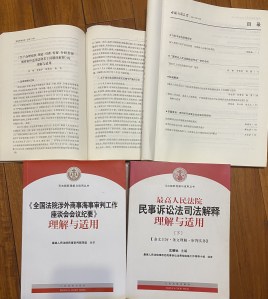
The publications are often issued as articles in one of the SPC’s online or print publications, listed below. The understanding and application of the most lengthy document are published as books,  such as the two-volume books on the understanding and application of the judicial interpretation of the Civil Procedure Law (in the photo above) and separately, the Criminal Procedure Law. Books can be searched on the People’s Court Press website.

The content usually includes details on the drafting history of the document, policy background, and the meaning of the clauses.  If an “understanding and application” publication is in book form, it generally provides commentary on each article.  Sometimes an understanding and application publication discusses the competing views related to a particular clause in a document, such as the understanding and application publication on the 2019 Minutes of the National Court Work Conference for Civil and Commercial Trials (全国法院民商事审判工作会议纪要).

The analogous publication for the National Symposium on Foreign-Related Commercial and Maritime Trial Work incorporates some model cases and discusses relevant non-Chinese legislation and case law, in addition to relevant Chinese legislation, the views of relevant institutions, and court practice. For example, on the scope of the phrase “外国法院” (foreign court) in that book, the authors mention that when the Ministry of Foreign Affairs was consulted on the draft of that document, it took the view that “foreign” did not include courts of international organizations such as European Union’s Unified Patent Court. It mentions during the negotiation of the Hague Judgments Convention, the recognition and enforcement of the judgments of such courts was controversial so that in China, the recognition and enforcement of the judgments of such courts await further research.

Understanding and application articles are published in one of the following places:

  1. the SPC  official website (court.gov.cn), the Chinese courts website (chinacourt.org), and sometimes the China International Commercial Court website (cicc.court.gov.cn);
  2. the SPC journal Renmin Sifa 人 民司法 [People’s Justice];
  3.  the National Judges College’s academic journal Falv Shiyong 法律适用 [Application of Law]; and
  4. journals of specialized SPC divisions (such as Reference to Criminal Trial, the journal of the five criminal divisions, 刑事审判参考, previously mentioned here).

These articles are often republished on the websites or WeChat accounts of lower courts and sometimes other institutions and can be searched on the Internet or through WeChat search.

Additional examples:

《全国法院毒品案件审判工作会议纪要》的理解与适用 (the Understanding and Application of the Meeting Minutes of the National Courts Symposium on the Trial of Drug-Related Crimes ), published in  Falv Shiyong 法律适用 [Application of Law, the National Judges College’s academic journal]–explaining the 2022 Meeting Minutes of the National Courts Symposium on the Trial of Drug-Related Crimes (the Kunming Meeting) 全国法院毒品案件审判工作会议纪要.  On the drafting history of the document, for example,  before the conference, the article states that the drafters (from the SPC’s #5 Criminal Division) solicited comments from relevant SPC divisions/chambers, various high people’s courts, the Supreme People’s Procuratorate, the Ministry of Public Security and relevant experts and scholars. The draft was further amended based on comments at the conference, including from other institutions that attended the symposium, and subsequently comments were solicited from relevant divisions of the SPC, the SPP, the Ministry of Public Security, the General Administration of Customs, the Ministry of Agriculture and Rural Affairs, and the Legislative Affairs Commission of the Standing Committee of the National People’s Congress.

最高法解释起草者谈《关于办理组织、强迫、引诱、容留、介绍卖淫刑事案件适用法律若干问题的解释》的理解与适用 (The Understanding and Application of the [2017] “Supreme People’s Court, Supreme People’s Procuratorate Interpretation on Several Issues Concerning the Application of Law in Handling Criminal Cases of Organizing, Compelling, Enticing, Sheltering, and Brokering Prostitution,” published originally in Reference to Criminal Trial #115, but republished on a WeChat public account of a local public security bureau. The section on the interpretation’s drafting history reveals that in the course of drafting, the #4 Criminal Division held discussions with the Public Security Bureau (治安局) of the Ministry of Public Security, some provincial public security bureaus and some city and county public security organs’ public security departments many times, as well as with experts. The Legislative Affairs Commission of the National People’s Congress later held a coordination meeting (协调会) with relevant ministries and commissions, indicating that the relevant authorities had differing views on the draft’s content. When those issues were resolved, the SPP agreed to the draft and to issue the interpretation jointly, after which the judicial committee of the SPC and the procuratorial committee of the SPP approved the issuance of the interpretation.

One small example of the relevance of these articles and books to scholarship is the recent draft article, posted on SSRN:  From Visibility to Shadows: The Impact of Police Discretion on Prostitution in Response to Legal Changes, which considers the impact of police discretion on prostitution regulation in China, following the issuance of the 2017  judicial interpretation discussed above. The authors describe the judicial interpretation several times as “an external policy change (a change in judicial interpretation) that was outside the police’s influence.”  However, a review of the legislative history described above reveals that the drafting of the interpretation heavily involved the Ministry of Public Security and local level public security bureaus.  It can be surmised that neither the authors nor the workshop commentators on the draft article were aware of the possible relevance of “understanding and application” articles. This post seeks to draw the attention of both scholars and practitioners to these publications so that advocates and authors can refer to these publications as appropriate and commentators will know of their existence.


Supreme People’s Court Issues New Guidance on Cross-Border Commercial & Procedural Legal Issues

In January 2022, the Supreme People’s Court (SPC) issued a Conference Summary [also translated as “Meeting Minutes”] of the National Symposium on Foreign-Related Commercial and Maritime Trial Work (Foreign-Related Commercial  & Maritime Law Conference Summary (bilingual version here) (全国涉外商事海事审判工作座谈会会议纪要).  From unauthorized versions released, it can be seen that it was another SPC year-end accomplishment.  Although this document is not a judicial interpretation and cannot be cited in Chinese court judgments, it is crucially important for legal professionals outside of China dealing with cross-border commercial issues involving China and for Chinese legal professionals focusing on cross-border commercial issues involving the rest of the world.

The conference summary has  111 provisions.  The focus is on legal issues because the target audience of domestic judges understands the political framing.  The conference summary applies to foreign-related cases and to Hong Kong, Macau, and Taiwan-related cases by reference (see Article 111,  set out at the end of this post).  They are in the following categories:

  • foreign-related commercial (涉外商事部分), the longest:
  • Maritime (海事部分); 
  • Judicial review of arbitration (仲裁司法审查部分).

This blogpost will explain why the conference summary was issued, its legal and policy basis, and why it addressed those particular issues and will leave the majority of the content of the conference summary for the experts in practice and academia.

Why this conference summary?

The conference summary (meeting minutes) is based on a national conference on foreign-related commercial and maritime trial work held in Nanjing in June of last year and the issues that the SPC would have heard raised by lower court judges.

When asked the question of why this conference summary was issued, an SPC judge is likely to say “to resolve difficult issues in practice and unify judgment standards.” But a fuller answer to this question for a larger audience requires further details. 

As to why a conference summary and not rely on “case law” with Chinese characteristics, including China International Commercial Court cases, SPC cases, and various types of typical or SPC selected cases as “soft precedents,” the answer is that the SPC is issuing this conference summary to guide lower court judges (and possibly judges in other divisions of the SPC) practically and efficiently and for some additional reasons.  The simple answer is that “case law” is not effective enough to practically guide lower court judges.  If it were, the SPC would not have issued this document. I have seen a number of academic articles (in English) that illustrate a misunderstanding of what the SPC is doing.   

Additionally, I surmise that at the Nanjing conference, behind closed doors, SPC judges heard about inconsistent approaches or requirements from lower court judges.  I surmise they also heard from lower court judges uncertainty in the approach that they should take concerning issues where the law is unclear.   The judicial evaluation system values deciding cases correctly. Moreover, the most recent SPC policy focuses on unifying the application of law. Its leadership has established a leading small group to that end.  So for all these reasons, lower court judges would look to the SPC for clarification.   What is contained in the conference summary is the SPC’s current consensus on major cross-border commercial, maritime, and arbitration review-related issues, based on their further research and consideration.

In the busiest courts where many of these cases arise, judges are under enormous pressure to decide cases timely and accurately, especially after the recent changes to the jurisdiction of lower courts under the reorientation of the four levels of the people’s courts and the issuance of other documents changing the jurisdiction of the lower courts in commercial cases.  “Codifying” the principles from cases and issues considered by the SPC in the form of a conference summary is the most useful and efficient form of guidance for lower court judges. As mentioned here, although conference summaries are not judicial interpretations and cannot be cited in a court judgment document as the basis of a judgment, they provide important guidance to the work of the courts concerning issues about which existing law and judicial interpretations are unclear.  Judges will rely on its provisions to decide cases.

The legal basis for the conference summary derives from the SPC’s authority under Article 10 of the Organic Law of the People’s Courts to supervise the lower courts. 

As for an answer to the question of why not issue a judicial interpretation–time, fluidity, and attenuated basis for some of the conference summary’s provisions do not permit a judicial interpretation to be issued.  One example of the attenuated basis and fluidity is Article 100,  which”codifies” the Guangzhou Intermediate People’s Court decision in the Brentwood case (discussed here).   It establishes welcome certainty to the enforceability of arbitral awards made by overseas arbitration institutions arbitrations seated in Mainland China.  It provides that such awards are regarded as foreign-related arbitral awards (rather than foreign awards) in Mainland China.  It is likely to be helpful to the overseas arbitration institutions that are considering establishing case management offices in China, as is now possible under Shanghai and Beijing regulations.   As mentioned before, the Arbitration Law being revised, the current draft addresses the issue, and the SPC is likely to issue a comprehensive judicial interpretation thereafter.  

Moreover, for some of the procedural provisions, such as those relating to the recognition and enforcement of foreign judgments, it gives the SPC a chance to pilot its guidance, before formalizing it in the form of a judicial interpretation.   A recent Wechat article (with further details) flags that in 2021, three foreign judgments and nine Hong Kong, Macau, and Taiwan judgments were recognized and enforced.  Likely more applications were made but not decided.

Other provisions consolidate existing guidance in a form that is easier for the lower courts to grasp quickly.  Article 22, on obtaining an opinion on foreign or international law from a China International Commercial Court (CICC) expert committee expert, for example, repeats what is to be found in CICC guidance.  The same can be said about Article 11, on the topic of electronic service of process, promoted in several Belt & Road-related SPC Opinions.  It should be noted that China maintains its traditional approach to service of process from foreign jurisdictions.

It appears that some clauses reflect a change in the negotiating position of Chinese financial institutions, in contrast to “back in the day. ” Article 2, on the topic of asymmetric jurisdiction clauses, states that Chinese courts will uphold them unless they violate Chinese rules on exclusive jurisdiction or relate to the interests of consumers or workers.   (For those with no background on these clauses, according to Herbert Smith Freehills: “asymmetric jurisdiction clauses are common in the financial sector, and typically require one party to bring proceedings in one jurisdiction only, while the other (usually the financial institution) may choose to bring proceedings in other jurisdictions.”  From this position, I surmise that Chinese banks use asymmetric jurisdiction clauses as well.

Articles 18-20 address a few of the ongoing issues related to the application of international conventions and treaties in the Chinese courts. Article 18 answers the question of what a court should do if the relevant treaty or convention is silent or China has made a reservation on that issue.  The answer is to use the Law on the Laws Applicable to Foreign-Related Civil Relations to determine the applicable law.  Article 20 focuses on what a Chinese court should do if it is applying Chinese law if Chinese law has conflicting positions and China has acceded to a relevant treaty or convention.  A report on a recent workshop involving the SPC, the Beijing #4 Intermediate People’s Court, and academics from the China Academy of Social Sciences and other institutions flags some of the many other unresolved issues.

Article 30 addresses an important question for Chinese and foreign banks, suppliers to Chinese EPC contractors, and project owners, particularly in Belt & Road jurisdictions–how easily can a Chinese court stop payment on a demand (independent) guarantee?  The answer is, strictly according to the provisions of the relevant judicial interpretation. Article 30 provides that when a court hears an application to stop payment on the basis of fraud (which can be filed as a preliminary matter or during the course of litigation or arbitration),  it must examine the independent letter of guarantee stop payment application submitted by the parties in according to Article 14 of the (updated) Provisions on Several Issues Concerning the Hearing of Independent Letter of Guarantee Dispute Cases, and conduct a preliminary substantive examination on whether there are fraudulent grounds for stop payment in accordance with the provisions of Article 12 and set out its finding of facts and reasoning as required by  Article 16.

The Bigger Picture

This conference summary is another form of SPC soft law. It harmonizes the decisions of the Chinese courts to be consistent with SPC policy (or said another way, strengthens the firm guiding hand of the SPC). 

This document reflects the awareness of its drafters, the judges of the #4 Civil Division of the SPC, that the issues that come before the Chinese courts far outpace the infrastructure of Chinese foreign-related commercial law. Given the larger trends I described in my brief article last fall, we can expect the SPC to continue to play an important role in developing China’s body of law related to cross-border commercial matters.

_____________________________________

111.【涉港澳台案件参照适用本纪要】涉及香港特别行政区、澳门特别行政区和台湾地区的商事海事纠纷案件,相关司法解释未作规定的,参照本纪要关于涉外商事海事纠纷案件的规定处理)。111. [The application by reference of this conference summary to cases involving Hong Kong, Macao and Taiwan]. As for commercial and maritime cases involving the Hong Kong Special Administrative Region, Macao Special Administrative Region and Taiwan, which are not otherwise stipulated in relevant judicial interpretations, shall be handled with reference to the provisions of this conference summary on foreign-related commercial and maritime cases.