

Category Archives: Court Reform

General Party Secretary Xi Jinping Issues Written Instructions (批示) to the Supreme People’s Court (Updated)

zfgzhy2014_720

On the eve of the Chinese New Year, a banner headline was posted on the  Supreme People’s Court (Court) websites:

Study the Important Written Instructions of  General Party Secretary Xi Jinping

A revised version of that banner has remained on those websites since (the photo above), apparently unobserved by outside commentators, who may have not realized its significance.   This blogpost will look at:

  • what written instructions (批示) are;
  • the significance of Xi Jinping giving written instructions;
  • what Xi Jinping’s instructions were;
  • why the instructions were issued on eve of the New Year; and
  • why Zhou Qiang, President of the Court called on the lower courts to study diligently Xi Jinping’s instructions.

What are written instructions (批示)?

”Written instructions“ (批示) means notes or comments made by a superior on a written document submitted for approval or comment.  It is used in reference to Party/government documents as well as documents within the court system (see the regulations on handling each type of document).  The term has been used throughout the history of the PRC as well as in Chinese history.  Analysis of Chinese political documents often mentions written instructions.

According to the reports on various Court websites and in the press, Xi Jinping gave his written instructions on 28 January in response to a report submitted by the Supreme People’s Court  entitled Situation Concerning the Work of the People’s Courts in 2013 and Proposals for their Work in 2014 (关于2013年人民法院工作情况和2014年工作打算的报告).  The report has not been made public.

What were Xi Jinping’s written instructions and what is their significance?

Xi Jinping wrote what to the outside observer appears to be a collection of slogans from the Third Plenum Decision.  However appearances can be deceiving.

He wrote that the courts had diligently implemented the Center’s policies and implemented their responsibilities and achieved new results.  He expressed his hope that the courts will make persistent efforts, implement the spirit of the 18th Party Congress, Third Plenum etc, uphold the Party’s leadership, promote judicial reform, advance the building of a judicial system that is fair, efficient, and authoritative..provide powerful judicial protection for reform, and continue to promote the building of the rule of law in China.

The significance of the written instructions is not so much in its content as the fact that Xi Jinping issued it to the Supreme People’s Court.  It is unusual for a Party General Secretary to have issued them.  By doing so, Xi Jinping expresses his support, praise, demands, and hopes for Zhou Qiang and the Court leadership.

Why were the written instructions issued on eve of the New Year?

The written instructions were issued on the eve of the Chinese New Year to approve what Zhou Qiang and the other Court leaders did in 2013, as well as confirm the planned policies of the Court for 2014.  The written instructions were issued before the Chinese New Year to enable the Court leadership to be better equipped when dealing with issues at the National People’s Congress (NPC) meeting in early March. Court leaders are likely anticipating that local opposition to judicial reforms under consideration may be expressed at the NPC meeting.

Why are the lower courts requested to study diligently Xi Jinping’s instructions?

Xi Jinping’s instructions summarize in one paragraph the Central Committee’s policy towards the courts and their role in the Third Plenum reforms as well as judicial reforms.  The written instructions enable the lower courts  to understand the political background against which they work and the political goals for their work in the near and longer term.

The more sophisticated lower court judges understand that the written instructions mean that the Party leadership values the work of the Court leadership, but recognize that this will not resolve their caseload.

Concluding Remarks

To the outside observer:

  • it illustrates what is meant by Party leadership of the courts at the highest level;
  • in the political context of China, it is a major coup for Zhou Qiang (and colleagues) and their reform policies for Xi Jinping to have issued those written instructions; and
  • It means the political leadership is behind those reforms.
  • At the same time, it places a great deal of pressure on the Court leadership to deliver results (as seen from the political leadership) in the judicial reforms.
  • It would not be surprising to hear voices opposing some of the reforms at the NPC meeting.
The Supreme People’s Court: Week Ending 21 December 2013

1.  The Chinese government cracks down on medical institution crime. On 21 December, 11 government and Party bodies, including the:

  • National Health and Family Planning Commission;
  • Supreme People’s Court;
  • Ministry of Public Security;
  • Ministry of Justice; and
  • Supreme People’s Procuratorate,

initiated 1 year movement to crack down on crime relating to medical institutions. The plan, reported here and  linked here , calls for the punishment of offenses related to medical institutions.  It also announces the framework for related reforms:

  • restructuring state-owned medical institutions;
  • resolving medical disputes with mediation;
  • improving rural health; and
  • improving security in medical institutions.

Although the Supreme People’s Court co-issued this document, it is not a judicial opinion.  It is a policy document.

2.  The Court posted structural reform issues for on-line discussion, although it is unclear what the response has been.  On 18 December, the Court posted two court structural reform issues raised by the Third Plenum Decision on the “Everyone Discuss Judicial Reform” Website (linked here) and asked for comments:

  • local courts and procuratorates–promote uniform administration of  personnel, finance, and property at provincial level and below;
  •  the four levels of the courts–clarify their role and position.

Questions raised by the Court concerning the “uniform administration of the local courts”:

  • what does this mean;
  • what are its implications,
  • will it mean further bureaucratization of the courts and procuracy,
  • what flexibility should there be,
  • what will it mean for local protectionism.

Questions raised by the Court concerning “clarify the role and position of the functions of the four levels of the courts” concern the implications for:

  •  judicial interpretations,
  • appeals systems;
  • internal organization of the courts.

The “Everybody Discuss Judicial Reform” website is a joint project of the national court website, justice website (Supreme People’s Procuratorate), and the China Law Society.  It is a forum for eliciting discussion on important issues for which the institutions must already have framework plans.

Communist Party Political-Legal Committees Come out of the Closet and Onto the Web

As everyone who has spent some time paying close attention to the Chinese legal system knows, the Chinese Communist Party has a system (系统) of Political Legal Committees (政法委员会 or 政法委) that oversee, coordinate, and implement Communist Party policy in the legal institutions–public security (and state security), procuratorate,  courts, and justice (公检法司).  The Political-Legal  Committees, that exist at every level of the Communist Party and government, have been existence for many years.  This quick blogpost reports on two unnoticed phenomena:

  • the Political-Legal Committees “coming out”; and
  • the Supreme People’s Court (Court) opening discussion on the relationship among the legal institutions.

What I mean by “Political-Legal Committees ‘coming out'” is that from the central level on down, Political Legal Committees now have their own websites that link to the institutions (with the exception of state security) at the same level of government.  At the top level is Chinapeace, featuring articles related to Party policy (and other topics) in the legal institutions and linking horizontally to the websites of those institutions and vertically (downwards) to the local political legal committees. Chinapeace has links to the websites of local political-legal committees at the provincial level (or equivalent)–such as the Guangdong Political-Legal Committee.

The Communist Party must have issued a decision to permit these websites to be established.  It means that the Communist Party has decided that the Political Legal Committees need to be on the Internet to promote the Party’s policies. For the veteran observers of the Chinese legal system, it is an amazing phenomenon, when for many years, these committees had been in the metaphorical closet.

The second  unnoticed phenomenon is that at the end of October, the Court has posted on its website a link to the newest topic for discussion for a project it co-sponsors with Tsinghua University on judicial reform–the relationship between the legal institutions and whether they should be “adjusted.”

The Constitution (Article 135) sets out the basic principle–they shall “in handling criminal cases, divide their functions, each taking responsibility for its own work, and they shall coordinate their efforts and check each other to ensure the correct and effective enforcement of law” . It is significant that the Court has raised this, especially publicly.  It is another issue for all concerned about the Chinese legal system to watch.

Dispute Resolution Reforms in the Shanghai FTZ Underway– Updated

Current plans for the new Shanghai Free Trade Zone (Shanghai FTZ) include  reforms to China’s dispute resolution systems, both the courts and commercial arbitration. Court reform developments, in particular, are moving rapidly.

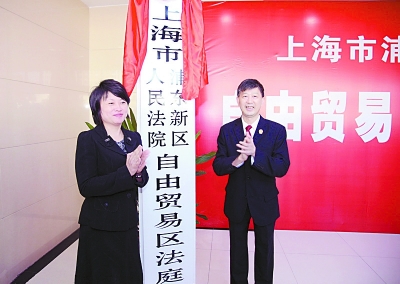
On 5 November, the establishment of a tribunal (自贸区法庭) in the Shanghai FTZ was announced, with Judge Luo Dongchuan, the head of the #4 civil division of the Supreme People’s Court (Court) in attendance, among others.

It follows the announcement by the Court designating the Shanghai courts to be among the first in the country to implement certain judicial reforms.  These reforms are linked to the Supreme People’s Court  2013 Judicial Reform Opinion (discussed in this blogpost).

Professor Ding, Chairman of Legal Affairs Commission, Shanghai Municipal People’s Congress Standing Committee, identified some of the reforms contemplated as well as some of the obstacles to legal reform in the Shanghai FTZ.  in a thoughtful speech given at the opening of the China (Shanghai) Pilot Free Trade Zone Court of Arbitration (affiliated with the Shanghai International Arbitration Center).

This post, which updates my earlier blogposts on the subject, looks at two important developments affecting dispute resolution in the Shanghai FTZ:

  • the Court designating the Shanghai courts to take the lead in judicial reforms;
  • Professor Ding highlighting to the Shanghai political and legal leadership that the Shanghai FTZ provides an unprecedented opportunity for Shanghai to build itself into an international arbitration center.

A.             The Courts

The presence of Judge Luo of the Court is a signal that the Shanghai FTZ tribunal is an initiative that the Court backs.   According to a statement of the vice president of the Shanghai Higher People’s Court, the jurisdiction of the tribunal will include civil and commercial cases related to the Shanghai FTZ:

  • investment;
  • trade;
  • finance;
  • intellectual property; and
  • real estate.

According this statement by the President of the Pudong New Area People’s Court, the Shanghai FTZ tribunal will implement the following reforms:

  • case acceptance;
  •  pre-litigation mediation;
  • greater transparency;
  •  use of model cases, and
  • moving more litigation procedure on-line. 201311061401215050.

The decisions of the tribunal will be considered decisions of the Pudong New Area People’s Court and appeals will be made to the #1 Municipal Intermediate People’s Court.

The new reforms for all of Shanghai announced by the Court on 25 October, which build on previous work by  the Shanghai court leadership, include:

  • increasing judicial transparency, including judicial procedure, judicial decisions, and information concerning enforcement;
  • reforming the internal operating rules of the judiciary, so that it operates according to judicial rather than administrative principles;
  • motivating and providing protection to judges to enable them to decide cases fairly;
  •  improving the operating structures of the courts;
  • amending the operating rules for judicial committees;
  • providing a structure for the discussion of cases.

The Shanghai courts have started to take the first steps by issuing regulations to address one of the many issues facing litigants in the Chinese courts, the refusal to take cases (http://www.chinacourt.org/article/detail/2013/11/id/1116965.shtml).  We can expect many more regulations to come.

The reforms highlighted by the Court will be difficult to implement, particularly the reform of internal operating rules of the judiciary, because the PRC judiciary has operated according to those principles throughout its history (as many others inside and out of the Chinese judiciary and mainland China have pointed out (including this author)). Many of these reforms relate, indirectly, to the relationship of the courts and other government institutions, as well as the nature of Communist Party leadership of the courts.

The Court announced that it has established standards and metrics to evaluate the effectiveness of the announced reforms. On the basis of those reforms, The Court will gradually roll out those reforms throughout the entire country.

The announcement designating the Shanghai courts as one of the court designated to lead the way in judicial reforms indicates  the importance of Shanghai and the Shanghai FTZ.  The Court has put aside the scandal involving a group of senior judges of the Shanghai Higher People’s Court visiting prostitutes (that led the Supreme People’s Court to issue a statement that the judges had tarred the image of the nation’s judges and scarred judicial credibility (http://english.peopledaily.com.cn/90882/8356970.html)).

Designating the Shanghai courts to take the lead in court reform presents a challenge to the Shanghai Higher People’s Court—can they establish a court that will earn the credibility of both domestic and foreign litigants through having competent judges who are able to put into practice ethical standards?  The announcements related to the Shanghai FTZ tribunal indicate that the Shanghai court authorities are selecting well educated judges for the task.

B.             Arbitration

Among the challenges Professor Ding identified in building the Shanghai FTZ into an international arbitration center is challenges to the arbitral institution.  One of those challenges is internationalization.

Challenges to the arbitration institution—possible internationalization?

 In the September interview mentioned above, Lu Hongbing advocated that cooperation between foreign arbitration institutions and Shanghai based ones should be encouraged in the Shanghai FTZ.

Real cooperation involves the following questions (among others!), and a web of legal issues:

  • Should cooperation between foreign and Shanghai based arbitration mean allowing international arbitration institutions to establish offices in the Shanghai FTZ?
  • If that is permitted, should foreign arbitration institutions be permitted to hold arbitrations (seated) in China?
  • Would an arbitral award under those circumstances still be considered to be “international” and enforceable in China under the Convention on the Recognition and Enforcement of Foreign Arbitral Awards (the New York Convention) or Arrangement Concerning Mutual Enforcement of Arbitral Awards between the Mainland and the Hong Kong Special Administrative Region (Arrangement with Hong Kong)

Enabling real cooperation between foreign arbitration institutions and Shanghai based ones will require profound analysis of and well-considered solutions to the complex of issues related to the Arbitration Law and Civil Procedure Law raised by the above questions.

An additional outstanding issue that the Court will need to resolve  is the issue of the validity and enforceability of arbitration clauses of the Shanghai Court of International Arbitration (and its predecessor, the CIETAC/Shanghai).  A draft of a judicial opinion resolving the matter is said to be under consideration by the Supreme People’s Court.  That also needs to be resolved if dispute resolution in the Shanghai FTZ (and all of Shanghai) is to serve the needs of disputing parties.

The Court, Professor Ding Wei (and other Shanghai government legal specialists) and the legal advisers for the People’s Government of Pudong District (lead outside counsel is understood to be the Zhong Lun Law Firm) need to work on designing solutions to untangle  the web of interconnected legal issues affecting the internationalization of arbitration.  Given that multiple central government institutions will need to be involved with any solution, it is likely progress on real cooperation with foreign arbitration institutions can only occur over the long term.

C.             Conclusion

The Shanghai FTZ provides the Chinese government an opportunity to experiment with Chinese dispute resolution reforms, both in the courts and arbitration.  The Court is taking steps in Shanghai to address the difficult legal and political issues that must be considered and resolved to make real progress.  Many are “watching this space”, particularly after the establishment of the Shanghai FTZ tribunal.


[ii] http://www.chinacourt.org/article/detail/2013/09/id/1080615.shtml

Dispute Resolution Reforms in the Shanghai FTZ Underway

Few are aware that current plans for the new Shanghai Free Trade Zone (Shanghai FTZ) include  reforms to China’s dispute resolution systems, both the courts and commercial arbitration. Court reform developments, in particular, are moving rapidly, because the Supreme People’s Court (the Court) has designated the Shanghai courts to be among the first in the country to implement certain judicial reforms (http://rmfyb.chinacourt.org/paper/html/2013-10/26/content_72024.htm?div=-1#).  These reforms are linked to the Supreme People’s Court  2013 Judicial Reform Opinion (discussed in my 30 October blogpost) and  announced on 29 October.

Reforms in dispute resolution were highlighted by Professor Ding Wei, Chairman of Legal Affairs Commission, Shanghai Municipal People’s Congress Standing Committee (http://www.cietac-sh.org/English/ResourcesDetail.aspx?tid=39&aid=571&zt=3) , in a thoughtful speech given at the opening of the China (Shanghai) Pilot Free Trade Zone Court of Arbitration (affiliated with the Shanghai International Arbitration Center) on 22 October.  Professor Ding identified some of the reforms contemplated as well as some of the obstacles to legal reform in the Shanghai FTZ.

This post, which updates my blogpost of 28 October, looks at two important developments affecting dispute resolution in the Shanghai FTZ:

  • the Court designating the Shanghai courts to take the lead in judicial reforms;
  • Professor Ding highlighting to the Shanghai political and legal leadership that the Shanghai FTZ provides an unprecedented opportunity for Shanghai to build itself into an international arbitration center.

A.             The Courts

Professor Ding’s made a statement in his speech that “judicial arrangements (for the FTZ) relate to the organization and authority of matters stipulated by the Organizational Law of the People’s Courts, and local government cannot make changes” makes it clear that substantial court reform in the FTZ is not in the hands of the Shanghai government, but rather the central government.  From its press announcement on 25 October (http://www.chinacourt.org/article/detail/2013/10/id/1113813.shtml), it is clear that the Court sees the opportunity presented by the dynamism of economic developments in Shanghai, including the Shanghai FTZ (although not mentioned).

Although currently there is no Shanghai FTZ court ( Lu Hongbing, vice president of the All China Lawyers Association and founding partner of the Shanghai-based Grandall Law Group,  mentioned in a September article the possibility  that one will be established (http://stock.sohu.com/20130924/n387092295.shtml)), the Court is calling on the Shanghai courts to make reforms that will benefit litigants in the Shanghai FTZ  (as well as the entire Shanghai court system.

The new reforms announced by the Court on 25 October, which build on previous work by  the Shanghai court leadership, include:

  • increasing judicial transparency, including judicial procedure, judicial decisions, and information concerning enforcement;
  • reforming the internal operating rules of the judiciary, so that it operates according to judicial rather than administrative principles;
  • motivating and providing protection to judges to enable them to decide cases fairly;
  •  improving the operating structures of the courts;
  • amending the operating rules for judicial committees;
  • providing a structure for the discussion of cases.

The Shanghai courts have started to take the first steps by issuing regulations to address one of the many issues facing litigants in the Chinese courts, the refusal to take cases (http://www.hshfy.sh.cn/shfy/gweb/xxnr.jsp?pa=aaWQ9MjkyMzQ0JnhoPTEPdcssz)(http://www.chinacourt.org/article/detail/2013/11/id/1116965.shtml).  We can expect many more regulations to come.

The reforms highlighted by the Court will be difficult to implement, particularly the reform of internal operating rules of the judiciary, because the PRC judiciary has operated according to those principles throughout its history (as many others inside and out of the Chinese judiciary and mainland China have pointed out (including this author)). Many of these reforms relate, indirectly, to the relationship of the courts and other government institutions, as well as the nature of Communist Party leadership of the courts.

The Court announced that it has established standards and metrics to evaluate the effectiveness of the announced reforms. On the basis of those reforms, The Court will gradually roll out those reforms throughout the entire country.

The announcement designating the Shanghai courts as one of the court designated to lead the way in judicial reforms indicates  the importance of Shanghai and the Shanghai FTZ.  The Court has put aside the scandal involving a group of senior judges of the Shanghai Higher People’s Court visiting prostitutes (that led the Supreme People’s Court to issue a statement that the judges had tarred the image of the nation’s judges and scarred judicial credibility (http://english.peopledaily.com.cn/90882/8356970.html)).

Designating the Shanghai courts to take the lead in court reform presents a challenge to the Shanghai Higher People’s Court—can they establish a court that will earn the credibility of both domestic and foreign litigants through having competent judges who are able to put into practice ethical standards?

B.             Arbitration

Among the challenges Professor Ding identified in building the Shanghai FTZ into an international arbitration center is challenges to the arbitral institution.  One of those challenges is internationalization.

Challenges to the arbitration institution—possible internationalization?

 In the September interview mentioned above, Lu Hongbing advocated that cooperation between foreign arbitration institutions and Shanghai based ones should be encouraged in the Shanghai FTZ.

Real cooperation involves the following questions (among others!), and a web of legal issues:

  • Should cooperation between foreign and Shanghai based arbitration mean allowing international arbitration institutions to establish offices in the Shanghai FTZ?
  • If that is permitted, should foreign arbitration institutions be permitted to hold arbitrations (seated) in China?
  • Would an arbitral award under those circumstances still be considered to be “international” and enforceable in China under the Convention on the Recognition and Enforcement of Foreign Arbitral Awards (the New York Convention) or Arrangement Concerning Mutual Enforcement of Arbitral Awards between the Mainland and the Hong Kong Special Administrative Region (Arrangement with Hong Kong)

Enabling real cooperation between foreign arbitration institutions and Shanghai based ones will require profound analysis of and well-considered solutions to the complex of issues related to the Arbitration Law and Civil Procedure Law raised by the above questions.

An additional outstanding issue that the Court will need to resolve  is the issue of the validity and enforceability of arbitration clauses of the Shanghai Court of International Arbitration (and its predecessor, the CIETAC/Shanghai).  A draft of a judicial opinion resolving the matter is said to be under consideration by the Supreme People’s Court.  That also needs to be resolved if dispute resolution in the Shanghai FTZ (and all of Shanghai) is to serve the needs of disputing parties.

The Court, Professor Ding Wei (and other Shanghai government legal specialists) and the legal advisers for the People’s Government of Pudong District (lead outside counsel is understood to be the Zhong Lun Law Firm) need to work on designing solutions to untangle  the web of interconnected legal issues affecting the internationalization of arbitration.  Given that multiple central government institutions will need to be involved with any solution, it is likely progress on real cooperation with foreign arbitration institutions can only occur over the long term.

C.             Conclusion

The Shanghai FTZ provides the Chinese government an opportunity to experiment with Chinese dispute resolution reforms, both in the courts and arbitration.  The Court is taking steps in Shanghai to address the difficult legal and political issues that must be considered and resolved to make real progress.  Many are “watching this space”!


[i] My translation: The translation on the website states: the justice arrangement concerning duty allocation among people’s court is an important power under the “PRC People’s Organization Law.” No local organizations are permitted to change it.

[ii] http://www.chinacourt.org/article/detail/2013/09/id/1080615.shtml

The Supreme People’s Court 2013 Judicial Reform Opinion: A Flash Analysis (Part 1)

On 29 October 2013 the Supreme People’s Court (the Court) released Several Opinions Regarding the Actual Practice of Justice for the People, Vigorously Strengthening a Fair Judiciary and Continuously Increasing Judicial Credibility (关于切实践行司法为民大力加强公正司法不断提高司法公信力的若干意见)  ( 2013 Judicial Reform Opinion).  It is an immediate call for action by the Court leadership, who see this as a unique opportunity to make changes to the status quo of the Chinese courts.  The Court leadership is seeking to make changes in the real world of the Chinese courts, under the limitations that it works under, including:

  • The role of the courts in the Chinese political system;
  • Administrative nature of the Chinese courts;
  • Greater societal environment, with its focus on money and power;
  • Vast disparities in the quality of judicial personnel;
  • Vast disparities in judicial funding;
  • Deficiencies in Chinese legislation.

The 2013 Judicial Reform Opinion is significant for its timing, for what is says, for and what it does not say.  This post sets out a flash analysis (supplemented as time permits).

A.             Timing

The timing of the issuance of this document was no accident.  It was approved within the Supreme People’s Court on 6 September but not publicly released until 29 October.  This document requires approval by the Central Committee’s Political Legal Committee (much as a major initiative of a corporate business unit requires board approval).  It was issued after the conclusion of the Bo Xilai trial and before the Third Plenum of the 18th Communist Party Central Committee.  It further develops some of the issues raised by President Zhou Qiang in his August, 2013 interview in Seeking Facts.

B.             What does the 2013 Judicial Reform Opinion Say?

The 2013 Judicial Reform Opinion ties its content to the Party line as set out by General Secretary Xi Jinping.  This is a precondition for the rest of the opinion and the key to its success.

1.              Seize the Day!

In the beginning of the 2013 Judicial Reform Opinion, the Court leadership stresses that they need to seize this opportunity to make changes (历史机遇) and

the political leadership is providing the conditions to do so and ordinary people have great expectations.  However, the courts are facing the following difficulties:

  • complicated issues (i.e. political, legal, personnel related);
  • expectations of ordinary people for the court system are increasingly higher;
  • increasingly greater gap between the courts and expectations or ordinary people;
  • judges and other court personnel have to recognize their roles.

2.              Uphold judicial independence and implement the responsibilities of the courts under the law

The Court leadership wants to see the courts:

  • operating according to law;
  • Implementing judicial power independently without interference;
  • Improving the implementation of law by improving the quality of judicial guidance, including judicial policy, interpretations, guiding and reference court decisions; and
  • Improving the leadership role/prestige of the courts in society by deciding cases fairly and regularizing letters and visits.

The call on the courts in point 4 of the 2013 Judicial Opinion to operate according to law and to cease instances of courts violating the law is a sad commentary on the state of affairs  in the Chinese courts, but that is the Court leadership recognizes, is the reality.

The call on the lower courts to implement independent exercise of judicial power in accordance with law and prevent interference by such factors as power, money, “personal relations,” “relationships” will be difficult to realize, given the institutional reality of the Chinese courts, which makes them open to influence by all of these factors.  However, the Court leadership cannot change the structure of the courts in the short run.

3.              Integrate the courts with societal expectations

The Court leadership repeatedly calls on greater professionalism within the courts as well as greater sensitivity to differing demands for different sections of Chinese society.  One of the issues that needs to be dealt with is the differing application of judicial policy and judicial interpretations in difficult issues involving major discrepancies in economic and social development and the status of different interests, and the consequences that judicial decision-making affected by various external factors can have on social stability.  In this section, the Court leadership calls on the lower courts to separate themselves from the rest of the local bureaucracy, by not involving themselves in administrative matters such as joint law enforcement operations, development of local businesses, and land seizure/housing condemnation operations.

C.             What Doesn’t the 2013 Judicial Reform Opinion Say?

Other than the obvious points that are not practically possible in the real world of the Chinese judiciary, there are a number of proposals that have been made by the Court’s Judicial Reform Office and discussed within (and outside) the Chinese courts.  One of those is breaking the link between the provinces (administrative divisions) and the courts, and establishing circuit courts (analogous to the US federal system) that would hear major cases from several provinces.

D.             Conclusion

The Chinese public, the foreign business community in China, and the rest of the world awaits the successful implementation of this 2013 Judicial Reform Opinion.  Many obstacles face the Court leadership in doing so, including the political climate.  Lastly, institutional change is always difficult, particularly in China with its particular political-legal traditions.

Pentatonic themes from the Supreme People’s Court

Pentatonic themes emanate from five articles on the national court website (www.chinacourt.org), which is managed by the Supreme People’s Court (the Court).  Although these themes appear dissonant, they reflect where the Court is now and where it may be headed. The five articles (or interfaces) relate to the

  • Mass line education and practice campaign;
  • Defense of the new joint interpretation on Internet defamation;
  • Interview with Court President  Zhou Qiang ;
  • Judicial reform: should the judicial committee be abolished; and
  • The Enterprise Bankruptcy Law Interpretation (II).

The first two articles are the most political and the last is most technical.  The middle one is the most significant, although it inevitably requires some decoding, and the fourth is related to the third.

1.  The mass line education and practice campaign

The national court website includes a banner that links to further information about the mass line education and practice campaign.  There is likely an internal Party Propaganda department directive directing that this be done.  The Supreme People’s Procuratorate website has a similar banner, as do the websites of the lower court websites. Communist Party (Party) leadership of the courts means that the mass line education and practice campaign must be featured and implemented in the courts.  This section features articles on themes in the campaign stressed by the Party as well as action by the Court.

 2. Justifying the joint interpretation criminalizing the posting of internet rumors

Several articles on the national court website relate to the joint interpretation criminalizing the posting on the internet of false rumors.  Many others have examined the joint interpretation, the comments by a “responsible person,” and the related Party documents that preceded (and directed) its issuance, so I will not re-hash those issues. The articles on the national court website justify the joint interpretation (and could not do otherwise), including one stating that “freedom of speech” and criminal punishment of false rumors is not contradictory.  It would appear (from the posting of the comments of the responsible person on the judicial interpretation on the website of the Supreme People’s Procuratorate) that the Supreme People’s Court did not take the lead in drafting this interpretation that has drawn derisive comments from the legal community within China.

3.  Court reform under Party leadership: Interview with Court President Zhou Qiang published in Seeking Facts

This article, which links to an interview with Court President Zhou Qiang in the magazine Seeking Facts (the journal of the Central Committee of the Communist Party) is important because he identifies (within the constraints of his role and the audience that he is addressing) the major issues facing the court system and his vision of the development of courts, linking it, (as he must), to the Party line as set out by General Secretary Xi Jinping, including the mass line education and practice campaign.  He uses as his anchor the statement that Xi Jinping made earlier this year:

“In every single legal case in China, we should work hard to ensure that the mass of the public feel they have received fair justice.”

Among the issues that he raises in the interview, Zhou Qiang identifies the new challenges facing the courts—as he sees it, the demands of the people on the courts are continuously increasing, while the relatively retarded capabilities of the courts are unchanged, manifesting themselves in the following types of cases:

  • eminent domain,
  • environmental and
  • internet cases.

He said these types are cases that are particularly difficult to resolve, and the new media environment means that any case at any stage can become high profile—imposing particular pressure on the courts. He touches on a number of issues that relate to public perception of the courts:

  • Obstacles to litigation, such as court refusal to accept cases;
  • Legal aid for the poor;
  • Interference into court operations;
  • Localism and bureaucratic nature; and
  • Wrongful convictions.

On the latter point he says that the criminal justice system should work together to avoid them, and the victims should be compensated and those responsible punished. In a related development, the Party Central Political Legal Committee has issued guidelines on dealing with those cases, although the full text of those guidelines does not seem to have been released.

Zhou Qiang is (inevitably) less specific in suggesting specific solutions to the issues that he has raised.

4.  Judicial reform: should the judicial committee be abolished?

Related to the judicial reform issues discussed by Court president Zhou Qiang, an article on the national court website raises the issue of the role of judicial committees in the Chinese courts  (). This brief article further links to a website with a project jointly sponsored by the national court website and Qinghua University—designed to rekindle discussions on what should become of the judicial committee (see my 2010 article on judicial committees–Article on judicial committees).  Throughout the history of the PRC, court legislation has stated that judicial committees “practice democratic centralism” and that their task is to “sum up judicial experience and to discuss important or difficult cases or other issues relating to judicial work.”  Judicial committees operate according to Communist Party principles of leadership to decide cases that are too difficult or important for an individual judge or judicial panel to decide, to ensure the optimal substantive result (as seen from the institutional perspective of the courts.

The pluses and minuses of judicial committees have been debated within China and abroad for 20 or more years.

5.  Judicial Interpretation of the Bankruptcy Law (II)

This article is included because it relates to the ongoing technical role of the Court.  A second long judicial opinion (but shorter than the first) has been under consideration for some time, and according to reports a third judicial opinion is being drafted.  The Court has wisely included practicing lawyers as well as liquidators in discussions on the future draft.  A draft version of this second interpretation was released in 2012 for discussion by some lower courts as well as specialists.  Comments by the drafters to the press on the interpretation can be found here.

6.  Conclusions?

As to the pentatonic themes:

  • The courts are under the leadership of the Party and must act in accordance with its policy line;
  • The Chinese courts are facing ever more complicated social issues, requiring greater professional (and political) competence;
  • The Chinese courts are facing ever more complicated commercial issues, requiring a greater level of technical competence;
  • Court leadership is exploring more sensitive court reform issues (at a theoretical level);
  • Court leadership is taking concrete steps concerning less controversial reform issues that will benefit “the masses”, such as legal aid to the poor.

The Supreme People’s Court: Reforming the Chinese courts the Party Way

On April 8, 2013, the Supreme People’s Court announced that its Communist Party (Party) Committee was implementing an  “educational movement to improve judicial work style” (judicial work style movement)  in the second quarter of 2013. Zhou Qiang, the newly appointed president of the Supreme People’s Court, is also the head of its Party Committee.

This clunkily named announcement, written in densely packed Party jargon, is has critical implications for the Chinese court system and all those affected by it, domestic and foreign.  Unpacking the announcement requires a Chinese political jargon decoder and a strong cup of coffee.

This posting will explain why the announcement is so important by highlighting:

  • The meaning of an “educational movement” and “judicial work style.”
  • The impetus for the movement.
  • The goals of the movement.
  • How will it be done?
  • What are its implications?

What is an “educational movement” and  “judicial work style”?

Both phrases are frequently used in Chinese political jargon.

  • An “educational movement”  refers to a political initiative with both educational and punitive aspects, focused on correcting certain ways of thinking while “work style” means the standards of conduct of officials.
  • Work style issues cover a broad range of activity, from deciding cases to womanizing, to luxurious banquets.

Impetus for the movement:

At the 18th Party Congress, the Communist Party leadership identified “judicial credibility” (司法公信力) as a critical area for improvement because of its political implications, particularly the profound loss of confidence in the ability of the Chinese judiciary to provide competent and fair justice.  This was symbolized by the vote  by 20% of National People’s Congress deputies against the Work Report of the Supreme People’s Court.

Goals of the movement:

As announced by the Court’s Party Committee, this education movement has the following goals:

  • Implement the ideal that justice is for the people, so that litigants will not feel they are despised;
  • Decide cases according to law, so that litigants will feel that justice has been done;
  • Improve judicial responsibility, so that judicial laziness, delays, indifference, arbitrariness, failure to hear both sides, and gross errors are avoided.
  • Improve judicial self-discipline and establish a clean judiciary, stop cases decided by money, connections, and sympathies.

Implementing the movement

The Court has called on the lower courts to implement the movement by the following:

  • Study relevant Party and Court documents;
  • Have court leadership take responsibility for implementing the required measures;
  • Implement appropriate internal systems to avoid conflicts of interests, institute training and monitoring programs;
  • Analyze issues in each local court, taking account of the views of various parts of society, identify the weak spots in the judicial system and evolve effective means to deal with them;
  • Use good and bad examples, including instances of judicial irresponsibility and other judicial action that harms judicial prestige;
  • Stop major abuses in the courts, such as taking gifts and money, using court vehicles for private business, using judicial posts to engage in business, and lavish eating and entertainment at public expense.  Violators should be exposed, ordered to change, and if they do not, be dealt with.

What does this educational movement mean?

The implementation of this “educational movement” means that Party leadership recognizes that corruption and abuses in the court system are causing dissatisfaction and resentment among a substantial number of Chinese citizens, including among the political and business elite, and the leadership has called on the new Court leadership to do something about it. The Court leadership recognizes (more than any outside observer) that the Chinese judiciary often delivers a poor quality of justice, but that the issues are different in different parts of the country and even within the same city or province.

What may result from this “educational movement”?

  • Expect a spate of judicial scandals to hit the Chinese media and blogosphere.
  • Behind the scenes there may be a pushback from lower court judges, who feel they cannot make ends meet if they are honest.
  • Expect greater engagement between the Supreme People’s Court and the outside legal world, including greater dialogue between the courts and other parts of the legal profession in China, such as lawyers and academics in evolving reforms.  President Zhou Qiang has led the way by holding a meeting with leading academics and lawyers in late April.
  • Because this educational movement does not deal with the structural issues that have created the conditions under which judicial abuses flourish, expect incremental institutional changes to be gradually rolled out in the next few years.