
Category Archives: Elderly law

Supreme People’s Court Developments, December 2024-January 2025

from the report on the 2025 Central Political-Legal Work Conference on one of the SPC’s websites

See below a brief summary of recent developments  (or at least the principal recent developments) at the Supreme People’s Court (SPC) in January 2025 (as of January 19, the date of publication of this post) and December 2024.

January 2025

  1. On January 8th, the Party leadership heard the SPC Party Group’s report on the SPC’s work, along with those of other institutions.  I mention the requirement for this report in my 2024 article;

certain phrases (such as “report to a superior on their work” [shuzhi 述职] imply a hierarchical relationship between the SPC and the Central Political-Legal Committee and the Party Center. The fact that the SPC reports to the Party leadership can be seen in public reports on the leadership of the political-legal institutions meeting with Xi Jinping and other senior leaders before the annual sessions of the National People’s Congress and Chinese People’s Political Consultative Congress, although the materials actually submitted to the Party leadership are not publicly accessible.)

2.  January is when many important conferences are held that have an impact on the work of the courts: the Central Political-Legal Work Conference (中央政法工作会议) and the National Conference of Higher Court Presidents (Higher Court Presidents Conference 全国高级法院院长会议),  at which the spirit of the Political-Legal Work Conference is transmitted and the goals for judicial work in 2025 are announced. The SPC has held this conference annually for many years. In the recent historical past (the early 1990’s, for example), the Higher Court Presidents Conference was called the National Court Work Conference.

3. Policy documents: 

a. In early January, the SPC and the All-China Federation of Overseas Chinese (Overseas Chinese Federation 中国侨联权益保障部) issued a joint policy document on the strengthening the judicial protection work of the interests of overseas Chinese and returned overseas Chinese and their families in the New Era (关于加强新时代侨益司法保护工作的意见), and related reference cases.  The document seeks to ease litigation formalities for these groups and promote resolving disputes through mediation, among other matters, such as improving research on Overseas Chinese-related issues, such as through establishing a research base, as has been done with other issues.  The title of this document differs from Zhou Qiang era policy documents, but the goal of providing judicial support for an important national policy goal is the same. 

The SPC’s Research Office led the drafting of this document, in cooperation with the Overseas Chinese Federation.  This responsibility is consistent with the role of the Research Office, which deals with many legal policy and cross-internal institutional matters, such as Hong Kong, Macau, and Taiwan-related issues and the transition to the Civil Code.  It does not hear cases.

This is the first joint policy document between the SPC and Overseas Chinese Federation. Closer cooperation between the two institutions began in 2018, with 30 courts piloting closer cooperation with local Overseas Chinese Federations, and with the 2020 establishment of a “general-to-general” online mediation mechanism (the SPC has established this type of mechanism with the China Securities Regulatory Commission and other institutions).    The policy document is linked to language in recent Party Plenums on protecting the rights of returned Overseas Chinese and Overseas Chinese and their families.

b. Opinions of the Supreme People’s Court on Serving Technological Innovation with High-quality Trial Services 最高人民法院关于以高质量审判服务保障科技创新的意见.  The press conference report is here.  China IP Law Update’s summary in English is here.  If time had permitted, I would discuss the links in this document with the recent Party Plenum and other Party initiatives.

4. Judicial interpretations:

a. The SPC issued its second interpretation of the Marriage and Family Part of the Civil Code, aimed at addressing common troublesome issues facing the courts, such as property division when a cohabiting couple split, many issues relating to divorcing couples, including property division and ownership of a company established by a couple.  To provide further guidance on applying the interpretation, the SPC issued typical cases. This interpretation provides important insights into family law issues in current Chinese society.  

b.  The SPC joined with the Supreme People’s Procuratorate to issue the Interpretation of Several Issues Concerning the Application of Law in Handling Criminal Cases of Attacks on Police Officers (关于办理袭警刑事案件适用法律若干问题的解释).  From the provisions of this interpretation,  the confusion lower-level procuratorates and courts had about the application of Article 277 of the Criminal Law is apparent.

5. Other typical cases issued in January included: one on protecting natural reserves and national parks; another on punishing rural saohei (underworld forces) crimes; protecting the rights and interests of foreign investors; and refusing to pay wages (6200+ cases in the past four years)

6. The SPC established its Judges’ Disciplinary Committee, with President Zhang Jun as the chair.  At the first meeting, he noted that the establishment of a judges’ disciplinary committee and the implementation of a judges’ disciplinary system are political requirements for implementing the decisions and arrangements of the CPC Central Committee.  In 2021, I published a book chapter on Chinese judicial disciplinary developments, available here.

December 2024

December is the end of the year, so the SPC always issues many documents–judicial interpretations, policy documents, guiding and typical cases etc. at year’s end.  2024 was no exception. Among the documents worth noting:

  1. Judicial interpretations and meeting minutes

a. The SPC and the China Securities Regulatory Commission (CSRC) issued meeting minutes (conference summary) on bankruptcy (insolvency)  and reorganization of listed companies.  From the document number, it appears that the SPC took the lead in drafting it and it provides an update to a 2012 conference summary that the SPC issued itself. A DeHeng law firm partner comments here on the meeting minutes. The CSRC is soliciting public comments on Regulatory Guidelines for Listed Companies No. 11 – Matters Related to Bankruptcy and Reorganization of Listed Companies (this link contains the text and an explanation).  

b. On December 25, the SPC issued a Decision on Amending the Supreme People’s Court’s Regulations on Acknowledgement and Execution of Civil Judgments from Taiwan Area Courts, Chinese original 最高人民法院关于修改《最高人民法院关于认可和执行台湾地区法院民事判决的规定》的决定.  An English language summary is available here.  From a quick look, most amendments are procedural or unsurprising. Some reflect amendments to the Civil Procedure Law or codifying court practice. The provision “the people’s court shall make a ruling not to acknowledge a civil judgment if acknowledging it would violate fundamental principles of state laws, such as the one-China principle, or undermine state sovereignty, security, or social public interests” is consistent with analogous provisions and codifies what has been court practice.

2.  Guiding cases: on December 25, the SPC issued six guiding cases on state compensation issues, some of which provide glimpses of problems with prison management; On December 24, the SPC issued the first group of guiding cases on labor issues.

3. Typical cases: The SPC issued many typical cases in December 2024. As I mentioned previously, President Zhang Jun favors using typical cases to guide the lower courts in correctly applying the law.

The SPC issued typical  cases on: the protection of the rights and interests of the elderly; administrative public interest litigation (second group), issued jointly by the SPC and SPP;  “one letter and two books”  labor law supervision, issued jointly by the SPC, the SPP and the All-China Federation of Trade Unions;  wage arrears, issued in cooperation with the All-China Federation of Trade Unions and the Ministry of Human Resources and Social Security;  two groups of financial loan dispute mediation cases, issued by the  State Financial Supervision and Administration Bureau and the SPC, with one case providing a model for dealing with non-performing microloan cases; rights and interests of Taiwan compatriots, linked to the Party’s policy on promoting cross-straits integration and development; crimes involving counterfeit safety production qualification certificates (linked to a policy document issued in July, 2024 that does not appear to be publicly available (关于进一步加强安全生产资格证书涉假案件刑事审判工作的通知)); petty corruption (each case provides insights into the world of official corruption); punishing illegal production, sales, and use of eavesdropping and stealing equipment, with several cases involving the hidden filming (and marketing of those films) of people having sex in hotel rooms; inheritance disputes (first  and second group); criminal punishment of illegal fishing; and traffic accident liability.

3. Policy documents: Guiding Opinions on Improving the Quality and Efficiency of Trial Work and Promoting the Substantial Resolution of Contradictions and Disputes (关于在审判工作中促进提质增效 推动实质性化解矛盾纠纷的指导意见).  This document focuses on civil and administrative disputes, promoting mediation (Fengqiao Experience) and the resolution of the substance of disputes (as discussed here).  I will draw on this document in a forthcoming article.

4. Plans: 

a. the SPC issued the Sixth Five-Year Judicial Reform Outline.  This article links to the text of the Outline and the related press release. I will publish an article later this year providing a summary and analysis of this document. 

b.  the SPC issued the National Court Education and Training Plan (2024-2028).  I analyzed the previous two plans here and here.  Training of judges handling foreign-related matters receives special attention (see my earlier analysis).

5.  National People’s Committee (NPC) Standing Committee’s Recording & Review:  SPC judicial interpretations and other judicial documents must be filed with the NPC Standing Committee. At the end of 2023, the NPC SC adopted a decision strengthening the recording and review mechanism (see the NPC Observer’s analysis). On 22 December 2024, the Legislative Affairs Commission of the NPC Standing Committee gave its view in its annual report on Recording and Review that a July 2024 Supreme People’s Court interpretation that directed lower courts to retroactively apply a new provision in the recently revised Company Law concerning equity transfers,  controversial in the business community,  was inconsistent with the Legislation Law. The Legislative Affairs Commission stated that the “[they] will urge the relevant judicial interpretation-making authorities to take appropriate measures to properly handle the matter.”  The SPC issued a follow-up interpretation two days after the annual report was made public, signaling that the SPC had been previously been informed.  Although the problematic July 2024 interpretation must have been reviewed by the Legislative Affairs Commission in draft form before it was approved by the SPC judicial committee, as required by Article 18 of the SPC’s Judicial Interpretation Work Provisions, it appears that that whichever office of the Legislative Affairs Commission initially reviewed the SPC’s draft and the office responsible for recording and review took different views. 

____________________________________________________

Thank you, subscribers, for your patience.  The blog will transition from being completely researched and written by me (including discussions with knowledgeable persons and experienced judges, for the avoidance of doubt) sometime after Chinese New Year. I plan to involve my research assistants more in analysis and writing, although I have at least one long analytical blogpost that I will complete soon.   I want to focus on consolidating and developing my research in longer pieces.

 

Supreme People’s Court’s New Policy on Providing Judicial Services and Safeguards for the National Strategy on Aging

In late March 2021, the Supreme People’s Court issued its Opinion on Providing Judicial Services and Safeguards for Implementing the National Strategy for Actively Addressing Population Aging (Population Aging Opinion, 最高人民法院关于为实施积极应对人口老龄化国家战略提供司法服务和保障的意见).  The SPC issued a set of typical cases (translation available here) to illustrate specific issues for the lower courts and the general public, consistent with the developments discussed in my last blogpost. The Population Aging Opinion develops some of the principal measures of the National Strategy.

A brief summary of the Population Aging Opinion follows, along with a bit of background information and some very brief comments.

Background

It is one of the latest in a large number of “judicial services and safeguards” (also translated as guarantees) documents, usually issued in the form of opinions, that the SPC has issued in the Xi Jinping New Era.

Although this steadily growing group of SPC documents has not attracted much attention from either academics or practitioners, they are worthy of further attention as they illustrate a number of New Era themes.  These opinions package related measures, some relating to substantive and procedural law and some related to administrative matters, as broadly understood. The SPC flags legal issues (relevant to the courts) in these opinions.  The document embeds the SPC’s analysis of the possible impact of the national strategy or policy on the courts and relevant measures needed to fulfill the obligations of the courts under the strategy or policy. The SPC tweaks judicial policy to respond to the implications of the national strategy or policy.  Follow-up measures implementing specific provisions are usual, as the Population Aging Opinion illustrates. (This blog has published a number of analyses of earlier judicial services and safeguards opinions and I have written two book chapters related to services and safeguards opinions.)

From having read the Shanghai Jingan District People’s Court 2020 White Paper on protecting the rights of the elderly, I knew that the SPC was aware that the aging of the Chinese population is having an impact on the court system and that the legal infrastructure related to the elderly has lagged behind the needs of the aging population. That court has had a specialized division focusing on the elderly for thirty years, although the title of the division has evolved along with related court policy.  I recommend the White Paper to any readers who are interested in elderly-related issues in China.

Specialized focus on legal issues related to the elderly does not seem to be widespread either among practitioners or academics. From my inquiries with those teaching in Chinese law schools and in legal practice in China, elderly law is new.  The Ministry of Justice issued a notice on legal services for the elderly, but I surmise that the notice caught few persons’ attention with the nationwide concern about the spread of Omicron in China and lockdowns across many Chinese cities.

The SPC’s #1 Civil Division led the drafting of the Population Aging Opinion. That division that is in charge of “traditional” civil law matters, such as family law disputes (including inheritance, marriage, divorce, and support), as the explanatory press release was entitled as “a responsible person of the #1 Civil Division ” answers questions about the Population Aging Opinion. It is clear that the drafters also consulted with colleagues in other SPC divisions, as many provisions relate to matters outside the competence of the #1 Civil Division.  This type of package document effectively coordinates different divisions and offices of the SPC to work together toward fulfilling the SPC’s responsibilities in making the national strategy successful.

The Population Aging Opinion is relatively short, especially when compared to the Belt & Road-related Opinions.  It has three sections: the introductory one, framing the political background; the second, on maximizing adjudication functions; and the third, one on reform-related matters.

Political framing

The Population Aging Opinion is linked to last November’s National Strategy. This section is typical of the introductory section of services and safeguards opinions. It calls for courts to raise their political positions, adhere to the guidance of Xi Jinping thought,  and now that Xi Jinping legal thought has been canonized, implement those principles as relevant to the protection of the rights of the elderly.  Harmonizing with greater themes in Xi Jinping thought, the part relating to guiding ideology reiterates the importance of traditional Chinese values.   Those values are the “traditional Chinese virtues of filial piety and respecting the elderly.”  The range of disputes mentioned in the second part and the typical cases signal that traditional virtues of filial piety seem to be respected in the breach among some part of the Chinese population.

2. Maximizing adjudication functions

This section is the longest (as is typical with such documents) and a careful reader can easily see typical legal problems that appear in the Chinese courts that involve the elderly.  Typical of services and safeguards opinions, each article packages a number of sub-issues. This section includes articles on elder care, including services contracts and occupancy rights (Article 8); rights of rural elderly to land (Article 9); disputes over medical service contracts (Article 10); employment rights of the elderly (Article 11); cracking down on crimes against the elderly, including elder abuse and elder fraud (Article 12).

This analysis focuses on the following four groups of issues: 1) marriage and family cases; 2) inheritance; 3) domestic violence; and 4) guardianship issues.  Most of these issues are common to other societies around the world.

  1. Article 4 relates to marriage and family cases. The first sentence,  “cases regarding disputes over the support for the elderly shall be tried in accordance with the law to guarantee the basic living needs of the elderly” signals that many disputes relating to the elderly involve the failure of grown children to provide financial support for the elderly. This is also flagged in accompanying typical case #3 and other SPC typical cases.  The Population Aging Opinion calls for using mediation to encourage sons and daughters to provide “spiritual support” (such as visitation) for the elderly, an obligation now incorporated into the Civil Code. Because it reiterates that older people enjoy freedom of marriage,  it signals what the SPC states explicitly in the typical cases, grown children are too often interfering in the divorce of their parents or the second marriage of a parent.  The Jingan Court White Paper noted a steady increase in the number of divorces among the elderly:

The steady rise in the number of divorce disputes reflects, to some extent, the changing understanding of marriage among older people, whose expectations of “old age” are not only limited to making do with what they have, but are becoming more aware of the need to truly follow their heart and actively strive for their own happiness in their old age.

The last provision in Article 4 responds to the increasing number of property disputes involving elderly people who cohabit, reminding lower court judges to consider the period of time the couple lived together, the contributions made by both parties, the interests of both parties shall also be considered, and other factors so that these disputes can be fairly decided.

Article 5 relates to inheritance and wills and signals that the wishes of the elderly should be respected. It flags the system of estate administrators, now incorporated into the Civil Code, apparently a concept adapted from Taiwan’s legal system.  This recent article published by the Shanghai Bar Association has a useful update.

Article 6 relates to elder abuse, calling for the better protection of the personal safety and the property of the elderly, calling for better coordination among related departments.  The first typical case involves elderly abuse. Article 6 calls for improving guidance on the burden of proof for elderly victims, better linkage with psychological counseling, and priority status for victims of elder abuse.  A quick search of the public health literature finds studies on elder abuse in China, particularly in rural areas and among the less educated, and that Covid-19 has had a negative impact.  One study found that much of the abuse was either neglect or financial abuse. This article, summarizing and analyzing a survey by the national and local aging authorities, found that at least 60% of respondents reported some type of abuse, either physical, mental, intimidation, or violation of their legal rights.

Article 7 concerns guardianship.  It encourages the elderly to issue an advance guardianship directive.  It reflects special concerns about abuses committed by guardians when the elderly person is in some way capacitated and those who abuse the guardianship system for their own benefit, also reflected in typical case #2.

3. Reform measures

The third section of the Population Aging Opinion concerns judicial reforms to be applied to aging issues.  Among those are:

  • the Fengqiao experience (here referring to diversified dispute resolution), and integrating the resolution of elderly-related disputes in cross-institutional arrangements involving the courts at the basic level.
  • integration of socialist core values into the trial of cases involving the elderly: and family trial reforms.
  • The last article concerns improving case registration and other services related to elderly persons filing a case.  This article likely involved input from the SPC’s case registration division and some type of guidance, either publicly available or internal can be expected. Although the Chinese courts are promoting smart courts, this last article recognizes that many elderly either need in-person, phone, or other non-smartphone procedures, or an assistant to help them access court facilities.

Concluding comments

Many of the issues addressed in the Population Aging Opinion are not limited to China, whether it is elder abuse, abuse of guardianship, re-marriage of the elderly, employment rights of the elderly, or medical care contracts.  Elder law issues could possibly be a useful area in which the Chinese courts (perhaps in cooperation with one of the Chinese law schools), could engage with international specialists in a workshop setting and share experiences.  It is likely to be seen as an area of “foreign beneficial experience.”

Veneration rights litigation in China

timg
tombstore states “veneration rights”

In honor of the Qingming Festival, one of the Supreme People’s Court’s (SPC) media outlets, Faxin, published a set of cases on veneration rights (祭奠权).  The cases were previously published in Selection of People’s Court Cases (人民法院案例选, edited by the China Institute of Applied Jurisprudence (Applied Jurisprudence Institute) (one of the research institutes affiliated with the SPC).  This publication is one of the authoritative case collections of the SPC. Litigation related to the honoring of deceased relatives has been on the increase in recent years, a sign of fundamental changes in Chinese society.   Among the cases in this category are:


  • rights to be informed about the death of a relative or friend and the location of burial;
  • rights related to burial or storage of ashes; and
  • rights relating to tombstones, with a number of cases involving a sibling omitting the names of others on a parent’s tombstones.

This is one of the many areas where there is a blank space in Chinese law, but where litigation is on the rise.  The principal case highlighted was a 2007 case tried in Beijing’s Fengtai District People’s Court, published in a 2009 collection:

Cui Yan v. Cui Shufang.  Cui Yan was the granddaughter of a deceased couple, Cui Jinshu and Li Runhua.  She sued her aunt, Cui Shufang, for failing to inform her about the death of her grandmother (the grandfather passed away many years before).  The court ruled that the aunt did not have a legal obligation to inform the granddaughter, although informing her would be in accordance with good morality, but Cui Yan did not visit or care for her grandparents during their lifetime and that was more significant than saying farewell to the departed.  The facts of the case are familiar to people around the world–the grandmother left her apartment to her daughter in her will, excluding her other children.  The aunt, in defense of what she had done, alleged that Cui Yan’s parents had abused the couple.

Huang Bin,  researcher of the Applied Jurisprudence Institute, who edited the case, noted that the case raised three questions: whether Chinese law protects the right to venerate ancestors; if it constitutes a right, then what constitutes a violation of that right; and conversely, what circumstances do not violate that right.

Huang noted that Chinese law does not protect that right, currently, but in his view, it should, looking to legal theory to support his argument and analogizing it to the right of privacy.  A breach should be covered by the elements of tort law:  infringement of rights protected by law;  fault; damage to the infringed party; an causation. Although these cases occur frequently, the editor remarked that few people research this. It raises issues such as: who should enjoy this right, what type of notice should be required, how to calculate damages, and exemptions.  The editor suggests looking at resources outside the court, such moral reasoning, administrative assistance, mediation and so on, in order to save court resources.

Although statistics on the number of cases are not available, a quick search of one of the judgment databases revealed about 100, arising primarily in Beijing, Shanghai, and Zhejiang.  According to a recent press report, a Beijing court recognized veneration rights of a bereaved father. The father had sued his son in law for damages in the amount of 100,000 RMB for removing his daughter’s ashes without informing him and seeking the right to determine where the ashes should be stored. The court ordered the son in law to pay 20,000 RMB damages to his father in law for inflicting mental distress, compensate him for the cost of a portrait of his daughter, but said the widower had the right to determine where the ashes should be stored.

Brief Comment

The drafting of China’s Civil Code is underway and unbeknownst to the world outside of China, whether the Civil Code should recognize veneration rights is part of the discussion.  The fact that these cases are on the increase is significant for what is means for changes in Chinese society, how ordinary Chinese people are using the courts, and the place of traditional customs and morality. These cases are one of many in which Chinese judges find themselves having to deal with claims to individual rights in the absence of clear law.


Supreme People’s Court rushes to achieve year end targets

imgres-4The rush towards year end in the Supreme People’s Court (SPC), as in the business world, means a flurry of announcements of important developments, to ensure that the SPC meets its own performance targets.  Among the recent announcements are:

  • reform of the maritime courts, to make them internationally influential (this has both political and legal implications, blogpost to come);
  • approval by central Party authorities of the third round of judicial reform pilots, and the holding of a large scale meeting of representatives from the Leading Group on Judicial Reform with the SPC and Supreme People’s Procuratorate (SPP),  on the focus (personnel reforms) and roll out of these projects.  Jiang Wei,deputy director of the Office of the Central Leading Group for Judicial Reform, spoke along with his SPC and SPP counterparts.  Political legal committee secretaries from the pilot areas attended, along with court and procuratorate officials.
  • Reform of the family court system, announced at a conference held in Guangzhou, attended by Justice Du Wanhua, highlighting that the rush of judges to meet performance targets (closing cases) Iamong other factors) has had a negative effect on children, elderly, disabled, and women.  The SPC likely published typical/model family law cases in November (discussed in this  blogpost)  because pulling together those cases was part of the preparations for the Guangzhou conference;
  • progress report and further plans on improving judicial assistance (separate but related to legal assistance), with the release  of the2014  multi-agency document (Central Political Legal Committee, SPC, SPP, Ministry of Finance, Ministry of Public Security, Ministry of Justice), stating that the central government had allocated 700 million RMB for judicial assistance and local governments  1.7 billion RMB, targeted at financial assistance for victims of crimes and others, with funds allocated to about 80,000 in 2014, (certainly a fraction of what is needed)
  • long pronouncement by Justice Shen Deyong on the “standardization” of the courts, citing the important status and important role of the judiciary in the governance of the country, but the growing contradiction between the needs of the people and  judicial resources and judicial capacity, decrying the lack of “top level design,” and calling for the implementation of related reforms.

This list will be supplemented later this month, as further announcements are made.


Some typical Chinese family law cases in 2015

dd9a8f4c1a39797ea5a7e4843c8a2724 (1)Each month (as highlighted this earlier blogpost), the Supreme People’s Court (SPC) issues typical cases at a press conference. In November, family law cases were the center of attention for a change and were briefly reported by the South China Morning Post.

This month’s typical cases were selected from the Beijing, Shandong, and Henan courts and are aimed at educating the general public rather than legal professionals.  The cases, statistics, and comments from the Supreme People’s judiciary  give a glimpse into the social, economic, and cultural changes that have affected Chinese families over the past 20 years and reflect the differences between rural and big city life.

Statistics

Judicial statistics is one of the areas slated for reform by the Court, which has the potential to improve (or not) the situation for analysts of the Chinese court system.

  • 4,000,000 family law cases have been heard in the past year and 10 months. President Zhou Qiang reported earlier this year that  1,619,000 family law cases were heard in 2014, accounting for about 30% of civil cases, which would mean that over 2 million cases had been heard in the first 10 months of 2015 (assuming the cases are classified the same way in both years).
  • 124981 family law cases have been heard in the Shandong courts this year, constituting about 24% of all civil cases.
  • In the Beijing courts, 38, 619 first instance family law cases were heard in 2014.

Issues for Chinese judges

The press release hinted at some of the difficult issues facing Chinese family law judges nationally, which are many of the same facing their counterparts in Shenzhen:

  • Division of property when spouses divorce, which means both division of family home(s) and family business(es).  Parents often provide some or all of the funds for the home, before marriage, and the controversial rule set out in the #3 Marriage Law Interpretation
  • Child custody;
  • Divorce after a second marriage.

Divorcing spouses are increasingly antagonistic, making it difficult for judges to mediate a settlement, which is the preferred resolution for Chinese judges.

Summaries of some of the 30 typical cases

Must engagement gifts be returned? A case from a rural court in Shandong

Zhang and Zhao were introduced by Zheng, and became engaged. Zhang gave Zhao 40,000 RMB cash, four rings, and other gifts as betrothal gifts (彩礼).  The couple did not marry, and Zhao refused to return the cash and gifts. Zhang sued in the Jining District Court.  At trial, Zhao returned the 4 rings.  The Jining Court ordered Zhao to return the cash but not the gifts.

The SPC commentary noted that although the cash and other items are in form a gift, the legal consequences are different, and according to the #2 Interpretation of the Marriage Law, the gifts must be returned. Article 10 (1) of that interpretation addresses this situation: if the court finds in pleadings a demand for the return of the betrothal gifts given to the other party according to the traditional practices because the parties fail to register their marriage, the people’s court shall uphold the demand.

Concealing property from ex-spouse (Beijing)

Sun and Li divorced in 2004.  The arrangements the couple made were that the wife Li would have custody of the child, the formerly state-owned housing would belong to the wife, and the business, cars, etc. would belong to the husband, who would provide alimony and child support.  In the process of demanding child support from Sun in 2014, Li discovered that Sun had bought property during the marriage, but had concealed that fact from her. She went to court to demand that ownership of the apartment be transferred to her name. Sun said that the apartment was bought when the couple was living apart, he had told her, the divorce settlement provided that the business, cars, etc. belonged to the husband and besides the statute of limitations had lapsed years ago.

The Changping District court decided that because the apartment had been bought during the marriage, it was joint marital property and Sun could not provide credible evidence that Li knew of the property during the marriage.  Therefore the statute of limitations argument failed. The court decided that ownership of the apartment should remain with Sun, but that Li was entitled to half of its market value, or 1,400,000 RMB.  The couple appealed to the #2 Beijing Intermediate Court which upheld the lower court.

The SPC commented that because traditional attitudes of marriage for life have changed, there are more and more divorce cases.  In this case,  because Sun concealed the purchase of the apartment, under Article 47 of the Marriage Law that when the court partitions the property, it could allocate less or no part to Sun.

Does the non-custodial parent of a child born to an unmarried couple have visitation rights? (case from a rural Henan court)

Wang and Chai were introduced and subsequently had a wedding celebration according to local customs, but never formally registered their marriage. They lived together and Chai gave birth to little Wang.  Thereafter the couple separated.  The couple went to the Xun County court to resolve their disagreements about the child.  The court decided that Chai should have custody of the child, until the child is old enough to express her preferences.  A month later Wang went back to court to demand visitation rights.

The Xun County court relied on Art. 38 of the Marriage Law, concerning visitation rights of the non-custodial parent in divorce to decide that the father could visit the child the first Sunday of each month from 9 am to 5 pm.

The SPC commented that visitation rights are a basic legal right of a non-custodial parent to have contact, visit, and live together for short periods, but visitation must be done in a way that does not affect the normal life and studies of the child.

Do the elderly have the right to support from their children? (a Beijing case)

Seventy seven year old Mrs. Liu was in poor health and in financial difficulties.  She sued her two children in Beijing’s Xicheng District Court to require them to provide her support in the amount of 900 RMB monthly.  The daughter said she had no income and the son said his after- tax income was only 6500 RMB and refused.  The court ordered the son to pay 800 RMB per month and the daughter 500 RMB (on the grounds that based on her work history she must have income).

The SPC commented that grown children have the legal duty to support their parents [under the Law on the Protection of the Rights and Interests of the Elderly], but the amount will depend on the elderly person’s cost of living, the health of the elderly person, and life style, and if the elderly person has several persons to look to, the amounts each will need to pay in support will depend on each person’s financial situation.


Advocates for the elderly coming soon to Chinese courtrooms?

24787
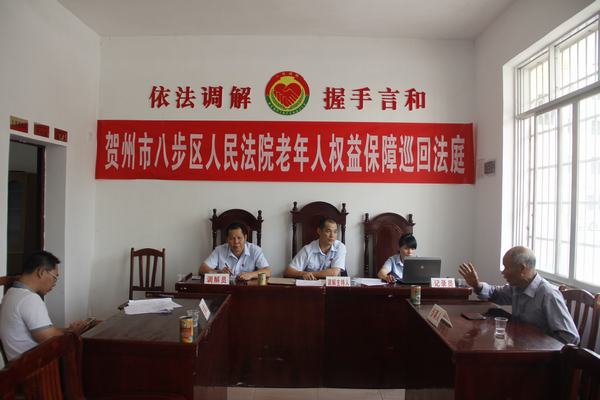
circuit court protecting elderly rights (old man v. son)

In the middle of April, 2015, the Chinese courts carried a report on the issuance of a policy document (the full text is not yet available) by the Ministry of Justice and the National Committee for the Ageing (NCA) (a joint State Council/Party organization, as the Chinese version of the NCA’s website states) on establishing a system of lawyers and legal aid for the elderly.  Issues relating to representing the elderly in China mirror those in other parts of the world.

Although the Supreme People’s Court was not one of the institutions that issued the policy document, the national court system is affected by profound changes to Chinese society, including the greying of Chinese society, its urbanization, and other factors.  These cases are considered by the courts those relating to people’s livelihood, as discussed in previous blogposts.

The issuance of this document relates to Article 55 of the 2012 Law on the Protection of the Rights of the Elderly, which calls for elderly people to obtain legal assistance if they cannot afford a lawyer needed to defend their rights. The Chinese courts are facing a major increase in cases involving the elderly, both civil and criminal, involving psychological and physical abuse, as a study done by the Suzhou Intermediate Court illustrates.  It is likely that the Ministry of Justice and NCA did a more comprehensive study on the need for advocates for the elderly before issuing this document.

The Suzhou study, summarized in Legal Daily in the fall of 2014 gives an update concerning elderly-related disputes in wealthy Suzhou, where the elderly population has reached 23%:

  • From 2011 to 2013, the Suzhou courts accepted 1,100 civil cases involving the elderly. Those increased rapidly over the 3 years in question, because in 2013 586 cases were accepted, an increase of 102.77% over the previous year. The cases related to support, divorce, inheritance, and division of property rights.
  • in 2013, there was an 83% increase in civil cases involving the right to the division of property rights arising from land acquisition, with over 80% of the property division cases arising in rural areas;
  • Over 90% of the support cases arose in rural areas;
  • In 2013, there was a 183% increase in inheritance disputes involving the elderly;
  • In over 70% of the cases involving division of property rights from land acquisitions, elderly were forced to live in bicycle sheds, garages, or other unfavorable conditions.
  • In many cases, elderly are shunted back and forth between their grown children, who were fighting over valuable property rights held by elderly parents.

The domestic violence policy document issued in March, 2015, addresses criminal law domestic violence issues against the elderly, which are also rampant, as discussed in this earlier blogpost.

The policy document calls for a one month movement in October to focus on the establishment of probono legal service centers for the elderly.  A one month movement appears inadequate for the breadth and depth of this important social problem, which reveals that Confucian values concerning support and care for the elderly have landed in the dustbin of history in too many cases.  We look forward to hearing more detailed reports from law firms and NGOs on how the rights of over a hundred million Chinese elderly (anticipated to more than double by 2050) can be better protected.