
Category Archives: Labor law

Supreme People’s Court Developments, December 2024-January 2025

from the report on the 2025 Central Political-Legal Work Conference on one of the SPC’s websites

See below a brief summary of recent developments  (or at least the principal recent developments) at the Supreme People’s Court (SPC) in January 2025 (as of January 19, the date of publication of this post) and December 2024.

January 2025

  1. On January 8th, the Party leadership heard the SPC Party Group’s report on the SPC’s work, along with those of other institutions.  I mention the requirement for this report in my 2024 article;

certain phrases (such as “report to a superior on their work” [shuzhi 述职] imply a hierarchical relationship between the SPC and the Central Political-Legal Committee and the Party Center. The fact that the SPC reports to the Party leadership can be seen in public reports on the leadership of the political-legal institutions meeting with Xi Jinping and other senior leaders before the annual sessions of the National People’s Congress and Chinese People’s Political Consultative Congress, although the materials actually submitted to the Party leadership are not publicly accessible.)

2.  January is when many important conferences are held that have an impact on the work of the courts: the Central Political-Legal Work Conference (中央政法工作会议) and the National Conference of Higher Court Presidents (Higher Court Presidents Conference 全国高级法院院长会议),  at which the spirit of the Political-Legal Work Conference is transmitted and the goals for judicial work in 2025 are announced. The SPC has held this conference annually for many years. In the recent historical past (the early 1990’s, for example), the Higher Court Presidents Conference was called the National Court Work Conference.

3. Policy documents: 

a. In early January, the SPC and the All-China Federation of Overseas Chinese (Overseas Chinese Federation 中国侨联权益保障部) issued a joint policy document on the strengthening the judicial protection work of the interests of overseas Chinese and returned overseas Chinese and their families in the New Era (关于加强新时代侨益司法保护工作的意见), and related reference cases.  The document seeks to ease litigation formalities for these groups and promote resolving disputes through mediation, among other matters, such as improving research on Overseas Chinese-related issues, such as through establishing a research base, as has been done with other issues.  The title of this document differs from Zhou Qiang era policy documents, but the goal of providing judicial support for an important national policy goal is the same. 

The SPC’s Research Office led the drafting of this document, in cooperation with the Overseas Chinese Federation.  This responsibility is consistent with the role of the Research Office, which deals with many legal policy and cross-internal institutional matters, such as Hong Kong, Macau, and Taiwan-related issues and the transition to the Civil Code.  It does not hear cases.

This is the first joint policy document between the SPC and Overseas Chinese Federation. Closer cooperation between the two institutions began in 2018, with 30 courts piloting closer cooperation with local Overseas Chinese Federations, and with the 2020 establishment of a “general-to-general” online mediation mechanism (the SPC has established this type of mechanism with the China Securities Regulatory Commission and other institutions).    The policy document is linked to language in recent Party Plenums on protecting the rights of returned Overseas Chinese and Overseas Chinese and their families.

b. Opinions of the Supreme People’s Court on Serving Technological Innovation with High-quality Trial Services 最高人民法院关于以高质量审判服务保障科技创新的意见.  The press conference report is here.  China IP Law Update’s summary in English is here.  If time had permitted, I would discuss the links in this document with the recent Party Plenum and other Party initiatives.

4. Judicial interpretations:

a. The SPC issued its second interpretation of the Marriage and Family Part of the Civil Code, aimed at addressing common troublesome issues facing the courts, such as property division when a cohabiting couple split, many issues relating to divorcing couples, including property division and ownership of a company established by a couple.  To provide further guidance on applying the interpretation, the SPC issued typical cases. This interpretation provides important insights into family law issues in current Chinese society.  

b.  The SPC joined with the Supreme People’s Procuratorate to issue the Interpretation of Several Issues Concerning the Application of Law in Handling Criminal Cases of Attacks on Police Officers (关于办理袭警刑事案件适用法律若干问题的解释).  From the provisions of this interpretation,  the confusion lower-level procuratorates and courts had about the application of Article 277 of the Criminal Law is apparent.

5. Other typical cases issued in January included: one on protecting natural reserves and national parks; another on punishing rural saohei (underworld forces) crimes; protecting the rights and interests of foreign investors; and refusing to pay wages (6200+ cases in the past four years)

6. The SPC established its Judges’ Disciplinary Committee, with President Zhang Jun as the chair.  At the first meeting, he noted that the establishment of a judges’ disciplinary committee and the implementation of a judges’ disciplinary system are political requirements for implementing the decisions and arrangements of the CPC Central Committee.  In 2021, I published a book chapter on Chinese judicial disciplinary developments, available here.

December 2024

December is the end of the year, so the SPC always issues many documents–judicial interpretations, policy documents, guiding and typical cases etc. at year’s end.  2024 was no exception. Among the documents worth noting:

  1. Judicial interpretations and meeting minutes

a. The SPC and the China Securities Regulatory Commission (CSRC) issued meeting minutes (conference summary) on bankruptcy (insolvency)  and reorganization of listed companies.  From the document number, it appears that the SPC took the lead in drafting it and it provides an update to a 2012 conference summary that the SPC issued itself. A DeHeng law firm partner comments here on the meeting minutes. The CSRC is soliciting public comments on Regulatory Guidelines for Listed Companies No. 11 – Matters Related to Bankruptcy and Reorganization of Listed Companies (this link contains the text and an explanation).  

b. On December 25, the SPC issued a Decision on Amending the Supreme People’s Court’s Regulations on Acknowledgement and Execution of Civil Judgments from Taiwan Area Courts, Chinese original 最高人民法院关于修改《最高人民法院关于认可和执行台湾地区法院民事判决的规定》的决定.  An English language summary is available here.  From a quick look, most amendments are procedural or unsurprising. Some reflect amendments to the Civil Procedure Law or codifying court practice. The provision “the people’s court shall make a ruling not to acknowledge a civil judgment if acknowledging it would violate fundamental principles of state laws, such as the one-China principle, or undermine state sovereignty, security, or social public interests” is consistent with analogous provisions and codifies what has been court practice.

2.  Guiding cases: on December 25, the SPC issued six guiding cases on state compensation issues, some of which provide glimpses of problems with prison management; On December 24, the SPC issued the first group of guiding cases on labor issues.

3. Typical cases: The SPC issued many typical cases in December 2024. As I mentioned previously, President Zhang Jun favors using typical cases to guide the lower courts in correctly applying the law.

The SPC issued typical  cases on: the protection of the rights and interests of the elderly; administrative public interest litigation (second group), issued jointly by the SPC and SPP;  “one letter and two books”  labor law supervision, issued jointly by the SPC, the SPP and the All-China Federation of Trade Unions;  wage arrears, issued in cooperation with the All-China Federation of Trade Unions and the Ministry of Human Resources and Social Security;  two groups of financial loan dispute mediation cases, issued by the  State Financial Supervision and Administration Bureau and the SPC, with one case providing a model for dealing with non-performing microloan cases; rights and interests of Taiwan compatriots, linked to the Party’s policy on promoting cross-straits integration and development; crimes involving counterfeit safety production qualification certificates (linked to a policy document issued in July, 2024 that does not appear to be publicly available (关于进一步加强安全生产资格证书涉假案件刑事审判工作的通知)); petty corruption (each case provides insights into the world of official corruption); punishing illegal production, sales, and use of eavesdropping and stealing equipment, with several cases involving the hidden filming (and marketing of those films) of people having sex in hotel rooms; inheritance disputes (first  and second group); criminal punishment of illegal fishing; and traffic accident liability.

3. Policy documents: Guiding Opinions on Improving the Quality and Efficiency of Trial Work and Promoting the Substantial Resolution of Contradictions and Disputes (关于在审判工作中促进提质增效 推动实质性化解矛盾纠纷的指导意见).  This document focuses on civil and administrative disputes, promoting mediation (Fengqiao Experience) and the resolution of the substance of disputes (as discussed here).  I will draw on this document in a forthcoming article.

4. Plans: 

a. the SPC issued the Sixth Five-Year Judicial Reform Outline.  This article links to the text of the Outline and the related press release. I will publish an article later this year providing a summary and analysis of this document. 

b.  the SPC issued the National Court Education and Training Plan (2024-2028).  I analyzed the previous two plans here and here.  Training of judges handling foreign-related matters receives special attention (see my earlier analysis).

5.  National People’s Committee (NPC) Standing Committee’s Recording & Review:  SPC judicial interpretations and other judicial documents must be filed with the NPC Standing Committee. At the end of 2023, the NPC SC adopted a decision strengthening the recording and review mechanism (see the NPC Observer’s analysis). On 22 December 2024, the Legislative Affairs Commission of the NPC Standing Committee gave its view in its annual report on Recording and Review that a July 2024 Supreme People’s Court interpretation that directed lower courts to retroactively apply a new provision in the recently revised Company Law concerning equity transfers,  controversial in the business community,  was inconsistent with the Legislation Law. The Legislative Affairs Commission stated that the “[they] will urge the relevant judicial interpretation-making authorities to take appropriate measures to properly handle the matter.”  The SPC issued a follow-up interpretation two days after the annual report was made public, signaling that the SPC had been previously been informed.  Although the problematic July 2024 interpretation must have been reviewed by the Legislative Affairs Commission in draft form before it was approved by the SPC judicial committee, as required by Article 18 of the SPC’s Judicial Interpretation Work Provisions, it appears that that whichever office of the Legislative Affairs Commission initially reviewed the SPC’s draft and the office responsible for recording and review took different views. 

____________________________________________________

Thank you, subscribers, for your patience.  The blog will transition from being completely researched and written by me (including discussions with knowledgeable persons and experienced judges, for the avoidance of doubt) sometime after Chinese New Year. I plan to involve my research assistants more in analysis and writing, although I have at least one long analytical blogpost that I will complete soon.   I want to focus on consolidating and developing my research in longer pieces.

 

Welaw Monitor (微律观察) #2

I am traveling at the moment, so my time to review articles published on Wechat is limited.  But below are some links of interest.

Screen Shot 2017-06-17 at 10.04.02 AM
Huazhen (Flower Town) emotional counseling

Oldies but goodies

Several prominent media sources, the South China Morning Post among them, are running articles on China’s clean-up of the financial sector, this one pointing to the government’s focus on privately owned insurance companies.

But those reading Wechat would have known that several years ago, China’s legal analysts had been writing  articles such as “China’s private entrepreneurs are all on their way to jail  or China’s businesspeople are either in jail or on their way to jail. 

China’s Good Samaritan case Peng Yu back in the news-  a backgrounder plus-retired SPC judge Cai Xiaoxue criticizes as does former judge & Peking U Professor Fu Yulin.

Detention Center Law draft

The Ministry of Public Security (MPS) has recently issued its draft Detention Center Law for public comments (link to Chinalawtranslate.com’s translation.  The draft has caused a great deal of comment within China and those concerned about the treatment of fellow human beings in criminal detention in China should read these articles:

The MPS is drafting the Detention Center Law, but the entire legal world is opposed

10 years of calls for separating detention from criminal investigation

Professor Chen Ruihua, defects of the detention system and how it should be reformed

Professor Chen Ruihua–the detention centers should be transferred to the justice authorities

Commercial law

China’s distraught buy online counseling packages, but does China’s consumer protection legislation protect them if there are no standards for counseling?

Party discipline

A Cangzhou court president is under investigation. Is it connected to the strip search of a woman lawyer?

In CCDI hearing procedures, will evidence provided by the accused be considered?  The answer is, the scope is limited

Criminal law

Three SPC judges (likely to have been on the drafting team) unpack the asset recovery regulations (discussed in this January blogpost). It shows they looked to foreign legislation when doing so;

 20 years of bribery prosecutions, with 9 acquittals

SPC on anti-drug day, with white paper and 10 typical cases

Is it rape if the sexual contact comes after the coercion?

Supervision Commission

The first father’s day after being transferred to the Supervision Commission

Labor law

Does “remote working” in China mean the place of employment has changed?

Don’t make these 10 mistakes when terminating employees

Family law issues & property

Leta Hong Fincher’s book Leftover Women discusses the Marriage Law interpretation & home purchases.  This Wechat post sets out a chart with various scenarios related to marriage & home purchase--a very handy reference.

Bankruptcy

10 typical bankruptcy cases from Suqian, Jiangsu Province, including some real estate companies

Chongqing courts borrow concepts of personal bankruptcy from abroad when dealing with private (shadow) borrowing cases

The many inadequacies in China’s non-performing asset legislation

Judiciary

A review of the Party’s work at the SPC since the 18th Party Congress


Welaw Monitor (微律观察) #1

I am tweaking the type of content on the blog, cutting down on the long analytical blogposts.   I will provide links to reports and analysis on court and other legal matters on Wechat. I am concentrating on writing a book and some other related writing and editing projects.

It remains my hope that some followers with the financial wherewithal to do so will consider supporting (in some fashion) the blogs that are enabling the English speaking and reading public to perceive (through translation or bite-sized analysis) the “elephant” that is the Chinese legal system, among them Chinalawtranslate.com and this blog.

Commercial law

14 situations where the corporate veil can be pierced

Criminal law

Public security v. SPC & SPP on what is prostitution–does that include other types of sexual services?

SPC vice president Li Shaoping on drug crimes–relevant sections of Criminal Law should be amended, better evidentiary rules needed for drug crimes, & death penalty standards need to be improved

Hebei lawyer’s collateral appeal statement, alleges torture during residential surveillance, procedural errors (part of China’s innocence project

China’s financial crime trading rules are unclear

Defendant changed his story on appeal but the appeal court ruled he was the killer

25 criminal law case summaries from People’s Justice magazine 

Criminal procedure law

public security does not want the procuratorate supervisors in police stations

A corrupt official’s polygraph problems

Supervision Commission

Its power should be caged

Beijing supervision authorities take someone into custody, will shuanggui be abolished?

Party discipline

On confession writing

10 No nos for Party members using Wechat

Administrative litigation law

SPC issues 10 typical administrative cases, including one involving the Children’s Investment Fund

Those disputing compensation for expropriation of rural land must first apply for a ruling–land is now part of the Harbin Economic and Technical Zone (unpacking of  case #46 of #2 Circuit Court’s case summaries)

Labor law

Important study by the Guangzhou Intermediate Court on labor disputes 2014-16, with many insights & a section devoted to sex discrimination issues

Don’t make these 10 mistakes when terminating employees

Family law

Status report on family court reforms (& difficult issues for judges)

 Why it’s so hard to deal with school bullying in China

How juvenile justice should be improved (the semi-official view)

Judiciary

300 cases in 100 days–a team of young judges & expedited criminal cases

Environmental Law

Procuratorate has brought 79 public interest law suits in Yunnan (press report)

Bankruptcy

Why bankruptcy is so difficult and what needs to improve

Lawyers

 legal qualification system needs changing, the profession needs those with non-law undergraduate training


Liaoning high court looks into labor issues in bankruptcy

While Zhou Qiang’s statements on  judicial independence, mistaken “Western” thinking, and separation of powers continue to be discussed inside and outside of China, others in the Chinese legal community face more prosaic and difficult issues of how to protect workers when companies go into bankruptcy.  This is a particular issue in the northeastern provinces, particularly in Liaoning.

According to statistics released in the past month (January, 2017), there were 345 other bankruptcy cases accepted by the Liaoning courts, aside from the bankruptcy of Dongbei Special Steel, which has received the lions share of attention outside of China. While strikes are regularly reported in the English language media , what is not known that in many of these bankruptcy cases, employees have gone to court.

A research report by the Liaoning Higher People’s Court (Liaoning High Court) recently released in the People’s Court Daily (the Supreme People’s Court’s )SPC) newspaper, giving the report the SPC’s semi-official imprimatur) drilled down on 79 labor cases related to enterprise bankruptcy that arose in 2015-16. The Liaoning High Court did not specify the overall number of bankruptcy-related labor cases the provincial courts accepted.  A quick search reveals several hundred, the exact number depending on how the search is framed.

The research report provides a glimpse into the concerns of the judiciary, involvement of counsel in these disputes (a more general report on representing workers was recently published, available here), inadequacies of related legislation, and chaotic record keeping of these companies.

Research report reveals several major issues

The report identified the top issue to be the re-employment of workers, citing two large scale bankruptcies, the Hongmei Group (MSG manufacturer) and Badaohao Coal Mine. (A 2014 social media posting criticized the Hongmei Group’s violation of labor law).

A second issue was that bankruptcy caused group labor litigation, particularly by senior staff, who were more highly paid, and older, but faced difficulties being reemployed (and likely had the funds to hire a lawyer).  The report noted that this group had overly high expectations from litigation and if their individual claims were not supported by the court, they would resort to group litigation or petitioning.The research report mentioned, with a positive spin, that labor lawyers were involved  to resolve disputes.

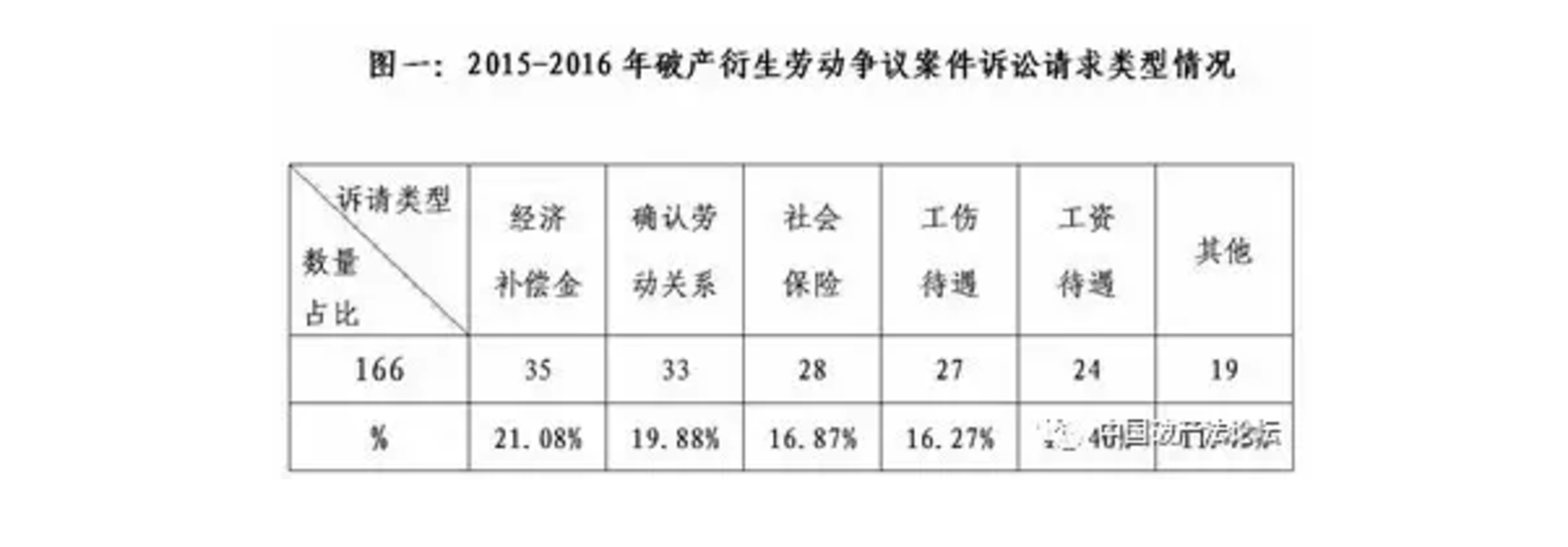
The litigants raised more varied claims rather than simply wages, including: damages; determination of a labor relationship; social insurance; work-related injury; wages and status; etc., as shown by the chart below.

screen-shot-2017-02-02-at-8-50-40-amUnlike ordinary labor cases, most cases were decided by court judgment, not mediated. In 66% of the cases, the plaintiff’s claim was upheld in whole or part, with a dismissal of the plaintiff’s claims in 28% of cases.
The report also illustrates the importance of social stability related procedures.  Although a Chinese law firm partner criticized as quite vague and incompatible with the existing labor law system  the requirement in a 2016 State Council policy document that a worker resettlement plan (for certain industries)  be approved by the workers’ congress or all workers, this is not new and is taken seriously by local judges.  The requirement is contained in Liaoning provincial level legislation (and other legislation) and compliance was noted by the research team. (The team noted that after the resettlement plan was approved (for Hong Mei Group and Badaohao Coal) was approved by the workers congress, it was reported to the local labor and union authorities authorities.

Compliance with labor law related formalities, by both  companies and employees created problems for judges hearing these claims, such as in work-related injury cases, where companies failed to pay legally required wages to employees and employees failed to submit needed documentation.  Some of the companies continued to pay employees under old “planned-economy” systems rather than comply with current labor law, requiring employees to work overtime without overtime pay, a particular issue in the Badahao Coal Mine bankruptcy.

Inadequacies of legislation highlighted by the team included: how to characterize labor claims in bankruptcy, and whether they should be treated as labor disputes or claims against the bankruptcy estate; whether labor disputes needed to be submitted first to labor arbitration; how the courts can better obtain files from labor arbitration authorities and can ensure labor disputes are addressed and not avoided; and how to ensure that bankrupt enterprises pay social insurance payments for their employees.

Comments

The research team (at least on the version publicly available) did not further explore the reasons for the failure of these bankrupt companies (likely many SOEs) to comply with basic labor law requirements, why local labor arbitration authorities avoided hearing cases, or why the Liaoning High Court needed to issue the recommendation that  “labor administrative departments should also strengthen the daily management and supervision of the enterprises before their bankruptcy.”

This report contains a disturbing signal about the disposal of assets of bankrupt companies.  This is significant because the government is promoting the use of bankruptcy. The report recommended that the liquidation group effectively dispose of tangible and intangible assets of the bankrupt companies such as coal mines and well-known trademarks, and implement better supervision and management, to ensure that the realization of bankruptcy assets to maximize the protection of the employees.

Liaoning bankruptcies may be an illustration of what an bankruptcy lawyer recently commented in Caixin:  “falsifying financial reports and asset transfers has often occurred in SOE bankruptcy cases to escape obligations. Meanwhile, local governments’ intervention has also often disrupted the fairness of such cases.”

It appears that employees of the bankrupt companies are the ones who suffer the most when these cases are not handled fairly.As the research team recognized, employees are the weaker party. The team recommended that local government provide a coordination mechanism and funding to secure the workers’ claims against the company, so that the company can withdraw from the market but overall societal interests are balanced.  Whether local Liaoning governments do so remains to be seen.

Data from the Supreme People’s Court on 2015 Labor/Employment Disputes

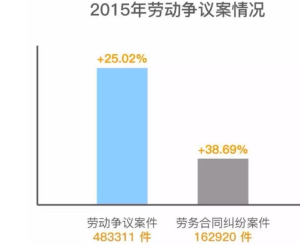
Screen Shot 2016-03-27 at 10.26.57 AMAnother indication of the soft economy is the growing number of labor disputes. The Supreme People’s Court (SPC) has released selected national statistics (chart from linked source), indicating a significant increase in labor disputes.  Unfortunately, the SPC did not release a provincial breakdown and the searches necessary to set out such data are relatively time-consuming.

The statistics are divided into labor disputes (劳动) and labor service (劳务) disputes.  Labor disputes are disputes which arise because the employee is or should have been employed under the Labor Contract Law.

Labor service disputes

Labor service disputes, which totalled 162,920, an increase of 38.69%.  relate to an “independent contractor,” but more often a quasi-employment relationship, governed by the Contract Law and General Principles of Civil Law, under which the laborer has minimal protections.  Although an attempt had been made to set forth better legal infrastructure (and protections) for this category of workers, “for a variety of reasons,” more comprehensive legislation has not yet been promulgated. Local courts have identified the following categories of litigants to labor service disputes:

  • Migrant construction workers,  often hired (without a written contract) by construction contractors or sub-contractors who lack the proper qualifications to be in business, often occurring when the worker has been injured or has not been paid.
  • Older workers, who are beyond retirement age.  According to a Guangdong court, many small companies hire these workers to reduce their labor costs.

These cases often involve large groups of workers, but little documentation. Courts note that  “mass incidents” arise if the cases are not handled properly.

Labor contract disputes

New labor contract disputes accepted by the Chinese courts totalled 483,311 labor dispute cases, up 25.02 percent.For certain categories of labor disputes, the dispute must be first heard by labor arbitration. In an indication of the view of the SPC, its official newspaper, the People’s Court News, has published an article by a judge in a Nanjing court, suggesting that if the employer is in bankruptcy, the employee can sue in court, without resorting to labor arbitration.

Some provincial courts have reported an increase in large scale labor disputes. The  Xinjiang High Court, for example, reported retrials of at least 10 labor disputes involving 600 or more persons.

Some lawyers and judges in China have done a further “big data” analysis of labor cases.  One of the more relevant and detailed was done by the Guangdong Moreking Law Firm), which in 2015 published a series of charts along with their analysis (but relating to 2014, based on a search of the SPC’s case database).  A selection of those charts are set out below (©remains with them).

image
Location of labor disputes in Guangdong, 2014

In 2014, the Guangdong courts accepted 13,168 cases, 80% of which arose in the Pearl River Delta cities of Guangzhou, Shenzhen, Dongguan, Foshan, Zhongshan and Zhuhai (10178).

image-1

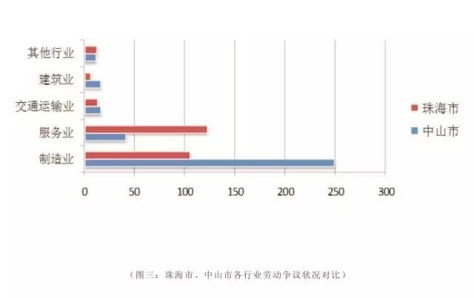
Comparing Zhongshan (red) and Zhuhai (blue), most cases were in the manufacturing sector, followed by service, transportation, construction, and other inddustries.

image-2


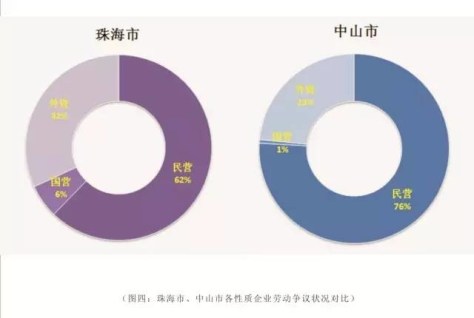
In Zhuhai (on left) and Zhongshan (on right), the majority of disputes arose in privately owned companies, followed by foreign invested companies.  The authors noted that foreign invested companies tended to have more compliant labor management, with those company represented by lawyers in most cases.image-6

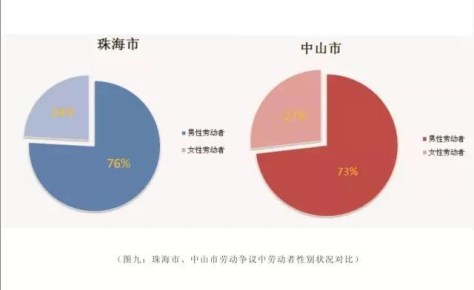
Comparing Zhuhai (blue) and Zhongshan (red), in each location three quarters of litigants were men.  Similarly, the Panyu district court (part of Guangzhou), noted the same phenomenon.

image-7

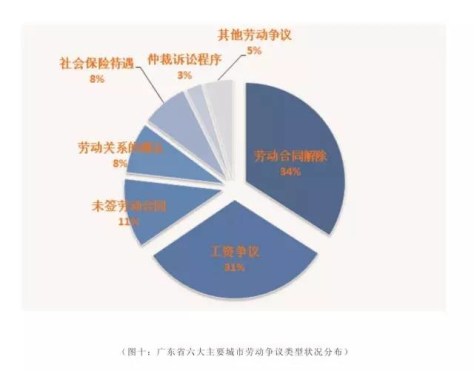
Most cases related to termination, followed by payment, with failure to sign a labor contract, social insurance and other reasons far behind.

image

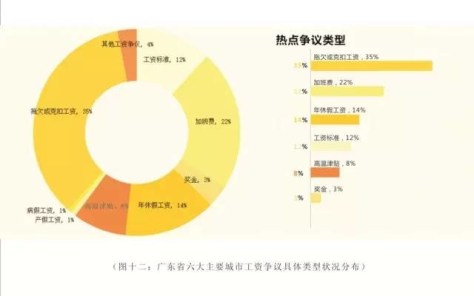
On disputes over payment, the greatest reason is wage arrears (35%), followed by overtime pay (22%).  The Guangdong High Court issued guidance in 2015 enabling lower courts to impose a criminal sentence for wage arrears if certain minimum thresholds are met.

Comment

A more comprehensive survey is needed by province, as well as an analysis of the underlying reasons.  From the statistics above, and from earlier comments by senior leaders of the SPC, it is clear that labor abuses of migrant construction workers by unscrupulous contractors are widespread, and it is difficult for the legal system to deal with them.  The private sector has a far greater incidence of labor disputes, and women are more willing to tolerate ill-treatment at work.  Finance Minister Lou Jiwei criticized the Labor Contract Law during this year’s National People’s Congress session, but the numbers reveal significant issues with labor relations in China.