

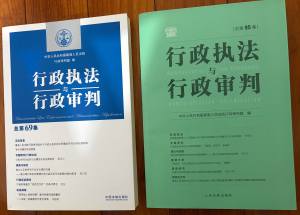
The August 1 post in Administrative Enforcement and Administrative Trial (Adjudication) (行政执法与行政审判 ), the official WeChat account of the Supreme People’s Court’s (SPC’s) Administrative Division, described the work of the Yantai (Shandong) Intermediate People’s Court in working with the local market regulator as an example of deepening cooperation between the courts and regulators (深化法监联动) to build a joint governance platform. I surmise that the SPC’s Administrative Division reposted the article, originally published in the local court’s WeChat public account, to illustrate how a local court “extends its judicial functions” and promotes the substantive resolution of disputes at the source, harmonizing administrative and judicial standards, thereby implementing Party and SPC policy. The article was likely reposted as a reference for other local court administrative divisions, the legal departments of local market regulators (法规处), local justice departments, and law firms representing local governments. For observers of the Chinese courts, this article provides insights into larger trends in Chinese administrative law, some signaled by earlier SPC documents, but more recently by SPC President Zhang Jun in his 2024 report to the National People’s Congress Standing Committee (2024 report).
What are the Takeaways?
The article describes the goal of cooperation between the local court and the market regulator as judicial-administrative enforcement collaborative governance (深化法监联动 …共治平台). President Zhang Jun used a version of this phrase (judicial and administrative enforcement collaboration 执法司法协同) in his 2024 report. Cooperation between the judiciary and regulators has a long history and is more important post-19th Party Congress, when it was decided that the judicial system is to be part of a modernized governance system. A recent academic article links this collaboration to performance indicators of the judiciary and regulators. The author, the Chinese administrative law scholar Ma Chao (马超), argues that the current adjustment of the relationship between judicial and administrative powers stems not only from the functional shift in administrative litigation, but more profoundly from the goal-oriented coordination of the two powers under the pressure of performance governance.
The collaboration in Yantai directly links to “optimizing the business environment” (优化营商环境), an unresolved issue for Chinese regulators. “Optimizing the business environment” is a keyword (提法) that derives from World Bank business indicators, and General Secretary Xi Jinping has spoken on the topic often. The phrase appears in many Party policy statements, government and SPC documents. A June, 2026 article on the Ministry of Justice’s website stressed the contribution of government-court collaboration to this policy.
The Yantai Intermediate Court report illustrates how a local court implements the 3+N mechanism that SPC President Zhang Jun promoted in his 2024 report to the National People’s Congress Standing Committee. As flagged in that report, the “3+N” working mechanism involves the SPC, the Supreme People’s Procuratorate, and the Ministry of Justice and certain regulators. Through the mechanism, the SPC works with regulators to analyze high- frequency administrative disputes and evolve measures to reduce or eliminate them, or in bureaucratic jargon, prevent and substantively resolve them (行政争议预防与实质化解). The Yantai Intermediate Court shows how to do this at the municipal level.
Disputes over administrative penalties on companies (enterprises) are among the most frequent types of administrative disputes. The Yantai Intermediate Court uses a “full-chain legal supervision and collaborative governance closed-loop mechanism,” a Chinese governance mechanism that involves the courts, procuratorate or other authorities with supervision authority to monitor administrative behavior at all stages. Yantai Intermediate Court does it through case guidance – law enforcement self-inspection – judicial feedback – issuance of suggestions – follow-up rectification, apparently not involving collaboration with the public or businesses. We can only see the details of case guidance, entitled “reference examples of administrative penalties involving enterprises (涉企行政处罚参考范例) in the post, some of which involve the old problem of the market regulator imposing heavy penalties on minor infractions by private businesses. Those interested can review the attached translation of case #10. Other readers could compare New York City Mayor Mamdani’s efforts to combat an analogous problem.
Comments
The work of the Yantai courts illustrates, among other points, how Chinese courts compensate for the weaknesses of other institutions and the shift in the role of the relationship between the courts and regulators in the New Era.
Although legal reforms since 2014 have called for strengthening the legal advisory function within government by promoting the role of public service lawyers and public legal consultants, the courts still serve the greater situation by advising government. (Although I can identify a string of documents issued by the Ministry of Justice related to public service lawyers and the Implementation Outline for the Construction of a Government under the Rule of Law (2021-2025) calls for increasing the role of public legal consultants, their role appears to be a work in progress (as does related English-language research). (As an aside, I cannot find the current counterpart of the 2021-2025 Party-State Council document on the construction of a government under the rule of law.)
This WeChat article by a Da Cheng lawyer describes the special skills needed to serve as outside counsel for government, but I could not find a related English-language article. In many other jurisdictions (I don’t believe the civil or common law distinction makes a difference) market regulators would obtain legal advice from their legal department (office of general counsel), municipal corporate counsel, or legal affairs department, or possibly outside counsel. Robust legal advice from government lawyers may have prevented many of the typical cases published from arising.
As Ma Chao pointed out in his article (and which I will explore in a later article), the collaboration between the government and the courts lacks comprehensive procedural rules and oversight mechanisms. He noted that apart from internal oversight by higher courts and higher administrative organs, external oversight mechanisms such as prosecutorial oversight, oversight by people’s congresses and by society are absent. He proposes a more systematic and effective oversight and evaluation mechanism to, among other matters, better protect the rights of affected parties. As he notes, the impact of the collaboration mechanism raises concerns about judicial neutrality and judicial legitimacy.
__________________________________
Many thanks to Yuan Ye (袁野), one of my former students (the author of two posts on this blog) and a current PhD student at the Peking University School of Law for his thoughtful comments on an earlier version of this post.


You must be logged in to post a comment.