
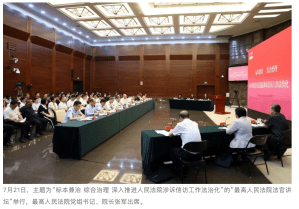
 As one of my research assistants, Liu Yanmu (刘严木), discovered, each activity of the President of the Supreme People’s Court (SPC) made public illustrates his unique role and the institution’s multiple roles. One recent example is the July 21 (2026) forum on substantively resolving disputes, focusing on petitioning (标本兼治 综合治理 深入推进人民法院涉诉信访工作法治化). It also signals that one part of the SPC’s work is responsibility for “litigation-related” petitioning (涉诉信访), petitioning related to the work of the courts. The SPC’s responsibility (accountability) and that of its leaders link to related accountability regulations. That means the institution is responsible in two ways. If petitioners petition the SPC headquarters or, more often, one of the circuit courts, the SPC is responsible for properly handling the matter, including possibly resolving the underlying problem. Additionally, the SPC is responsible for guiding lower courts in dealing with petitioners. The forum participants, forum content, and repeated appearance of petitioning in recent judicial reform programs are significant.
Participants
Although I cannot decode the significance of all participants in this forum, the identities of the two senior SPC judges and two commentators are important. The two SPC judges are Qian Xiaochen (钱晓晨), the Director of the SPC’s Case Filing Division and Chen Xueyong (陈学勇), Deputy Director of the Second Circuit, in Shenyang. Among the many duties of the SPC’s Case Filing Division, according to the Chinese version of the official website, is guiding litigation-related petitioning work (涉诉信访) of the courts. Multiple official documents also so require. Chen Xueyong, as the deputy director of the #2 Circuit Court, is stationed in Shenyang and is responsible for overseeing the appropriate handling of petitioners in that circuit. It is understood that the #2 Circuit Court still receives a relatively large number of petitioners, particularly compared to the wealthier First and Third Circuits. In June (2026), the #2 Circuit Court hosted a national conference entitled “‘Disputes End with Me’: The Unity of Front-End and Back-End, Explicit and Implicit Achievements (“纠纷止于我”:末端与前端、显绩与潜绩的统一), much of which related to handling petitions.
The July 21 forum also included two commentators from two institutions that coordinate or are concerned about petitioning policy nationally: Ms. Jin Yanli (金艳丽), deputy head of the Office of the Central Petitioning Joint Conference (中央信访联席办副主任) and deputy director/Party group member of the State Letters and Visits Bureau (家信访局党组成员副局长) and Mr. Ji Tao (吉涛), bureau chief within the Central Political-Legal Commission (中央政法委八局局长). The Joint Conference (see my earlier posts for information about joint conferences) is mentioned in the 2022 Petitioning Regulations. Under the 2023 institutional reforms, the State Letters and Visits Bureau became an institution directly under the State Council, under the unified leadership of the Central Social [Society] Work Department (see this article for one view of the Department’s work).
Timing
It is unclear whether the timing was linked to the July (2026) issuance of a Party and State policy document on social (society) work in the New Era (关于加强新时代社会工作的意见), or whether the forum was long-planned. The full text of the document is not available, but the detailed summary includes phrases on “deepening the reform of the petitioning system, promoting the rule of law in petitioning work, and continuously advancing the root-cause governance of petitioning issues and the resolution of long-standing cases.”
Judicial Reform and Petitioning
Petitioning has appeared in at least the last three judicial reform plan outlines. The current judicial reform plan, which draws on similar provisions in the last two plans and is far more detailed, provides:
(15) Deepening the prevention and resolution of petitioning related to litigation. In light of the work of the people’s courts, institutions and mechanisms for comprehensively promoting the legal footing for work related to petitioning shall be improved. The combination of visits and investigations, with mediation given priority, shall be upheld, and coordination and linkage between mediation and work related to petitioning shall be promoted. The working mechanism for substantially resolving petitioning involving litigation shall be improved. Introduction procedures, public hearings, assistance and relief, and other methods shall be comprehensively utilized, and the mechanism for the participation of NPC deputies, CPPCC members, lawyers, and others in handling public complaints shall be enhanced. Responses to each petition shall be deepened, and the efficiency and quality of responses shall be improved. The separation between litigation and petitioning shall be further promoted. The reviewers, standards, and procedures for recording the termination of petitions involving litigation shall be refined, and the mechanisms for termination and transfer shall be improved. The organic integration of receiving petitions and incorporating petitions into case handling, supervision through the judicial hierarchy, judicial aid, and other work shall be promoted to facilitate case resolution and dispute settlement, thereby strengthening the source control of petitions related to litigation. Inappropriate acts such as persistent complaint visits, disruptive complaint visits, and profit-seeking through public complaints shall be dealt with in accordance with the law, and guidance shall be provided to ensure lawful and reasonable presentation of demands.
I surmise that the June 2026 forum in Shenyang was intended to develop related measures.
Content
Although detailed guidance for judges was not set out in the press release on the July forum, the June 2026 report signalled how petitions should be handled. It is consistent with policies directed at preventing and reducing disputes:
- examine and resolve deep-seated issues reflected in petitions and complaints, thereby improving the quality and efficiency of first and second instance trials [and avoiding petitions from arising];
- link higher and lower courts and court divisions handling substantive matters (业务部门) as well as SPC circuit courts and the courts within their circuits;
- implement mechanisms for analyzing the underlying issues and liaising with court divisions handling substantive matters;
- improve the linkage with comprehensive governance centers and other relevant institutions, and form a joint force for the prevention and resolution of conflicts and disputes;
- deploy trial management indicators to spur judges to resolve petitioning disputes.
For those interested in a more detailed analysis of issues related to petitioning at the #2 Circuit Court, I recommend (retired) Justice Hu Yunteng’s 2019 article.
_______________________________________
Many thanks to one of my former students for her thoughtful comments on an earlier draft of this post.

