
Category Archives: Petitioning

Petitioning and the Supreme People’s Court

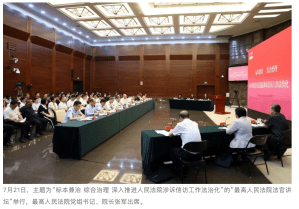
As one of my research assistants, Liu Yanmu (刘严木), discovered, each activity of the President of the Supreme People’s Court (SPC) made public illustrates his unique role and the institution’s multiple roles. One recent example is the July 21 (2026) forum on substantively resolving disputes, focusing on petitioning (标本兼治 综合治理 深入推进人民法院涉诉信访工作法治化).  It also signals that one part of the SPC’s work is responsibility for “litigation-related”   petitioning (涉诉信访), petitioning related to the work of the courts. The SPC’s responsibility (accountability) and that of its leaders link to related accountability regulations.  That means the institution is responsible in two ways. If petitioners petition the SPC headquarters or, more often, one of the circuit courts, the SPC is responsible for properly handling the matter, including possibly resolving the underlying problem.  Additionally, the SPC is responsible for guiding lower courts in dealing with petitioners. The forum participants, forum content, and repeated appearance of petitioning in recent judicial reform programs are significant.

Participants

Although I cannot decode the significance of all participants in this forum, the identities of the two senior SPC judges and two commentators are important.   The two SPC judges are Qian Xiaochen (钱晓晨), the Director of the SPC’s Case Filing Division and Chen Xueyong (陈学勇),  Deputy Director of the Second Circuit, in Shenyang.  Among the many duties of the SPC’s Case Filing Division, according to the Chinese version of the official website, is guiding litigation-related petitioning work (涉诉信访) of the courts.  Multiple official documents also so require.   Chen Xueyong, as the deputy director of the #2 Circuit Court, is stationed in Shenyang and is responsible for overseeing the appropriate handling of petitioners in that circuit.  It is understood that the #2 Circuit Court still receives a relatively large number of petitioners, particularly compared to the wealthier First and Third Circuits.  In June (2026), the #2 Circuit Court hosted a national conference entitled “‘Disputes End with Me’: The Unity of Front-End and Back-End, Explicit and Implicit Achievements (“纠纷止于我”:末端与前端、显绩与潜绩的统一), much of which related to handling petitions.

The July 21 forum also included two commentators from two institutions that coordinate or are concerned about petitioning policy nationally: Ms. Jin Yanli (金艳丽), deputy head of the Office of the Central Petitioning Joint Conference (中央信访联席办副主任) and deputy director/Party group member of the State Letters and Visits Bureau (家信访局党组成员副局长) and Mr. Ji Tao (吉涛),  bureau chief within the Central Political-Legal Commission (中央政法委八局局长). The Joint Conference (see my earlier posts for information about joint conferences) is mentioned in the 2022 Petitioning Regulations.  Under the 2023 institutional reforms, the State Letters and Visits Bureau became an institution directly under the State Council, under the unified leadership of the Central Social [Society] Work Department (see this article for one view of the Department’s work).

Timing

It is unclear whether the timing was linked to the July (2026)  issuance of a Party and State policy document on social (society) work in the New Era (关于加强新时代社会工作的意见), or whether the forum was long-planned.  The full text of the document is not available, but the detailed summary includes  phrases on “deepening the reform of the petitioning system, promoting the rule of law in petitioning work, and continuously advancing the root-cause governance of petitioning issues and the resolution of long-standing cases.”

Judicial Reform and Petitioning

Petitioning has appeared in at least the last three judicial reform plan outlines.  The current judicial reform plan, which draws on similar provisions in the last two plans and is far more detailed, provides:

(15) Deepening the prevention and resolution of petitioning related to litigation. In light of the work of the people’s courts, institutions and mechanisms for comprehensively promoting the legal footing for work related to petitioning shall be improved. The combination of visits and investigations, with mediation given priority, shall be upheld, and coordination and linkage between mediation and work related to petitioning shall be promoted. The working mechanism for substantially resolving petitioning involving litigation shall be improved. Introduction procedures, public hearings, assistance and relief, and other methods shall be comprehensively utilized, and the mechanism for the participation of NPC deputies, CPPCC members, lawyers, and others in handling public complaints shall be enhanced. Responses to each petition shall be deepened, and the efficiency and quality of responses shall be improved. The separation between litigation and petitioning shall be further promoted. The reviewers, standards, and procedures for recording the termination of petitions involving litigation shall be refined, and the mechanisms for termination and transfer shall be improved. The organic integration of receiving petitions and incorporating petitions into case handling, supervision through the judicial hierarchy, judicial aid, and other work shall be promoted to facilitate case resolution and dispute settlement, thereby strengthening the source control of petitions related to litigation. Inappropriate acts such as persistent complaint visits, disruptive complaint visits, and profit-seeking through public complaints shall be dealt with in accordance with the law, and guidance shall be provided to ensure lawful and reasonable presentation of demands.

I surmise that the June 2026 forum in Shenyang was intended to develop related measures.

Content

Although detailed guidance for judges was not set out in the press release on the July forum, the June 2026 report signalled how petitions should be handled.  It is consistent with policies directed at preventing and reducing disputes:

  • examine and resolve deep-seated issues reflected in petitions and complaints, thereby improving the quality and efficiency of first and second instance trials [and avoiding petitions from arising];
  • link higher and lower courts and court divisions handling substantive matters (业务部门) as well as SPC circuit courts and the courts within their circuits;
  • implement mechanisms for analyzing the underlying issues and liaising with court divisions handling substantive matters;
  • improve the linkage with comprehensive governance centers and other relevant institutions,  and form a joint force for the prevention and resolution of conflicts and disputes;
  • deploy trial management indicators to spur judges to resolve petitioning disputes.

For those interested in a more detailed analysis of issues related to petitioning at the #2 Circuit Court, I recommend (retired) Justice Hu Yunteng’s 2019 article.

_______________________________________

Many thanks to one of my former students for her thoughtful comments on an earlier draft of this post.

The Supreme People’s Court’s New Petitioning Measures

Beijing petitioners at SPC (used with permission of Natalie Behring)

In the past two weeks, the Supreme People’s Court (the Court) has taken new measures to resolve the problem of petitioning (ordinary people petitioning higher authorities concerning their grievances).  Court petitioners generally have grievances related to judgments (or the enforcement of judgments) in the lower courts.  Petitioning affects the Court itself.  The current measures are tied with the document released on 27 February 2014 by the General Offices of the Communist Party Central Committee and the State Council on petitioning reform (the Petitioning Reform Document, linked here) and briefly reported here. More measures from the Court are anticipated this year.

Approximately 60,000-70,000 petitioners approach the Court each year, many repeat petitioners. In the Court Reform Decision of November, 2013 and other statements in 2013, Court leadership identified resolving the issues underlying petitioning as a target for action (see previous blogposts in January, 2014, October, 2013, and September, 2013).  It is likely that its current and future initiatives related to petitioning will be mentioned in the Court’s Work Report to the National People’s Congress.

Link to the Petitioning Reform Document

The Petitioning Reform Document is intended for distribution to the court system, as a Party document distributed to “all departments.” It pinpoints measures for the court system to take, some highlighted below.

Several points of the Petitioning Reform Document relate to the new measures taken by the Court.  Point 5 of the document relates calls for pathways for petitioning issues to be heard, including on-line petitioning platforms.  Point 9 of the document calls for greater legalization of petitioning, such as:

  • separating litigation from petitioning;
  • taking petitioning into the courtoom;
  • improving various types of appeal procedures (litigation/arbitration/administrative reconsideration)
  • improving systems within the courts/procuracy/public security/judicial administration to deal with the underlying issues causing petitioning.

The last sentence in Point 9 calls on the strengthening of the capacity of the judicial system, to satisfy the ever-increasing demands on the judicial system of the masses (ordinary people), and to make the masses feel that they have received fair justice.

Phrases in the last sentences are frequently used by the Court leadership. The latter phrase is part of a statement made by Xi Jinping in early 2013 and is often used by the Supreme People’s Court leadership (discussed here).

Internet petitioning platform

To implement the Petitioning Reform Document, on 28 February, the Court established an electronic platform for petitioners, linked here.  The internet platform can be accessed from the Court’s official website:

网上办事

The platform includes a short video explaining how to use the on-line system, as well as its benefits, linked here.  It is likely intended as a model for the lower courts.

Time will tell how the Court (and the lower courts) will promote the electronic system and resolve the underlying issues.  A related issue is whether the Party anticipates a greater scope for NGOs in dealing with court-related issues.

For example, will a team of Court staff be dispatched to the street with tablet computers to register petitioners’ cases?  Will this mean that NGO representatives will assist petitioners to register their issues with the courts(although this report from Guangzhou anticipates official channels only)?  Most importantly, what will the Court do to resolve the underlying issues?  Will this initiative be successful and result in few petitioner visits to the Court and the lower courts?

7 Model Cases

On 17 February 2014, the Supreme Court (Court) issued 7 model cases (典型案例) on protecting the livelihood of ordinary people. “Protecting the livelihood of ordinary people” is a political rather than legal term, and is described in court press releases as cases affecting the lives and livelihood of ordinary people (for more details, see here).

These model cases (linked here) and explained below, are not precedents but intended to be instructional. The legal reasoning in the cases is not important. The release of these cases sends several messages.

  • It shows the political leadership that the Court has taken the initiative to deal with petitioning related cases.
  • The Court is showing ordinary people that it is implementing Party policy by taking measures to improve how the court system deals with the underlying issues causing petitioning.
  • It is sending a signal to the lower courts that these cases are a political priority.

These cases include:

  1. a dispute seeking compensation for forced demolition of property on village land;
  2. a copyright infringement case in which Yang Jiang, widow of the writer Qian Zhongshu sought an injunction to prevent an auction house from auctioning some of his letters (see a discussion here);
  3. a Sierra Leone ship (with an Albanian captain and Syrian crew) arrested by the Xiamen Maritime Court  (see a press report here);
  4. a judicial review of an administrative decision in an environmental case in which a farmer’s complaint made to the local environmental protection bureau concerning water pollution was ignored;
  5. a celebrated case in which two men sought compensation for wrongfully being incarcerated for 10 years for a crime they did not commit (see a press report here);
  6. a medical malpractice case; and
  7. an unenforced judgment (despite multiple efforts by the court) in a forced demolition of property case brought by a trade union against a real estate development company (the defendant was one of the companies on the first list of judgment debtors issued by the Court).

Cases #2, #3, and #5 were well known either nationally or locally, and case #7 may have come to the Court’s attention when the defendant was named on the judgment debtor’s blacklist, but it is unclear how the rest came to attention of Court officials (possibly when they met with provincial court officials).

Although the Court is promoting the use of cases to guide the lower courts, including its announcement in the October, 2013 the Court Reform Decision, that it would ” fully expand the important role of leading cases and cases for reference.”

充分发挥指导性案例和参考案例的重要作用

these cases are meant as political rather than legal guidance.  The subject matter of these is typical of many “people’s livelihood” cases.

In a November, 2013 blogpost, Mark Cohen (of Chinaipr.com) gave a good overview of model cases, contrasting them with guiding cases.  The case descriptions of the model cases do not contain the original judgments but rather a brief summary of the facts, judgment, and (critically) the importance of the case.  These model cases are not an indication that the Chinese judiciary is borrowing case law from common law system.

It is likely that 2014 will see more initiatives by the Court to deal with some of the issues underlying petitioning, including working with the NPC Legal Work Commission on expanding the jurisdiction of the courts under the Administrative Litigation Law. The Petitioning Reform Document calls for:

  • the establishment and improvement of systems imposing liability for mistaken verdicts and
  • lifetime responsibility (liability) for the quality of cases handled.

The Court is likely to focus on these as well as other issues related to the judiciary raised in the Petitioning Reform Document.

The Supreme People’s Court’s New Petitioning Measures

Beijing petitioners at SPC (used with permission of Natalie Behring)

In the past two weeks, the Supreme People’s Court (the Court) has taken new measures to resolve the problem of petitioning (ordinary people petitioning higher authorities concerning their grievances).  Court petitioners generally have grievances related to judgments (or the enforcement of judgments) in the lower courts.  Petitioning affects the Court itself.  The current measures are tied with the document released on 27 February 2014 by the General Offices of the Communist Party Central Committee and the State Council on petitioning reform (the Petitioning Reform Document, linked here) and briefly reported here. More measures from the Court are anticipated this year.

Approximately 60,000-70,000 petitioners approach the Court each year, many repeat petitioners. In the Court Reform Decision of November, 2013 and other statements in 2013, Court leadership identified resolving the issues underlying petitioning as a target for action (see previous blogposts in January, 2014, October, 2013, and September, 2013).  It is likely that its current and future initiatives related to petitioning will be mentioned in the Court’s Work Report to the National People’s Congress.

Link to the Petitioning Reform Document

The Petitioning Reform Document is intended for distribution to the court system, as a Party document distributed to “all departments.” It pinpoints measures for the court system to take, some highlighted below.

Several points of the Petitioning Reform Document relate to the new measures taken by the Court.  Point 5 of the document relates calls for pathways for petitioning issues to be heard, including on-line petitioning platforms.  Point 9 of the document calls for greater legalization of petitioning, such as:

  • separating litigation from petitioning;
  • taking petitioning into the courtoom;
  • improving various types of appeal procedures (litigation/arbitration/administrative reconsideration)
  • improving systems within the courts/procuracy/public security/judicial administration to deal with the underlying issues causing petitioning.

The last sentence in Point 9 calls on the strengthening of the capacity of the judicial system, to satisfy the ever increasing demands on the judicial system of the masses (ordinary people), and to make the masses feel that they have received fair justice.

Phrases in the last sentences are frequently used by the Court leadership. The latter phrase is part of a statement made by Xi Jinping in early 2013 is often used by the Supreme People’s Court leadership (discussed here).

Internet petitioning platform

To implement the Petitioning Reform Document, on 28 February, the Court established an electronic platform for petitioners, linked here.  The internet platform can be accessed from the Court’s official website:

网上办事

The platform includes a short video explaining how to use the on-line system, as well as its benefits, linked here.  It is likely intended as a model for the lower courts.

Time will tell how the Court (and the lower courts) will promote the electronic system and resolve the underlying issues.  A related issue is whether the Party anticipates a greater scope for NGOs in dealing with court-related issues.

For example, will a team of Court staff be dispatched to the street with tablet computers to register petitioners’ cases?  Will this mean that NGO representatives will assist petitioners to register their issues with the courts(although this report from Guangzhou anticipates official channels only)?  Most importantly, what will the Court do to resolve the underlying issues?  Will this initiative be successful and result in few petitioner visits to the Court and the lower courts?

7 Model Cases

On 17 February 2014, the Supreme Court (Court) issued 7 model cases (典型案例) on protecting the livelihood of ordinary people. “Protecting the livelihood of ordinary people” is a political rather than legal term, and is described in court press releases as cases affecting the lives and livelihood of ordinary people (for more details, see here).

These model cases (linked here) and explained below, are not precedents but intended to be instructional. The legal reasoning in the cases is not important. The release of these cases sends several messages.

  • It shows the political leadership that the Court has taken the initiative to deal with petitioning related cases.
  • The Court is showing ordinary people that it is implementing Party policy by taking measures to improve how the court system deals with the underlying issues causing petitioning.
  • It is sending a signal to the lower courts that these cases are a political priority.

These cases include:

  1. a dispute seeking compensation for forced demolition of property on village land;
  2. a copyright infringement case in which Yang Jiang, widow of the writer Qian Zhongshu sought an injunction to prevent an auction house from auctioning some of his letters (see a discussion here);
  3. a Sierra Leone ship (with an Albanian captain and Syrian crew) arrested by the Xiamen Maritime Court  (see a press report here);
  4. a judicial review of an administrative decision in an environmental case in which a farmer’s complaint made to the local environmental protection bureau concerning water pollution was ignored;
  5. a celebrated case in which two men sought compensation for wrongfully being incarcerated for 10 years for a crime they did not commit (see a press report here);
  6. a medical malpractice case; and
  7. an unenforced judgment (despite multiple efforts by the court) in a forced demolition of property case brought by a trade union against a real estate development company (the defendant was one of the companies on the first list of judgment debtors issued by the Court).

Cases #2, #3, and #5 were well known either nationally or locally, and case #7 may have come to the Court’s attention when the defendant was named on the judgment debtor’s blacklist, but it is unclear how the rest came to attention of Court officials (possibly when they met with provincial court officials).

Although the Court is promoting the use of cases to guide the lower courts, including its announcement in the October, 2013 the Court Reform Decision, that it would ” fully expand the important role of leading cases and cases for reference.”

充分发挥指导性案例和参考案例的重要作用

these cases are meant as political rather than legal guidance.  The subject matter of these is typical of many “people’s livelihood” cases.

In a November, 2013 blogpost, Mark Cohen (of Chinaipr.com) gave a good overview of model cases, contrasting them with guiding cases.  The case descriptions of the model cases do not contain the original judgments but rather a brief summary of the facts, judgment, and (critically) the importance of the case.  These model cases are not an indication that the Chinese judiciary is borrowing case law from common law system.

It is likely that 2014 will see more initiatives by the Court to deal with some of the issues underlying petitioning, including working with the NPC Legal Work Commission on expanding the jurisdiction of the courts under the Administrative Litigation Law. The Petitioning Reform Document calls for:

  • the establishment and improvement of systems imposing liability for mistaken verdicts and
  • lifetime responsibility (liability) for the quality of cases handled.

The Court is likely to focus on these as well as other issues related to the judiciary raised in the Petitioning Reform Document.