Category Archives: Role of the Supreme People’s Court

Benchbooks (Judicial Handbooks) for the New Era

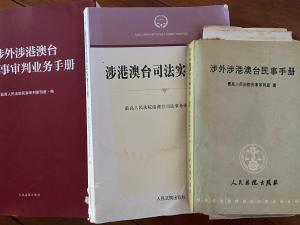
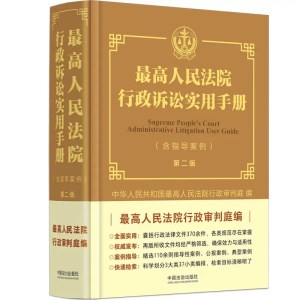
A recent message in the WeChat public account of the Supreme People’s Court (SPC)’s Administrative Division was devoted to promoting its new book,  Supreme People’s Court Administrative Litigation User’s Guide (Administrative Litigation User’s Guide (2nd edition), 最高人民法院行政诉讼实用手册), shown in the photo above.   Had the SPC’s #4 Civil Division had a WeChat public account last year when they published 涉外涉港澳台民商事审判业务手册( Foreign-Related, Hong Kong, Macao and Taiwan Related Commercial Trial Work Guide — “Foreign-Related Judicial Handbook”), I am sure that I would have received a similar message.  I had previously thought that judicial handbooks were a historical artifact of the days before electronic databases.   In my 1993 article, I discussed the phenomenon of judicial handbooks:

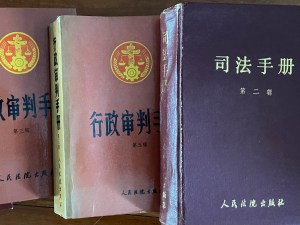
..A …problem is presented when the lack of consistency in issuance and authority makes it difficult for the lower courts to know when an interpretation is no longer valid…The [SPC] tries to cure these problems by issuing handbooks for adjudication in various subject areas….The Research Office and other divisions of the Court compile adjudication handbooks such as Sifa Shouce [司法手册] (Judicial Handbook), many of which are internal publications.

Some of those historical handbooks can be found in my research library of Supreme People’s Court publications–see here and below:

Two Administrative Litigation Judicial Handbooks and the second volume of the Judicial Handbook

Why would specific divisions of the SPC return to the practice of issuing judicial handbooks in printed form?  How does it link with the role of the SPC? What sources have the editors included, and what could students, scholars, and practitioners learn from that?

Official reasons for publishing these print books

The authors of the  Administrative Litigation User’s Guide describe the reasons for publishing the book as follows:

the Supreme People’s Court, on the one hand, provides professional guidance (业务指导) by formulating judicial policies 司法政策), issuing guiding cases, and making judicial replies (司法答复); on the other hand, it strengthens research and collects problems, and formulates judicial interpretations based on the accumulation and maturity of judicial practice. At present, the comprehensive judicial interpretation of the Administrative Litigation Law, the judicial interpretation of administrative agreements, and the judicial interpretation of the appearance of administrative agency heads in court to respond to lawsuits have been formulated and issued…, and there are more and more normative documents and guiding cases related to administrative litigation. In addition, with the increase in the number of administrative cases, more judges have joined the administrative trial team. In the process of gradually becoming familiar with administrative litigation, they urgently need to master the  relevant provisions that have been issued and learn the relevant guiding cases. However, judicial replies are internal in nature, with a large volume and lack of a unified release mechanism. The channels for obtaining them from the outside world are limited, which is time-consuming and laborious.

According to the announcement, the audience for the Administrative Litigation User’s Guide is staff in administrative agencies, judicial practitioners, and researchers of administrative law [students and academics].  The editors note that to provide readers with reference materials and to make the book more practical, they have included guiding cases, SPC Gazette Cases, and typical cases from the last 10 years.

The #4 Civil Division authors/editors say their handbook is urgently needed by front-line judges and as a reference book for judges, arbitrators, lawyers, and other practitioners, and, I would add, to students and scholars seeking to decode the foreign-related and Hong Kong, Macau, and Taiwan-related operations of China’s judiciary.

Legal basis for publishing these books

Publishing these books is linked to Article 10 of the Organic Law of the People’s Courts and related documents, which authorize the SPC to supervise and guide(监督指导) the lower courts.

Comments on the content

Both books contain judicial interpretations and a range of SPC guidance documents such as meeting minutes/conference summaries (会议纪要), notices, and replies to requests for instructions, signaling to the reader that they are important sources of reference for judges and that “soft law” may understate the way that meeting minutes are understood within the Chinese court system.

The authors/editors of the Foreign-Related Handbook included many other types of legal provisions they considered relevant for hearing cross-border cases, such as relevant national legislation, administrative regulations, such as foreign exchange regulations, Chinese versions of international commercial rules (Incoterms, ICC Uniform Rules for Demand Guarantees (URDG 758), ISP 98) ), Hague Conventions to which China has acceeded,  and civil judicial assistance treaties, as well as some of the National People’s Congress Standing Committee decisions related to some of the international conventions.  The #4 Civil Division did not include guiding, typical cases, and other types of cases it issues for reference.  In my view, it was a practical decision that does not imply that those types of cases are irrelevant to judges hearing cross-border commercial cases, but rather that including cases would make the book too long to be published as a single volume.

Comment

The underlying rationale for publishing these judicial handbooks has not changed much in the past 30 years.  Judges responsible for processing cases efficiently and correctly face similar challenges:  sorting out the current legal position on an issue quickly despite the piecemeal way that the SPC develops the law, locating and assessing the validity of historical documents, easily identifying special arrangements, and for cross-border cases, understanding how to correctly implement international conventions, treaties and practices and correspondingly arrangements or related provisions concerning cases involving Hong Kong, Macau and Taiwan parties.

One experienced senior judge in a local court noted that judges are often asked to rotate among divisions (tribunals) periodically.  Senior judges recommend that new joiners read these handbooks to familiarize themselves quickly with a different (and complicated) area of law.

From the left, the 2024 Foreign-Related Handbook, a 2013 Hong Kong, Macau, Taiwan Related Judicial Handbook, and the 1992 Foreign, Hong Kong, Taiwan-Related Civil Matters predecessor volume


Promoting Legal Change Through Reports to the NPC Standing Committee–Reducing the Number of Administrative Disputes

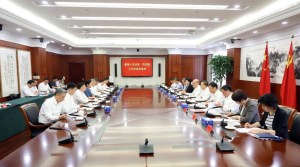
Meeting between SPC and MOJ at the SPC

Although few (except the NPC Observer) outside the Supreme People’s Court (SPC) likely have noticed, earlier this year it was agreed between the National People’s Congress (NPC) Standing Committee and the SPC that this year’s SPC specialized report to the NPC Standing Committee will focus on administrative litigation.  (For those who need a refresher on SPC specialized reports to the NPC Standing Committee, see this blogpost). This blogpost argues that the SPC is promoting ( the Chinese phrase is “倒逼 “) significant changes to resolving administrative disputes, that is disputes between individuals or enterprises and government agencies,  by agreeing to report on administrative litigation.  Related official press reports ground this conclusion.  

As explained below, the SPC is working with the Ministry of Justice (MOJ) and coordinating with provincial-level high courts. The MOJ houses both the former State Council Legislative Affairs Office and the Office of the Party’s Commission for Comprehensive Law-based Governance (依法治国办). The goals are to improve how administrative agencies consider and deal with administrative disputes so that they  “resolve disputes at their source,”  slowing the flood of administrative cases that enter the court system. More specific goals are for government agencies to resolve disputes at the reconsideration stage (administrative appeal/administrative adjudication),  respond to litigation when they are sued, and comply with mediation agreements and unfavorable judgments.  It also means changing how local courts hear administrative cases and the SPC providing better rules on which local courts can rely.

These changes implement current SPC policies promoted by President Zhang Jun, the goals of the recently amended Administrative Reconsideration Law, and policies promoted by the Party leadership.  This post provides a discrete example of judicial monitoring of government action, the unique operation of the SPC, and the skills required of its judges.  

Background: The Thematic Education Campaign

As briefly mentioned in my 2023 article published in New York University’s US-Asia Law Institute’s Perspectives series, during last year’s thematic education campaign the SPC’s Administrative Division identified a large percentage of appeals and retrial applications as a long-standing issue in administrative disputes, as well as an upward trend in five types of administrative cases.  The press release published in People’s Court Daily in 2023 summarizing the Administrative Division’s report diagnosed the reasons and proposed solutions.  While some other jurisdictions might publish the full text of such reports, understanding SPC developments requires unpacking the report’s terse summary.

The Administrative Division pointed to a long list of problems with administrative divisions in the lower courts, such as a mechanical approach to hearing cases, badly reasoned judgments, disbanding of administrative divisions in some courts, departure of experienced administrative judges,  case filing divisions that did not filter out cases that did not meet filing standards, unhelpful judicial suggestions, and higher courts that did not supervise lower courts.

The Administrative Division identified other problems with parties to administrative litigation, particularly local government.  It described some administrative organs as unenthusiastic about coordinating and resolving administrative disputes, noting that administrative reconsideration was generally a failure [at the time of the report]. The report described administrative organs waiting for courts to decide cases, presumably rather than compromise with the plaintiff or change problematic procedures.  Some local authorities (in a minority of cases) interfere with court review. Losing administrative organs often choose to appeal or file a retrial application rather than comply with a court judgment. Because courts can only review the legality of the administrative behavior, and cannot replace the administrative organs in exercising their powers, courts cannot resolve the substantive disputes.  

Implementing the SPC’s Proposed Solutions

This year, the SPC is implementing the solutions proposed by the Administrative Division, with the cooperation of the MOJ.  Those solutions involve both inter-institutional efforts and measures specific to the courts.  The State Council and the Party’s Office of the Commission for Comprehensive Law-based Governance are also involved in inter-institutional efforts to promote the newly amended Administrative Reconsideration Law,  for which the MOJ has issued more specific regulations and policy documents. The underlying goal is to achieve progress in resolving administrative disputes by October. 

  1. Inter-institutional measures

More specific measures involving inter-institutional cooperation involving the courts appear to have been finalized in two official meetings between SPC President Zhang Jun and Minister of Justice He Rong.  It can only be imagined the hundreds of hours of staff-level meetings that must have preceded the meeting between the two senior officials, that eventuated in agreements on joint measures (not made public). 

One of those measures involves joint training sessions at the national and provincial level, the first of which was held by the SPC and MOJ in November, 2023. These sessions have been replicated at the provincial level. These national and provincial sessions have multiple goals.  Provincial high courts are working with the provincial departments of justice to improve administrative agency handling of administrative reconsideration cases under the amended Administrative Reconsideration Law and for those departments to better understand the standards by which courts review administrative action.  

These joint training sessions and smoother cooperation between the courts, departments of justice, and Party authorities, also have other goals related to resolving administrative disputes. One of those is encouraging mediation of administrative disputes, as the amended Administrative Reconsideration Law provides.  The SPC and provincial courts are involved with related measures to promote mediation, such as what is entitled  “fault-tolerant ”  and self-correcting” mechanisms.  One example of the self-correcting mechanism is one promoted by a Guangdong court, sending a “pre-judgment mediation suggestion letter”(判前调解建议) to the defendant agency,  suggesting an administrative agency self-correct, for cases where administrative agencies are likely to lose.  Additionally, the courts seek to change cadre and institutional performance indicators related to administrative disputes, so that an institution and officials involved are not assessed negatively for agreeing to a mediated solution or change problematic measures.  Additionally, the SPC and provincial courts want to incorporate administrative litigation-related performance indicators in governmental and cadre assessments. Those include administrative agencies’ execution of judgments, the frequency of agencies losing cases, the appearance of responsible persons in court to respond to lawsuits, feedback on judicial suggestions, a reduction in the litigation rate of administrative cases per 10,000 people, and the mediation or conciliation of administrative disputes into the government assessment systems, such as safe (Pingan) China and law-based government (法治政府).

2. Improving the administrative litigation system

 The SPC’s Administrative Division is promoting several measures to promote better administrative dispute resolution. One aspect is better involving specialist administrative judges at the case filing phase to ensure that only cases that meet statutory standards are accepted.  This type of measure is not unusual, as other SPC specialist divisions require the same.

Second, the SPC leadership has agreed to more guidance on administrative cases of the lower courts. They have agreed to the drafting or the amendment of current judicial interpretations on some of the most important administrative  issues–the incidental review of normative documents (when a court is reviewing the legality of a specific administrative act), compensation for the expropriation of buildings on state-owned land, compensation for expropriation of collective land, and government information disclosure.  Additionally, the SPC is issuing more administrative-related typical cases and appears to have encouraged local high courts to do the same, some with provincial departments of justice.

Concluding Comments

This post provides another discrete example of the unique operation of the SPC and indirectly highlights the skills required of its judges.  It has illustrated another aspect of the SPC’s judicial activism, in addition to those about which I wrote in my China Law and Society Review article.  Through unpacking official press reports, the careful reader can glimpse some of the understated ways that the Administrative Division of the SPC uses its specialist knowledge in administrative cases to engage in legal oversight of administrative authority outside of the courtroom.  Underlying last year’s proposals and this year’s implementation are the skills of designing policies, actions, initiatives, and other decisions that hit the target of being politically correct (post-19th and 20th Party Congresses) while being “problem-oriented” (坚持问题导向) that is, addressing relevant practical issues. 


What’s New in the 2024 Supreme People’s Court report to the National People’s Congress?

Susan Finder and Zhu Xinyue

I. Overview of the 2023 SPC Work Report

Supreme People’s Court (SPC) Work Reports to the National People’s Congress (NPC) appear to the casual reader as much of a muchness. Like all official work reports, it provides a perfectly positioned overview of the previous year’s accomplishments and a high-level summary of 2024 work priorities.

To the attentive reader,  the March 2024 SPC Work Report to the NPC  (2024 SPC Work Report or Report) signals something new and different compared to its predecessor reports.  This much-delayed blogpost flags only some of what is new.  I have italicized many of my comments. (Please contact me if I have not mentioned your area of interest.)

The 2024 SPC Work Report signals that since President Zhang Jun took office, he has vigorously implemented new policies and set new priorities. Accordingly, the Report highlights Zhang Jun era keywords. Conveniently for the reader, they are contained in this single report.  A single phrase or sentence in this report links to one or more SPC documents, initiatives, and guiding/typical cases.

As in previous years, local court cases or innovations are considered accomplishments and heralded on local court WeChat accounts. Last year’s report, in contrast, was President Zhou Qiang’s last and served as an official summary of his accomplishments over the previous five years.

Several phrases in the first paragraph of  the 2024 Work Report (bolded) signal the new themes in this report:

… by focusing on the working theme of “justice and efficiency”, insisting on active justice, deepening and realizing service for the overall situation and justice for the people, we have made solid progress in promoting the modernization of judicial work聚焦“公正与效率”工作主题,坚持能动司法,做深做实为大局服务、为人民司法,推动审判工作现代化迈出坚实步伐…

As the regular reader of this blog could predict, the word “active ( 能动)” and the watchword or keyword  “active justice (能动司法)  can be found throughout the report.

Some statistics

The initial section of the 2024 SPC  Work Report provides overall statistics from the SPC and the entire court system.  The SPC accepted 21,081 cases and concluded 17,855 cases, representing a year-on-year increase of 54.6% and 29.5%, respectively. These numbers reflect the end of the pilot project to reorient the four levels of the Chinese courts and the corresponding increase in retrial applications made to the SPC. It can be anticipated that those numbers will be even higher in the 2024 calendar year. As I have previously written, most of the civil and administrative retrial applications to the SPC are unsuccessful, but it requires SPC judicial time to review them. For Americans, a useful but not entirely appropriate analogy is the petition for certiorari to the Supreme Court.

The report states that courts at all levels accepted 45.574 million cases and concluded 45.268 million cases, with 15.6% and 13.4% yearly increases, respectively.  Most cases in Chinese courts are civil/commercial (60.05%) or enforcement cases (29.34%).  I would be grateful if a reader could provide comparative statistics (from other jurisdictions) on enforcement.  My reaction is that the proportion of enforcement cases is relatively large. See the chart below:

These numbers likely are linked to the poor economy, which from comments by friends in the court system, means an increase in business disputes and business-related crime.  These increases are evident despite policies to reduce the number of disputes entering the courts and resolve cases filed before they reach the hearing stage. Those policies include: resolving cases at their source, resolving others through mediation, (now promoted under the keyword/title of Fengqiao Experience),  and promoting arbitration.  Some judges have remarked privately that it also has to do with the low cost of litigation.

II.  Serve the overall situation effectively and ensure high-quality development and high-level security with active justice

The title of this section combines several watchwords/keywords 提法/关键词, robustly signaling that President Zhang Jun led the drafting of this report.

The ten subsections in this section must be understood as ones that were priority areas for the Chinese courts in 2023. I have selected only a few of the subsections out of the ten:

Assisting the Strengthening of the Construction of the Financial Rule of Law

This subsection in the 2024 SPC Work Report is positioned immediately after the sections on safeguarding national security and social stability, promoting public security governance, and fighting corruption, reflecting its priorities in the SPC’s work. Although both the 2023 and 2024 SPC Work Reports address judicial support for finance, the 2024 SPC Work Report emphasizes strict regulatory enforcement in the banking and securities sectors, both subsumed under the category“financial trials.”

The Chinese courts concluded 3.032 million financial cases, an 8% year-on-year increase, and heard 861 money-laundering cases, involving 1,019 individuals, with increases of 23.5% and 22.2%, respectively. The money-laundering cases are likely linked to the ongoing multi-institutional anti-money-laundering campaign of which the SPC is a participating institution. The Report stresses the importance of “compliance in financial activities, strict punishment for senior management illegalities (高管违法要严罚), and holding intermediaries accountable for negligence.” The report illustrated the last two policies by mentioning a securities false statement case in which senior managers were found liable and an intermediary bore 20% joint and several liability.  Given those signals, it will not be surprising that the Shanghai, Beijing, and Chengdu-Chongqing Financial Courts have made analogous judgments in 2023 and 2024. The allocation of liability in these cases is a current issue. The Report also mentioned two financial law-related judicial suggestions that the SPC issued, rarely, if ever mentioned in the past, linked to last year’s judicial interpretation on judicial suggestions/advice (司法建议).

 Promoting the Development and Growth of the Private Economy in Accordance with Law

This subsection, new in comparison with last year’s report, links to the July 2023 Central Committee and State Council document on promoting the private economy,  focusing on measures contained in a September 2023  policy document and typical cases.  It includes a paragraph discussing the measures in that policy document and highlighting that the courts heard 42 cases of property rights-related wrongful convictions.  The SPC issued 12 typical retrial  cases (civil, criminal, and administrative) involving the rights of private enterprises and private entrepreneurs. Cases of bribery and embezzlement involving non-state employees amounted to 6,779, involving 8,124 individuals, with a year-on-year increase of 26.6%. Although the SPC intends to enhance legal certainty, boosting business confidence and stabilizing expectations, other sources report on profit-oriented law enforcement at the local level, often leading to the jailing of private entrepreneurs and the confiscation of their assets.

III   Safeguarding and Enhancing People’s Livelihood through  Active Justice

The section title above replaces “The Path of Judicial Services for the People With Chinese Characteristics” in the 2023 report.

New themes introduced include “Supporting Guaranteed Delivery of Commercial Housing and Stable Livelihoods,” to deal with issues related to the ongoing crisis involving real estate developers.

  • Safeguarding Housing Rights: The financial collapse of many real estate developers has meant disputes along the real estate development supply chain. A 2023 SPC judicial interpretation prioritizes homebuyer rights, clarifying the order of claim repayment in disputes over unsuccessful delivery of sold commercial housing.
  • Strengthening Housing Pre-sale Supervision: The SPC issued Judicial Suggestion No. 1 to promote contract online signing and pre-registration, enhance pre-sale funds supervision for commercial housing, strengthen pre-sale information inquiries, and warn about home buying risks.  [These suggestions do not seem to have been made public.]
  • Restructuring the Financial Chain of Homebuying: In response to a financial chain rupture of a private real estate enterprise in Hunan Province, a court-facilitated restructuring revitalized 16.8 billion yuan, resolving housing delivery issues for 16,000 households by facilitating the merger and restructuring of 13 related companies.  This type of case was mentioned in a typical case that the SPC issued last year.

IV. Promoting National and Social Governance through Active Justice Which Practically Grasps the Front End and Treats the Disease Before it’s too Late 

As could be anticipated, this section emphasizes judicial suggestions, among other matters.

Deepening the Effective Use of Judicial Suggestions: The Report emphasized judicial suggestions that fill legal gaps and governance deficiencies, mentioning the regulations on comprehensive governance-oriented judicial suggestions, discussed here. This is yet another initiative emphasized by President Zhang Jun. The SPC led with Judicial Suggestions No. 1 to No. 5, and lower courts issued 9,429 suggestions.

V. Ensuring Judicial Justice through Actively Performing Duties 

This section underscores Party leadership within the judicial system, with the primacy of the Party’s political construction. It promotes “strengthening Party nature, emphasizing practical work, and achieving new accomplishments” (“强党性、重实践、建新功”) through solid “learning of ideology” (扎扎实实“学思想”) and outlines the result of “deepening investigation and research and solidifying thematic education”( 大兴调查研究,让主题教育走深走实) and implementing “investigation promoting case handling, and case handling also being investigation” (“调研促进办案、办案也是调研”).

The Report indirectly addresses public concerns about the China Judgements Online database by emphasizing efforts to improve transparency in judicial proceedings (裁判文书上网) and the “People’s Court Case Database”,  such as posting 2.165 million documents online in 2023, with a year-on-year increase of 111.6%, covering a wider range of trial areas and case types, with the SPC and higher courts posting 35,000 documents, a 370% increase. The 2024 Report details measures for the uniform application of legal standards, including 15 judicial interpretations, 13 guiding cases, and 610 typical cases. As discussed here, the “People’s Court Case Database” contains SPC-approved cases, and judges must search this database.   “Legal Response Network (法答网)” (analysis to come) launched on July 1, 2023, facilitates communication among courts and has received 280,000 legal application inquiries, answering 230,000. Insights from this platform have led to the revision or drafting of 27 judicial interpretations and regulatory documents.

More specific selected statistics

Bankruptcy cases: 29,000 bankruptcy cases were concluded, marking a year-on-year increase of 68.8%. Additionally, 1,485 bankruptcy restructuring and settlement cases were concluded. Local court white papers on bankruptcy (link is to the Shanghai court white paper) are an undervalued source of insights on more specific bankruptcy trends, such as the type of companies going bankrupt and the length the companies have been in business. One law firm report on bankruptcy flagged missingness on the SPC’s bankruptcy platform and the rate at which local courts accepted bankruptcy cases.

Foreign-related civil and commercial cases: 24,000 foreign-related civil and commercial cases and 16,000 maritime cases were concluded, representing annual increases of 3.6% and 5.3%. The average trial time decreases by nearly 10 days. 16,000 cases of judicial review of commercial arbitration were concluded, reflecting a 5% year-on-year increase. During this period, 552 arbitration awards were revoked, remaining stable year-on-year, while 69 foreign arbitration awards were recognized and enforced, representing a 16.9% increase. This section mentions a Shanghai Financial Court case in which the court stopped payment on a demand guarantee, although in fact most of such lawsuits are unsuccessful.

Deepening the diversification of dispute resolution: Since 2013, court cases have increased by an average annual rate of 13%, doubling over 10 years. Judges handled an average of 357 cases annually in 2023, up from 187 in 2017.  The courts successfully mediated 11.998 million disputes through people’s mediation, administrative mediation, and industry-specific mediation organizations/institutions, representing a 32% increase year-on-year and accounting for 40.2% of the total civil and administrative cases filed.

Fully leveraging the role of scientific evaluation as a “command baton”: The annual case closure rate was adjusted to the closure rate within the trial period, which reached 97.7% last year, a 2 percentage point increase. A special case cleanup initiative concluded 1,914 lawsuits pending for over three years and 2,455 pending cases involving 6,909 individuals, accounting for 81.3% and 86.8%, respectively, of the total cases.  The title of this section is significant. Judges at all levels of courts feel that “command baton.”

VI. 2024 Work Targets

As readers of this blog could anticipate, the 2024 work arrangements of the courts are focused on the modernization of judicial work, active justice, and other 2023 top keywords. The work arrangements listed here are more general than the types of work plans mentioned in my article.  They are intended to signal to the NPC and general public the overall direction of the SPC’s work in the current year. For the most part, the arrangements are expressed in phrases or single sentences.

Criminal cases: Implement the holistic national security concept, severely punish crimes threatening national security and public safety, promote the normalization of crackdowns on gangs and evil [sometimes used against local entrepreneurs], and severely crack down on telecommunications network fraud, cross-border gambling, and corruption, with harsher punishment for bribery crimes. All if not most of these crimes were flagged during January’s annual Central Political-Legal Work Conference.

Intellectual property and digital rights: Strictly protect intellectual property rights and promote their transformation and application, and serve the development of new productive forces. Justice Tao Kaiyuan published an article in People’s Daily in late March explicating the link between the development of new productive forces and the improvement of intellectual property rights protection. Strengthen personal information protection and improve digital rights protection rules. The latter two presumably imply inter-institutional cooperation.

Bankruptcy and Economic Development: Increase work on hearing bankruptcy cases and give full play to “active rescue” and “timely liquidation”. We can expect to see the courts accepting more bankruptcy cases this year. Deepen the compliance reform for companies involved in criminal cases and continue to optimize the growth of the private economy. Properly handle real estate development and affordable housing contract disputes, and actively serve the new model of real estate development (recent Party/state initiative). Strengthen hearing and enforcement work in “agriculture, rural areas and farmers” (“三农”) to support rural revitalization. The latter is consistent with previous SPC policy.

Ecological and Social Justice: Serve ecological civilization [the environment]  and green and low-carbon development in accordance with the law. Strengthen the protection of the rights of women, children, the elderly, disabled people, etc. (It is unclear whether that will include a better legal infrastructure for sexual harassment cases.) Strengthen administrative trials, supervise and support administrative agencies to administer according to law and strictly enforce the law. Promote judicial advice/suggestions and national and social governance.

Court administration.  Improve the quality and efficiency of court hearings and accelerate the modernization of trial work. Deepen the comprehensive supporting reform of the judicial system and formulate the “Sixth Five-Year Plan” reform outline for the people’s courts. [It is unclear when it will be issued] Comprehensively and accurately implement the judicial responsibility/accountability system (see related documents here), and further implement  “supervision/”review” system  (阅核制) by senior court leaders. That system is one of President Zhang Jun’s initiatives.  Improve the hierarchical selection system for judges and promote the coordinated use of posts and establishments across administrative regions. This seems to be a reform to share judicial headcount. Deepen the “three-in-one” reform of criminal, civil, and administrative cases in intellectual property, environmental resources, and juvenile matters.

Foreign-related and Grassroots Courts: Enhance the foreign-related judicial hearing system (consistent with my observations about the importance of foreign-related matters) and efficiency. Do a good job of “replying to letters and visits“, and strengthen the management of the source of letters and visits.

Grassroots Courts:  Practice the “Fengqiao Experience” in the new era, promote resolving cases at source (诉源治理), provide practical guidance for mediation, and vigorously create “Fengqiao Style People’s Tribunals.” The SPC has issued six groups of related typical cases and the Chinese court media has begun to report on the creation of such people’s tribunals. The Report mentions strengthening relatively weak grassroots courts (相对薄弱基层法院), another initiative by President Zhang Jun. Under this initiative (full text of measures unavailable), 106 relatively weak local courts are targeted for additional support. The SPC has set quotas for each province, as well as a goal of removal from the list within one to three years.

Supervision, Guidance and Digital Courts: Strengthen supervision and guidance (stressed by President Zhang Jun, as mentioned above), deepen trial management, use the “People’s Courts Case Database” and improve the “Legal Response Network 法答网”. [More on this in a later blogpost, but it appears to be an updated version of letters to the 人民司法 (People’s Justice) mailbox)]. Develop a nationwide court “one network” and digital courts (数字法院) to boost efficiency. Note that the term “smart courts” (智慧法院), the subject of books, articles, and PhD dissertations in Chinese and English,  appears to have been dropped.

Court Supervision and Integrity: The final section for the most part repeats principles seen previously, such as improving political, professional, and professional ethical qualities. It flags improving the training of professional trial talents in foreign-related, intellectual property, and other fields and stresses the use of personnel assessment of all court staff.

Finally, I conclude with this extended quotation from the Report:

 the new development of the work of the people’s courts in the new era and new journey is fundamentally due to the leadership of General Secretary Xi Jinping and the scientific guidance of Xi Jinping Thought on Socialism with Chinese Characteristics for a New Era. It has benefited from the effective supervision of the National People’s Congress and its Standing Committee, the strong support of the State Council, the democratic supervision of the National Committee of the Chinese People’s Political Consultative Conference, the supervision of the National Supervision Commission and the Supreme People’s Procuratorate, the democratic supervision and support of various democratic parties, the Federation of Industry and Commerce, people’s organizations and non-party personages, and the enthusiastic concern, support and help of local party and government organs at all levels, deputies to the National People’s Congress, members of the National Committee of the Chinese People’s Political Consultative Conference, all sectors of society and the general public.

________________________________________________________

Many thanks to an anonymous peer reviewer!

References to “I, me or mine” are to Susan Finder rather than Zhu Xinyue. Finally, I’d like to express my appreciation to followers of this blog for their patience.

Supreme People’s Court’s Specialized Reports to the National People’s Congress Standing Committee

Collection of SPC Specialized Work Reports

By Susan Finder, drawing on research by Sun Dongyu (Christopher)

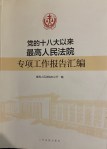
In October 2022, Supreme People’s Court (SPC) President Zhou Qiang delivered a report to the National People’s Congress (NPC) Standing Committee on foreign-related adjudication work since the 18th Party Congress (党的十八大以来人民法院涉外审判工作情况) (Foreign-Related Adjudication Work Report).  Under NPC legislation, this type of report is classified as a specialized report (专项报告).  In the New Era, the SPC delivers such reports to the NPC Standing Committee annually.  Han Xiaowu, the deputy head of the Supervisory and Judicial Affairs Committee of the NPC, in an article reviewing the supervisory powers of the NPC Standing Committee, described listening to and reviewing specialized reports as a significant means by which the NPC Standing Committee exercises its supervision authority over other institutions.  The SPC has published a collection of these reports issued since the 18th Party Congress, pictured above.  

This blogpost provides a dive into the law and practice of these specialized reports, focusing on reports prepared by the SPC. A subsequent post will focus on the content of the Foreign-Related Adjudication Work Report.   

Specialized Reports & the Relationship between the NPC and SPC

Most people with basic knowledge about the operation of the Chinese legal system know that the SPC president delivers a report to the NPC annually,  every spring.  Less known is that the SPC president also gives specialized reports to the NPC Standing Committee, under the Law on Oversight by Standing Committees of People’s Congresses at Various Levels (People’s Congresses Oversight Law). According to the  NPC Observer, that law is scheduled to be updated.  The details of NPC Standing Committee supervision of the SPC through specialized reports provide one discrete example of how Party leadership of legal institutions is implemented in practice and the interrelationship among state legal institutions.

The People’s Congresses Oversight Law authorizes the NPC Standing Committee to supervise the SPC, Supreme People’s Procuratorate (SPP), and the government in several ways, one of which is requiring these institutions to provide specialized reports, as set out in the NPC Standing Committee’s annual plan. Han Xiaowu described them as drawn up according to the work deployment of the Party Center ( 中央的工作部署). Articles 8 and 9 of the People’s Congresses’ Oversight Law provide some basic principles concerning the topics of those specialized reports.   It is understood that early in the year, the NPC’s Supervisory and Judicial Affairs Committee communicates with the SPC (and analogously with the other institutions that the NPC Standing Committee supervises), to set the topic and timing of the specialized report.  It is likely that the SPC’s General Office, which is responsible for inter-institutional liaison, is the entity within the SPC that works out the details with the NPC Standing Committee.

A quick search on Wechat reveals that foreign-related adjudication work was part of the overall supervision plan of the NPC Standing Committee in 2022. It meant that the NPC Standing Committee allocated significant time to investigating how Chinese courts hear foreign-related cases.  Official reports on Wechat flag that senior NPC Standing leaders went to certain provinces to investigate how local courts heard foreign-related cases as well as understand local developments relating to juvenile procuratorial work.  In the summer of 2022. Cao Jianming, vice chair of the NPC Standing Committee (and former senior SPC leader and procurator-general) visited Jiangsu and Guangdong in the summer of 2022, while Hao Mingjin visited Fujian.  In each case, according to bureaucratic protocol, senior leaders of the SPC and SPP accompanied the NPC Standing Committee leaders, who in turn had senior NPC Standing Committee staff in attendance.

These visits (described as research/调研)  were consolidated into a report provided to the SPC (non-public), as revealed by the Foreign-Related Adjudication Work Report.  It also enabled the NPC Standing Committee leaders to monitor how well the SPC and SPP respectively supervise and guide the lower courts and procuratorates in their work, politically and substantively, monitor local developments and the interaction among local institutions.   Cao Jianming told senior leaders in Jiangsu that they must adhere to the guidance of Xi Jinping Thought on Socialism with Chinese Characteristics for a New Era, resolutely implement the decision-making and deployment of the Party Central Committee, the work deployment of the SPC and the requirements of the provincial party committee. Cao reiterated principles for which local court leaders need no reminders–that they must thoroughly study and implement Xi Jinping’s thoughts on the rule of law, deeply understand the significance of foreign-related rule of law work, focus on researching new situations and new problems, improve systems and mechanisms, and continuously improve the level of foreign-related adjudication work.

The  People’s Congresses Oversight Law provides further details concerning specialized reports.  It requires the NPC Standing Committee to gather some questions to send to the SPC (or other institution providing a report), presumably intended to highlight issues that the NPC Standing Committee requires to be incorporated in the report. The procedure requires the SPC to send its draft report to the relevant specialized NPC committee 20 days before the formal report is delivered. Presumably, Han Xiaowu was involved in the review of the Foreign-Related Adjudication Work Report. If the SPC amends the draft report, it must be submitted to the NPC Standing Committee at least 10 days before that date, so the revised report can be distributed to the members. The head of the institution must deliver the report, which is discussed by members.  The results of the discussions of the reports are forwarded to the SPC (or other reporting institutions), which must respond to them.  The issues that the NPC Standing Committee raises with the institution providing the specialized report are made public in summary form. What is occasionally made public is the SPC (or other institution’s) response to the comments of NPC Standing Committee members.  As I  have not seen the SPC’s response to comments on last October’s report, I presume that the SPC has not yet finalized a response to the comments.  Presumably, the #4 Civil Division would take the lead in drafting the response, which would be reviewed by the vice president in charge of that division, and likely by the SPC president. The NPC Observer discusses responses to reports in this blogpost.

Those who have been involved with the specialized report process explain that both institutions see benefits in the NPC Standing Committee requiring specialized reports of the SPC.  The NPC Standing Committee sees it as an effective way of exercising its supervision (oversight) authority over the SPC, while the SPC sees it as an effective way to display its competence while providing a forum to raise issues that require the involvement of the NPC Standing Committee.  It can also be said to be another way in which Party leadership of the courts (and other institutions) is indirectly implemented.

The specialized report procedure is a less understood way in which the NPC and its Standing Committee supervise (监督 oversees) the SPC and implement Party leadership, and provides an example of how the SPC is institutionally both more and less powerful than other apex courts.


Decoding the Supreme People’s Court’s Services and Safeguards Opinions

I recently published a short article on the Perspectives blog of the  New York University School of Law U.S. -Asia Law Institute, with the same name as this post, linked here.  The Perspectives blog has posted a PDF version, and I am reposting it here for the convenience of some blog readers. I have finished a long version of the article which I am now amending. The research on which this article is based draws on discussions with many persons who cannot be thanked by name and others who will be whenever the longer version is published. I particularly appreciate those knowledgeable persons who have shared their insights with me over the many years it has taken to write the longer version.

About a year ago, I published an article on the same blog, entitled Why I Research China’s Supreme People’s Court.   The PDF version is available here.

Many thanks to Katherine Wilhelm, Executive Director of the U.S. -Asia Law Institute, for her skillful editing of both articles.

Why & How the Supreme People’s Court is Providing Services and Safeguards for the Unified Market Policy

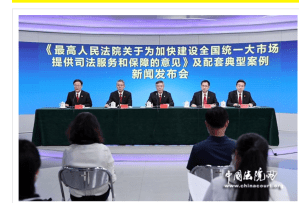
Press conference, at which representatives from the SPC’s Research Office, Civil Division #2 and #3 spoke, as well as the SPC spokesperson

In the middle of July (2022), the Supreme People’s Court (SPC) issued another document providing “judicial services and safeguards” to another major government policy initiative, this one on the work to create a unified market, entitled Opinions on Providing Judicial Services and Safeguards for Accelerating the Construction of a Unified National Market (SPC Unified Market Opinion 最高人民法院关于为加快建设全国统一大市场提供司法服务和保障的意见). (See bilingual version here). It implements the April 2022 Communist Party Center and State Council Opinions on Accelerating the Construction of a Unified National Market.  The SPC also released ten   typical/model/exemplary cases.  These cases provide guidance to the lower courts through specific examples phrased in current political language.   The document and cases are a shining example of the long series of “judicial services and safeguards opinions” that the SPC has issued since 2015. The SPC issued the first one with that title in the Xi Jinping New Era to anticipate legal issues created by the then-new (or relatively new) Belt & Road Strategy.

The SPC Unified Market Opinion reveals a great deal about what is on the agenda of the SPC as well as deeper trends in the development of the Chinese courts in the New Era.  A  summary of what the SPC’s Unified Market Opinion covers and reveals follows, with some comments on what it says about larger trends.

I.  What Does the SPC’s Unified Market Opinion Cover?

The SPC Unified Market Opinion covers many aspects of the work of the courts. only some of which are discussed in this overly long blogpost.  Therefore the SPC’s Research Office took the lead in drafting it, along with the #2 Civil Division, focusing on domestic commercial matters and the #3 Civil Division, focusing on intellectual property matters. For that reason, representatives from those offices spoke at the press conference, along with Justice Yang Wanming, who must have been the SPC leader responsible.  However, it is clear from the document that many other entities within the SPC contributed to the drafting, particularly the #4 Civil Division, which focuses on cross-border commercial matters, including arbitration, maritime, trade and investment issues.  The International Cooperation Bureau, which has substantive responsibilities in addition to its duties under China’s foreign affairs system clearly contributed to it as well.

It is consistent with other judicial services and safeguards opinions for the document to serve as a “package” for judicial measures, broadly understood. Many of the measures are not new to the regular reader of SPC documents, indicating that the problem is important and the related issue has not gone away.

Japanese wrapping cloth, photo ©japanobjects.com

the classic multitool, the Swiss Army Knife

In the SPC’s bureaucratic language contained in the SPC’s press release, the document “coordinates the precise efforts in all areas of the judiciary” (统筹司法各领域精准发力” ). In plain language, it means that measures across all relevant areas of law for which the SPC is involved are incorporated. It also means that different types of measures are included in the package, including relevant administrative matters.

The function of coordinating with Party and state institutions, about which I wrote last year is described in the press release as “coordinating all forces to implement comprehensive policies 统筹各方力量综合施策.”  Oddly enough, at least one well-known Chinese scholar who has written about the Chinese courts doubted that this is a judicial function.  From these points, it can be seen that this document is a multifunctional tool.

II.  What is On the SPC’s Agenda?

For those of us seeking to monitor what is on the SPC’s judicial interpretation agenda since the SPC stopped publishing its annual agenda,  the SPC Unified Market Opinion has a great deal of useful information.  The document also flags forthcoming judicial policies and related administrative matters that the SPC leadership has approved and a great deal of guidance for the lower courts.  For cross-border matters, because I am more familiar with the SPC’s judicial policies, I will go into greater detail.  In several other areas, I will flag forthcoming judicial interpretations and other important matters.

A.  Cross-border commercial matters

As relates to cross-border commercial matters, Articles 5 and 16 of the SPC Unified Market Opinions signal many matters to the careful reader.

  1.  Judicial interpretations on the ascertainment of laws and application of international treaties and international practice and possibly others are on the agenda. I surmise that they are at an early stage because it says “research shall be conducted.”  It would not be surprising if one or more of the SPC’s Belt & Road Research Bases would be tasked with providing research.  If that is so, given the usual gap between academic research and the requirements of the Chinese courts, it will be some time before drafts of these judicial interpretations are circulating within the court system and among selected experts.
  2.  Another topic on the judicial interpretation agenda, seemingly again at an early stage, is one on jurisdiction over foreign-related civil and commercial cases tried by the courts of first instance.  I surmise that this is linked to last year’s reforms to the four levels of the Chinese courts and is likely to involve centralized jurisdiction over cross-border cases (foreign and Hong Kong, Macau and Taiwan), as has been the trend thus far.
  3. One sentence flags developments related to service of process and possibly collection of evidence, although the latter is not specifically mentioned.  It calls for judicial assistance to be strengthened [improved], foreign-related service mechanisms to be improved, and work to commence on a  unified electronic platform for the service of process abroad.   As mentioned earlier, Greater Bay Area policy documents have included this.  Chinese Civil Procedure Law permits electronic service of process from China, although no mention is made of being more flexible in the service of process from abroad to China.   The latter matter would involve the Ministry of Justice, which is designated as the Central Authority under the relevant Hague Conventions.
  4. Another early stage project is  “promoting the construction of a system for the extraterritorial application of Chinese laws to legally protect the lawful rights and interests of enterprises and citizens that go global.” So I believe that we will eventually see more Chinese legislation providing for extraterritorial jurisdiction (or what is called in Chinese discourse, “longarm jurisdiction”), and likely eventually judicial interpretations.  This language suggests that the SPC takes the view that its expertise is needed in the drafting of such legislation because its judges would be able to thoroughly consider what type of system will not cause further decoupling of interactions between China and the outside world.
  5. There is language about improving the operation of the China International Commercial Court, the expert committee, and the affiliated one-stop platform.  It appears from the language that some procedural rules are needed.
  6. Article 5 has a long reminder to lower court judges on “correctly applying” foreign investment law, foreign (non-mainland Chinese) law, international treaties and practice, as well as equally treating domestic and foreign-funded companies.  So it appears that additional training is needed for lower court judges if the Chinese courts are to become a preferred jurisdiction for international commercial dispute resolution, as the political leadership would like the Chinese courts to be.
  7. Article 16 focuses on improving the connection between domestic laws and international rules., highlighting improving domestic rules as well as foreign-related ones (as addressed in at least one blogpost last year).  Much of Chinese legislation is domestically focused and is inconsistent with international practice.  The Construction Law’s prohibition on subcontracting is one example, that often arises in dispute resolution in BRI projects.  As this article explains, Chinese general contractors often subcontract part of their projects to other Chinese companies in Chinese law-governed contracts (regardless of the requirements of local law), in violation of Chinese law.  It also mentions modernizing China’s foreign-related adjudication system and capacity, which I understand to be a signal that the SPC would like to see changes to the foreign-related section of the Civil Procedure Law as well as resources allocated to the training of judges hearing foreign-related cases (see last year’s blogpost for further details).
  8. Two of the model cases concern foreign-related matters–one on foreign investment law, the other on maritime law, the latter signaling the accomplishments of the Chinese courts in resolving disputes at source and mediating to conclusion a dispute with a foreign arbitration clause.

B. Other Areas of Law

When read together, the other provisions of the SPC Unified Market Opinion can be seen as an assessment of the state of legality and the economy after ten years of documents issued by the political leadership as well as SPC (and other institutions).  The impact of multiple campaigns, regulatory and otherwise, and the grip of government on the economy is visible.   Many new and forthcoming developments are visible as well, such as the implementation of Chinese government undertakings concerning climate change and the challenge of new forms of employment.

Abuse of Administrative and Prosecutorial Power

Articles 3 and 4, entitled  “helping the implementation of unified market entry” and “enhancing equal protection of property rights” provide guidance to lower courts on trying cases related to abuses of administrative power that harm business, the misuse of administrative power to exclude or restrict competition. property, and the abuse of prosecutorial power that transforms a business dispute into a criminal case.  The language “it is imperative to improve the mechanism for petition and retrial, etc. of enterprise-related property right cases and refine the mechanism for effective prevention and correction of wrongful convictions” signals that the many documents issued to protect the interests of private entrepreneurs have not been effective and that the campaign (now normalized) to sweep out organized crime and get rid of evil (saohei 扫黑除恶) has likely resulted in another group of persons wrongfully convicted. That section and one of the model cases also signal that the protection of private property rights in criminal cases continues to be a problem.

Bankruptcy

Article 6 focuses on bankruptcy (insolvency) law. In addition to a long list of guidance, it mentions the SPC facilitating (推动) amendments to the Bankruptcy Law and legislation on individual bankruptcy.    SPC President Zhou Qiang has received delegations from the NPC working on the drafting of the Bankruptcy Law several times, and it is likely that staff-level interactions occur much more often.

Another matter to note in that article is the establishment of the normalized  “government-court interaction” coordination mechanism (常态化“府院联动”协调机制).  SPC judges who have spoken about this mention that the coordination mechanism faces many barriers, but it is a fact that in the Chinese context, bankruptcy cannot proceed without the assistance of local governments.

Quickly mentioned

Article 7 is on enforcement, and mentions that the SPC will cooperate (presumably with the NPC Standing Committee and its Legislative Affairs Commission) on efforts relating to the Civil Compulsory Enforcement Law and amend or otherwise issue a judicial interpretation to enforce it.

Article 8 is on unifying the urban and rural land markets.  In addition to a great deal of guidance, it mentions that to adapt to the adjustments of land supply policies, the standards for the hearing cases involving disputes over the assignment and transfer of the right to use state-owned land shall be unified. It does not specify the form that the unification will take.

Article 9 relates to the securities and financial markets.  In addition to a great deal of guidance, it mentions that the SPC will improve rules (审 理规则)  for hearing new types of cases:  private equity investment, entrusted wealth management, asset securitization, and cross-border financial asset transactions, among others. It flags that the SPC will research legal issues concerning digital currency and mobile payment (I surmise possibly looking to the academic sector for initial research),

Article 10 focuses on the unification of the data and technical market, flagging that judicial safeguards will be provided for the data element market driven by data and the SPC will focus on improving judicial protection of data property rights.

Article 11 relates to energy and the environment.  Those focusing on these issues would be able to write an entire article on this article–I would only mention that the SPC plans to research judicial policy support for achieving the target of carbon peaking and carbon neutrality.

Article 12 focuses on the judiciary and business environment, mentioning work on establishing an indicator system consistent with China’s national conditions and international standards; issuing judicial interpretations and judicial policies providing services and safeguards for the business environment, and cooperating with relevant functional departments (unspecified有关职能部门), in promulgating an implementation plan for building a business environment under the rule of law.

Article 13 is devoted to creating a good faith transaction environment.  At least three points to be noted: the issuance of the judicial interpretation of the Contract Part of the Civil Code, work on deep integration of socialist core values with the work of the courts; and exploring paths for better integrating the social credit system with the work of the courts.

Article 14 focuses on regional market integration and Article 15 on improving the linkage of rules between the mainland, Hong Kong, Macau, (and mentioned less, Taiwan). The last blogpost explored Greater Bay Area judicial policy in depth.

Article 18 focuses on labor issues, reminding judges that employment discrimination cases should be tried properly but not mentioning the drafting of a judicial interpretation. It flags that the SPC will do research related to a judicial interpretation concerning labor disputes of employees in new business forms.

Article 20 focuses on providing better protection for the consumer.  It mentions improving e rules for hearing cases involving online consumption, mechanisms for trying consumer disputes, work on establishing a  collective litigation system for consumer cases plus a related public interest litigation system and cooperation mechanism with consumer protection authorities.

Article 21 is a long paragraph on anti-monopoly law, so much in this area can be anticipated. It mentions “strengthening” judicial regulation over monopoly by platform enterprises, improving rules for making judgments in competition cases and eventually issuing a judicial interpretation on anti-monopoly civil litigation.  The article on intellectual property law, Article 19, appears to be a summary of current policies.

Article 22, on supervising and supporting market regulators also deserves standalone analysis.  It mentions amending and improving the judicial interpretations relating to public disclosure of government information and cooperating with the procuratorate to  push market regulatory departments to improve their regulatory system  through administrative public interest litigation cases and judicial recommendations. The courts will communicate and cooperate more with the market regulators to unify administrative and judicial rules.

Article 23 focuses on criminal and other violations of market order. On the agenda in this area is a future judicial interpretation on hearing tax-related criminal cases. It also mentions intensifying the punishment of tax evasion by making use of dual contracts and by high-net-worth individuals in culture and entertainment fields. As could be anticipated the judiciary will collaborate with the taxation and public security authorities on tax matters.

Article 24 summarizes SPC policy in support of epidemic prevention and the economy.  I have a forthcoming short article on this topic.

Implications for the Courts

The concluding section (Articles 25-29) of the SPC Unified Market Opinion focuses on the courts themselves. The message from the SPC is that this document is important and that lower court leaders should regard it as an important political task.  This section summarizes recent litigation-related reforms, SPC efforts to unify the application of law, smart courts, and diversified dispute resolution.

III. What Does It Signify About Larger Trends?

I surmise that the SPC issued this document in July so that it could be included in its forthcoming mid-term report to the NPC Standing Committee about the piloting of the reforms to the four levels of the courts. That reform means a shift in focus of the work of the SPC, especially SPC headquarters, to judicial policy, judicial interpretations, and guidance of the lower courts as well as reducing the number of cases the SPC considers.  It is meant to illustrate to the members of the NPC Standing Committee the many contributions the SPC makes when focused on judicial policy, interpretations, and guidance of the lower courts. For that reason, it also appears designed “to welcome” the upcoming 20th Party Congress by showing the relevance of the SPC and the court system to promoting the development of the economy and socialist rule of law (with Chinese characteristics).

Assuming that the mid-term report is approved and the reform of the four levels of the Chinese courts continues to be implemented,  we will see more of such relatively comprehensive judicial services and safeguards opinions promoting the multiple functions of the Chinese courts. These will strengthen the centralizing role of the SPC, or as I have mentioned often in this blog, strengthen the firm guiding hand of the SPC.