
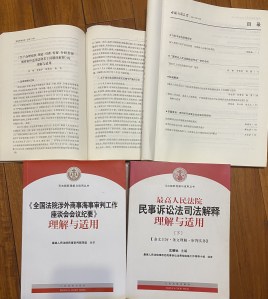
Late last year, some followers asked me to describe the principal sources for Supreme People’s Court’s (SPC) research. This is the second of several posts, as few (particularly outside of China) seem to be aware of the range of publicly available publications of the SPC and its many affiliated entities. The second set of publications I’ll introduce contains the phrase “understanding and application” (理解与适用).
What are “understanding and application” publications?
The understanding and application publications explain and provide further background to the following types of SPC documents:
- SPC interpretations (司法解释), either drafted only by the SPC or with the Supreme People’s Procuratorate (SPP);
- SPC meeting minutes (conference summaries) (会议纪要); and
- SPC (or SPC and SPP) policy documents entitled Opinion (意见).
The authors of “understanding and application” publications are principally the drafters of the documents in question. In China, the audience of these publications are judges in that substantive area, lawyers, and possibly in-house counsel. For some unknown reason, academics, including law students, are less familiar with these publications. However, these publications are relevant to researching, writing, and peer-reviewing articles or reports on topics that focus on any of these documents.
The publications are often issued as articles in one of the SPC’s online or print publications, listed below. The understanding and application of the most lengthy document are published as books, such as the two-volume books on the understanding and application of the judicial interpretation of the Civil Procedure Law (in the photo above) and separately, the Criminal Procedure Law. Books can be searched on the People’s Court Press website.
The content usually includes details on the drafting history of the document, policy background, and the meaning of the clauses. If an “understanding and application” publication is in book form, it generally provides commentary on each article. Sometimes an understanding and application publication discusses the competing views related to a particular clause in a document, such as the understanding and application publication on the 2019 Minutes of the National Court Work Conference for Civil and Commercial Trials (全国法院民商事审判工作会议纪要).
The analogous publication for the National Symposium on Foreign-Related Commercial and Maritime Trial Work incorporates some model cases and discusses relevant non-Chinese legislation and case law, in addition to relevant Chinese legislation, the views of relevant institutions, and court practice. For example, on the scope of the phrase “外国法院” (foreign court) in that book, the authors mention that when the Ministry of Foreign Affairs was consulted on the draft of that document, it took the view that “foreign” did not include courts of international organizations such as European Union’s Unified Patent Court. It mentions during the negotiation of the Hague Judgments Convention, the recognition and enforcement of the judgments of such courts was controversial so that in China, the recognition and enforcement of the judgments of such courts await further research.
Understanding and application articles are published in one of the following places:
- the SPC official website (court.gov.cn), the Chinese courts website (chinacourt.org), and sometimes the China International Commercial Court website (cicc.court.gov.cn);
- the SPC journal Renmin Sifa 人 民司法 [People’s Justice];
- the National Judges College’s academic journal Falv Shiyong 法律适用 [Application of Law]; and
- journals of specialized SPC divisions (such as Reference to Criminal Trial, the journal of the five criminal divisions, 刑事审判参考, previously mentioned here).
These articles are often republished on the websites or WeChat accounts of lower courts and sometimes other institutions and can be searched on the Internet or through WeChat search.
Additional examples:
《全国法院毒品案件审判工作会议纪要》的理解与适用 (the Understanding and Application of the Meeting Minutes of the National Courts Symposium on the Trial of Drug-Related Crimes ), published in Falv Shiyong 法律适用 [Application of Law, the National Judges College’s academic journal]–explaining the 2022 Meeting Minutes of the National Courts Symposium on the Trial of Drug-Related Crimes (the Kunming Meeting) 全国法院毒品案件审判工作会议纪要. On the drafting history of the document, for example, before the conference, the article states that the drafters (from the SPC’s #5 Criminal Division) solicited comments from relevant SPC divisions/chambers, various high people’s courts, the Supreme People’s Procuratorate, the Ministry of Public Security and relevant experts and scholars. The draft was further amended based on comments at the conference, including from other institutions that attended the symposium, and subsequently comments were solicited from relevant divisions of the SPC, the SPP, the Ministry of Public Security, the General Administration of Customs, the Ministry of Agriculture and Rural Affairs, and the Legislative Affairs Commission of the Standing Committee of the National People’s Congress.
最高法解释起草者谈《关于办理组织、强迫、引诱、容留、介绍卖淫刑事案件适用法律若干问题的解释》的理解与适用 (The Understanding and Application of the [2017] “Supreme People’s Court, Supreme People’s Procuratorate Interpretation on Several Issues Concerning the Application of Law in Handling Criminal Cases of Organizing, Compelling, Enticing, Sheltering, and Brokering Prostitution,” published originally in Reference to Criminal Trial #115, but republished on a WeChat public account of a local public security bureau. The section on the interpretation’s drafting history reveals that in the course of drafting, the #4 Criminal Division held discussions with the Public Security Bureau (治安局) of the Ministry of Public Security, some provincial public security bureaus and some city and county public security organs’ public security departments many times, as well as with experts. The Legislative Affairs Commission of the National People’s Congress later held a coordination meeting (协调会) with relevant ministries and commissions, indicating that the relevant authorities had differing views on the draft’s content. When those issues were resolved, the SPP agreed to the draft and to issue the interpretation jointly, after which the judicial committee of the SPC and the procuratorial committee of the SPP approved the issuance of the interpretation.
One small example of the relevance of these articles and books to scholarship is the recent draft article, posted on SSRN: From Visibility to Shadows: The Impact of Police Discretion on Prostitution in Response to Legal Changes, which considers the impact of police discretion on prostitution regulation in China, following the issuance of the 2017 judicial interpretation discussed above. The authors describe the judicial interpretation several times as “an external policy change (a change in judicial interpretation) that was outside the police’s influence.” However, a review of the legislative history described above reveals that the drafting of the interpretation heavily involved the Ministry of Public Security and local level public security bureaus. It can be surmised that neither the authors nor the workshop commentators on the draft article were aware of the possible relevance of “understanding and application” articles. This post seeks to draw the attention of both scholars and practitioners to these publications so that advocates and authors can refer to these publications as appropriate and commentators will know of their existence.
 Supreme People's Court Monitor
You must be logged in to post a comment.