All posts by Supreme People's Court Monitor

Susan Finder has been observing the PRC Supreme People's Court for over 20 years, and was the first person to engage in a close analysis of its operations. She taught Chinese law and other subjects in the Law Department of the City University of Hong Kong, before putting her knowledge to work in the China practice group of Freshfields Bruckhaus Deringer, one of the first international law firms to recognize the importance of the China market. She had the good fortune to study with three of the early pioneers of Chinese legal studies: Jerome Cohen, R. Randle Edwards, and Stanley Lubman and to have many leading practitioners and legal academics among her classmates at Harvard Law School (J.D.) and Columbia Law School (LL.M). Susan Finder speaks and reads (Mandarin) Chinese and Russian and some German.

Takeaways from the Supreme People’s Court 2015 work report

20160313104344_51387The Supreme People’s Court (SPC)’s 2015 work report has many takeaways for different audiences.  The apparently formulaic report took five months to draft, involving comments and input by many within and outside of the SPC (this article  describes the process, as did my earlier blogpost), most likely involving clearance by the Central Leading Group on Judicial Reform.  It was drafted to show certain accomplishments, send certain signals–show that judicial reform is on the right path and is successful, particularly that the court leadership and the courts are doing their part to fulfil the tasks set for them by the Party/state leadership.  This year’s report has three sections, rather than the usual two, with one section summarizing judicial reform accomplishments. This post will focus on highlights of the overview of 2015, and leave judicial reforms and tasks for this year for another day.

In a sign that the diminished attention spans have come to China, the SPC has come up with graphic and even musical versions of the report.

Statistics to convey current message

url

This short book, explaining how statistics are used to convey certain messages, was originally published in the 1950’s and translated into Chinese about 10 years ago (and given to me when I was 11 by my parents). It is a useful reference when puzzling out what SPC court statistics are saying and mean, because as this  Wall Street Journal article noted, the categories used in the annual reports often shift from year to year, making comparisons difficult, and breakdowns of specific categories are generally missing. The reason for that is the report (including the statistics) are meant to harmonize with the latest government/Party policies and be on message. The SPC is reforming judicial statistics and seeking to make better use of big data, but the fine details are not in this report.

Takeaway #1–Caseload Up Significantly

e8fade90gw1f1v665qoeqj209i0g4tab


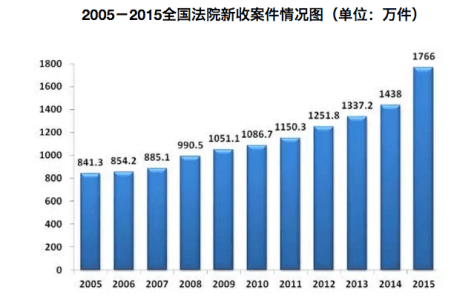
The caseload of all levels of courts were up significantly, primarily because of the docketing reforms implemented last year (mentioned here).  Civil (family, inheritance, private lending) and commercial cases account for most of the growth.

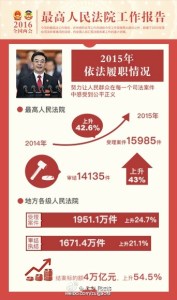
Cases heard at the Supreme People’s Court were up 42.6% compared with 2014 (accepted 15985, concluded 14,135). with most of those heard at headquarters in Beijing rather than the two circuit courts.    The local people’s courts heard 19,511,000, and concluded 16.714 million cases, with large increases  in the amounts in dispute, an increase of 24.7%, 21.1% and 54.5%, respectively. This seems to exclude cases heard in the military courts.

Performance target reforms mean that judges are no longer under enormous pressure to conclude cases by year end (although some local court officials may not been on message).

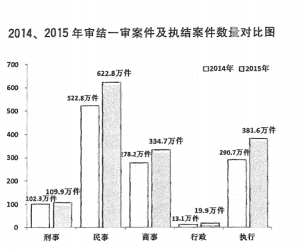
The bar chart below compares 2014 and 2015 numbers for criminal, civil, commercial, administrative, and enforcement cases respectively.Screen Shot 2016-03-15 at 7.16.13 pm

Criminal and Commercial cases up–Takeaway #2

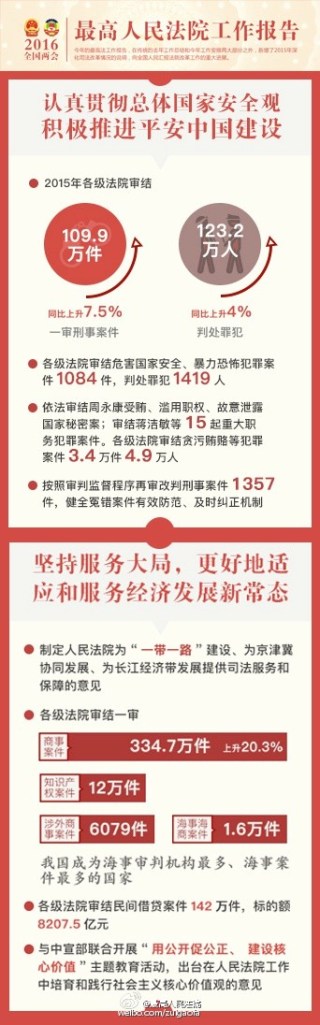
Just briefly on the criminal cases, as the overview graphic of commercial cases is linked to criminal cases-criminal cases are up by 7.5%. Significantly, criminal cases involving refusal to pay wages were up 58%, with last year’s report revealing that 753 persons were convicted, which means that 2015 convictions were close to 1200. a\Analysis of  the statistic of 1419 persons convicted of state security and terrorist crimes can be found here.

e8fade90gw1f1v665sc3uj209i0ugq6mCommercial cases were up 20% (3,347,000, with 120,000 intellectual property cases (up from 110,000 in 2014).  This is likely linked to the new intellectual property courts, but I will cede further analysis on this to my fellow blogger Mark Cohen of Chinaipr.com.  Again, tiny numbers of foreign-related (6079), but up from last year (5804) and Hong Kong, Macau, and Taiwan-related cases.  Cases involving subsidiaries of foreign companies are not in this category–this is a commercial case with a foreign party. The maritime courts heard 16,000 cases, the large increase apparently also attributable to the case registration system.  The language in the speech (making headlines) about making China an international maritime judicial center reflects language in previous speeches Zhou Qiang gave in China (analyzed here), but unnoticed until the NPC report.
Private lending disputes up significantly

The courts heard 1,420,000 private lending disputes, up from 1,045,600 in 2014.  Further background on private lending disputes can be found in my previous articles for the Diplomat. Last year the private lending disputes were categorized with the civil cases, rather than commercial cases.

SPC doing its part for greater government policy

The SPC issued policy documents on One Belt One Road (see this analysis of its implications), the Beijing/Tianjin/Hebei area, and Yangtze River Economic Belt to implement government policies. Those strategic projects are priorities for government.

Takeaway #3 Commercial disputes

Screen Shot 2016-03-15 at 8.33.59 pm

In 2015, 1,053,000 financial disputes were heard and 100,000 insurance disputes, as well as 4238 securities fraud and insider trading cases, compared with 824,000 financial disputes in 2014, a number which included insurance cases.  This speaks to the weakness in the Chinese economy.

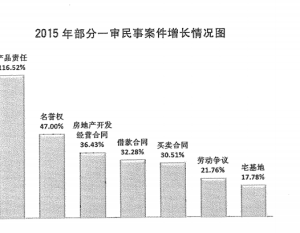
The bar chart to the left illustrates percentage increases in product liability (in 2014 there was also a large increase), reputation, real estate development (see this blogpost), loans, sales contracts, labor (up 21%!), and rural residential land disputes. The report flags 1400 bankruptcy cases and highlights pilot projects.

In another indication of problems with the real estate sector, Zhou Qiang mentioned “mass real estate disputes” and the expert handling by the Jinan court (in coordination with the government) of a large villa project in Jinan that encountered financial difficulties in 2008 (see this description) and led 2000 purchasers to petition in Beijing and even surround the Jinan Party Committee, Shandong Party Committee, and the Central Inspection Group that was on site. In 2014, the Shandong government decided to use “legal thinking” to involve the Jinan intermediate court.

An area for commercial lawyers to monitor is unfair competition and anti-monopoly, where the regulators are working on a stream of regulations. Last year the Chinese courts heard 1802 cases.

Takeaway #4– Big jump in civil disputes

Screen Shot 2016-03-15 at 5.38.32 pm


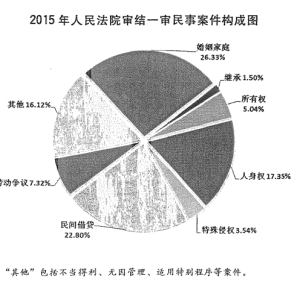
The pie chart on left shows the distribution of first instance civil cases–26% family (1,733,000), 1.5% inheritance, 5% ownership disputes, 17% personal rights (privacy, portrait, reputation), 22.8% private lending, 7.32% labor disputes, including 300,000 migrant worker wage arrears (and other cases related to rural residents rights (拖欠农民工工资等涉农案件 30 万件).  Consumer, education, housing and employment accounted for 720,000 cases.

For environmental cases, 78,000 civil cases were concluded, along with 19,000 criminal cases.


Takeaway #5 Big jump in administrative cases

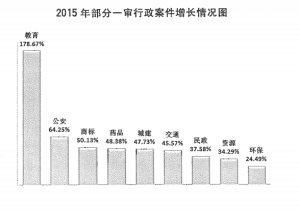
The amendment of the Administrative Litigation Law last year, the docketing reforms, and the decision to push disputes off the streets and into the courtroom has been a large increase in administrative disputes, although the baseline was very low.  In 2015, 241,000 first instance administrative cases were accepted, up 59% from the year before, with 199,000 concluded.  Reforms have been undertaken to move administrative cases outside of the area in which they arise, which is another reason that some persons or entities have been willing to file.  The bar chart has the percentage increase in different types of administrative cases, with an 176% increase in education cases. The remaining categories (from the left are: public security, trademark, pharmaceutical, construction, transportation, energy, and the environment.

(Black & white charts from SPC work report, thanks to Josh Chin of the Wall Street Journal).

Screen Shot 2016-03-15 at 10.51.25 pme8fade90gw1f1v66664yyj209i0tstbr-1

Supreme People’s Court issues statistics on crimes against women and children

In honor of International Women’s Day and as evidence that the Supreme People’s Court (SPC) is doing its part, the SPC released statistics related to crimes against women and children.  This brief blogpost gives some of the highlights.

Trafficking of women and children

Trafficking of women and children is an ongoing problem in China, and it is likely that a significant number of cases do not find their way to the courts.  The statistics show a reduction in cases involving the trafficking of women and children–last year, 853 cases were resolved, in comparison to 1919 in 2010, involving 3631 persons in 2010 and 1362 in 2015.


.

Rape cases

As in many other places in the world, women are often reluctant to bring charges of rape in China, particularly when it involves men more powerful than themselves. (Rape of men is still not a crime, according to this analysis by Jeremy Daum).  It is unknown how many of the rape cases were heard in the military courts. This analysis of cases from the SPC’s case database evidences that that the military courts have heard some.  Trends in the last three years in the number of rape cases heard in courts (cases concluded and persons sentenced):


Indecent assault cases

The number of convictions in indecent assault cases (the crime of using violence, coercion or other methods to act indecently against others or insult women) is on the rise. This report by a local court  suggest that those charges are sometimes used when rape cannot be proved.


Child molestation cases

Convictions in child molestation cases are on the rise, or at least more make it into the court system.


The SPC commented that the situation involving crimes against women’s and children’s rights remains grim:

  • No reduction in the number of crimes involving the sale of biological children by parents;
  • High number of cases of sexual abuse of minors, which has not gone down;
  • Many serious incidents of school violence;
  • Children left behind in rural areas are often abandoned and subject to domestic violence;
  • Specific rules are needed to implement the Domestic Violence Law and relevant sections of the Criminal Law Amendment (9);
  • Better mechanisms are needed to protect the rights of children.

Comments

Paul Schmidt, a follower of this blog, who is Counsel with Jun He Law Offices in Beijing and a former Colorado State Prosecutor, had the following comment:

This is a heart rendering issue, but the statistics provided continue to tell, what I believe, is a very interesting story about criminal prosecutions in the PRC. The basic story is this: criminal prosecutions in the PRC are rare.

Some very rough math shows what I mean. In 2014, the New York Police Department investigated 1,352 instances of rape. (See, http://www.nyc.gov) In 2014, the population of NYC was 8,500,000. In short, this works out to very roughly 1 rape investigation per every 5,000 people.

In China in 2014, the courts there handled 23,158 rape cases. China’s population was 1,367,000,000. In short, this works out to very roughly 1 rape case per every 50,000 people.

What’s going on? Is NYC 10 times more violent than the PRC? Are people in China 10 times more reluctant to report rape than in NYC? Even if we assume that New Yorkers are twice as violent and the Chinese are twice as reluctant (neither of which I actually believe to be true), this still leaves a huge gap.

The above pattern repeats itself regardless of the crime examined. Chinese crime statistics appear to be not just lower when compared to other countries – but profoundly lower. Additionally, I have seen little to indicate that such statistics are being actively manipulated (unlike, say, economic statistics). I don’t believe PRC courts are actively under reporting their cases – civil or criminal.

What mainly accounts for the gap, I believe, is that only a certain percentage of crime in the PRC is handled by the formal criminal system. A lot of crime is dealt with through administrative means or informal “mediations” adjudicated by the police between victims and perpetrators.

A retired Chinese lawyer pointed to the availability of commercial sex [however this is  also available in New York] as a reason for the small number of rape cases.  He also mentioned settlements between victims and perpetrators, mediated by the family or lawyer for the perpetrator and the victim and her family.  He suggested that the lawyer for the perpetrator will seek to convince the victim and her family that she is best off with a monetary settlement, conditioned on the victim withdrawing charges.

There is also likely a link to the performance indicators of the police and prosecutors.  Like judges, they have been evaluated based on a number of quantitative indicators, including the number of arrests and number of prosecutions.  Settlement of cases removes the risk of a case going wrong from the police and prosecutors.  It may be for a combination of these reasons that the number of rape cases reaching the courts, and rape convictions in China is relatively low.

If you have further information on this, please use the comment function.


Chinese bankruptcy courts to become “hospitals for sick companies”

hospital-clipart-hospital3As recent blogposts  (and academic studies) have shown, Chinese bankruptcy courts have been acting as underused morgues rather than hospitals for ailing Chinese companies.  The Supreme People’s Court (SPC) anticipates major changes, because (as highlighted on this blog) the government has decided that a stake needs to be driven through the heart of zombie companies.

This blogpost will focus on the role that courts are to play in clearing up zombie enterprises.  But because the role of the courts in bankruptcy is linked to other government policies, it will also flag some significant ones that have not yet come to the attention of observers outside of China. It appears that behind the scenes, officials have been working on putting together the policy machinery to do so and that the process is ongoing.

In late February, the SPC convened a conference of bankruptcy judges and other officials on dealing with zombie enterprises in Hangzhou, Zhejiang Province, both to transmit the newest judicial policy on bankruptcy and to find out from local judges and other officials what the issues are.

Judge Du Wanhua, a senior SPC judge, has been designated to take the lead on bankruptcy law reforms. The location of the conference is intentional, because (as mentioned in an earlier blogpost), Zhejiang Province has been piloting new approaches to bankruptcy law. The Zhejiang Higher People’s Court has been working with government to promote bankruptcy related policies, but at the same time has emphasized that the courts need to hear cases independently. In 2015, the courts of that province accepted over 600 bankruptcy cases.

According to Judge Du, the “courts are to become hospitals for sick companies.” Listed below is the approach that the SPC is intending for the lower courts to take (with some of my comments).

  • The courts should promote more bankruptcy reorganization and conciliation, and diminish liquidation cases (a contrast to what has occurred in recent years).  (The SPC has promoted this approach through recent reports promoting reorganizations by the courts and is continuing to promote this in its pronouncements. Local governments are adopting policies to promote reorganization of companies.)
  • A market-oriented mechanism should be established which classifies zombie enterprises.  The mechanism should distinguish ones than can be saved through restructuring or conciliation procedures from the ones that should be liquidated.  The classification should fulfil the industrial development goals, targets, and other principles of the central government.  (But, Professor Liu Zhibiao, a leading economist suggested in a recent interview that it should the market to determine this, not government.)
  • The rights and interests of the state, workers, creditors, and investors should be protected (listed in this order).
  • A corporate restructuring bankruptcy information platform mechanism that uses modern information technology tools should be created to promote the greatest degree of success of corporate restructuring, and better use of economic resources.  (This is consistent with government (including SPC) policy promoting the use of information technology tools);
  • A unified coordination mechanism for bankrupt enterprises needs to be created under the local Party committee’s strong leadership and support of the relevant government departments to ensure cases are handled in an orderly manner. (However, in the fall of 2015, Ma Jian of the SPC’s research office pointed to local government interference in the acceptance, and trial of bankruptcy cases, as being an major issue.
    • A local court judge writing recently described a judge’s role: “bankruptcy involves the vital interests of many people, and directly affects social harmony and stability. Thus the social dimension of bankruptcy cases determines that the court can not ” go it alone” in bankruptcy cases. Some local governments do not want companies to go bankrupt for statistical , performance, maintenance of stability and other considerations.  [According to Professor Liu, it can have a negative effect on the performance evaluation of local officials.] The court should actively seek the support of the local government where the debtor is located, to provide good placement of workers of bankrupt enterprises, payment of wages, disposal of plant or other fixed assets disposal.  By communicating with relevant departments, policy support can be provided to help pay taxes , apply for transfer [of property], coordinate the interests of creditors, debtors , investors, employees and others) ;
  • Orderly mechanisms should be established to deal with wages, state tax, and the priority and realization of secured claims, unsecured claims.
  • Local courts should establish bankruptcy divisions and provide bankruptcy judges with better bankruptcy law training;
  • Procedures should be established to consolidate related bankruptcy proceedings in different courts;
  • Procedures for bankruptcy administrators should be drafted and their status should be improved;
  • Special funds should be established to pay for bankruptcies and bankruptcy administrators.

Related to this are the following government initiatives:

  • Local governments, such as Guangdong, are starting to issue policy programs on “supply-side reforms.” The Guangdong program, issued on 28 February, contains a section on bankruptcy. The policies reiterate and further detail the principles Judge Du enounced (and merit further analysis).
    • The Guangdong policies mention separate databases for bankrupt state-owned and non state owned enterprises, mentioning that special policies would be forthcoming for state owned enterprises and that courts would be given the “green light” to deal with the bankruptcy of zombie companies. Reflecting policies seen elsewhere, the Guangdong government is seeking to encourage private enterprises to assist in reorganizing state-owned zombie enterprises and is considering establishing special funds to assist companies to upgrade.
  • The central government is also looking to simplify procedures by which companies with no debts can be closed.  During 2015, the State Administration of Industry and Commerce announced that it was piloting reforms in a number of locations, first designating Shenzhen, the Pudong district of Shanghai, and several other locations, and subsequently expanded the locations.
  • Training sessions on bankruptcy law, either within the courts or with related government agencies and institutions. In late February, the Changsha (Hunan) Intermediate People’s Court held a training session with experts from the SPC (First Circuit Court) and professors of bankruptcy law from Beijing, while the local government in Quanzhou organized cross-institutional training.
  • Local courts (such as this one in Quzhou, Zhejiang Province) are providing reports to local government/Party Committees on what the courts can do.

But what are bankruptcy judges really doing?  If a recent message on Wechat is any indication, they are reaching out to their fellow judges for guidance and creating a chat group on how to deal with the many legal and social complexities that bankruptcy cases pose.

Can bankruptcy court “doctors” save zombie enterprises and their millions of employees?  It is very early days. What can safely be said is that bankruptcy and zombie enterprise related policies merit close monitoring by lawyers, the business community and others.


Another Chinese judge killed

Screen Shot 2016-02-28 at 10.57.01 AM

The Chinese legal community is mourning Judge Ma Caiyun, who served in a tribunal of the Changping District Court, in suburban Beijing, is understood to have been killed outside her home by two men, one of whom was a party to a divorce property settlement case. (They have committed suicide.)  Her husband, a court policeman, was wounded.

Details recently released indicate that the two men attacked the husbands of their former wives, killing the husband of one, before killing the judge.  This domestic violence tragedy, seen elsewhere in the world, has occurred a few days before China’s new Domestic Violence Law goes into force.

Official commentary took over 24 hours to be released, as was pointed out in these caustic remarks (“what is the wait?) by a former judge.

One announcement by the Supreme People’s Court (SPC), found here, initially stressed that she settled almost 400 cases each year and had received awards for her work, but has now been supplemented by an article linking her tragedy to earlier cases of violence against judges.

A article on the case posted on Wechat on 27 February by one of the prominent legal Wechat public accounts (CU检说法) was viewed almost half a million times in four hours before being removed and received almost 700 comments.

Today (28 February), many articles are being published on Wechat without being removed, so it appears that there has been a change in policy. Local court Wechat accounts have posted articles about the tragedy (always with one from the SPC), and many other legal public accounts have done so as well.  One of Judge He Fan’s (of the SPC) postings has received over 100,000 age views.

This tragedy is the latest in a series of violent attacks against judges, and like some of the earlier cases, was carried out by a man upset by the property settlement in his divorce case.

Donations are being collected by some former judges to give to the family of Judge Ma.


Bulking up the Chinese maritime courts

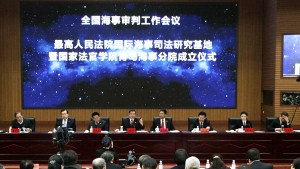
December, 2015 Maritime courts conference

The South China Sea continues to be in the news. But one of the many unnoticed developments related to the Supreme People’s Court (SPC) and the Chinese seas is the recent “bulking up” of the Chinese maritime courts.

The Chinese maritime courts, established 30 years ago, are said to be the busiest in the Asia Pacific region, and hear cases arising in Chinese waters, coastal and inland. In 2015, the maritime courts heard about 31,000 cases, a 43% increase year on year, with cases involving foreign parties accounting for about 15%.

The “bulking up”  of the maritime courts has occurred through the following recent events:

  • establishment of a maritime court training campus and research base;
  • two conferences convened by the SPC in December, 2015  on reforms to the maritime courts; and
  • two February, 2016 judicial interpretations revamping the jurisdiction of the maritime courts.

These developments are responding to both international and domestic factors and link to earlier government/Party initiatives

This blogpost will highlight some of the international developments.

Party initiatives guiding the reform of the maritime courts

Reforming the maritime courts was foreshadowed in the 4th Plenum Decision, Supreme People’s Court 4th Five Year Plan for reforming the courts and more specifically in One Belt One Road Opinion:

From the 4th Plenum:

Adapt to the incessant deepening of opening up to the outside world, perfect foreign-oriented legal and regulatory systems, stimulate the construction of new structures for an open economy. Vigorously participate in the formulation of international norms, promote the handling of foreign-related economic and social affairs according to the law, strengthen our country’s discourse power and influence in international legal affairs, use legal methods to safeguard our country’s sovereignty, security and development interests.

From the court reform plan:

Reform the maritime case jurisdiction system. Further clean up the system for trial of maritime matters. Scientifically determine the scope of jurisdiction for maritime courts, establish working mechanisms better suited for maritime courts hearing of cases.

The One Belt One Road SPC Opinion highlighted some of the current reforms to the maritime courts, in some detail.

SPC new training center

December’s national maritime courts conference was held in Qingdao, where the maritime court training campus was established.  SPC President Zhou Qiang, who presided over the conference, described its purpose as:

to implement the decisions and arrangements of the CPC Central Committee, to accelerate the trial of maritime personnel training, promote maritime judicial theory and innovative practice.  It is an important measure for promoting the development of maritime trial work and advances international maritime justice.

A senior staff member of the Central Political Legal Committee and officials of Ministry of Foreign Affairs, State Ocean Administration, and other government agencies also attended the conference.

New regulations on jurisdiction of maritime courts

As mentioned above, in February, 2016, two regulations on the jurisdiction of the maritime courts were issued by the SPC.  Those regulations had been previously highlighted in several conferences and SPC documents, including the November, 2014 4th National Work Conference on Foreign-Related Commercial and Maritime Adjudication, OBOR Opinion, and December, 2015 Maritime Courts conference.  These regulations had been issued for less than two weeks in November for public comment, making it difficult if not impossible for interested foreign parties to comment.

One of the new regulations relates to the geographical jurisdiction of several maritime courts, principles for determining jurisdiction in administrative cases and objections to jurisdiction.  The other expands the scope of cases that can be heard by the maritime courts, setting out over 112 categories of cases that can be brought. In the section on ocean and sea navigable waters exploitation and environmental protection related disputes, ocean and sea navigable waters construction disputes are included, such as underwater dredging construction, land reclamation and ..artificial islands.

International maritime justice

Zhou Qiang had the following to say about the goals of reforming the maritime courts to improve their international  prestige.

  • Make the maritime courts  internationally influential.  We have already established ourselves as the Asia Pacific area maritime judicial center (确立了亚太地区海事司法中心的地位).  (A corollary to this (derived from conference presentations) appears to be a push to move the locus of maritime dispute resolution from London and other centers in Europe to China, where Chinese parties will encounter a more familiar dispute resolution system);
  • Increase China’s influence over the development of international maritime rules.  Improve China’s contribution to international maritime law, effectively safeguarding national sovereignty, security and development interests. (This is directly related to the 4th Plenum Decision.)
  • Strengthen the sense of national sovereignty (要强化国家主权意识), exercise jurisdiction over all types of maritime development and utilization of marine waters within the jurisdiction of the country.  This refers to all the marine waters China claims in the South China Sea and elsewhere, according to a Chinese maritime law expert.

Commercial issues

From comments by (foreign) maritime law practitioners, it appears that major European and American shipping companies have concerns about the Chinese maritime courts.  Concerns include:

  • Chinese courts, particularly the maritime courts, have repeatedly refused to enforce choice of court clauses when the chosen forum has no actual connection with the dispute.    Chinese maritime courts rely on the principle in Article 34 of the Civil Procedure Law that the choice of court selected by the parties must have a connection to the matter (although China’s choice of law legislation does not require a choice of law to have a connection) to disregard choice of courts clauses in bills of lading or other documentation, even if  proceedings have begun in other jurisdictions. This often occurs in cases involving bills of lading.
  • Related to this is that the Chinese maritime courts are sometimes the site of parallel proceedings, when there may be proceedings elsewhere in the world relating to the same dispute.  Some of these cases were described in a talk at the University of Hong Kong by Professor Vivienne Bath of the University of Sydney and will be incorporated into a forthcoming article.

The larger issue, of course, is that while the Chinese maritime courts now include some very highly trained and experienced judges, the emphasis on Chinese national interests and national sovereignty leads non-Chinese and private enterprise litigants to question whether their dispute will be considered fairly.


Why is assigning responsibility for wrongful convictions in China so difficult?

d397e647d9fea2da22ef78a1f4a2ecc6At least two recent articles in the Chinese media provide some answers to the question of why assigning responsibility (within the courts) in wrongful conviction cases (known in China as “mistaken cases”) is so difficult. ( A recent  New York Times article has previously discussed the question as well and provided commentary by several well known authorities.) This brief blogpost looks at these two recent articles, which provide additional insight.

  1.  “Russian doll” system of committee decisions

The first response can be found in an article in the official Chinese press, published 20-21 February,  entitled “China’s judicial reform stepping into a deep water area facing people, power, and money.” The article sets out a response to the dissatisfaction of the public (and experts), which captures, in officialese, the core of the reason–decisions in high profile court cases are made in through a “Russian doll” (Matryoshka, the Russian nested doll) set of committee decisions.

Russian nesting dolls (from Wkipedia)
Russian nesting dolls (from Wikipedia)

“For a long time, Chinese judicial organs [referring both to courts and procuracy] have internally formed an administrative work system.  For example internally, in the courts, cases are approved and checked on by division chiefs and heads of courts level by level, and it is the person with the highest administrative position who has the final say, which created the situation in which the persons hearing the case do not decide it, and those deciding the case do not hear it.  This not only affects judicial efficiency and justice, it also makes it difficult to pursue responsibility for mistaken cases.”

    长期以来,中国司法机关内部形成了一套行政化的工作机制,比如法院内部,案件由厅长、院长层层审批把关,由行政职位高的人说了算,造成审者不判、判者不审的局面,不仅影响司法效率和公正,也难以追究错案责任。

What this means in plain English is that Chinese courts exercise an administrative system in which all cases are approved by division chiefs or higher.  For major cases, as well as cases in which the death penalty is proposed to be imposed, the case is forwarded to the judicial committee of the court.  As I wrote over one year ago, although this has not been mentioned, judicial committees must have approved the original decisions in a number of cases recently revealed to have mistaken, such as:

the 1996 execution of Huugjilt, in Inner Mongolia;
The 1995 conviction of Tian Weidong, Chen Jianying and others in Hangzhou, Zhejiang.

One layer of the Russian doll is the judicial committee. In that December, 2014 blogpost, I described how judicial committees operate (and some proposals for judicial committee reform).  Court legislation states that these committees “practice democratic centralism” and that their task is to “sum up judicial experience and to discuss important or difficult cases or other issues relating to judicial work.”

The reason that the panel that hears the case must follow the decision of the judicial committee is that judicial committees are designated as the “highest judicial organ” within a court and implement the principle of democratic centralism.  Wang Bin, a Nanjing judge whom I quoted in that blogpost,  stated that judicial committee members [made up of the court leadership] have neither the opportunity nor the time and energy to learn more about the specific circumstances of each case.Members are not required to state their view and rationale before voting.  Decisions are made by a simple majority.   Additionally, as I implied, during judicial committee consideration, members are aware of their bureaucratic rank vis a vis the court president and vice presidents.  As Professor He Xin of City University noted in his study of judicial committees, since the decision is made collectively [by the judicial committee], no single committee member is held personally responsible.”

What is implied by the administrative system described by the statement in the official media is that the local political-legal committee or other Party authorities may liaise with the court leadership concerning high profile cases.  That is the next layer of the Russian doll, and may involve higher level Party authorities.

Professor He’s study found that judicial committees had in many cases succumbed to external influences, while my own (more limited sample) found that external pressure was sometimes resisted.  Pressure by local political-legal committees was likely involved in some of these mistaken cases, but liability is not pursued, for a similar rationale as Professor He’s–since the decision is made collectively, no one is held personally responsible.

What effect will the 2015 regulations aimed at reducing official interference in court cases have on this practice?  As noted in this earlier blogpost, one of those regulations does not require the recording of certain types of guidance–that of “Party and government organs, professional associations, social public interest organizations and public institutions with administrative functions in accordance with law retained or permitted by people’s courts to follow the working procedures to submit consultative opinions in cases of national interest or societal public interest, may be not entered into information archive on prying, but relevant materials shall stored in the case file for future reference.”  But will documents issued by Political Legal Committees at various levels really be placed in case files and made accessible to lawyers?

2.  Why does affixing responsibility in mistaken cases take so long?

The author of the second article,  published in a popular legal Wechat public account highlighted earlier, suggests reasons that it often takes 10 or more more years for mistaken cases to be redressed, and proposes that the SPC and SPP increase their staffs to review mistaken cases:

Ten years is the time it takes for two terms of the [local] Party Committee and the heads of the court and procuracy.  That means that the heads of the Party Committee and court/procuracy have changed at least once or twice… [Why won’t it take less time?] It is because when the leaders who have had the final say still have their positions,…if they reverse the mistaken case and one can well imagine that they will not want to overturn a case in which they had the final say…There is hope …only when the leaders have retired, have become old or passed away, and a new leader is in position and takes the matter seriously.


More on Justice Scalia and what he means to the Chinese legal profession

showimage
Judge Jiang

Followers of this blog are likely to have seen the New York Times (Chinese version) and Wall Street Journal stories on Justice Scalia and what he means to China.  At least two additional articles are worth mentioning:

Judge He Fan published an article by a former Shanghai judge and current Fulbright Scholar on her experience paying her respects to Justice Scalia lying in state at the Supreme Court, with the following comments:

While we sigh with regret with every “model laborer” or “advanced” [worker], here [in the US] the President announced to the entire people that the late judge was one of the Supreme Court’s most important judges and thinkers, and will be remembered by history.

当我们还在为每一位“劳模”或“先进”扼腕叹息时,这里的总统向全国人民宣布逝去的法官毫无疑问是最高法院最重要的法官和思想者,将被历史所铭记

Judge Jiang Qiang of the Supreme People’s Court in his Wechat account (junnylaw) desribed how American legal controversies are relevant to Chinese judges.  His Wechat post contains an excerpt from one of Justice Scalia’s lectures, included in the book Judges On Judging. (Judge He Fan translated the book, previously discussed this blogpost.)

Judge Jiang prefaces the excerpt with the following comment:

Although we here cannot use the Constitution as the basis of a judgment, American controversies concerning Constitutional interpretation can still provide a reference to us here in principles and techniques in interpreting areas of [Chinese] law.

(虽然我们这里的宪法不能作为裁判依据,但是美国关于宪法解释的争论,仍然能为我们这里关于部门法解释的原则和技术提供参考.]

Farewell to Justice Scalia from the Supreme People’s Court

MAIN201509151724000284030400616
Judge He

The US Supreme Court holds a special fascination for many members of the Chinese legal community, including some members of the Supreme People’s Court.  Judge He Fan of the judicial reform office of the Supreme People’s Court, who has translated eight or nine books on or relating to the US Supreme Court, published on the morning of 14 February a moving (and accurate) profile of Justice Scalia on his Wechat public account that (as of the evening of 14 February) had received over 60,000 page views.

Some phrases from He Fan’s profile for Chief Justice Roberts to consider when he writes his eulogy:

  • He (Justice Scalia) rode a crane to the West (他已驾鹤西去)(a phrase meaning he passed away–in traditional Chinese symbolism, a crane takes the souls of the departed to the (Western) heaven);
  • Whether you love him or hate him, everyone must admit that Antonin Scalia was the most influential contemporary American judge (无论爱他还是恨他,所有人必须承认,安东宁·斯卡利亚是对当代美国法律影响最大的大法官。
  • Farewell, Justice Scalia (别了,斯卡利亚大法官).


First quarter 2015 bankruptcy cases in the Chinese courts

Continuing my series on bankruptcy law, this blogpost gives a quick report on 2015 first quarter bankruptcy cases in the Chinese courts, drawn from this report (including the charts used).

Bankruptcy cases accepted, by province

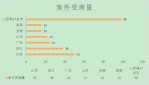
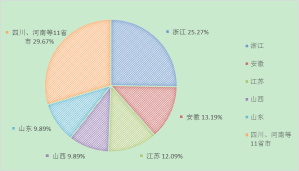
During that period, the Chinese courts accepted 264 bankruptcy cases.  Jiangsu, Zhejiang, and Guangdong had the top number of cases, followed by Shanxi, Anhui, and Hunan.  The top bar is cases is the rest of the country. d5015987-bb7f-4ee4-812a-e711a3264557

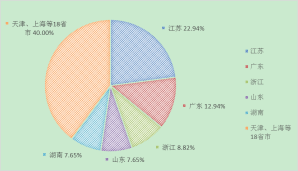
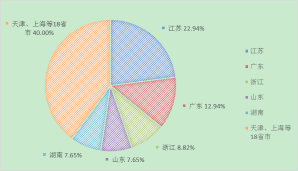
The piechart sets out the percentage distribution of cases by province (the largest percentage is from the rest of the country).

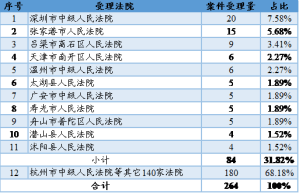
A listing of the courts that have accepted the most bankruptcy cases bears out earlier analysis on this blog about the Shenzhen courts (Shenzhen is the court that has accepted the most bankruptcy cases in the country, with Zhangjiagang (Jiangsu Province) in second place.

270c4d61-bf82-43df-a982-271859fca937

As for the types of cases, the piechart below shows that most cases (about 2/3s) were bankruptcy liquidation cases, followed by reorganization (about 1/3), with very few settlement cases.  This article explains the three different types of cases.

d5015987-bb7f-4ee4-812a-e711a3264557On the geographical distribution of the liquidation cases.the piechat above shows that most arose in Jiangsu Province (about 23%), with Guangdong, Zhejiang, Shanxi, and Anhui Provinces following in descending order.  The 40% is from the rest of the country. Several cases involve multi-tiered, overlapping layers of complex entities (as elsewhere in the world), leading Chinese courts to consolidate the bankruptcy cases of several related companies (this Harvard Law School article gives a US bankruptcy perspective on consolidation).3be5b38d-70a0-4ebd-bdae-3472f9de09ae

On the geographical distribution of the reorganization cases, the piechart above shows that greatest proportion of reorganization cases were in Zhejiang (25%) (the site of at least one pilot court for bankruptcy cases), followed by Anhui, Jiangsu, Shandong/Shanxi) (the 30% is for the rest of the country).

As mentioned previously, the Supreme People’s Court expects to see an upturn in bankruptcy cases, and I would expect to see initiatives in transferring cases from enforcement to bankruptcy (an outstanding issue for the courts) and proposed solutions to achieve more reorganization and settlement cases. These are likely to happen because (as mentioned previously) the Chinese government has committed to reducing the number of zombie enterprises.  Early this spring, a conference will be held in China on the trial of bankruptcy cases, where these issues are likely to be discussed. If the organizers (and funding) permit, I will attend.


Accessing Chinese legal developments through Wechat (updated)

logoWechat, as most people with an interest in China know, has become the preferred form of social media in China.  The legal community in China has taken to it too.

Some are official accounts of government entities, including the courts and others are public accounts (公众账号) established by companies, law firms, individuals, and other organizations. Ir  Each has its benefits for the user located outside of China.

To access these public accounts, it does not matter where in the world you are located, but you need a smart phone to install the Wechat app. The accounts can be accessed through “search official accounts” or “Add contacts” and typing in either the Wechat ID or the name of the account. The accounts can also be accessed through computer or table as well, by searching for the account in question.

The official government accounts enable the user to keep current on the issues and latest government position in that area of law–new policy, new legislation, and new reforms.  The Supreme People’s Court, for example, has one, as does the Supreme People’s Procuratorate, as well as their local counterparts.

Another category is the less official public accounts.   Some are affiliated with official organizations, while others are not, while others are in a grey area. The writing tends to be aimed at the professional, with less bureaucratic language.   Some accounts are aimed at practicing lawyers, more focused on civil and commercial law than criminal law or administrative law, but both can be found. Some accounts publish writings by the account holder, while others accept articles submitted by followers.  One very popular type of article is one that reviews the law and cases in a particular area of law.

Some of the legal public accounts that I follow (or are highly recommended by those that I know) are listed below.  The list has now updated with further information provided by a 31 January article in Empire Lawyers and Lawread on the top 10 public accounts. Please use the comment function (or email me) to suggest additional accounts.

  • Arbitration:  Wechat ID: cnarb1, account of Lin Yifei, mentioned in an earlier blogpost.  I highly recommend it to both practitioners and others interested in arbitration.
  • Labor law:Wechat ID: laodongfaku (劳动法库) (with over 200,000 followers (this is mentioned in Empirelawyers top 10; Wechat ID: ldfview (子非鱼说劳动法);
  • Civil law 海坛特哥 (haitanlegal), account of Chen Te, formerly of the Beijing Higher People’s Court, now a lawyer (高衫legal) [his earlier posts focused on medical law], Wechat ID: gaoshanlegal;  审判研究, Wechat ID: spyjweixin; 法客帝国, Wechat ID: Empirelawyers; 审判研究, Wechat ID: msspck.
  • Criminal law: 辩护人 (bianhuren1993); 刑事实务, Wechat ID: xingshishiwu, with over 200,00 followers; 刑事审判参考 Wechat ID: criminailaw.
  • Judiciary: There are many, among them are: 法影斑斓 , account of He Fan, judge in the judicial reform office of the Supreme People’s Court, Wechat ID: funnylaw1978 and JunnyLaw (JunnyLaw1977) the newly established account of Jiang Qiang, a judge in the #1 Civil Division of the Supreme People’s Court, so far, articles focusing on civil law issues.
  • Civil litigation, 天同诉讼圈, Wechat ID: tiantongsusong (in the top 10), established by Tian Tong & Partners), with over 250,000 followers;
  • International law: Wechat ID: ciil 2015 国际法促进中心
  • IP law–知识产权那点事, Wechat ID: IPR888888.  The posting of 30 January, for example, includes the Supreme People’s Court judgment 11 January in its retrial of the Castel wine trademark infringement case and an article on indirect infringements of copyright on the Internet.
  • Aggregators/General–智和法律新媒体, Wechat ID: zhihedongfang; 法律博客, Wechat ID: falvboke,  法律读品, Wechat ID: lawread, 尚格法律人, wechat ID: falvren888 (followed by at least 130,000 legal professionals). 法律读库 Wechat ID: lawreaders, followed by 500,000 (in top 10); 法律讲堂, Wechat ID: yunlvshi, established by a partner with the Yingke Law Firm (also listed among the top 10).

This linked article written by Chen Te discusses how legal professionals can market themselves through a public account as well as some of the issues of having a public account.

Accessing Chinese legal developments through Wechat

logoWechat, as most people with an interest in China know, has become the preferred form of social media in China.  The legal community in China has taken to it too.  Some are official accounts of government entities, including the courts and others are public accounts (公众账号) established by companies, law firms, individuals, and other organizations.  Each has its benefits for the user located outside of China.

To access these public accounts, it does not matter where in the world you are located, but you need a smart phone to install the Wechat app. The accounts can be accessed through “search official accounts” or “Add contacts” and typing in either the Wechat ID or the name of the account. The accounts can also be accessed through computer or table as well, by searching for the account in question.

The official government accounts enable the user to keep current on the issues and latest government position in that area of law–new policy, new legislation, and new reforms.  The Supreme People’s Court, for example, has one, as does the Supreme People’s Procuratorate, as well as their local counterparts.

Another category is the less official public accounts.   Some are affiliated with official organizations, while others are not, while others are in a grey area. The writing tends to be aimed at the professional, with less bureaucratic language .   Some accounts are aimed at practicing lawyers, more focused on civil and commercial law than criminal law or administrative law, but both can be found. Some accounts publish writings by the account holder, while others accept articles submitted by followers.  One very popular type of article is one that reviews the law and cases in a particular area of law.

Some of the legal public accounts that I follow (or are highly recommended by those that I know) are listed below.  Please use the comment function (or email me) to suggest additional accounts.

  • Arbitration:  Wechat ID: cnarb1, account of Lin Yifei, mentioned in an earlier blogpost.  I highly recommend it to both practitioners and others interested in arbitration.
  • Labor law:Wechat ID: laodongfaku (劳动法库) (with over 200,000 followers; Wechat ID: ldfview (子非鱼说劳动法);
  • Civil law 海坛特哥 (haitanlegal), account of Chen Te, formerly of the Beijing Higher People’s Court, now a lawyer (高衫legal) [his earlier posts focused on medical law], Wechat ID: gaoshanlegal;  审判研究, Wechat ID: spyjweixin; 法客帝国, Wechat ID: Empirelawyers; 审判研究, Wechat ID: msspck.
  • Criminal law: 辩护人 (bianhuren1993); 刑事实务, Wechat ID: xingshishiwu; 刑事审判参考 Wechat ID: criminailaw.
  • Judiciary: There are many, among them are: 法影斑斓 , account of He Fan, judge in the judicial reform office of the Supreme People’s Court, Wechat ID: funnylaw1978 and JunnyLaw (JunnyLaw1977) the newly established account of Jiang Qiang, a judge in the #1 Civil Division of the Supreme People’s Court, so far, articles focusing on civil law issues.
  • International law: Wechat ID: ciil 2015 国际法促进中心
  • IP law–知识产权那点事, Wechat ID: IPR888888.  The posting of 30 January, for example, includes the Supreme People’s Court judgment 11 January in its retrial of the Castel wine trademark infringement case and an article on indirect infringements of copyright on the Internet.
  • Aggregators–智和法律新媒体, Wechat ID: zhihedongfang; 法律博客, Wechat ID: falvboke,  法律读品, Wechat ID: lawread

This linked article written by Chen Te discusses how legal professionals can market themselves through a public account as well as some of the issues of having a public account.

Shenzhen leads the way in bankruptcy law reforms

Screen Shot 2016-01-22 at 9.26.04 AM
Shenzhen’s bankruptcy information platform

This very brief blogpost is reporting on bankruptcy law developments in Shenzhen.  The Shenzhen courts are often used as a venue for piloting reforms, and bankruptcy law is no different.  It is likely that the Supreme People’s Court (SPC) is aware of this.

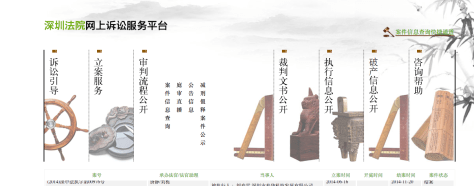
The Shenzhen Intermediate Court held a press conference on 21 January  to announce that they had established a bankruptcy information platform (linked here) with information case guidance, filing guidance, guidance on procedures, bankruptcy case announcements, bankruptcy judgements, etc.  The Shenzhen court also released some recent statistics on their caseload.  In 2015, the Shenzhen intermediate court accepted 131 cases, up 105% from the year before, tried 283 cases, and resolved 82 cases (up 26% from the year before). On the timing for cases to be resolved, as mentioned in a previous blogpost, bankruptcy cases tend to take a long time to be closed in the Chinese courts.

The bankruptcy platform is likely to be a model for other courts around China and fits nicely with the other “informatization” initiatives of the SPC.  Having a single platform should make it easier for bankruptcy practitioners (as well as buyers of distressed assets).  For those of outside of the Chinese court system seeking to understand what is happening, it will provide more information for us to consider.
The cases in Shenzhen accounted for 40% of the total bankruptcy caseload in Guangdong.  Although national statistics for bankruptcy cases in 2015 have not yet been released, when compared with 2014 (and presuming China had more cases bankruptcy in 2015), Shenzhen accounts for a significant proportion of bankruptcy cases. That is likely not a sign of weaker companies in Shenzhen, but that the Shenzhen government is more willing to see companies go through bankruptcy procedure.


Bankruptcy: What to expect in 2016 from the Chinese civil & commercial courts (II)

imgres-1As readers of this blog know, in recent years, the Chinese courts have had very few bankruptcy cases. Judges of the Supreme People’s Court (SPC) predict that will change in 2016.  Why (and where) do they say so? What guidance is the SPC giving Chinese bankruptcy judges? What else do we know about bankruptcy cases?

Why more bankruptcy cases?

At the 8th national conference for civil and commercial judges (discussed in an earlier blogpost), Judge Yang Linping of the #2 Civil Division revealed that the SPC expects an upward trend in bankruptcy cases because the Economic Work Conference at the end of 2015 called for quickening the clearance and exit of “zombie companies” through transfer of ownership and bankruptcy.

What is the guidance from the SPC?

Among the guidance from Judge Yang:

  • Make it easier for companies to go into bankruptcy proceedings, while not using the new filing system.  Shenzhen, one of the local courts that has heard a significant proportion of bankruptcy cases, issued local court guidance in May, 2015 on the filing of bankruptcy cases that the SPC is likely considering.
  • Distinguish real bankruptcies from fraudulent ones, in which the bankrupt enterprise “maliciously” seeks to defeat its creditors;
  • Courts hearing bankruptcy cases should monitor bankruptcy administrators to be sure they are recovering assets;
  • Review the reasons for the bankruptcy to see whether criminal conduct was involved in the collapse of the company;
  • Higher level court should monitor the way lower level courts handle bankruptcy cases;
  • Use bankruptcy reorganization procedures where appropriate, particularly for larger scale companies that have operational value.

It would not be surprising to see further guidance from the SPC as the year progresses.

What else?

How to deal with the collapse of real estate companies (highlighted in a previous blogpost) is likely high on the list of difficult issues for Judge Yang and her colleagues to consider.  The Zhejiang courts have already issued detailed guidance on the bankruptcy of real estate companies.  A conference on real estate companies and bankruptcy was held in Zhejiang, just after the 8th civil and commercial judges conference, attended by a senior SPC bankruptcy judge, bringing together bankruptcy judges, practitioners, academics, accountants, and financiers. The effect on migrant labor construction workers was likely on everyone’s minds as well, as bankruptcy cases must be handled with an eye to maintaining social stability.

The official media has predicted a wave of shipping company bankruptcies in 2016.Several Chinese shipping companies went into bankruptcy in 2015.

We are likely to see more bankruptcies among Chinese P2P lending platforms. According to media reports late in 2015, 270 failed in the last year.


Supreme People’s Court upgrades its database

Screen Shot 2016-01-07 at 7.27.12 AM.png

This short blogpost is just to bring to the attention to the world outside of China that the Supreme People’s Court (SPC) has substantially upgraded its case database, enabling users to search by keyword, cause of action, party, court, lawyer, law firm, full text (or facts, headnotes).  The database can be accessed here.  The SPC has required higher, intermediate courts and some basic level courts to upload their judgments on its database (with certain exceptions). The military courts are an exception, although senior military legal academics are advocating greater transparency for the military courts.

Basic level courts in the more developed coastal regions have gone first, with other areas following as they have the technical ability to do so.  The higher people’s courts issue their own implementing regulations to guide their local courts (see regulations mentioned by an Inner Mongolian court). Local courts issue their own guidance in implementing the SPC system, such as this guidance from an Inner Mongolian county court, where the court leadership (court president/Party secretary and the other Party group members (the leaders of divisions of the court)  is leading  the implementation.

Although judgments in sensitive cases are often not uploaded,  for the vast majority of cases (that do not fall into that category), the SPC database remains a rich source of understanding how the Chinese court system is operating, through (for example) a focused search of a  specific type of case, from rape to breach of contract to challenge of public security penalties, to enforcement of arbitral awards.

What to expect from Chinese civil & commercial courts in 2016 (I)

top-happy-new-year-2016-wallpaperIn late December, the Supreme People’s Court (SPC) held its 8th conference for civil and commercial judges, gathering together senior court leaders from around the country and from both civilian and military courts responsible for a broad range of civil and commercial issues. Speeches of two senior SPC judges responsible for civil and commercial matters, as well as a draft conference summary have been circulating among Chinese legal professionals.  What is the relevance of all of this to the world outside of the Chinese courts, particularly to the world outside of China?

It is relevant for several reasons:

  • The court conference illustrates the role of the SPC in the Chinese political legal system and its relationship with other institutions;
  • As in other legal systems, the Chinese courts are an individual or company’s  last resort for resolving disputes;
  • Those disputes highlight major issues in the Chinese economy and society.  The slowdown in the Chinese economy is already affecting the rest of the world, and the difficult issues for the courts signal where economic problems are.  Social issues have a more indirect impact on the outside world, but still affect foreign businesses and institutions.

The phenomenon of the court conference (and conference summary)

As this blog has highlighted earlier, the Chinese government regularly organizes conferences to ensure that subordinate entities are implementing the latest central policy on the matter as well as to harmonize local practice.  This is true of the courts as well as the food safety authorities.

Because the SPC is one of several central political legal institutions, the speakers included Meng Jianzhu, head of the Central Political Legal Committee, and participants included representatives from the Central Political Legal Committee, the Legal Work Commission of the National People’s Congress, the Legislative Affairs Office of the State Council, and other central legal institutions.

The conference summary, now circulating in draft form, is a type of SPC official document (see the SPC’s regulations on the subject), classified as a “normative document” and often address new issues or areas of law in which the law is not settled.  Under SPC rules, it can not be cited as the basis  of a court judgment but guides how lower courts consider the issue.

As to why the SPC organized the conference, the vast majority of Chinese court cases are civil and commercial. At the conference it was revealed that 80% of cases resolved by the Chinese courts since 2008 are civil and commercial cases. For that reason, if the goal of the SPC is to make every person feel fairness and justice in every case (under Party leadership), the focus must be on doing a good job in hearing civil disputes.

images-2
Judge Cheng Xinwen interviewed in 2014

What are the issues facing the Chinese courts?

Judge Cheng Xinwen, the head of the #1 Civil Division spoke about the issues civil  court judges need to monitor in 2016 (some of which have been mentioned in earlier blogposts) and the current official thinking on them (set out in the conference summary):

  1. Real estate, property and construction;
  2. Family;
  3. Torts;
  4. Labor;
  5. Agriculture;
  6.  Consumer protection;
  7. Challenges to enforcement action;
  8. Private lending.

This blogpost looks at some of the issues relating to real estate, property, and construction cases.

Real estate, property and construction cases

Real estate cases account for a substantial part of the caseload of the Chinese courts.  Trying them properly, according to the SPC leadership, is linked to implementing the government’s macro-economic policies. Cases are on the increase, particularly in third and four tier cities.  The market has switched from a seller’s to a buyer’s market in some second and third tier cities:  Some of the problems include:

  • developers suing to invalidate grant contracts (under which they purchase land for development) and seek the return of the land grant fees (upon which local governments depend);
  • Developers who are short of funds and are unable to hand over properties on time;
  •  Declines in property prices causing “mass incidents.” Local courts are directed to liaise with local Party and government authorities, and take steps to prevent chain reactions.  This 2014 article mentions incidents in Taizhou, Zhejiang province, a province where many cities have seen a deflating property market;
  • Many cases involve both real property and private lending, and include developers illegally fundraising, mortgaging or selling the same property several times;
  •  Property registration, ownership in common, and bona fide purchases, are difficult issues for the courts, and the SPC will issue further guidance in the form of a judicial opinion on these soon.

Construction cases account for a relatively small number of cases (about 100,000 annually), but they tend to be complex and involve large amounts of money. Issues with construction cases indicate big problems in the industry because of funding problems, causing quality problems in construction, many unpaid migrant construction workers and an increasing number of disputes. Among the problems:

  • construction contracts that should have been let out for bidding that weren’t;
  • construction contracts illegally subcontracted;
  • construction contracts illegally subdivided;
  • contracts in which a contract party should have had a construction qualification or planning permit.
  • Contract parties to these invalid contracts that seek to minimize their payouts under these contracts and seek to avoid the payment clauses (but the SPC states that those should be respected);
  • Unless a subcontractor’s migrant construction workers remain unpaid, courts shouldn’t disturb liquidated damage clauses to expand a project owner’s liability. With unpaid laborers, the project owner’s lability could be expanded to cover the amounts owed to the actual unpaid workers.

Courts are directed to balance individual and societal interests, to uphold social public interests and an orderly construction market.

At the conference, the SPC leadership promoted six slogans (i.e.principles) of:

  • protection of  property rights;
  • respect for freedom of contract;
  • upholding equal protection;
  • upholding the unity of rights and duties;
  • maintaining honesty and keeping promises;
  • promoting procedural and substantive justice;

Litigants of all types, domestic and foreign, corporate and individual will be able to come to their own conclusions about how well the Chinese court system delivers on these broad principles.


Supreme People’s Court Monitor’s 2015 year end report

images-2In 2015, the Supreme People’s Court Monitor had over 25,000 page views, from 140 countries (regions), primarily from:



  • United States;
  • Hong Kong;
  • Australia; and
  • Mainland China,

with the United Kingdom, Germany, and Singapore trailing closely. I am particularly honored to have so many visitors from China when WordPress blogs are often difficult to access there.  Visitors came from many of China’s neighbors (and all parts of greater China), including:

Macau, Taiwan, Philippines, Thailand, Laos, Cambodia, Vietnam, South Korea, Mongolia, Kazakhstan, Myanmar, Nepal, Pakistan, India, Bhutan, Russia,  Tajikistan.

Like my sister blog, China IPR, my followers include academics, students, journalists, government officials (and officials of international organizations) as well as practicing attorneys (in private practice, government service and with NGOs).  I am honored to have my blog listed as a Chinese law resource by Harvard and Yale Law Schools, Oxford Bodleian Library as well as many other universities.

I was honored to have been invited to speak about China’s judicial reforms by the Faculty of Law of the University of Hong Kong, University of Pennsylvania, Columbia Law School, and Guangzhou University, and the European China Law Studies Association, among other institutions.


“Improper discussions” of Chinese judicial reform are forbidden


a29fc3aa1b904dbe8b6345d0ec3cd234
Home of Judges

One of my favorite Wechat public accounts, the “Home of Judges” (法官之家) was closed down earlier this month.  The public account had about 100,000 followers. (Wechat public accounts  are explained here.)  While some public accounts are used as corporate marketing platforms, “Home of Judges,” along with several other public accounts have become platforms for (primarily) young judges (and lawyers) to share their views, experiences, and analyses. The Home of Judges public account published articles by many local judges, many with their concerns and thoughts about different aspects of judicial reform, with other articles describing by current or former judges explaining why they left or were thinking of leaving the judiciary.  The account holder for the public account, Li Liang, a former Guizhou Higher People’s Court judge wrote:

I had a feeling that Home of Judges would be closed down–first the News Bureau of the Supreme People’s Court contacted the news department of my court, demanding that the name of the public account be changed, but the editor did nothing, then I heard that the internal reference service of the Supreme People’s Court SPC) carried some Home of Judges articles, then recently the Beijing News Department deleted articles.

法官之家被禁封了,其实最近即有预感,先是最高法院新闻局找到我院新闻处长,要求将公号改名,小编未置可否,后来听说最高法院内参连续刊载法官之家文章,最近北京新闻处长多次联系删稿,

An anonymous article by the Sword of Heavenly Peace (长安剑) (according to some sources a pseudonym for the Central Political Legal Committee set out a seemingly more official explanation of why the account was closed down.  The name of the public account was a problem, because the account holder had left the court.   However the same name (Home of Judges) is used for the name of a hotel in Beijing, apparently the Supreme People’s Court’s guest house (see the comments to this hotel review).

Others (including some other legal bloggers) have said that it was because the Home of Judges was “improperly discussing” judicial reforms (妄议司改), a variation of “improperly discussing Central policy (妄议中央)”, a violation of the Chinese Communist Party Standards on Integrity and Self Restraint.

Stepping into the shoes  of the Supreme People’s Court leadership for a minute, it seems likely that a public account with a large number of judges criticizing the judicial reforms approved by the Party leadership would make the SPC leadership uncomfortable.   Why?  Because it would indicate that they were not doing a good job of “uniting thinking” (统一思想)–uniting the judges of the lower courts behind policies drafted by the SPC that had been approved by central Party authorities.

Comments by a fellow blogger

Following the closure of the “Home of Judges,” one of its fellow bloggers commented on the current environment.   Zhao Jun, a judge of the Jiangsu Higher People’s Court, who has a popular (among the legal community) public account, under the pen name  Gui Gongzi 桂公梓,  explained why he hasn’t been writing legal articles:

Third and more importantly , with the fluttering banner of democracy and the rule of law more and more ambitious,  the space for speech is obviously  tightening.

三也是更重要的是,随着民主和法治的旗帜招展得越来越宏大,言论的尺度却显而易见地越来越收紧了也是更重要的是,随着民主和法治的旗帜招展得越来越宏大,言论的尺度却显而易见地越来越收紧了

logo

Comments from the outside

Chinese social media is an invaluable way to understand what is going on in the Chinese court system and Chinese law generally, enabling you to keep up with developments wherever you are.

It is a shame if public accounts such as “Home of Judges” are seen as a threat to the government rather than a way to understand what the younger generation of judges, prosecutors and lawyers are thinking.

The older generation?

The older generation of judges and lawyers, particularly those who have lived through the Cultural Revolution, comment privately that at this time,  the best approach is to say nothing.

Year end bonus from the Supreme People’s Court

images-1As highlighted in the last blogpost, the Supreme People’s Court (SPC) is issuing all sorts of documents in the rush towards year end, far outpacing the time available to the Supreme People’s Court Monitor to analyze them.   Some of the recent developments that merit closer scrutiny:

  • more model/typical family law cases (incorporating the ones highlighted in an earlier blogpost) and with many more involving domestic violence and cohabitation issues;
  • 19 model/typical contract cases, including several private lending cases, real property cases, etc.
  • 14 model/typical food and drug crime cases, including one involving a supermarket (I had written this on food safety raids earlier this year;
  • Five model/typical cases of refusing to implement court judgments/rulings;
  • Two model/typical cases on non-payment of wages (this is an issue of high priority for the government;
  • Ten model/typical fraud cases;
  • Updated sentencing guidelines for a broad range of criminal cases, including rape, picking quarrels, and fraud;
  • Guidance from the head of the #2 criminal division on principles for applying the sections of the recent amendment to the Criminal Law on bribery and corruption (in which is likely to be incorporated into a future judicial interpretation);
  • An authoritative article by the SPC’s research office on the new terrorism crimes set out in the recent amendment to the Criminal Law;
  • approval by the SPC judicial committee (in principle) of the first judicial interpretation of the Property Law, which means most provisions are finalized, but the final draft is not set.  A recent draft discussed by the Civil Law Society was published recently. Several provisions address the issue of a “bonafide purchaser.”


Supreme People’s Court rushes to achieve year end targets

imgres-4The rush towards year end in the Supreme People’s Court (SPC), as in the business world, means a flurry of announcements of important developments, to ensure that the SPC meets its own performance targets.  Among the recent announcements are:

  • reform of the maritime courts, to make them internationally influential (this has both political and legal implications, blogpost to come);
  • approval by central Party authorities of the third round of judicial reform pilots, and the holding of a large scale meeting of representatives from the Leading Group on Judicial Reform with the SPC and Supreme People’s Procuratorate (SPP),  on the focus (personnel reforms) and roll out of these projects.  Jiang Wei,deputy director of the Office of the Central Leading Group for Judicial Reform, spoke along with his SPC and SPP counterparts.  Political legal committee secretaries from the pilot areas attended, along with court and procuratorate officials.
  • Reform of the family court system, announced at a conference held in Guangzhou, attended by Justice Du Wanhua, highlighting that the rush of judges to meet performance targets (closing cases) Iamong other factors) has had a negative effect on children, elderly, disabled, and women.  The SPC likely published typical/model family law cases in November (discussed in this  blogpost)  because pulling together those cases was part of the preparations for the Guangzhou conference;
  • progress report and further plans on improving judicial assistance (separate but related to legal assistance), with the release  of the2014  multi-agency document (Central Political Legal Committee, SPC, SPP, Ministry of Finance, Ministry of Public Security, Ministry of Justice), stating that the central government had allocated 700 million RMB for judicial assistance and local governments  1.7 billion RMB, targeted at financial assistance for victims of crimes and others, with funds allocated to about 80,000 in 2014, (certainly a fraction of what is needed)
  • long pronouncement by Justice Shen Deyong on the “standardization” of the courts, citing the important status and important role of the judiciary in the governance of the country, but the growing contradiction between the needs of the people and  judicial resources and judicial capacity, decrying the lack of “top level design,” and calling for the implementation of related reforms.

This list will be supplemented later this month, as further announcements are made.


Update on case filing reform and other challenges for Chinese courts and judges

Case filing hall in a Jingdezhen court

In late November, the Supreme People’s Court (SPC) held a press conference on case filing (docketing) reforms to announce a 32% increase in civil and administrative case filings, year on year, putting a positive spin on what is a highly stressful situation for frontline judges, but a generally positive development for litigants and their lawyers. There are many stressful factors for Chinese judges and the Chinese courts, leading many judges to leave or contemplate suicide, and others to vote with their feet.  This blogpost will look at some of the recent developments:

  • Large number of cases;
  • Increasing fraudulent litigation;
  • Dysfunctional performance indicators that refuse to die.

The three issues are interrelated.

Case filing (docketing) reforms

On the case filing reforms, through the end of September, civil cases are up almost 23%, and administrative cases up 76%, while private prosecutions of criminal cases are up 60%,The most litigious provinces are ones with highly developed economies: Jiangsu (608,000 cases), Zhejiang, Shandong, Guangdong (558,000 cases).  The Supreme People’s Court caseload was up as well, with 6852 cases accepted through September, up 58%, estimated to reach 15,000 cases by year end.

Fraudulent litigation

Fraud of all sorts is a growth industry in China, especially with the worsening economy. Creative thinkers have come up with ways to use the court system to defeat or at least delay or avoid creditors.  In recent years, the Chinese courts have been faced with an increasing amount of fraudulent litigation, now criminalized on one of the unnoticed provisions in the 9th Amendment to the Chinese Criminal Law (new Article 307-1).  However, the law does not set out a definition, although some provincial court have issued guidance.  Usual factors include litigation based on: fabricated facts, fabricated arbitration award, or notarized documents, or collusion between the parties  or third party to use fabricated facts, false evidence, false documents, destruction of evidence, provide false documents, expert opinion and other means to avoid debt or improperly gain assets.

With the reform to the case filing system (described in this earlier blogpost), fraudulent litigation on the increase. For this reason, the SPC recently issued its first ruling on fraudulent litigation, imposing a penalty of 500,000 RMB on two Liaoning companies, to signal to lower court judges that they need to monitor case filings for indications of fraud.  Fraudulent litigation can be found in various types of cases, and in the maritime as well as local courts.

On fraudulent litigation in the maritime courts, an experienced maritime judge provided the following typical scenario: because the Chinese shipping industry is in a downturn (see these articles, for example), a ship owner who is unable to repay their debts (and finds that the size of the mortgage is more than the value of the ship) will conspire with their employees to bring a claim for unpaid wages, because under the Special Maritime Procedure Law, those claims take priority over the mortgage.  The employees and shipowner will split the proceeds from the claim, shortchanging the bank and other creditors.

According to Zhou Qiang’s report to the NPC, about 3400 cases of fraudulent litigation were discovered in 2014.  According to studies done by provincial courts in recent years,  104 cases were found in 2011-2012 in Jiangsu, and 940 in selected courts in Guangdong during 2001-2009.

With the case filing reforms and soft economy, these numbers are likely to rise. Readers (of Chinese) interested in diving further into this topic should read this article.

Dysfunctional  performance indicators

Writing in People’s Daily, Judge He Fan, head of one of the departments of the SPC’s Judicial Reform Office, highlighted that “some leading cadres” wanting to achieve year end “pretty data”  are still imposing unrealistic year end performance targets, forcing front line judges to work unreasonable hours (and also  diminishing case quality). These performance targets were abolished in 2014, as highlighted in this blog.

As for why Chinese judges are leaving in such numbers and why they are so unhappy, that will be the subject of another blogpost.