Category Archives: Court Reform

Supreme People’s Court’s 4th Five Year Reform Plan sees the light of day

IMG_0877
February, 2015 photograph of the SPC building

The Supreme People’s Court’s 4th Five Year Reform Plan has finally been released to the public (linked here). An English translation will be forthcoming here.  Some of the issues highlighted have been discussed in earlier blogposts (as linked) and it builds on the principles released in July, 2014 and in the 4th Plenum Decision. It is critical to the development of the Chinese legal system and has its international implications as well. Some of the highlights:

  • Basic principles (Party leadership is a given): independence of judicial power (审判权的独立性); neutrality (中立性), procedurality 程序性), finality(终局性) (all distinguished from “Western style” judicial independence).

Among the specific measures are:

  • Specific deadlines for reforms or structures for reforms to be put in place (some by end 2015, others by end 2016, 2017, 2018);
  • Greater transparency in a broad range of areas, ranging from the parole of prisoners, assignment of judges, to the handling of property seized or confiscated by the courts;
  • Measures to cut back on local protectionism, such as cross jurisdictional and circuit courts, focusing in particular on major administrative cases, environmental cases, bankruptcy cases, food safety cases and others, by changing jurisdictional provisions in administrative cases, environmental cases, and others);
  • Details on what the Court means about “hearing centered procedure,” and imposes a goal of end 2016 to establish a hearing centered system, as having evidence presented and reviewed at the hearing, both parties being given a chance to be heard, requiring witnesses and experts appear at hearings; assumption of innocence, exclusion of illegally obtained evidence (and establish systems for determining and excluding such evidence), all of which involves a greater role for lawyers;
  • In the area of criminal justice, provides better protection to defendants and their counsel, such as prohibiting criminal defendants from being forced to wear prison clothing, shackles, etc., idea that the prosecution and defense have equal status in the criminal process, better judicial review of individuals whose freedom is restricted;
  • In civil cases, requiring evidence to be reviewed at trial and major disputed evidence must be highlighted in the judgment or ruling and whether the court is relying upon it;
  • Improving the status of lawyers in both criminal and civil litigation;
  • Reforming jurisdiction in environmental cases;
  • Improving jurisdictional provisions in public interest cases (which at this time means environmental and consumer cases);
  • Changing the docketing process from a substantive review to a registration procedure (which in the past has meant that “inconvenient” cases were not accepted);
  • Reforming internal court procedures and roles, particularly that of the court president, members of the judicial committee, and heads of division, requiring documentation of communications with the judge or judges handling the cases, as well as focusing the judicial committee on legal questions (external pressure on these court leaders has been a significant factor in the miscarriages of justice now being revealed);
  • Distinguishes the functions of courts at first and second instance (as well as re-trial and judicial supervision) stages;
  • Changes the current performance indicator system, and gets rid of league tables for courts;
  • In appeal cases, the court should set out the issues in the case at first instance;
  • Changes the relationship between the higher and lower courts so that they operate independently;
  • Prevents judicial corruption in a variety of ways, such as improving the judicial auctioning process, confiscation of property, and much more transparency;
  • Calls for establishing a system of integrating Party disciplinary systems (in anti-corruption cases) with court punishment systems;
  • Highlights providing greater openness to the press and others to attend court hearings;
  • Calls for establishing a more professional personnel system for judges and a transitional system from the current one.
  •  a judicial selection system;
  • More details on having local judges appointed at the provincial level;
  • Setting up a system for preventing interference in court cases by requiring notes, etc. from leaders to be retained in the file and made available to parties and their counsel;
  • Improving the military courts.

In the spirit of greater openness, the document states that reforms by lower courts are to be reported to the Court before being launched and major reforms need to be reported to the Party central authorities before being launched [apparently to ensure Party leadership to prevent the political authorities from being unpleasantly surprised].

The changes relating to basic court institutions will affect all types of cases, whether they are environmental, intellectual property, or foreign-related ones.

The drafting of this document required countless hours of work and negotiations.  The real work is ahead, in implementing its principles, and in particular changing patterns of behavior as well as institutional and political culture formed over several decades.
Supreme People’s Court‘s sunshine cure for corruption in commutation and parole procedures

20140221112449_2571
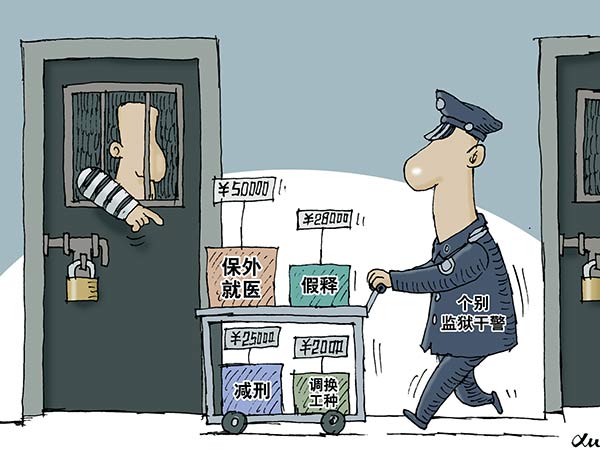
Prisoner choosing commutation & parole options from corrupt jail official


Before Chinese new year, the Supreme People’s Court held a news conference  to highlight its accomplishments in reforming parole procedures. The previous procedures (or lack of them) (as described below) appeared to have been a money-spinner for prison officials. The reform in parole procedures highlights the value that current Chinese legal policy places on Justice Louis D. Brandeis’s wisdom (without citing him):

“Publicity is justly commended as a remedy for social and industrial diseases. Sunlight is said to be the best of disinfectants…”

The change in parole procedures also are a good example of how results of investigations by the Central Commission for Discipline Inspection (CCDI) and Central Political and Legal Committee policy documents are eventually are translated into improvements in legal procedures.

The reforms to parole procedures include:

  • The Court’s August, 2014, Provisions On Commutations And Parole(最高人民法院关于减刑、假释案件审理程序的规定) (translation can be found here), requiring much more transparency;
  • November, 2014 procedures issued by the Court along with the Ministry of Justice, Ministry of Public Security, Supreme People’s Procuratorate, and National Health and Family Planning Commission on medical parole and related issues (暂予监外执行规定), establishing stricter guidelines.
  • Establishing an internet platform on the Court website to make public (provide sunlight) parole/commutation matters: acceptance of applications, notice of court hearings,and court rulings;
  • Establishing a filing system under which decisions relating to officials of county level (or section (处) need to filed with provincial high courts and provincial department (bureau level(局)) need to be filed with the Court;
  • Model cases on parole and commutation, to guide lower court judges in their work, and inform the public on these reforms.

    ________.x_large
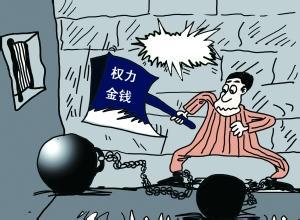
    Axe labeled “power”, “money”

The background

With flexible provisions and limited transparency on medical parole, commuting sentences, and parole procedures, in recent years apparently underpaid Chinese prison officials caught the entrepreneurial spirit and (like the Monopoly game that many of us grew up playing), sold “get out of jail cards” to those who could afford to pay.  Those were generally made up the wealthy and (formerly) powerful, particularly those who had committed the following crimes:

  • duty crimes (including taking bribes and abusing authority);
  • organized crimes;
  • financial crimes.

An August, 2014 press report mentioned that over 700 prisoners  nationwide had improperly secured early release.  Other reports cited that prison officials in Guangdong were particularly entrepreneurial, arranging for the improper release of approximately 140 in Guangdong, primarily former officials, including:

  • Wang Ju, former vice mayor of Shenzhen;
  • Zhao Yuchun, former head of Shenzhen customs;
  • Huang Shaoxiong, former deputy head of the Guangdong United Front Work Department; and
  • Lin Chongzhong, former deputy mayor of Jiangmen.

CCDI investigations and Central Political Legal Committee policy document

It appears that these reforms can be traced back to CCDI investigations in 2013 (and possibly earlier), because in August, 2013, the CCDI website carried a summary of a speech by Xi Jinping at a CCDI conference in which he calls for reforms to parole procedures. At about the same time reports of  investigations into prison officials were released by CCDI, such as one of a Hunan Province Justice Department (the Justice departments run the prison) official who was found to have almost USD 2 million (12 million RMB) in assets disproportional to his income.  Many other prison officials in other provinces have also been investigated.

In January, 2014, the Central Political Legal Committee issued a policy document outlining the policy framework for the reforms, which began with the frank admission that society was incensed by the rich and powerful who had been sentenced to prison who often served relatively short sentences because they had their sentences commuted or were given parole, directing special restrictions prisoners convicted of the above three types of crimes. (The Supreme People’s Procuratorate has issued its own regulations to implement the policy document.)

Going forward

Reducing corruption in the justice system and giving Chinese people more confidence in it is a multi-faceted process, with greater transparency needed across many areas.  These reforms to parole and commutation procedures are likely to be one of the accomplishments that President Zhou Qiang will be able to point to when he gives his report to the National People’s Congress next month, particularly as the August, 2014 regulations are listed as one of one of the Court’s 10 major policy accomplishments of 2014.

Additionally, the internet platform also serves as a window into criminal activity in China, such as the recent application by a Han native of Xinjiang, convicted in Beijing of dealing in drugs, but who was permitted by the Chaoyang District Court to serve his sentence outside of jail for the next six months, because he has AIDs.


When will the Supreme People’s Court become a tourist destination?

800px-Supreme_peoples_court_chinaI had the good fortune to have a meeting with some judges of the Supreme People’s Court last week in the main building of the Supreme People’s Court.  The rules are now such that photographs of the gate (and nameplate of the Supreme People’s Court) are forbidden, a contrast to 20+ years ago, when I was able to ride my bicycle along the road fronting the Court.  As the Supreme People’s Court guides the courts towards more transparency and public access, I look forward to the day when it can become a tourist destination and its hearings more  open to the Chinese and foreign public.

I wish all my readers all the best for the Year of the Sheep  祝大家新春快乐,身体健康,万事如意!

What does the 4th Plenum mean for military legal reforms (continued)

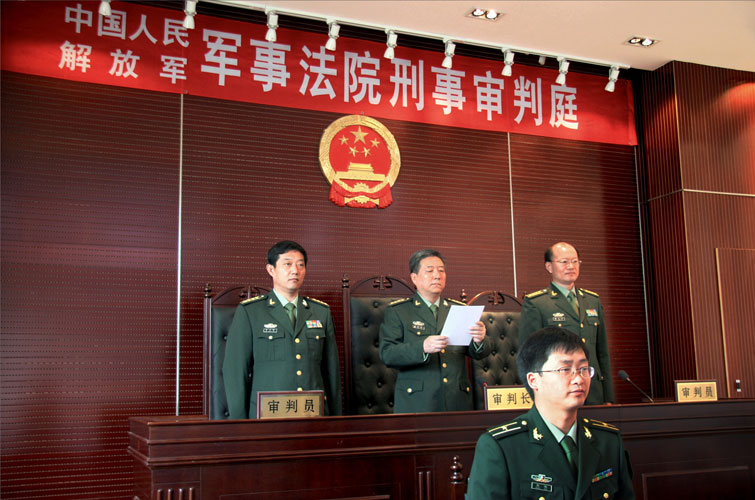
Criminal Division, PLA Military Court

In early February, I published an article in The Diplomat, focusing on little understood post 4th Plenum developments on Chinese military law, which (to my surprise) was summarized and translated by Chinese official media.  Professor Zhang Jiantian of China University of Political Science and Law recently published an article in People’s Court Daily on issues affecting the military courts, in which gives the outside world a glimpse of the gated Chinese military legal community and sets out his recommended reforms. My article in the Global Military Justice Reform blog summarizes Professor Zhang’s views and recommendations.

Why the Supreme People’s Court is harnessing the NGO “genie”

u=3330605769,467553553&fm=15&gp=0
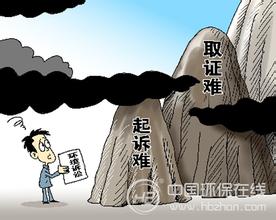
Obstacles to public interest litigation-filing suit & obtaining evidence

Many China observers were surprised to learn that in early January, 2015, the Supreme People’s Court (Court) issued an interpretation on enabling civil society organizations to sue polluters on behalf of the public, when most commentators take the view that those organizations are controlled more tightly than before.  The Court issued it after years of work, analysis, and low numbers of environmental lawsuits (highlighted in my earlier blogpost), particularly public interest ones.

This blogpost explains:

  • what the Interpretation does;
  • what its background is;
  • why the Court is enabling environmental NGOs to file suit; and
  • An assessment of its implications.

This blogpost should be read with Barbara Finamore’s blogpost, How China’s Top Court is Encouraging More Lawsuits Against Polluters.

What the interpretation does

The interpretation, entitled “Interpretation on Several Issues Regarding the Application of Law in Public Interest Environmental Civil Litigation (Interpretation) (Chinese original found here and translated here). The Interpretation (like many other Court interpretations) combines court procedural rules with additional rules on liability and other legal standards to put in place a framework for Chinese environmental NGOs to file public interest environmental cases against polluters. It supplements Article 58 of the Environmental Protection Law (amended in 2014) and the 2012 Civil Procedure Law, because neither law had sufficient legal rules to guide local NGOs in bringing and local courts in accepting, hearing, and deciding these lawsuits.

A draft of the Interpretation had been issued for public comment on 1 October and the final draft reflects comments from the public.  Both domestic and international organizations commented on the draft.

The Interpretation authorizes environmental NGOs with a five year track record that are legally registered with the local NGO regulator, the Ministry of Civil Affairs or its local counterpart, to sue polluters on behalf of the public, and to seek the equivalent of a permanent injunction, compensation, orders to clean up the pollution, or an apology, among other measures. A Ministry of Civil Affairs official recently estimated that about 700 environmental groups met current qualifications.

The highlights:

  • Broad definition of environmental NGOs that can file suit. At the press conference announcing the Interpretation, the Court spokesman said that a broad definition was adopted so that it would be flexible enough to accommodate additional types of approved non-profit groups.  This may be have been done to accommodate contemplated reforms to non-profit institutions;
  • Provisions permitting an NGO to seek a court within a provincial boundary but outside the locality of the polluter to hear the case. Because local courts are locally funded, they are often reluctant to hear or decide cases that cause result in judgments against companies that are often substantial contributors to local tax bases. An NGO is also allowed to sue polluters outside of its own locality. This was also highlighted in the same press conference.
  • The Interpretation enables injured private parties to piggyback on the NGO’s case, also highlighted by the Court spokesman.
  • Several provisions to require court oversight when NGO settles the lawsuit, to guard against intimidation by the polluter, which may be allied with local government.
  • The damages the polluter pays are paid into a pool of money, which is used to compensate those harmed.
  • If the defendant polluter refuses to provide information about pollution discharge, the court can presume that the plaintiff’s assertions have been established.
  • Several provisions are designed to reduce the costs of litigation to the NGO.
  • The litigation must not be profit making for the NGO.

The Court spokesman described these cases as “a new type”, difficult to try and enforce, and ones that attract a great deal of public attention,  but given the high degree of public concern, in January, 2015, China’s People’s Court Daily identified the Court’s environmental legal policies, as being the SPC’s top judicial policy initiative in 2014.

Some background

The Interpretation reflects years of work within China by local legal experts, local environmental NGOs, as well as the technical support of international organizations such as the United Nations Development Program, the Asian Development Bank, and other China-based foreign NGOs, and universities. The structure established by the Interpretation reflects concepts adapted from US law and other foreign legal systems, but reflects Chinese legal, political and societal realities.

The Court worked with the Ministry of Civil Affairs (MCA), which regulates NGOs, and the Ministry of Environmental Protection (MEP) in establishing a policy framework for implementation, which set out in the document issued with the Interpretation, the Notice of the Supreme People’s Court, Ministry of Civil Affairs, and Ministry of Environmental Protection on Implementing the System of Environmental Public-interest Civil Litigation (Chinese original here).

The Third and Fourth Plenum decisions both highlighted establishing compensation systems for those responsible for creating ecological or environmental damage, and the Court’s policy document on environmental issues, issued in June, 2014, signaled the importance to the government of public interest environmental litigation.

Track record of Chinese courts on environmental litigation

About 170 courts have now established environmental divisions, but according to Court studies, most have heard relatively few cases. Public interest environmental litigation was piloted in provinces as diverse as economically developed Jiangsu Province and the less developed southwestern provinces of Yunnan and Guizhou.  These cases have been analyzed  both in Chinese and English.The pilot projects highlighted some of the underlying issues, which include local protectionism, lack of specific provisions on these cases, lack of training, and lack of coordination between the environmental protection authorities and the courts. An additional issue is also the performance indicators (now being reformed) of the courts, which incentivizes judges to avoid taking risks.

From 2000 to 2013, only about 50 environmental public interest lawsuits were heard in China, most of which were filed by government agencies, according to a report by the state-sponsored All-China Environmental Federation. NGOs have attempted to file environmental public interest cases for many years, but have generally been refused by the courts. For example, although the All-China Environmental Federation filed eight lawsuits in 2013, but none were accepted.

Model cases before the Interpretation was issued

In the last few months, several public interest environmental cases have received a great deal of attention, including:

  • A case decided at the end of 2014 involving by a semi-official NGO in Jiangsu Province, where the Taizhou City Environmental Protection Association (the chairman, Tian Jun, is also the head of Taizhou’s environmental protection bureau) against six chemical companies that had polluted local rivers resulting in a 16 milllion RMB compensation against the polluters.
  • A case filed in December, 2014 in a county court in Chongqing by Chongqing Green Volunteers Association against a Hubei mining company.

Rationale for harnessing the NGO “genie”

u=1354040791,1172977602&fm=21&gp=0
[public interest litigation] compensate my losses!
The Chinese government recognizes that the degradation of the environment in China, along with the harm suffered by hundreds of millions of people from air, water, and soil pollution is a social and political problem, and the system, without involving NGOs, was unable to address the problem, and that it is preferable to resolve environmental problems by bringing environmental disputes into the courtroom, rather than having demonstrations against polluters.

The joint policy document issued by the Court, MCA and MEP seeks to overcome local government hostility to environmental NGOs.  Local governments had often been often unfriendly to environmental NGOs. The head of the Chongqing Green Volunteers Association was quoted in 2012 as saying “I annoyed a lot of government officials and businessmen. They hired gangsters to beat me up,” he says of the early days of his work. “After hearing this news, many of my environmental activist friends were too frightened and they left me – one after another. I was feeling very helpless.”

Implications

The predictions in the Chinese legal press are that the Interpretation will eventually lead to more litigation, despite local protectionism and the technical demands on NGOs preparing to bring these lawsuits.

  • On January 1, 2015, the day that the new Environmental Protection Law went into effect, the environmental NGOs Friends of Nature and Fujian Green Home, with the support of lawyers from the environmental law center at China University of Politics and Law, , filed an environmental public interest suit to counter damage to a woodland area by mining activities in Nanping, Fujian province; the case was subsequently officially accepted
  • On January 4, 2015 with the support of funding from the Alibaba Foundation, NRDC’s partner organization Friends of Nature officially launched an “Environmental Public Interest Litigation Support Fund.”
  • On January 13, 2015 the All-China Environmental Federation filed two lawsuits in Shandong’s Dongying Intermediate People’s Court against polluters in Zhejiang and Shandong provinces, which were accepted.
  • Based on my own contacts, other environmental NGOs are reviewing their activities to consider whether they have an appropriate case.


A new audience for US Supreme Court Chief Justice Roberts’ 2014 Year-end Report

imgresChief Justice John Roberts of the US Supreme Court may be surprised to learn that (an edited and translated version of ) his year-end report (linked here), is being read by tens of thousands of Chinese judges and lawyers. The reason is a translation by the Institute for Applied Legal Studies, affiliated with the Supreme People’s Court (Court), was published on the Supreme People’s Court website and distributed through its social media channels (Wechat and Weibo), as well by the social media feeds of local Chinese courts.

What relevance does Justice Robert’s report have for the Chinese judiciary?  It reflects how the Court considers foreign legal models as it seeks to reform the Chinese courts. Some of the “take-aways” are highlighted below.

Borrowing foreign legal models

Referring to or “borrowing”  foreign legal models has been a important part of China’s legal modernization, particularly in technical areas of law, but it remains politically sensitive.

The official position on borrowing/referring to foreign legal models is set out in the 4th Plenum Decision: “Draw from the quintessence of Chinese legal culture, learn from beneficial experiences in rule of
law abroad, but we can absolutely not indiscriminately copy foreign rule of law concepts and models.”

Earlier this month, an official of the Communist Party’s Central Political-Legal Committee, writing in the Communist Party’s journal Qiushi (Seeking Truth)  warned:

We want to study and borrow from the world’s best achievements of legal civilization, but studying and borrowing does not mean simply “take-ism (grab-ism)” [this phrase is the title of a 1934 essay by the famous Chinese writer Lu Xun  to mean that China should learn what it needs from Western culture through a process of selection].

 What are the takeaways for the Chinese courts?

The following excerpts from Justice Roberts’ report clearly resonated with the Supreme People’s Court leadership, as they consider court reforms that can be successfully adopted in China’s current political, legal and cultural environment:

  • The courts understandably focus on those innovations that, first and foremost, advance their primary goal of fairly and efficiently adjudicating cases through the application of law.
  • Courts are simply different in important respects when it comes to adopting technology, including information technology. While courts routinely consider evidence and issue decisions concerning the latest technological advances, they have proceeded cautiously when it comes to adopting new technologies in certain aspects of their own operations.
  • For 225 years, since the enactment of the Judiciary Act of 1789, the federal courts in each state have exercised a fair degree of operational independence to ensure that they are responsive to local challenges, capabilities,and needs. The individual courts have had considerable latitude to experiment with new technologies, which has led to some courts initiating local innovations. When the Administrative Office plans a nationwide initiative, such as Next Generation CM/ECF [electronic case filing and case management], it must devote extensive resources to conferring with judges, court executives, and lawyers across the country, examining what has worked on a local basis, and identifying features that should be adopted nationally.
  • The federal courts, however, also face obstacles that arise from their distinct responsibilities and obligations. The judiciary has a special duty to ensure, as a fundamental matter of equal access to justice, that its case filing process is readily accessible to the entire population, from the most techsavvy to the most tech-intimidated. Procedural fairness begins in the clerk’s office.


Supreme People’s Court overhauls judicial performance indicators

351916247
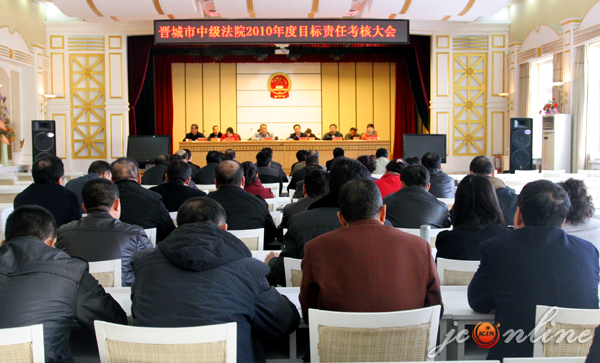
Jincheng Shanxi court evaluation meeting

The 27 December headline story in the People’s Court Daily and the national court website is the decision by the Party Committee of the Supreme People’s Court (the Court), issued to the entire court system, to:

  • cancel court performance rankings;
  • Except for those targets for resolving cases that according to law are compulsory, the remaining targets should become reference data for analyzing judicial operations.
  • oppose the practice of avoiding accepting cases at year end with the excuse that it would bring down the court’s case resolution index.

This is the result of its own fieldwork, as well as criticism from the lower courts, NPC delegates, academics, and lawyers. Chinese courts avoid accepting new cases close to year end if the case will not be resolved until the next year, because these cases will pull down a court’s performance indicators, even though the rights of litigants can be sacrificed.

Chinese and foreign academics have highlighted the negative consequences of judicial performance performance targets for many years.

He Fan, a Court judge on the staff of the research office, while applauding the change, pointed out in his blog that despite the change of policy by the Court, some lower court judges remain under pressure by local court leadership to work overtime to resolve cases.

What indicators will replace them?

The reports do not link to the underlying Court document and so it remains unclear what performance indicators will replace the ones that have been abolished, or which indicators fall into the second category.  The judicial reforms anticipate having a smaller number of judges handling an increasing number of cases.  If judges find the new performance evaluation system unacceptable, this may lead to an even greater outflow of judges than is already occurring.

New circuit courts opening soon in Shenzhen and Shenyang

Chinese press reports have revealed that the Supreme People’s Court (Court) will establish pilot circuit courts (巡回法庭) in Shenzhen and Shenyang by year’s end.  According to Chinese social media, Judge Liu Guixiang will head the Shenzhen circuit court, which has now been officially confirmed.  The vice presidents in Shenzhen will be Zhou Fan, formerly deputy head of the #4 civil division and Kong Xiangjun, formerly deputy head of the #3 civil division.  Hu Yunteng will head the Shenyang circuit court, while the vice presidents will be Zheng Xuelin, who now heads the environmental division and Yu Zhengping of the trial supervision tribunal.

The Central Leading Group for Judicial Reform approved their establishment in early December.  Although documents have not yet been released describing their location, jurisdiction or the personnel appointed, press reports pinpoint the former site of the Shenzhen Intermediate Court on Hongling Road as the location of the Shenzhen circuit court, with jurisdiction over administrative and major commercial trans-provincial cases arising in Guangdong, Guangxi, and Hainan. According to press reports, the Court issued a notice to judges inviting applications for the circuit courts.

On 30 December, the Court announced that the circuit courts will start taking cases from the beginning of 2015.

Where is the Supreme People’s Court headed with judicial committee reform?

55e15ba4755d55f74efa66a505224312Judicial (also called adjudication) committees are the unseen force behind the panel of three judges hearing a case in a Chinese court.  The decision a judicial committee makes binds the panel that heard the case.  Although this has not been mentioned, judicial committees must have approved the original decisions in a number of cases recently revealed to have mistaken, such as:

  • the 1996 execution of Huugjilt, in Inner Mongolia;
  • The 1995 conviction of Tian Weidong, Chen Jianying and others in Hangzhou, Zhejiang.

For this reason, judicial committees are important to anyone involved with or concerned with the Chinese courts, whether as a lawyer, litigant, or representative of a foreign or international organization, NGO, or government.

The Third and Fourth Plenum Decisions both mentioned judicial committee reform but without any details.  The Court has revealed the direction of its thinking on this topic in two recent articles published this month (December, 2014) on the national court website.

What are judicial committees?

Throughout the history of the PRC, court legislation has stated that these committees “practice democratic centralism” and that their task is to “sum up judicial experience and to discuss important or difficult cases or other issues relating to judicial work.”

The reason that the panel that hears the case must follow the decision of the judicial committee is that judicial committees are designated as the “highest judicial organ” within a court and implement the principle of democratic centralism. They decide cases that are too difficult or important for an individual judge or judicial panel to decide, to ensure the optimal substantive result (as seen from the institutional perspective of the courts.  Judicial committees have long been criticized by the academic community both inside and outside of China, and some judges have written about their drawbacks as well.

Judicial committees operate under 2010 regulations that I analyzed in an earlier article (Reforming judicial committees).  (According to those rules, major cases such as death sentences must be approved by a court’s judicial committee, so judicial committees must have been involved in the mistaken cases mentioned above).  (For those interested learning more about  the operations of the judicial committee of a local court, I highly recommend the study linked here).

The state of judicial committee reform policy

For over a year, the Supreme People’s Court (which itself has a judicial committee) has apparently been exploring where it wants to go with its policies towards judicial committees.  Both the Third and Fourth Plenum Decisions signalled that some reform of the judicial committee system was on the agenda:

  • Reform the trial committee system, perfect case handling responsibility systems for presiding judges and collegiate benches, let those hearing the case judge, and those judging the case be responsible.
  • Clarify the duties of all levels within judicial organs and complete internal mechanisms for supervision and check. Internal personnel of judicial organs must not violate provisions to interfere with other personnel’s handling of cases, establish recording and accountability systems for internal personnel looking into cases. Improve case handling responsibility systems for presiding judges, collegial panels, … to implement a system where the person handling the cases bears responsibility.

Issues with judicial committees

Wang Bin, a judge on the Nanjing Intermediate Court commented on some of the issues she has observed with judicial committees in an article published in early December in the People’s Court Daily:

1. The judicial committee inserts a  “subjective filter” between the judges who try cases and the judicial committee that decides the case, “making it difficult to guarantee the objectivity and accuracy of the results of the judgment.”

2.Judicial committees decide cases in conference, which involves a wide range and large number of cases. Although the 2010 regulations require the judges that heard the case to prepare a written report, Judge Wang notes that judicial committee members have neither the opportunity nor the time and energy to learn more about the specific circumstances of each case.  The committee has a large number of members (court president, vice presidents,division heads and some specialist committee members, and the local procurator), which means each case receives limited discussion time and and the views of defense counsel are not properly considered.

3. The members of the judicial committee include heads of the criminal, civil, and administrative divisions of a court, but with the greater complexity of Chinese legislation and the cases coming before the courts, and the fact that each member of the committee receives one vote, it is difficult to ensure that the resulting decision will be fair and appropriate.

Judicial committee reform

The solutions that she suggests are in line with (and more pointed than) those suggested by  President Zhou Qiang, whose remarks need to be appropriate for the wide range of Chinese courts.

1. Judicial committees should provide a macro-level guidance to judges. Given the increase in a broad range of litigation, judicial committees should use their authority to select typical cases, summarize best practices, and issue normative documents.

2. Judicial committees should reduce the number of actual cases that they decide.  Judge Wang suggests (as have others), that the standard under which cases are submitted to the judicial committee are too vague, and more specific guidance should be drafted. Cases in which evidence is disputed should not be submitted to a judicial committee.

3. Judge Wang recommends that criminal cases that judicial committees discuss should be limited to ones in which the evidence is clear, and most cases should be decided by the panel that has heard the case. In death penalty cases, a vote of 2/3 of judicial committee members should be required (rather than a simple majority), because this is more consistent with national death penalty policy.

4. The members of the judicial committee should be selected for their professional competence rather than their administrative rank.

5. Judge Wang suggests the decision making process should be changed, so that members are required to state their view and rationale before voting.

6.  Judge Wang advocates that the procurator not be a member of the judicial committee.  In her view, this violates the principle of independence of the judiciary and interferes with justice.

President Zhou Qiang links judicial committee reforms to principles of judicial responsibility, suggesting that judicial committee meetings be recorded and judicial committee members assume responsibility for their decisions.

We can expect these judicial committee reforms to take firmer shape in the medium term.  While President Zhou Qiang mentioned that the Court will take the lead in implementing some of these judicial committee reforms, according to recent press reports, these will also be incorporated into some of the local pilot projects.


Updated with further analysis: What does the 4th Plenum mean for death penalty reviews?

video interview in a death penalty review case

In a  press report in Southern Weekend last month (summarized in this report), the Supreme People’s Court (the Court) revealed that  an important legal reform related to death penalty reviews is forthcoming–institutionalizing legal representation in death penalty reviews.  This development, and others still in the works, are likely linked to the following provisions in the 4th Plenum Decision:

  • For appeals from dissatisfaction with effective judgments or decisions of judicial organs, gradually implement a system of lawyer representation. Bring appellants unable to hire a lawyer within the scope of legal aid.
  • Advance systemic reform in litigation with trial at the center;
  • complete effective guards against unjust, false and wrongfully decided cases.
  • bring about a system of lifetime responsibility for case quality and wrongful cases accountability system.

The Southern Weekend report has now been more fully summarized by the Duihua Foundation.

(This reform caught my attention because because I raised this issue when conducting an interview at the Supreme People’s Court in the early 1990’s, when researching my 1993 Supreme People’s Court article in the Journal of Chinese Law.)

Some background on death penalty review in the Court

As many others have described, death penalty review is carried out solely within the Court (in contrast to the period that I wrote my article) in an administrative procedure (my article describes the procedure at the time, and other articles describe the current process). The Southern Weekend article describes it as taking place in an unmarked office building away from  Court headquarters, guarded by a member of the Armed Police.

The Court has increased the number of criminal tribunals from two (when I wrote about this procedure 20 years ago in my article) to five tribunals, but the Court has not issued regulations setting out their jurisdiction.  According to the Southern Weekend reporters, four of the tribunals, which review cases based on geography and subject matter, have about 70 staff (both judges and support staff), while one has about 50 staff and reviews cases only on a subject matter basis. According to Southern Weekend, there is some flexibility in the jurisdiction of the criminal tribunals.(See this report for a translation of Southern Weekend’s chart.)

Institutionalizing legal representation in death penalty reviews

The Southern Weekend article reported that a senior member of the one of the criminal tribunals had revealed that the Court has drafted regulations on institutionalizing legal representation in death penalty review and it is hoped that they will be issued before year end.  According to the article, the draft regulations are entitled:

死刑复核案件听取辩护律师意见的若干规定 (Regulations on Considering the Views of Defense Lawyers in Death Penalty Review Cases).

This reform was flagged in Article 240 of the 2012 Criminal Procedure Law:

When the Supreme People’s Court reviews a death case, it should examine the defendant; if the defense attorney requests, it should hear the opinion of the defense attorney.

Article 42 of the 2012 Supreme People’s Court interpretation of the Criminal Procedure Law provides:

When the SPC performs final review of a death penalty case and the defendant has not retained a defender, the legal aid organization shall be notified to appoint a lawyer to provide him a defense.

A statement of principle in an a Court interpretation does not translate immediately into systemic reform.  It is apparent from the Southern Weekend article, a 2013 article on the Court’s website, and other sources that the mechanism for doing so is being considered within the Court and that local justice bureaus are implementing regulatory changes.

In the Southern Weekend article, a Court judge pointed out what the academics and defense lawyers have been saying, that many persons sentenced to death are from the bottom of society and do not have a lawyer defending them. (It appears from this interview with the President of the Zhejiang Higher People’s Court that Zhejiang has been taking the lead in working with the justice authorities to have legal aid provided to criminal defendants.)

In an article earlier this year in the Legal Daily (organ of the Communist Party Central Political Legal Committee), Professor Liu Wenren of the Law Institute, China Academy of Social Sciences emphasized the necessity of involving lawyers in the death penalty review process.  A Chinese lawyer has established a website for death penalty review lawyers, highlighting cases where legal representation has been effective.  Jiangsu province justice department has implemented  regulations on giving defense lawyers rights in death penalty review cases.

It is unclear what provisions will be contained in these regulations, but it is hoped that they include a provision for legal aid as well as rights for lawyers to review the case file.

Changing the form of death penalty review: when will the time come for this reform?

It appears that the Court is considering changing the form of death penalty review to a hearing-centered procedure.  (Dean Zhao Bingzhi of Beijing Normal University, College of Criminal Law Science, Professor Liu Wenren, and  others have been advocating this for some years (see this in this 2012 interview with Professor Zhao in Legal Daily).) Movement on this issue can be seen from the following:

  • In June, 2013, the Court held its first hearing in a death penalty review case, reported here. In July, 2013, Legal Daily published a follow-up article in which it was suggested that more hearings will take place.
  • In 2013, the Court website published an article (written by a Jiangxi judge) on deficiencies in the death penalty review procedure, suggesting that a hearing procedure be adopted.
  • In July, 2014, the China Law Society held a training session for defense lawyers in death penalty cases, at which four of the five criminal tribunal heads spoke.

The Supreme People’s Court Observer understands these developments to be linked to the goal in the 4th Plenum Decision of bringing about a system of lifetime responsibility for case quality and a wrongful cases accountability system. Going to a hearing procedure for death penalty review cases in which defendants have legal representation would go far to “complete effective guards against unjust, false and wrongfully decided cases” and at the same time would better protect the hundreds of Court judges who will bear lifetime responsibility for their decisions in death penalty cases.

If there are errors in the above analysis, please use the comment function.

Those further interested in this important topic can refer to one or more of the many articles, books, and reports in English (and Chinese).  In contrast to the early 90’s, death penalty review in China has now attracted the attention of major scholars and international organizations.

A lesson in Plenumology

4th plenum voting
4th plenum voting

The skills of a Kremlinologist (the Supreme Court Observer first learned these skills when reading Pravda and other Communist Party of the Soviet Union publications as a Russian Studies major) are needed to unpack what a Plenum Communique and a Plenum Decision mean for the Chinese legal system. (For those who haven’t heard the term “Kremlinologist,” the Wikipedia article gives a good summary).

The Plenum Communique  (now nearly forgotten) is a set of high level bullet points.  The 4th Plenum Decision, released late on 28 October, is something akin to a memorandum of understanding (MOU), for those who have spent time in the world of commercial law or business.  The 4th Plenum Decision cannot be implemented by itself–for many issues it requires complex bureaucratic arrangements, as well as framework legislation and detailed rules (akin to the sets of contracts that are needed for a business deal).  So evaluating how the 4th Plenum Communique or Decision will affect the real world of Chinese law requires the same analytical skills as  taking a deal’s high level bullet points or MOU and predicting how a business will operate.

Evaluating a Plenum decision requires analytical sifting of the standard language from the operative provisions.  Those provisions are often single phrases, and have behind them years of research and policy analysis within the institutions involved, as well as Chinese universities and think tanks.

The Supreme People’s Court Observer will take this opportunity to evaluate discrete provisions in the 4th Plenum Decision in future blogposts, as time permits.

4th Plenum and the Supreme People’s Court

4th plenum voting
4th plenum voting

According to the Wechat postings of one of its members, the judicial reform office of the Supreme People’s Court has been working overtime for months to prepare for the 4th Plenum.  It appears, at least from the initial 4th Plenum communiqué, that the hard work has paid off.  We will know more about the leadership’s plans for legal reforms when the full decision is released.  Four quick questions about the communique are set out below (to be supplemented as time permits).

Some questions for the Supreme People’s Court and the judiciary:

1.The communique stressed the need for improving the quality of legislation, including incorporating more public consultation and experts.  Will this reduce the need for judicial interpretations? What will this mean for the drafting of judicial interpretations?  Will the Supreme People’s Court require public consultation for its own judicial interpretations?  The release this month of drafts for public comment of the environmental public interest litigation regulations and the trademark validity administrative case rules are a step in the right direction.

2. The communique called for greater judicial transparency, as was highlighted in the Court’s 4th Five Year Reform Plan.  In its press releases to the domestic audience, the Supreme People’s Court has mentioned the visits it has hosted of the foreign press, foreign diplomats, and ordinary citizens, and of analogous events at the local level.  When can we look forward to easier access by all (foreign or domestic) to proceedings in the Chinese courts (at least in non-sensitive cases)?

3.  The communique indicated approval by the leadership of the establishment of circuit courts that cross administrative lines, a concept mentioned in the 4th Five Year Reform Plan (see this earlier blogpost).  It also reflects the use in China of foreign legal concepts or frameworks (as is frequently stressed, a reference and not as a transplant).

4.  It also called for an end to “interference” by leading cadres in specific court cases.  How will this long-standing practice will be curbed?  In recent weeks, articles have appeared in the legal press on changes to the Party Political Legal Committees. Will those changes imply less involvement in actual cases? And what is the distinction between “interference” and “leadership”?


Some questions about Chinese judicial reforms answered

law professors Fu Yulin and He Haibo (©Southern Weekend)

An article on the judicial reforms in the 25 September edition of  Southern Weekend (南方周末) is now making its way across Chinese social media, featuring an interview with Peking University Law professor Fu Yulin and Tsinghua University law professor He Haibo. The article  addresses some of the questions many inside and outside of China have been asking:

  • What is the status of the judicial reform pilot projects outside of Shanghai?
  • What is the status of some of the issues mentioned in the judicial reform documents?
  • Why haven’t China’s judicial reform documents been made public?


Some background

The two principal judicial reform documents approved by the highest political authorities are:

  •  the Fourth Five Year Plan Judicial Reform Outline, a summary of which was issued on 9 July (blogpost analysis here and here).
  • the Shanghai Judicial Reform Pilot Project Work Plan(上海市司法改革试点工作方案). A detailed description of how the Shanghai authorities will implement this (上海市司法改革试点工作方案>实施意见) has been released by both the Shanghai and national press (an English translation available here).

The published reports on the Fourth Five Year Plan Judicial Reform Outline have mentioned that pilot projects would be implemented in Guangdong, Hubei, Jilin, Qinghai and Hainan, but no outlines of those pilot projects have surfaced.

What is the status of those judicial reform plans?

According to Southern Weekend, drafts for judicial reform plans for Guangdong, Hubei, Jilin, Qinghai, and Hainan are basically finished and have been submitted to the Central Political Legal Committee. They are awaiting approval.

What is the status of some of the issues mentioned in the judicial reform outlines?

 Judicial selection committees

According to  Southern Weekend, it is unresolved under the judicial reforms, who will select judges and how they will be selected. Plans for all five pilot plans designate the the head of the provincial political legal committee as the head of judicial selection committee, with the judicial selection committee to be based at the provincial political legal committee. The reforms in Shanghai are the exception, where the judicial selection committee will be based in the Shanghai Higher People’s Court.  The two law professors interviewed suggest that the provincial people’s congress would have been more appropriate (for the other five pilot plans), but they state that the people’s congresses in these locations did not want to take on that role. (And one comment on the article was that the Party, after all, selects people’s congress members.)

The law professors stressed the need for legal professionals to be members of judicial selection committees. One noted that in China, the principle of “the Party manages cadres” (党管干部) cannot be avoided and suggested that judicial selection committee and Party organization department clearance could run parallel.

It seems that the tension between Party involvement and professionalism in judicial selection remains an issue.

Quota system for judges

The quota system for judges refers to establishing quotas on the numbers of judges in relation to other personnel within the judicial system.  As described in these articles, the plan in Shanghai is to limit judges to 33%, with administrative and support staff constituting 55% and 15% respectively. The  framework in Shanghai has been widely discussed and criticized in the Chinese legal press and on social media, particularly for its impact on younger judges, who note that they would not fit the judicial criteria and would be made “obsolete.”

Professor Fu echos criticism made by judges and others in the press that imposing a rigid quota system for the number of judges was inappropriate.  She pointed out that at the basic level, having a system with fewer than 40% judges was unworkable, given that the Chinese courts at the basic level had to deal with large number of minor offenses.  The reason was that China had not yet established separate courts to deal with minor offences [the Supreme Court Monitor notes that pilot projects for these courts are underway in some areas]. Another issue is the many responsibilities that Chinese judges have in addition to hearing cases and how a smaller number of judges will be able to hear cases as well as carry out their other responsibilities (research, compiling judicial statistics, promoting the courts).

 Why haven’t the current judicial reform documents been made public?

The professors note that they themselves have not seen the judicial reform documents either. They suggest that policies for many issues have not been worked out, but that the uncertainty about the direction and content of the reform policies has a negative effect.

The upcoming plenum

It seems likely that the upcoming fourth plenary session of the Chinese Communist Party’s 18th Central Committee, on rule of law, in October will give us more certainty about the direction and content of the judicial reform policies.  In the meantime, the issues and their implications give us all much to think about.

More on the Supreme People’s Court’s Judicial Reform Plan

On 16 July the Supreme People’s Court’s (Court’s) newspaper and social media outlets headlined two articles important for observers seeking to understand the judicial reforms:

  • a  report on statements by Meng Jianzhu, Politburo member and chair of the Central Political Legal Committee on the importance of the judicial reforms; and
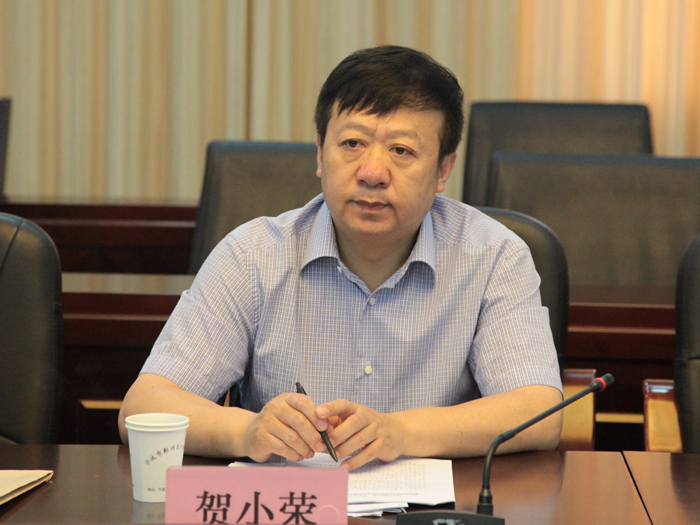
  • an long explanation by HeXiaorong, the leader of the working group on judicial reform (of the Court’s judicial reform office) on the theory, logic and implementation of the judicial reforms.

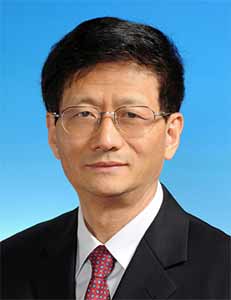
    Meng Jianzhu
    Meng Jianzhu

Statement by Meng Jianzhu

The statement by Meng Jianzhu , made after he heard reports on the implementation of judicial reform pilot projects in six areas, stressed that the Central leadership considers the judicial reforms very important and has given a set of policy instructions on the implementation of the reforms. He calls on all involved in various political/legal organs at all levels to implement the reforms.

For anyone who has spent any time in a large organization, his message, although expressed in Chinese political language, will sound familiar:

  • make sure those at the local level are “on message”;
  • don’t impose the same method everywhere (不搞一刀切;
  • ensure enthusiasm about the reforms, otherwise they may fail.

The thinking behind the judicial reforms

015149e9c9534961384733a6061d96b3
He Xiaorong

A long article by He Xiaorong published on 16 July in the People’s Court Newspaper and other Court media outlets summarizes the thinking behind the judicial reforms (and what must have been the hundreds of pages of policy papers that underly what has been made public).  It is an edited version of a fuller paper, that has been issued on Wechat and perhaps other outlets (and is said to express He’s own thinking).  For those seeking to understand the judicial reforms, it deserves close analysis. A flash analysis will follow when time permits.

More on lifting the cloak of invisibility over the Chinese military courts

The Supreme People’s Court Observer contributed another post to the Global Military Justice Reform blog. It commented on an article in the July 9, 2014 edition of the South China Morning Post.  The newspaper article quoted several retired PLA officers on the subject of greater transparency for the Chinese military courts, advocating General Xu Caihou (see this earlier post) be tried publicly. The blogpost expressed the view of the Supreme People’s Court Observer that bringing transparency to the Chinese military courts will be a long-term enterprise, and something unlikely to happen in the short term.  The analysis in the post listed several possibly relevant factors.

The Supreme People’s Court Issues its Newest Five Year Reform Plan for the Courts

On 9 July, the Supreme People’s Court issued its fourth five year reform plan for the courts, approved by the Party leadership, which sets out 4 broad areas of reform, relating to 8 general areas. An overview has been released on Wechat and other Chinese social media and can be expected to be published very soon in more traditional media. An clear info graphic was published on the Court website and other official media, translated here.

The Court described it as taking first steps towards establishing a judicial system with Chinese characteristics and is intended to roll out reforms announced in the 3rd Plenum decision and the judicial reform decision announced earlier this spring and some of its themes were highlighted in press releases published just after Chinese new year.  Many of these issues are ones that have been discussed within the Chinese legal community for many years and draw on international expertise as well. The summary below highlights five of the eight broad areas.

  • Personnel reforms
  • Separate administrative and judicial jurisdiction
  • Improve the operation of the judicial function
  • Improve the protection of human rights
  • Increase judicial transparency
  • Clarify the roles of the four levels of the courts
  • Improve judicial administration
  • Promote reforms relating to petitioning

Personnel reforms

The intention of the personnel reforms are to split the treatment of judges from other civil servants, to step away from the traditional model of judges as cadres. This will involve pushing forward the initial reforms being tested to change the personnel management of local courts, and transfer that to the provincial level. This will include:

  • the establishment of provincial level selection committees, will involve clearance by Party disciplinary and other functions, and retain appointment by the people’s congress.
  • Personnel reforms will also involve splitting the management of judges from other judicial personnel, such as judicial police and clerks.
  • Additionally, reforms are intended to the use of judicial headcount, to focus that by increasing the number of judges.
  • Two other reforms involve establishing new systems for judicial promotions and establishing differing criteria for the recruitment of different types of judges.

Separate administrative and judicial jurisdiction

Reforms in this area include:

  • taking steps to take certain cases, such as some environmental and commercial cases out the local administrative jurisdictions, so that they can be heard fairly.
  • Reform some of the lesser known courts, such as the forestry courts, to bring them into the ordinary court system.
  • Establish a system for circuit tribunals at provincial level to hear difficult cases, and focus on environmental cases.
  • In areas where  there are more intellectual property cases, promote the establishment of intellectual property courts.

Improve the operation of the judicial function

The summary concerning this section admits that having the person who heard the case decide it remains difficult to implement within the Chinese jidicial system, and that despite initial attempts, internal multi-level approvals for deciding cases remains the norm.  The intended reforms in this area include:

  • improving the system of responsibility of the primarily responsible judge and the panel that heard the case.
  • Changing the system of signing judicial decisions.
  • Improving the monitoring of judicial performance.
  • Improving judicial disciplinary procedures.

Importantly, reforms look to change the current relationship between the judge responsible, the tribunal, and others in a position of leadership within the courts, such as the head of the division and court president. There has been a great deal of academic writing about this, in both English and Chinese, as well as articles written by judges serving at various levels.  A great deal of thought has gone into this section and implementing these reforms will involve changing long-term patterns of interaction.

Improve the protection of human rights

Reforms in this area are intended to improve the protection of human and property rights, particularly by improving judicial review of the investigation and prosecution stages:

  1. Eliminate the use of illegally obtained evidence.
  2. Improve the role of the defense lawyer and the statement by the advocate for the defendant.
  3. Improve systems for pursuing judicial negligence.
  4. Improve the protection of assets relating to [criminal cases].
  5. Improve reforms in the area of minor crimes, so that those cases are heard more quickly (pilot projects are underway in some areas).

These reforms represent the result of years of discussions within the judiciary, with lawyers, academics, and interactions with members of foreign courts, research into foreign legal systems, and others.

Increase judicial transparency

Reforms in this area build on the initial steps taken late last year and include:

  1. Make the hearing stage more open, by improving the system of announcements and permitting spectators to attend court hearings, increase real time broadcasts of hearings.
  2. Improve the handling of judicial information, so that litigants can determine the status of their case on-line.
  3. Improve the judicial decision database, Judicial Decisions of China.

All of these reforms are good practical proposals. Foreign observers of the Chinese courts would welcome easier access to Chinese court hearings.

A quick comment

Drafting this reform plan has been a tremendous undertaking and its implementation promises to be even more challenging.  Some of the reforms discussed above are the subject of pilot projects in various parts of the country, ranging from Guangdong and Shanghai, where the courts have heavy caseloads and face cutting edge cases, to less prosperous inland provinces. Reforms are likely to start with what is most easily implemented and where results can most easily be achieved.  What this means for some of the specialized courts, such as the military and maritime courts, will be clarified in time. The extent to which these reforms can change patterns of interaction within the judiciary and between the judiciary and government/Communist Party of many decades standing remains to be seen.  It is hoped that the pressure of greater professionalism within the judiciary, and other social and economic forces will eventually result in a judiciary that better serves the needs of all.


“The Chinese military legal framework must be improved”

pla.flagThe Supreme People’s Court Observer contributed a post to the Global Military Justice Reform blog.  It looks at the improvements that Chinese military experts see as necessary to improve military law as a part of the government’s plans for reforming and modernizing China’s national defense establishment and People’s Liberation Army.  The post sets out the issues involved.

Seen on the China Policy Institute Blog of the University of Nottingham

supreme_court_civil_case-400x210 The Supreme People’s Court Observer published (by invitation)  Using Model Cases to Guide the Chinese Courts on the blog of the China Policy Institute of the University of Nottingham. The post discusses:

  • what model cases are;
  • which courts issue them;
  • the authority of model cases;
  • recent model cases the Court;
  • why the Court (and the lower courts) are using them; and
  •  trends in the use of model cases.

Clearing the Backlog of Civil Disputes in the Chinese Military Courts

Zhou Qiang visiting PLA Military Court, 2013


A short notice on the Supreme People’s Court’s websites and Wechat on 2 March (linked here) announced the launch of an 8 month campaign in the military courts to clear out a backlog of major civil disputes.  The announcement (and related information) gives the outside world a peek behind the curtain of the almost 100 military courts.  Any lawyer involved in due diligence projects in China in the last 15 or more years will have encountered issues related to Chinese military law, particularly land issues, but the issues targeted in the campaign are much broader.

This blogpost will look at:

  • the military court system;
  • transparency of the military courts;
  • judicial reforms in the military courts;
  • civil jurisdiction of the military courts; and
  • the clearup campaign.

Military Court System

The Chinese military court system, a system to itself within the Chinese court system, apparently has attracted little attention outside of China (or at least in open sources).  The military court system is headed by the PLA Military Court, which is under the Political Department of the Central Military Commission, and under the Supreme People’s Court.  Below the PLA Military Court there are courts in the military regions as well as the military services–Navy, Air Force, Armed Police and below those courts, basic level courts within each of these regions, military services, and other units  (see this description.

Transparency

Although several articles in the Chinese press suggest that the military courts are more transparent than before, national security concerns apparently mean that the transparency measures being pushed by the Court leadership have not yet extended to the military courts.  For example, the judgment debtor database established in the fall of 2013 includes all the courts but the military ones (although some military-linked companies can be found in the database). The Court’s websites link to websites of the provincial-level local courts, but not that of the military courts. However, internet searches (as well as searches of legal databases) will turn up many reports of cases involving both the civilian and military court systems.

Judicial reforms in the military courts

The Third Plenum Decision called for improvement in military legislation, and it is understood to include judicial reforms in the military courts.  The head of the PLA Military Court stated that judicial reforms included improving the quality of military justice, including the quality of cases handled. What that involves has not been revealed in the open press, although presumably these are issues for the leadership of the PLA military court.  It is likely that increased training of military judicial personnel will be part of the solution,both within the military system and outside it.

Civil jurisdiction of the military courts

Civil, rather than criminal cases, are the focus of the clear up campaign.  The military courts have heard over 2500 civil cases, most of which have been settled.  The Chinese military courts have civil jurisdiction, most recently under a judicial interpretation in the form of regulations issued by the Supreme People’s Court in 2012, “Provisions on Several Issues Concerning the Jurisdiction of Military Courts in Civil Cases” (Civil Cases Jurisdiction Provisions, linked here) and a previous 2010 notice.  The rationale for giving military courts civil jurisdiction is to enable certain types of civil disputes to be resolved more effective, because the local court have encountered difficulties in dealing with them.  Difficulties cited range from serving military personnel or military entities, freezing military assets, obtaining evidence held by military entities, having military personnel attend hearings in the civilian courts, and enforcing judgments against military entities.

The Civil Cases Jurisdiction Provisions deserve more discussion than this quick blogpost can provide, and stipulate:

  • certain civil cases must be exclusively heard in the military courts (including cases in which both parties are military personnel or military entities):
  • parties have the choice whether or not to file a civil suit in the military courts under certain circumstances:
  1. tort cases in which military personnel or entities are tortfeasors;
  2. family disputes in which one party is in the military;
  3. tort cases that occurred within a military facility; or
  4. military real property disputes with a military individual or entity as party.
  • civil cases can be transferred to and from the military and local courts, respectively.

    Head of Lanzhou Military District Court visiting local intermediate court
    Head of Lanzhou Military District Court visiting local intermediate court

The PLA Military Court has issued regulations further specifying the jurisdiction of various levels of military courts, that have been summarized in the press but not made public.

The clear up campaign

The campaign, undertaken with the concurrence of the Political Department of the  Central Military Commission, focuses on the following types of cases:

  • construction of military installations;
  • ownership of military land;
  • defense technology (and presumably other intellectual property-related cases);
  • family law cases involving military personnel;
  • torts;
  • condemnation of property; and
  • labor.

Although reports have not given further details on specific cases, the following is generally known or presumed:

  • In many cities, PLA entities hold real estate in prime areas and the ownership disputes may involve significant sums of money;
  • it is likely that military families have not escaped greater social trends of increased rates of divorce, particularly in the major cities, and some of those divorces are likely to involve disputes over valuable real property;
  • there are likely are disputes over the intellectual property rights held by military personnel and military entities (one reported case involved infringement of copyright (by civilian publishers) of writings by military personnel);
  • military entities have contract disputes involving construction of military installation as well as military goods and services procured.

Greater engagement with the outside world?

It is unclear whether military exchanges with foreign armed forces have included the military courts, or whether the PLA Military Court (or the Central Military Commission) would welcome further engagement with the outside world.  Presumably efforts aimed at increasing the role of law within the military and strengthening the military courts would benefit all.

Why the Supreme People’s Court is lobbying National People’s Congress Delegates?

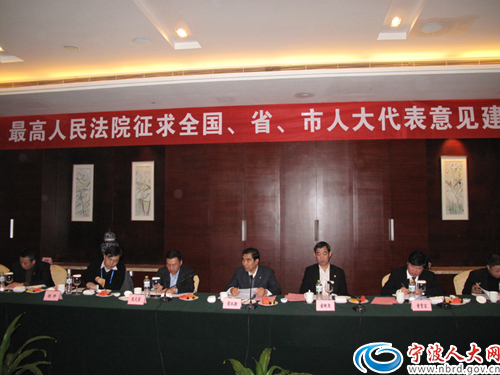
Deputy court president in Ningbo, December, 2011
Deputy Court president in Ningbo, December, 2011

Since the end of Third Plenum in November, senior Supreme People’s Court (Court) officials have been racking up airmiles, traveling all over China to meet with National People’s Congress (NPC) and  Chinese People’s Political Consultative Conference (CPPCC) representatives.  Over forty meetings have been held over the past year. Although Court officials had met with NPC and CPPCC delegates in previous years, it is apparent that these meetings are taking on special significance this year. This blogpost will explain what occurs at these meetings and the rationale for having them.  It also illustrates one of the skills that an effective court president needs in China.

In recent months, senior Court officials, primarily the Court vice presidents, have traveled to the four corners of China, from Gansu to Guangxi and from Jilin to Yunnan. Zhou Qiang has also met with Beijing based delegates.

The stated purpose of these meetings is to “listen” (听取) (and respond) to the views and suggestions of NPC and CCPCC delegates. Court officials have either released to NPC and CPCC delegates a copy of the Court draft work report or summarized the developments in the courts in 2013 and plans for 2014.  Some meetings apparently involved more substance than others.  The meeting with Shanghai delegates, which included a leading law firm partner as well as the general manager of Shanghai Electric (listed on the Hong Kong Stock Exchange) raised the issues of:

  • quality of judicial personnel;
  • increasing judicial independence;
  • resolving local protectionism;
  • having more witnesses appear in court; and
  • cross-examination.

It is apparent from the extensive reports on these meetings that Zhou Qiang is taking a tactical approach to these meetings.  As the former governor of Hunan, former Party Secretary of Hunan and director of the Standing Committee of the Hunan People’s Congress, he has extensive experience in dealing with people’s congress and consultative congress deputies.

It appears that the rationale Zhou Qiang (and colleagues) have for these meetings is two-fold.  First, it is to diffuse criticism of the Court (and the work of the lower courts) at the upcoming NPC session and incorporate frequently issues into either the final version of the Court Work Report or the 2014 Court agenda.   The large number of votes against the 2013 Court Work Report was seen as a loss of face and it is likely that Court leadership wants to avoid that.

The second reason Zhou Qiang has for closely liaising with NPC delegates is to lay the groundwork for implementing  court reforms.  If the Court is able to obtain support for overhauling the structure for the funding of courts and appointment of judges at the local level (as foreseen by the Third Plenum Decision) this reform will require that the NPC amend the basic statute for the court system, the Organizational Law of the People’s Courts (人民法院组织法) and will  require NPC delegates support the reforms in large numbers.

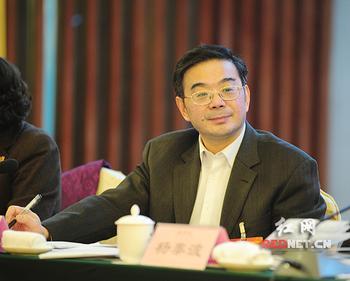
Zhou Qiang listening to Hunan provincial people's congress delegates, 2011
Zhou Qiang listening to Hunan provincial people’s congress delegates, 2011