A recent message in the WeChat public account of the Supreme People’s Court (SPC)’s Administrative Division was devoted to promoting its new book, Supreme People’s Court Administrative Litigation User’s Guide (Administrative Litigation User’s Guide (2nd edition), 最高人民法院行政诉讼实用手册), shown in the photo above. Had the SPC’s #4 Civil Division had a WeChat public account last year when they published 涉外涉港澳台民商事审判业务手册( Foreign-Related, Hong Kong, Macao and Taiwan Related Commercial Trial Work Guide — “Foreign-Related Judicial Handbook”), I am sure that I would have received a similar message. I had previously thought that judicial handbooks were a historical artifact of the days before electronic databases. In my 1993 article, I discussed the phenomenon of judicial handbooks:
..A …problem is presented when the lack of consistency in issuance and authority makes it difficult for the lower courts to know when an interpretation is no longer valid…The [SPC] tries to cure these problems by issuing handbooks for adjudication in various subject areas….The Research Office and other divisions of the Court compile adjudication handbooks such as Sifa Shouce [司法手册] (Judicial Handbook), many of which are internal publications.
Some of those historical handbooks can be found in my research library of Supreme People’s Court publications–see here and below:
Two Administrative Litigation Judicial Handbooks and the second volume of the Judicial Handbook
Why would specific divisions of the SPC return to the practice of issuing judicial handbooks in printed form? How does it link with the role of the SPC? What sources have the editors included, and what could students, scholars, and practitioners learn from that?
Official reasons for publishing these print books
The authors of the Administrative Litigation User’s Guide describe the reasons for publishing the book as follows:
the Supreme People’s Court, on the one hand, provides professional guidance (业务指导) by formulating judicial policies 司法政策), issuing guiding cases, and making judicial replies (司法答复); on the other hand, it strengthens research and collects problems, and formulates judicial interpretations based on the accumulation and maturity of judicial practice. At present, the comprehensive judicial interpretation of the Administrative Litigation Law, the judicial interpretation of administrative agreements, and the judicial interpretation of the appearance of administrative agency heads in court to respond to lawsuits have been formulated and issued…, and there are more and more normative documents and guiding cases related to administrative litigation. In addition, with the increase in the number of administrative cases, more judges have joined the administrative trial team. In the process of gradually becoming familiar with administrative litigation, they urgently need to master the relevant provisions that have been issued and learn the relevant guiding cases. However, judicial replies are internal in nature, with a large volume and lack of a unified release mechanism. The channels for obtaining them from the outside world are limited, which is time-consuming and laborious.
According to the announcement, the audience for the Administrative Litigation User’s Guide is staff in administrative agencies, judicial practitioners, and researchers of administrative law [students and academics]. The editors note that to provide readers with reference materials and to make the book more practical, they have included guiding cases, SPC Gazette Cases, and typical cases from the last 10 years.
The #4 Civil Division authors/editors say their handbook is urgently needed by front-line judges and as a reference book for judges, arbitrators, lawyers, and other practitioners, and, I would add, to students and scholars seeking to decode the foreign-related and Hong Kong, Macau, and Taiwan-related operations of China’s judiciary.
Legal basis for publishing these books
Publishing these books is linked to Article 10 of the Organic Law of the People’s Courts and relateddocuments, which authorize the SPC to supervise and guide(监督指导) the lower courts.
Comments on the content
Both books contain judicial interpretations and a range of SPC guidance documents such as meeting minutes/conference summaries (会议纪要), notices, and replies to requests for instructions, signaling to the reader that they are important sources of reference for judges and that “soft law” may understate the way that meeting minutes are understood within the Chinese court system.
The authors/editors of the Foreign-Related Handbook included many other types of legal provisions they considered relevant for hearing cross-border cases, such as relevant national legislation, administrative regulations, such as foreign exchange regulations, Chinese versions of international commercial rules (Incoterms, ICC Uniform Rules for Demand Guarantees (URDG 758), ISP 98) ), Hague Conventions to which China has acceeded, and civil judicial assistance treaties, as well as some of the National People’s Congress Standing Committee decisions related to some of the international conventions. The #4 Civil Division did not include guiding, typical cases, and other types of cases it issues for reference. In my view, it was a practical decision that does not imply that those types of cases are irrelevant to judges hearing cross-border commercial cases, but rather that including cases would make the book too long to be published as a single volume.
Comment
The underlying rationale for publishing these judicial handbooks has not changed much in the past 30 years. Judges responsible for processing cases efficiently and correctly face similar challenges: sorting out the current legal position on an issue quickly despite the piecemeal way that the SPC develops the law, locating and assessing the validity of historical documents, easily identifying special arrangements, and for cross-border cases, understanding how to correctly implement international conventions, treaties and practices and correspondingly arrangements or related provisions concerning cases involving Hong Kong, Macau and Taiwan parties.
One experienced senior judge in a local court noted that judges are often asked to rotate among divisions (tribunals) periodically. Senior judges recommend that new joiners read these handbooks to familiarize themselves quickly with a different (and complicated) area of law.
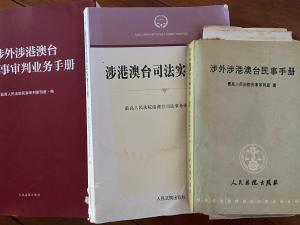
From the left, the 2024 Foreign-Related Handbook, a 2013 Hong Kong, Macau, Taiwan Related Judicial Handbook, and the 1992 Foreign, Hong Kong, Taiwan-Related Civil Matters predecessor volume
By Susan Finder with initial research assistance by Zhu Xinyue
President Zhou Qiang delivering the report
The Supreme People’s Court’s (SPC) October 2022 specialized report on foreign-related adjudication work (最高人民法院关于人民法院涉外审判工作情况的报告) provides an overview of the SPC’s and the lower courts’ work related to foreign-related matters over the past 10 years. This blogpost uses the term “adjudication work” to encompass the multiple functions of the SPC (see my U.S.-Asia Law Institute article for a refresher) as well as the lower courts. (My previous blogpost gives a detailed explanation of the significance of specialized reports of the SPC and other institutions to the NPC Standing Committee). The report is intended to showcase the SPC’s work in supporting Xi Jinping era fundamental changes in foreign policy, or as the concluding section words it, “vigorously serving the greater situation of the Party and State’s external policy work” (积极服务党和国家对外工作大局). An analysis of the content of this specialized report provides insights into the role of the SPC and its relationships with other Central institutions as well as the current and evolving concept of “foreign-related rule of law” (涉外法治). Concerning the link between “foreign-related rule of law” and the foreign-related adjudication work of the people’s courts, as President Zhou Qiang said: “the foreign-related adjudication work of the people’s courts is an important part of foreign-related rule of law work (人民法院涉外审判工作是涉外法治工作的重要组成部分).”
I surmise that the NPC Standing Committee requested the SPC submit a specialized report on the SPC’s foreign-related work because the political leadership is prioritizing developing China’s foreign-related body of law and takes the view that SPC expertise is needed to that end. As in any legal system, issues that come before the Chinese courts highlight the gaps in current legislation (broadly defined).
1. Overview of the Report
The report covers all areas of SPC work–criminal, civil and commercial, maritime, intellectual property, administrative, and other areas, as well as the recognition and enforcement of foreign judgments, recognition and enforcement of foreign arbitral awards, and other forms of international judicial assistance. Because cases involving Hong Kong, Macau, and Taiwan are considered by reference to the principles for foreign-related cases, the report provides highlights of those developments as well.
Following some background material, this blogpost follows the structure of the report and therefore the blogpost is much longer than usual. A more comprehensive analysis of many aspects is found in my “never-ending article,” currently on its meandering way to publication.
2. Drafting of the Specialized Report
Because most of the cases involving foreign-related matters tend to be in the commercial area generally (incorporating maritime, recognition and enforcement of foreign judgments and arbitral awards), it is likely that the #4 Civil Division took the lead in drafting the report, worked closely with the International Cooperation Bureau, and involved other divisions and offices of the SPC as needed, including those working on criminal law issues. Although this report appears to be just another anodyne official report, what underlies it is likely to be hundreds of hours of drafting, soliciting data and comments from related offices, including the Research Office (with a department in charge of Hong Kong and Macau issues), comments from the vice president in charge of the #4 Division (it now appears to be Justice Tao Kaiyuan), President Zhou Qiang’s office, and the NPC Standing Committee itself. It is unclear whether the Ministry of Foreign Affairs and the Ministry of Comments also provided input. It incorporated the SPC’s response to a research report on foreign-related adjudication work prepared by the NPC Standing Committee’s Supervisory and Judicial Affairs Committee (mentioned in the previous blogpost).
3. Summary of the Report
The report highlights the SPC’s work in foreign-related cases in support of related policies. The structure of the report is the usual one for such reports–a long list of accomplishments, followed by a summary of outstanding challenges and suggestions to the NPC Standing Committee for future work. It reveals some previously unknown developments and clearly sets out the official conceptual structure underpinning the SPC’s foreign-related adjudication work and therefore China’s “foreign-related rule of law.” The report takes an inclusive view of accomplishments: judicial interpretations, policy documents, typical and guiding cases, as well as correctly deciding important cases. This blogpost decodes the details in the report, with brief comments and links to some of my earlier blogposts.
a. Selected Statistics
The report provides selected statistics. As I have said when I have spoken on the Belt & Road and the SPC, the number of foreign-related cases heard in the Chinese courts has increased substantially over the past ten years, but even now they constitute a tiny percentage of cases heard in the Chinese courts. The report reveals some of the challenges, as seen officially.
From 2013 to June 2022, Chinese courts heard a total of 384,000 foreign-related (including Hong Kong, Macau, and Taiwan-related) cases. These numbers are tiny compared to the large number of cases accepted by the Chinese courts annually. For example, in 2021, that number reached over 33 million cases. The number of first-instance foreign-related civil and commercial cases nationwide increased from 14,800 in 2013 to 27,300 in 2021. The SPC has not released more detailed statistics about the types of civil and commercial cases or foreign-related cases in other areas of law, such as criminal cases.
b. Protecting China’s National Security and Sovereignty
As is usual with SPC official reports and documents, matters relating to national security and sovereignty take a prominent place. The SPC reiterates that its foreign-related adjudication work serves the domestic and external greater situations. This section highlights two areas of service in protection of national security and sovereignty:
protecting China’s investments abroad. Cases so classified include infrastructure-related cases, trade cases, and shipping cases. The principal accomplishment is issuing a judicial interpretation on the hearing of independent letter of guarantee (demand guarantee) disputes and unifying the rules governing such disputes. These developments, which have come through several SPC cases (discussed here) and the end 2021 Conference Summary, have been flaggedonthisblog. A long-pending China International Commercial Court (CICC) case may provide additional guidance.
c. Creating a Legalized International Business Environment
This section is relatively long and highlights much of the SPC’s foreign-related adjudication work in the past 10 years. The focus is on international commercial dispute resolution rather than intellectual property disputes. i. Foreign investment: The courts have supported the revised Foreign Investment Law and Implementing Regulations with two interpretations (including one on the application of the Foreign Investment Law, mentioned here), as well as a policy of centralizing the hearing of such cases, seeking to ensure greater competency. ii. Pilot free trade zones and ports: The courts have supported these policies through several services and safeguards opinions (one general one, discussed in my book chapter, as well as ones on Lingang, Hainan, and new zones in Beijing). The SPC also issued related typical cases and encouraged local courts to establish additional measures to support national free trade zone policy. iii. The courts have supported national policies supporting a competitive market order, and to that end have issued regulations on bankruptcy, normative documents on improving the business environment (including services and safeguards opinions and a conference summary), and established financial courts (see Mark Jia’s related article). iv. Supported national policy concerning economic development and COVID-19 pandemic control (I have a related article that will be published in Italian). The SPC promulgated four guiding opinions (policy documents) on the trial of civil cases related to the Covid-19 pandemic, one of which focused on foreign-related commercial and maritime cases. This document was included in UNCITRAL’s CLOUT database.
v. Respecting international conventions and international practices (customs or usage, by which is meant trade/commercial practices or usages). As mentioned here, the SPC is drafting a judicial interpretation on the application of international conventions and treaties and international practices and has issued related typical cases. vi. Application of (foreign (non-mainland) governing law. Since 2013, the courts have applied foreign law in 542 cases. My draft article discusses related issues briefly. vii. Cross-border recognition and enforcement of judgments: Since 2013, the courts nationwide have considered 7,313 cases of applications for recognition and enforcement of civil and commercial judgments from foreign courts. My draft article discusses the evolution of this policy. The report mentions the enforcement of Chinese judgments abroad.
d. Serving national maritime policy
The report underlines that the SPC’s maritime adjudication work directly serves foreign trade shipping and marine development to maintain national [judicial] sovereignty and related national interests. The report mentions that the SPC issued judicial interpretations on maritime litigation jurisdiction, and issued judicial interpretations for hearing cases of compensation for damage to marine natural resources and ecological environment. The SPC and the Supreme People’s Procuratorate issued regulations on handling public interest litigation cases on marine natural resources and ecological environment, and released related typical cases. The report mentions China’s work on becoming an international maritime justice center (See my article in the Diplomat). Related accomplishments include the SPC expanding the network of maritime courts and their dispatched tribunals and the report highlights that more parties without a jurisdictional link with China have chosen the jurisdiction of the Chinese maritime courts (for a different view from the official one, see Professor Vivienne Bath’s research on parallel litigation involving the Chinese maritime courts).
e. Improving international commercial dispute resolution mechanisms to serve high-quality development of the BRI
According to the report, the SPC is implementing the deployment of the political leadership in this area. Those include:
the CICC and related developments, including: the CICC’s bilingual website, the CICC’s expert committee; two BRI Services and Safeguards Opinions, and typical BRI cases, as well as establishing local international commercial courts. (This blog has discussed these developments in some detail, with more contained in my draft article).
f. Establishing diversified dispute resolution of international commercial disputes
i. The SPC reports that it established a “one-stop” diversified international commercial dispute resolution mechanism, which integrates litigation, arbitration, and mediation. The report mentions the accomplishments of several local courts and the incorporation of arbitration and mediation institutions into the SPC’s (CICC’s (Chinese version)) one-stop platform. ii. Arbitration: The SPC issued judicial interpretations on judicial review of arbitration cases and enforcement of arbitral awards, and introduced a mechanism and reporting system for judicial review of arbitration cases; since 2013, Chinese courts have heard over 110,000 judicial review cases (presumably the vast majority domestic). iii. Mediation: The report describes local developments and accomplishments related to the mediation platform of the people’s courts (see the related white paper).
g. Serving national Hong Kong, Macao and Taiwan policy
On the details of SPC and Greater Bay Area policy, please see my earlier blogpost and presentation at a November, 2022 conference held at the Law Faculty of the University of Hong Kong.
This blogpost summarized earlier developments related to Taiwan. The SPC issued judicial interpretations on the recognition and enforcement of Taiwan civil judgments and arbitration awards. The SPC mentioned that the courts have supported national policy on integrating Hong Kong and Macao into Greater Bay Area policy by supporting [Ministry of Justice led policy] to permit lawyers from Hong Kong and Macao to practice in the Greater Bay Area (note, such lawyers must be Chinese citizens). The courts are also supporting the initiatives related to integrating Hong Kong, Macau, and Taiwan legal professionals (again, foreign professionals registered in these jurisdictions are not included).
f. Improving the quality and credibility of China’s foreign-related adjudication
i. Jurisdiction: the report mentions a notice on jurisdiction on foreign-related cases (flagged in this blogpost) and centralized jurisdiction. ii. Service of process: The SPC amended the judicial interpretation of the Civil Procedure Law to enable more flexible service of process abroad and established a platform with the Ministry of Justice (discussed in this blogpost) to enable more efficient handling of service of process requests from abroad. (There is no mention of greater flexibility in foreign service of process into mainland China.) iii. Determination of foreign law: the SPC established a unified platform for the determination of foreign law (accessible through the CICC website, see the links above), which links to SPC-authorized institutions providing such services. My draft article provides additional details.
iv. Improving cross-border litigation services. This integrates with the SPC’s smart courts policy. One of the major accomplishments mentioned in the SPC’s judicial interpretation on cross-border online litigation. iv. Training foreign-related adjudication talents (涉外审判人才. See my earlier blogpost.
g. Promoting the development of the domestic and foreign-related legal systems
Matters so classified include: vigorously supporting the development of foreign-related legislation (mentioned in this blogpost); application of foreign-related law; and undertaking related research. The foreign-related legislation that the report mentions (Civil Procedure Law and several maritime-related laws), is actually only one small part of what the SPC has done. The application of foreign-related legislation gives the SPC an opportunity to reiterate its accomplishments in issuing judicial interpretations; policy documents; conference summaries; and typical cases. The SPC also mentions its BRI research center and establishing research centers at 15 universities and research institutions.
h. International judicial exchanges to promote the establishment of a community with a shared future of mankind
The SPC includes in this category the following: judicial exchanges in the form of memoranda of understanding and large-scale conferences; international judicial assistance in both civil and criminal matters; participation in the formulation of international rules (negotiating international conventions and bilateral treaties, as mentioned here, as well as providing support to China’s initiatives in various matters, including railway bills of lading (see my student Zhang Huiyu’s article); and “telling China’s rule of law story well.” The latter category includes certain conferences and meetings with foreign judiciaries. I have either been a participant or an observer in some of those “telling China’s rule of law story well” events, such as the CICC international conferences and the 2019 third meeting of the UK-China Joint Judicial Expert Working Group on Commercial Dispute Resolution.
4. Challenges in foreign-related work
The report listed the following challenges: a. Limited ability of some courts to engage in foreign-related adjudication work, as evidenced by the lack of experience of some courts in foreign-related work. When I spoke at a Hong Kong International Arbitration Centre event in October, 2022, my co-panelist Arthur Dong illustrated that with his accounts of how several local courts handled applications for interim measures. b. Ongoing difficult issues: difficulties in service of process, extraterritorial investigation and evidence collection; determining foreign (non-mainland Chinese) law; shortening the trial period for hearing foreign-related cases (also note that at least one CICC case has been outstanding for over two years). c. The “one-stop” diversified international commercial dispute resolution mechanism needs improving and China needs to accelerate the drafting of a commercial mediation law. The need for a commercial mediation law has been discussed within central institutions since at least 2019 (as I have observed). So it seems that the SPC is in line with the view of the Ministry of Commerce that such a law is needed to promote more professional mediation. d. A significant shortage in the number of judicial personnel with foreign-related expertise (discussed here).
5. Future developments
The report emphasized adhering to the leadership of the Party to ensure foreign-related adjudication is politically correct and in line with the deployment of the political leadership. The practical measures (directed towards the NPC Standing Committee) included:
Accelerating the process of amending the foreign-related part of the Civil Procedure Law (this has been accomplished). Incorporating the amendment of the Special Maritime Procedure Law into the [NPC’s] legislative plan; amend the NPC Standing Committee decision establishing the maritime courts, to give maritime courts in coastal cities jurisdiction over certain criminal cases (an issue under discussion since at least 2014);
improving certain matters related to the CICC to resolve certain “bottleneck” issues (unspecified).
At an appropriate time, drafting a commercial mediation law to provide a sufficient legal basis for China’s competitive position in international commercial dispute resolution;
Delegating authority to Guangdong and other courts that hear a large number of cases involving Hong Kong and Macau cases to simplify civil litigation procedures, such as proof concerning the identity of the party and authorization of its representative. (These issues are linked to the fact that China has not yet signed the Hague “Apostille Convention” (see my earlier blogpost) and has not yet created an analogous procedure for Hong Kong and Macau);
Improving training of foreign-related legal personnel through implementing an exchange policy with international institutions. As I have observed, much of the discussion of training foreign-related legal personnel has involved training in China, with minimal foreign involvement.
Concluding comment
As this report has illustrated, the SPC (and the court system) are taking an active part in the evolving project of creating a foreign-related legal system that better reflects both the demands of the political leadership and the practical needs of the users of the Chinese legal system. It should be clear from this analysis that China’s foreign-related rule of law is a work in progress involving a multitude of issues, and that the SPC has a multifaceted and crucial role in its creation.
This report contains useful information for legal professionals in Hong Kong, Macao, and those beyond as it reveals issues and concerns in the area of civil and commercial law as relations between the mainland and the two SARs become closer through the GBA Strategy. For reasons of time, I am focusing my comments on the first two sections but the rest of the report merits analysis as well. My comments are in italics.
I. Political background
The opening sentence of the report states that the development of the Greater Bay Area is a national strategy personally devised, personally planned, and personally driven by President Xi Jinping. The report sets out how the judicial functions of the courts serve and safeguard the construction of the GBA. The opening paragraph sets out some of the basic principles that the SPC is implementing, including “promoting the convergence (linkage) of judicial legal rules, deepening judicial exchanges and cooperation among Guangdong, Hong Kong and Macao (在推进粤港澳司法法律规则衔接,深化粤港澳司法交流合作).
The first sentence frames the political importance of the report and the work of the SPC supporting the GBA Strategy.
The SPC has issued many “judicial services and safeguards” documents setting out the role of the courts in supporting and promoting national strategies. Understanding these documents is important for understanding current issues in the Chinese courts as related to that strategy, as well as the future direction of judicial policy and related measures. This blog has analyzed quite a few of those“judicial services and safeguards” documents. Of those many posts, GBA-related “judicial services and safeguards” documents are mentioned here and there. The report sets out a list in the following section.
Section III will briefly address the judicial legal rules linkage and judicial exchanges and cooperation policies.
II. Mechanisms for implementing the GBA national strategy through the courts
The mechanism is “horizontal coordination and vertical implementation.” The SPC established a GBA special working small group (专项工作小组) jointly composed of relevant SPC departments and the Guangdong Higher People’s Court (Guangdong High Court) The Guangdong High Court is the institution that has principal responsibility. It has involved all levels of the (mainland) Chinese courts.
It is the normal working practice of the SPC and other central institutions to establish working small groups to achieve important tasks that link across institutions. It appears that a significant part of the GBA strategy involves implementing reforms within the mainland. It is not clear whether there are discussions among the Guangdong High Court and HKSAR and Macao SAR authorities on specific matters affecting the two SARs. One assumes that to be the case.
The SPC has focused on promoting judicial cooperation mechanisms between the Mainland and Hong Kong and Macau, signed Discussion Minutes” (会谈纪要) with Hong Kong and Macau on strengthening judicial and legal exchanges and cooperation (full text here), and instructed the Guangdong High Court and the Hong Kong Department of Justice (HK DOJ) to sign a “Guangdong-Hong Kong-Macao Greater Bay Area Legal Exchange and Mutual Cooperation Arrangement” (粤港澳大湾区法律交流与互鉴框架安排).
It appears that the SPC is taking the lead on more major matters involving interactions with Hong Kong and Macao. I have not been able to find all of the documents mentioned, however. It appears that this legal exchange and mutual cooperation agreement (dated 2019) should be added to the list of arrangements about which I wrote last year. I have not been able to identify the full text of this arrangement and would welcome a citation. Judge Si Yanli mentioned the Meeting Minutes and Mutual Cooperation Arrangement in her article published earlier this year.
To implement “wherever the Party Center’s policy decisions are deployed, the judicial services of the people’s courts will be there” (党中央的决策部署到哪里,司法服务就跟进到哪里), the SPC issued the following documents:
Opinion Concerning the Provision of Judicial Services and Safeguards for the Construction of the Guangdong, Hong Kong, and Macao Greater Bay Area 关于为粤港澳大湾区建设提供司法服务和保障的意见》I have not been able to locate this document.
The Guangdong High Court, taking the lead in implementing GBA judicial policy, has issued a number of operational plans and assembled a list of reform measures. The operational plan includes: 1. three-year operational plan for promoting the construction of the GBA (推进粤港澳大湾区建设三年行动方案);
2. Three-Year Action Plan to Support Shenzhen in Building an Experimental Demonstration Zone for Socialism with Chinese Characteristics(支持深圳建设中国特色社会主义先行示范区三年行动方案)
3. A list plus ledger of 46 reform measures “清单+台账”方式推动46项改革举措
Other measures that GBA-area local people’s courts have taken:
centralized trial of foreign-related, Hong Kong, Macao and Taiwan civil and commercial cases (this is a theme in professionalizing the hearing of foreign-related cases);
Trying out a trial model of “professional judges + Hong Kong and Macao jurors + industry experts”; (it is not clear how much this is actually happening in the Covid era, with strict border controls still ongoing);
Accumulate practical experience that can be promoted and replicated elsewhere such as the centralized jurisdiction of Hong Kong and Macao-related cases, separation of complicated and simple cases, and expanded application of laws.
The Higher People’s Court of Guangdong Province has released 60 typical cases of cross-border disputes in the Guangdong-Hong Kong-Macao Greater Bay Area for three consecutive years, providing professional and clear legal guidance for parties in the three places. See my earlier blogpost on SPC typical cases.
The Shenzhen Intermediate People’s Court established the first administrative trial center in the Mainland to implement centralized jurisdiction of administrative cases and took the lead in exploring the transfer of some administrative cases involving Hong Kong and Macao to the jurisdiction of grassroots courts. The People’s Court of the Guangdong-Macao Deep Cooperation Zone in Hengqin was inaugurated,
This last list of matters is highlighting the accomplishments of the GBA courts in implementing judicial reform, especially in mechanisms that can be replicated elsewhere in the Chinese court system.
III. Judicial Legal Rules Convergence and Judicial Exchanges and Cooperation Policies
Section 3 of the report addresses this topic, focusing primarily on what is termed judicial exchanges and cooperation policies (司法交流合作), mentioning that the SPC concluded three arrangements and one judicial assistance document (司法协助文件) with the HKSAR and two arrangements with the Macao SAR. Because I have previously written about this topic in severalearlier blogposts, I will instead focus on the topic of judicial legal rules convergence (linkage, 司法法律规则衔接). The report mentions very little about this.
As mentioned above, Judge Si Yanli published an article earlier this year (2022) in China Law Review(Research into Difficult Issues of Legal Rules Convergence in the Greater Bay Area, Focusing on the Diversified Dispute Resolution Mechanism as an Entry Point中国法律评论, 粤港澳大湾区法律规则衔接疑难问题研究——以多元化纠纷解决机制为切入点 ) with very useful insights for understanding what is meant by judicial legal rules convergence (linkage) and the areas of law that are under consideration. What she discusses in her article are not official statements of policy.
Among the many suggestions for rule convergence in her article are the following: concluding civil and commercial judicial assistance agreements between (or among) Guangdong, Hong Kong and Macao. Among the areas she suggests a GBA judicial assistance agreement would be useful is the service of process and creating a mechanism bringing the entire process online. She also suggests that the three jurisdictions cooperate in areas of law outside of the arrangements that have been reached, such as inheritance and intellectual property. She also suggests that Hong Kong and Macao invested entities in the GBA be able to choose Hong Kong or Macao law for contracts and Hong Kong or Macao arbitral institutions for arbitration. Note that an article on the website of the Hong Kong Department of Justice mentions that this is being piloted.
Judge Si very usefully proposes a GBA agreement on the enforcement of mediation agreements that would draw on the Singapore MediationConvention, discussing the many obstacles in the way of that occurring, including gaps in Chinese (mainland) mediation legislation. Hong Kong official media has reported on work on GBA mediation platform, with ongoing work on mutual recognition of qualifications, accreditation, and mediator code of conduct.
————-
As I have previously commented, the judicial (and more broadly, the legal) aspects of the GBA merit more attention than they have received thus far. But understanding the documents of the GBA has its challenges. As mentioned previously, some documents have not yet been made public. The larger challenge in understanding them for local Hong Kong (and I assume Macao students) is that it requires the reader to be familiar with the language of (mainland) Chinese official documents.
The GBA is likely to have an impact on the careers of at least some students in the GBA area law schools, including my own students at the Peking University School of Transnational Law (in Shenzhen), as well as in Hong Kong’s and Macao’s three law schools, so I look forward to some group of students taking up the challenge.

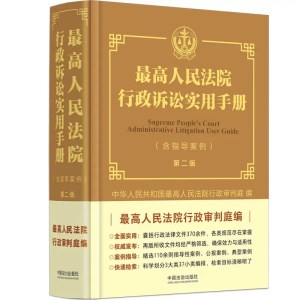 A recent message in the WeChat public account of the Supreme People’s Court (SPC)’s Administrative Division was devoted to promoting its new book, Supreme People’s Court Administrative Litigation User’s Guide (Administrative Litigation User’s Guide (2nd edition), 最高人民法院行政诉讼实用手册), shown in the photo above. Had the SPC’s #4 Civil Division had a WeChat public account last year when they published 涉外涉港澳台民商事审判业务手册( Foreign-Related, Hong Kong, Macao and Taiwan Related Commercial Trial Work Guide — “Foreign-Related Judicial Handbook”), I am sure that I would have received a similar message. I had previously thought that judicial handbooks were a historical artifact of the days before electronic databases. In my 1993 article, I discussed the phenomenon of judicial handbooks: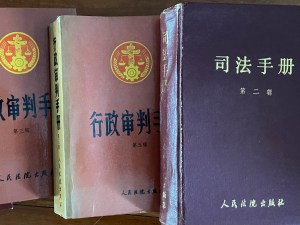

 Supreme People's Court Monitor
You must be logged in to post a comment.