Many thanks to Benjamin Pissler and Holger Hanisch of the journal for their efficient and thoughtful editing. Special thanks to Maximus Sandler for his help with the references and Hu Changming (胡昌明) for his perceptive comments on earlier drafts of the article.
Wishing all followers and readers a very good year of the Horse! 马年吉祥!
This post is the written and English-language version of a speech I first delivered in Chinese at the annual meeting of the Shanghai Judicial Think Tank Society (Think Tank Society, 上海司法智库学会, sponsored by the Shanghai Higher People’s Court) on November 30, 2024, held at Shanghai Jiaotong University. (The official report on the meeting is available here.) The views are my own and should not be attributed to the Shanghai Higher People’s Court or the Think Tank Society. I would like to express my appreciation to Dean Jiang Huiling(蒋惠岭)and Professor Luo Tianxuan (罗恬漩) of Tongji University for the kind invitation to participate in the meeting. Further acknowledgments can be found at the end of this post.
the author giving the presentation on which this post is based
Front-line judges often tell the author that “judicial reform is a failure,” although the author does not take their words literally. It is their way of expressing dissatisfaction with aspects of the design and implementation of judicial reform. The official view is that judicial reform is a success, and the basic structure (四梁八柱) of judicial reforms has been constructed in the past 10 years, although work continues to be needed in specific areas. The author is not prepared to say simply that judicial reform is a success or failure, particularly when significant gaps in information prevent the author from making a comprehensive, objective, and informed assessment. Although the author has only been a minor player in the complicated drama of drafting, implementing, and internally evaluating judicial reform in the last ten years, she considers herself fortunate to have the opportunity to monitor it closely and know personally many involved.
Within the limits of this short essay, the author focuses on the “front-end” and “back-end” of the judicial reform process. Her focus is on the process of deriving reforms that fit courts with widely different resources, and internal and external environments. The author roots her comments in the highly complex reality of the Chinese courts and with an international perspective.
Front-end Issues
The author considers that the “front-end” of judicial reform is most important–the drafting of judicial reform plans. She considers four aspects particularly important for the overall success of judicial reforms: evaluating local innovations; pilot projects and foreign mechanisms or experience; improving centrally designed mechanisms; and enabling greater stakeholder input into the judicial reform process. Each has separate and common challenges.
The author turns first to local innovations, pilot projects and foreign mechanisms or experience. Pilot projects are undertaken to “test drive” a possible reform while local innovations, draw on local wisdom and institutions to experiment with a new mechanism. She discusses these together because when reformers consider whether these specific experiences are suitable to be promoted nationally, the challenges are similar.
Family trial reforms (家事审判改革) provide a good example because they involve the above three aspects–evaluating foreign experience, domestic innovations, and pilot projects. In the case of family trial reforms, the relevant reform leaders were able to travel overseas to observe family courts and the ecosystem surrounding them and brought foreign experts to China to discuss specific issues and the related institutions needed to make family trial reforms successful.
Given the geopolitical changes of recent years, this type of onsite research is not as easy to accomplish. Foreign experience is particularly challenging to consider in the context of judicial reform. The first issue is understanding the foreign experience accurately, because written materials may not be comprehensive and fail to explain the institutional infrastructure on which the success of the mechanism is based. International travel to experience that mechanism may not be as feasible as previously, given constricted budgets. A third issue is the issue of “moving the foreign plant to Chinese soil,” to consider whether the mechanism will work as anticipated, given that related institutions operate in a different environment from those abroad.
Next to a pair of related mechanisms–pilot projects, which are undertaken to “test drive” a possible reform, and local innovations, which often draw on local wisdom and institutions to experiment with a new mechanism. The author discusses them together because they share a common challenge when reformers consider whether these two specific experiences are suitable to be promoted nationally. A pilot project approved by the Supreme People’s Court is likely to enjoy more resources, guidance from the Supreme People’s Court and possibly the Legislative Affairs Commission of the National People’s Congress (if delegation legislation is involved), support from local court leaders, as well as relevant institutions outside the courts.
The piloting of family trial reforms in recent years provides a good example. A research team based at Xiamen University* assessing those reforms found large disparities in whether those reforms were successful or even implemented, depending on many factors, such as whether the court was in an urban or rural area, the commitment of supporting organizations, whether local court leaders were committed to the reform and the case burden of individual judges. Pilot courts in urban areas could liaise with psychological counselors and mediators trained to resolve family disputes to achieve better outcomes. Rural judges generally did not have such resources available. The research team found that when judges were overburdened with cases, they would revert to usual practice, following reform practice only when needed for court news releases.
Should judicial reformers have anticipated the gap between rural and urban courts, and the cultural differences in different geographies, particularly in rural areas? Now that these gaps are known, what should be done to improve outcomes for rural as well as urban families? Perhaps special arrangements can be considered to support court teams hearing family matters in rural courts, as is done in some other jurisdictions, such as Australia, but that requires further research and analysis. [Family trial reforms are listed in point 6 of the Sixth Five-Year Reform Outline, issued in December 2024].
Next, on the phenomenon of centrally designed measures implemented with apparently limited input from affected persons. One recent example of this is the recently revised trial quality management indicator system (审判质量管理指标体系). Although the official view is that the relevant departments had engaged sufficient research and input from experts (充分调研论证) and one-half year of piloting the new trial quality management indicator system, from the fact that after nine months of official implementation of the system, “in order to reduce the burden on the lower courts (续深化给基层减负工作)” the number of indicators was reduced from 26 to 18 strongly suggests that after the system was fully implemented, the negative reaction from lower court judges was very strong. Had the relevant departments done a more representative survey of the views of lower court judges on this, the embarrassment of reversing themselves within several months could have been avoided.
Reforms designed without involving the personnel directly affected, without stakeholder input, are not likely to meet their goals. It is unlikely that a small team of persons working in Beijing have sufficient evidence, data, and analysis to reflect the varied types of judicial work and the complex environment in which judges work. It is unclear which type of courts piloted the new indicators and whether the piloted courts considered it prudent to provide responses that the relevant departments sought. This author surmises that it could make sense to have different sets of indicators for urban and rural courts, instead of having a single standard for all, but making that recommendation would require more data and analysis than this author has available. The author has heard lower court judges describe this reform as another example of “building a cart behind closed doors (闭门造车).”
Back-end Issues
The crucial part of the “back-end” of judicial reform is analyzing the results of a reform, or more likely the multiple reforms that have been launched and considering whether further continuity is needed in the form of measures to sustain the reform or to compensate for problems that become apparent. The current judicial system contains many such unfinished judicial reforms. One example of an unfinished judicial reform is the role of the judges assistant (法官助理).* [The reform is now listed in point 41 of the Sixth Five-Year Reform Outline]. Law and Supreme People’s Court guidelines have not defined clearly the scope of a judicial assistant’s work. This lack of clarity has an impact on the operation of the entire judicial system. Reforms themselves need continuity.
Conclusion
It is a truism that Chinese judicial reform is a highly difficult and complex matter, as the brief discussion above has signaled. The development of a modernized judiciary depends on cultivating judicial reform specialists possessing the entire package of skills required to evolve and implement judicial reforms appropriate for all Chinese courts, whether they are urban or rural, large or small, specialized or general. These specialists need to combine deep local knowledge with that of international “best practices.” Reformers need to be able to focus on front-end and back-end matters, including accurately evaluating foreign experience, pilot projects, local innovations, and incomplete reforms. They also need to involve stakeholder input to the extent possible, so that judicial reform measures most closely fit the complex needs of the Chinese judicial system.
The author hopes that these views are useful as a whole or in part.
______________________________________
*The two examples of uncompleted judicial reforms mentioned above draw on the research and experience of Zeng Yuhang (曾宇航, STL 4L student, on family trial reform) and Xue Ye (薛偞, 2023 graduate of STL, on judicial assistant reform).
Many thanks also to Yuan Ye (袁野), PhD student at Peking University Law School (and 2022 graduate of STL) for transforming PowerPoint slides written in 洋式中文 into standard Chinese.
four judicial reform books edited by the Judicial Reform Office
Although no formal announcement has been made in the Chinese press (of which I am aware), it appears that sometime during the last six months, more likely before early June (2023), the Supreme People’s Court (SPC)’s Judicial Reform Office, or more formally the office of the SPC’s leading small group for judicial reform (最高人民法院司法改革领导小组办公室) ceased to exist as a separate entity. Its work has been assumed by the Research Office. The leading small group that the Judicial Reform Office supported appears to have been disbanded as well. This post provides some comments on the office, some fragments concerning its history, an explanation of the nature of the office and leading small groups, and evidence for reaching the conclusion that the office no longer exists.
Over the past 10 years, this blog has discussed or cited statements or documents issued, reports drafted, and books published by the Supreme People’s Court (SPC)’s Judicial Reform Office. As is visible from the photo above, I have a collection of books edited by that office, many of which I have not yet cited in this blog or my other writings. Some books contain documents, others set out authorized commentary, and others are collections of analytical essays for the most part written by lower court judges. I had intended to draw on some of these materials when writing something more detailed about the drafting of judicial reform measures, setting out my understanding of the drafting process. A number of our Peking University School of Transnational Law students have interned in the Judicial Reform Office. I will now need to wait until I am able to gather enough information about how the new system operates before writing a current and historical description.
The offices of leading small groups are not permanently established, although this one had been in existence for almost twenty years. It is not unusual for them to be abolished and their duties assumed by permanent institutions. The temporary nature of the office may explain why published structure charts of the SPC have never mentioned the Judicial Reform Office. The SPC has other such offices, but this one appears to be the most well-known. Leading small group offices exist in analogous form at the local level as well.
For those who are not aware of the system of “leading small groups,” many exist throughout the Chinese Party and government system to deal with cross-institutional matters, often involving participants from multiple Party and/or state institutions. There seems to be a growing English language scholarly literature on multi-institutional leading small groups, mostly behind publishers’ paywalls, but this detailed summary of leading small groups and affiliated offices by Alice Miller is helpful to those without university library access. The summary explains that “leading small group general offices have dedicated office space, a roster of personnel, and an operating budget for administrative expenses. Although they cannot implement anything on their own, they can levy work on other offices.” My forthcoming (“neverending”) article has a description of the SPC’s Judicial Reform Office levying work on (assigning work to) other SPC offices, divisions, and institutions.
The Judicial Reform Leading Small Group and its supporting office were established in 2006. Although I have not been able to find the document approving its establishment, I assume that it was established to draw together a team of people to focus on judicial reform matters and to coordinate matters across multiple SPC entities, with the lower courts, and with the related Party bureaucracies. The Judicial Reform Leading Small Group had a predecessor entity entitled the SPC Judicial Reform Research Leading Small Group (最高人民法院司法改革研究领导小组). The China Institute of Applied Jurisprudence provided institutional support for the predecessor entity. I assume that the establishment of the SPC’s Judicial Reform Leading Small Group and its predecessor are linked to the 2003 establishment of the Party’s Central Judicial System Reform Leading Small Group (中央司法体制改革领导小组), which has (had?) members from multiple Party and state institutions. That Leading Small Group also has (had) an affiliated office (中央司法体制改革领导小组办公室). I have not seen public mention of the Party’s Central Judicial System Reform Leading Small Group in the past year or more, so I assume it has been disbanded and its functions subsumed by some part of the Central Political-Legal Committee/Commission.
Prior to 2003, judicial reform research at the SPC was conducted and coordinated by the Research Office. That office often deals with SPC cross-institutional matters, such as the transition to the Civil Code. So this development appears to be an instance of the SPC either going back to the “good old days” or as a former SPC judge recently wrote about the end of a piloted judicial reform, “restoring the original condition (恢复原状).”
During the March 2023 meeting of the National People’s Congress, He Fan, previously mentioned on this blog, spoke to the press about judicial reform, as a responsible person of the Judicial Reform Office (最高人民法院司法改革领导小组办公室负责人). In September of this year, public statements concerning judicial reform (in this case, the termination of the piloted reform of the four levels of the courts) were issued by a responsible person of the Research Office. A related document issued in June (2023) did not mention the Judicial Reform Office or the Judicial Reform Leading Small Group. When He Fan spoke at Fudan University Law School in September, he was described as a vice director of the Research Office and the former responsible person of the Judicial Reform Office (最高人民法院研究室副主任、原司法改革办公室负责人何帆博士). So I surmise from this that sometime between March and June, the Judicial Reform Office was abolished and its responsibilities and personnel were transferred to the Research Office.
I will be monitoring this change (to the extent possible). Questions that come to mind include the following. What will being located in the Research Office mean for judicial reform matters? Will the staff take on additional tasks in addition to judicial reform matters? What will this mean for the analysis of the impact of prior judicial reforms? What will this mean for the drafting of the sixth judicial reform plan outline? Will this mean more or fewer staff resources? When the plan is issued, will we on the outside of the Chinese court system notice the impact of this bureaucratic change? And as several highly knowledgeable persons have asked me in recent weeks, how should the judicial reforms of the last ten years be objectively assessed?
_________________________________________
Many thanks to the knowledgeable persons who contributed to this blogpost. Those with additional information or corrections should contact me. My apologies to my patient followers for the long gap between blogposts. but I have spent much of the last two months revising my “endless” long article for publication, as it needed to be updated to reflect recent changes. This change requires an additional update. I plan to do several more analytical blogposts in the upcoming months, but use more of my time putting together my research, as highlighted earlier this year.
As the readers of this blog know, Tongji University Law School Dean Jiang Huiling worked at the Supreme People’s Court for over 30 years, and for over 25 of those years, he was involved in judicial reform. He has the most comprehensive and deep understanding of the importance, challenges, and multiple implications of reforming China’s court system.
On 11 January 2023, Dean Jiang spoke on the last 10 years of judicial reform to my judicial reform class at the School of Transnational Law, colleagues and students from Tongji University, and some other visitors. This very delayed blogpost summarizes his presentation and responses to questions from the audience. The references to “we” in the summary are his, as are the unattributed quotations.
Presentation Outline
A. Roadmap of [the last ]10 Years of Judicial Reform
B. Four Fundamental Reforms
C. Judicial Organizations Reform
D. Procedural Justice Reform
E. Diversified Dispute Resolution
F. Judicial Democracy
G. Other Reforms
H. General Observations
A. Roadmap of Chinese Judicial Reform
The focus of his presentation was the last ten years of judicial reform (2013-2023), which included two five-year judicial reform plans. He first provided some historical background to the most recent two judicial reform plans, speaking about earlier judicial reform plans from a participant’s perspective.
1. Earlier judicial reform plans
Many Chinese scholars and some foreign scholars consider that those earlier ones were working method reforms, focusing on efficiency and other matters-they say is it not real judicial reform. He disagrees but says that it was only with the reforms of the last 10 years that structural (radical) reforms were made.
The first judicial reform plan (starting in 1999)–Dean Jiang was involved in drafting it. The principal focus was making the public and judicial professionals aware of the nature of a judicial system.
The second 5-year judicial reform plan: Setting the tone of the judicial system–procedural justice, professionalization and other basic elements of a judicial system.
The third 5-year judicial reform plan: in 2002 the Central Government [中央] discussed structural judicial reforms, and although the environment was very helpful, after preparing detailed plans (in which Dean Jiang was involved), the government and the SPC gave up those structural or radical reforms.
2. The Last Two Judicial Reform Plans
The fourth 5-year judicial reform plan (from 2013): Radical change of the judicial structure, organization, and nature of the legal profession. In response to my question as to why was the political leadership willing to do these reforms, Dean Jiang said that it was there had already been 15 years of judicial reform, of reforms to working methods, but it did not solve severe basic problems of judicial independence [it will be evident in this account what he means by this], fairness, and local protectionism. It is 穷则变塔–if there are no other options, then that is what needs to be done, and reflects what Chinese scholars had been calling for. As to the nature of the legal profession, he meant treating judges and prosecutors differently, not simply as civil servants.
The fifth 5-year judicial reform plan (from 2019): comprehensive and supplementary reform and “Zhengfa” (政法 political-legal) reforms. (See his explanation in last year’s presentation).
3. Summary of the characteristics of judicial reform in the past ten years-
“It’s a new time….”
Breadth: From the judiciary to other related areas
Depth: From judicial system reform to broader systematic innovation
Goal: From a fair, efficient, and authoritative judicial system to basic values of judicial system systems–touching on basic values such as independence, professionalization, and public confidence
Method: From branch-driven to Central Committee-driven–by this he means that previously, reforms were undertaken by institutions separately, but now the reforms are driven by the Central Committee [Central political leadership]
Nature: Chinese style and self-owned brand
B. Four Fundamental Reforms
Dean Jiang focused on four fundamental reforms, giving a quick summary and some comments. I will supplement with scattered comments, some links to some English-language academic articles, and some of my own blogposts.
Judicial Personnel Management System Reform
This is one of the most important reforms. Although the Central Government had sought to improve the quality of judicial personnel (judges and prosecutors) for a long time, they had been treated as ordinary civil servants with ranking. Now they are managed as professional civil servants. He noted that when he was in Taiwan in 2011, Taiwan had done something similar. (The reform is not complete, and the SPC’s website and casual conversation among judges and legal professionals reflect this).
(For those interested in the quota judge system, please see this article by Hong Kong University Faculty of Law Dean Fu Hualing and Zhongshan University Professor Sun Ying. )
2. Judicial Responsibility and Accountability System Reform (司法责任制)
He quoted President Xi Jinping’s description of it as “牛鼻子工程”–the nose of the cow project–crucially important. He noted that it is right to punish ethical violations and intentionally wrong judgments. Although this reform provides for more· internal Independence, it comes with strict restrictions and supervision. Jurists, prosecutors legal scholars, and others disagree with this approach. They argue that the reason for continued corruption, miscarriages of justice, and unfairness lies in the lack of reform elsewhere, The focus on judicial responsibility is a politician’s wisdom. Under that system, supervision is more important, and that is the reason for defining “four types of cases.”
See my earlier blogpost on the “four types of cases” and Straton Papagianneas’s article on the use of automated methods of supervision.
3. Professional Guarantee Reform: Salary, Rankings, Selection, Training, Disciplinary Reform
He spoke only briefly on this, saying these were needed so that judges were treated as judges.
4. Judicial Administration at the Provincial Level–
Delocalizing the Chinese judiciary–local protectionism was criticized by legal scholars and those within the judiciary [not to mention litigants and their lawyers] for many years. Judicial protectionism was terrible for fairness. Officials now characterize judicial power as a central power.
Chinese and foreign scholars consider the first and fourth most important.
See this earlier blogpost on problems with the court funding reform.
C. Judicial Organization Reform
These reforms are more technical and less fundamental.
1. Branch Courts of the Supreme People’s Court (Circuit Courts)
Six Branches in the country. The country is large but only one Supreme Court in Beijing exists. They were established to deal with trans-provincial cases, so that cases involving parties from different provinces, especially when the local government or its entities are a defendant, are heard fairly. He favored the scholars’ proposal of making the circuit courts into a separate tier (or quasi-tier), but that idea was not accepted.
Note my earlier research on the caseload of the SPC Circuit Courts, which found that most cases that these courts considered were applications for retrial, most in administrative cases. This has now changed with the reform to the four levels of the Chinese courts, as discussed here. See this article by the deputy chief of the SPC administrative division and two colleagues.
2. Specialized Courts
IPR Courts
Financial Courts
Internet Courts……
He noted that the Internet Court is not officially recognized as a specialized court by the Organic Law of the People’s Courts, but is an innovative action by the Chinese government.
See also Georgetown Law Professor Mark Jia’s article on China’s specialized courts.
3. Transregional Court Systems
“It’s another interesting invention in China.” Virtually all courts in China are based on the corresponding administrative area, so a county court will be established in a county, emphasizing the localized nature of the courts. So in 2015, the Central Government established the following two courts:
Beijing Fourth Intermediate Court
Shanghai Third Intermediate Court
Under the situation that judicial appointments and budgets have been transferred to the provincial level, this reform may not be so useful. It is his suggestion that China establishes transregional courts beyond the provincial level. This overlaps with the circuit courts. It is a scholar’s view.
5. Internal Organs of Courts
This one has many Chinese characteristics.
This involves the five-eight-ten test. If you have under 50 personnel in your court, you can establish up to give internal organs in your court. If you have between 50-150 personnel, you can establish eight internal organs, and if more than that, you can establish 10 internal organs. This means that it is possible to save some quota (headcount) for personnel [linked to the headcount system of the organizational departments–see here]. But it also pushes local courts in the direction of professional, rather than bureaucratic management.
D. Procedural Justice Reform
This is considered a “technical” reform but touches upon fairness, and what President Xi Jinping says about making each person feel fairness in every case.
Criminal Justice Reforms
Both inquisitorial and adversarial systems have the same standards of procedural justice. But in China, traditionally 公检法都是一条龙, the public security, procuratorate, and courts are a production line. “We have a long history in China with this.” They consult with one another and sometimes other bodies coordinate them. Which is the center? In this round of reforms, the Central Government pointed out that the trial, the hearing should be the center in criminal justice. It’s very difficult and the reform is not finished. But we are moving in the right direction.
2. Accesss to Justice
Case filing reforms, making it easier for a party to file a case.
3. Simplification of procedure
For judicial efficiency, enabling more cases to be closed in a short period of time, the following reforms were made:
Sole judge and One Judge Panels
Small claims
4. Functions of the four levels of the courts
“An old item of reform but a new action taken in recent years.”
“Cylinder or Cone”?
Traditionally the Supreme People’s Court could hear a case within the jurisdiction of a local court. But this is not good for professionalism. So now, the reform is to have the higher courts focus on legal issues and more important issues, that is for the court system to be shaped more like a cone.
ADR–in China called Diversified Dispute Resolution. This is an efficiency issue. It is also important for Chinese state governance. The courts are a beneficiary of these developments because they resolve more cases.
1. One-stop Litigation Service
2. One-stop Dispute Resolution Service
3. Judicial Platform and Governmental Platform
4. Judicial Confirmation of Mediation Settlements
–we learned from the United States and other countries in designing this. In the US, courts approve a settlement, while in China, we have a confirmation of mediation settlement procedure.
5. Arbitration–In China, we have over 260 arbitration commissions, almost one for each city, with CIETAC, Beijing Arbitration Commission, Shanghai International Arbitration Center, and the Shenzhen Court of International Arbitration being the most prominent. We have learned from overseas in arbitration.
F. Judicial Democracy
1. People’s Congress Supervision
This sometimes makes courts anxious. The president of a court does an annual report and the people’s congress votes on it. If it does not pass by much or does not pass, the court president and the court feel embarrassed. It has happened. What happens if the report does not pass? After two or three months, the court president has an opportunity to report again. It is a type of facilitation.
See my recent blogpost related to people’s congress supervision.
2. Peoples Accessors (Lay Judges) System
–although the terminology in Chinese is similar to a jury, it is actually more similar to the lay judge system in Europe. It has a long history in China (not as long as Europe), and changed in the last 20 years. Now the people’s congress appoints them on the recommendation of the people’s court.
3. Judicial Transparency: Written Judgements, and Live Broadcast of Hearings
4. Media Supervision
Very different from people’s congress supervision and he spoke about the rise of commentary on the courts through social media platforms.
G. Other Reforms
1. Constitutionality Review
The Chinese courts do not do that, it is a function of the National People’s Congress. They have established a committee. This is a big progress, although some scholars think this should be given to a constitutional commission or court, or to the courts. He is not sure which is better. The NPC Standing Committee has recently published its annual report on this. These contain legal judgments. But how should these legal judgments be made? Should they follow some procedures? The legislature is trying to reflect people’s views. The standard between the courts (black-letter rules) and people’s views is different. He hopes there will be some improvement.
2. Judicial interpretation
The SPC and Supreme People’s Procuratorate both have interpretative power within their area of competence. This is always criticized by NPC deputies, the staff of the NPC, and some scholars because the content is abstract and looks similar to legislation, but it plays an important role in unifying the application of law in the whole country. The judges love it. Without interpretations of law, given the brief provisions of law, it gives judges great discretion, so there is a risk of inconsistent application of law. He is sure judicial interpretations will be there for another decade.
3. Guiding Case System
Justice Xiao Yang found another way of interpreting the law-through cases.
4. Prosecution system
The procuratorate disappeared in the former Soviet Union but in China, it is still here. It has found a new way of life with public interest litigation, supervising administrative, civil, and criminal litigation, enabling them to oversee the executive.
5. Ministry of Justice
The State Council’s Legal Affairs Office has been merged into the Ministry of Justice. And everyone knows that President Xi chairs the Rule of Law Commission and that secretariat is located in the Ministry of Justice.
6. Public Legal Service
The Central Government just issued a reform plan.
7. Legal Profession and Pre-career Training
It is another technical but important reform for the future of the legal profession. We followed the civil law countries in planning pre-career training. I hope we can insist on two years of legal training.
H. Some General Observations
1. The first 5 years vs. the second 5 years–very different. The first five years of reforms are structural or system reform, like the identity of the judges or prosecutors, delocalization…But the second five-year reforms–comprehensive, supplementary reforms–the four fundamental reforms have finished, and we go on to the next. But those reforms and others are not finalized–it is not possible within four or five years to fundamentally change a judicial system. This reform plan is continuing the former plan, plus supplementary reforms. Unfortunately, the Central Government has invested less. This is linked to Covid-19, the unsatisfactory international environment, and the economy—many negative factors.
2. From judicial reform to “Political and legal (政法) reform”–from judicial (司法) to political-legal reform, including reforms to the people’s congress system. The comprehensive, supplementary reforms must fit into the political-legal reforms
3. Step-by-step reform: Waiting for or creating satisfactory conditions for some reforms–only a few provinces have finished the financial reforms, less than half. Reasons– now few meetings to coordinate with other branches on this.
4. How to deal with the halfway reforms and progressing with the Comprehensive supplementary reforms–there should be some evaluation–but there are no formal critical objective evaluations published. How to deal with the halfway reforms.
5. Yes and no to Politics-Driven Reform–the nationwide judicial reforms must be driven by political power. No comprehensive effect is possible without the use of political power. There should be more legal elements in this process.
6. On the Track of Rule of law–how to keep judicial reform on the track of the rule of law.–#5 of Xi Jinping rule of law thought is putting state governance on the track of the rule of law. That will take all legal professionals, foreign scholars, the international community, and internal incentives. This is what is needed to keep judicial reforms on the track of the rule of law.
In the next five or ten years, the judicial reforms will not stop. The pace might be slower. The country has so many difficulties. We hope that the rule of law will help the development of this great country.
He concluded the main part of his presentation by cautioning that these are his views, as a scholar.
____________________________________
In response to the question concerning which reform is the most important and what obstacles it faces, Dean Jiang said that two are the most important–the centralization of judicial power and the professionalization of judges, so that judges are sufficiently qualified to exercise greater judicial power. Time is a challenge.
A question from one of my students–what about using contract judges to supplement the shortage of judges? A: In UK, they are called part-time judges. But in China, Chinese judges must have 政法专项编制 (political-legal specialized headcount)–in China we have not changed our minds on this–we are concerned about corruption. Perhaps in the next 10 years, we will have part-time judges, more likely borrowed from the executive. Professional ethics is very important.
A second question from one of my students, concerning the constitutionality of the quota judge reform–removing the title of judge from 70,000-80,000 personnel. Dean Jiang said it was a good question and would have been challenging if done in Europe. The Central Government leadership decided, saying that many people were not doing judicial work, but were in the General Office, Research Department, etc. People thought about the legality or constitutionality of this. We didn’t use the word “removal,” but “suspension,” you keep the title of “judge,” but no longer do judicial work. Dean Jiang himself was affected by this reform. He was appointed as a senior judge by the NPC Standing Committee but was working in the Judicial Reform Office. Approximately 360 judges were appointed as quota judges by the SPC. He was not one of them, not a 员额制法官, but still enjoyed the title of “senior judge,” (of the bureau-chief ranking 正局级). If all those judges had continued to be judges, it would have been a disaster for judicial reform, it would have slowed things down. It was a balancing, at the edge of legality/constitutionality. The second question that the student asked was about the accountability of judicial assistants under the judicial responsibility system. Dean Jiang said the reason is that they are involved in judicial work and are future judges.
Another question from the audience related to reforms such as abolishing the Procuratorate and moving the prosecution function to the Ministry of Justice (like many other jurisdictions)–unlikely and why the enforcement bureau remains in the courts, when the enforcement function is elsewhere in many jurisdictions. Dean Jiang said many court presidents would welcome that, and the proposal has been made, but during the 16th Party Congress, it was decided that it was not appropriate to do so. A question was raised about military courts–he noted that they are considered specialized courts, and under the reforms moved from being under the General Political Department to being directly under the Central Military Commission (through its Political-Legal Commission).
SPC list of winners of the Ram City Cup for judicial reform essays
This post is a lengthy summary/incomplete translation of an article entitled 省级统管后法院经费保障机制再造 (Reconstruction of the Court’s Funding Guarantee Mechanism after Provincial Administration)by Fan Lisi (范丽思), a judge of the Wuhou People’s Court, Chengdu, Sichuan Province. Judge Fan was one of the first prize winners in the 2020 “Ram City Cup” competition for articles on judicial reform, administered by the Supreme People’s Court (SPC)’s judicial reform office. People’s Justice (人民司法) published her article in 2021. Many thanks to Guo Ran, a current Tufts student, and Tina Chen ( 陈雨茗), an Oxford undergraduate for assisting with the translation/summary. I have included some explanations in square brackets []. I have omitted most of the charts/graphics. I welcome corrections to the summary/abridged translation and comments.
Based on her review of data from multiple provinces/directly administered cities, the author shows that the reform of funding the courts at the provincial level (cited as one of the successes of the judicial reforms in several English language academic articles) has been a failure. The reforms make the local courts even more dependent on local financing. She explains why that happened.
I surmise that 2022 will be an even more challenging year for court budgets in many areas, as provincial/local budgets are under greater stress because of testing for Covid-19, decreased income from land sales, and less tax revenue because of lockdown-related downturns in business activity.
She looks at other court financing models abroad and discusses a topic I have rarely seen mentioned in the academic literature about the Chinese courts (certainly in English–I don’t claim to be as familiar with the Chinese academic literature)–separating the judicial and administrative functions. I have had discussions with several persons previously affiliated with the SPC on this issue. She proposes that the SPC establish a finance committee and that local courts establish counterpart institutions. Drawing on her research on Chinese court funding and that of other jurisdictions, she proposes a new model. I cannot claim any expertise on this and will not comment on the practicability of her proposal.
Introduction
The role of the people’s courts in national governance has changed. Judicial authority has transformed into a central power from a local power [司法事权属性已由地方事权转变为中央事权]. The transformation of the courts’ functions requires a mechanism for guaranteeing funding that matches the operation of judicial power. The provincial unified administration reform in 2014 saw the beginning of the current funding guarantee mechanism reform. [This reform was part of the 4th Five-Year Judicial Reform Plan]. But after five years of pilot practice, the provincial unified administration has not achieved its established goals of “de-localization,” “de-administratization” [去行政化] and “balanced judicial supply power (均衡司法供给力).” It is necessary to reflect on the reasons for the failure of the provincial unified management reform, clarify the theoretical components [应然内涵] of the court funding guarantee mechanism, identify the situational variables affecting the choice of reform tools, and “reload “the reform toolbox. Based on provincial unified management, China should build a court funding guarantee mechanism that follows judicial principles [规律] and financial management principles, so as to effectively solve the problem of financial resources for the operation of the judiciary and assist in constructing modern social governance in China based on the rule of law.
Number
Problems that the Reform aimed to resolve
Solution provided by the Reform
Underlying judicial value
1
Who is paying (the money)?
The source of funding is raised to the provincial level of administration, altering from local finance departments to provincial finance departments.
To allow the courts to gain independence economically from local governments, removing localized variants and guarantee judicial independence.
2
Who is responsible for the distribution and management of the money?
The main body of funding is raised to the provincial level. Funding used to be distributed and managed by local financial departments is now subject to provincial financial departments.
To eliminate regional differences within the same province, and to realize the standardization of judicial services through standardizing financing capacity of the courts.
3
How is the total amount of funding determined?
Fixed-base budget: The reform uses the total amount of funds before as the “base;” the base will only be raised but not reduced.
Institutionally secure the “guaranteed amount” of legal funding, overcome the problem of arbitrariness in determining the total amount of funding in the previous years, and establish a benign dynamic growth mechanism of funding
4
To whom is the power of reviewing budgets vested in:
Governmental budgeting department with limited power to review: provincial finance departments delegate the power to conduct initial review of budgets to provincial courts. They will then sum up the subordinate courts’ budgets and conduct initial review of their reasonableness and compliance. Then the provincial finance department will submit them among other departmental budgets to the provincial People’s Congress.
Develop the court’s function of funding management, make use of the higher court’s knowledge of the lower courts, and enable the higher courts to fully participate in the lower courts’ budget filing, review, and coordination processes
I. Benchmarking review: Evaluating the practical effectiveness of provincial unified management
The provincial unified management of court funding attempts to centralize the administration of court funding at the provincial level. Cout funding was previously an obligation of local government on the same administrative level as the local court. The reform aims to break the previous local court fund management pattern, reshaping the relationship between courts, administrative agencies, and Party and government agencies, which has had an impact on the autonomy and fairness of the local courts.
To analyze the success of this reform, the author selected the 2019 and 2020 budget and final accounts data of 1,535 basic-level courts (data from 14 provincial-level jurisdictions: Tianjin, Jiangsu, Guangxi, Hunan, Jiangxi, Inner Mongolia, Guizhou, Hebei, Shaanxi, Shanghai, Guangdong, Beijing, Shanxi, Yunnan. She reviewed the following data:
basic-level court department’s budget,
final accounts public statement, and
people’s courts’ financial statistics analysis system
and analyzed key indicators such as :
source of funding,
average cost of each case
average public expenditure per case, and t
growth rate of case-handling operational funds, etc.
A. The reform has not eliminated local court dependence on government at the same level
The study presented the following findings:
(1) Shifting the source of court funding has not completely freed the local courts from depending on local governments.
The current judicial reform centered on withdrawing court funding from the government-led horizontal model of bureaucracy and removing the function of allocating or transferring funds from governments on the same administrative level through institutional reforms, which in turn removes the possibility of the judiciaries colluding with governments on the same administrative level to solicit funding. After the transformation into provincial unified management, the judiciaries’ funding will mainly be composed of provincial finance; governments on the same administrative level will cease to allocate funds to the judiciary.
By examining the funding income structure of the sample courts in 2020, the study found that, out of 741 courts that have been reformed, 249 still relied on funding from governments on the same administrative level, which comprised 43.22% of the courts’ total funding.
In the case of some local courts in Shanxi and Hebei province, the percentage could even reach 87%. Funding from government on the same administrative level compensates for the lack of funding for:
labor costs;
office administration;
facilities procurement; and
general maintenance,
Labor costs are the largest proportion, at 63.05%.
From the above data, it is clear that nearly 33.6% of local courts have not yet completely detached from local governments financially, even after the reform.
B. Raising the funding guarantee to the provincial level has not significantly improved unequal financial supply capacity
Balanced judicial finance is the necessary condition for standardized judicial services. One of the objectives of the provincial unified management reform was to ensure that the public has equal access to judicial services of equivalent quality and quantity within a province, by arranging courts’ funds on a provincial level.
The equalization of financing provision capacity is a sensitive indicator. In order to obtain a concrete observation of this indicator, the author has selected “public expenditure per case” and “cost per case” to reflect, respectively, the ability to finance “administrative affairs” and “enforcement of courts’ decision”….
Suppose we reflect on the tools adopted by the provincial unified management plan. In that case, we could explore the problems in tool selection and application with the existing reform and establish useful precedents for a new funding guarantee mechanism.
C. The policy requirement of a guaranteed minimum funding does not necessarily produce a sustainable dynamic increase in the courts’ funds.
In “Framework Opinions on Several Issues of Judicial System Reform Pilot” (referred to as “Framework Opinions”) issued by the Central Leadership in 2014, it was stated that after the implementation of the provincial unified management reform the total amount of funding must not decrease, however, this minimum requirement does not suggest a sustainable increase in funding. Among the sample courts, 711 courts experienced growth in the number of cases heard in 2018.
Through comparing and analyzing the growth rate of cases heard and the growth of overall funding in handling cases, it was found that in 66.67% of the courts the growth rate of overall case funding was lower than the growth rate of cases heard; among them, 55.13% of the courts even had a decrease in case funding when the number of cases heard had increased; the courts that been reformed had a comparative advantage in terms of the increase of funding in cases. Among the 237 courts that saw equivalent or higher growth in case funding than cases heard, there was almost a fifty-fifty division between reformed and unreformed courts. (See the figure below)
D. The power of provincial courts to manage funds continues to be marginalized.
Under the institutional framework of “One Government, One Committee and Two Courts”, [government, the supervision commission, the courts and procuratorate] judicial independence manifests in the division of labor rather than independent authority from the government.
However, a mode of leading and being led, managing and being managed is formed between the local courts and government on the same administrative level, through the mediation of the fiscal relationship. The provincial unified management reform hopes to rebalance the power constraints between the provincial court and governmental departments, through the practice of restoring an interactive relationship between the courts and government, by developing the courts’ own financial management capacity and transferring the power to manage funds from government to the courts.
But the four management models developed in the process of promoting the reform have been found to be problematic in their own respects: the direct management model (adopted by 57.15% of the reformed courts) tends to marginalize the managing power of provincial courts, and local courts will communicate directly with provincial fiscal departments; in the assisted-management model (adopted by 38.1% of the reformed courts), although the provincial courts are involved in the management process, their role is reduced to that of a megaphone, with no substantial power of their own; the model of entrusting municipal management of court funds does not achieve the reform objective of transferring the fund management power to the provincial courts; the trusteeship model, in which the provincial treasury delegates the daily management of funds to the provincial courts, is only an expedient measure to fill up the absence of the provincial government’s financial management capacity. It is also worth noting that only one province has adopted this model.
Therefore, it can be concluded that the provincial courts have not taken up the power of allocating funds as the reform expected, and have again ended up being marginalized in fund management.
II. real-world problems: dissecting the failure of provincial management reforms
Reason 1: lack of capacity to financially supply at the provincial level inhibits the local courts from becoming financially independent from local governments
The ideal plan, according to the provincial unified management reform is that the local courts should be funded only by the provincial treasury. This is a completely novel expenditure for the provincial budget and can only be financed through increased provincial revenue. However, a comparative analysis of the increase in the courts’ budget against the incremental revenue increase at the provincial level suggests that almost all provincial-level finances are unable to satisfy such a large increase in funding demand: Tianjin, Guizhou, Beijing, and 10 other regions have experienced a reduction in provincial-level revenues compared to the previous year, and it is simply impossible to spare funding for local courts when existing provincial needs remain difficult to satisfy.
Jiangxi, Yunnan, and Guangdong Province have less than 1.8 billion Yuan of increase in revenue to finance their own budgets, which is far less than the funding needs of local and provincial courts. Even in economically developed regions such as Shanghai and Beijing, budgets were further contracted compared to the previous year, with arranged courts’ budget revenue accounting for less than 2% of the provincial budget. The same lack of financial supply capacity can be observed. (See Table 2)
The lack of financial supply capacity on the provincial level has forced the courts to continue fundraising with the local governments. In the process of fundraising, the local courts will now have to communicate on the one hand with the provincial finance department for more funding, and on the other hand with the local government to compensate for the lack. Having to communicate simultaneously on two administrative levels increases the costs of fundraising for the courts. A further difficulty since the reform lies in the fact that, facing the funding applications from the local courts, the local government can decline their requests using the reform as a legitimate excuse, by saying that the courts have now “completed the provincial unified management reform”, increasing difficulties in fundraising, and potentially deepening local courts’ dependence on local governments.
Reason 2:
The reform asked for formal unified management on the provincial level, while failing to bring about substantial unity in expenses, resulting in the continued imbalance of financial supply capacity within provinces. Firstly, provincial unified management suggests standardization, however, in reality, local standard in labor and public funds still persists, while the funding for case-handling remains insufficiently supplemented. Secondly, the reform also demands unity in expenses, i.e. the amount of funding from provincial expenditure to the local courts should be standardized. But the reality is that the provincial finance department simply required local governments to report the total funding allocated to local courts before the reform, and use this figure as a criterion to budget for local courts for the year. Some provinces with limited capacity to guarantee funding even require the local finance departments to transfer this amount upward, before the provincial finance department then transfers the funding to the courts, so as to achieve formal unified management. Provincial finances in this process did not take effective means to coordinate and adjust the funding budgets to balance the substantial expenditure, and the status quo of having huge gaps in financial capacity among the courts within provinces has not been significantly improved.
Reason 3:
There is a tension between the self-expansionary nature of court funding and the principle of necessity, which prevented court funding from increasing alongside the expansion in courts’ capacity to handle cases. The idea of public finance in principal-agent theory conceptualizes the government as a “trust fund” established to serve the public interest of society, whilst recognizing that the government’s natural tendency of self-expansion may create excessive demand for financial power. Therefore, in order to curb the government’s urge to abuse public finance, budgeting should follow the principle of necessity.
The courts, however, while budgeting for their own expenditures, tend to be self-expansionary: justice is the highest normative value of judicial activities; when justice and economic efficiency are in tension, cost-effectiveness has to come second. Fair and just judicial activities must be backed up by adequate and stable financial resources. However, when reviewing court budgets, finance departments usually follow the principle of necessity and reject the demands to increase budgets alongside the expansion of judicial activities, while the courts themselves have no effective means to reject this practice.
Reason 4: The absence of legislation and policies leads to the lack of legitimacy in the expansion of courts’ power to manage funds
It was clearly stated in “Framework Opinions” that it aims at “the establishment of a provincial unified management mechanism”, i.e. the department responsible for managing courts’ funding is the provincial finance department. The revised budget law in 2018 defines the budget as “public actions involving revenue and expenditure”. The statute did not specify for the normative standard of judicial actions involving revenue and expenditure, which suggests that the state has recognized, on a legislative and policy level, the subordinate status of the court budget in relation to the total public budget. The relationship between the finance department and the courts constitutes a de facto managing-and-managed relationship. Although having provincial courts participating in the management of funds allows for the decision-makers to make informed decisions, the whole process is made difficult due to the lack of legitimacy in the expansion of power.
III. Theoretical reflection on the reform’s “toolbox”
A. The normative components and theoretical toolbox of the court funding guarantee mechanism
Before introducing a theory to transform the court funding guarantee mechanism, it is necessary to clarify its normative outlook. The author examined changes in the PRC’s court funding guarantee system since 1949 and its counterparts in Japan, the U.K., and the United States. She concluded that the court funding guarantee mechanism must determine four core issues in varying political and economic environments: the source of funding, the court funding administrator, the method of ascertaining court budgets, and the authority to review court budgets.
1. The source of funding, or who pays the money
Judicial services maintain social order and justice through the resolution of specific disputes. It is both a private product that protects the legal interests of individuals and a public product that provides legal services to the state. Therefore, when ascertaining the source of funding, there are two available sources, namely, the state and the litigating parties. In cases where the state provides court funding, two sources are available–central government finance and local government finance–depending on the financial condition of each government.
Due to the centralized nature of unitary states, central government finance tends to be the funding provider in unitary states such as Japan and the United Kingdom. On the other hand, the federal countries tend to fund the court through local government finance. For example, the U.S. state courts are financed by state funds. Some other courts are also funded by the litigating parties. The British civil courts, for example, are funded by the case acceptance fee. Although China is a unitary state, Chinese local courts have historically been funded by local government finance because of the country’s vast territory, significant regional differences, and limited central financial resources.
2. The court funding administrator, or who manages and distributes funding
Generally speaking, whoever pays for the funds naturally controls the allocation and management of the funds, so the funding provider is usually the guarantor of court funding. The central government finance is guaranteed by the central government, and the local government finance is guaranteed by local governments. This one-to-one correspondence is particularly prominent during the historical variations of China’s court funding mechanism.
To prevent undue government interference in judicial fairness, many countries have enacted laws or other institutional arrangements that grant the court funding administrator a high degree of independence from the government that provides court funding. For example, in Japan, the Supreme Court is mainly responsible for funding management; the United Kingdom and the United States have set up an independent judicial administrative department for this purpose. Depending on the funding provider and its dynamic interaction with the court, the author identified four main administrators of court funding–the central government, the local government, the Department of Judicial Administration, and the courts.
3. The method of ascertaining court budgets, or how to determine the total amount of funding
Figuring out the quantity of budgetary funds helps the judiciary to secure the resources necessary for it. To ascertain court budgets, there are three methods to choose from: “fixed amount method”, “fixed percentage method”, and “incremental budget increase method”. The four periods of China’s funding guarantee model all rely on the fixed amount method or its modifications, as it is operationally the easiest; the fixed percentage method is more often used in Latin American countries. However, it is not accepted by the mainstream because one cannot quantitatively test and justify the set percentage; the incremental budget increase method, which is the most responsive to the needs of the courts, is used in the United States and the United Kingdom.
4. The authority to review court budgets, or who has the power to review and revise the court budget during budget declaration and approval
Depending on the level of detail that the executive branch reviews court budgets, there are three types of budget review authority: “government departmental review”, “independent review”, and “government departmental review with limited power”. In the government departmental review model, the court budget is a sub-system of the government budget. The government finance department has the strongest scrutiny and involvement in the courts’ budget. In the independent review model, the courts are relatively independent, and the finance department has the weakest scrutiny of the court budgets. The court budget is filed, reviewed, and revised within the court system or by an independent judicial funding management authority. The government has no substantive right to review or revise the court budgets. In the “government departmental review with limited power” model, the court has a say and could participate in the budget review process, but the ultimate review power still lies within the finance department. The model is a compromise between the first two models, but is essentially more inclined to the government departmental review model.
Summary: By comparing the application of the four major types of guarantee tools during various reform periods and in different political entities, the author concluded that the choice of reform tools in the “toolbox” is closely related to the national financial situation, political institutions and the role and function of judicial power in society. The reform plan of court funding guarantee should fully consider the influence of situational variables including political, economic and judicial power. It should also accurately identify the role and function of courts in the national governance structure. To fill the reform “toolbox,” it should choose the appropriate combination of the above 13 tools.
B. Reflections on the problems with the existing reform
Having clarified the reform’s normative outlook and theoretical toolbox, it is necessary to reflect on the tools adopted by the provincial unified management plan. In this way, we could explore the problems in tool selection and application with the existing reform and set up useful precedents for a new funding guarantee mechanism.
1. Confusions in tool selection: the unclear boundary between judicial authority and administrative authority in the judiciary
The unclear boundary between judicial authority and administrative authority in the judiciary has led to the inappropriate mixing of reform tools for judicial funding and judicial administrative funding. Judicial authority refers to the court’s authority to try and legal supervision on behalf of the state, while the administrative authority in the judiciary refers to the power to manage personnel, property, technical equipment and other administrative affairs of the judiciary for the purpose of supporting judicial authority.
The two kinds of authority are essentially different in forms, functions, and substantive contents. The operation of judicial authority should follow the judicial principles and stress judicial independence; the administrative authority in the judiciary should follow administrative principles and stress subordination within the administrative hierarchy. However, in the provincial unified management reform, the two authorities have been confused as the same court functions. The funds for case handling and court facilities, which represent the operating costs of judicial power, and the personnel and public expenditure funds, which represent the operating costs of administrative affairs, are placed in the same guarantee model. The choice of various reform tools has failed to differentiate between the operation of the two powers.
2. Reflection on the choice of tools: the court’s role and function remain unclear, resulting in the deviation of tool choices from the reform’s values
Historical changes in the court’s funding mechanism have shown a continued evolution of the court’s functions. The court’s role in society and the state determines the Party’s policy arrangement of court funding: if the court serves to resolve specific cases and disputes within its jurisdiction, then the court exercises local affairs; as the judicial responsibility should match with the court’s power of finance, the court should be financed by local government. If the court serves to promote the rule of law in social governance at the national level, then the court should be financed by the central government.
Since the founding of the PRC, the court’s role has shifted from a means to an end to an end in itself; from “a political means to realize revolutionary goals” to “a manifestation of value in improving the political system.” The court’s function has been elevated to the level of “providing the foundation of the rule of law for national development.
Accordingly, the court should be funded by the central government. The provincial unified management plan has been aware of the public service provision function of judicial products. It has also established values such as“de-localization” and “ameliorating the regional divergence in financial supply capability.” Nevertheless, since it still viewed the court’s main role as the settler of specific disputes, the source, and management of court funding remained on a provincial level after the reform, which partially contradicted the reform’s goal of de-localization.
3. Reflection on the application of tools: the insufficiency of financial resources hindered the intended application of tools
The foremost issue of funding reform is to figure out “where the money comes from.” As the leading reformer, the court did not control economic resources. Therefore, when faced with significant financial supply shortages on a provincial level, the reformers sought to avoid the risk of failed reforms. They came up with a compromised but effective method: the courts on each administrative level cooperated with local finances to determine a base amount of funding, which must be no less than the pre-reform amount. The local governments on the same administrative level would then transfer the funding to the provincial treasury, which would then distribute funding to local courts through transfer payments.
This process formally satisfies the requirements of provincial unified management and that the court funding remains no less that the current level. It also seems to push forward the reform. However, the local governments on the same administrative level remained deftly as the actual source of funding. The provincial courts were deprived of the possibility to coordinate the arrangement of provincial funds. The end result of the reform completely deviated from its original intention of shifting the main body of funding guarantee up to the provincial level.
4. Reflection on the implementation of tools: insufficient political resources leads to the lack of internal motivation to enact and push forward the reform tools
The court funding guarantee mechanism reform seems to be a reform within the judiciary. However, because China’s court funding system is decentralized and deeply intertwined with politics, the reform would not only involve a reconfiguration of legal institutions and their respective functions. It would also require adjustments to China’s contemporary legal principles. In practice, both the local financial departments and the provincial financial departments held a passively cooperative attitude toward the reform initiatives, resulting in the initiatives’ weak implementation nationwide compared with other reforms of the judicial system.
The court funding guarantee mechanism reform seems to be a reform within the judiciary. However, because China’s court funding system is decentralized and deeply intertwined with politics, the reform would not only involve a reconfiguration of legal institutions and their respective functions. It would also require adjustments to China’s contemporary legal principles. In practice, both the local financial departments and the provincial financial departments held a passively cooperative attitude toward the reform initiatives, resulting in the initiatives’ weak implementation nationwide compared with other reforms of the judicial system.
IV. Tool Re-selection: the remaking of the court guarantee mechanism around “separation of the judicial and administrative authorities”
Having reflected on the reform toolbox, the author concluded that the new funding guarantee mechanism should abide by the principle of “separation of the judicial and administrative authorities.” Accordingly, it should apply different funding guarantee mechanisms for judicial and administrative fundings in the judiciary. It should also re-select the source of funding, the funding guarantee administrator, and the reviewer of judicial funding budgets. The reform should also establish a dynamic growth mechanism for court funding centered on the average cost per case.
A. A general change of plan: from single-center provincial unified management to a unified management model based on the judicial-administrative separation
Xi Jinping pointed out that “the judicial power is fundamentally a central governmental affair.” According to the principle that the administrative power should match with the financial expediture responsibility [根据事权与财政支出责任匹配的原则], the main body in charge of judicial expenditure should be the central government. The judicial funding should thus be included in the central government budget and managed by the central government management mechanism yet to be established.
On the other hand, as the judicial administration includes judicial personnel, property, legal infrastructure construction and maintenance, and party and political-administrative affairs, it manifests interactions between the local courts and governments. Compared with judicial power, judicial administrative power demonstrates a clear local feature. Therefore, it should continue with the provincial unified management model, with its funding mainly provided by provincial finance and supplemented by the transfer payment from a national and provincial level.
B. Changing the source of judicial funding: establishing a special fund for judicial activities to guarantee stable funding
The central government finance should collect the litigation fee revenue from all courts nationwide and set up a special fund for judicial expense for case-handling. It should also establish five basic rules to fully implement the “separation of revenue and expenditure” requirement – unified revenue collection and expenditure, earmarking, limitation on carryover and balance surplus, managing surplus/shortage, and auditing and supervision – which would, in principle, prohibit mixing judicial funds with administrative funds. In this way, it provides a stable source of revenue for the central finance to guarantee court case-handling expenditure:
Firstly, litigation fees are capital costs charged by the courts in providing judicial products and services to the litigating parties. Its main purpose is to compensate for the material costs of service provision. Therefore, the use of litigation fee revenue to compensate for the cost of case-handling is justified and reasonable. Secondly, the analysis of the sample courts’ financial data shows that the total litigation fee revenue in 2019 was 27,830 billion Yuan, and the total expenditure on case handling and equipment was 22.266 billion yuan. The litigation fees exceed the court’s case-handling expenditure by 0.25 times, so it is realistic to compensate the case-handling cost with the litigation fee revenue.
In addition, it is necessary to clarify that the use of litigation fee income as a source of financial guarantee for central finance does not violate the principle of “separation of revenue and expediture.” Nor does it mean a rollback to the “revenue generation era” at the cost of litigating parties.
Although the litigation fee is collected by the court, it goes directly into the central treasury. The central treasury is responsible for both the management and expediture of litigation fees after collection, not the courts themselves. This solution is thus in line with the principle of “separation of revenue and expenditure.”
Additionally, through reasonable institutional arrangements, the funding distribution is not linked to the local courts’ amounts of litigation fee revenue. The courts at all levels thus lose the original motive to increase allocated funds by generating more litigation fee revenues.
C. Reforming the court funding administrator: setting up an independent professional institution responsible for the management and allocation of funds.
The Supreme People’s Court should set up a judicial fund management committee. The committee should consist of professionals in charge of managing the judicial funds, which should include financial budget management experts, personnel assigned by the Ministry of Finance, and audit experts.
Specifically, the committee should: communicate on behalf of the Supreme People’s Court with the central finance department and the National People’s Congress and its Standing Committee; collaborate with the Ministry of Finance to design a set of regulations on judicial fund management and budget filing; be responsible for the budget collection and review of lower courts; be responsible for the budget declaration and responding the questioning of higher administrative institutions; assume internal supervision responsibilities; establish a special inspection system that regularly monitors the exercise of judicial funding.
The provincial courts should set up funding management committees that consist of budgeting, auditing, accounting and other professionals as well as the personnel appointed from the provincial finance departments. The committee should be specifically responsible for communicating with the funding management committee of the Supreme People’s Court, managing and allocating the judicial funds below the provincial level, communicating with the provincial finances, and managing and allocating the judicial administrative funds below the provincial level.
D. Changing the method of determining judicial funding budget: establishing a dynamic budget adjustment mechanism around the average cost per case.
The early stage of the reform: the average cost per case varies from place to place; some courts’ case-handling expenses are intertwined with public expediture of varying amounts; the court financial personnel varies in their professionality; and some financial data lack credibility. To solve the problems, the total amount of funding can be temporarily determined as the sum of the previous year’s case-handling and equipment expenses. The funding can float with the growth or decline in the number of cases handled in the next years.
Trial run phase: Strictly enforce the absolute one-way barrier [单向绝对壁垒] between judicial and administrative funding; constructing IT infrastructure [信息化建设] under the supervision of the Supreme People’s Court, so that the quality control of data information could improve.
Formal operation phase: After 3 to 5 years trial run, the judicial funding should have basically eliminated administrative funding, and the quality of data should have been effectively guaranteed. Then, the government would collect historical funding statistics and local development indicators and determine key elements such as “the average cost per case,” “the proportion of case categories,” “case growth expectation,” and “local economic development indicators.” In this way, the government could construct a system of indicators and a dynamic funding adjustment mechanism around the average cost per case.
E. Inheriting and improving the budgetary framework [预算权归属工作]: establishing a judicial budget system led by the judicial fund management committee.
As a legal basis to modify the court budget status in the existing budgetary model is lacking, the court funding reform must be restrained by the governmental sector budget model. Both judicial and administrative funding should also follow the basic principles in the current budget law. However, the Supreme People’s Court judicial funding management committee and provincial court judicial funding management committees could participate in the design, review, and auditing of budget rules. The committees could set up institutional arrangements such as restricting the finance departments’ right to delete or edit court budgets during the review process. In this way, it could effectively exclude undue interference from the administrative branch.
Conclusion
The funding guarantee proposal based on “the separation of judicial and administrative funding” is a problem-oriented one. It also reflects the strategies adopted by the provincial unified management reform. By transferring the litigation fee to the newly established judicial funds in the central government, the proposal could provide sufficient and stable financial resources for the centralized provision of judicial funding; by decoupling judicial funding from provincial finance, the proposal could reduce the provincial financial burden and effectively alleviate funding shortages; by establishing a dynamic adjustment mechanism for judicial funding, which centers around the average cost per case, the proposal could effectively balance the judicial financial supply capacity nationwide; by establishing judicial funding management committees and other professional organizations to participate in the funding management, the proposal could provide an institutional basis for empowering the courts. The funding guarantee model attempts to solve various problems faced by the current reform from the real-world application perspective and thus has a strong practical value.
In early November 2021, the Supreme People’s Court (SPC) issued a new Guiding Opinion regarding Further Improving the Trial Supervision and Management Mechanism for the Four Types of Cases (关于进一步完善“四类案件”监督管理工作机制的指导意见translationhere) (“Four Types of Cases Guiding Opinion” or “Guiding Opinion”). Official commentary by the drafters is found here. The “Four Types of Cases” refer to certain types of cases, all politically or socially sensitive, that require special handling within the court system and involvement by the relevant court leadership. The term “Four Types of Cases” originates with the 2015 SPC document “Several Opinions on Improving the Judicial Responsibility System of the People’s Courts,” (2015 Opinion) although special treatment within the Chinese court system for special types of cases is not new, as I described in my (the Monitor’s) 1993 article. This Guiding Opinion illustrates themes newly stressed in General Secretary Xi Jinping’s 15 February 2022 article on the socialist rule of law.
While the “Four Types of Cases” are a little-known concept outside of China, they are well known within the Chinese court system and are embedded in other court guidance. The Four Types of Cases Guiding Opinion draws together threads of related policy to provide standardized principles on:
Redefined “Four Types of Cases;”
Mechanisms for flagging cases as one of the “Four Types of Cases” at each stage of the court process;
Mechanisms for special treatment of these cases; and
A range of mechanisms for involving more senior judges in the handling of these cases while monitoring their involvement.
The Four Types of Cases Guiding Opinion provides insights into the operation of the Chinese judicial system, particularly after the 19th Party Congress and the ongoing transformation of the judicial system and legal system.
This blogpost gives a summary of the background to this Guiding Opinions before examing its details and providing some comments linking to larger themes.
1. Origin of the “Four Types” of Cases
a. The 2015 Opinion
The 2015 Opinion implements the broad principles in the 4th Plenum of the 18th Party Congress decision and 4th Judicial Reform Plan Outline by setting out guidelines for greater autonomy and greater responsibility for judges, known as the “judicial responsibility system.” It contrasts to the pre 4th five-year judicial reform plan period when all court decisions needed to be approved by a person (or committee) in a leadership role in a court. It also requires the preferential use of a random allocation of cases system, while pre-reform, court leaders at various levels designated judges hearing cases.
At the same time, the 2015 Opinion also imposed more responsibility or accountability on frontline judges, while reducing (or eliminating) the involvement of court leaders not involved in the hearing. It gives court leaders (a court president, vice president, and division head) supervisory and management authority. Other guidance prohibits court leaders from involving themselves in cases handled by other judges, with certain exceptions. An exception was made for “major, difficult, and complicated cases” when court leaders could designate collegiate panels to conduct hearings (Article 7). These cases are called the “Four Types of Cases” (四类案件). They refer to the following cases:
Group disputes that may affect social stability;
Ones that are difficult, complex, and have a significant impact on society;
They might conflict with the judgment of the court or a higher-level court; and
Relevant units or individuals report that the judge has violated the law (Article 24).
The 2015 Opinion did not provide any further details about these Four Types. Lower courts issued guidance detailing the meaning and scope of these cases, while the SPC incorporated measures relating to “Four Types of Cases” in documents relating to the judicial responsibility system listed below.
b. Subsequent documents
Pre and particularly post 19th Party Congress, the SPC issued a number of documents related to the judicial responsibility system and the special responsibility of court leaders. At the same time, Party authorities issued documents imposing greater responsibility on Party members in leadership positions. Many of these are collected in a 2021 book edited by the office of the SPC leading small group on the judicial responsibility system and the SPC Political Department. These documents include:
February, 2019 Fifth Five-Year Judicial Reform Plan (5th Judicial Reform Plan): it emphasizes the full implementation of the judicial responsibility system. That system in turn is linked to broader Party initiatives to expand the responsibility of leading Party and government cadres as well as court leaders to cooperate better with Party inspections of various types.
March, 2020 Opinions on Deepening the Comprehensive Reform Supporting the Judicial Accountability System issued by the General Office of the CPC Central Committee (关于深化司法责任制综合配套改革的意见 full text not available);
Four Types of Cases cases are deemed too complex, sensitive, or important to be handled by a frontline judge or panel of judges alone. The new Four Types of Cases Guiding Opinion embeds multiple levels and a range of guidance and supervision as well as penalty provisions for court personnel. The guidance and supervision are aimed at personnel at various levels and roles within a court. It is intended as a practical set of basic principles that consolidates and develops measures that appeared in the guidance listed above. It anticipates local courts issuing more detailed rules to implement it. A 2022 media report by the Shanghai Higher People’s Court on its judicial reform program for 2022 highlights the issuing of detailed rules on the Four Types of Cases as a priority matter. A summary of the definition and scope; identification mechanism, handling and supervision; and liability provisions follows.
Definition and scope
The 2021 Guiding Opinion redefines the Four Types of Cases and their scope, sets out the responsibilities of various persons within a court at different stages of a case, both front line and in a leadership role (court president and division chiefs) According to Article 14, those in a leadership role include the court president, vice presidents, full-time members of the judicial committee, division heads and deputy heads, and others in a supervision and management role. The guidance promotes using a multi-stage mechanism for identifying these cases and flagging them for special handling. Article 2 to 6 go into detail concerning the meaning and scope of “Four Types of Cases”, with changes from the 2015 Opinion. The new “Four Types of Cases” encompass the following types of cases:
They are major, difficult, complex, or sensitive;
They involve mass disputes or cause widespread societal concern, which might affect social stability;
They might conflict with the judgments and rulings of the court or a higher level people’s court in similar cases;
Relevant units or individuals reported that a judge has violated the law in the trial.
The comments below address points 1-3. The first type significantly expands the scope from the original “group disputes that may affect social stability”. The drafters explain this change: “the difficulty and complexity of cases are not necessarily proportional to their social impact”. For example, a divorce case can be complicated and sensitive, yet their impact on regional or national society might be minimal. “Major, difficult, complex, or sensitive” could cover a case in any area of law, in theory.
The second type also changes the definition in the 2015 Opinion significantly, now referring to cases that involve large groups, or cases that cause widespread social concern. Most importantly is that these cases may affect social stability. For example, some types of cases may involve a large number of litigants, such as traffic accidents, but carry little risk of causing further mass incidents or intensifying social conflicts. These cases should not be considered one of the Four Types of Cases.
However, cases that may trigger mass incidents (e.g., labor protests after failure of litigation), risk intensifying social conflicts, or the case may have a “demonstration”, i.e., precedent-setting, effect (e.g., land-taking compensation cases), and may trigger more litigation. This may impact the development of specific industries, or the interest of specific groups, and are all cases that do need careful supervision and management.
Additionally, the SPC is of the view that cases that cause widespread concern and may affect social stability are not limited to group disputes. For example, murder cases are known to stir up public outcries. Additionally, cases involving rape claims have recently also garnered a lot of public attention.
For the third type, the Opinion broadened the scope. First, it changed the wording from “judgment” (判决) to “decision” (裁判). This can be translated as “judgment and rulings.” Second, in addition to a final judgment by a court, it includes other rulings or decisions regarding inadmissibility, objections, suspension or termination of litigation. This suits the more comprehensive process-based type of supervision that is intended and is further discussed below. The conflict with current or prior judgments and rulings is specified to be with decisions of that court or higher courts within the past three years, or are currently being heard, and where it is necessary to unify the application of law.
While the Opinion further details the meaning and scope of the Four Types, the drafters explain that they insist on maintaining a healthy balance between broadness and specificity, so as to allow local courts leeway in determining how to identify a case as one of the Four Types. This recognizes that courts in different regions have different considerations, and that, based on local conditions, different kinds of specific cases require supervision and management.
Article 7 contains additional measures to widen the scope of “Four Types of Cases.” It provides that the oversight and management measures for Four Types of Cases can be applied to other types of cases: effective decisions that are in error and require retrial; cases in which the procuratorate has filed a protest; whether a death sentence (including suspended ones) is intended to be imposed; the amount in dispute is very large; or where a court plans to pronounce a defendant not guilty. This Article is consistent with recent policy to expand the scope of supervision of the exercise of judicial power, most recently emphasized in Xi’s February, 2022 article.
Identification Mechanism, Handling. and Supervision
Article 8 requires local courts to establish mechanisms to cover the entire court process to identify, label, and give a warning concerning Four Types of Cases. This article additionally requires local courts to set rules on the responsibility of internal entities to flag cases and report them, as well as responsibility for the failure to do so. The rest of the article sketches the SPC’s concept of how the Four Types of Cases are to be flagged through the entire court process and who decides any dispute over classification.
Article 9 and 10 address the adjustments and measures that senior court members may make regarding the case, depending upon when the case is flagged as one of “Four Types of Cases.” Regardless of whether a case is designated at the filing stage or not until it has been transferred to a case hearing division, the Opinion requires the case must be heard by a collegial panel rather than a single judge, and a member of the court leadership could serve the presiding judge. The recent Civil Procedure Law reforms mentioned in this earlier blogpost expand the scope of cases that a single judge can hear, but this Guiding Opinion makes clear that a collegial panel must take on responsibility for hearing one of “Four Types of Cases.” These provisions links to previous SPC guidance to senior court leaders on the role they need to fulfill since the judicial reforms. The court leadership can also change the presiding judge and the size and composition of the panel.
Article 10 lists the oversight and management measures that court leaders may take within their authority, such as: requesting reports on the progress of the case, reviewing the case files and trial report, attending trial hearings, submitting the case to a professional judges meeting, to the judicial committee, or even reporting to the court at one level above for guidance. The measures taken are likely to depend on how sensitive, difficult, or otherwise troublesome the case is. I surmise that this system will lead to more such cases discussed by a professional judges meeting or judicial (adjudication) committee meeting so that the decision is made on a collective basis.
Article 10 importantly clarifies the exact measures that constitute permissible supervision and management under the new responsibility system. These measures need to be incorporated into the list of powers and responsibilities based on the court member’s position. All actions and measures need to be in accordance with local procedures and within the scope of authority of the judge exercising supervisory authority. The Opinion specifies that any action that falls within this scope does not constitute undue interference in cases and does not violate provisions about internal interference with judicial processes.
In contrast to previous practice, in which court leader guidance in these types of cases was not generally recorded, Article 11 requires that court leader oversight and management of “Four Types of Cases ” must be recorded in the case file and on the case-handling platform. Note that the recording would not be accessible to lawyers reviewing a court file. The views of court leadership about the case must be announced at a professional judges meeting or judicial committee meeting, Court leaders can request that a collegial panel reconsider their proposed decision, but cannot directly change the panel’s decision without going through permitted procedures. These measures seem to be aimed at preventing improper practices that enable corruption. Those improper practices must have regularly occurred in the handling of “Four Types of Cases.” Article 14 specifies that supervision and administration of “Four Types of Cases” are considered part of the scope of a court leader’s work and therefore will be incorporated into the person’s performance evaluation.
Article 12 contains penalty provisions for both the frontline judges handling the case and the court leadership. Acts that can trigger liability for frontline judges include concealing that a case is a “Four Types of Case” case, failure to obey supervision and management, or causing a serious error in a decision through that conduct with serious consequences.
Court leaders who neglect or improperly perform their oversight and management of a “Four Type of Case” case intentionally or through gross negligence causing errors in decisions and serious consequences bear liability with reference to the provisions and procedures for the management of cadres.
Article 13 addresses using the smart courts mechanism to identify “Four Types of Cases,” remind front-line judges to report the case, and prompt court leaders to supervise and manage the cases.
Concluding comments
In one short document, the Guiding Opinion on the Four Types of Cases captures many themes in internal court administration regulation and in the operation of the Chinese judicial system after the 19th Party Congress as well as the ongoing transformation of the judicial system and legal system.
The Guiding Opinion seeks to protect front-line judges from deciding “Four Types of Cases” autonomously in a way that is considered wrong or inconsistent with policy and legal provisions (non-unified). Consistency of judicial decision-making is a high priority of the SPC recently, consistent with Xi’s article mentioned above: “maintaining the unity of the country’s rule of law is a serious political issue 维护国家法治统一是严肃的政治问题. ” This links to the role of court leaders as well.
The Guiding Opinion consolidates guidance for court leaders, who under the Chinese bureaucratic court system, have special responsibilities under the SPC guidance listed above, as well as more general Party regulations applicable to “#1” leaders, and Party group members in the Zhengfa 政法 (political-legal) system. It imposes greater pressure on court leaders to hear cases, as required by earlier guidance. As discussed earlier, judges in a leadership position spend substantial time on administrative, coordination, and Party matters rather than hearing cases. Guiding the proper handling of one of the Four Types of Cases is also a way for a court leader to display leadership qualities while mishandling it will trigger criticism in an internal judicial or Party inspection (see my chapter on judicial discipline for a discussion of the principal types of inspections.) On incorporating work on “Four Types of Cases” into leaders’ performance evaluation, although the Chinese court slogan (of several years ago) is that judges should be treated more like judges, the Guiding Opinion appears to treat lower court judges analogously to secondary or university students, to be given grades for their class participation.
The Opinion embeds supervision of the activity of court leaders, particularly by the use of the digital(smart courts) case-handling platform. By now, the majority of Chinese courts have a fully online and digital case-handling platform, many of which automatically record these types of supervisory and managerial measures. However, it is unclear how this has changed judicial practice regarding sensitive cases, and whether new informal practices to circumvent this digital system have emerged.
This Guiding Opinion is an important document in understanding the Party leadership’s and the SPC’s vision of the Chinese courts in the New Era. It illustrates themes in what Xi calls in the February, 2022 article “comprehensively deepening reforms in the area of rule of law 全面深化法治领域改革,” therefore a vision of reshaping Chinese law and legal institutions generally. It links to the Party leadership’s vision of whole process supervision (全过程监督), mentioned in Xi’s most recent article, which to this observer has its roots in traditional Chinese concepts of supervision of the bureaucracy. It uses its cutting-edge smart court system towards this end. That would be consistent with themes mentioned recently in an earlier blogpost, that Chinese characteristics have a great deal of weight in the reshaping of the Chinese legal system. It is also consistent with an important statement in Xi Jinping’s February, 2022 article: “the socialist rule of law system with Chinese characteristics that we want to build must be a rule of law system that is rooted in Chinese culture, based on Chinese conditions and solving Chinese problems, and cannot be misled by Western misconceptions (我们要建设的中国特色社会主义法治体系,必须是扎根中国文化、立足中国国情、解决中国问题的法治体系,不能被西方错误思潮所误导).”
The definition and scope of the “Four Types of Cases” are flexible, so as to accommodate a system in which judges bear lifetime responsibility for their decisions and court leadership bears responsibility for the decisions of their judges, and multiple types of inspections, both Party and court, monitor implementation of campaigns (such as those for the Sao Hei campaign), as well as more general policies. The accountability (responsibility or liability) provisions are broad and linked with the Party’s system for cadres, rather than professional rules. That too is consistent with traditional Chinese law.
The vision of the approach to handling”Four Types of Cases” in the Opinion is holistic, in line with the principles mentioned in the 2021 Opinion on integrating socialist core values into judgment instruments— the organic unity of political, legal, and social effectiveness (政治效果、法律效果和社会效果有机统一 ), because through this process, a judicial decision that best meets that target is likely to be achieved. And this has implications for litigants.
____________________________________________
Many thanks to Straton Papagianneas for translating the “Four Types of Cases Guiding Opinion” and drafting an initial version of this blogpost (and responding to several rounds of comments). Many thanks also to an anonymous peer reviewer for perceptive comments on a later draft of this blogpost.
On 7 January 2022, Dean of Tongji University’s School of Law and Professor Jiang Huiling gave a guest lecture in my School of Transnational Law class. We were honored to hear Dean Jiang provide his unique perspective and insights on over 20 years of Chinese judicial reform and his insights on future developments. He has been involved with Chinese judicial reform starting from the first plan in 1999 (see also more about his background here). This blogpost summarizes his presentation. I have inserted my occasional comments in italics. If a point is not more fully elaborated, it means he did not do so.
He spoke on the following six topics:
1. Brief History of Chinese Judicial Reform
2. How Judicial Reform Actions Are Taken
3. From the 4th to the 5th Judicial Reform Plan
4. Strategic Move: From Judicial Reform to “Zhengfa” (政法) Reform
5. Technical Measures: Rule of Law
6. Future Direction
1. Brief History
Dean Jiang went briskly through the history of judicial reform, commenting that in the first judicial reform plan, the focus was on raising public and professional awareness about the judiciary。 The second one, in which the Central Government greatly supported the SPC to undertake work mechanism (工作机制) reforms, not touching on structural reforms such as the status of judicial personnel. He noted that there was great progress during the second judicial reform plan. He called the third judicial reform plan a test before the New Era, and said that a decision had been taken to de-localize the judiciary and change the status of the judges and prosecutors, but at the end, there wasn’t internal confidence that the legal profession and society would accept such changes. He called the fourth judicial reform plan a structural, systematic, and radical change to the judicial system, especially the decision that judges would not be treated as ordinary civil servants. Dean Jiang characterized the fifth judicial reform plan as comprehensive and supplementary, and part of the Zhengfa reforms (as he further explained in the latter part of his presentation).
What were the lessons learned?
Right (科学) concept of the judicial system (universal and with Chinese characteristics)–that the legal profession and the leading party accepted the value of the rule of law and the importance of the judiciary;
Theoretical preparation–although he thought scholars had not done enough;
Consensus for change–the judiciary is regarded as and is a bureaucracy–there is that consensus among both court leaders, who are legal professionals and with a Party role, and ordinary judges, who are legal professionals;
Common achievements of human civilization–that means learning from other countries–China had done so not only in science and technology but also in law and democracy. Chinese judicial reformers had benefited from the open policy–he himself was an example; and
Critical role of strong leadership–legal professionals could not initiate fundamental changes themselves–it needed court and political leadership to do so–he quoted General Secretary Xi Jinping on the ability to do what could not have been done before.
2. How Judicial Reform Actions are Taken
Dean Jiang rapidly made the following six points:
Judicial awareness and enlightenment;
Negative case matters;
Reform for branches and reform for all (parochialism);
Top-down design and comprehensive reform–the court system is part of the political system and reform has to be done by the Central Government;
Coordination with other departments–in China, unlike in other countries, some matters require coordination with other departments, such as the Ministry of Finance;
A group of devoted experts–both within the judiciary and among academics.
3. From the 4th to the 5th Judicial Reform Plan
Dean Jiang mentioned that the two plans are connected, but that significant differences exist in the value or orientation of the two plans. The fourth one made radical (revolutionary) changes to the judicial system. The fifth one is a new phase, and comes after the completion of the fourth one, which made the following fundamental changes:
Structural changes–delocalizing the judicial system
Status of the judges and prosecutors
Changes to the internal operation of the judiciary
Improvements to the guarantees for judges and prosecutors.
Although these reforms are not completed, these were the focus of their work in the judicial reform office of the SPC and of the Central Government.
The 4th judicial reform plan focused on the following:
1. Separation of administrative region and judicial jurisdiction area–delocalization, as Xi Jinping said, the judicial power is a central power, uniform application of law, so that the law is not applied in favor of one locality;
2. Judiciary-centered litigation system–“in the real world in China, the judiciary does not always have the final say”–and in the past the public security and prosecutors had the final say rather than the judges. The reform to have personnel and financing of courts at the provincial level is part of this reform;
3. Optimization of internal power allocation–as a court is a bureaucracy with different entities with different functions, and the leaders have different functions from ordinary judges;
4. Operation of hearing and adjudicatory power
5. Judicial transparency;
6. Judicial personnel–this is basic but very important; and
7. Independence of the court–this is basic but very important.
The 5th judicial reform plan:
Party’s leadership
Work for the country’s overall task and situation—subject of one of my forthcoming articles
Litigation service–treat litigants properly and give them judicial services– the courts have public funds to pay for legal representation if people do not meet the standard for legal aid
Judicial transparency–“always on the way”
Responsibility-based judicial operation
Court’s organization and function–reforms in that area (he referred to the recent repositioning of the four levels of the court system, among others)
Procedural system
Enforcement reform
Court personnel system reform–better training of judges
Smart court–using technology
The bolding above reflects his stress on those points in his presentation.
Dean Jiang mentioned that the Central Government put the court system into a bigger picture, but that the prior reforms were needed to make the judicial system more professional. It is for this reason that the Central Government mentions the phrase “judicial reform” much less than before.
The bigger picture is involving the court system more in the development of the whole country. This reflects a change in China’s overall policy, and we Chinese legal professionals need to understand this.
Comparing the 4th and 5th Reform Plans:
Similar, but different;
Duplicated, but deepening and supplementary;
To those unfinished tasks, less emphasis
He said these should be seen in the context of the national plan for achieving the rule of law, and from 2035, China will have achieved rule of law and be a modernized, democratic country–the second 15-year plan will be about rule of law. He thinks that the timing is insufficient.
4. Strategic Move: From Judicial Reform to “Zhengfa” (政法) Reform
1. Before 2012, judicial work mechanism reform
2. From 2013,Judicial system reform
3. From 2017,Comprehensive supplementary reform of the judicial system
4. From 2019, Promoting Comprehensive
Reform in Zhengfa Area
5. From 2020,Xi Jinping rule of law thoughts
On point 4 above, that relates to a comprehensive document adopted in 2019 [Implementing Opinion On the Comprehensive Deepening Reforms of the Political-Legal Sector 关于政法领域全面深化改革的实施意见, not publicly available but mentioned previously on this blog], of which judicial reform plays only a small part. From 2020, Xi Jinping rule of law thoughts plays an important guiding role in the role of law. He said all law students and legal professionals should read it because it will have an important impact on the building of rule of law in China.
Structure of the new arrangement:
Breadth: From the judiciary to other related areas
Depth: From judicial system reform to broader systematic innovation–the latter means is moving from judicial system reform to areas previously little discussed, such as Party leadership and the role of the Political-Legal Commission, and the relationship between the Party and the law.
Goal: From fair, efficient, and authoritative judicial system to modernization of Zhengfa work system and capability—that is, that the judicial system is to be part of a modernized governance system and governance capability [国家治理体系和治理能力现代化–from the Decision of the 4th Plenum of the 19th Party Congress]. That is the goal for the next 30 years. It means the rule of law in the future will have a major part to play as part of modernized governance, and the courts will have an even more important role to play in supporting this modernized state governance (this is in my draft article). It may not be apparent from the English words, but it is a change.
Method: From branch-driven to Central Committee-driven–how to get there? He says this wording is not quite accurate as the 4th Judicial Reform Plan was also Central Committee driven, but because the Central Government put the project of the rule of law into the modernization of state governance, it has a different method for treating reform in the legal area, but he thinks that change of method is only an improvement.
Nature: Chinese style and self-owned brand–when you read English language literature on building a fair and independent judicial system from abroad you will see many common points. In the current arrangement–in the Zhengfa reforms, Chinese characteristics have a great deal of weight and also in the reconstruction of the legal system. Although China has learned a great deal from other countries, China has to go on its own way, since it has its own history, political situation and historical stage and there is a change in the international situation. China has changed its position in the world. He is getting accustomed to this new way of judicial reform and it will be more difficult for foreigners to understand it.
The change of emphasis can be seen from the VIP (very important research projects of 2021), which are all more general than before:
No. 67. Practice and Experiences of the Party Comprehensively Promote Law-based governance
No. 68. Socialist Legal Theory with Chinese Characteristics
No. 69. Spirit of Socialist Rule of Law
No. 70. Constitution-centered Socialist Legal System with Chinese Characteristics
No. 71. Promoting Comprehensive
Reform in Zhengfa Area
Dean Jiang described the 2019 document mentioned above as containing the following areas of reform.
Seven Areas of Zhengfa Reform:
Party’s leadership of the Zhengfa work–that is the Chinese situation
Deepening reforms of Zhengfa institutions–not only the courts and the prosecutors, but changing the overall structure of Zhengfa institutions
Deepening reform of systems of law implementation–we combined Legislative Affairs Office (of the State Council 法制办) into the Ministry of Justice [MOJ]–that’s an important change
Deepening reform of social governance system–the Zhengfa Wei important for social governance–one of the most popular words is “governance“–how to support social stability, social development; innovative spirit, people’s lives;
Public Zhengfa service system–public legal service is part of Zhengfa service–all the political-legal organs will work together to provide efficient high-quality services for the people-人民为中心–Xi Jinping says all our work needs to be people-centered;
Zhengfa profession management reform–no major change here
Application of IT technology–no major change here–continued application of IT in the Zhengfa area
These are seven areas of Zhengfa reform, based on the prior judicial reforms, but now going to a new stage. Governance is a crucial word.
5. Technical Measures
This is what he has devoted his life to before.
Law is a profession, and the judicial system is the carrier of law and justice.
Law is also science of law.
Rule of law is one of the most technical way of state governance.
Rule of law will have no efficacy without the joint efforts of other institutions.
He listed 10 legal issues for consideration for reference and research, as these are the most important topics:
Structural reform: local judicial power, or central judicial power–at the present time, the Central Government cannot manage all those 200,000+ judges and prosecutors, and at first stage, the provincial level is taking that over, but he is not sure of the final judicial model
Organizational reform: bureaucratic or judicial, especially the internal organs–this is a more technical reform, including internal and external organs, different tiers of the court and branches of the judiciary, including the procuracy;
Functions of the four tiers of court: their role and function–cylinder, or cone (his metaphor of 20 years ago)–should the SPC concentrate on judicial interpretations and a small number of cases, and does not need 400 judges–this relates to the pilot program of late last year on the repositioning of the four levels of the Chinese court; the local courts will focus on factual issues;
Personnel reform: Profession, or ordinary public servant–this is still an ongoing issue, and in his view, some continental European countries have not resolved this issue either. Although there are improvements, judges and prosecutors feel that it is not sufficient, given their new role in society, and the importance of their work. He agrees, having been a former judge.
Procedural reform: Court-centered litigation system, fair trial, simplification of procedure–how to make things fairer, and given the more than 10% annual increase in cases, a big burden on judges in particular, how to simplify procedure. This links to the recent amendments to the Civil Procedure Law, which focuses on simplification of procedures and giving online procedures the same status as offline.
Adjudication committee: advisory, or adjudication–there is a great deal of discussion about it–it is the highest decision-making body in a court (see this blogpost).
Judicial responsibility system: The hearing officer makes the decision, and decision-maker takes the responsibility–司法责任制–this is another tricky one–this is required by the Central Government, a step forward towards the rule of law, instead of having a judge’s boss approve his decision (because the court is bureaucracy)–for China, this is a step towards the rule of law, but there is still a long way to go.
Supervision over “four types of cases”–that means for most cases, judges take responsibility for their cases, but for difficult, controversial, and possibly having an impact on social stability–because junior judges have different capacities from the more senior–for those four types of cases, the court president and senior court leaders are involved to oversee or supervise (see translation of guidance here, commentary to come)–he has not found useful academic papers on this point;
ADR (Diversified dispute resolution): this is a traditional topic–optimizing the allocation of resources of dispute resolution
Judicial administration: local government loses its administrative power, but what internal administration;
Judicial democracy: lay judge system–different from common law jury (but China can learn from the common law jury–having them focus on factual rather legal issues)–the law has changed, but academic work is insufficient.
Judicial transparency–this is an old issue, to make the judiciary more transparent to the parties and the public.
These are the major issues in the next five years. These technical legal issues are very interesting and need legal scholars to look at them to support the Zhengfa reforms.
6. Future Direction
Xi Jinping rule of law thoughts–inevitable guideline–some of political and strategic, but it provides some guidelines for basic principles;
Rule of law-driven first;
Politics driven and guarantee–politics should be a consideration but it should not be unbalanced. Political role of the rule of law-leading the legislative institutions. Guarantee means guaranteeing the executive implementation of law, supporting the judiciary, and being a model of a law-abiding citizen; This will be very important in putting judicial reform forward;
To complete those halfway reforms–judicial personnel reforms;
More rethought and theoretical guide–scholars criticize the judiciary for having an insufficient theoretical basis;
Dealing with the other judicial civilizations–we never stopped, especially in technical areas, and for our legal professionals, that has never stopped. We need to work together for all of humanity.

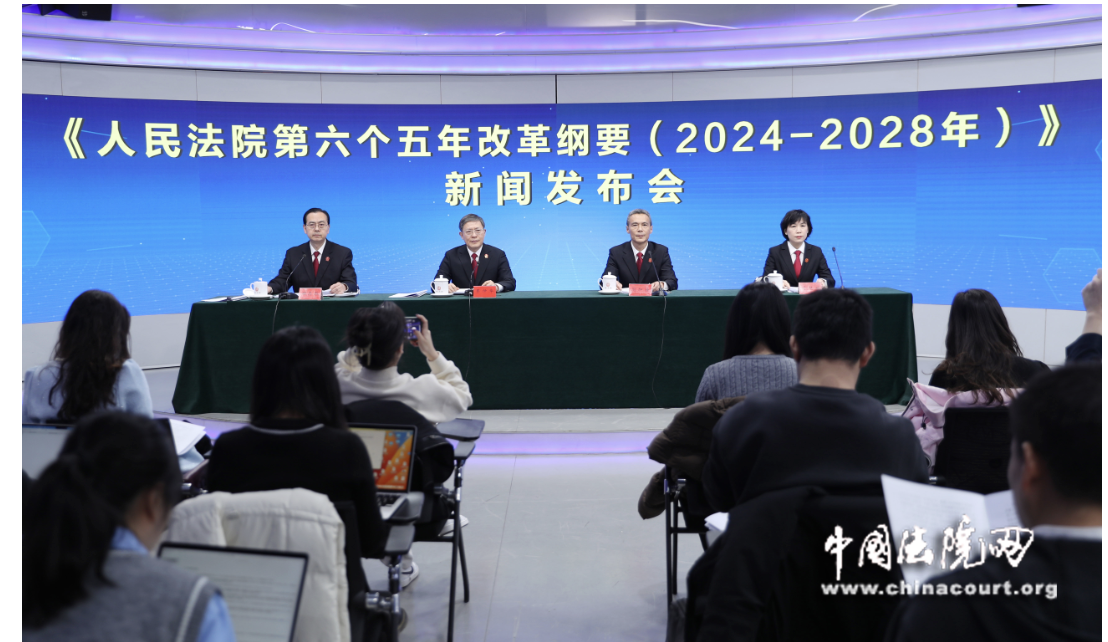

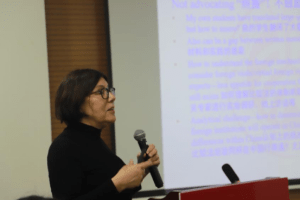
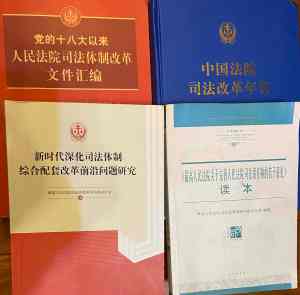

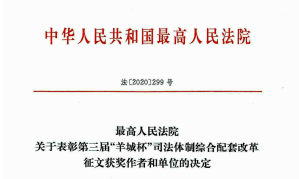
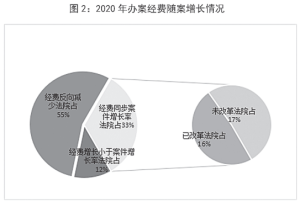
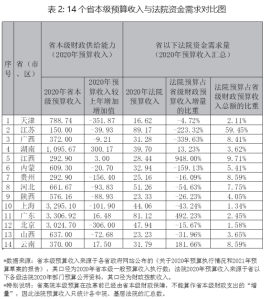

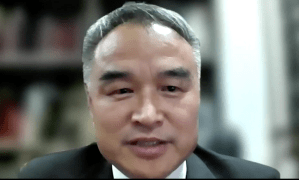 On 7 January 2022, Dean of Tongji University’s School of Law and Professor Jiang Huiling gave a guest lecture in my School of Transnational Law class. We were honored to hear Dean Jiang provide his unique perspective and insights on over 20 years of Chinese judicial reform and his insights on future developments. He has been involved with Chinese judicial reform starting from the first plan in 1999 (see also
  Supreme People's Court Monitor
You must be logged in to post a comment.