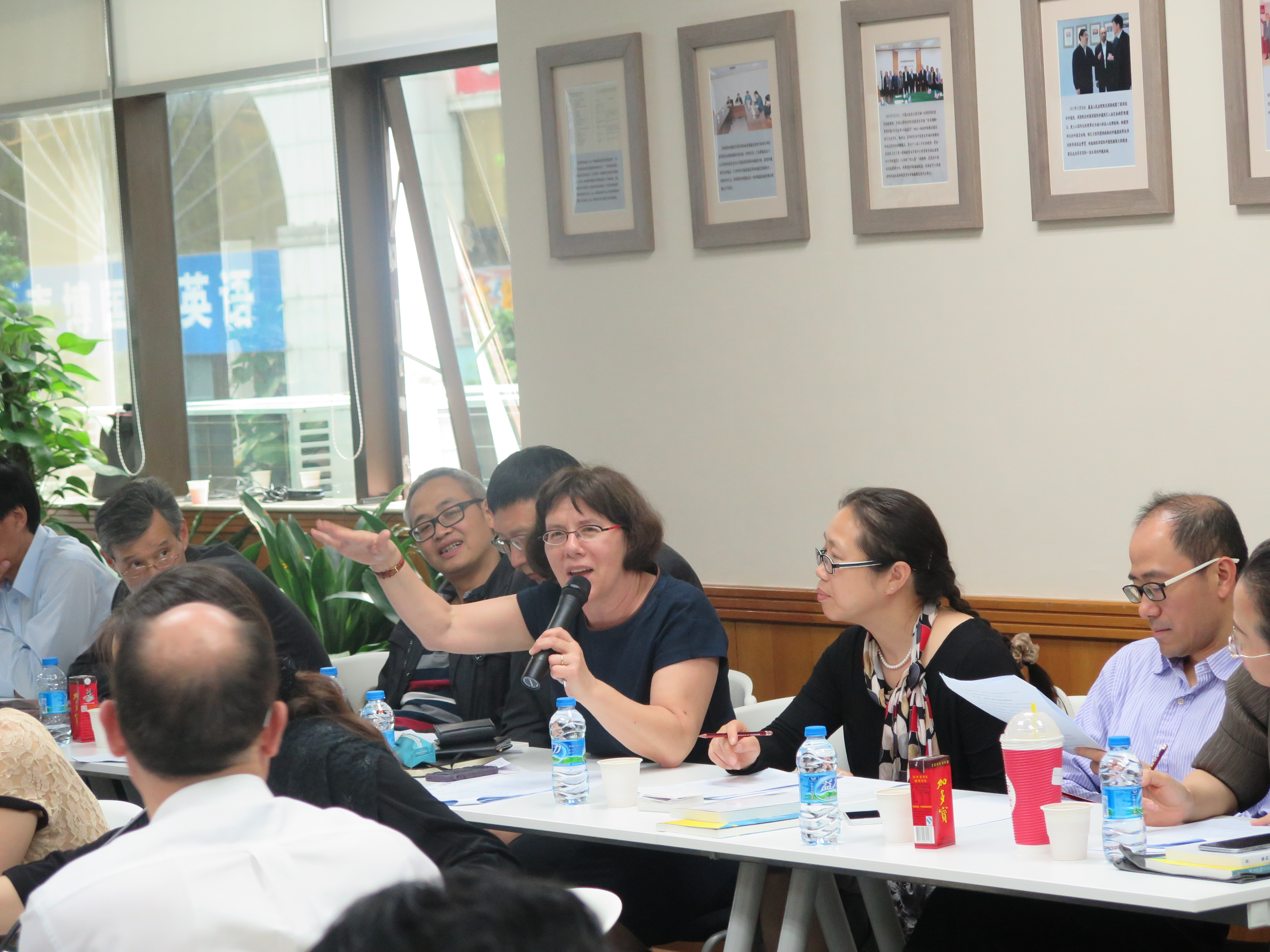
Susan Finder has been observing the PRC Supreme People's Court for over 20 years, and was the first person to engage in a close analysis of its operations. She taught Chinese law and other subjects in the Law Department of the City University of Hong Kong, before putting her knowledge to work in the China practice group of Freshfields Bruckhaus Deringer, one of the first international law firms to recognize the importance of the China market.
She had the good fortune to study with three of the early pioneers of Chinese legal studies: Jerome Cohen, R. Randle Edwards, and Stanley Lubman and to have many leading practitioners and legal academics among her classmates at Harvard Law School (J.D.) and Columbia Law School (LL.M).
Susan Finder speaks and reads (Mandarin) Chinese and Russian and some German.
Medical malpractice law is the elephant in the room for those considering investing in China’s healthcare sector. In March, the Chinese government issued a large scale plan for reforming medical institutions. Part of those reforms include attracting private and foreign capital to invest in hospitals, clinics, and other medical institutions (as the Communist Party Central Committee highlighted in the Third Plenum Decision), but a few other phrases highlight doing a better job of resolving medical disputes.
According to the head of the #1 Civil Division of the Supreme People’s Court (Court) in 2014, the Chinese courts heard almost 20,000 medical malpractice cases, and over the last seven years, there has been 81% increase. Chinese patients (and families) are increasingly aware that litigation may result in a more favorable outcome than other methods. In a recently issued document (still in draft, but already published on the Internet), the Supreme People’s Court has signalled that it is working on:
a body of medical malpractice law rules; and
better systems to resolve disputes involving the medical system.
Some background
In recent years, disputes between doctors, hospitals and patients in China have been in the news, in policy reports, and scholarly articles, with descriptions of beatings, brawls, and killings occurring in Chinese hospitals. The current problems have been highlighted (in English, at least) on this blog, in the press, in NGO reports, and analyzed in several law review articles, including a detailed study by Professor Benjamin Liebman, of Columbia Law School.
What issues is the Court looking at?
Chinese medical malpractice law (and related institutions) are inadequate for dealing with increasingly litigious Chinese patients (and their families) (as highlighted in this earlier blogpost). In the document, the Court announced:
it is working on new ways of trying medical malpractice cases;
high on its priority is more detailed rules on the burden of proof and the standard of proof in medical malpractice cases (the new interpretation of the civil procedure law does not add significant details on this, leaving earlier rules in place);
the concept is to strike a balance between protecting the interests of the patients and enabling normal operation of medical institutions.
The document sets out some rules that are likely to be incorporated into a judicial interpretation:
a plaintiff seeking to bring a medical malpractice cases must provide evidence of the doctor-patient relationship (evidence could include registration card, medical history, hospital discharge certificate), payment receipts;
a medical institution has the burden of proof when asserting that it should not be liable because medical personnel had taken all reasonable medical efforts, or the state of medical development, or other such issues;
in a medical dispute, if a party is found to have been tampering with the medical record, as a result of which it is not possible to determine causation or the extent of damages, the party who has tampered should bear the adverse legal consequences, and the party who cannot explain internal inconsistencies and errors in the medical record should also bear the advertise legal consequences.
Concluding comments
A press report in January, 2015 mentioned that the Court has started work on drafting a judicial interpretation on medical malpractice issues. If previous legislation is any guide, it is likely that the drafters will be looking to foreign jurisdictions with developed medical malpractice legislation when considering these issues. The Court will consult with the relevant regulatory institutions, such as the China Food and Drug Administration and the National Health and Family Planning Commission. Will the Court solicit public opinion?
Investors considering investing in Chinese medical institutions (or doctors practicing in China), should anticipate a more robust medical malpractice system, although not immediately.
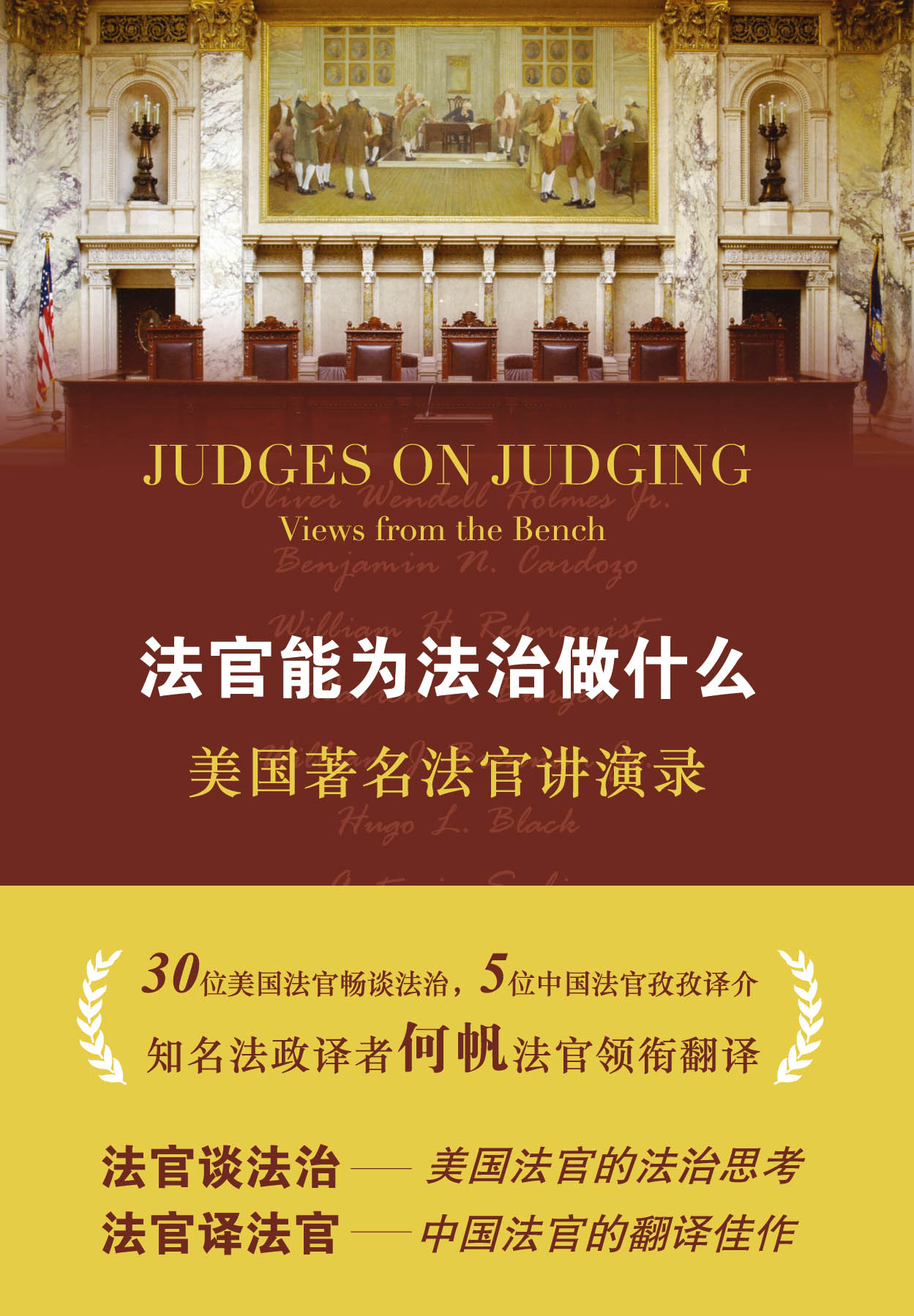
Although Supreme People’s Court president Zhou Qiang has said that judges must “conscientiously resist the infiltration of western wrong ideas,” the May 8 edition of the People’s Court Paper (and the Court’s Wechat feed, which goes out to over 100,000 subscribers) contains a pitch for the Chinese translation ofJudges on Judging: Views From the Bench, by David O’Brien, Professor of Government at the University of Virginia. For those who do not know the book, the publisher describes it as offering: insights into the judicial philosophies and political views of those on the bench. Broad in scope, this one-of-a-kind book features off-the-bench writings and speeches in which Supreme Court justices, as well as lower federal and state court judges, discuss the judicial process, constitutional and statutory interpretation, judicial federalism, and the role of the judiciary. The translation team for the book was five Chinese judges, including one from the Court.
What are the takeaways?
The book is a collection of “greatest hits”–with essays by Cardozo, Posner, Brennan, Ginsburg, Souter, and many others;
It provides a diversity of perspectives and insights into the operation of the US judiciary, including from the state as well as federal judiciary, and from the lower courts, including case selection, internal meetings and opposing views;
The book shows judgment with feeling (感性判断);
It echoes China’s problems. Some of the issues it discusses are being disputed in China’s judicial reforms.Are there enough or too few federal judges? Is having a small number of judges and many cases a real problem? What is the importance of trials (court hearings)? Are judges resolvers of disputes or makers of policy? For those (in China) accustomed to use the US as a model, remarks the chief translator, it is interesting that as the number of cases in the federal courts have risen, the number of trials/hearings has gone down, and that lower court judges spend most of their time with case management and pre-trial negotiations;
Finally, (according to the chief translator) although the book has no answers for China, it provides much food for thought. With rule of law talked about by all, for Chinese judges, to be able to make a contribution to the rule of law, they need to be able to decide independently ( 真正成为独立判断), take matters on, and have sufficient job security.
The chief translator dedicates the book to the late Judge Zou Bihua, who has become a model judge (but whom he knew personally).
On 27 April 2015, the Supreme People’s Court issued a judicial interpretation (English translation here) (27 articles) of the Administrative Litigation (Procedure) Law) (Administrative Litigation Law JI). Judge Li Guangyu, deputy head of the Administrative Tribunal noted that it is not intended to be comprehensive but to address major practical issues the lower courts will face as the law becomes effective.
It was not issued for public comment (there is no such requirement), but comments were solicited within the court system, as well as from the procuratorate, and other authorities, such as the administrative authorities (State Council Legislative Affairs Office and its local counterparts) and the National People’s Congress Legislative Affairs Commission (and its local counterparts).
This judicial interpretation sets out specific rules concerning judicial review of administrative action, filling in some of the blank spots, adding definitions and inserting some specific legal infrastructure (such as filing deadlines) into the Administrative Litigation Law. It is relevant to:
Chinese individuals, companies (domestic and foreign-invested alike), and organizations seeking to challenge a broad range of government actions and decisionmaking;
Foreign governments and international organizations reviewing China’s undertakings to provide impartial and independent tribunals to review administrative action (as China did in its accession to the WTO) or negotiating investment protection and other treaties with the Chinese government;
Foreign companies, organizations, and individuals seeking to challenge Chinese government action.
The judicial interpretation addresses 10 major areas, but this post will highlight the following:
case filing;
requirement that a “responsible person” of an administrative agency to appear in court;
consolidated hearing of a related civil matter;
consolidated review of normative documents;
administrative agreements
consolidated hearing of a related civil matter.
Case filing
Article 1 of the judicial interpretation addresses pervasive refusal by local courts to accept cases (and related problems)(recognized by all stakeholders), by:
directing courts to accept cases on the spot, if it is apparent that the complaint meet statutory requirements;
directs courts to respond within 7 days, if further review is required;
if a court still is unsure after 7 days, it is directed to accept the case.
Appearance by a responsible person
Although during the passage of the Administrative Litigation Law, much was made of the requirement in Article 3 that a “responsible person” appear in court, Article 5 of the Administrative Litigation Law JI clarifies that the head or deputy head of an administrative agency may appoint a representative to appear in court.
Administrative agreements
Article 11 of the Administrative Litigation JI seeks to address, in greater detail, several issues: the definition of an administrative agreement, and what to do about a breach of one. In particular, it details how courts need to hear an aggrieved private party, when a government agency improperly terminates, amends, or fails to perform either:
land acquisition and condemnation agreement; or
a concession agreement.
The first has been a widespread underlying cause of protests, while the second must be resolved if private capital is to heed the call of the Chinese government is encouraging to participate in public-private partnerships, civil-military partnerships, and other uses of private capital to operate public services. Article 11 of the Administrative Litigation Law permits aggrieved private parties to challenge a government failure to perform, or decision to terminate unilaterally or amend a government concession agreements, land or housing expropriation and compensation agreements. In an indication of the the problem, on 6 May the National Development and Reform Commission , which has recently issued regulations on infrastructure concessions, issued a notice to government officials with several warnings including a reminder that concession agreements in force even if a senior government leader changes.
The interpretation also clarifies that a court can hear related civil claims, such as breach of contract or tort claims.
Review of normative documents
Article 53 of the Administrative Litigation Law permits a court to review the legality of a normative document (规范性文件) (often called red titled documents (红头文件)) when reviewing the legal of an administrative act (Under the Legislation Law, these documents have an uncertain status). The Administrative Litigation Law JI adds some further procedural detail and requires a judge that considers a document incompatible with law to set out his reasoning in his judgment and permits a judge to set out suggestions regarding the document to the issuing authority, its counterpart at the next higher level of government, as well as the people’s government at the same level).
Jurisdiction
The judicial interpretation does not address the the issue of hearing administrative cases outside the area in which the case arose. Reform in this area is mentioned in the Administrative Litigation Law itself, and some pilot projects are now underway, (and it is one of the measures listed in the 4th Five Year Judicial Reform Plan Outline), but no consensus has yet been reached on a new approach.
Afterward
Administrative Litigation Law scholars who have spotted errors this blogpost should feel free to use the comment function!
For commercial cases, the amount of dispute does matter in determining which Chinese court will hear your dispute.
On 30 April, the Supreme People’s Court adjusted the jurisdiction of higher and intermediate level courts, both the civilian and military courts in first instance civil/commercial cases in 关于调整高级人民法院和中级人民法院管辖第一审民商事案件标准的通知 (Notice on adjusting jurisdiction for higher and intermediate courts in 1st instance Civil/Commercial cases). The rules described in the notice, which went into effect on 1 May gave Chinese commercial litigators no advance warning. They are not applicable to the following types of cases:
maritime;
foreign, Hong Kong, Macau, and Taiwan related civil cases (there are separate rules on these); and
IP cases.
This means that these rules are applicable to cases brought by (or against) foreign invested enterprises (and domestic enterprises), with the above exceptions. “For the avoidance of doubt,” the notice does not use the term “tier.”
The notice gives a rough idea of the size of business disputes in different parts of China and has special rules to deal with local protectionism, by enabling higher courts to take cases with smaller amounts in dispute if one party is registered outside of the jurisdiction (the Chinese version of diversity jurisdiction in the US federal courts).
First tier jurisdictions
The higher people’s courts of Beijing, Shanghai, Jiangsu, Zhejiang, and Guangdong will now have jurisdiction over cases with an amount in dispute of RMB 500 million or more, (300 million if one party is not registered locally) and intermediate courts, if the amount in dispute is at least RMB 100 million (50 million if one party is not registered locally).
Second tier jurisdictions
The higher people’s courts of the following jurisdictions will now have jurisdiction over cases with an amount in dispute of RMB 300 million (100 million if one party is not registered locally), and intermediate courts if the amount in dispute is at least RMB 30 million (20 million if one party is not domiciled locally):
Tianjin;
Hebei;
Shanxi;
Inner Mongolia;
Liaoning,
Anhui,
Fujian,
Shandong,
Henan;
Hubei,
Hunan;
Guangxi;
Sichuan;
Chongqing.
Third tier jurisdictions
The higher people’s courts of the following jurisdictions will now have jurisdiction over cases with an amount in dispute of RMB 200 million (50 million for non-locally domiciled parties) and intermediate courts will now have jurisdiction over cases with an amount in dispute of RMB 10 million:
Jilin;
Heilongjiang;
Jiangxi;
Yunnan;
Shaanxi;
Xinjiang and the Xinjiang Construction &Production Corp. Court {this latter court deserves a closer look).
Fourth tier jurisdictions
The higher people’s courts of the following jurisdictions will now have jurisdiction over cases with an amount in dispute of RMB 100 million (20 million for a non-locally domiciled party) and intermediate courts will now have jurisdiction over cases with an amount in dispute of RMB 5 million:
Guizhou;
Tibet;
Gansu;
Qinghai;
Ningxia.
Basic level courts:
Are generally to hear the following types of cases:
The PLA Military Court has jurisdiction over civil cases with an amount in dispute of RMB 100 million or more; and
Military region military courts have jurisdiction over civil cases with an amount in dispute of RMB 20 million to 100 million.
Judgments from the military courts are not yet published on the Court’s database. Earlier this year, (as reported here), a PLA legal academic suggested a change in that policy.
Rules to be applied flexibly
There is some flexibility in the rules for cases considered important, difficult, of a new type, or raising issues of general application, in which a higher court can decide to take the case, or alternatively a lower court can apply to hear such cases.
In March, 2015, the Supreme People’s Court (the Court) issued Judicial Transparency in Chinese Courts, its bilingual white paper on judicial transparency (a note for those who don’t know Chinese that the two language versions are not entirely identical, and the English version could have benefited from some polishing).
The paper begins (both in Chinese and English) with the quote–Justice is not to be done, but to be seen done.” The authors appear to be aware with the frustrations of both Chinese and foreign users (and observers) of the Chinese court system with its inadequate transparency, although as an official publication, the report does not confront those issues.The report identifies the (Chinese) general public as having greater expectations concerning judicial transparency and it posing great challenges to the judiciary.
The report highlights the following:
Trial process disclosure platform–the establishment of electronic platforms for litigants and their counsel. Case filing information is not available to third parties (unlike many other jurisdictions). The Court can consider expanding access in this area as well;
Greater access to trials, through on-line broadcasts.
Use of electronic files. China is following a worldwide trend in national court management in piloting electronic files in several locations. It is unclear how China’s current complicated requirements for authenticating a foreign power of attorney, and foreign evidence will interact with this.
Video recording of trial proceedings. Court reporting is not mentioned. This recent blogpost by an anonymous basic level judge criticizes the elimination in the judicial reforms of written transcripts and clerks. The author decries the elimination of written transcripts and the role of clerks as creating an even greater burden on judges, especially at the basic level, who now rely on clerks to review written transcripts. The reforms, according to the author, will mean that the judge must review the video transcript of a trial before drafting a decision. Clerks, according to the author, are generally temporary rather than permanent staff, poorly paid (RMB 1500-2000 in the Yangtze River Delta region) recently law graduates.
Amending Court Rules to permit persons to attend trials more easily. Will those Court Rules be issued for public comment? Will the rules distinguish between foreigners (including foreign journalists) and domestic observers?
The Judicial Opinions of China database. For those with a long-term perspective, it is a a major step forward in Chinese judicial transparency. The database has been criticized both inside and outside of China. Sensitive cases (as may be expected) rarely are posted. In some areas, posting judgments centrally has resulted in less transparency rather than more. For those observers seeking to analyze Chinese court practice, the database makes for slow going, because the search function does not work well, and copying and downloading is apparently not possible. The database is an important tool for lawyers, scholars, and others to understand court practice in specific areas of law, but upgrading the database functionality would be very helpful.
Greater transparency in parole, sentence reduction, and medical parole procedures (described in this earlier blogpost).
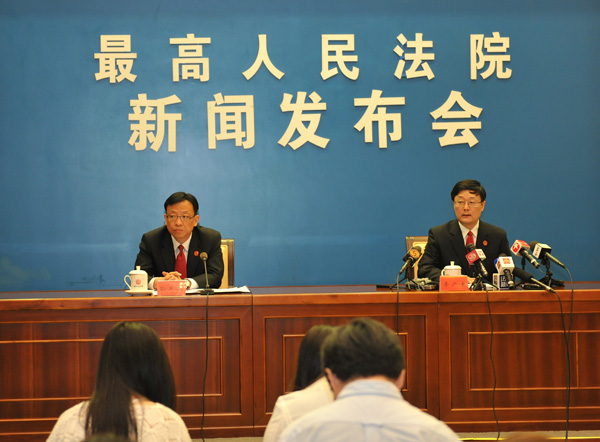
Disclosure of enforcement information (described in this earlier blogpost).Use of press conferences, guiding and typical cases (the latter have been the subject of earlier blogposts) As for press conferences, the practice seems to be for one or more judges (and officials of other central authorities) involved in the drafting of a new judicial interpretation (or other document) to speak at the press conference. For those analyzing Court judicial interpretations or other documents, the press conferences are invaluable, because they provide useful background information concerning their provisions, policy goals, and drafting.
Judicial transparency and state secrets. The white paper mentions state secrets several times. In view of greater transparency in state secrecy classification matters, it would be a step forward for state secrecy regulations relating to the courts to be made public.
As has been highlighted earlier, greater transparency is needed in the drafting of judicial interpretations and other documents.
The report concludes that in the near future, the “Supreme People’s Court will continue to thoroughly deepen judicial transparency…so as to make greater contribution to the full promotion of the rule of law, the construction of a socialist country under the rule of law and the realization of the China Dream of the great rejuvenation of the Chinese nation.” There is still much to be done and many challenges ahead, as the Court navigates between the expectations of lawyers, litigants and the general public and robust state secret/information control regulatory systems.
The answer to this question (in some Chinese courts, at least), is yes. A recent legal blogpost flagged a ruling in a labor case published in the Supreme People’s Court’s case database: Su Qiao v. the Taian (Shandong) Municipal Communist Party Disciplinary Inspection Commission. The author of the blog cited in support of his view Articles 48 of the 2012 Civil Procedure Law and Article 52 of the 2015 Civil Procedure Law Judicial Interpretation (concerning organizations that can be parties to civil litigation).
A subsequent (partial) database search revealed some other civil cases in which Communist Party organizations have appeared in variously as plaintiff, defendant, third party, and party against which the enforcement of an arbitral award was sought, including one decided by the Supreme People’s Court (Court):
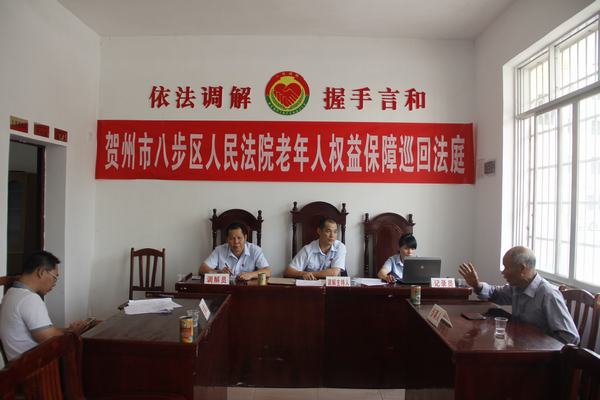
circuit court protecting elderly rights (old man v. son)
In the middle of April, 2015, the Chinese courts carried a report on the issuance of a policy document (the full text is not yet available) by the Ministry of Justice and the National Committee for the Ageing (NCA) (a joint State Council/Party organization, as the Chinese version of the NCA’s website states) on establishing a system of lawyers and legal aid for the elderly. Issues relating to representing the elderly in China mirror those in other parts of the world.
Although the Supreme People’s Court was not one of the institutions that issued the policy document, the national court system is affected by profound changes to Chinese society, including the greying of Chinese society, its urbanization, and other factors. These cases are considered by the courts those relating to people’s livelihood, as discussed in previousblogposts.
The issuance of this document relates to Article 55 of the 2012 Law on the Protection of the Rights of the Elderly, which calls for elderly people to obtain legal assistance if they cannot afford a lawyer needed to defend their rights. The Chinese courts are facing a major increase in cases involving the elderly, both civil and criminal, involving psychological and physical abuse, as a study done by the Suzhou Intermediate Court illustrates. It is likely that the Ministry of Justice and NCA did a more comprehensive study on the need for advocates for the elderly before issuing this document.
From 2011 to 2013, the Suzhou courts accepted 1,100 civil cases involving the elderly. Those increased rapidly over the 3 years in question, because in 2013 586 cases were accepted, an increase of 102.77% over the previous year. The cases related to support, divorce, inheritance, and division of property rights.
in 2013, there was an 83% increase in civil cases involving the right to the division of property rights arising from land acquisition, with over 80% of the property division cases arising in rural areas;
Over 90% of the support cases arose in rural areas;
In 2013, there was a 183% increase in inheritance disputes involving the elderly;
In over 70% of the cases involving division of property rights from land acquisitions, elderly were forced to live in bicycle sheds, garages, or other unfavorable conditions.
In many cases, elderly are shunted back and forth between their grown children, who were fighting over valuable property rights held by elderly parents.
The policy document calls for a one month movement in October to focus on the establishment of probono legal service centers for the elderly. A one month movement appears inadequate for the breadth and depth of this important social problem, which reveals that Confucian values concerning support and care for the elderly have landed in the dustbin of history in too many cases. We look forward to hearing more detailed reports from law firms and NGOs on how the rights of over a hundred million Chinese elderly (anticipated to more than double by 2050) can be better protected.
The Supreme People’s Court often organizes experts meetings (论证会) when drafting judicial interpretations, which are analogous to what in Hong Kong is called “soft consultations” (closed door consultation with market participants).
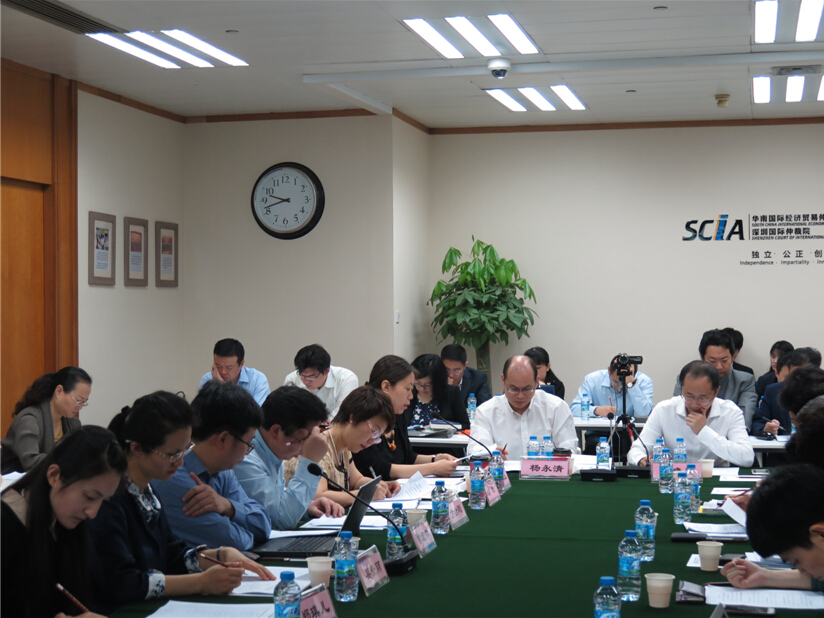
In late March, the Shenzhen Court of International Arbitration (SCIA) and the #2 civil division of the Supreme People’s Court held a experts meeting in Shenzhen to obtain comments from the market on a draft of the #4 interpretation on company law. It was attended by a packed roomful of SCIA arbitrators (as attested by these photos from the report on the SCIA website). Participants included lawyers from the Shenzhen Stock Exchange (SSE), chief counsel for listed companies (primarily on the SSE), law firm partners with a broad range of clients, and the author of this blog.
Judge Wang Dongmin of the #2 Civil Division chaired the half-day proceedings. Vice President of the #2 Civil Division, Yang Yongqing, and Judge Liu Min of the #1 Circuit Court [Tribunal] based in Shenzhen, and other Supreme People’s Court judges also attended.
The review of the draft proceeded in five sections, mirroring the sections of the draft:
when can a court declare invalid or cancel a decision of a board of directors/shareholders meeting;
procedures by which a shareholder’s right to know can be enforced;
how can a shareholder enforce his right to have profits distributed;
issues related to the transfer of shareholding;
issues related to derivative litigation.
The commentators raised some issues not previously raised in previous experts meetings, as well as a broad variety of drafting comments, and practical issues, including many relating to cross-border issues.
The judicial interpretation is being drafted to provide guidance to the lower courts (and the market) in hearing cases concerning these basic company law issues that the Company Law itself does not yet address in sufficient detail. We look forward to a revised draft being issued for public comment, so that the drafting team can receive an even broader range of comments.
The Shenzhen courts, dealing with the “new normal” in China’s social and economic changes ahead of the rest of the country, often find current legislation and Supreme People’s Court interpretations inadequate to deal with the issues that come before them. Divorce law and shadow banking (loans made outside the formal banking system) are two types of cases inundating the Shenzhen courts (and yes, there is a connection).
At the end of last year, the Shenzhen intermediate court issued local court guidance (with an accompanying explanation–these are not “interpretations of law”), binding only on the Shenzhen courts, on two important issues:
In Shenzhen, which is wealthy and where women are relatively rights conscious (at least in divorce), the local courts found that existing rules failed to deal with the issues that came before them regularly.Some of those issues include:
marital property (particularly rights to real property);
the business that a couple may have built up together;
children born outside the marital relationship, and
issues relating to cross-border marriages.
As in so many areas of Chinese law, legislation lags behind social reality. The 2011 interpretation by Supreme People’s Court of the Marriage Law, as it relates to marital property, has been controversial both inside and outside of China, as highlighted by many articles and books addressing the issue because it has meant that in divorce, women often lost possession to home(s) to which they or their parents had contributed substantial funds.This has been particularly true in Shenzhen. The local intermediate court highlighted that over 80% of the divorce cases that are heard locally involve disputes over real property. In divorces, women have continued to argue that they should be awarded possession of the home.
Another issue leading to disputes in and out of the courtroom is the practice of some courts. when dealing with divorces, to split ownership of the family business. The guidance directs judges to consider the family law issues only, and have the division of the business considered in separate proceedings. These rules also contain provisions relating to Hong Kong, where there are many cross border marriages and couples whose lives and property crisscross the border. The court guidance, besides setting out new legal rules, provides a deep dive look into what goes on in many local marriages, judging from the rules relating to children born outside of the marital relationship.
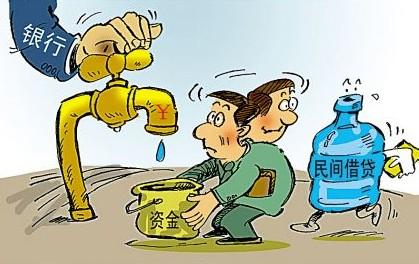
banks turn off funding tap, shadow banking comes to the rescue
Shadow banking loans, which the Supreme People’s Court has finally recognized to be valid (if they meet certain conditions) constitute about 20% of civil disputes in the Chinese courts, according to President Zhou Qiang’s report to the NPC, and the numbers are even greater in Shenzhen. In the court in the business district of Futian, for example, the statistics are as follows:
2012: 1153 cases;
2013: 1627 cases
first half of 2014: 976 cases.
The court guidance in substance an answer to FAQs of the Shenzhen courts on the following questions (and many more):
what if the loan relates to a gambling debt?
What if one spouse lends money to a third party without informing the other spouse?
How can shadow banking be distinguished from the crime of illegal fund raising?
What if the legal representative of a company loans out company money in his own name?
What are the ceilings, if any on interest, penalties and other fees?
We can expect that the Supreme People’s Court will be monitoring the success of these rules in practice when issuing its next judicial interpretation in these areas. And with the Supreme People’s Court Circuit Court (Tribunal) located in Shenzhen, it is likely that discussion of these issues occurs from time to time behind the scenes.
My article on the 4th Five Year Reform Plan for the courts appeared in the Diplomat earlier this week. It gave me an opportunity to put court reforms in their systemic context. This blog will focus on the some of the many micro-steps needed to implement it. One of those micro-steps occurred earlier this month, when the Shanghai #1 Intermediate Court issued regulations on implementing a registration case acceptance system for commercial cases.
My article below was published in the 17 March edition of the South China Morning Post:
To solve the many specific cross-border legal issues affecting the people of Hong Kong and the rule of law in the special administrative region, an independent and non-partisan advisory committee on cross-boundary legal issues should be established.
The committee, which ideally would draw its membership from current or retired senior members of the legal profession, would provide policy guidance to a working group drawn from the legal community. The idea would be to draw together people familiar with the Hong Kong and mainland legal systems. They would work together to propose options for practical solutions to problems involving complex legal issues.
These problems could be issues in the news, such as parallel trading, and other serious problems not in the news such as cross-boundary pollution, criminal justice or domestic violence. The members of the working group must be able to reach out to those with the right expertise or background, regardless of political views.
One example of an important issue not in the news is domestic violence. Grenville Cross SC has recently written about the need for improving Hong Kong domestic law on this front. I have written about domestic violence on the mainland, highlighting new guidance by the Supreme People’s Court and others for dealing with this serious social problem. Hong Kong social trends, such as cross-border marriages and Hong Kong elderly people settling on the mainland, mean that cross-border domestic violence is an unrecognised problem.
Another issue concerns cross-border cooperation in criminal matters. The South China Morning Post reported last autumn that the Supreme People’s Procuratorate had announced that it would focus on establishing ways to bring suspects home, including extradition and repatriation, with Hong Kong as the first target. If the government is being asked to conclude a rendition agreement or criminal law judicial assistance arrangement, this touches on a broad range of legal issues for individuals, companies and other organisations.
A Hong Kong foundation can consider investing some resources to fund the necessary research and analysis on which the advisory committee will need to rely. Such foundations have been generous in funding research on law and Chinese studies in universities elsewhere. The proposed advisory committee and working group are intended to provide practical results and are sure to provide value for money.
On 12 March 2015, Zhou Qiang, president of the Supreme People’s Court (Court) delivered his work report to the NPC, putting the best face on where the Chinese courts are and where they’re going. He described court reforms as being in a “deep water area” (深水区)(a high risk area). This blogpost will highlight issues that other commentators (outside of China) have so far missed:
the mismatch between the focus of the work report and the work of the courts;
what the work report (on other than criminal cases reveals); and
the challenges to the Court leadership in the year ahead.
The primary focus of the work report (as always) is law and order, as seen from the perspective of Communist Party leadership, particularly state security related offenses (including terrorism and “splittism”) as well as ordinary crimes. A big difference in this year’s report is that President Zhou Qiang apologized for previous miscarriages of justice and highlighted efforts to prevent future ones. Other commentatorshavealreadyfocused on these both of these important developments and and other issues related to the criminal justice system.
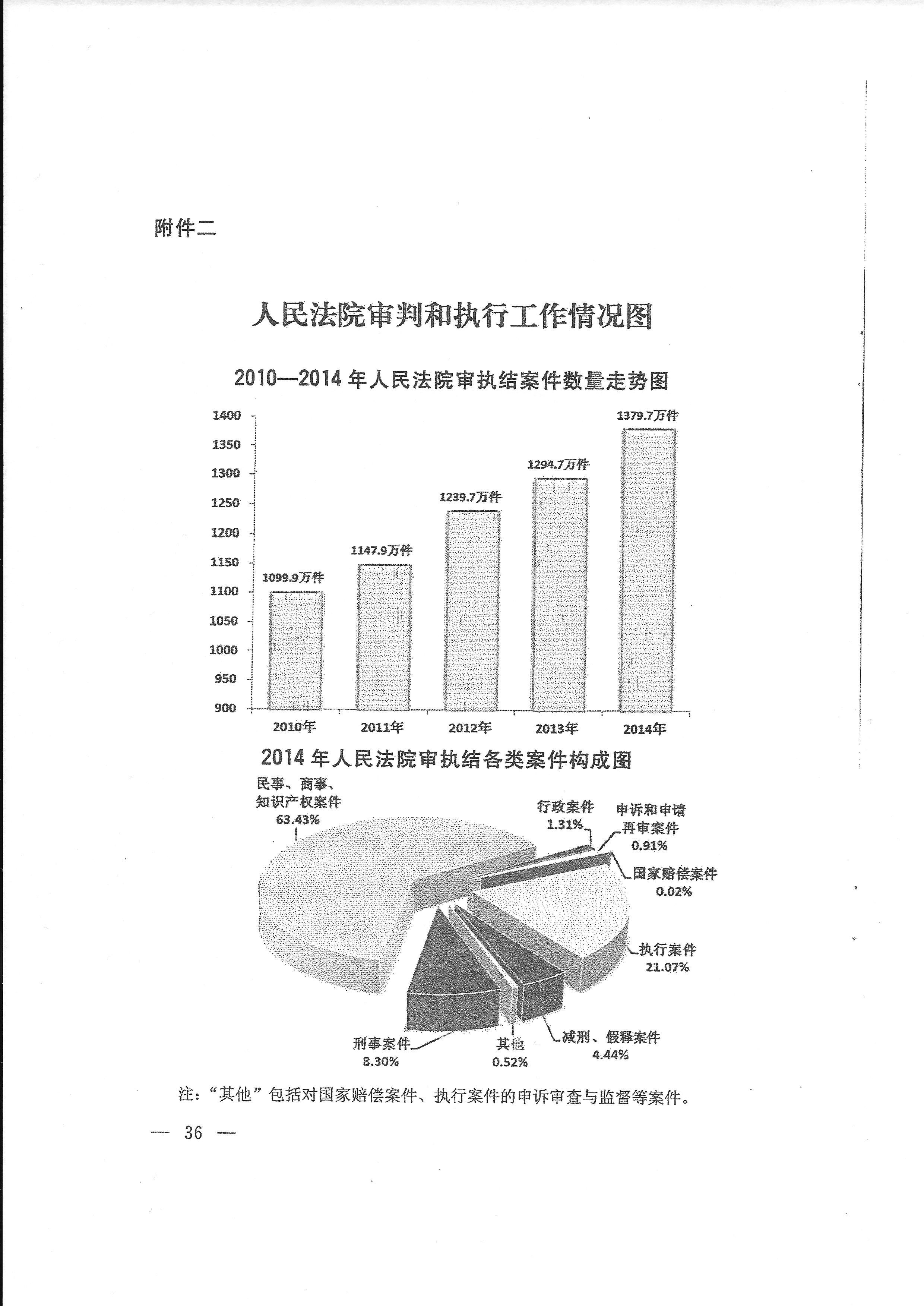
bar chart: 2010-2014 increase in cases resolved by courts (in 10K) Pie chart: civil/commercial/IP; admin; re-trial/govt compens/enforcement/; parole; other/criminal
What the work report reveals is that most cases heard in the Chinese courts are not criminal and that the number of cases heard by the courts is rising.
What are cases are the Chinese courts hearing?
The pie chart (distributed as an attachment to President Zhou Qiang’s report at the NPC), illustrates that over 63% of the cases heard in the Chinese courts are civil cases (including commercial, family law and intellectual property cases), not criminal. Criminal cases (including parole related cases) account for something over 10% of cases (as others have discussed, many minor offenses are handled as administrative, rather than criminal offenses).
A closer look at civil cases in the Chinese courts
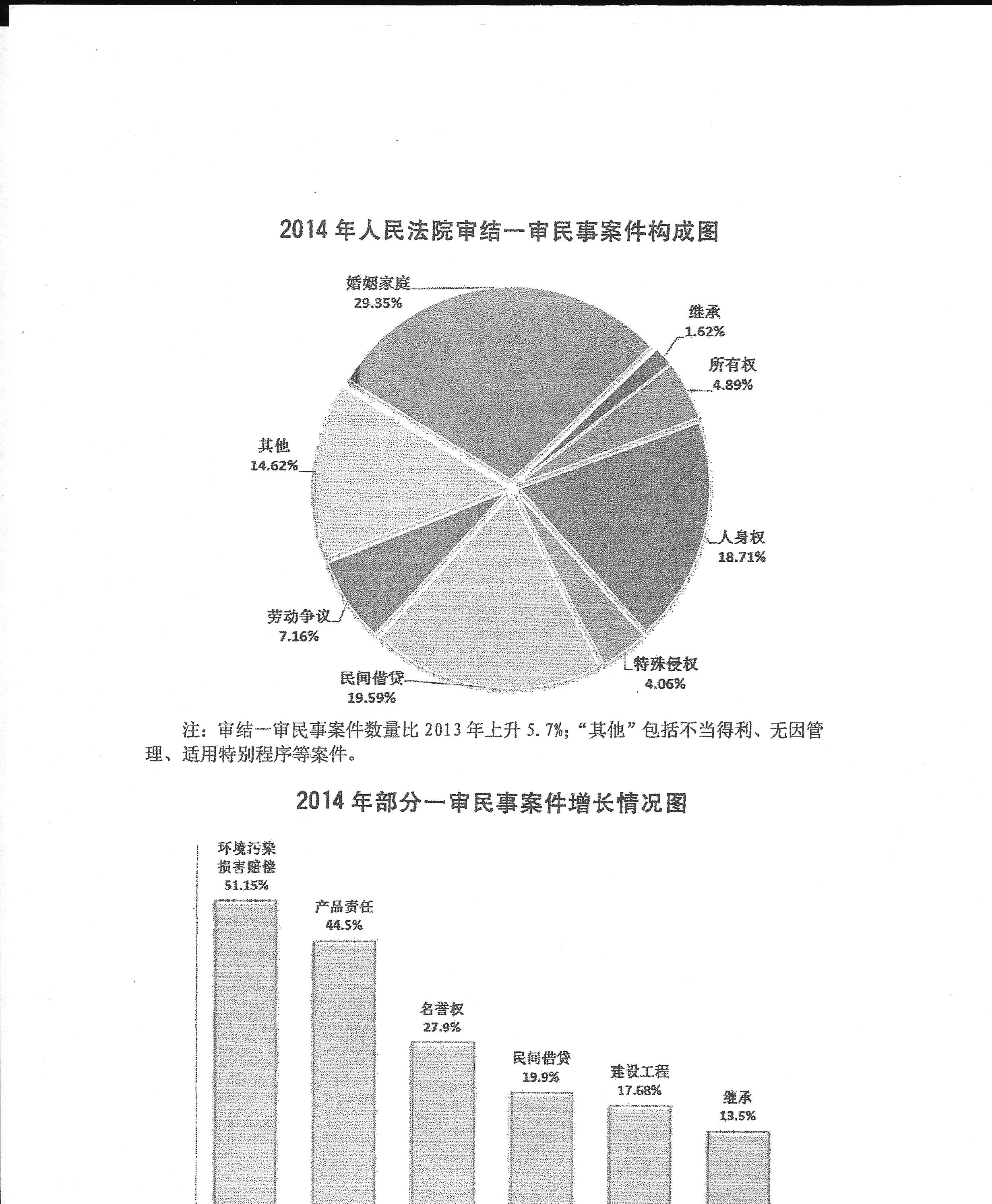
A bit of arithmetic reveals (unfortunately the authors of the Report did not set out a corresponding chart), that 34% of civil cases (2,782,000) in 2014 were commercial cases (up 8.5% year on year), while 66% were what classified as civil cases (in the narrow sense, described below).
Commercial cases:
(These cases are illustrated in the chart to the left that has the ¥ sign.)
1. Finance cases (824,000)(a broad category including various types of loans, credit cards, securities, futures, insurance etc.).
2. Sales contracts disputes (664,000).
3.Intellectual property (110,000, up 10% year on year)(I the detailed analysis of this can be found here, by my fellow blogger, Mark Cohen, at the ChinaIPR blog);
Foreign-related cases (5804), )these, although a focus of foreign law firms alerts and the press, are a tiny drop in the sea of Chinese civil cases. Many cases involving foreign companies actually involve their China incorporated subsidiaries.
The number of finance cases suggests a large number of disputes relating to loans by financial institutions.
Civil cases
(These cases are illustrated in the chart that has two people standing next to one another and the pie chart below.)
2014 civil cases in the Chinese courts
In 2014, 5,228,000 civil cases were heard in the Chinese courts (up almost 6% year on year):
1. Family law cases (1,619,000),(this category includes contested divorces, inheritance, support cases), accounting for about 30% of civil cases. The chart above 13% year on year increase in inheritance cases (showing an increasing number of people have assets worth fighting in court over, and perhaps also inadequate estate planning).
2. Loan cases not involving financial institutions (between individuals, company and individual, or two companies) (1,045,600), accounting for almost 20% of civil cases. (The categorization has changed, making a year on year comparison not easily possible).
3. Labor cases (374, 324), accounting for 7.16% of all civil cases. These include appeals from labor arbitration as well as cases that can be directly brought in the courts).
4. Environmental tort cases (3331) (up 51% year on year).
5. Product liability cases are up 44%, but the base or total number for 2014 is not set out.
6. Cases involving rights of rural residents (219,00)(rights to rural residential land, transfer of contracted land) migrant laborers seeking unpaid wages).
7. Construction disputes are up almost 18% (base or total number for 2014 not set out).
These numbers speak to:
1. changes to the Chinese family;
2. a large number of loans that are under the radar of the financial authorities;
3. employees who are increasingly rights conscious;
4. continued litigation risk for foreign companies doing business in China (including through subsidiaries), because as perceived “deep pockets”, Chinese litigants often target them in product liability cases.
Administrative cases
First instance administrative cases (companies or individuals suing the government) (131,000) continue to be a tiny number, although up 8.3%, and it remains to be seen whether the amended Administrative Litigation Law (Administrative Procedure Law) will lead to an increase in cases.
Enforcement cases
Enforcement cases (compulsory enforcement of court judgments or orders, arbitral awards, etc) account for 3,430,000, a 14% increase year on year. This suggests that fewer people (companies) are complying with dispute resolution voluntarily.
10% increase in cases accepted (will be a challenge to the courts if this trend continues because the intent is to cut the number of judges), amount in dispute is up 15%.
Court reforms already in a “deep water area”
Zhou Qiang highlighted that court reforms are already in a “deep water area” (high risk area) and the courts:
need to penetrate interest group barriers;
have the courage to move their own “cheese”;
need to use “the knife” against itself (presumably to cut out corrupt, poorly or non-performing judges);
deal with many deep-seated problems;
make progress on a long list of reforms:
continue and expand pilot reforms on changing the financing and personnel appointments of the local courts to all provinces/directly administered cities;
implement hearing-centered litigation reforms;
make progress on case filing reforms (to resolve the long term problem of litigants facing obstacles when they file suit);
put in place a system with dealing with assets seized and confiscated by the courts (to avoid violation of property rights and further judicial corruption in this process);
implement the prohibition against defendants wearing prisoner’s garb in court;
further implement judicial reforms related to petitioning;
promote alternative dispute resolution, such as arbitration, people’s mediation, administrative mediation etc.
continue work on pilot projects on expedited criminal procedures (for minor matters);
improve the people’s assessors system.
All of these reforms create tremendous challenges for the courts. The number of cases accepted by the courts in 2014 (15,651,000) was up about 10%. The judicial reforms to petitioning and other reforms will channel more disputes into the court system. Planned personnel reforms are leading to an exodus of young judges. Many of the planned judicial reforms are intended to the way the courts operate internally and interact with other institutions. The 4th Five Year Court Reform Plan sets out target dates for accomplishing certain major judicial reforms. The salary gap between what an experienced lawyer in private practice in a major law firm and a counterpart in the judiciary is large, leading many talented people to prefer the greater financial benefits and professional flexibility that comes with being a lawyer.
The political leadership has approved the 4th Five Year Court Reform Plan. Issuing it raises expectations among ordinary people as well as those in legal profession. The pressure is on for the Court leadership to deliver on the promised judicial reforms.
On 4 March 2015, the Supreme People’s Court hosted a press conference, attended by officials from the Supreme People’s Procuratorate, Ministry of Public Security, and Ministry of Justice, to announce their jointly drafted and long-awaited policy document (translation here) on domestic violence, on which the Supreme People’s Court took the lead. (The Domestic Violence Law has not yet been promulgated. The intention is to create an effective anti domestic violence system, incorporating principles common to other jurisdictions as well as international domestic violence legislation. The United Nations, the American Bar Association, the Australian government, and many other international and national institutions and organizations have worked with the Supreme People’s Court and other Chinese institutions for many years on these issues, to assist the Chinese institutions to understand domestic violence law and practice elsewhere in the world. This blog has highlighted earlier work by the Supreme People’s Court on domestic violence. Some of the highlights include:
Domestic violence includes violence between family members and others who live together in relationships, such as guardianship,support, foster care, cohabitation (it intends heterosexual relationships and may (or may not include homosexual relationships).
The authorities need to intervene timely and efficiently, to protect the safety and privacy of victims;
Collect evidence of domestic violence in a timely manner, including objects on site, undertakings by the victim, witness statements, as well as from the community obtain medical records, photos, videos, and other evidence.
Respect the intention of the victims;
Provide special protection to juveniles, the elderly, the disabled, pregnant and nursing mothers, and the severely ill through legal assistance and other measures;
Encourage the community to report cases, including friends, neighbors, coworkers, hospitals, schools, kindergartens, and other institutions and entities;
The authorities (public security, procuratorate, courts) must protect the privacy of persons making accusations or reporting domestic violence who do not want their identity revealed;
The authorities must make arrangements to ensure the health and safety of victims;
If the accused aggressor is permitted to be out on bail, the aggressor can be order to stay away from the victim and juvenile children;
It sets out principles concerning the abused spouse/partner defense;
Cases must be quickly and efficiently investigated, accepted, and transferred (to avoid the “buckpassing” that occurs, to the detriment of victims);
In less serious cases, the authorities should make use of undertakings by aggressors not to commit the offense, apologizing to the victims, compensating the victim, and other non-criminal measure;
Courts should use measures to protect the safety of victims and other dependents, such as ordering the aggressor to leave the home, forbidding the aggressor from approaching the victim, and other protection orders.
The Supreme People’s Court also issued model/typical five domestic violence cases to illustrate issues such as:
domestic violence includes elderly violence;
domestic violence includes violence to children;
domestic violence includes violence to persons living together who are not married;
domestic violence includes maltreatment to the point of causing the victim to commit suicide.
Comments
Many of the provisions of the opinion address outstanding problems that the Chinese justice system has in dealing with domestic violence–disregarding it as a “family matter,” revealing the identities of those who report it, recognizing beatings,forced overwork, mental and physical torture as abuse.
This opinion is intended to deal with the many domestic violence issues that have arisen and which have caused a great deal of public controversy. Implementing it will require a great deal of hard work, including a change in attitude among many in the police, prosecutors, and courts.
The Supreme People’s Court’s 4th Five Year Reform Plan has finally been released to the public (linked here). An English translation will be forthcoming here. Some of the issues highlighted have been discussed in earlier blogposts (as linked) and it builds on the principles released in July, 2014 and in the 4th Plenum Decision. It is critical to the development of the Chinese legal system and has its international implications as well. Some of the highlights:
Basic principles (Party leadership is a given): independence of judicial power (审判权的独立性); neutrality (中立性), procedurality 程序性), finality(终局性) (all distinguished from “Western style” judicial independence).
Among the specific measures are:
Specific deadlines for reforms or structures for reforms to be put in place (some by end 2015, others by end 2016, 2017, 2018);
Greater transparency in a broad range of areas, ranging from the parole of prisoners, assignment of judges, to the handling of property seized or confiscated by the courts;
Measures to cut back on local protectionism, such as cross jurisdictional and circuit courts, focusing in particular on major administrative cases, environmental cases, bankruptcy cases, food safety cases and others, by changing jurisdictional provisions in administrative cases, environmental cases, and others);
Details on what the Court means about “hearing centered procedure,” and imposes a goal of end 2016 to establish a hearing centered system, as having evidence presented and reviewed at the hearing, both parties being given a chance to be heard, requiring witnesses and experts appear at hearings; assumption of innocence, exclusion of illegally obtained evidence (and establish systems for determining and excluding such evidence), all of which involves a greater role for lawyers;
In the area of criminal justice, provides better protection to defendants and their counsel, such as prohibiting criminal defendants from being forced to wear prison clothing, shackles, etc., idea that the prosecution and defense have equal status in the criminal process, better judicial review of individuals whose freedom is restricted;
In civil cases, requiring evidence to be reviewed at trial and major disputed evidence must be highlighted in the judgment or ruling and whether the court is relying upon it;
Improving the status of lawyers in both criminal and civil litigation;
Reforming jurisdiction in environmental cases;
Improving jurisdictional provisions in public interest cases (which at this time means environmental and consumer cases);
Changing the docketing process from a substantive review to a registration procedure (which in the past has meant that “inconvenient” cases were not accepted);
Reforming internal court procedures and roles, particularly that of the court president, members of the judicial committee, and heads of division, requiring documentation of communications with the judge or judges handling the cases, as well as focusing the judicial committee on legal questions (external pressure on these court leaders has been a significant factor in the miscarriages of justice now being revealed);
Distinguishes the functions of courts at first and second instance (as well as re-trial and judicial supervision) stages;
In appeal cases, the court should set out the issues in the case at first instance;
Changes the relationship between the higher and lower courts so that they operate independently;
Prevents judicial corruption in a variety of ways, such as improving the judicial auctioning process, confiscation of property, and much more transparency;
Setting up a system for preventing interference in court cases by requiring notes, etc. from leaders to be retained in the file and made available to parties and their counsel;
In the spirit of greater openness, the document states that reforms by lower courts are to be reported to the Court before being launched and major reforms need to be reported to the Party central authorities before being launched [apparently to ensure Party leadership to prevent the political authorities from being unpleasantly surprised].
The changes relating to basic court institutions will affect all types of cases, whether they are environmental, intellectual property, or foreign-related ones.
The drafting of this document required countless hours of work and negotiations. The real work is ahead, in implementing its principles, and in particular changing patterns of behavior as well as institutional and political culture formed over several decades.
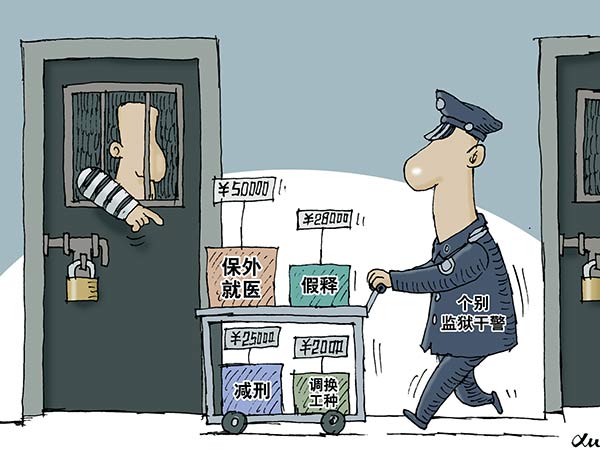
Prisoner choosing commutation & parole options from corrupt jail official
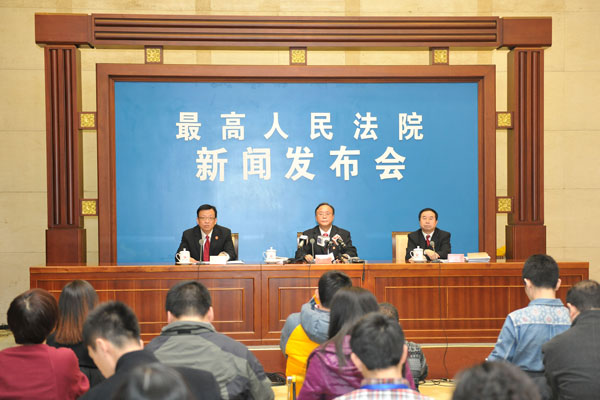
Before Chinese new year, the Supreme People’s Court held a news conference to highlight its accomplishments in reforming parole procedures. The previous procedures (or lack of them) (as described below) appeared to have been a money-spinner for prison officials. The reform in parole procedures highlights the value that current Chinese legal policy places on Justice Louis D. Brandeis’s wisdom (without citing him):
“Publicity is justly commended as a remedy for social and industrial diseases. Sunlight is said to be the best of disinfectants…”
The change in parole procedures also are a good example of how results of investigations by the Central Commission for Discipline Inspection (CCDI) and Central Political and Legal Committee policy documents are eventually are translated into improvements in legal procedures.
The reforms to parole procedures include:
The Court’s August, 2014, Provisions On Commutations And Parole(最高人民法院关于减刑、假释案件审理程序的规定) (translation can be found here), requiring much more transparency;
November, 2014 procedures issued by the Court along with the Ministry of Justice, Ministry of Public Security, Supreme People’s Procuratorate, and National Health and Family Planning Commission on medical parole and related issues (暂予监外执行规定), establishing stricter guidelines.
Establishing an internet platform on the Court website to make public (provide sunlight) parole/commutation matters: acceptance of applications, notice of court hearings,and court rulings;
Establishing a filing system under which decisions relating to officials of county level (or section (处) need to filed with provincial high courts and provincial department (bureau level(局)) need to be filed with the Court;
Model cases on parole and commutation, to guide lower court judges in their work, and inform the public on these reforms.
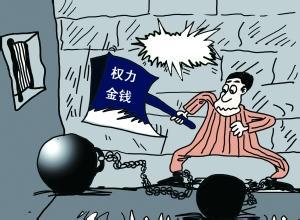
Axe labeled “power”, “money”
The background
With flexible provisions and limited transparency on medical parole, commuting sentences, and parole procedures, in recent years apparently underpaid Chinese prison officials caught the entrepreneurial spirit and (like the Monopoly game that many of us grew up playing), sold “get out of jail cards” to those who could afford to pay. Those were generally made up the wealthy and (formerly) powerful, particularly those who had committed the following crimes:
duty crimes (including taking bribes and abusing authority);
organized crimes;
financial crimes.
An August, 2014 press report mentioned that over 700 prisoners nationwide had improperly secured early release. Other reports cited that prison officials in Guangdong were particularly entrepreneurial, arranging for the improper release of approximately 140 in Guangdong, primarily former officials, including:
Wang Ju, former vice mayor of Shenzhen;
Zhao Yuchun, former head of Shenzhen customs;
Huang Shaoxiong, former deputy head of the Guangdong United Front Work Department; and
CCDI investigations and Central Political Legal Committee policy document
It appears that these reforms can be traced back to CCDI investigations in 2013 (and possibly earlier), because in August, 2013, the CCDI website carried a summary of a speech by Xi Jinping at a CCDI conference in which he calls for reforms to parole procedures. At about the same time reports of investigations into prison officials were released by CCDI, such as one of a Hunan Province Justice Department (the Justice departments run the prison) official who was found to have almost USD 2 million (12 million RMB) in assets disproportional to his income. Manyother prison officials in other provinces have also been investigated.
In January, 2014, the Central Political Legal Committee issued a policy document outlining the policy framework for the reforms, which began with the frank admission that society was incensed by the rich and powerful who had been sentenced to prison who often served relatively short sentences because they had their sentences commuted or were given parole, directing special restrictions prisoners convicted of the above three types of crimes. (The Supreme People’s Procuratorate has issued its own regulations to implement the policy document.)
Going forward
Reducing corruption in the justice system and giving Chinese people more confidence in it is a multi-faceted process, with greater transparency needed across many areas. These reforms to parole and commutation procedures are likely to be one of the accomplishments that President Zhou Qiang will be able to point to when he gives his report to the National People’s Congress next month, particularly as the August, 2014 regulations are listed as one of one of the Court’s 10 major policy accomplishments of 2014.
Additionally, the internet platform also serves as a window into criminal activity in China, such as the recent application by a Han native of Xinjiang, convicted in Beijing of dealing in drugs, but who was permitted by the Chaoyang District Court to serve his sentence outside of jail for the next six months, because he has AIDs.
I had the good fortune to have a meeting with some judges of the Supreme People’s Court last week in the main building of the Supreme People’s Court. The rules are now such that photographs of the gate (and nameplate of the Supreme People’s Court) are forbidden, a contrast to 20+ years ago, when I was able to ride my bicycle along the road fronting the Court. As the Supreme People’s Court guides the courts towards more transparency and public access, I look forward to the day when it can become a tourist destination and its hearings more open to the Chinese and foreign public.
I wish all my readers all the best for the Year of the Sheep 祝大家新春快乐,身体健康,万事如意!
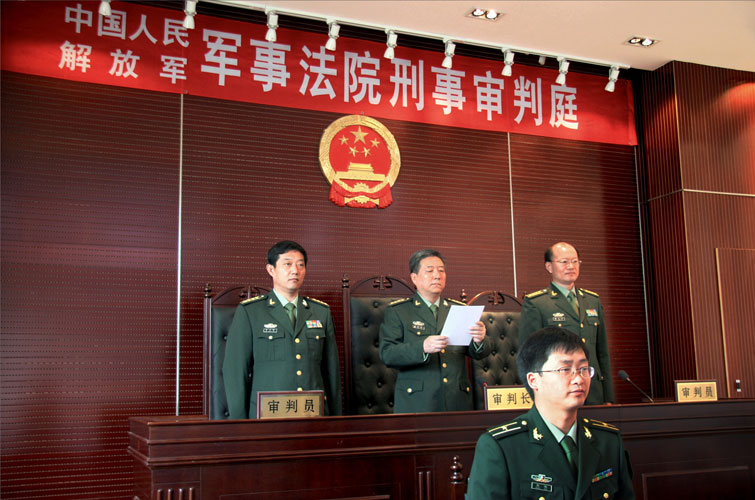
In early February, I published an article in The Diplomat, focusing on little understood post 4th Plenum developments on Chinese military law, which (to my surprise) was summarized and translated by Chinese official media. Professor Zhang Jiantian of China University of Political Science and Law recently published an article in People’s Court Daily on issues affecting the military courts, in which gives the outside world a glimpse of the gated Chinese military legal community and sets out his recommended reforms. My article in the Global Military Justice Reform blog summarizes Professor Zhang’s views and recommendations.
On 4 February the Supreme People’s Court (Court) issued a comprehensive interpretation of the 2012 Civil Procedure Law, with 552 articles, longer than the 294 articles in the law itself. It creates a much more sophisticated body of civil procedure law. The Court has been working on this interpretation for over two years. As is usual, the Court held a press conference to explain its significance. The text of the press conference, in which the Court spokesman and Judges Du Wanhua and Sun Youhai spoke, is also available on the Court’s website. A few of the highlights of the interpretation:
More detailed section on evidence, including recordings, reflecting the longer term work underway to draft an evidence code.
A new section on public interest litigation, in relation to environmental, consumer cases and other such cases. The organization must show prima facie evidence of harm to the public interest. Other organizations and administrative agencies can apply to be joint plaintiffs.
Much longer section on foreign related issues, including provisions concerning foreign language evidence (translations should be provided), and if the parties disagree on the translation, they should agree on a third party translation agency.
Permission of the court is required to tape, video, or provide live posting on social media.
Many provisions relating to divorce of [former] Chinese citizens who have settled outside of China.
On 29 January, the Supreme People’s Court issued regulations on legal representation in death penalty cases, Measures for Considering the Views of Defense Lawyers in Death Penalty Review Cases (最高人民法院关于办理死刑复核案件听取辩护律师意见的办法) (translation available here). This blog previously flagged that the Court was drafting them and that they were meant to be issued by the end of the year. They will become effective on February 1. They were accompanied by a brief question and answer session with a “responsible person” from the Court’s #1 Criminal Division. presumably the head or deputy head. These brief regulations provide important protections to those sentenced to death, and are part of the Court’s efforts to minimize mistaken cases.
The regulations permit defense lawyers to review the defendant’s file, provide additional evidence and have a hearing with the judges handling the case, although not a formal court hearing. The Court has created a room for lawyers to use to review death penalty review materials. The transcript of the hearing (as signed off by the defense lawyer) is to be included in the case file. However, defense counsel has only two weeks to submit its additional opinion in the case. Presumably this deadline can be extended if counsel provides justification.
The regulations set out the telephone numbers of the Court’s criminal divisions, which review death penalty cases. This blogpost translated a chart drafted by the Chinese magazine Southern Weekend setting out jurisdiction of the various divisions.
This is an important step forward in protecting the rights of criminal defendants and is the product of many years of law reform efforts.
Obstacles to public interest litigation-filing suit & obtaining evidence
Many China observers were surprised to learn that in early January, 2015, the Supreme People’s Court (Court) issued an interpretation on enabling civil society organizations to sue polluters on behalf of the public, when most commentators take the view that those organizations are controlled more tightly than before. The Court issued it after years of work, analysis, and low numbers of environmental lawsuits (highlighted in my earlier blogpost), particularly public interest ones.
This blogpost explains:
what the Interpretation does;
what its background is;
why the Court is enabling environmental NGOs to file suit; and
An assessment of its implications.
This blogpost should be read with Barbara Finamore’s blogpost, How China’s Top Court is Encouraging More Lawsuits Against Polluters.
What the interpretation does
The interpretation, entitled “Interpretation on Several Issues Regarding the Application of Law in Public Interest Environmental Civil Litigation (Interpretation) (Chinese original found here and translated here). The Interpretation (like many other Court interpretations) combines court procedural rules with additional rules on liability and other legal standards to put in place a framework for Chinese environmental NGOs to file public interest environmental cases against polluters. It supplements Article 58 of the Environmental Protection Law (amended in 2014) and the 2012 Civil Procedure Law, because neither law had sufficient legal rules to guide local NGOs in bringing and local courts in accepting, hearing, and deciding these lawsuits.
A draft of the Interpretation had been issued for public comment on 1 October and the final draft reflects comments from the public. Both domestic and international organizations commented on the draft.
The Interpretation authorizes environmental NGOs with a five year track record that are legally registered with the local NGO regulator, the Ministry of Civil Affairs or its local counterpart, to sue polluters on behalf of the public, and to seek the equivalent of a permanent injunction, compensation, orders to clean up the pollution, or an apology, among other measures. A Ministry of Civil Affairs official recently estimated that about 700 environmental groups met current qualifications.
The highlights:
Broad definition of environmental NGOs that can file suit. At the press conference announcing the Interpretation, the Court spokesman said that a broad definition was adopted so that it would be flexible enough to accommodate additional types of approved non-profit groups. This may be have been done to accommodate contemplated reforms to non-profit institutions;
Provisions permitting an NGO to seek a court within a provincial boundary but outside the locality of the polluter to hear the case. Because local courts are locally funded, they are often reluctant to hear or decide cases that cause result in judgments against companies that are often substantial contributors to local tax bases. An NGO is also allowed to sue polluters outside of its own locality. This was also highlighted in the same press conference.
The Interpretation enables injured private parties to piggyback on the NGO’s case, also highlighted by the Court spokesman.
Several provisions to require court oversight when NGO settles the lawsuit, to guard against intimidation by the polluter, which may be allied with local government.
The damages the polluter pays are paid into a pool of money, which is used to compensate those harmed.
If the defendant polluter refuses to provide information about pollution discharge, the court can presume that the plaintiff’s assertions have been established.
Several provisions are designed to reduce the costs of litigation to the NGO.
The litigation must not be profit making for the NGO.
The Court spokesman described these cases as “a new type”, difficult to try and enforce, and ones that attract a great deal of public attention, but given the high degree of public concern, in January, 2015, China’s People’s Court Daily identified the Court’s environmental legal policies, as being the SPC’s top judicial policy initiative in 2014.
Some background
The Interpretation reflects years of work within China by local legal experts, local environmental NGOs, as well as the technical support of international organizations such as the United Nations Development Program, the Asian Development Bank, and other China-based foreign NGOs, and universities. The structure established by the Interpretation reflects concepts adapted from US law and other foreign legal systems, but reflects Chinese legal, political and societal realities.
The Third and Fourth Plenum decisions both highlighted establishing compensation systems for those responsible for creating ecological or environmental damage, and the Court’s policy document on environmental issues, issued in June, 2014, signaled the importance to the government of public interest environmental litigation.
Track record of Chinese courts on environmental litigation
About 170 courts have now established environmental divisions, but according toCourt studies, most have heard relatively few cases. Public interest environmental litigation was piloted in provinces as diverse as economically developed Jiangsu Province and the less developed southwestern provinces of Yunnan and Guizhou. These cases have been analyzed both in Chinese and English.The pilot projects highlighted some of the underlying issues, which include local protectionism, lack of specific provisions on these cases, lack of training, and lack of coordination between the environmental protection authorities and the courts. An additional issue is also the performance indicators (now being reformed) of the courts, which incentivizes judges to avoid taking risks.
From 2000 to 2013, only about 50 environmental public interest lawsuits were heard in China, most of which were filed by government agencies, according to a report by the state-sponsored All-China Environmental Federation. NGOs have attempted to file environmental public interest cases for many years, but have generally been refused by the courts. For example, although the All-China Environmental Federation filed eight lawsuits in 2013, but none were accepted.
Model cases before the Interpretation was issued
In the last few months, several public interest environmental cases have received a great deal of attention, including:
A case decided at the end of 2014 involving by a semi-official NGO in Jiangsu Province, where the Taizhou City Environmental Protection Association (the chairman, Tian Jun, is also the head of Taizhou’s environmental protection bureau) against six chemical companies that had polluted local rivers resulting in a 16 milllion RMB compensation against the polluters.
[public interest litigation] compensate my losses!The Chinese government recognizes that the degradation of the environment in China, along with the harm suffered by hundreds of millions of people from air, water, and soil pollution is a social and political problem, and the system, without involving NGOs, was unable to address the problem, and that it is preferable to resolve environmental problems by bringing environmental disputes into the courtroom, rather than having demonstrations against polluters.
The joint policy document issued by the Court, MCA and MEP seeks to overcome local government hostility to environmental NGOs. Local governments had often been often unfriendly to environmental NGOs. The head of the Chongqing Green Volunteers Association was quoted in 2012 as saying “I annoyed a lot of government officials and businessmen. They hired gangsters to beat me up,” he says of the early days of his work. “After hearing this news, many of my environmental activist friends were too frightened and they left me – one after another. I was feeling very helpless.”
Implications
The predictions in the Chinese legal press are that the Interpretation will eventually lead to more litigation, despite local protectionism and the technical demands on NGOs preparing to bring these lawsuits.
On January 1, 2015, the day that the new Environmental Protection Law went into effect, the environmental NGOs Friends of Nature and Fujian Green Home, with the support of lawyers from the environmental law center at China University of Politics and Law, , filed an environmental public interest suit to counter damage to a woodland area by mining activities in Nanping, Fujian province; the case was subsequently officially accepted
On January 4, 2015 with the support of funding from the Alibaba Foundation, NRDC’s partner organization Friends of Nature officially launched an “Environmental Public Interest Litigation Support Fund.”
On January 13, 2015 the All-China Environmental Federation filed two lawsuits in Shandong’s Dongying Intermediate People’s Court against polluters in Zhejiang and Shandong provinces, which were accepted.
Based on my own contacts, other environmental NGOs are reviewing their activities to consider whether they have an appropriate case.
You must be logged in to post a comment.