“Improper discussions” of Chinese judicial reform are forbidden


a29fc3aa1b904dbe8b6345d0ec3cd234
Home of Judges

One of my favorite Wechat public accounts, the “Home of Judges” (法官之家) was closed down earlier this month.  The public account had about 100,000 followers. (Wechat public accounts  are explained here.)  While some public accounts are used as corporate marketing platforms, “Home of Judges,” along with several other public accounts have become platforms for (primarily) young judges (and lawyers) to share their views, experiences, and analyses. The Home of Judges public account published articles by many local judges, many with their concerns and thoughts about different aspects of judicial reform, with other articles describing by current or former judges explaining why they left or were thinking of leaving the judiciary.  The account holder for the public account, Li Liang, a former Guizhou Higher People’s Court judge wrote:

I had a feeling that Home of Judges would be closed down–first the News Bureau of the Supreme People’s Court contacted the news department of my court, demanding that the name of the public account be changed, but the editor did nothing, then I heard that the internal reference service of the Supreme People’s Court SPC) carried some Home of Judges articles, then recently the Beijing News Department deleted articles.

法官之家被禁封了,其实最近即有预感,先是最高法院新闻局找到我院新闻处长,要求将公号改名,小编未置可否,后来听说最高法院内参连续刊载法官之家文章,最近北京新闻处长多次联系删稿,

An anonymous article by the Sword of Heavenly Peace (长安剑) (according to some sources a pseudonym for the Central Political Legal Committee set out a seemingly more official explanation of why the account was closed down.  The name of the public account was a problem, because the account holder had left the court.   However the same name (Home of Judges) is used for the name of a hotel in Beijing, apparently the Supreme People’s Court’s guest house (see the comments to this hotel review).

Others (including some other legal bloggers) have said that it was because the Home of Judges was “improperly discussing” judicial reforms (妄议司改), a variation of “improperly discussing Central policy (妄议中央)”, a violation of the Chinese Communist Party Standards on Integrity and Self Restraint.

Stepping into the shoes  of the Supreme People’s Court leadership for a minute, it seems likely that a public account with a large number of judges criticizing the judicial reforms approved by the Party leadership would make the SPC leadership uncomfortable.   Why?  Because it would indicate that they were not doing a good job of “uniting thinking” (统一思想)–uniting the judges of the lower courts behind policies drafted by the SPC that had been approved by central Party authorities.

Comments by a fellow blogger

Following the closure of the “Home of Judges,” one of its fellow bloggers commented on the current environment.   Zhao Jun, a judge of the Jiangsu Higher People’s Court, who has a popular (among the legal community) public account, under the pen name  Gui Gongzi 桂公梓,  explained why he hasn’t been writing legal articles:

Third and more importantly , with the fluttering banner of democracy and the rule of law more and more ambitious,  the space for speech is obviously  tightening.

三也是更重要的是,随着民主和法治的旗帜招展得越来越宏大,言论的尺度却显而易见地越来越收紧了也是更重要的是,随着民主和法治的旗帜招展得越来越宏大,言论的尺度却显而易见地越来越收紧了

logo

Comments from the outside

Chinese social media is an invaluable way to understand what is going on in the Chinese court system and Chinese law generally, enabling you to keep up with developments wherever you are.

It is a shame if public accounts such as “Home of Judges” are seen as a threat to the government rather than a way to understand what the younger generation of judges, prosecutors and lawyers are thinking.

The older generation?

The older generation of judges and lawyers, particularly those who have lived through the Cultural Revolution, comment privately that at this time,  the best approach is to say nothing.

Year end bonus from the Supreme People’s Court

images-1As highlighted in the last blogpost, the Supreme People’s Court (SPC) is issuing all sorts of documents in the rush towards year end, far outpacing the time available to the Supreme People’s Court Monitor to analyze them.   Some of the recent developments that merit closer scrutiny:

  • more model/typical family law cases (incorporating the ones highlighted in an earlier blogpost) and with many more involving domestic violence and cohabitation issues;
  • 19 model/typical contract cases, including several private lending cases, real property cases, etc.
  • 14 model/typical food and drug crime cases, including one involving a supermarket (I had written this on food safety raids earlier this year;
  • Five model/typical cases of refusing to implement court judgments/rulings;
  • Two model/typical cases on non-payment of wages (this is an issue of high priority for the government;
  • Ten model/typical fraud cases;
  • Updated sentencing guidelines for a broad range of criminal cases, including rape, picking quarrels, and fraud;
  • Guidance from the head of the #2 criminal division on principles for applying the sections of the recent amendment to the Criminal Law on bribery and corruption (in which is likely to be incorporated into a future judicial interpretation);
  • An authoritative article by the SPC’s research office on the new terrorism crimes set out in the recent amendment to the Criminal Law;
  • approval by the SPC judicial committee (in principle) of the first judicial interpretation of the Property Law, which means most provisions are finalized, but the final draft is not set.  A recent draft discussed by the Civil Law Society was published recently. Several provisions address the issue of a “bonafide purchaser.”


Supreme People’s Court rushes to achieve year end targets

imgres-4The rush towards year end in the Supreme People’s Court (SPC), as in the business world, means a flurry of announcements of important developments, to ensure that the SPC meets its own performance targets.  Among the recent announcements are:

  • reform of the maritime courts, to make them internationally influential (this has both political and legal implications, blogpost to come);
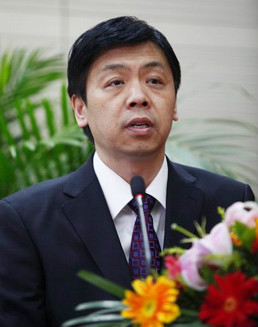
  • approval by central Party authorities of the third round of judicial reform pilots, and the holding of a large scale meeting of representatives from the Leading Group on Judicial Reform with the SPC and Supreme People’s Procuratorate (SPP),  on the focus (personnel reforms) and roll out of these projects.  Jiang Wei,deputy director of the Office of the Central Leading Group for Judicial Reform, spoke along with his SPC and SPP counterparts.  Political legal committee secretaries from the pilot areas attended, along with court and procuratorate officials.
  • Reform of the family court system, announced at a conference held in Guangzhou, attended by Justice Du Wanhua, highlighting that the rush of judges to meet performance targets (closing cases) Iamong other factors) has had a negative effect on children, elderly, disabled, and women.  The SPC likely published typical/model family law cases in November (discussed in this  blogpost)  because pulling together those cases was part of the preparations for the Guangzhou conference;
  • progress report and further plans on improving judicial assistance (separate but related to legal assistance), with the release  of the2014  multi-agency document (Central Political Legal Committee, SPC, SPP, Ministry of Finance, Ministry of Public Security, Ministry of Justice), stating that the central government had allocated 700 million RMB for judicial assistance and local governments  1.7 billion RMB, targeted at financial assistance for victims of crimes and others, with funds allocated to about 80,000 in 2014, (certainly a fraction of what is needed)
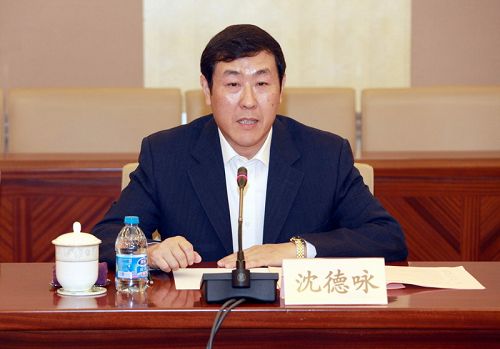
  • long pronouncement by Justice Shen Deyong on the “standardization” of the courts, citing the important status and important role of the judiciary in the governance of the country, but the growing contradiction between the needs of the people and  judicial resources and judicial capacity, decrying the lack of “top level design,” and calling for the implementation of related reforms.

This list will be supplemented later this month, as further announcements are made.


Update on case filing reform and other challenges for Chinese courts and judges

Case filing hall in a Jingdezhen court

In late November, the Supreme People’s Court (SPC) held a press conference on case filing (docketing) reforms to announce a 32% increase in civil and administrative case filings, year on year, putting a positive spin on what is a highly stressful situation for frontline judges, but a generally positive development for litigants and their lawyers. There are many stressful factors for Chinese judges and the Chinese courts, leading many judges to leave or contemplate suicide, and others to vote with their feet.  This blogpost will look at some of the recent developments:

  • Large number of cases;
  • Increasing fraudulent litigation;
  • Dysfunctional performance indicators that refuse to die.

The three issues are interrelated.

Case filing (docketing) reforms

On the case filing reforms, through the end of September, civil cases are up almost 23%, and administrative cases up 76%, while private prosecutions of criminal cases are up 60%,The most litigious provinces are ones with highly developed economies: Jiangsu (608,000 cases), Zhejiang, Shandong, Guangdong (558,000 cases).  The Supreme People’s Court caseload was up as well, with 6852 cases accepted through September, up 58%, estimated to reach 15,000 cases by year end.

Fraudulent litigation

Fraud of all sorts is a growth industry in China, especially with the worsening economy. Creative thinkers have come up with ways to use the court system to defeat or at least delay or avoid creditors.  In recent years, the Chinese courts have been faced with an increasing amount of fraudulent litigation, now criminalized on one of the unnoticed provisions in the 9th Amendment to the Chinese Criminal Law (new Article 307-1).  However, the law does not set out a definition, although some provincial court have issued guidance.  Usual factors include litigation based on: fabricated facts, fabricated arbitration award, or notarized documents, or collusion between the parties  or third party to use fabricated facts, false evidence, false documents, destruction of evidence, provide false documents, expert opinion and other means to avoid debt or improperly gain assets.

With the reform to the case filing system (described in this earlier blogpost), fraudulent litigation on the increase. For this reason, the SPC recently issued its first ruling on fraudulent litigation, imposing a penalty of 500,000 RMB on two Liaoning companies, to signal to lower court judges that they need to monitor case filings for indications of fraud.  Fraudulent litigation can be found in various types of cases, and in the maritime as well as local courts.

On fraudulent litigation in the maritime courts, an experienced maritime judge provided the following typical scenario: because the Chinese shipping industry is in a downturn (see these articles, for example), a ship owner who is unable to repay their debts (and finds that the size of the mortgage is more than the value of the ship) will conspire with their employees to bring a claim for unpaid wages, because under the Special Maritime Procedure Law, those claims take priority over the mortgage.  The employees and shipowner will split the proceeds from the claim, shortchanging the bank and other creditors.

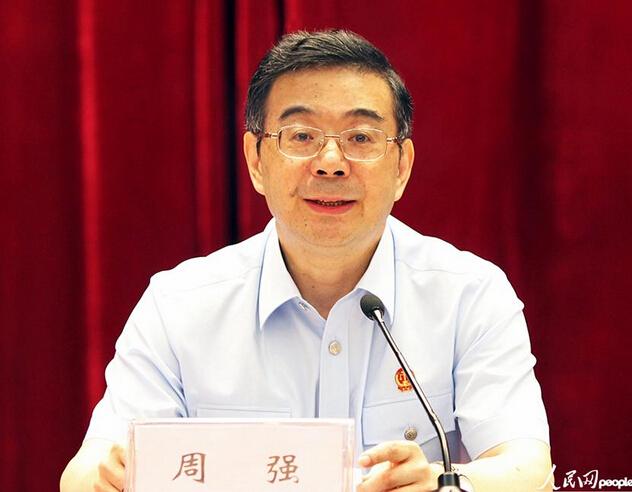
According to Zhou Qiang’s report to the NPC, about 3400 cases of fraudulent litigation were discovered in 2014.  According to studies done by provincial courts in recent years,  104 cases were found in 2011-2012 in Jiangsu, and 940 in selected courts in Guangdong during 2001-2009.

With the case filing reforms and soft economy, these numbers are likely to rise. Readers (of Chinese) interested in diving further into this topic should read this article.

Dysfunctional  performance indicators

Writing in People’s Daily, Judge He Fan, head of one of the departments of the SPC’s Judicial Reform Office, highlighted that “some leading cadres” wanting to achieve year end “pretty data”  are still imposing unrealistic year end performance targets, forcing front line judges to work unreasonable hours (and also  diminishing case quality). These performance targets were abolished in 2014, as highlighted in this blog.

As for why Chinese judges are leaving in such numbers and why they are so unhappy, that will be the subject of another blogpost.


Some typical Chinese family law cases in 2015

dd9a8f4c1a39797ea5a7e4843c8a2724 (1)Each month (as highlighted this earlier blogpost), the Supreme People’s Court (SPC) issues typical cases at a press conference. In November, family law cases were the center of attention for a change and were briefly reported by the South China Morning Post.

This month’s typical cases were selected from the Beijing, Shandong, and Henan courts and are aimed at educating the general public rather than legal professionals.  The cases, statistics, and comments from the Supreme People’s judiciary  give a glimpse into the social, economic, and cultural changes that have affected Chinese families over the past 20 years and reflect the differences between rural and big city life.

Statistics

Judicial statistics is one of the areas slated for reform by the Court, which has the potential to improve (or not) the situation for analysts of the Chinese court system.

  • 4,000,000 family law cases have been heard in the past year and 10 months. President Zhou Qiang reported earlier this year that  1,619,000 family law cases were heard in 2014, accounting for about 30% of civil cases, which would mean that over 2 million cases had been heard in the first 10 months of 2015 (assuming the cases are classified the same way in both years).
  • 124981 family law cases have been heard in the Shandong courts this year, constituting about 24% of all civil cases.
  • In the Beijing courts, 38, 619 first instance family law cases were heard in 2014.

Issues for Chinese judges

The press release hinted at some of the difficult issues facing Chinese family law judges nationally, which are many of the same facing their counterparts in Shenzhen:

  • Division of property when spouses divorce, which means both division of family home(s) and family business(es).  Parents often provide some or all of the funds for the home, before marriage, and the controversial rule set out in the #3 Marriage Law Interpretation
  • Child custody;
  • Divorce after a second marriage.

Divorcing spouses are increasingly antagonistic, making it difficult for judges to mediate a settlement, which is the preferred resolution for Chinese judges.

Summaries of some of the 30 typical cases

Must engagement gifts be returned? A case from a rural court in Shandong

Zhang and Zhao were introduced by Zheng, and became engaged. Zhang gave Zhao 40,000 RMB cash, four rings, and other gifts as betrothal gifts (彩礼).  The couple did not marry, and Zhao refused to return the cash and gifts. Zhang sued in the Jining District Court.  At trial, Zhao returned the 4 rings.  The Jining Court ordered Zhao to return the cash but not the gifts.

The SPC commentary noted that although the cash and other items are in form a gift, the legal consequences are different, and according to the #2 Interpretation of the Marriage Law, the gifts must be returned. Article 10 (1) of that interpretation addresses this situation: if the court finds in pleadings a demand for the return of the betrothal gifts given to the other party according to the traditional practices because the parties fail to register their marriage, the people’s court shall uphold the demand.

Concealing property from ex-spouse (Beijing)

Sun and Li divorced in 2004.  The arrangements the couple made were that the wife Li would have custody of the child, the formerly state-owned housing would belong to the wife, and the business, cars, etc. would belong to the husband, who would provide alimony and child support.  In the process of demanding child support from Sun in 2014, Li discovered that Sun had bought property during the marriage, but had concealed that fact from her. She went to court to demand that ownership of the apartment be transferred to her name. Sun said that the apartment was bought when the couple was living apart, he had told her, the divorce settlement provided that the business, cars, etc. belonged to the husband and besides the statute of limitations had lapsed years ago.

The Changping District court decided that because the apartment had been bought during the marriage, it was joint marital property and Sun could not provide credible evidence that Li knew of the property during the marriage.  Therefore the statute of limitations argument failed. The court decided that ownership of the apartment should remain with Sun, but that Li was entitled to half of its market value, or 1,400,000 RMB.  The couple appealed to the #2 Beijing Intermediate Court which upheld the lower court.

The SPC commented that because traditional attitudes of marriage for life have changed, there are more and more divorce cases.  In this case,  because Sun concealed the purchase of the apartment, under Article 47 of the Marriage Law that when the court partitions the property, it could allocate less or no part to Sun.

Does the non-custodial parent of a child born to an unmarried couple have visitation rights? (case from a rural Henan court)

Wang and Chai were introduced and subsequently had a wedding celebration according to local customs, but never formally registered their marriage. They lived together and Chai gave birth to little Wang.  Thereafter the couple separated.  The couple went to the Xun County court to resolve their disagreements about the child.  The court decided that Chai should have custody of the child, until the child is old enough to express her preferences.  A month later Wang went back to court to demand visitation rights.

The Xun County court relied on Art. 38 of the Marriage Law, concerning visitation rights of the non-custodial parent in divorce to decide that the father could visit the child the first Sunday of each month from 9 am to 5 pm.

The SPC commented that visitation rights are a basic legal right of a non-custodial parent to have contact, visit, and live together for short periods, but visitation must be done in a way that does not affect the normal life and studies of the child.

Do the elderly have the right to support from their children? (a Beijing case)

Seventy seven year old Mrs. Liu was in poor health and in financial difficulties.  She sued her two children in Beijing’s Xicheng District Court to require them to provide her support in the amount of 900 RMB monthly.  The daughter said she had no income and the son said his after- tax income was only 6500 RMB and refused.  The court ordered the son to pay 800 RMB per month and the daughter 500 RMB (on the grounds that based on her work history she must have income).

The SPC commented that grown children have the legal duty to support their parents [under the Law on the Protection of the Rights and Interests of the Elderly], but the amount will depend on the elderly person’s cost of living, the health of the elderly person, and life style, and if the elderly person has several persons to look to, the amounts each will need to pay in support will depend on each person’s financial situation.


Brief report on bankruptcy litigation in the Chinese courts

u=3218972303,895659764&fm=21&gp=0
Declaration of bankruptcy meeting of Guangdong company

The soft Chinese economy means that an increasing number of Chinese companies are in financial difficulties.  But, according to the Supreme People’s Court, the number of bankruptcy cases have been decreasing rather than increasing, with over a thousand cases accepted nationally in 2014.  Earlier this fall, the All China Lawyers Association held a conference for its bankruptcy practitioners, to which were invited the head of  #2 Civil Division of the Supreme People’s Court, Judge Liu Min (principal author of the bankruptcy law judicial interpretation),  KPMG partner, Cao Chunye, SASAC officials, and others.  What more can be said about the decrease in cases, why the decrease in cases and what is the Court doing about it?

Some Statistics

According to a 2014 Court study by Ma Jian of the Court’s Research Office, from 2003-2012, the Chinese courts accepted about 40,500 bankruptcy cases, decreasing an average of 12.23% a year, only increasing in Henan and Tianjin, which Ningxia, Hunan, Hebei, and Qinghai decreasing at a rate of 20% a year or more. In almost 70% of cases, the debtor company applied for bankruptcy, with only 30% creditor initiated.  The Court analysis was that creditors didn’t have a clear picture of the business operations of their creditors, or still believed that the debtor would be able to repay, or believed that because asset recovery in bankruptcy was so little, they did not want to bother initiating bankruptcy. Practically all the companies in bankruptcy proceedings were domestic companies, with 55% state owned companies, 26% collectively owned. Almost half of the cases took a year or more to resolve.

Why?

Ma Jian set out the following factors:

  • In a Chinese bankruptcy, the judge has more of a societal function than legal.
  • Most companies misunderstand bankruptcy law;
  • Local government interference in the acceptance, and trial of bankruptcy cases, with local governments closing down companies through administrative means, leaving unresolved debts and workers who have not been resettled;
  • Many obstacles stand in the way of realizing assets: 1) many companies in financial trouble have old equipment that is not worth much on the market or no one appears at the auction; 2) many SOEs occupy allocated land (land given by the government for free), and when the government takes possession of the land, it is impossible to sell the buildings on the site; 3) some companies use collective land, so that only other collectively owned entities can purchase the buildings built on the land.
  • It is very difficult to recover bankruptcy assets.  The debts are generally very old, and often times the statute of limitations has expired; additionally it is often difficult to find company debtors;
  • Resettlement of workers, is the primary issue to be considered in a bankruptcy case, particularly with the social safety net in such a fragile situation (according to Ma Jian).
  • Additionally, reorganization is very difficult to do, with multiple government approvals, difficulties in obtaining creditor agreement, difficulties in changing a company’s line of business, etc.
  • KPMG partner Cao Chunye highlighted the unfavorable tax treatment of companies in bankruptcy restructuring;
  • As to why courts do not want to accept cases, Ren Yimin of the All China Lawyers Association Bankruptcy and Restructuring committee mentioned that a bankruptcy of private company may cause a chain of other companies to fail, and it is difficult to resolve a chain of linked cases.

Measures

Some of the many measures under consideration or being explored include:

  • Moving bankruptcy cases out of the local courts where the company is located, to centralize jurisdiction in certain courts;
  • Making it easier for creditors to switch from enforcement proceedings to bankruptcy;
  • Improving the system for bankruptcy administrators.;
  • Looking to have a fast track system for small cases;
  • Exploring better restructuring systems.
  • Looking to foreign law, particular US bankruptcy law, for concepts that could be used to improve the bankruptcy system.

(Those with a greater interest in this topic can review this law review article–in the current situation, this area of law deserves closer attention by concerned professionals than it is currently receiving.)

Central Political Legal Committee issues model cases on leadership interference with the Judicial process

0d338744ebf81a4cfaf247bad42a6059242da685Five model cases on interference with the judicial process are are making the headlines today on the Communist Party’s Central Political Legal Committee’s website (www.chinapeace.gov.cn) (and therefore on its press outlet, Legal Daily as well as one of the Supreme People’s Court’s websites). It is the first time the Central Political Legal Committee has done so, but is unlikely to be the last.

The practice of issuing model cases in the courts has been discussed previously on this blog, but these have been issued to create an example (in this case a senior judge) to scare others into compliance (“kill the chicken to show the monkeys” (杀鸡儆猴)).

The first of the five cases, and the only one from the courts, is that of Chen Hai’ou, chief judge of the #2 civil division of the Beijing Higher People’s Court (and judicial committee member). Chen seems to be well-known as a bankruptcy law specialist and was likely known to counterparts on the Supreme People’s Court.

According to the press release, Chen received an administrative penalty and has been transferred away from doing trial work because he involved himself in a case that was not within his authority In violation of March, 2015 Central Political Legal Committee regulations on judicial personnel prying into cases.  Some more specific conflict of interest allegations against Chen remain posted on the Internet, although other allegations (and photos) on other sites have been taken down.  It seems likely that these led to his downfall.

Fourth Plenum and Chinese military legal reforms

From time to time, I write on Chinese military legal developments, an outgrowth of my interest in one of the few Chinese courts without a internet presence, the military courts.  I recently published an article on the military legal reform document published earlier this year (full text not available), looking at some of the related academic discussions and relating it back to the 4th Plenum Decision and the 4th Five Year Judicial Reform Plan.  I would welcome any comments or corrections any readers might have.

Should the retirement age for Chinese judges be raised?

20140708044640531
President Zhou Qiang, speaking at a national court conference

The retirement age of Chinese judges, is 55 for women and 60 for men, the age when judges in many other jurisdictions are in their prime. US Supreme Court judges have lifetime appointments, while compulsory retirement ages include:  Germany–68, Australia, 70, Hong Kong, 65 (with provisos).  The discrepancy between China and the rest of the world has not escaped NPC deputies as well some of the more senior members of the Chinese judiciary.  Many of them have been working in the courts since the early 1980’s, and are now facing retirement.

As work begins on a re-draft of the Judges Law (as highlighted in an earlier blogpost), one of the issues that has been repeatedly mentioned in the Chinese legal press is raising the retirement age and/or permitting judges to go on “senior status.” Among those speaking out include President of the Supreme People’s Court, Zhou Qiang, presidents of provincial high court of Hubei, Zhejiang among others, as well as the president of the National Judicial College. The 4th Five Year Judicial Reform Plan mentions raising the age for becoming a judge,but is silent about retirement.

The issue of retirement for judges relates to larger issues, such has separating the treatment of judges from other civil servants, raising the general retirement age for judges, and the type of qualifications that judges should have, and of course compensation.

The president of the National Judicial College published a long article in the People’s Court Newspaper (affiliated with the Supreme People’s Court) in August of this year calling for a re-think of career paths for judges. He noted (among other issues) that many judges are “three gate cadres” (三门干部) who have gone from the gates of home, school, to the courts, and lack the necessary life experience.  (The article seems to be the public version of a talk he gave to a closed door conference on judicial reform sponsored by the China Academy of Social Sciences, reported here).

It is a waste of know-how and experience, particularly for women, who are forced to retire five years before men. The Chinese courts need to try to retain the talent that they have, particularly when the courts will be faced with an increasing number of cases relating to an ageing population. With Zhou Qiang and other senior court leaders backing delayed retirement, it appears the reform will eventually be implemented, but it is likely to be too late for those now close to retirement age.

Result of the “3 nos policy” when Chinese companies arbitrate abroad

f6ac33117179fe35848072c3a7ed0c69With more and more Chinese companies doing business abroad or with overseas companies, more and more Chinese companies have agreed to arbitrate outside of China.  According to a recent blogpost in one of the best known Chinese arbitration blogs (written by Lin Yifei, formerly on the staff of the Shenzhen Court of International Arbitration), some Chinese companies adopt the “three nos policy” when a foreign party initiates arbitration proceedings abroad: no participation in the foreign arbitration proceedings, no cooperation with the foreign arbitration proceedings, and no enforcement of the foreign award.

The thinking is: foreign arbitration is troublesome, so it’s best to focus on making the offshore award worthless, or (alternatively) we’re going to lose the case anyway, so it just means an additional enforcement procedure.

Do the Chinese courts support this approach?

A ruling from the Suzhou Intermediate Court in 2014 in the case of Brambill Limited (Brambill) v. Zhangjiagang Huafeng Heavy-duty Equipment Manufacturing Co., Ltd (Zhangjiagang Huafeng) set out in the blogpost provides an answer. “Three nos” companies should expect that Chinese courts will enforce offshore arbitral awards.

In 2014, Brambill filed an enforcement action in the Suzhou Intermediate Court to enforce an ICC (Hong Kong) award, under the Arrangement Concerning Mutual Enforcement of Arbitral Awards between the Mainland and the HKSAR  The dispute related to  a sales contract, in which Zhangjiagang Huafeng failed to make delivery.  In June, 2010, Brambill Limited filed a request for arbitration.  Although Zhangjiagang Huafeng was served with Brambill’s pleadings, informed of its right to file an answer, appoint an arbitrator, give views on the location and language of the arbitration, the Chinese company failed to respond. The case was heard in Hong Kong and arbitral tribunal members in the ICC case were: my former colleague Peter Thorp (chair), Professor Shen Sibao (Executive Director of the Shenzhen Court of International Arbitration and former Dean of the law school of the University of International Business in Beijing), and Mr. Hee Theng Fong.

In June, 2012, the tribunal issued its award, which was served on Zhangjiagang Huafeng.  The Chinese company did not apply to set aside the award within six months, but opposed enforcement on the grounds that the arbitration clause was unclear. The Suzhou court ruled that Zhangjiagang Huafeng should have raised the issue of the invalidity of the arbitration agreement during the arbitral proceedings or applied to set aside the ICC award in Hong Kong within six months of issuance. According to the Suzhou court, there were no public policy reasons to refuse enforcement of the ICC award, and so the Suzhou court ruled to enforce the award, and required the Chinese company should pay Brambill’s enforcement fees.

(In honor of Hong Kong’s Arbitration Week 2015)

China’s judicial legislation takes first step on road to complete overhaul

Vice President Shen Deyong

Implementing the judicial reforms in China requires an overhaul of China’s current basic legislation, the Judges Law (法官法)and the Organizational Law of the People’s Courts (人民法院组织法). The Supreme People’s Court (the Court) media outlets have recently reported that on 23 October the first meeting was held of the drafting group to amend the Judges Law, with Court Vice President Shen Deyong chairing the meeting, and senior Court judges in attendance.  The report notes that the focus is on securing the independence of the courts (but having them remain firmly under Party control). Judge Shen mentioned that issues under consideration include: criteria for the selection of judges; protection for judges undertaking their duties; evaluation of judges, judicial assistants, salaries scales, retirement and insurance, and rewards and punishments.

Part of the preparatory work for amending the Judges Law is to include field research and surveys, particularly of front-line judges in the judicial reform pilot areas.  The drafting group will designate some local courts and some universities/research institutes to assist with the drafting.  The drafting of the Judges Law will need to be consistent with the principles of the amendment of the Organizational Law of the People’s Courts and the work of the Central Leading Group on Judicial Reform.  This summer, the Court convened an initial meeting to discuss amending the Organizational Law of the People’s Courts.  How to reorganize the Chinese judiciary and what professional status Chinese judges should have and work under will affect how judicial reforms are implemented and less directly, more fundamental issues concerning China’s economy and society.

What are China’s new circuit courts doing?

#1Circuit Court Building
#1 Circuit Court Building

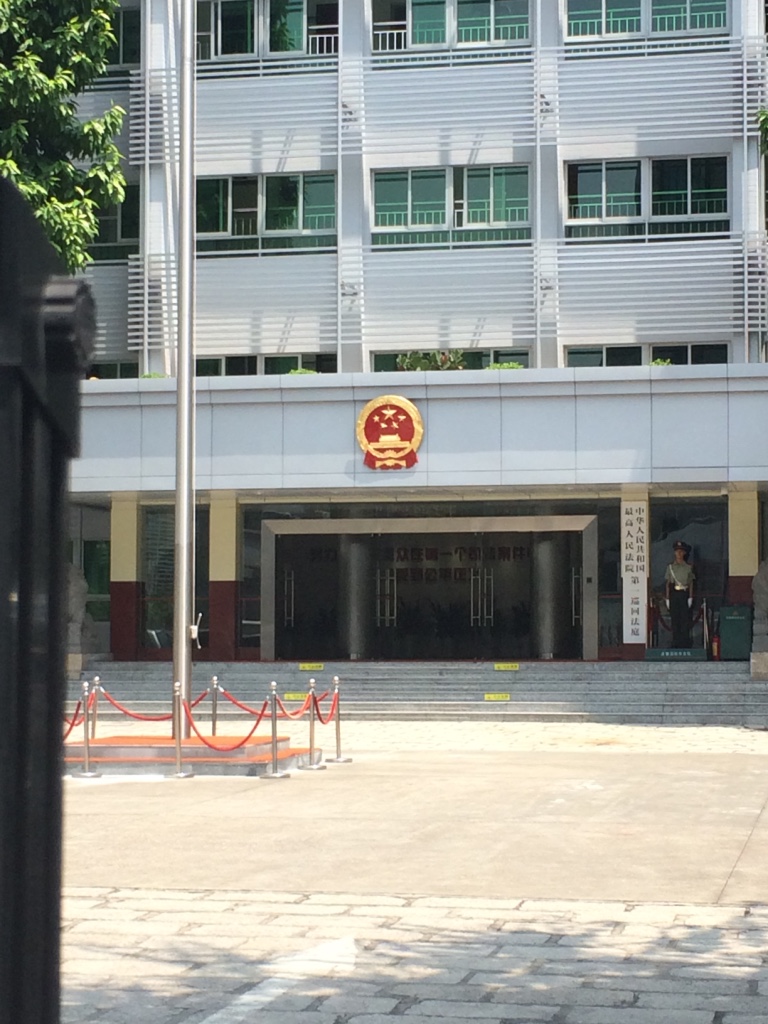
In January, 2015, the Supreme People’s Court (the Court) established circuit courts (actually circuit tribunals) in Shenzhen and Shenyang.  Are they doing anything more than serving as places to divert petitioners from Beijing?  In September I visited the #1 Circuit Court in Shenzhen to have a look for myself.

The #1 Circuit Court It is located in the former Shenzhen Intermediate Court building, but an annex contains the reception area for petitioners and separate area with courtrooms.  Visitors, including petitioners, enter through the entrance in the photo below. The burdensome security checks that Chinese lawyers have complained about for many years still operate, with security personnel (and the system under which they operate) who seem to be unable to distinguish between professional visitors and persons who may be a security threat.

The circuit courts are not separate level of courts, but a branch of the Court, but have a narrower jurisdiction, as set out in the regulations governing their operation, primarily civil, commercial, and administrative.

Part of the goal of the circuit court is to implement the personnel and structural reforms that the Court is promoting.  There are 12 judges, plus 12 judge’s assistants, who come from areas outside the circuit.  The twelve judges are  profiled on the Court’s website.  The judges do not serve in fixed collegiate panels, but each serves as presiding judge, with cases assigned randomly, and hearings in appeal cases focused on the issues in dispute on appeal, rather than a re-opening of the entire dispute.

The #1 Circuit Court occasionally “rides circuit”– hears cases outside of its headquarters.

thumb_IMG_1138_1024

Caseload

As of early September, the #1 Circuit Court had accepted close to 500 cases.  The hearing that I attended was an appeal from the Hainan Higher People’s Court, a dispute over shareholding between a Hebei and Beijing companies.  The presiding judge was Gao Xiaoli, formerly of the #4 civil division, who often writes and speaks on arbitration, private international law, and judicial review of arbitration.  She, like her other colleagues is highly experienced.

Petitioners

As described in a blogpost by Ivy Chen, a former intern with the circuit court:

In the Court, the interns first review the petitioners’ materials. If these materials fulfill the procedural requirements, the petitioners then would talk to the judge’s clerks and the clerks would decide whether to recommend the case for a further review by the judges. The judges would make the final decision of whether to grant a retrial. The clerks in the Court were actually sitting judges from the High People’s Court and Intermediate People’s Court from provinces other than Guangdong, Guangxi and Hainan. My job there included: 1. to review the cases filed by petitioners and decide whether their cases have fulfilled the procedural requirements stipulated in the procedure laws, and whether the cases belong to the 11 categories of case stipulated to be handled by the Court; 2. to assist the clerks to document each petitioner’s case; and 3. to review the letters written to the Court, categorize the letters by their subject matter (criminal, civil, administrative or non-litigation), geographical associations and procedural status, and decide whether the letters should be resent to the High People’s Court of Guangdong, Guangxi or Hainan, or be resent to the SPC in Beijing or stay with the Court for the judges to review…..during the work, people realized that many petitioners have difficulty in finding good legal assistance and then the Court set up place for lawyers to offer free legal advice to the petitioners in late July.

Window to the world or window dressing?

The  #1 Circuit Court isn’t window dressing, although it seems to receive foreign delegations regularly.  What it does is provide the Court with more headcount to hear more cases, pilot  structures promoted in the judicial reforms in a environment under the Court’s direct control, seek to improve the quality of its legal policy role by research into local legal issues and greater interaction with the local legal communities.  Shenzhen is often on the leading edge in China in legal matters, particularly in commercial law.

Comments on cooperation between the US and China on judicial reform

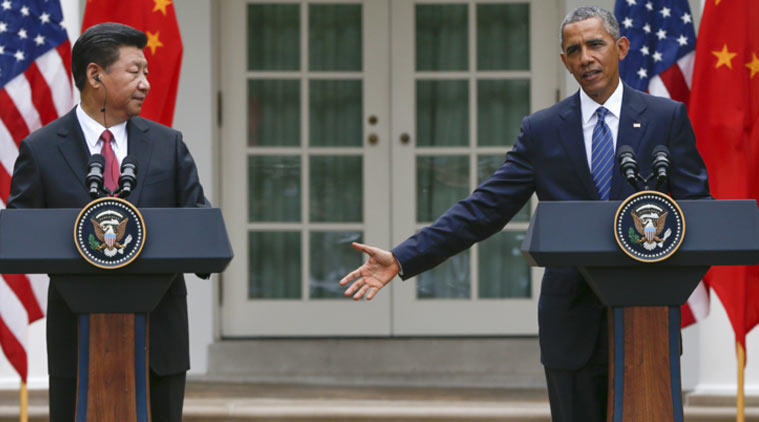
One of the lesser known outcomes of Xi Jinping’s trip to the United States is the commitment by the United States government to work with China on judicial reform.

The official White House press release (mirrored in statements by the Chinese Ministry of Foreign Affairs) states:

the United States and China commit to conduct high-level and expert discussions commencing in early 2016 to provide a forum to support and exchange views on judicial reform and identify and evaluate the challenges and strategies in implementing the rule of law.  U.S. participants are to include leading members of the U.S. judiciary, U.S. government legal policy experts, and officials from the Departments of Commerce and Justice and the Office of the United States Trade Representative.  Chinese participants are to include officials from the Central Leading Group on Judicial Reform, leading members of the Chinese judiciary, and Chinese government legal policy experts.  This dialogue is to result in an improvement in the transparency and predictability of the business environment.  This dialogue does not replace, duplicate or weaken existing regular bilateral legal and human rights dialogues between the United States and China.

This statement deserves more attention from the legal community than it has received so far.  Some brief comments below:

  • It is good for China and the rest of the world for Chinese judicial reform to be the subject of inter-government dialogue aimed at positive results.  Whatever improvements eventually result from this dialogue will eventually benefit both Chinese and foreign litigants.
  • The Communist Party’s Central Leading Group on Judicial Reform is explicitly named as one of the participants from the Chinese side.  It approves major Chinese judicial reforms (the text of the 4th five year judicial reform plan evidences that), so it makes sense for it to have one or more representatives involved in future dialogue (although technically it is not a “judicial institution.”
  • It is likely to include leading members of the Supreme People’s Court, but is unclear what other institutions will be involved.  Do the legal policy experts of the Chinese government also include the State Council’s Legislative Affairs Office?
  • The question is what issues the dialogue will focus on.  It is clear that the intent is to focus on technical legal issues, but which ones?  Perhaps the Law Committees of Amcham China and Amcham Hong Kong can draft a list of issues for the US government agencies involved in the dialogue to consider.
  • Among the issues I would nominate would be those related to better integrating the Chinese courts with its counterpart institutions in the rest of the world.  The Supreme People’s Court One Belt One Road (OBOR) opinion (see my earlier blogpost) mentioned that China was looking to expand bilateral and multilateral mutual judicial assistance arrangements, for better delivery of judicial documents, obtaining evidence, and recognition and enforcement of foreign court judgments.  My fellow blogger, Mark Cohen, recently wrote about the issues relating to the problems of litigants in the US courts seeking evidence relating to Chinese counterfeiters. The number of cases in foreign courts involving Chinese commercial activity is likely to increase and better judicial assistance structures should be put in place.
  • Related to the previous issue would be improving the international standing and influence of the Chinese courts (as the OBOR opinion states is a goal) in a positive way, by being a more neutral forum for cross-border disputes.  Statements such as the one made by Chinese judges in the Huawei vs. InterDigital case (pointed out by Mark Cohen in a recent presentation) do not give foreign litigants confidence that their cases will be heard fairly in Chinese courts.  The judges wrote: “Huawei is good at using antitrust laws as a counter-weapon, which other Chinese companies should study…. domestic enterprises [should] break through technical barriers in the development of space for their own gain, through bold use of antitrust litigation.”

If you have further issues to add to the list, please use the comment function!

Judge Xi Xiaoming and his vanishing assets

Although Chinese judicial reforms include establishing a trial-centered judicial system that provides better protection for human rights (including property rights), under Party disciplinary regulations senior Party officials (such as former Supreme People’s Court Vice President Xi Xiaoming, subject of an earlier blogpost),  often have property confiscated or other property punishments imposed at the conclusion of Party disciplinary proceedings. This means that confiscation of assets occurs before an official’s case is transferred to the procuracy and heard by the courts.  According to the official statement on the disposition of Judge Xi’s case:

(He) was ordered to make restitution of certain amounts that were in violation of discipline;the issues related to his suspected crimes and related amounts are transferred to the judicial organs for handing.责令退赔违纪款;将其涉嫌犯罪问题及涉款物移送司法机关依法处理.

The wording  is similar to official statements issued in relation to other senior officials investigated by the CCDI and the same language is to be found in reports on the dispositions of local Communist Party disciplinary investigations.

Han Jinping, director-general of the CCDI’s case coordination department and a former judge in the #2 criminal division of the Supreme People’s Court, provided more details on the CCDI’s authority to impose property punishments in a July, 2015 interview she gave to Chinese Central Television.

(A 2014 profile of Ms. Han reveals that she was involved in guiding some of the lower courts in recent high profile corruption cases and has been involved in some of the thinking behind China’s initiatives to pursue corrupt officials abroad).

She mentioned that more than half of the assets recovered since the beginning of the anti-corruption campaign have been confiscated by the CCDI itself (RMB 20.1 billion) and handed over to the national treasury, while 18.6 billion has been recovered through the formal legal system.  Ms. Han explained that according to applicable rules (set out below), CCDI is authorized to:

  • confiscate assets (没收);
  • recover assets(追缴);
  • order restitution (责令退赔)

relating to violations of Party and government rules and orders.

She noted the following rules guide their authority:

Related to the rules she cited are additional regulations issued by the General Offices of the Central Committee and the State Council on the handling of money and property management in criminal cases earlier this year, focused on coordination between departments (and less explicitly with CCDI).

Assets of officials determined by CCDI to have violated Party rules are confiscated in closed proceedings (subject to Party Committee approval at the relevant level), but the handling of the property must be in accordance with the above procedures. The official under investigation does not have access to counsel, and there does not seem to be a procedure by which a third party can oppose the property punishments imposed by CCDI. ( 2014 regulations of the Supreme People’s Court, by contrast, give third parties that right when property punishments are imposed in criminal proceedings.) For the family members, friends, and associates of an official subject to CCDI proceedings, it appears that any recourse they have is very limited.  A good proportion of the assets recovered in the current anti-corruption campaign have been recovered by skirting the procedural protections of the persons involved under the Chinese Criminal Procedure Law.  It appears to be a modern day version of the traditional legal system’s punishment of officials.

(Please use the comment function if there are errors in the above analysis.)


Educating Chinese judges for new challenges

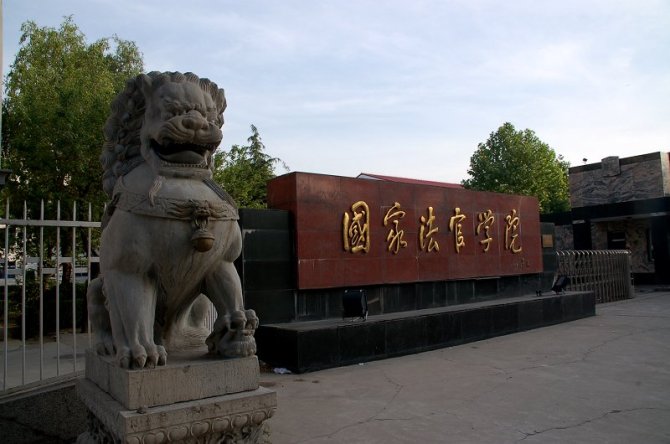
National Judges' College
National Judges’ College

Buried in the depths of documents issued in the course of this year are the outlines of the way the Supreme People’s Court (Court) intends to create a corps of judges in which litigants, domestic and foreign, have faith will provide justice.  The many measures set out in the 4th Five Year Judicial Reform Plan raise the competency bar for judges.  A more litigious and rights conscious public, the increasingly complex economy and greater number of cross-border transactions and interaction, as well as smaller number of judges to hear more cases means that judicial training is an important part of of preparing Chinese judges for the new normal.

The broad outlines of the Court’s plans for judicial training are set out in the following documents:

  • the Court’s latest 5 Year Training Plan, for 2015-2019, issued in June, the framework document;
  • the September 17, 2015 Communist Party Central Committee/State Council document on the open economy, calling for improving foreign-related competence in the judiciary; and
  • the September 25 White House press release, in which the  United States and China commit to conduct high-level and expert discussions commencing in early 2016 to provide a forum to support and exchange views on judicial reform and identify and evaluate the challenges and strategies in implementing the rule of law.

The training plan

The training plan is linked to the 4th Plenum and 4th Five Year Judicial Reform Plan Outline, the Communist Party Central Committee’s five year training plan for Party cadres (as stated in the plan itself, which means that judges are treated as a type of Party cadre), the Court’s regulations on judicial training,  as well the Court’s 2013 policy document on creating a new judicial team (队伍) in the new situation. Team (or work team) derives from “classical” Party terminology (as Stanley Lubman highlighted in an article last year)).

The Training Plan stresses ideological, ethical, and professional training, for judges and other judicial personnel.  Ideological education is required to be a part of the required training described below, so that judges will comply with Party discipline (a modern day counterpart to Confucian cultivation of virtue) and oppose the osmosis of mistaken Western values (抵制西方错误思想观点的渗透).

Who’s being trained

The focus of the training is:

  • Court leadership, particularly at the basic level. The training plan requires senior personnel of lower level courts to participate in training organized by the the Court and higher people’s courts, with newly appointed basic level and intermediate court management to participate in training session within their first year in office, and higher people’s courts to organize training for at least 20% of lower court senior management annually;
  • Front-line judges, particularly those in the basic level courts:  continuing legal education, with a minimum of 10 days a year,  and in the 2016-2018 period, a new training program is to be implemented, including the heads of people’s tribunals (branches of basic level courts dealing with minor disputes). Training materials are to be compiled by the Court.  The second aspect of the training program is to pilot a  judicial training program (apparently drawing from the practice in Taiwan and Japan) for new judges in designated areas for judicial reforms (as highlighted in point 50 of the judicial reform plan).
  • Professionally outstanding judges: the Court is to continue its program of cooperating with certain universities and research institutes to provide master’s and doctoral training (the Chinese University of Political Science and Law seems to be one of the Court’s partners); the National Judges College is to run training programs for outstanding young/middle aged judges for a minimum of one month.  Additionally, a corps of outstanding judicial trainers at the provincial level is to be created.  The September, 2015 measures to improve foreign-related competence in the judiciary are likely linked to this, as are some of the programmatic outcomes from the US-China initiative on judicial reforms.
  • Judges bilingual in Mongolian, Tibetan, Uygur, Kazakh, Korean, Yi and Zhuang.  This target was mentioned  in the Fourth Plenum and Fourth Five Year Judicial Reform Plan, and is linked to an arrangement by the State Ethnic Affairs Commission, Organizational Department of the Communist Party Central Committee, and the Supreme People’s Court to train 1500 bilingual judges by 2020.  This will also involve more and higher quality translation of legal materials into local languages. Press reports from Uighur and Tibetan areas, for example, describe civil litigants who do not understand Mandarin and find the justice system inaccessible for resolving business disputes, as well as criminal defendants who are unable to understand criminal proceedings, such as a Tibetan who did not understand what a “suspended death sentence” was.  In Xinjiang, for example, only 40% of judges described themselves as bilingual.

How training will be implemented

Judicial training is to focus on active and practical methods, including the case method (no less than 30%), moot courts, and other interactive methods.  The intellectual influence of exchange and training programs with offshore counterparts is apparent from the more interactive methods required.  Previous training programs (often funded by foreign NGOs) have enabled judges from the Supreme People’s Court and other Chinese courts to receive training in China with noted international experts while others have received training outside of (mainland) China.  Will this continue under the new normal?

The language of architecture of the courts, mainland China and Hong Kong

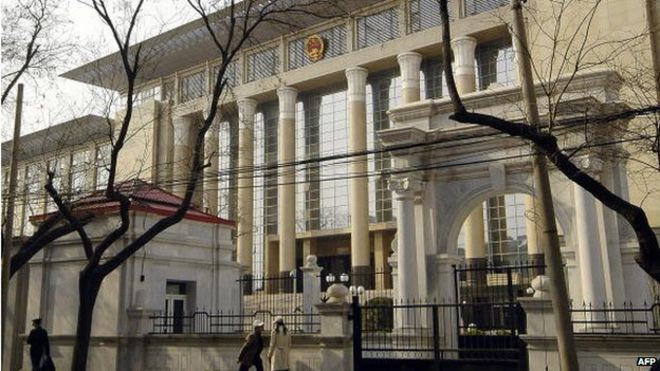
_75765239_57215039
Supreme People’s Court building, Beijing
IMG_1137
#1 Circuit Court building, Shenzhen
jinan court
Jinan Intermediate Court building

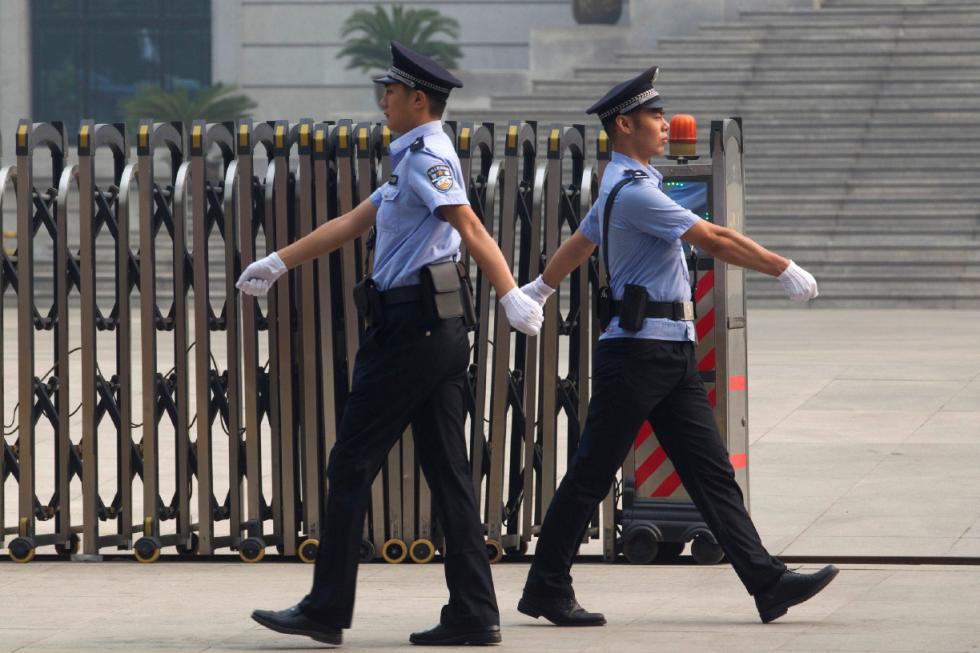
I had the opportunity to visit the Supreme People’s Court #1 Circuit Court in Shenzhen recently (thank you to all involved for arranging the visit, about which I will discuss further in another post).  The visit, recent events in China and a recent article in Hong Kong’s South China Morning Post (by my friend and former student, Simon Ng, of the University of Hong Kong)  on the newly renovated Court of Final Appeal building in Hong Kong (over one hundred years old, and one of the first purpose-built British court buildings in Asia) got me to thinking about the language of architecture, in particular the steel gates around Chinese courts. The #1 Circuit Court, as all Chinese courts I have visited or seen, has steel gates surrounding it and police protection.

Among the reasons for the steel gates is incidents such as the one detailed in this article in the English language version of Caixin.  A factory worker in the city of Shiyan, Hubei Province attacked four judges, angry about the outcome of his case against his employer.  This case is not exceptional–in a 2010 case, reported here, three judges were killed and several others injured in Hunan province, by a man disgruntled by the property settlement in his divorce case. Professor Bi Yuqian of  the Chinese University of Political Science and Law commented on the Shiyan case: “The public authority of judges has not yet been founded in China… It is not shocking that a judge is stabbed in China.”

For that reason, the Fourth Plenum Decision sets as a goal: raise judicial credibility…strive to have the people feel fairness and justice in every judicial case.”

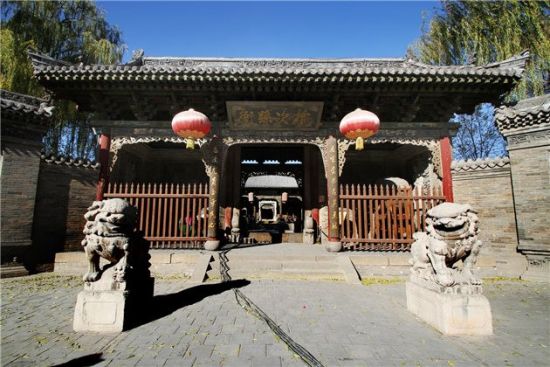
The architecture of modern Chinese courts borrows some elements from the traditional architecture of a yamen, while the language of the architecture of the courts of Hong Kong  is very different.yamen

0d4d9991abf326a007ab4f5a1dcd99fa
Court of Final Appeal building

Simon Ng recently published the following comments about the Hong Kong’s Court of Final Appeal Building, “It is an icon of Hong Kong’s judicial independence, which has been practised for over a century and is preserved under the solemn pledge of “one country, two systems”.

The blindfolded Themis standing right above the royal coat of arms is a visual reiteration of the centuries-old ideal of rule of law that even the sovereign must be subject to the law and reason. The administration of justice under the dome has to live up to that spirit.

Over the years, the architecture has helped to shape public understanding and expectations of the legal system. Fairness and impartiality, as symbolised by Themis, are the legal values that people treasure most.

With the reoccupation by the Court of Final Appeal, the building will continue to convey the meaning of rule of law across time through its language of architecture, the practice of judicial independence, and the upholding of justice and equality.”

The language of architecture conveys the status of the judiciary at this time and public expectations of the  legal system.  We can only hope that some day, the steel gates surrounding Chinese courts will be unneeded.

(©Court of Final Appeal building, SCMP; Jinan, Getty images; SPC, BBC)

Official interference or leadership?

W020150821328044625106
Interference in cases forbidden!(©Xu Jun, Xinhua)

In late August, the Supreme People’s Court (Court) issued a pair of regulations, aimed at reducing the phenomenon of officials, within and outside a court, involving themselves in cases.

Translations of the regulations are available, thanks to Chinalawtranslate.com: (the Chinese originals are available on the Court’s website here and there):

  • Implementing Measures for People’s Courts Carrying Out the ‘Provisions on Recording, Reporting and Pursuing Responsibility of Leading Cadres Interfering with Judicial Activities or Tampering with the Handling of Specific Cases (Leading Cadres Measures); and
  • Implementing Measures On Pursuing Responsibility In Cases Of Internal Judicial Personnel Prying Into Cases (Judicial Prying Measures).

This blogpost takes a quick look at the first one.

What do the Leading Cadre Measures say?

The Leading Cadre Measures (which implement State Council/Central Committee (General Office) regulations issued in March are directed at officials outside the judiciary who seek to influence court decisions, and require judges (who are other subject to penalties for not doing so) to  record all communications relating specific cases made by entities and individuals other than those in courts, and retain the relevant materials. These Measures implement language in the 4th Plenum Decision (Establish a system for recording, reporting, and investigating the responsibility of instances wherein leading cadres interfere in judicial activities or get involved in the handling of certain cases.)  The reports are to be submitted to the local political legal committee (or next higher political legal committee, depending on the status of the offending individual) and the next highest court, generally on a quarterly basis. If the conduct is serious, and might cause unjust, false and wrongfully decided cases or other “serious consequences,” the court is directed to report immediately.

Article 7 of the Leading Cadre Measures lists some of the most frequently used techniques, many of which have a economic, rather than political motivation:

The Leading Cadre Measures place the views of certain organizations in a different category:

“Party and government organs, professional associations, social public interest organizations and public institutions with administrative functions in accordance with law retained or permitted by people’s courts to follow the working procedures to submit consultative opinions in cases of national interest or societal public interest, may be not entered into information archive on prying, but relevant materials shall stored in the case file for future reference.”

Professor He Haibo of Tsinghua University explains what this means:

the courts must accept these materials, and it gives those organizations a chance to participate and speak; placing the materials in the case file gives the other party as well as possibly the public an opportunity to understand and evaluate them. This is consistent with the requirements of due process…

Will documents issued by Political Legal Committees at various levels really be placed in case files and made accessible to lawyers?

How do officials and judges interact?

The patterns of behavior that these regulations are aimed at changing are long-standing. From Doing Business in China, a leading book for practitioners (chapter by Harry Liu, Meg Utterback, Yu Simin):

Informally, judges are occasionally given instructions by political leaders on individual cases. Intervention by Party leaders in individual cases remains acceptable…The forms of interference vary: sometimes oral instructions are given, or sometimes the instructions are incorporated into official documents, with a requirement that the judge report back on the outcome. As to the content, the instructions may (1) tell courts to emphasize a case or handle a particular case “according to law,” (2) express an opinion on certain aspects of the case, or (3), recommend certain action to the court in lieu of dictating the outcome.

Professor He Haibo of Tsinghua University School of Law, writing in the People’s Court Daily–the line between “coordination in accordance with law” and interference with judicial activities is very hard to draw (什么是“统筹协调依法处理”、什么是“干预司法活动”,界限似乎难以划得清清楚楚)。

Comments from an unscientific sampling of judges

  • How the regulations work out in practice will depend to a large extend on how the officials undue intervention recorded will affect their future career or have legal liability.  If yes, the leaders will refrain from intervening. It will also depend on whether the judges would suffer from recording the intervention, particularly if he institutions are not administratively or financially independent from the agencies the officials represent or are able to influence.  In the latter case, judges wold be reluctant to record the intervention. It is likely that court leaders will interfere less frequently and with less success.
  • It will be of some help, when the interference is from strangers. But if from old friends, direct leaders, those won’t be reported, because it would betray the relationship.

More autonomy under Party leadership

The Leading Cadre Measures are not a magic bullet that will change the way the Chinese courts operate. The intent is to reduce the involvement of local officials in court cases to achieve fairer outcomes, while maintaining central policy leadership (and recognizing current reality by having a framework for Party officials to provide their views “for consideration”).

How well will the Measures work during the transitional period that the local judiciary remains under the control of local authorities? And how should the line be drawn between interference, leadership, and coordination?

A model case?

In late August, the Jinhua Intermediate Court (Zhejiang province) used the March regulations to call the attention of the press (and higher authorities) to a local official who threatened a judge with physical harm, when local courts ruled against the official’s wife in a shareholding dispute, although the case led one Zhejiang University law professor to comment that it wasn’t typical of official interference. According to the latest reports, the Jinhua Intermediate Court has withdrawn the notice, and both the judge and official in question are being investigated by the relevant CCDI organization.  A local Jinhua lawyer was quoted as saying that the local court staff had erred in making the matter public at this point.

The Jinhua case, while perhaps not a typical interference case, is typical of the widespread lack of civility confronting Chinese judges (and doctors), that in too many cases means a threat to their physical safety, and could indicate how difficult it will be to actually implement the Leading Cadre Measures.

Supreme People’s Court and its normative documents

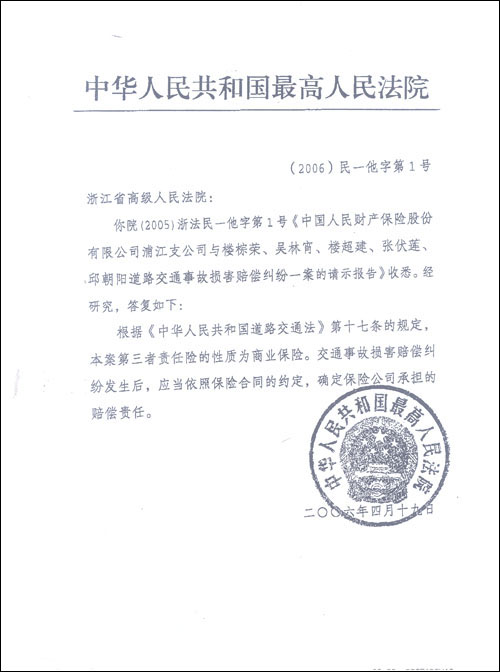
Court reply
Court reply

This blogpost discusses some of the documents that the Supreme People’s Court (Court) issues and what they mean, particularly to foreign legal professionals who may encounter them in practice. They reflect the bureaucratic way the Court operate (about which I (and others) have written). It is not a complete list, but a description of some of the ones I’ve written about on this blog.

The 4th Five Year Plan anticipates some reform in this area: “improve the Supreme People’s Court’s methods of trial guidance, increase the standardization, timeliness, focus and efficacy of judicial interpretations and other measures of trial guidance.”

Terminology–Some of these are described on the Court website as judicial documents (司法文件) or judicial normative documents (司法规范性文件).  They are not cited in judgments or rulings (unlike judicial interpretations), but judgments or rulings should be consistent with them. There do not seem to be clear rules on which of these documents should be made public.  Some of those documents include:

  1. Opinions (意见), issued by the Court and other institutions not authorized to issue judicial interpretations.

 Example:  Opinion on Handling Criminal Cases of Domestic Violence in Accordance with Law (Supreme People’s Court,(Law Release (2015) No. 4), The Supreme People’s Procuratorate, The Ministry of Public Security, and Ministry of Justice), discussed here, with normative provisions (instructions to the lower courts–“please implement conscientiously”).

2.  Opinions (意见), issued by the Court, but setting out judicial policy.

Opinions of the Supreme People’s Court on Fully Strengthening Environmental Resources Trial Work to Provide Powerful Judicial Safeguards for Promoting Eco-civilization Construction (最高人民法院关于全面加强环境资源审判工作 为推进生态文明建设提供有力司法保障的意见) and Opinions on Providing Judicial Services and Safeguards for the Building of One Belt One Road by People’s Courts” (关于人民法院为“一带一路”建设提供司法服务和保障的若干意见) (Instructions to the lower courts– “the following guiding opinion is set out”).

These may require further implementing regulations but judgments should be consistent with these opinions.

3. Conference summaries often address new issues or areas of law in which the law is not settled.  Conference summaries are not required to be made public, although with the internet and social media, they are now more widely available than in the early 1990’s, when I first wrote about them.

Example–the 2015  one on drugs (全国法院毒品犯罪审判工作座谈会纪要). (instructions to the lower courts-please implement this as reference, combined with the actual situation of trial work, if in implementation problems are encountered, please report in a timely manner to this Court) 请结合审判工作实际参照执行。执行中遇到问题,请及时报告我院)

4. Replies (请示复函).  Arbitration lawyers see these in published replies to the lower courts, such as those done under the Court’s reporting system relating to judgments/rulings concerning foreign-related and foreign arbitral awards.The response is binding on the lower court regarding the particular case.  The Court publishes these replies (and the report from the lower courts) in its periodical China Trial Guide: Guide on Foreign-Related Commercial and Maritime Trial, from which the following example is taken:

Example: This 2012 response to a report from the Hubei Higher People’s Court: SPC reply to Hubei High Court.

In the area of arbitration practice, the principles set out in these responses are persuasive, but not binding in later cases, and arbitration lawyers discuss these responses as a particular form of case law, such as this law firm client alert.

Replies (批复).  These are seen in requests for lower courts for approval of certain matters, such as having basic level courts hear foreign-related cases, based on relevant law and judicial interpretations.

Example, a 2013 reply by the Court to a request from the Anhui Higher People’s Court.  These are binding on the lower courts.

5. Decision (决定).  These are seen when the Court issues documents setting out an administrative approval.

Example: a 2015 decision designating certain courts as model courts for diversified approaches to dispute resolution, mentioned here.

Supreme People’s Court regulates private (shadow) lending

cf3ceb83123a55e7e1534d64c542a87c
private lending

On August 6, the Supreme People’s Court issued its long-awaiting judicial interpretation on private (shadow) lending.  Its provisions are applicable to P2P funding platforms and other lenders not under the jurisdiction of the financial regulators. My article in The Diplomat summarizes the judicial interpretation and its significance.

Updated musings on Supreme People’s Court Vice President Xi Xiaoming

Vice President Xi XiaomingThis updated blogpost muses on Judge Xi Xiaoming, and:

  • phenomena of “assumption of guilt” and trial in the press
  • political factors in Chinese judicial decision-making;
  •  judicial corruption;
  •  implications for related parties;
  •  investigation-centered criminal justice system
  •  effect on lower court judges;
  • the intellectual legacy of Judge Xi;
  •  effect on the credibility of the judicial system.

The comments below are made with no further information about Judge Xi’s case than what is publicly available.

The background

In the late afternoon of 12 July, Xinhua news issued a statement reporting that the Central Commission for Discipline Inspection (CCDI) announced that Supreme People’s Court (Court) Vice President Xi Xiaoming, was under investigation for violation of Party discipline and law.  Judge Xi has worked in the Court for over thirty years and is well known for his expertise in civil and commercial law. The announcement caused shockwaves in the Chinese legal community. Chinese press reports have linked the allegations to a case involving a 420 million RMB dispute over shareholding in a Shanxi coal mine, but the allegations have not been confirmed by the CCDI.

On 20 August, Meng Jianzhu, head of the Central Political Legal Committee, made the following statement about Judge Xi: “Xi Xiaoming has shamed the judiciary, as a experienced judge who has worked in the Supreme People’s Court for 33 years, who has colluded with certain  illegal lawyers, judicial brokers, and lawless business people by accepting huge bribes. “作为在最高法院工作33年的老法官,奚晓明却同个别违法律师、司法掮客、不法商人相互勾结,收受巨额贿赂,这是司法界的耻辱。”

 “Presumption of guilt” and trial in the press

Judge Xi is under investigation by the CCDI and it has not yet been reported that the procuracy has yet filed a case against him.  It does not seem that the lawyers involved in the Shanxi case have been prosecuted or penalized for illegal activity.  Meng Jianzhu’s statement evidences two phenomenon in Chinese criminal justice–the presumption of guilt and “trying” suspects in the press

As Zhu Zhengfu, the vice-chairman of the All China Lawyers Association warned earlier this year, there is a widespread and dangerous “presumption of guilt” among mainland law enforcers.”  Zhu proposed a law be enacted to fully protect each citizen’s right to be presumed innocent until proven guilty.

“An arrest is made on one day, then the next day you have the suspect confessing on television, and some are forced to confess,” Zhu said.

“After the confession, [law enforcers] immediately say the case has been solved and they celebrate their achievement. So you can imagine how much pressure the court is under if it wants to pass an innocent verdict.”

As Si Wejiang of the Debund Law Firm pointed out, CCTV often declares a person guilty even before the procuracy has approved his arrest and does not give his defense lawyer a chance to speak.

Complex politics of large commercial disputes in China

In private comments, several senior Chinese lawyers and other Chinese legal experts have suggested that Judge Xi’s case is not a simple case of corruption, but is tied to more complex political factors.
As two DLA Piper lawyers commented in a Practical Law publication, “large commercial disputes between Chinese parties are usually settled with the help of political influence and/or commercial pressure, with the rule of law methods such as litigation and arbitration either not used at all or used as a bargaining tool.”

They further noted that in recent years “there has been a return to non-rule of law methods of settlement, particularly in relation to disputes involving over CNY100 million.”

The senior lawyers noted that judges hearing cases involving politically powerful litigants (called interest groups in Chinese political jargon) may be under pressure to decide the cases in particular way (as further described in the next section). As time goes on, the litigants may not be as politically powerful as before, and the judgment (and the judges who made decisions) may be called into question.

Corruption in the courts

The corruption allegations are said to be connected to the Shanxi case, reported in further detail in the Caxin report.  But the corruption allegations may be more complicated than they appear.  As several  academic studies have noted, judicial corruption in China has several root causes related to the nature of the judicial system.  In her 2014 book,  The Judicial System and Reform in Post-Mao China, Li Yuwen, Professor of Chinese Law at Erasmus University stated:

First, the lack of judicial independence leaves room for corruption.In practice, when a case is brought to court or assigned to a judge, court officials or the responsible judge are often contacted by various people–the most influential ones are those with government positions….In addition, the lack of recognition of the nature of the judiciary to enforce law fairly and efficiently also results in a puzzling perception of courts and judges….

Secondly, judicial corruption cannot be divorced from its social context…It is unrealistic to expect judges to operate completely outside the social environment, especially in the absence of a workable system to reduce the incidence of judicial corruption….

Thirdly, certain shortcomings of the court system leave the door open for corruption. For instance, the flexible use of the re-trial system leads to the easy re-opening of cases if influential people wish to interfere in the case. This not only diminishes the finality of the case but also creates opportunities for using personal networking to change a court’s judgment. Furthermore, the relatively law judicial salary makes judges an easy target for corruption…In modern-day China, a profession’s income is too often linked to the profession’s social status. Judges’ low salaries are not conducive to building self-respect amongst the profession and, moreover, they constitute a major ground for fostering judicial corruption.

So returning to the social context of 2011. A number of Chinese lawyers and academics have privately noted that at the time of the case in question, it would not be unusual for supplemental payments to be made to Court judges in connection with commercial disputes involving large amounts of money, and refusing payment could also have been awkward for those involved.  Whether this was in fact the case for Judge Xi is not known.

Implications for related parties

It is likely that the anti-corruption investigation into Judge Xi will touch on parties, including other judges, related to the case(s) in question.  It is also likely that the full extent of the investigation will not be made public.

Investigation-centered criminal justice system

Judge Xi is now experiencing the Chinese investigation-centered criminal justice system, in which Party members are generally subject to shuanggui, where they are subject to long periods of interrogation outside the formal criminal justice system, followed by repeated interrogations if and when the case is transferred to the procuracy. His case is part of the current anti-corruption campaign.

As Professor Fu Hualing of the Faculty of Law, University of Hong Kong has written:

The anti-corruption campaign is also a highly politicized process. Investigations are selective, politically motivated, and aim to achieve particular political consequences….

Xi’s campaign further shifts power from legal institutions to the Party’s disciplinary mechanism. Compared with anti-corruption work under the previous government, the current campaign more decisively bypasses legal procedures and institutions. After a brief moment in which law seemed to be able to play a central role in the anti-corruption process, legal institutions have been effectively marginalized to the role of initiating anticorruption
purges of ‘tigers’. There is no longer any meaningful discussion
on the end goals and limits of shuanggui, the Party’s power to detain its own delinquent members and little mention of the creation of a more neutral anti-corruption body.

Effect on other judges?

What will be the effect of Judge Xi’s case on judges in the lower courts, who may not want to find themselves involved in local parallels of his case? Will it lead to further departures of experienced judges?

The intellectual legacy of Judge Xi

Judge Xi has been a major force in the area of civil and commercial law, involved in many major legal developments in China over the past thirty years. He has been involved the drafting of major judicial interpretations, edited many books, and been involved in other major legal initiatives, including, most recently, the drafting of the Civil Code and the establishment of an environmental law research center affiliated with the Court.  The many technical legal reforms in which he has been involved are crucial to the operation of the Chinese judicial system. The initiatives in which he has been involved are likely to go on with other talented people, but he is sure to be missed.

Effect on the credibility of the judicial system

Improving the credibility of the Chinese judicial system is said one of the goals of the Chinese judicial reforms.  We will need to wait and see how Judge Xi’s case progresses, and how both official and unofficial commentators, as well as members of the Chinese public and international community view his case.