Chinese maritime courts, which primarily hear maritime commercial cases, also have jurisdiction over maritime pollution cases. This short blogpost provides a brief update on the first public interest environmental case filed in the maritime courts.
According to its official social media Weibo, the plaintiff filed a lawsuit on July 7th, 2015, requesting the court to order two defendants to repair the environmental damage caused during the 2011 Bohai Bay oil spill. The court accepted the case on July 21st, 2015.
This is the first maritime pollution case in China brought by a social organization in accordance with the Article 58 of the Environmental Protection Law, which for the first time granted social organizations to file litigation relating to pollution activities that cause environmental pollution, ecological damage or public interest harm.
CBCGDF had previously filed cases regarding fresh water pollution and red wood destruction, which were accepted by the respective courts. Back in May 2015, another social organization brought a similar lawsuit against PetroChina in Dalian Maritime Court for oil spill, which was dismissed by the court. The plaintiff in that case did not seek to appeal the dismissal after PetroChina set aside an ecological repair fund of RMB 200 million.
The 2011 Bohai Bay oil spill has been followed by government investigation and fines, as well as related civil lawsuits. This case will be widely watched by the environmental community, including social organizations [foundations, NGOs, and others] and environmental law experts and Chinese and international practitioners.
[Contributed by Fang Jianwei (Jerry) Fang, a partner with the China-based Global Law Office in the firm’s Shanghai and Beijing offices. He was a judge in China and studied law at Columbia Law School. For more information on this report, please contact him at jfang@glo.com.cn.]
Judge Luo Dongchuan. chief judge,#4 civil division, at the OBOR Opinion press conference
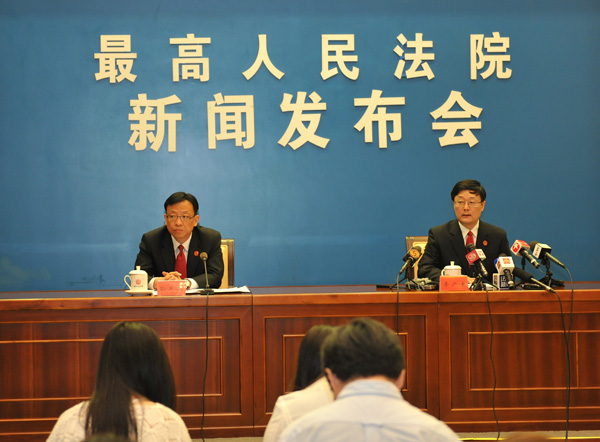
On 7 July the Supreme People’s Court (the Court) issued an opinion (意见) policy document on how the courts should provide services and protection to “One Belt One Road” (OBOR Opinion) (关于人民法院为“一带一路”建设提供司法服务和保障的若干意见). This blogpost explains why the Supreme People’s Court issued it, what the policy document provides and what it means for legal professionals. The typical (model) cases issued at the same time include the Sino-Environment case, subject of an earlier blogpost (and deserve closer analysis).
Why was the One Belt One Road document issued?
One Belt One Road (OBOR) is a major government strategic initiative. As a central government institution, the Court must do its part to support OBOR. Major SOEs contemplating investing in OBOR projects or trading with companies on OBOR recognize that their interests are best protected through legal infrastructure and the Court has an important role in this. MOFCOM and other related regulatory agencies realize this as well. Local courts linked to the Belt or the Road, are dealing with new demands because of OBOR and are looking to the Court for guidance.
The OBOR Opinion was drafted with input from these regulatory agencies and certain legal experts, but was not issued for public comment.
What the OBOR Opinion covers
The OBOR Opinion covers cross-border criminal, civil and commercial, and maritime as well as free trade zone-related judicial issues. It also deals with the judicial review of arbitration.
Criminal law issues: the lower courts are requested to improve their work in cross-border criminal cases, and the courts are to do their part in increased mutual judicial assistance in criminal matters. The focus is on criminal punishment of those characterized as violent terrorists, ethnic separatists, religious extremists, and secondarily on pirates, drug traffickers, smugglers money launderers, telecommunication fraudsters, internet criminals, and human traffickers. It also calls on courts to deal with criminal cases arising in trade, investment, and other cross-border business, and deal with criminal policy and distinguishing whether an act is in fact a crime, so that each case will meet the test of law and history. The political concerns behind criminal law enforcement issues are evident in this.
Much of the focus in the OBOR Opinion is on civil and commercial issues, including the exercise of jurisdiction, mutual legal assistance, and parallel proceedings in different jurisdictions and in particular, improving the quality of the Chinese courts in dealing with cross-border legal issues. These issues are explained in more detail below
One of the underlying goals set out in the OBOR Opinion, is to improve the international standing and influence of the Chinese courts and other legal institutions.
What does it mean for legal professionals
The OBOR Opinion signals that the Court is working on a broad range of practically important cross-border legal issues. Some of these issues involve working out arrangements with other Chinese government agencies and are likely to require several years to implement. The OBOR Opinion mentions that the Court:
seeks to expand bilateral and multilateral mutual judicial assistance arrangements, for better delivery of judicial documents, obtaining evidence, recognition and enforcement of foreign court judgments.
supports and promotes the use of international commercial and maritime arbitration to resolve disputes arising along One Belt One Road. China will promote the use of the Convention on the Recognition and Enforcement of Foreign Arbitral Awards (New York Convention) between countries on One Belt One Road and encourage countries that have not yet acceded to the Convention to do so.
supports and promotes the use of various types of mediation to resolve OBOR related cross-border disputes.
it signals that the Court will become more involved in Chinese government initiatives such as the Asian Infrastructure Investment Bank, the conference of supreme courts under the Shanghai Cooperation Organization, and other international or regional multilateral judicial cooperation organizations.
is signalling the lower courts that they should limit the range of cross-border contracts being declared invalid or void.
sets out the new thinking on the issue of reciprocity in the enforcement of foreign judgments, in particular that Chinese courts can take the initiative in extending the reciprocity principle to parties from other jurisdictions. This is practically significant for foreign parties and their counsel, and has been discussed repeatedly by both practitioners and academics (suchas these);
will improve Chinese legal infrastructure on overseas evidence, overseas witnesses giving evidence, documenting the identity of overseas parties, “to better convenience Chinese and foreign parties. ” This would involve evolving from the current system embedded in Chinese legislation of requiring notarization and legalization of many documents (because mainland China is not yet a party to the Hague Convention on the Abolishing the Requirement of Legalization of Foreign Public Documents. This is a positive sign;
The Court has on its agenda further legal infrastructure on the judicial review of arbitration (as signalled at the end of last year), involving foreign/Hong Kong/Macau/Taiwan parties, aimed at supporting arbitration and having a unified standard of judicial review on the following issues:
refusing enforcement of arbitral awards; and
setting aside arbitral awards.
has on its agenda judicial legal infrastructure for supporting the resolution of bilateral trade, investment, free trade zone and related disputes.
Reflecting language in the 4th Plenum, it calls for China to be more greatly involved tin the drafting of relevant international rules, to strengthen China’s voice concerning issues of international trade, investment, and financial law.
mentions that an improved version of the Court’s English language website and website on foreign-related commercial and maritime issues is forthcoming. Specific suggestions can be emailed to supremepeoplescourtmonitor@gmail.com.
The topic of the Supreme People’s Court and the interpretation of law is one that vexes many, legal practitioners and academics alike. Although the Chinese constitution vests the power to interpret law with the Standing Committee of the National People’s Congress (NPC SC), the Supreme People’s Court (the Court) and the Supreme People’s Procuratorate (SPP) actively issue interpretations of law. The Court more so than the SPP, because it deals with a broader range of legal issues. These interpretations of law are critical to the operation of the Chinese legal system because national law tends to set out broad principles that require additional legal infrastructure to be workable and the courts, in particular, need that legal infrastructure to decide cases.
A 1981 decision by the NPC SC delegated to the Court the authority to interpret law relating to questions involving the specific application of laws and decrees in court trials, while the Supreme People’s Procuratorate (SPP) was delegated authority to interpret law relating to questions involving the specific application of laws and decrees in procuratorial work. The Organic Law of the People’s Courts re-iterates the delegation of authority to interpret law to the Court. Oddly enough, the principle is not in the Organic Law of the People’s Procuratorates. Interpretations by both the SPP and the Court are known as “judicial interpretations.”
In 2015, the Legislation Law, which had previously not addressed interpretation of law by the Court and the SPP, addressed the issue in Article 104. This article is taken as intended to codify existing practice, because the explanation of the law recognizes the practical necessity of judicial interpretations:
“Interpretations on the specific application of law in adjudication or procuratorate work issued by the Supreme People’s Court or Supreme People’s Procuratorate shall primarily target specific articles of laws, and be consistent with the goals, principles and significance of legislation.”
It requires the Court (or SPP) in the situation described in the second paragraph of Article 45 of the Legislation Law (where the NPC SC gives interpretations of national law), to submit a request for a legal interpretation, or a proposal to draft or amend relevant law, to the NPC SC.
Courts and procuratorates other than the Court and the SPP must not make specific interpretations of law. (This sets out in national law what had previously been contained in Court (and SPP regulations.) The lower courts continue to issue guidelines applicable within their jurisdiction, as discussed here.
The process for drafting Court interpretations described in the 2007 regulations requires that the views of the relevant special committee or department of the NPC SC be solicited during the drafting process, and there would be pushback from the NPC SC if it was considered that the judicial interpretation had gone ‘too far.’
What types of judicial interpretations are there?
The 2007 Court regulations on judicial interpretations (linked here) limit judicial interpretations to the following four types:
“decision”(决定) (a document abolishing or amending existing judicial interpretations).
Those 2007 regulations set out various procedures for drafting and promulgating judicial interpretations, including a requirement that they be approved by the Court’s judicial committee and be made public. As discussed in earlier blogposts, broad public consultation may be done if it affects the “vital interests of the people or major and difficult issues. These regulations also provide that judges may cite judicial interpretations as the basis for a court decision or ruling. Article 23 of the 4th Five Year Court Reform Plan mentions reform of judicial interpretations:
Improve the Supreme People’s Court’s methods of trial guidance, increase the standardization, timeliness, focus and efficacy of judicial interpretations and other measures of trial guidance. Reform and improve mechanisms for the selection, appraisal and release of guiding cases. Complete and improve working mechanisms for the uniform application of law.
As discussed in earlierblogposts, the Court also issues other documents with normative provisions that do not fit the above definition. Those will be discussed separately.
The Supreme People’s Court and Supreme People’s Procuratorate are together drafting a judicial interpretation on Article 399a of the Criminal Law, the crime of “twisting the law in arbitration.” My understanding is that one of the criminal law divisions of the Supreme People’s Court is involved in the drafting, rather than the #4 civil division, well-known internationally for its expertise in arbitration issues. According to an article published by the Guiyang Arbitration Commission, in late April, the State Council Legislative Affairs Office distributed the draft to some arbitration commissions for comment. Given the many legal issues it raises for domestic and foreign arbitrators (and the Chinese government’s international/regional obligations), it should be issued publicly for comment.
What is Article 399a of the Criminal Law?
Article 399a, is part of Chapter IX: Crimes of Dereliction of Duty.
Where a person, who is charged by law with the duty of arbitration, intentionally runs counter to facts and laws and twists the law when making a ruling in arbitration, if the circumstances are serious, he shall be sentenced to fixed-term imprisonment of not more than three years or criminal detention; and if the circumstances are especially serious, he shall be sentenced to fixed-term imprisonment of not less than three years but not more than seven years.”(依法承担仲裁职责的人员,在仲裁活动中故意违背事实和法律作枉法裁决,情节严重的,处三年以下有期徒刑或者拘役;情节特别严重的,处三年以上七年以下有期徒刑.)
Article 399a is a duty crime (one committed by officials). How is it that Chinese arbitrators who are not officials, or foreign arbitrators can commit this crime?
The procuratorate investigates duty crimes. This means that the procuratorate must review an award to make a decision whether to investigate whether an award has been intentionally rendered “in violation of facts and law.” Will a procuratorate be able to conduct this review applying foreign law?
If a procuratorate prosecutes a case under Article 399a, it also requires a court to undertake a substantive review of an arbitral award.
Judicial interpretations of both the Supreme People’s Court and Procuratorate raise important issues. As suggested in several earlier blogposts, part of the judicial reforms should include greater requirements for public comment on draft judicial interpretations. Depending on how familiar the US and EU bilateral investment treaty negotiators are with the details of Chinese law, this may be raised by negotiators.
Comment
Because this judicial interpretation has implications for China’s obligations under the Convention on the Recognition and Enforcement of Foreign Arbitral Awards (the New York Convention) and the analogous arrangement with Hong Kong, the draft should be made public so that the greater arbitration community, domestic and foreign, is able to provide detailed analysis and commentary on it. This is the interests of the international and Chinese legal communities.
New docketing procedures (case filing) (立案) have come to the Chinese courts. Chinese courts have a separate case filing divisions, which up until 1 May of this year acted as gatekeepers to courts. They exercised their approval authority over cases in a non-transparent manner, which meant for litigants in Chinese courts that their cases could be and were rejected without having the opportunity to argue why they should be accepted. Case filing divisions also were known to put troublesome filings aside, without issuing a rejection, or repeatedly asked for supplementary documents, seeking to drive away litigants by repeated formalistic demands.
More background is given in theseblog posts and law review article. It has been an ongoing problem for many years, provoking endless complaints and articles by ordinary people, lawyers, academics, and NGOs, and has been one of the issues driving petitioners to the streets.
The Supreme People’s Court (Court) leadership identified case filing as one of the needed reforms (and as one of the many contributing factors to the low prestige of the Chinese judiciary), even before the Third Plenum. Because of that, the Communist Party’s 4th Plenum Decision and the 4th Five Year Court Reform Plan flagged this as a priority. (Unsurprisingly), the language in the two documents is almost identical:
Reform systems for courts’ acceptance of cases, change the case filing review system to a case filing registration system, and in cases that should be accepted by the people’s courts, ensure parties procedural rights by requiring filing when there is a case, and requiring acceptance where there is a lawsuit.
Change the case filing review system into a case filing registration system, making it so that for cases that should be accepted by the people’s courts, where there is a case it must be filed, and where there is a suit it must be accepted; safeguarding the parties’ procedural rights.
Litigants in line at the #1 Circuit Tribunal
In late April, the Court issued case filing regulations which address many of the longstanding problems that litigants and their lawyers faced:
Case filing divisions
refusing to accept complaints;
refusing to issue notices rejecting complaints;
repeatedly asking for supplementary materials.
The new rules require case filing divisions to accept filings of civil and criminal private prosecution cases (brought by the victim of a crime if the state refuses to prosecute, generally relating to minor crimes) on the spot if possible, provide templates for frequently used types of cases, and to respond within statutory deadlines. Case filing divisions are directed to make requests for supplementary materials once. (The new administrative litigation law judicial interpretation, described in this earlier blogpost, contains similar provisions.) Litigants who encounter noncompliant behavior can file a complaint with the relevant court or the court above it.
Cases that the courts must refuse:
Illegal complaints or complaints that do not comply with law or regulations;
Matters that endanger the sovereignty or territorial integrity of the state;
Matters that endanger national security;
Matters that undermine national unity or ethnic solidarity;
Matters that undermine state religious policy.
Rights activists have likely noticed that these carveouts are broad and flexible enough to keep out some cases that they might want to bring.
The take-up on the reform: some “Big Data”
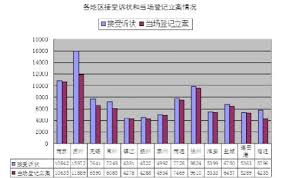
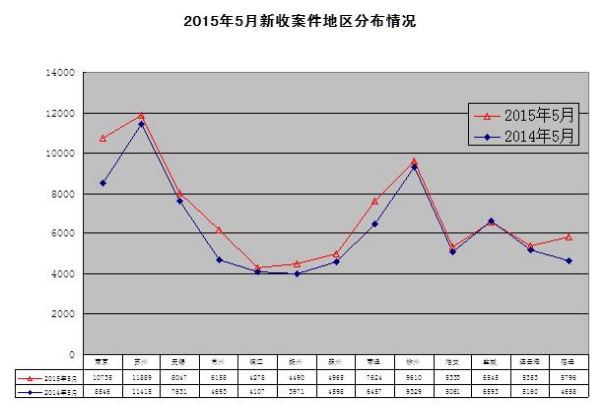
According to Court statistics, in the first month since the regulations went into effect, there was a 30% jump in the number of cases accepted,(1.13 million), with most of them accepted immediately. The Jiangsu, Zhejiang, and Shandong courts accepted over 80,000 cases, with Beijing, Hebei, and other areas accepting over 40,000.
the number of administrative cases accepted was up 221% in comparison to last year (starting from a low base), with Tianjin cases up 752.40%,Shanxi, 480.85%,and Shanghai 475.86%, reflecting both the new case registration and new Administrative Litigation Law going into force.
Courts in Zhejiang found that fewer litigants were mediating their cases before filing suit (down 17%), and the success rate of mediation was down by 14%. Does this mean a better outcome for litigants? Closer analysis is needed.
Much of the press coverage has been about litigants filing cases themselves, rather than with the assistance of a lawyer or other legal personnel, but I haven’t seen statistics that address this.
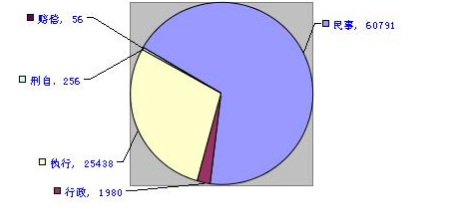
Case filings in Jiangsu Province, by cityCivil 60791, enforcement 25438, administrative 1980, private prosecution 256, state compensation 56May, 2015 cases accepted, by location
An evaluation after six weeks
Some thoughts about the case filing reform
It will mean more cases in the courts and greater stress for fewer judges and other judicial staff, to assist the many pro se litigants.
It should reduce the dissatisfaction level of some proportion of litigants with the court system, such as the anonymous staff from a Guangzhou car finance company quoted in a press report.
Violence against court personnel (like medical personnel), is another factor driving qualified and experienced people away, as described in these recent articles. Will the reforms reduce the level of frustration of ordinary people with the court system, and reduce physical and verbal attacks on judicial personnel? It is early days to say.
It does not resolve underlying issues such as local courts not wanting to offend local government or locally state-owned enterprises. The 4th 5 Year Court Reform Plan identifies cross-jurisdictional courts as a solution, and pilot projects have started on this in various locations, including Beijing, but a comprehensive framework is not yet in place.
For the numerically small number of foreign litigants in the system, it does not change all the documentary requirements needed, such as notarization and legalization of documents and powers of attorney. It should make it easier for foreign invested companies to litigate.
As a Court spokesman suggested, the rejection of many cases could come later, leading to greater pressure on the courts later on, from appeals, more requests for cases to be re-tried, and not ultimately reduce the number of petitioners.
It will inevitably lead to abuse of process and frivolous cases, such as the over-publicized case of a Shanghai man suing because of the stare of a TV star caused him spiritual damage. The Court is working on rules to address this.
“Pyramiding” private lending (potentially crushing the banks)
My article in The Diplomat on shadow banking disputes was recently published. It highlights what few outside of China have noticed–that shadow banking/private lending disputes account for a substantial proportion of civil/commercial disputes in Chinese courts, creating a particular burden on the courts. In some places, the percentage hovers close to 50%! These disputes raise a range of issues and the law is particularly unclear. Although some provincial (and municipal) courts have issued guidance in the absence of a more detailed judicial interpretation, the lower courts are looking to the Supreme People’s Court for a more comprehensive national legal framework.
This short blogpost follows up on the recent report on the same topic in the Diplomat.
In late May, the Supreme People’s Court issued a conference summary on drug crimes (全国法院毒品犯罪审判工作座谈会纪要) setting out further guidance to the lower courts on trying drug cases (for those diving deeper into the subject, a transcript of comments by an official of the #5 criminal division follows the text of the conference summary).
Conference summaries are what the Court entitles “normative documents” and often address new issues or areas of law in which the law is not settled. “Conference summaries” are also a form of Communist Party/government document. Conference summaries are not considered “judicial interpretations” and are not required to be made public. The full text was not generally issued in the legal press but has appeared in social media. This blogpost will look further into the conference summary and what it implies.
The Court organized the conference to ensure that the lower courts were trying drug crimes in line with the latest national policy on the matter and to harmonize lower court practice. That national policy is set out in the first Central Committee/State Council policy document on drug crimes, issued in July, 2014, and the content appears to be sensitive enough that the full text has not been published. “Harmonizing court practice” means in Chinese judicial parlance that judges are applying the law similarly. As explained earlier, judicial conferences are an important way of doing so. The conference summary, which was circulated among conference participants (and the Court leadership) sets out guidelines for judges on difficult issues, including the death penalty.
Death penalty
A good analysis of prior law on drugs and the death penalty can be found here. The conference summary provides guidance on how to apply the death penalty, and is consistent with the Court’s general principles on applying the death penalty–in a minority of cases and to the worst offenders. The conference summary provides guidance in relation to three issues:
Trafficking of illegal drugs–the death penalty is most appropriately applied to the head of a drug enterprise, who organizes, ships illegal drugs with armed guards, hires others, etc, and executing 2 or more persons in the same case should be very carefully considered.
Illegal drugs supply chain–the death penalty should be applied to the worst offenders.
New types of drugs-meth, ice, ketamine–similarly, the death penalty should be applied to the worst offenders.
Unemployed (51% in 2011), with about 90% peasants and unemployed (this has implications for the government’s urbanization plans;
Greater proportion (11%) of women in comparison to other crimes;
Many recidivists;
Generally low level of education;
Involving high level of profits when trafficked away from border areas; and
Increasingly involving new types of drugs.
Comment
As Chinese people become wealthier (and the economy becomes more internationalized), drug use (and the illegal drug industry) is growing correspondingly. As in legal goods, some illegal drug manufacturing has moved to China. Although last July’s high level document calls for a three year plan to control illegal drugs, it seems more likely that we will continue to see an increase in drug cases heard in the Chinese courts and capital punishment applied to the most major offenders.
The Supreme People’s Court (Court) recently issued a report on civil litigation in the Chinese courts in 2014 with some big data and analysis. (The graphics in this blogpost are from the report.) What are the trends relating to commercial disputes and what do they mean?
According to the commentary provided by Ma Jian of the Court’s research office, it reflects:
Dynamics and fluctuations in society and the economy;
Multiple effects of the government’s macro-control policies;
Outcomes of implementing legislation regulating the economy and society.
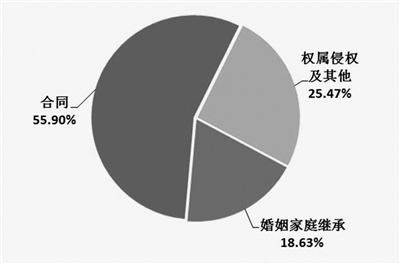
55.8% contracts; 25.47% ownership etc., 18.63% family/inheritance law
Over 9 million civil/commercial cases were accepted by the Chinese courts in 2014, up 7.41% compared to 2013. 1.2 million cases were carried over to 2015, reflecting a change in performance indicators for the courts, described in this earlier blogpost.
In recent years, civil and commercial cases have constituted 63% of all litigation in the Chinese courts. As the Court report noted, the enormous growth in the caseload places even more pressure on the judges. The large caseload, poor pay, lack of respect, and responsibilities unrelated to hearing cases have motivated a significant number of judges to leave (as this recent article highlights). The personnel changes announced in the judicial reforms have exacerbated these trends (and were anticipated by the drafters).
Contract disputes
Trend #2. In 2014, contract disputes constituted more than half of all civil/commercial disputes in the Chinese courts, far outweighing any other category.The proportion of contract disputes in proportion to other civil/commercial disputes has been rising. In 2014, the Chinese courts accepted 4.5 million contract cases, an increase of 11.36% in comparison to 2013. The top five types of contract disputes, accounting for 73% of first instance cases were:
loans;
sales;
labor;
service; and
real estate development & management cases.
The following types of contract disputes have increased most quickly:
credit card;
construction;
loans;
insurance.
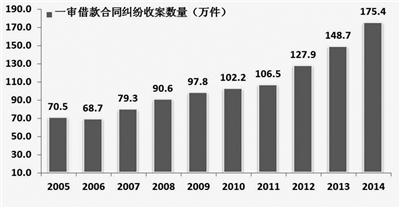
1st instance loan contracts (in 10,000s)
Loan disputes
Trend #3. Loan disputes have more than doubled in the past 10 years. In 2014, they increased by almost 18% in comparison to 2013, to reach 1.7 million cases, Since 2012, loan disputes have exceeded divorce cases. Reasons for this according to the Court:
the government’s prudent money policy;
monetary/funding tightening;
impact of the new company law reforms [more small companies coming onto the market needing funding];
effects of changes to capital market system;
large amount of private lending [民间, generally known as shadow lending outside of China], leading to many more disputes. (I will publish an article on these disputes in the near future).
Other contract disputes
In 2014, the courts accepted almost 700,000 sales contract disputes, an increase of 12.28%. According to Court research, many of these cases involved small companies (SMEs). Many of these cases involved small family companies, with inadequate contract templates, leading to disputes.
New real estate construction cases accounted for 118,700 cases, an increase of 18.7%, while 173,000 real estate development cases were accepted by the courts, a increase of 5.53%。 The large increase in real estate construction cases is related to the tightening of funding for real estate development and the hot and cold in the real estate development market.
Other ownership disputes
New first instance ownership disputes accepted in 2014 reached 2 million cases, an increase of 3.67%. Tort cases accounted for 1.6 million of those cases. New shareholder disputes accounted for about 26,0000, an increase of almost 37%, with a smaller number of commercial paper disputes (48000), an increase of 15.46%.
The Court commented that SMEs have been most affected by the overall macro-economic downturn, which has indirectly led to all sorts of shareholder disputes. The new Company Law has made it possible for funds to come in and out easily, but because many of these companies lack secure sources of operating capital and have to depend on private lending (shadow banking), if one party to these transactions has a funding problem, it causes a multi-party chain reaction and creates many complex shareholding disputes.
Mediation
Mediation/withdrawal of case rate for civil/commercial 1st instance cases
As can be seen from the above bar graph, the rate of settlement of first instance civil (and commercial) cases by mediation or other settlement is now back to 2007 levels. The Court did not set forth reasons for the significant drop in cases resolved by mediation. In my view, two of the factors include:
1) the rate of cases resolved by year end had been an important performance indicator for the courts. Since December, it has no longer been the case; and
2) The Court has moved away from a simplistic policy of “mediation first” to a more nuanced approach to dispute resolution, as indicated by its initiative regarding diversified approaches to dispute resolution.
Comment
Chinese civil litigation reflects what is going on in the real economy and society (this will be even more the case when the effects of case filing reforms are documented) and the effects of government policies and controls on both. Although the US and the European Union are negotiating bilateral investment treaties (BITs) with China, it appears from news reports that no one in either negotiating team has considered the impact of the current state and ongoing reforms of the Chinese judiciary on those BITs. These issues deserve more serious attention. Foreign investors (or more often, subsidiaries of foreign investors) in China are increasingly finding themselves in Chinese courts and this trend is likely to continue.
Although the Human Rights Watch report on the use of torture in the Chinese criminal justice system is capturing the attention of the media outside of China (and overshadowing a forthcoming report of an investigation done by the China University of Political Science and Law (CUPL) on the same subject), the report that may be more persuasive to the Supreme People’s Court (Court) in reducing injustices in China’s criminal justice system is one coming out of a symposium held recently in Henan Province.
The symposium on mistaken cases and “hearing centered criminal procedures”was sponsored by the Henan Higher People’s Court and CUPL, Participants at the symposium included the president of the Henan Higher People’s Court (Zhang Liyong), the head of the #5 criminal division of the Court (Gao Guijun), several leading academics, including one from the Communist Youth League’s training school, and two from the legal press (Legal Daily and the People’s Court Daily). The detailed report from which this blogpost is taken was published in the Court’s media outlets, and a more abbreviated version on the Central Political Legal Committee’s websites).
The criminal prosecution of senior management of GlaxoSmithKline (GSK)’s Chinese subsidiary and many other lower profile cases (such as this one about a Swedish teenager) serve as a reminder that criminal justice issues are relevant to the (foreign) business as well as the human rights community.
The comments from the participants were fairly consistent. Those from the judges who participated are particularly significant, because their remarks reflect reforms set out in the 4th Five Year Court Reform Plan that may be eventually implemented and they are the ones who can advocate directly these points in internal discussions with other participants in the criminal justice system.
Judge Zhang Liyong, President of the Henan Higher People’s CourtJudge Gao Guijun, head of the #5 Criminal Division of the Court
Comments from the judges
Put substance into trial procedure by requiring witnesses to appear in court and implement the exclusion of illegal evidence;
Improve judicial supervision of the investigation process, to ensure that the standard of the investigation process meets the standard at trial. This comment is liked to an unnoticed phrase in the 4th Five Year Court Reform Plan Outline, which calls for “Improving judicial supervision of judicial (i.e. justice system) measures and investigative methods which limit personal freedom.” Publications within the court system, such as this detailed study in Chongqing advocating better judicial controls over the investigatory stage) reveal that some judges are looking to Germany and Taiwan for examples in other civil law systems, in which detainees have the right to be brought before a court during the investigation process;
More effective curbs must be established on procuratorial authority;
Torture still exists to some extent, and measures must be taken to prevent it;
The procuratorate and defense must be on an equal footing;
The defendant is not a criminal until after sentencing, and he must be allowed to sit with defense counsel;
The presumption of innocence in doubtful cases must be implemented (疑罪从无原则).
Comments from the academics
The new [pre-trial] detention center law being drafted by the State Council’s Legislative Affairs Office should incorporate obligations on detention center staff to cooperate with courts in reviewing illegal evidence;
A system should be established to require criminal investigators to appear in court and for the investigation agencies (public security and procuracy) to provide full recordings of interrogations;
The hearing must become the center of proceedings, not the investigation file, and the trial (first instance hearing) is the foundation for preventing miscarriages of justice;
There are defects in the system of correcting miscarriages of justice–there should be a system under which a convict can apply for DNA testing, also the standard for exculpatory evidence in re-trials is too high;
Comments from the media:
To prevent mistaken cases, media monitoring is needed;
News must be made public, to satisfy the public’s right to know;
The justice system must be more transparent.
Comment
Implementing many of the recommendations of the participants of the symposium cannot be done solely by the Court. They will require approval by the political leadership, acting through the Central Committee’s Central Leading Group for Judicial Reform because they relate to other criminal justice institutions. Because many of the issues raised, such as Improving judicial supervision of the investigation process, instituting an effective system for excluding illegally obtained evidence are part of the 4th Five Year Court Reform Plan Outline, it is likely that progress will be made towards implementing these measures in the next few years, perhaps once the reforms mandated for the public security authorities have a had measurable impact. The leadership is unlikely to be willing to implement these reforms if it perceives a negative effect on “law and order” and social stability. The rights of a large number of people can potentially be improved if they are.
Medical malpractice law is the elephant in the room for those considering investing in China’s healthcare sector. In March, the Chinese government issued a large scale plan for reforming medical institutions. Part of those reforms include attracting private and foreign capital to invest in hospitals, clinics, and other medical institutions (as the Communist Party Central Committee highlighted in the Third Plenum Decision), but a few other phrases highlight doing a better job of resolving medical disputes.
According to the head of the #1 Civil Division of the Supreme People’s Court (Court) in 2014, the Chinese courts heard almost 20,000 medical malpractice cases, and over the last seven years, there has been 81% increase. Chinese patients (and families) are increasingly aware that litigation may result in a more favorable outcome than other methods. In a recently issued document (still in draft, but already published on the Internet), the Supreme People’s Court has signalled that it is working on:
a body of medical malpractice law rules; and
better systems to resolve disputes involving the medical system.
Some background
In recent years, disputes between doctors, hospitals and patients in China have been in the news, in policy reports, and scholarly articles, with descriptions of beatings, brawls, and killings occurring in Chinese hospitals. The current problems have been highlighted (in English, at least) on this blog, in the press, in NGO reports, and analyzed in several law review articles, including a detailed study by Professor Benjamin Liebman, of Columbia Law School.
What issues is the Court looking at?
Chinese medical malpractice law (and related institutions) are inadequate for dealing with increasingly litigious Chinese patients (and their families) (as highlighted in this earlier blogpost). In the document, the Court announced:
it is working on new ways of trying medical malpractice cases;
high on its priority is more detailed rules on the burden of proof and the standard of proof in medical malpractice cases (the new interpretation of the civil procedure law does not add significant details on this, leaving earlier rules in place);
the concept is to strike a balance between protecting the interests of the patients and enabling normal operation of medical institutions.
The document sets out some rules that are likely to be incorporated into a judicial interpretation:
a plaintiff seeking to bring a medical malpractice cases must provide evidence of the doctor-patient relationship (evidence could include registration card, medical history, hospital discharge certificate), payment receipts;
a medical institution has the burden of proof when asserting that it should not be liable because medical personnel had taken all reasonable medical efforts, or the state of medical development, or other such issues;
in a medical dispute, if a party is found to have been tampering with the medical record, as a result of which it is not possible to determine causation or the extent of damages, the party who has tampered should bear the adverse legal consequences, and the party who cannot explain internal inconsistencies and errors in the medical record should also bear the advertise legal consequences.
Concluding comments
A press report in January, 2015 mentioned that the Court has started work on drafting a judicial interpretation on medical malpractice issues. If previous legislation is any guide, it is likely that the drafters will be looking to foreign jurisdictions with developed medical malpractice legislation when considering these issues. The Court will consult with the relevant regulatory institutions, such as the China Food and Drug Administration and the National Health and Family Planning Commission. Will the Court solicit public opinion?
Investors considering investing in Chinese medical institutions (or doctors practicing in China), should anticipate a more robust medical malpractice system, although not immediately.
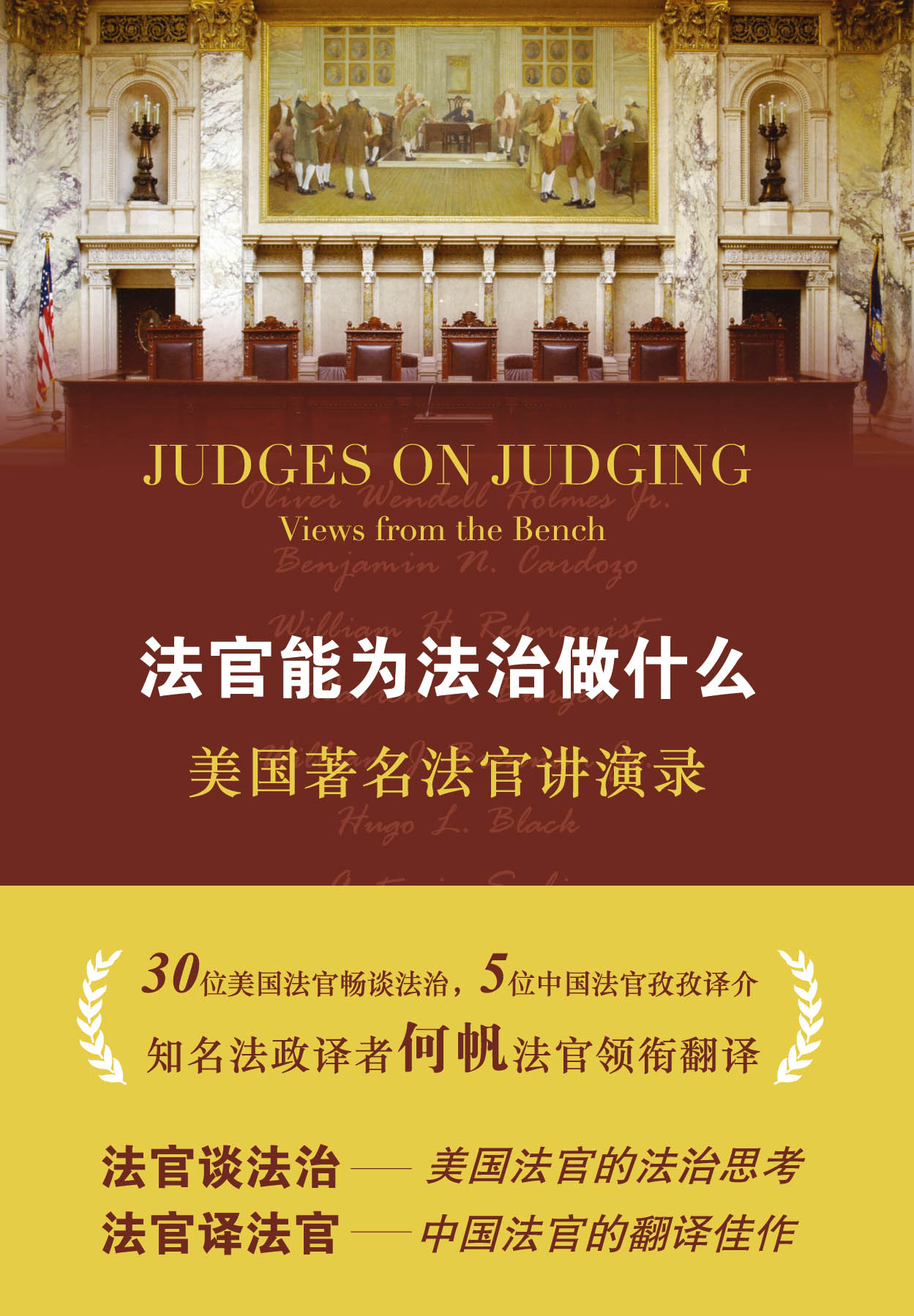
Although Supreme People’s Court president Zhou Qiang has said that judges must “conscientiously resist the infiltration of western wrong ideas,” the May 8 edition of the People’s Court Paper (and the Court’s Wechat feed, which goes out to over 100,000 subscribers) contains a pitch for the Chinese translation ofJudges on Judging: Views From the Bench, by David O’Brien, Professor of Government at the University of Virginia. For those who do not know the book, the publisher describes it as offering: insights into the judicial philosophies and political views of those on the bench. Broad in scope, this one-of-a-kind book features off-the-bench writings and speeches in which Supreme Court justices, as well as lower federal and state court judges, discuss the judicial process, constitutional and statutory interpretation, judicial federalism, and the role of the judiciary. The translation team for the book was five Chinese judges, including one from the Court.
What are the takeaways?
The book is a collection of “greatest hits”–with essays by Cardozo, Posner, Brennan, Ginsburg, Souter, and many others;
It provides a diversity of perspectives and insights into the operation of the US judiciary, including from the state as well as federal judiciary, and from the lower courts, including case selection, internal meetings and opposing views;
The book shows judgment with feeling (感性判断);
It echoes China’s problems. Some of the issues it discusses are being disputed in China’s judicial reforms.Are there enough or too few federal judges? Is having a small number of judges and many cases a real problem? What is the importance of trials (court hearings)? Are judges resolvers of disputes or makers of policy? For those (in China) accustomed to use the US as a model, remarks the chief translator, it is interesting that as the number of cases in the federal courts have risen, the number of trials/hearings has gone down, and that lower court judges spend most of their time with case management and pre-trial negotiations;
Finally, (according to the chief translator) although the book has no answers for China, it provides much food for thought. With rule of law talked about by all, for Chinese judges, to be able to make a contribution to the rule of law, they need to be able to decide independently ( 真正成为独立判断), take matters on, and have sufficient job security.
The chief translator dedicates the book to the late Judge Zou Bihua, who has become a model judge (but whom he knew personally).
On 27 April 2015, the Supreme People’s Court issued a judicial interpretation (English translation here) (27 articles) of the Administrative Litigation (Procedure) Law) (Administrative Litigation Law JI). Judge Li Guangyu, deputy head of the Administrative Tribunal noted that it is not intended to be comprehensive but to address major practical issues the lower courts will face as the law becomes effective.
It was not issued for public comment (there is no such requirement), but comments were solicited within the court system, as well as from the procuratorate, and other authorities, such as the administrative authorities (State Council Legislative Affairs Office and its local counterparts) and the National People’s Congress Legislative Affairs Commission (and its local counterparts).
This judicial interpretation sets out specific rules concerning judicial review of administrative action, filling in some of the blank spots, adding definitions and inserting some specific legal infrastructure (such as filing deadlines) into the Administrative Litigation Law. It is relevant to:
Chinese individuals, companies (domestic and foreign-invested alike), and organizations seeking to challenge a broad range of government actions and decisionmaking;
Foreign governments and international organizations reviewing China’s undertakings to provide impartial and independent tribunals to review administrative action (as China did in its accession to the WTO) or negotiating investment protection and other treaties with the Chinese government;
Foreign companies, organizations, and individuals seeking to challenge Chinese government action.
The judicial interpretation addresses 10 major areas, but this post will highlight the following:
case filing;
requirement that a “responsible person” of an administrative agency to appear in court;
consolidated hearing of a related civil matter;
consolidated review of normative documents;
administrative agreements
consolidated hearing of a related civil matter.
Case filing
Article 1 of the judicial interpretation addresses pervasive refusal by local courts to accept cases (and related problems)(recognized by all stakeholders), by:
directing courts to accept cases on the spot, if it is apparent that the complaint meet statutory requirements;
directs courts to respond within 7 days, if further review is required;
if a court still is unsure after 7 days, it is directed to accept the case.
Appearance by a responsible person
Although during the passage of the Administrative Litigation Law, much was made of the requirement in Article 3 that a “responsible person” appear in court, Article 5 of the Administrative Litigation Law JI clarifies that the head or deputy head of an administrative agency may appoint a representative to appear in court.
Administrative agreements
Article 11 of the Administrative Litigation JI seeks to address, in greater detail, several issues: the definition of an administrative agreement, and what to do about a breach of one. In particular, it details how courts need to hear an aggrieved private party, when a government agency improperly terminates, amends, or fails to perform either:
land acquisition and condemnation agreement; or
a concession agreement.
The first has been a widespread underlying cause of protests, while the second must be resolved if private capital is to heed the call of the Chinese government is encouraging to participate in public-private partnerships, civil-military partnerships, and other uses of private capital to operate public services. Article 11 of the Administrative Litigation Law permits aggrieved private parties to challenge a government failure to perform, or decision to terminate unilaterally or amend a government concession agreements, land or housing expropriation and compensation agreements. In an indication of the the problem, on 6 May the National Development and Reform Commission , which has recently issued regulations on infrastructure concessions, issued a notice to government officials with several warnings including a reminder that concession agreements in force even if a senior government leader changes.
The interpretation also clarifies that a court can hear related civil claims, such as breach of contract or tort claims.
Review of normative documents
Article 53 of the Administrative Litigation Law permits a court to review the legality of a normative document (规范性文件) (often called red titled documents (红头文件)) when reviewing the legal of an administrative act (Under the Legislation Law, these documents have an uncertain status). The Administrative Litigation Law JI adds some further procedural detail and requires a judge that considers a document incompatible with law to set out his reasoning in his judgment and permits a judge to set out suggestions regarding the document to the issuing authority, its counterpart at the next higher level of government, as well as the people’s government at the same level).
Jurisdiction
The judicial interpretation does not address the the issue of hearing administrative cases outside the area in which the case arose. Reform in this area is mentioned in the Administrative Litigation Law itself, and some pilot projects are now underway, (and it is one of the measures listed in the 4th Five Year Judicial Reform Plan Outline), but no consensus has yet been reached on a new approach.
Afterward
Administrative Litigation Law scholars who have spotted errors this blogpost should feel free to use the comment function!
For commercial cases, the amount of dispute does matter in determining which Chinese court will hear your dispute.
On 30 April, the Supreme People’s Court adjusted the jurisdiction of higher and intermediate level courts, both the civilian and military courts in first instance civil/commercial cases in 关于调整高级人民法院和中级人民法院管辖第一审民商事案件标准的通知 (Notice on adjusting jurisdiction for higher and intermediate courts in 1st instance Civil/Commercial cases). The rules described in the notice, which went into effect on 1 May gave Chinese commercial litigators no advance warning. They are not applicable to the following types of cases:
maritime;
foreign, Hong Kong, Macau, and Taiwan related civil cases (there are separate rules on these); and
IP cases.
This means that these rules are applicable to cases brought by (or against) foreign invested enterprises (and domestic enterprises), with the above exceptions. “For the avoidance of doubt,” the notice does not use the term “tier.”
The notice gives a rough idea of the size of business disputes in different parts of China and has special rules to deal with local protectionism, by enabling higher courts to take cases with smaller amounts in dispute if one party is registered outside of the jurisdiction (the Chinese version of diversity jurisdiction in the US federal courts).
First tier jurisdictions
The higher people’s courts of Beijing, Shanghai, Jiangsu, Zhejiang, and Guangdong will now have jurisdiction over cases with an amount in dispute of RMB 500 million or more, (300 million if one party is not registered locally) and intermediate courts, if the amount in dispute is at least RMB 100 million (50 million if one party is not registered locally).
Second tier jurisdictions
The higher people’s courts of the following jurisdictions will now have jurisdiction over cases with an amount in dispute of RMB 300 million (100 million if one party is not registered locally), and intermediate courts if the amount in dispute is at least RMB 30 million (20 million if one party is not domiciled locally):
Tianjin;
Hebei;
Shanxi;
Inner Mongolia;
Liaoning,
Anhui,
Fujian,
Shandong,
Henan;
Hubei,
Hunan;
Guangxi;
Sichuan;
Chongqing.
Third tier jurisdictions
The higher people’s courts of the following jurisdictions will now have jurisdiction over cases with an amount in dispute of RMB 200 million (50 million for non-locally domiciled parties) and intermediate courts will now have jurisdiction over cases with an amount in dispute of RMB 10 million:
Jilin;
Heilongjiang;
Jiangxi;
Yunnan;
Shaanxi;
Xinjiang and the Xinjiang Construction &Production Corp. Court {this latter court deserves a closer look).
Fourth tier jurisdictions
The higher people’s courts of the following jurisdictions will now have jurisdiction over cases with an amount in dispute of RMB 100 million (20 million for a non-locally domiciled party) and intermediate courts will now have jurisdiction over cases with an amount in dispute of RMB 5 million:
Guizhou;
Tibet;
Gansu;
Qinghai;
Ningxia.
Basic level courts:
Are generally to hear the following types of cases:
The PLA Military Court has jurisdiction over civil cases with an amount in dispute of RMB 100 million or more; and
Military region military courts have jurisdiction over civil cases with an amount in dispute of RMB 20 million to 100 million.
Judgments from the military courts are not yet published on the Court’s database. Earlier this year, (as reported here), a PLA legal academic suggested a change in that policy.
Rules to be applied flexibly
There is some flexibility in the rules for cases considered important, difficult, of a new type, or raising issues of general application, in which a higher court can decide to take the case, or alternatively a lower court can apply to hear such cases.
In March, 2015, the Supreme People’s Court (the Court) issued Judicial Transparency in Chinese Courts, its bilingual white paper on judicial transparency (a note for those who don’t know Chinese that the two language versions are not entirely identical, and the English version could have benefited from some polishing).
The paper begins (both in Chinese and English) with the quote–Justice is not to be done, but to be seen done.” The authors appear to be aware with the frustrations of both Chinese and foreign users (and observers) of the Chinese court system with its inadequate transparency, although as an official publication, the report does not confront those issues.The report identifies the (Chinese) general public as having greater expectations concerning judicial transparency and it posing great challenges to the judiciary.
The report highlights the following:
Trial process disclosure platform–the establishment of electronic platforms for litigants and their counsel. Case filing information is not available to third parties (unlike many other jurisdictions). The Court can consider expanding access in this area as well;
Greater access to trials, through on-line broadcasts.
Use of electronic files. China is following a worldwide trend in national court management in piloting electronic files in several locations. It is unclear how China’s current complicated requirements for authenticating a foreign power of attorney, and foreign evidence will interact with this.
Video recording of trial proceedings. Court reporting is not mentioned. This recent blogpost by an anonymous basic level judge criticizes the elimination in the judicial reforms of written transcripts and clerks. The author decries the elimination of written transcripts and the role of clerks as creating an even greater burden on judges, especially at the basic level, who now rely on clerks to review written transcripts. The reforms, according to the author, will mean that the judge must review the video transcript of a trial before drafting a decision. Clerks, according to the author, are generally temporary rather than permanent staff, poorly paid (RMB 1500-2000 in the Yangtze River Delta region) recently law graduates.
Amending Court Rules to permit persons to attend trials more easily. Will those Court Rules be issued for public comment? Will the rules distinguish between foreigners (including foreign journalists) and domestic observers?
The Judicial Opinions of China database. For those with a long-term perspective, it is a a major step forward in Chinese judicial transparency. The database has been criticized both inside and outside of China. Sensitive cases (as may be expected) rarely are posted. In some areas, posting judgments centrally has resulted in less transparency rather than more. For those observers seeking to analyze Chinese court practice, the database makes for slow going, because the search function does not work well, and copying and downloading is apparently not possible. The database is an important tool for lawyers, scholars, and others to understand court practice in specific areas of law, but upgrading the database functionality would be very helpful.
Greater transparency in parole, sentence reduction, and medical parole procedures (described in this earlier blogpost).
Disclosure of enforcement information (described in this earlier blogpost).Use of press conferences, guiding and typical cases (the latter have been the subject of earlier blogposts) As for press conferences, the practice seems to be for one or more judges (and officials of other central authorities) involved in the drafting of a new judicial interpretation (or other document) to speak at the press conference. For those analyzing Court judicial interpretations or other documents, the press conferences are invaluable, because they provide useful background information concerning their provisions, policy goals, and drafting.
Judicial transparency and state secrets. The white paper mentions state secrets several times. In view of greater transparency in state secrecy classification matters, it would be a step forward for state secrecy regulations relating to the courts to be made public.
As has been highlighted earlier, greater transparency is needed in the drafting of judicial interpretations and other documents.
The report concludes that in the near future, the “Supreme People’s Court will continue to thoroughly deepen judicial transparency…so as to make greater contribution to the full promotion of the rule of law, the construction of a socialist country under the rule of law and the realization of the China Dream of the great rejuvenation of the Chinese nation.” There is still much to be done and many challenges ahead, as the Court navigates between the expectations of lawyers, litigants and the general public and robust state secret/information control regulatory systems.
The answer to this question (in some Chinese courts, at least), is yes. A recent legal blogpost flagged a ruling in a labor case published in the Supreme People’s Court’s case database: Su Qiao v. the Taian (Shandong) Municipal Communist Party Disciplinary Inspection Commission. The author of the blog cited in support of his view Articles 48 of the 2012 Civil Procedure Law and Article 52 of the 2015 Civil Procedure Law Judicial Interpretation (concerning organizations that can be parties to civil litigation).
A subsequent (partial) database search revealed some other civil cases in which Communist Party organizations have appeared in variously as plaintiff, defendant, third party, and party against which the enforcement of an arbitral award was sought, including one decided by the Supreme People’s Court (Court):
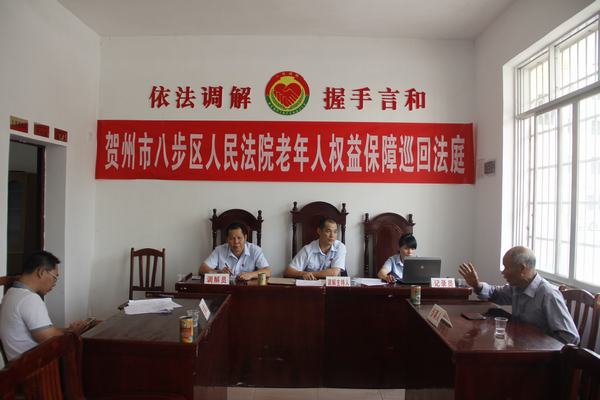
circuit court protecting elderly rights (old man v. son)
In the middle of April, 2015, the Chinese courts carried a report on the issuance of a policy document (the full text is not yet available) by the Ministry of Justice and the National Committee for the Ageing (NCA) (a joint State Council/Party organization, as the Chinese version of the NCA’s website states) on establishing a system of lawyers and legal aid for the elderly. Issues relating to representing the elderly in China mirror those in other parts of the world.
Although the Supreme People’s Court was not one of the institutions that issued the policy document, the national court system is affected by profound changes to Chinese society, including the greying of Chinese society, its urbanization, and other factors. These cases are considered by the courts those relating to people’s livelihood, as discussed in previousblogposts.
The issuance of this document relates to Article 55 of the 2012 Law on the Protection of the Rights of the Elderly, which calls for elderly people to obtain legal assistance if they cannot afford a lawyer needed to defend their rights. The Chinese courts are facing a major increase in cases involving the elderly, both civil and criminal, involving psychological and physical abuse, as a study done by the Suzhou Intermediate Court illustrates. It is likely that the Ministry of Justice and NCA did a more comprehensive study on the need for advocates for the elderly before issuing this document.
From 2011 to 2013, the Suzhou courts accepted 1,100 civil cases involving the elderly. Those increased rapidly over the 3 years in question, because in 2013 586 cases were accepted, an increase of 102.77% over the previous year. The cases related to support, divorce, inheritance, and division of property rights.
in 2013, there was an 83% increase in civil cases involving the right to the division of property rights arising from land acquisition, with over 80% of the property division cases arising in rural areas;
Over 90% of the support cases arose in rural areas;
In 2013, there was a 183% increase in inheritance disputes involving the elderly;
In over 70% of the cases involving division of property rights from land acquisitions, elderly were forced to live in bicycle sheds, garages, or other unfavorable conditions.
In many cases, elderly are shunted back and forth between their grown children, who were fighting over valuable property rights held by elderly parents.
The policy document calls for a one month movement in October to focus on the establishment of probono legal service centers for the elderly. A one month movement appears inadequate for the breadth and depth of this important social problem, which reveals that Confucian values concerning support and care for the elderly have landed in the dustbin of history in too many cases. We look forward to hearing more detailed reports from law firms and NGOs on how the rights of over a hundred million Chinese elderly (anticipated to more than double by 2050) can be better protected.
The Supreme People’s Court often organizes experts meetings (论证会) when drafting judicial interpretations, which are analogous to what in Hong Kong is called “soft consultations” (closed door consultation with market participants).
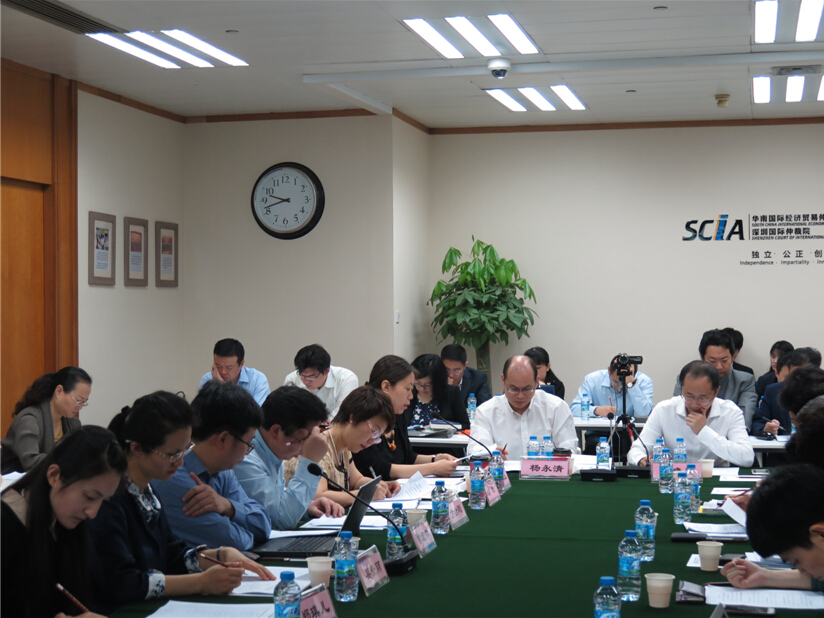
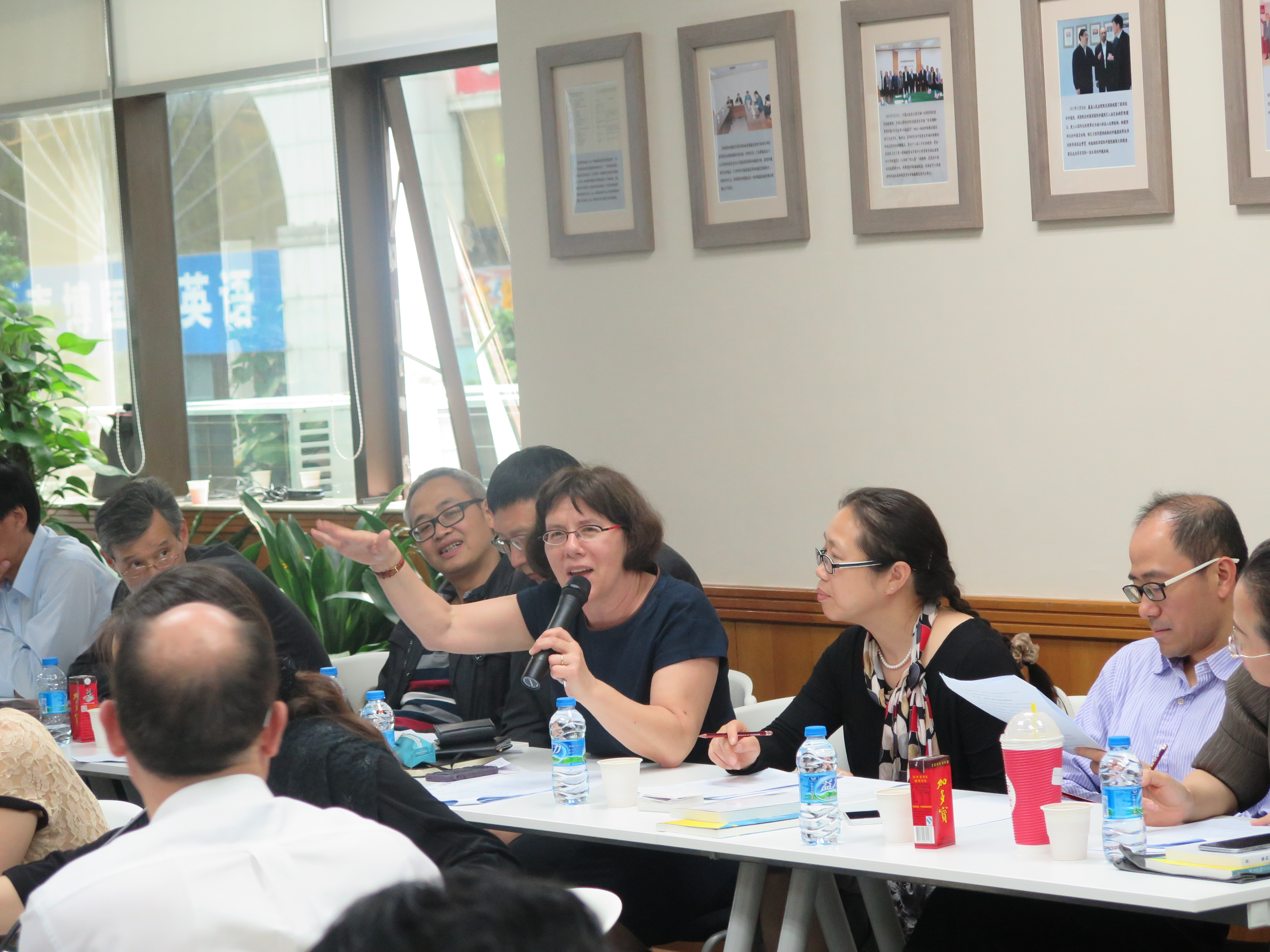
In late March, the Shenzhen Court of International Arbitration (SCIA) and the #2 civil division of the Supreme People’s Court held a experts meeting in Shenzhen to obtain comments from the market on a draft of the #4 interpretation on company law. It was attended by a packed roomful of SCIA arbitrators (as attested by these photos from the report on the SCIA website). Participants included lawyers from the Shenzhen Stock Exchange (SSE), chief counsel for listed companies (primarily on the SSE), law firm partners with a broad range of clients, and the author of this blog.
Judge Wang Dongmin of the #2 Civil Division chaired the half-day proceedings. Vice President of the #2 Civil Division, Yang Yongqing, and Judge Liu Min of the #1 Circuit Court [Tribunal] based in Shenzhen, and other Supreme People’s Court judges also attended.
The review of the draft proceeded in five sections, mirroring the sections of the draft:
when can a court declare invalid or cancel a decision of a board of directors/shareholders meeting;
procedures by which a shareholder’s right to know can be enforced;
how can a shareholder enforce his right to have profits distributed;
issues related to the transfer of shareholding;
issues related to derivative litigation.
The commentators raised some issues not previously raised in previous experts meetings, as well as a broad variety of drafting comments, and practical issues, including many relating to cross-border issues.
The judicial interpretation is being drafted to provide guidance to the lower courts (and the market) in hearing cases concerning these basic company law issues that the Company Law itself does not yet address in sufficient detail. We look forward to a revised draft being issued for public comment, so that the drafting team can receive an even broader range of comments.
The Shenzhen courts, dealing with the “new normal” in China’s social and economic changes ahead of the rest of the country, often find current legislation and Supreme People’s Court interpretations inadequate to deal with the issues that come before them. Divorce law and shadow banking (loans made outside the formal banking system) are two types of cases inundating the Shenzhen courts (and yes, there is a connection).
At the end of last year, the Shenzhen intermediate court issued local court guidance (with an accompanying explanation–these are not “interpretations of law”), binding only on the Shenzhen courts, on two important issues:
In Shenzhen, which is wealthy and where women are relatively rights conscious (at least in divorce), the local courts found that existing rules failed to deal with the issues that came before them regularly.Some of those issues include:
marital property (particularly rights to real property);
the business that a couple may have built up together;
children born outside the marital relationship, and
issues relating to cross-border marriages.
As in so many areas of Chinese law, legislation lags behind social reality. The 2011 interpretation by Supreme People’s Court of the Marriage Law, as it relates to marital property, has been controversial both inside and outside of China, as highlighted by many articles and books addressing the issue because it has meant that in divorce, women often lost possession to home(s) to which they or their parents had contributed substantial funds.This has been particularly true in Shenzhen. The local intermediate court highlighted that over 80% of the divorce cases that are heard locally involve disputes over real property. In divorces, women have continued to argue that they should be awarded possession of the home.
Another issue leading to disputes in and out of the courtroom is the practice of some courts. when dealing with divorces, to split ownership of the family business. The guidance directs judges to consider the family law issues only, and have the division of the business considered in separate proceedings. These rules also contain provisions relating to Hong Kong, where there are many cross border marriages and couples whose lives and property crisscross the border. The court guidance, besides setting out new legal rules, provides a deep dive look into what goes on in many local marriages, judging from the rules relating to children born outside of the marital relationship.
banks turn off funding tap, shadow banking comes to the rescue
Shadow banking loans, which the Supreme People’s Court has finally recognized to be valid (if they meet certain conditions) constitute about 20% of civil disputes in the Chinese courts, according to President Zhou Qiang’s report to the NPC, and the numbers are even greater in Shenzhen. In the court in the business district of Futian, for example, the statistics are as follows:
2012: 1153 cases;
2013: 1627 cases
first half of 2014: 976 cases.
The court guidance in substance an answer to FAQs of the Shenzhen courts on the following questions (and many more):
what if the loan relates to a gambling debt?
What if one spouse lends money to a third party without informing the other spouse?
How can shadow banking be distinguished from the crime of illegal fund raising?
What if the legal representative of a company loans out company money in his own name?
What are the ceilings, if any on interest, penalties and other fees?
We can expect that the Supreme People’s Court will be monitoring the success of these rules in practice when issuing its next judicial interpretation in these areas. And with the Supreme People’s Court Circuit Court (Tribunal) located in Shenzhen, it is likely that discussion of these issues occurs from time to time behind the scenes.
My article on the 4th Five Year Reform Plan for the courts appeared in the Diplomat earlier this week. It gave me an opportunity to put court reforms in their systemic context. This blog will focus on the some of the many micro-steps needed to implement it. One of those micro-steps occurred earlier this month, when the Shanghai #1 Intermediate Court issued regulations on implementing a registration case acceptance system for commercial cases.
My article below was published in the 17 March edition of the South China Morning Post:
To solve the many specific cross-border legal issues affecting the people of Hong Kong and the rule of law in the special administrative region, an independent and non-partisan advisory committee on cross-boundary legal issues should be established.
The committee, which ideally would draw its membership from current or retired senior members of the legal profession, would provide policy guidance to a working group drawn from the legal community. The idea would be to draw together people familiar with the Hong Kong and mainland legal systems. They would work together to propose options for practical solutions to problems involving complex legal issues.
These problems could be issues in the news, such as parallel trading, and other serious problems not in the news such as cross-boundary pollution, criminal justice or domestic violence. The members of the working group must be able to reach out to those with the right expertise or background, regardless of political views.
One example of an important issue not in the news is domestic violence. Grenville Cross SC has recently written about the need for improving Hong Kong domestic law on this front. I have written about domestic violence on the mainland, highlighting new guidance by the Supreme People’s Court and others for dealing with this serious social problem. Hong Kong social trends, such as cross-border marriages and Hong Kong elderly people settling on the mainland, mean that cross-border domestic violence is an unrecognised problem.
Another issue concerns cross-border cooperation in criminal matters. The South China Morning Post reported last autumn that the Supreme People’s Procuratorate had announced that it would focus on establishing ways to bring suspects home, including extradition and repatriation, with Hong Kong as the first target. If the government is being asked to conclude a rendition agreement or criminal law judicial assistance arrangement, this touches on a broad range of legal issues for individuals, companies and other organisations.
A Hong Kong foundation can consider investing some resources to fund the necessary research and analysis on which the advisory committee will need to rely. Such foundations have been generous in funding research on law and Chinese studies in universities elsewhere. The proposed advisory committee and working group are intended to provide practical results and are sure to provide value for money.

 Chinese maritime courts, which primarily hear maritime commercial cases, also have jurisdiction over maritime pollution cases. This short blogpost provides a brief update on the first public interest environmental case filed in the maritime courts.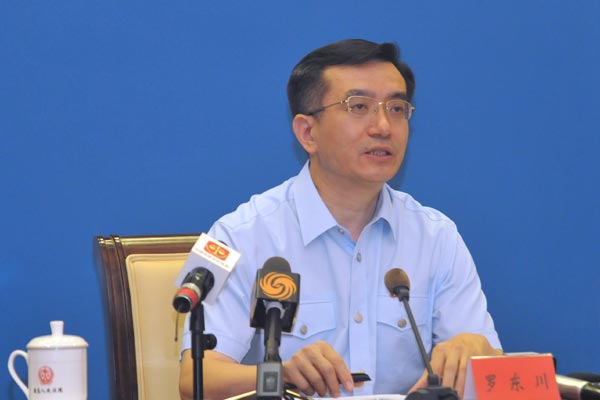










 Supreme People's Court Monitor
You must be logged in to post a comment.