Category Archives: Uncategorized

Supreme People’s Court tweaks capital punishment review procedure

Screen Shot 2016-06-26 at 3.28.09 PMSeveral days ago, the Supreme People’s Court (SPC) issued the brief judicial interpretation, translated below:

Supreme People’s Court

Reply Concerning issues related to the Application of Article 225 (para 2) of the Criminal Procedure Law

Approved by the 1686th meeting of the Judicial Committee of the Supreme People’s Court, in effect from 24 June 2016

Fa Yi(2016) #13

To the Henan Higher People’s Court:

We have received your request for instructions concerning the application of Article 225(2) of the Criminal Procedure. After consideration, we respond as follows:

I.  For cases remanded to the second instance people’s court for retrial by the Supreme People’s Court, on the basis of “People’s Republic of China Criminal Procedure Law” Article 239 (2) [if the Supreme People’ s Court disapproves the capital punishment sentence, it may remand the case for retrial or revise the sentence] and Article 353 of the Interpretation of the “Supreme People’s Court on the application of the People’s Republic of China Criminal Procedure Law [where the Supreme People’s Court issues a ruling on non-approval of the death penalty sentenced under a case, it may remand the case to the people’s court of second instance or the people’s court of first instance for retrial, depending on the actual circumstances of the case…], having ruled not to approve the death penalty,and  regardless of whether the people’s court of second instance had previously sent the case back to the first instance court on the grounds that original judgment’s facts were unclear or evidence was insufficient; in principle, it must not be sent back to the original first instance court for retrial; if there are special circumstances requiring the case to be sent back to the first instance court for a retrial, it must be submitted to the Supreme Court for approval.

II. in cases where the Supreme People’s Court had ruled to disapprove the death penalty and remanded the case to the second instance people’s court for retrial, and the second instance people’s court had remanded the case to the first instance court according to special circumstance, after the first instance court has issued its judgment and the defendant has appealed or the people’s procuratorate has made a protest, the second instance people’s court should issue a judgment or ruling according to law, and must not send the case back for re-trial, according to the specifics of the case, which had sent the case to the first instance court for retrial.

So replied.

_________________________________________________________

What is this and what does this mean?

This is a judicial interpretation by the SPC in the form of a reply, as explained here.  It is a reply (批复) to a “request for instructions” from a lower court relating to an issue of general application in a specific case.  The Henan Higher People’s Court had submitted a request for instructions, likely with two or more views on the issue, but the lower court’s request is not publicly available.  It is likely that practice among provincial courts had been inconsistent, and therefore the SPC is harmonizing judicial practice through this reply.  As required by the SPC’s  regulations on judicial interpretations, it must be approved by the SPC’s judicial committee as a judicial interpretation.

This gives further details to the SPC’s capital review procedures, requiring second instance (generally provincial level courts) to hear retrials of cases remanded by the SPC and not instructing those courts not send cases back to the first instance court for retrial.  It also requires the second instance court to rule on a defendant’s appeal or procuratorate’s protest and not remand the case back to the first instance court, expediting the final consideration of these cases and limiting the number of remands of these cases.

Is this a positive development for the protection of the rights of the defendants (the defendants in the typical drugs cases announced by the SPC recently were mostly peasants), by requiring the second instance court to hear these cases, away from the public pressure where the crime occurred?  In a 2013 article, criminal defense lawyer Sun Zhongwei described the pressure on a local first and second instance court is under from the victim’s family and the local Party committee and government, and how the institutions use delay and remanding the case to the procuratorate and public security for additional investigation to avoid making difficult decisions that will alienate local authorities.What has the role of defense counsel been in these cases?  Have most defendants been advised by counsel? Was the delay in final resolution in these cases an issue discussed by the Central Political Legal Committee?

What was the rationale for issuing this interpretation at this time?  Is it a measure to promote the efficiency of the courts, by expediting finality in criminal punishment, so that the courts can announce in a timely manner their crime fighting accomplishments and typical cases?A headline on one of the SPC’s websites  reporting on 30% increase in drugs crime convictions in the provincial level courts may indicate which is valued more–“People’s courts across the country cracked down hard on drug crime.”

Or is it linked to planned reforms to the criminal justice system and improvements to the legal aid system for criminal defendants approved by Xi Jinping and other top leaders on 27 June?

Environmental public interest litigation in the Qingdao maritime courts

large_article_im2286_ConocoPhillips_oil_spill_in_ChinaChinese maritime courts, which primarily hear maritime commercial cases, also have jurisdiction over maritime pollution cases.  This short blogpost provides a brief update on the first public interest environmental case filed in the maritime courts.

Qingdao Maritime Court has announced that it accepted a case filing by plaintiff China Biodiversity Conservation and Green Development Foundation (CBCGDF) against ConocoPhillips and China National Offshore Oil Corporation (CNOOC).

According to its official social media Weibo, the plaintiff filed a lawsuit on July 7th, 2015, requesting the court to order two defendants to repair the environmental damage caused during the 2011 Bohai Bay oil spill. The court accepted the case on July 21st, 2015.

This is the first maritime pollution case in China brought by a social organization in accordance with the Article 58 of the Environmental Protection Law, which for the first time granted social organizations to file litigation relating to pollution activities that cause environmental pollution, ecological damage or public interest harm.

CBCGDF had previously filed cases regarding fresh water pollution and red wood destruction, which were accepted by the respective courts. Back in May 2015, another social organization brought a similar lawsuit against PetroChina in Dalian Maritime Court for oil spill, which was dismissed by the court. The plaintiff in that case did not seek to appeal the dismissal after PetroChina set aside an ecological repair fund of RMB 200 million.

The 2011 Bohai Bay oil spill has been followed by government investigation and fines, as well as related civil lawsuits. This case will be widely watched by the environmental community, including social organizations [foundations, NGOs, and others] and environmental law experts and Chinese and international practitioners.

[Contributed by Fang Jianwei (Jerry) Fang, a partner with the China-based Global Law Office in the firm’s Shanghai and Beijing offices. He was a judge in China and studied law at Columbia Law School.  For more information on this report, please contact him  at jfang@glo.com.cn.]

What lessons can China learn from the US judiciary?

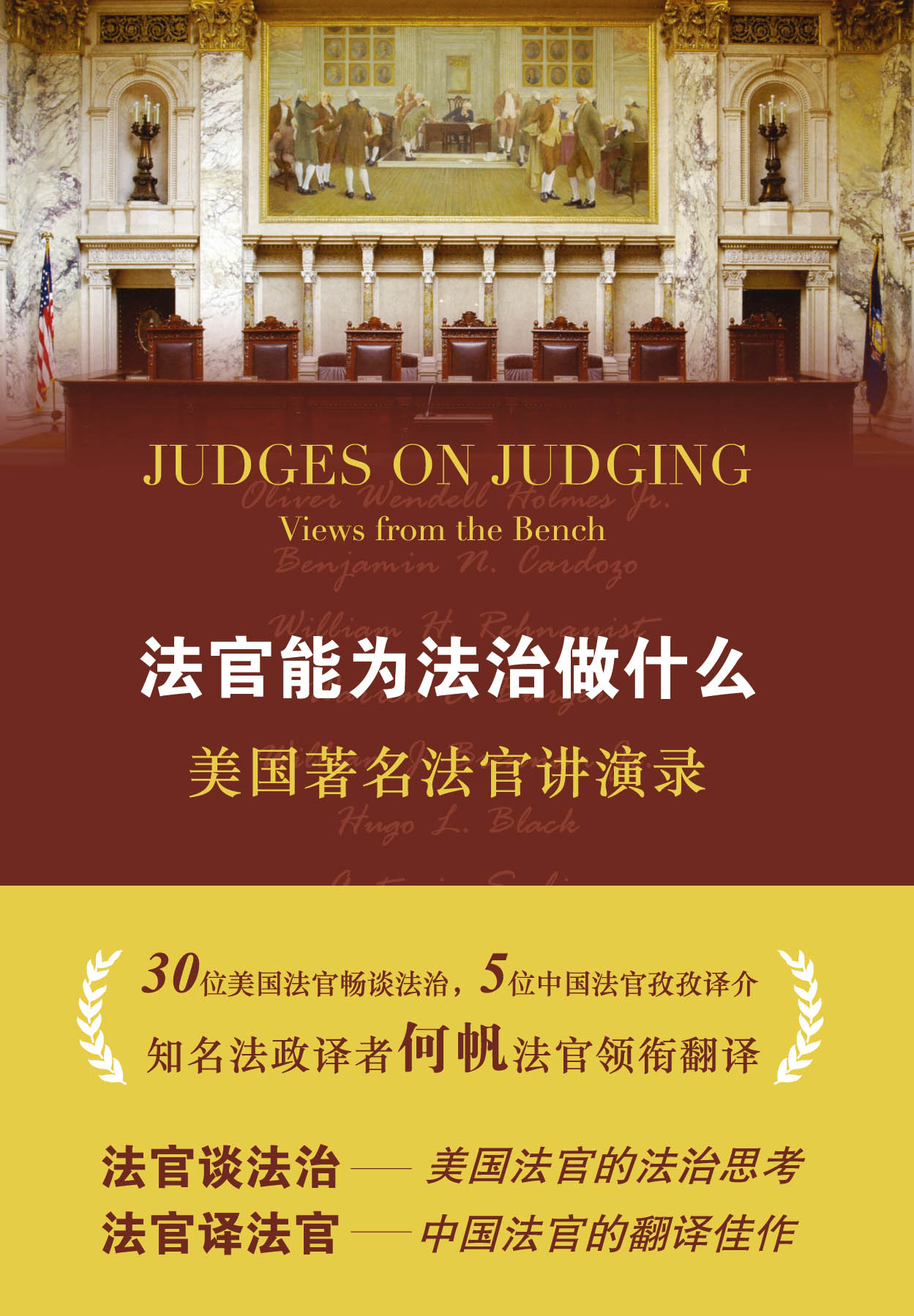
法官能为法治做什么(去问号)Although Supreme People’s Court president Zhou Qiang has said that judges must “conscientiously resist the infiltration of western wrong ideas,” the May 8 edition of the People’s Court Paper (and the Court’s Wechat feed, which goes out to over 100,000 subscribers) contains a pitch for the Chinese translation of Judges on Judging: Views From the Bench, by David O’Brien, Professor of Government at the University of Virginia.  For those who do not know the book, the publisher describes it  as offering: insights into the judicial philosophies and political views of those on the bench. Broad in scope, this one-of-a-kind book features off-the-bench writings and speeches in which Supreme Court justices, as well as lower federal and state court judges, discuss the judicial process, constitutional and statutory interpretation, judicial federalism, and the role of the judiciary. The translation team for the book was five Chinese judges, including one from the Court.

What are the takeaways?

  • The book is a collection of “greatest hits”–with essays by Cardozo, Posner, Brennan, Ginsburg, Souter, and many others;
  • It provides a diversity of perspectives and insights into the operation of the US judiciary, including from the state as well as federal judiciary, and from the lower courts, including case selection, internal meetings and opposing views;
  • The book shows judgment with feeling (感性判断);
  • It echoes China’s problems.  Some of the issues it discusses are being disputed in China’s judicial reforms.Are there enough or too few federal judges?  Is having a small number of judges and many cases a real problem? What is the importance of trials (court hearings)?  Are judges resolvers of disputes or makers of policy? For those (in China) accustomed to use the US as a model, remarks the chief translator, it is interesting that as the number of cases in the federal courts have risen, the number of trials/hearings has gone down, and that lower court judges spend most of their time with case management and pre-trial negotiations;
  • Finally, (according to the chief translator) although the book has no answers for China, it provides much food for thought. With rule of law talked about by all, for Chinese judges, to be able to make a contribution to the rule of law, they need to be able to decide independently ( 真正成为独立判断), take matters on, and have sufficient job security.
  • The chief translator dedicates the book to the late Judge Zou Bihua, who has become a model judge (but whom he knew personally).

Supreme People’s Court’s Judicial Transparency White Paper

62bc75491cff95d15b4742e0c32268d9In March, 2015, the Supreme People’s Court (the Court) issued Judicial Transparency in Chinese Courts, its bilingual white paper on judicial transparency (a note for those who don’t know Chinese that the two language versions are not entirely identical, and the English version could have benefited from some polishing).

The paper begins (both in Chinese and English) with the quote–Justice is not to be done, but to be seen done.”  The authors appear to be aware with the frustrations of both Chinese and foreign users (and observers) of the Chinese court system with its inadequate transparency, although as an official publication, the report does not confront those issues.The report identifies the (Chinese) general public as having greater expectations concerning judicial transparency and it posing great challenges to the judiciary.

The report highlights the following:

  • Trial process disclosure platform–the establishment of electronic platforms for litigants and their counsel.  Case filing information is not available to third parties  (unlike many other jurisdictions).  The Court can consider expanding access in this area as well;
  • Greater access to trials, through on-line broadcasts.
  • Use of electronic files.  China is following a worldwide trend in national court management in piloting electronic files in several locations. It is unclear how China’s current complicated requirements for authenticating a foreign power of attorney, and foreign evidence will interact with this.
  • Video recording of trial proceedings.  Court reporting is not mentioned.  This recent blogpost by an anonymous basic level judge criticizes the elimination in the judicial reforms of written transcripts and clerks. The author decries the elimination of written transcripts and the role of clerks as creating an even greater burden on judges, especially at the basic level, who now rely on clerks to review written transcripts.  The reforms, according to the author, will mean that the judge must review the video transcript of a trial before drafting a decision. Clerks, according to the author, are generally temporary rather than permanent staff, poorly paid (RMB 1500-2000 in the Yangtze River Delta region) recently law graduates.
  • Amending Court Rules to permit persons to attend trials more easily.  Will those Court Rules be issued for public comment? Will the rules distinguish between foreigners (including foreign journalists) and domestic observers?
  • The Judicial Opinions of China database.  For those with a long-term perspective, it is a a major step forward in Chinese judicial transparency. The database has been criticized both inside and outside of China.  Sensitive cases (as may be expected) rarely are posted.  In some areas, posting judgments centrally has resulted in less transparency rather than more.  For those observers seeking to analyze Chinese court practice, the database makes for slow going, because the search function does not work well, and copying and downloading is apparently not possible.  The database is an important tool for lawyers, scholars, and others to understand court practice in specific areas of law, but upgrading the database functionality would be very helpful.
  • Greater transparency in parole, sentence reduction, and medical parole procedures (described in this earlier blogpost).
  • Disclosure of enforcement information (described in this earlier blogpost).Use of press conferences, guiding and typical cases (the latter have been the subject of earlier blogposts) As for press conferences, the practice seems to be for one or more judges (and officials of other central authorities) involved in the drafting of a new judicial interpretation (or other document) to speak at the press conference. For those analyzing Court judicial interpretations or other documents, the press conferences are invaluable, because they provide useful background information concerning their provisions, policy goals, and drafting.
  • Judicial transparency and state secrets. The white paper mentions state secrets several times. In view of greater transparency in state secrecy classification matters, it would be a step forward for state secrecy regulations relating to the courts to be made public.
  • As has been highlighted earlier, greater transparency is needed in the drafting of judicial interpretations and other documents.

The report concludes that in the near future, the “Supreme People’s Court will continue to thoroughly deepen judicial transparency…so as to make greater contribution to the full promotion of the rule of law, the construction of a socialist country under the rule of law and the realization of the China Dream of the great rejuvenation of the Chinese nation.”  There is still much to be done and many challenges ahead, as the Court navigates between the expectations of lawyers, litigants and the general public and robust state secret/information control regulatory systems.

Supreme People’s Court’s Master Reform Plan for the Courts

u=1287881454,1818152496&fm=23&gp=0
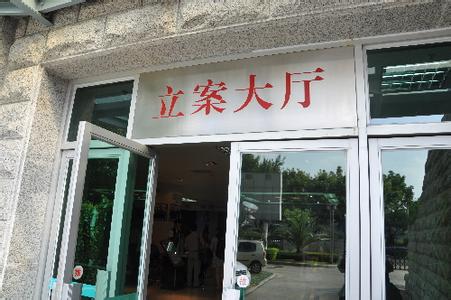
Case filing hall

My article on the 4th Five Year Reform Plan for the courts appeared in the Diplomat earlier this week.  It gave me an opportunity to put court reforms in their systemic context.  This blog will focus on the some of the many micro-steps needed to implement it.  One of those micro-steps occurred earlier this month, when the Shanghai #1 Intermediate Court issued regulations on implementing a registration case acceptance system for commercial cases.

Congratulations, Professor Allen!

Professor Ronald Allen

On 30 September John Henry Wigmore Professor of Law Ronald Allen  of Northwestern University School of Law was one of 100 foreign experts to be awarded China’s Friendship Award in the Great Hall of the People for his work with the Academy of Social Sciences, the China University of Political Science and Law and Supreme People’s Court on evidence law and related issues.  The national court website ran a story on Court Vice President Shen Deyong’s meeting with Professor Allen, at which Judge Shen thanked Professor Allen for his work on behalf of the Supreme People’s Court.  Judge Shen commented on the importance of evidence law. He also noted that although China’s court reform must be based on China’s situation, it can draw on foreign law methods and experience, including that of common law systems.  Well done Professor Allen!

The Supreme People’s Court Issues its Newest Five Year Reform Plan for the Courts

On 9 July, the Supreme People’s Court issued its fourth five year reform plan for the courts, approved by the Party leadership, which sets out 4 broad areas of reform, relating to 8 general areas. An overview has been released on Wechat and other Chinese social media and can be expected to be published very soon in more traditional media. An clear info graphic was published on the Court website and other official media, translated here.

The Court described it as taking first steps towards establishing a judicial system with Chinese characteristics and is intended to roll out reforms announced in the 3rd Plenum decision and the judicial reform decision announced earlier this spring and some of its themes were highlighted in press releases published just after Chinese new year.  Many of these issues are ones that have been discussed within the Chinese legal community for many years and draw on international expertise as well. The summary below highlights five of the eight broad areas.

  • Personnel reforms
  • Separate administrative and judicial jurisdiction
  • Improve the operation of the judicial function
  • Improve the protection of human rights
  • Increase judicial transparency
  • Clarify the roles of the four levels of the courts
  • Improve judicial administration
  • Promote reforms relating to petitioning

Personnel reforms

The intention of the personnel reforms are to split the treatment of judges from other civil servants, to step away from the traditional model of judges as cadres. This will involve pushing forward the initial reforms being tested to change the personnel management of local courts, and transfer that to the provincial level. This will include:

  • the establishment of provincial level selection committees, will involve clearance by Party disciplinary and other functions, and retain appointment by the people’s congress.
  • Personnel reforms will also involve splitting the management of judges from other judicial personnel, such as judicial police and clerks.
  • Additionally, reforms are intended to the use of judicial headcount, to focus that by increasing the number of judges.
  • Two other reforms involve establishing new systems for judicial promotions and establishing differing criteria for the recruitment of different types of judges.

Separate administrative and judicial jurisdiction

Reforms in this area include:

  • taking steps to take certain cases, such as some environmental and commercial cases out the local administrative jurisdictions, so that they can be heard fairly.
  • Reform some of the lesser known courts, such as the forestry courts, to bring them into the ordinary court system.
  • Establish a system for circuit tribunals at provincial level to hear difficult cases, and focus on environmental cases.
  • In areas where  there are more intellectual property cases, promote the establishment of intellectual property courts.

Improve the operation of the judicial function

The summary concerning this section admits that having the person who heard the case decide it remains difficult to implement within the Chinese jidicial system, and that despite initial attempts, internal multi-level approvals for deciding cases remains the norm.  The intended reforms in this area include:

  • improving the system of responsibility of the primarily responsible judge and the panel that heard the case.
  • Changing the system of signing judicial decisions.
  • Improving the monitoring of judicial performance.
  • Improving judicial disciplinary procedures.

Importantly, reforms look to change the current relationship between the judge responsible, the tribunal, and others in a position of leadership within the courts, such as the head of the division and court president. There has been a great deal of academic writing about this, in both English and Chinese, as well as articles written by judges serving at various levels.  A great deal of thought has gone into this section and implementing these reforms will involve changing long-term patterns of interaction.

Improve the protection of human rights

Reforms in this area are intended to improve the protection of human and property rights, particularly by improving judicial review of the investigation and prosecution stages:

  1. Eliminate the use of illegally obtained evidence.
  2. Improve the role of the defense lawyer and the statement by the advocate for the defendant.
  3. Improve systems for pursuing judicial negligence.
  4. Improve the protection of assets relating to [criminal cases].
  5. Improve reforms in the area of minor crimes, so that those cases are heard more quickly (pilot projects are underway in some areas).

These reforms represent the result of years of discussions within the judiciary, with lawyers, academics, and interactions with members of foreign courts, research into foreign legal systems, and others.

Increase judicial transparency

Reforms in this area build on the initial steps taken late last year and include:

  1. Make the hearing stage more open, by improving the system of announcements and permitting spectators to attend court hearings, increase real time broadcasts of hearings.
  2. Improve the handling of judicial information, so that litigants can determine the status of their case on-line.
  3. Improve the judicial decision database, Judicial Decisions of China.

All of these reforms are good practical proposals. Foreign observers of the Chinese courts would welcome easier access to Chinese court hearings.

A quick comment

Drafting this reform plan has been a tremendous undertaking and its implementation promises to be even more challenging.  Some of the reforms discussed above are the subject of pilot projects in various parts of the country, ranging from Guangdong and Shanghai, where the courts have heavy caseloads and face cutting edge cases, to less prosperous inland provinces. Reforms are likely to start with what is most easily implemented and where results can most easily be achieved.  What this means for some of the specialized courts, such as the military and maritime courts, will be clarified in time. The extent to which these reforms can change patterns of interaction within the judiciary and between the judiciary and government/Communist Party of many decades standing remains to be seen.  It is hoped that the pressure of greater professionalism within the judiciary, and other social and economic forces will eventually result in a judiciary that better serves the needs of all.


Power of foreign court appointed liquidator of overseas listed company to take over Chinese subsidiary comes before the Supreme People’s Court


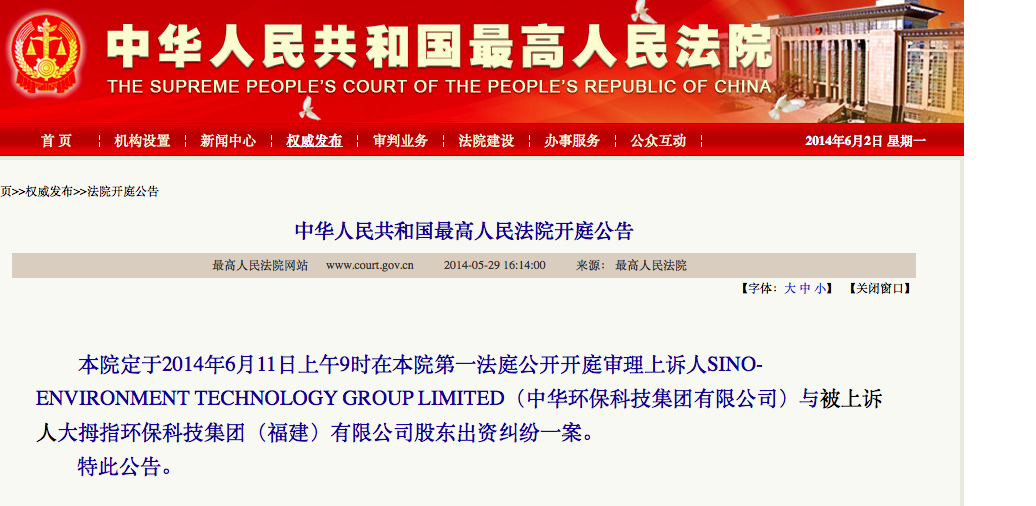
Sino-environment hearing notice

HEALTH WARNING: PLEASE SEE THIS BLOGPOST FOR THE MOST RECENT DEVELOPMENTS.

On 11 June 2014, the Supreme People’s Court will hear a shareholders dispute.  The facts of the case (described below) are familiar to the Hong Kong and Singapore legal and investment community. They touch on the power of overseas insolvency/bankruptcy professionals to take over assets in China.

The parties to the case are Sino-Environment Technology Group Limited (Sino-Environment Tech) (a company originally listed in on the main board in Singapore (but now in liquidation) and one of its wholly owned subsidiaries, Thumb Env-Tech Group (Fujian) Co., Ltd (Thumb Env-Tech).

The case has all the elements of a China deal gone very, very bad.

What we know

The case was originally brought in the Fuzhou Intermediate Court by Thumb Env-Tech (i.e., the original management group).  It challenged the right of the judicial manager (later the liquidator) (appointed by the Singapore High Court) to remove the original legal representative and directors.  Thumb Env-Tech alleged that the judicial manager had no right to  remove the directors and legal representative and it was arbitrarily implementing an order of a Singapore court, violating China’s judicial sovereignty.  The Fuzhou Intermediate Court rejected Thumb Env-Tech’s claim, determining that it was not a proper party.Thumb Env-Tech appealed to the Fujian Higher People’s Court.  The decision can be found here, on the court’s website. The Fujian Higher People’s Court rejected Thumb Env-Tech’s appeal, stating that the case is not a simple matter of private rights but involves issues of public policy, and that Article 119 of the Civil Procedure Law did not permit Thumb Env-Tech to bring the case. Thumb Env-Tech has brought a petition to have the case reviewed by the Court. (summary from the Fujian Higher Court decision)

Sino-Environment Technology Group Limited was a listed Singapore company that was principally engaged in the provision of environmental protection and waste recovery through its subsidiaries in PRC with over SG$165 million debt. Its liquidators investigated SG$84 million worth of suspicious transactions undertaken by the group, taking steps to secure control over the company’s PRC subsidiaries by removing all existing legal representatives and directors of the PRC subsidiaries and commencing legal proceedings against them, securing the company’s cash held with a PRC bank and assessing and defending legal proceedings. (from the liquidator’s website)

Morgan Stanley sold $US 109 million in Sino-Environment Technology Group Limited convertible bonds. The company defaulted on repayment of the bonds. (from a first press report and a second press report.)

Related litigation in the Hong Kong courts can be found here.

What will the outcome be?

We will wait the outcome of this case in the Court.  It is a “typical case” in its own way, because there are many cases in which foreign companies with Chinese subsidiaries, some of them listed, get into financial difficulties.  It is part of international insolvency practice that  bankruptcy trustees/judicial managers/administrators/liquidators appointed by foreign courts will take over control of subsidiaries in China.  Chinese law and practice do not make this an easy process.  This a classic example of why Chinese legal experts, as well foreign governments, Taiwan, and Hong Kong need to persuade the Chinese government  that it is important for China that it become an active part of the international legal framework governing bankruptcy (insolvency) proceedings.

More on the Supreme People’s Court and Typical Cases

SPC announces model cases

In a press conference on 30 April, the Supreme People’s Court (the Court) announced that it will more systematically use model (typical) cases (典型案例) to guide the lower courts. The Court is increasingly using model/typical cases.  My recent blogpost  explains what model cases are, which courts issue them and the authority of model cases.

One of the initiatives the Court highlighted in its October 2013 judicial reform plan is “expanding fully the important role of leading cases and cases for reference.” because its leadership considers model cases an important supplement to legislation, judicial interpretations, and “guiding cases” (a special category of cases so designated by the Court).  Mark Cohen, of chinaipr.com, has blogged on the Court’s use of model cases in the area of intellectual property law.

The Court will issue at least five model/typical cases on a monthly basis, selected from cases submitted by the lower courts.  The cases can be accessed through the Court’s Cases in Chinese Courts portal. The ones on the website are currently limited to those issued in 2013 and 2014.  Unfortunately, a search functions appears lacking.  Despite the limitations, it is a further development in the use of case law “with Chinese characteristics.”


The Supreme People’s Court Releases 7 Typical Cases of Judicial Misbehavior


SPC Releases 7 Typical Cases of Judiicla Misbehavior
SPC Releases 7 Typical Cases of Judicial Misbehavior

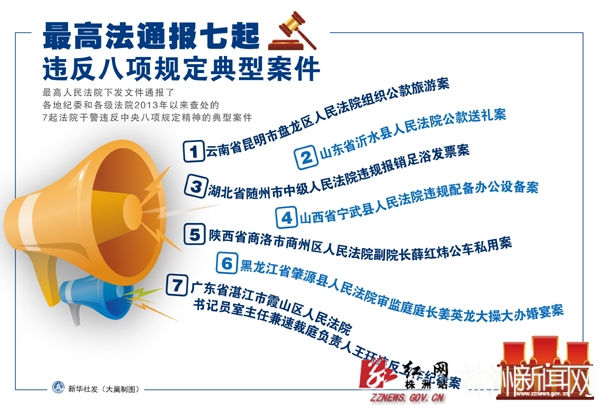
On 15 April, the Supreme People’s Court (Court) issued its latest model (or in this case, (all too typical cases): 7 typical cases of judicial misbehavior.

It is part of the name and shame campaign of the Communist Party’s Central Disciplinary Inspection Commission (CDIC), that appears to have started in September of last year, in which the CDIC releases typical cases of official corruption or other abuses, in violation of the Communist Party’s Eight Point Regulations (aimed at curbing official abuses). As reported  in a recent Wall Street Journal article, the CDIC has accelerated the release of cases on its website  from weekly to monthly.

Although cases previously released on the CDIC website have included some cases from the judiciary, this is the first time that the Court has released such cases.

The Court issued a document summarizing the cases to the lower courts and to the CDIC (which often takes the lead in investigating judicial misbehavior, because most judicial officials are Communist Party members).

The Seven Cases

Touring at public expense
  1. Touring at public expense (a group from Kunming (Yunnan Province)’s Panlong District Court used RMB 88,000 in public funds to visit the beach resort of Sanya after participating in a training course in Haikou);
  2. Using public funds for gifts (a Shandong district court court president arranged for the purchase of RMB 23,000 in gift cards at a local supermarket and obtained reimbursement as “offiice supplies.”)
  3. Obtaining reimbursement for foot massages (two Hubei Province Intermediate Court Division heads submitted RMB 2500 in foot massage receipts; they and the Deputy Court President who approved the reimbursement were punished).
  4. Wasteful procurement of office equipment (a Shanxi District Court spent over RMB 200,000 on office equipment ).
  5. Using government vehicles for private use (a Shaanxi Province local Deputy Court President and two judicial policemen toured a scenic spot on the way back from an enforcement action);
  6. Large scale wedding banquets (a Heilongjiang county judge held large wedding banquets for his daughter and accepted RMB 27500 in monetary gifts);
  7. Office misbehavior (a Zhanjiang (Guangdong Province) )District Court division head held a meeting with a litigant wearing slippers and was found to be playing a game on his office computer).
using government vehicles for private purposes

These cases are typical

According to an analysis done by the People’s Daily Overseas Edition, these cases are typical of the cases released by the CDIC.  Some of the highlights:

  • Almost 40% of the CDIC cases released involved improper use of public funds or government vehicles;
  • Of those, almost 25% involved touring at public expense;
  • A significant number involved improper reimbursement;
  • Some other “typical cases” involved officials playing computer games in the office (although there were local variations in this category);
  • About 12% involved “over-the-top” purchases of office equipment or building construction;
  • the infractions were relatively minor; and
  • The cases involved local court judges rather than those in provincial level higher people’s courts or the Court itself.

Why were these cases released?

It appears likely that the Court released these cases because the CDIC issued a document requiring all government departments and SOEs to provide typical cases (although the document does not appear to have been released publicly) and the Court need to show that it was complying with this document.

Other likely reasons would be similar to those for other government officials: scare judicial personnel, especially those in leadership positions, into complying with Party restrictions.  As the above graphic shows, it is meant as a bullhorn to those in leadership position in lower courts.  The Court leadership realizes that the widespread public impression that judicial officials fiddle the system and do not take their work seriously is a threat to the court system.  The typical cases are intended to provide evidence to ordinary people that the government is serious about corruption in the judiciary, and also to encourage people to report abuses.  Why these particular seven cases were selected for release is not known.

The cases were released for the political reasons, not the substantive reasons discussed in my recent blogpost.


Supreme People’s Court Focuses on Domestic Violence

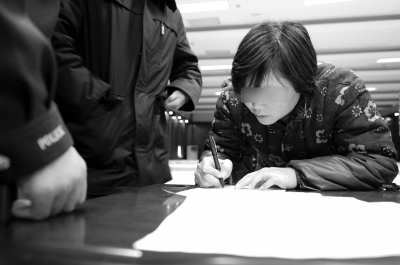
Domestic violence victim (photo from SPC website)

The Supreme People’s Court (the Court) devoted its 27 February 2014 press conference to domestic violence, highlighting:

  • the seriousness of the problem;
  • 10 model cases;
  • a forthcoming judicial interpretation on domestic violence.

Judge Xue Shulan, Deputy Head of the #1 Criminal Division, appeared at the press conference.  The Court websites have published a number of domestic violence related articles in the past 3 weeks.  Some of these articles have been reprinted on the website of the Central Communist Party Political Legal Committee, indicating that the Court initiative has political backing.

This blogpost will briefly explain:

  • the significance of the 10 model cases
  • some issues that should be incorporated into the judicial interpretation;

Some statistics about domestic violence in China

At the press conference, Sun Jungong, spokesman for the Supreme People’s Court, released some statistics about domestic violence.  He said that domestic violence occurs in approximately 24.7 percent of Chinese families, and almost 10 percent of intentional homicide cases are connected with domestic violence.

The significance of the 10 model cases

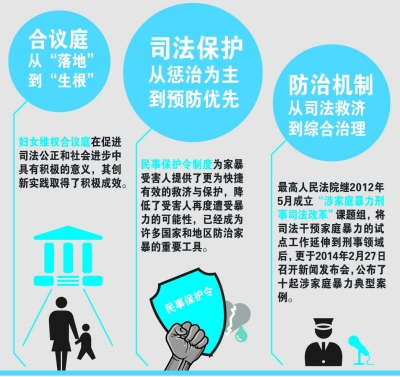
Domestic violence graphic from SPC website

These model cases are intended to convey lessons to the lower courts, lawyers, and the general public on how to consider cases involving domestic violence.

Civil protection orders

China has adopted the concept of a civil protection order (commonly used in other jurisdictions) into its legal system (see an academic study on the issue).  The amended Civil Procedure Law provides a legal basis for the issuance of these orders (see a summary in the linked article).  The Court revealed at the February news conference that over 500 civil protection orders have been issued since 2008.  

One model case involved a civil protection ordered issued to protect  an elderly man against his abusive child while another case involved a civil protection ordered against the uncle of the minor.

The cases convey the message that the scope of persons to be protected under domestic violence civil protection orders should be expanded to include:
  • the elderly;  and
  • minors.
These cases signal an expansion of the categories of individuals for whom orders may be issued and an expansion of the definition of relationship between victim and perpetrator. Academic studies suggest a prevalence of domestic violence against the elderly and minors in China.  Academic studies have found elder abuse occurring in approximately 35% of the populations surveyed and significant prevalence of child abuse.  
Previously, the sole guidance from the Court regarding the issuance of civil protection orders had been limited to issuing them on behalf of one spouse against the other while still married or in the process of seeking a divorce.

Evidence

The Court is providing guidance for judges about what can be considered evidence of domestic violence.  Examples of evidence of domestic violence in these cases include the statement of the victim, in writing, medical records, and the diary of a child and/or victim.In the past judges often did not consider the statement of the victim as evidence.  Reaffirming the evidentiary value of medical records and contemporaneous notes is also important.

Types of domestic violence

In one case, the description of domestic violence was described as excessive use of house rules.  In another example, emotional harm was specifically cited as an injury caused by the violence and a fine was issued.  In another case, use of threats to control the other party was cited.
By selecting these cases, the Court is also conveying a message about the types of behavior that can be considered to be domestic violence. The Court is stressing that domestic violence is not just physical, and that it is a specific dynamic where one individual exercises power and control over the other, including using threats of violence even when there is no physical violence and considerable rule making and other methods to intimidate and emotionally and mentally harm the victim.

Consequences of domestic violence

 In one case the daughter was injured when she tried to protect the mother against her abusive father so the divorce was granted and the mother given custody.  This case conveys the message that a parent who is found to have committed domestic violence against the other parent should not have custody of the child or children who were in that household when the abuse occurred, even if the child was not directly physically targeted or harmed.  This represents a sophisticated understanding of the impact of domestic violence on children and the danger of an abusive parent.

Issues for the judicial interpretation

Judge Xue mentioned at the press conference that a draft interpretation had already been prepared, but was subject to further studies and discussions and it was hoped it would be issued in the second half of 2014.  Issues to be covered by the interpretation include:
  • defining domestic violence;
  • determining whether acts constitute domestic violence;
  • classification of different types of domestic violence;
  • more specific guidelines on criminal punishment for domestic violence;
  • evidence in domestic violence cases;
  • guidelines for imposing punishment on  victims of domestic violence who commit crimes against their abusers.
The drafting of the interpretation was preceded by several years of field studies in 73 basic level courts.  At the press conference, the head of the Court’s Institute for Applied Jurisprudence stated that the definition of domestic violence will incorporate international practice and that the courts will work with other institutions to promote a unified approach to domestic violence.   

Judicial training

After the domestic violence judicial interpretation is issued, widespread judicial training will be needed to ensure that judges can recognize domestic violence and issue civil protection orders to protect women, children, and the elderly.  Many press reports (as well as studies by the Institute of Applied Jurisprudence) indicate that part of the problem can be traced to local courts, police and other authorities, who do not take domestic violence seriously.

This training is especially needed in rural courts, where many abuse cases occur, but also in the military courts.   Article 33 of the Marriage Law provides that the spouse of a soldier in active service who wants a divorce needs to obtain the soldier’s consent, unless the soldier has made “grave errors” (重大过错, which according to a 2001 interpretation of the Marriage Law, includes domestic violence.  This article by a judge from a court outside of Kunming describes some of the issues.

At the latest NPC session, delegates again brought up the delay in progress on domestic violence legislation (described here).  Domestic violence is an area that the scholars, NGOs, and the domestic (and international) public has been putting pressure on the courts to address for some years, and it will be significant progress if the domestic violence interpretation is issued this year.

(The case analysis was provided by a contributor who wishes to remain anonymous)

Supreme People’s Court Focuses on Domestic Violence

Domestic violence victim (photo from SPC website)

The Supreme People’s Court (the Court) devoted its 27 February 2014 press conference to domestic violence, highlighting:

  • the seriousness of the problem;
  • 10 model cases;
  • a forthcoming judicial interpretation on domestic violence.

Judge Xue Shulan, Deputy Head of the #1 Criminal Division, appeared at the press conference.  The Court websites have published a number of domestic violence related articles in the past 3 weeks.  Some of these articles have been reprinted on the website of the Central Communist Party Political Legal Committee, indicating that the Court initiative has political backing.

This blogpost will briefly explain:

  • the significance of the 10 model cases
  • some issues that should be incorporated into the judicial interpretation;

Some statistics about domestic violence in China

At the press conference, Sun Jungong, spokesman for the Supreme People’s Court, released some statistics about domestic violence.  He said that domestic violence occurs in approximately 24.7 percent of Chinese families, and almost 10 percent of intentional homicide cases are connected with domestic violence.

The significance of the 10 model cases

Domestic violence graphic from SPC website

These model cases are intended to convey lessons to the lower courts, lawyers, and the general public on how to consider cases involving domestic violence.

Civil protection orders

China has adopted the concept of a civil protection order (commonly used in other jurisdictions) into its legal system (see an academic study on the issue).  The amended Civil Procedure Law provides a legal basis for the issuance of these orders (see a summary in the linked article).  The Court revealed at the February news conference that over 500 civil protection orders have been issued since 2008.  

One model case involved a civil protection ordered issued to protect  an elderly man against his abusive child while another case involved a civil protection ordered against the uncle of the minor.

The cases convey the message that the scope of persons to be protected under domestic violence civil protection orders should be expanded to include:
  • the elderly;  and
  • minors.
These cases signal an expansion of the categories of individuals for whom orders may be issued and an expansion of the definition of relationship between victim and perpetrator. Academic studies suggest a prevalence of domestic violence against the elderly and minors in China.  Academic studies have found elder abuse occurring in approximately 35% of the populations surveyed and significant prevalence of child abuse.  
Previously, the sole guidance from the Court regarding the issuance of civil protection orders had been limited to issuing them on behalf of one spouse against the other while still married or in the process of seeking a divorce.

Evidence

The Court is providing guidance for judges about what can be considered evidence of domestic violence.  Examples of evidence of domestic violence in these cases include the statement of the victim, in writing, medical records, and the diary of a child and/or victim.In the past judges often did not consider the statement of the victim as evidence.  Reaffirming the evidentiary value of medical records and contemporaneous notes is also important.

Types of domestic violence

In one case, the description of domestic violence was described as excessive use of house rules.  In another example, emotional harm was specifically cited as an injury caused by the violence and a fine was issued.  In another case, use of threats to control the other party was cited.
By selecting these cases, the Court is also conveying a message about the types of behavior that can be considered to be domestic violence. The Court is stressing that domestic violence is not just physical, and that it is a specific dynamic where one individual exercises power and control over the other, including using threats of violence even when there is no physical violence and considerable rule making and other methods to intimidate and emotionally and mentally harm the victim.

Consequences of domestic violence

 In one case the daughter was injured when she tried to protect the mother against her abusive father so the divorce was granted and the mother given custody.  This case conveys the message that a parent who is found to have committed domestic violence against the other parent should not have custody of the child or children who were in that household when the abuse occurred, even if the child was not directly physically targeted or harmed.  This represents a sophisticated understanding of the impact of domestic violence on children and the danger of an abusive parent.

Issues for the judicial interpretation

Judge Xue mentioned at the press conference that a draft interpretation had already been prepared, but was subject to further studies and discussions and it was hoped it would be issued in the second half of 2014.  Issues to be covered by the interpretation include:
  • defining domestic violence;
  • determining whether acts constitute domestic violence;
  • classification of different types of domestic violence;
  • more specific guidelines on criminal punishment for domestic violence;
  • evidence in domestic violence cases;
  • guidelines for imposing punishment on  victims of domestic violence who commit crimes against their abusers.
The drafting of the interpretation was preceded by several years of field studies in 73 basic level courts.  At the press conference, the head of the Court’s Institute for Applied Jurisprudence stated that the definition of domestic violence will incorporate international practice and that the courts will work with other institutions to promote a unified approach to domestic violence.   

Judicial training

After the domestic violence judicial interpretation is issued, widespread judicial training will be needed to ensure that judges can recognize domestic violence and issue civil protection orders to protect women, children, and the elderly.  Many press reports (as well as studies by the Institute of Applied Jurisprudence) indicate that part of the problem can be traced to local courts, police and other authorities, who do not take domestic violence seriously.

This training is especially needed in rural courts, where many abuse cases occur, but also in the military courts.   Article 33 of the Marriage Law provides that the spouse of a soldier in active service who wants a divorce needs to obtain the soldier’s consent, unless the soldier has made “grave errors” (重大过错, which according to a 2001 interpretation of the Marriage Law, includes domestic violence.  This article by a judge from a court outside of Kunming describes some of the issues.

At the latest NPC session, delegates again brought up the delay in progress on domestic violence legislation (described here).  Domestic violence is an area that the scholars, NGOs, and the domestic (and international) public has been putting pressure on the courts to address for some years, and it will be significant progress if the domestic violence interpretation is issued this year.

(The case analysis was provided by a contributor who wishes to remain anonymous)