According to the Wechat postings of one of its members, the judicial reform office of the Supreme People’s Court has been working overtime for months to prepare for the 4th Plenum. It appears, at least from the initial 4th Plenum communiqué, that the hard work has paid off. We will know more about the leadership’s plans for legal reforms when the full decision is released. Four quick questions about the communique are set out below (to be supplemented as time permits).
Some questions for the Supreme People’s Court and the judiciary:
1.The communique stressed the need for improving the quality of legislation, including incorporating more public consultation and experts. Will this reduce the need for judicial interpretations? What will this mean for the drafting of judicial interpretations? Will the Supreme People’s Court require public consultation for its own judicial interpretations? The release this month of drafts for public comment of the environmental public interest litigation regulations and the trademark validity administrative case rules are a step in the right direction.
2. The communique called for greater judicial transparency, as was highlighted in the Court’s 4th Five Year Reform Plan. In its press releases to the domestic audience, the Supreme People’s Court has mentioned the visits it has hosted of the foreign press, foreign diplomats, and ordinary citizens, and of analogous events at the local level. When can we look forward to easier access by all (foreign or domestic) to proceedings in the Chinese courts (at least in non-sensitive cases)?
3. The communique indicated approval by the leadership of the establishment of circuit courts that cross administrative lines, a concept mentioned in the 4th Five Year Reform Plan (see this earlier blogpost). It also reflects the use in China of foreign legal concepts or frameworks (as is frequently stressed, a reference and not as a transplant).
4. It also called for an end to “interference” by leading cadres in specific court cases. How will this long-standing practice will be curbed? In recent weeks, articles have appeared in the legal press on changes to the Party Political Legal Committees. Will those changes imply less involvement in actual cases? And what is the distinction between “interference” and “leadership”?
In a build up to the National Day holiday (and since), the Supreme People’s Court (the Court) has focused some of its attention on combating the disease of judicial corruption. The prescription is in the form of three types of Communist Party documents. This blogpost highlights the prescription and speculates on the timing.
The herbs in this traditional prescription comes in the form of:
Six model (typical) cases of violations of the Communist Party’s Eight Point Regulations by court officials ( “cadres and police”/干警)). (An earlier blogpost analyzed seven earlier model cases that the Court issued. The six (relatively minor) cases included:
a Guizhou county court spending over 500,000 RMB on a trip to Hainan at public expense, lavish banqueting, and abuse of bonuses;
leadership of a Shaoguan (Guangdong) court, that caused the death of their dinner guest, an official of a county court, from alcohol poisoning;
vice president of a Hunan county court, who used a court vehicle to take his daughter to school;
the head of the disciplinary department of a Hancheng (Shaanxi) court caught by a reporter playing video games during work hours;
Holiday rules on what not to do during the Mid-Autumn Festival and National Day holidays. The Central Commission for Disciplinary Inspection (at various levels) issued notices distributed to the courts forbidding officials “gifting” moon cakes, shopping vouchers, “red packets”, and touring at public expense,
A document, linked here, providing policy guidance to the disciplinary departments of the courts in rooting corruption out of the courts. The head of these departments is Zhang Jiannan, who is the Communist Party’s Central Commission for Discipline Inspection’s (CCDI’s) chief representative in the Supreme People’s Court, and directs the disciplinary departments of the lower courts. The document is again focused on anti-corruption efforts within the courts. It directs the disciplinary departments to focus on discipline, report to the local Party disciplinary authorities as well as the disciplinary department of the higher courts, participate in major court internal meetings, improve the operation of disciplinary inspectors (described below). It directs disciplinary officials to participate in important meetings, drafting of important documents, and clear personnel appointments. The disciplinary officials are directed to implement the Party Constitution as well as 2008 regulations on supervision work in the courts.
Some background
The background for these documents is the Communist Party’s Central Committee’s five year anti-corruption plan (analyzed here). Following that:
the Court’s Party Committee issued a June, 2014 document on Party discipline:
the Court dispatched teams of its own disciplinary inspectors(最高人民法院司法巡查组) to Henan, Ningxia, Fujian and Anhui in May and September. These disciplinary inspectors are the Court’s counterpart to the CCDI’s inspection teams, which at the central level called Central Inspection Groups (中央巡视组) (“CIG”). These CIGs uncover corruption and other abuses, under which semi-retired high ranking officials are dispatched to provinces, ministries and SOEs for disciplinary inspection. The political background for these inspection teams is analyzed in this article. These inspection teams have operated in the courts for a number of years and operate according to these rules.
The Communist Party Central Committee’s Political Legal Committee issued three batches of “typical cases” of violations of law and Party discipline among the “political legal departments,” (each linkedhere) which included a substantial number of judges, including Liu Yong of the Supreme People’s Court, removed for suspicion of having taken about 2 million yuan in bribes (about $330,000).
The timing
The timing for the release of these recent documents appears to be linked to the upcoming Fourth Plenum of the 18th Chinese Communist Party Central Committee, on the rule of law. Part of the agenda, according toreports, is the role of the judiciary, curbing corruption and announcing forthcoming judicial reforms.
A traditional prescription
This prescription for curing the courts of corruption uses the traditional cure of Party discipline rather than judicial ethical models more commonly used in other jurisdictions. The Chinese judiciary has looked at approaches to judicial ethics in other jurisdictions, including Germany, the US, and Hong Kong. Elements of this prescription, such as having disciplinary officials participate in important meetings and the drafting of important documents appear to be inconsistent with some of the goals in the judicial reform plan of having the judges who heard cases decide them.
Will the prescription be effective?
The current prescription is a variation of what has been prescribed before. The Court needs to show the political leadership that it is it doing what it can to combat corruption in the courts and is implementing anti-corruption initiatives. The anti-corruption drive is being led by the CCDI, using Party channels and methods.
Corruption prevents or at least complicates efforts to establish and operate a court system that meets the needs of ordinary people. It appears that the Court leadership is under no illusions about what goes on in the court system. However, the Court leadership can only work within the current system and with current personnel. Will the broader anti-corruption campaign lead to a change in China’s social and business culture, of which the judiciary is a part? Or do these latest initiatives not go to the core of the problem? 换汤不换药?
On 30 September John Henry Wigmore Professor of Law Ronald Allen of Northwestern University School of Law was one of 100 foreign experts to be awarded China’s Friendship Award in the Great Hall of the People for his work with the Academy of Social Sciences, the China University of Political Science and Law and Supreme People’s Court on evidence law and related issues. The national court website ran a story on Court Vice President Shen Deyong’s meeting with Professor Allen, at which Judge Shen thanked Professor Allen for his work on behalf of the Supreme People’s Court. Judge Shen commented on the importance of evidence law. He also noted that although China’s court reform must be based on China’s situation, it can draw on foreign law methods and experience, including that of common law systems. Well done Professor Allen!
If you want to review and comment on China’s model for environmental public interest litigation, now you have your chance. On 1 October the Supreme People’s Court (Court) issued its regulations on environmental public interest litigation for public comment. The Court had highlighted the importance of these regulations in its July, 2014 policy document on environmental and natural resource tribunals. The Environmental Protection Law, amended earlier this year, gives the legislative framework for the regulations (a quick summary of the amendments can be found here).
The comment period is 1 month. The draft was published on the Court’s official website and is linked here. The notice requests that comments be accompanied by an explanation, and be submitted either on paper or electronically. The mailing address in Chinese is: 北京市东城区东交民巷27号,最高人民法院环境资源审判庭,邮编100745. The English address is: Environmental and Natural Resources Division, The Supreme People’s Court, No. 27, Dong Jiao Min Xiang, Dongcheng District, Beijing 100745. The email address for comments is: zgfyhzt@sina.cn.
The Supreme People’s Court Observer contributed a post to the Global Military Justice Reform blog, linked here, entitled “Does law have a place in China’s military and national defense reform?” The post commented on two recent articles, one by a researcher at China’s Academy of Military Sciences and the other by the Legislative Affairs Bureau of the Central Military Commission (中央军委法制局). The blogpost concludes with the prediction of the Supreme People’s Court Observer that when the Chinese leadership meets in October for the Fourth Plenum of the 18th Chinese Communist Party Central Committee to focus on the rule of law, some broad principles for military legal reform will be laid down, but notes that this prediction with be (dis)proved by events.
An article on the judicial reforms in the 25 September edition of Southern Weekend (南方周末) is now making its way across Chinese social media, featuring an interview with Peking University Law professor Fu Yulin and Tsinghua University law professor He Haibo. The article addresses some of the questions many inside and outside of China have been asking:
What is the status of the judicial reform pilot projects outside of Shanghai?
What is the status of some of the issues mentioned in the judicial reform documents?
Why haven’t China’s judicial reform documents been made public?
Some background
The two principal judicial reform documents approved by the highest political authorities are:
the Fourth Five Year Plan Judicial Reform Outline, a summary of which was issued on 9 July (blogpost analysis here and here).
the Shanghai Judicial Reform Pilot Project Work Plan(上海市司法改革试点工作方案). A detailed description of how the Shanghai authorities will implement this (上海市司法改革试点工作方案>实施意见) has been released by both the Shanghai and national press (an English translation available here).
The published reports on the Fourth Five Year Plan Judicial Reform Outline have mentioned that pilot projects would be implemented in Guangdong, Hubei, Jilin, Qinghai and Hainan, but no outlines of those pilot projects have surfaced.
What is the status of those judicial reform plans?
According to Southern Weekend, drafts for judicial reform plans for Guangdong, Hubei, Jilin, Qinghai, and Hainan are basically finished and have been submitted to the Central Political Legal Committee. They are awaiting approval.
What is the status of some of the issues mentioned in the judicial reform outlines?
Judicial selection committees
According to Southern Weekend, it is unresolved under the judicial reforms, who will select judges and how they will be selected. Plans for all five pilot plans designate the the head of the provincial political legal committee as the head of judicial selection committee, with the judicial selection committee to be based at the provincial political legal committee. The reforms in Shanghai are the exception, where the judicial selection committee will be based in the Shanghai Higher People’s Court. The two law professors interviewed suggest that the provincial people’s congress would have been more appropriate (for the other five pilot plans), but they state that the people’s congresses in these locations did not want to take on that role. (And one comment on the article was that the Party, after all, selects people’s congress members.)
The law professors stressed the need for legal professionals to be members of judicial selection committees. One noted that in China, the principle of “the Party manages cadres” (党管干部) cannot be avoided and suggested that judicial selection committee and Party organization department clearance could run parallel.
It seems that the tension between Party involvement and professionalism in judicial selection remains an issue.
Quota system for judges
The quota system for judges refers to establishing quotas on the numbers of judges in relation to other personnel within the judicial system. As described in thesearticles, the plan in Shanghai is to limit judges to 33%, with administrative and support staff constituting 55% and 15% respectively. The framework in Shanghai has been widely discussed and criticized in the Chinese legal press and on social media, particularly for its impact on younger judges, who note that they would not fit the judicial criteria and would be made “obsolete.”
Professor Fu echos criticism made by judges and others in the press that imposing a rigid quota system for the number of judges was inappropriate. She pointed out that at the basic level, having a system with fewer than 40% judges was unworkable, given that the Chinese courts at the basic level had to deal with large number of minor offenses. The reason was that China had not yet established separate courts to deal with minor offences [the Supreme Court Monitor notes that pilot projects for these courts are underway in some areas]. Another issue is the many responsibilities that Chinese judges have in addition to hearing cases and how a smaller number of judges will be able to hear cases as well as carry out their other responsibilities (research, compiling judicial statistics, promoting the courts).
Why haven’t the current judicial reform documents been made public?
The professors note that they themselves have not seen the judicial reform documents either. They suggest that policies for many issues have not been worked out, but that the uncertainty about the direction and content of the reform policies has a negative effect.
The upcoming plenum
It seems likely that the upcoming fourth plenary session of the Chinese Communist Party’s 18th Central Committee, on rule of law, in October will give us more certainty about the direction and content of the judicial reform policies. In the meantime, the issues and their implications give us all much to think about.
Individual suing government to release information
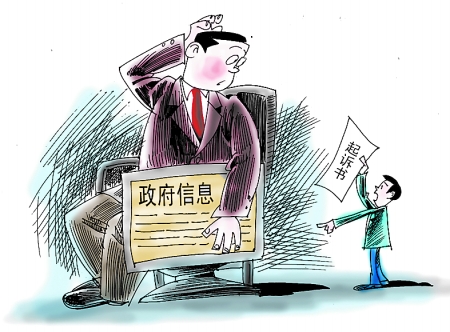
To show that open government information litigation in China is not an oxymoron, and send messages to the lower courts, government, and public, the Supreme People’s Court (Court) in a press conference on 12 September, released statistics and typical open government information cases brought under China’s version of the US’s Freedom of Information Act (and its counterparts elsewhere in world). For the first time, the Court issued 10 typical (model) open government information cases, although it had issued a guiding case earlier. (The cartoons hint at the difficulties). The underlying issues are relevant to many, including foreign investors and their lawyers.
As othershave described, China’s 2007 Open Government Information Regulations give individuals and groups the right to request government information and to challenge the failure to provide it in court. In comparison to the prevalent refusal of government departments to release government information, a small but increasing number of people have dared to take government to court. In particular (as highlighted by a variety of publications, NGOs, scholars and foundations), China’s environmentalists and environmental groups have been very active in using the regulations and litigating the failure of local government to release environmental impact statements.
Individual suing xxx department for information
What are the “take-aways” from the press conference?
Statistics on open government information cases;
The rationale for issuing typical/model cases;
10 typical/model cases;
Possible rationale for releasing the cases now.
Statistics on open government information cases
The Court revealed that the number of open government information cases are increasing, although the numbers are small in comparison to commercial cases. In 2013, the Chinese courts dealt with almost 5000 open information cases (despite the difficulties of suing government to release information highlighted by the cartoons). These cases account for the greatest proportion of administrative cases. Li Guangyu, deputy head of the Court’s administrative division said that the courts have helped protect the individual’s “right to know.” In understanding the demands of the Chinese public for more government information (and the frequent refusal of government to provide it and comply with legal requirements when doing), these cases represent the tip of the iceberg. Most people will accept, rather than challenge a government refusal.
Why did the Court issue these cases?
The Court issued these ten government information cases for several reasons:
In May, 2014, the Court formally announced it would issue model cases monthly (see the earlier blogpost on the subject). It has decided that issuing typical/model cases helps to guide the lower courts before judicial practice has settled enough and Court manpower permits issuing a judicial interpretation.
The single Guiding Case that the Court issued early addressed a narrow set of issues, and issuing these cases provides guidance on a wider range of issues.
The Court is sending a message to government departments, including central government ministries to comply with obligations under the Open Government Information Regulations to set out the legal basis for the decisions and their rationale, or risk having leading officials sitting in the defendant’s seat in a courtroom.
The Court is signaling government to increase government transparency (within the many limitations imposed) and improve their open government information procedures or risk losing court cases. The behavior of government departments, including on the central level, in dealing with open government information requests seen in the cases indicates that educating government officials on compliance with the legislation is needed.
The cases are needed guidance to the lower courts. Because the Open Government Information Regulations are not specific enough, they create difficulties for the lower courts trying to apply them to a large range of cases raising many different legal issues. The 2011 judicial interpretation does not deal with the principal recurring issues. These cases help unify judicial standards on a range of issues.
The cases send a message to the general public that the courts are protecting the interests of the individual against government action (or inaction) and that these disputes can be resolved through litigation rather than petitioning.
The cases provide a heads up to companies and their lawyers that members of the public (or competitors) may attempt to access their information submitted to or relating to their transactions with government.
What are the 10 cases?
Li Guangyu, the deputy head of the administrative division of the Court, who was involved in drafting the 2011 judicial interpretation on open government information, highlighted the cases and the issues raised. As discussed in earlierblogposts,the typical/model cases are not full decisions by the lower courts, but brief summaries. The important part is the section labeled “significance of the case.” Brief highlights include:
Case one (relates to the release of an environmental impact statement. According to earlier reports, many open government information cases have involved citizen demands for the release of this information.
Case two, Xi Mingqiang v. the Ministry of Public Security. As could be expected, the information requested was classified, and the court refused release. It is unclear whether the court considered whether the information had been properly classified.
Case three, Wang Zongli v. the Tianjin Heping District Real Estate Administration Bureau (Tianjin Bureau), relating to a major social issue, the expropriation of real property and compensation of owners. The plaintiff demanded the release of the contract signed by the developer with a center under the Bureau for payment of government fees for expropriation (which would reveal the gap between the compensation to owners and the amount paid to government (issues discussed here). The court determined that the Tianjin Bureau had failed to address whether the information requested by the plaintiff was considered a commercial secret.
Case four, Wang Zhengquan v. Hecheng [Shandong] Real Estate Administration Bureau, (relates to another major social issue, the allocation of low cost rental housing), involving the conflict between personal privacy (of the persons allocated housing) and the individual’s right to know;
Case five, relates to issues in case three, the expropriation of rural land and the compensation of farmers, and the refusal of local government to release documents related to expropriation of land. These issues already account for many “mass incidents” and are likely to becoming even more important with the government’s planned urbanization of the countryside.
Case six: Zhang Hongjun v. Rugao Municipal Price Bureau, in which the plaintiff challenged fees imposed by a township government, raising issues of access to government internal information.
Case eight, a case against a Zhejiang Township government, in which the plaintiff sought details about land use and expropriation of property, raising issues of access to information created before the Government Open Information Regulations became effective.
Case nine, Zhang Liang v. the Shanghai Urban Planning and Land and Natural Resources Bureaus, in which the plaintiff sought access to payment concerning 116 parcels of land granted by the government. It is yet another case relating to access to information about urban land use, and the government refusal to understand and reply flexibly to a request for information by an ordinary citizen.
Case ten: If You Like Marriage Company Ltd. v. the Ministry of Civil Affairs, requesting information concerning the registration of the China Society for the Research of Marriage and Family (under the All Women’s Federation). It is yet another case in which a government department (this time a central government department), failed to set out the legal basis and rationale for refusing to release government information.
Why now?
The Court may have several reasons for publicizing these cases now.
They are related to the ongoing drafting of the overhaul of the Administrative Litigation Law.
They are related to greater transparency requirements (affecting business) being rolled out under the Company Law Reforms and set as goals in the Third Plenum Decision
Government control of information, the individual’s right to know in the Internet age, and the role of the courts vis a vis government are major issues that may be addressed in the upcoming Fourth Plenum of the 18th Central Committee of the Chinese Communist Party. That these issues are on the Party agenda is indicated by the fact that a Central Party School official published on these issues earlier this year.
If others would like to contribute further analysis of these cases or further information about any of them, please use the comment function.
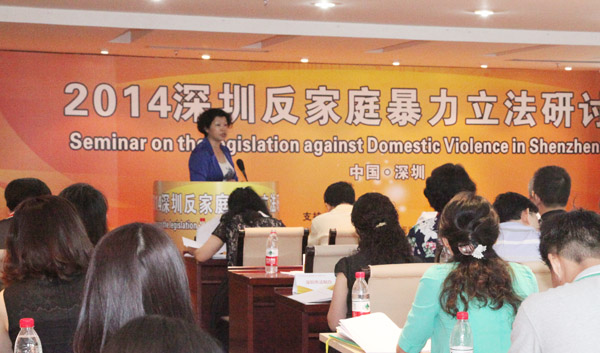
In its 29 August Wechat feed (which reproduced an article published in the People’s Court Newspaper), the Court issued an update on domestic violence legislation, focusing on Shenzhen’s draft Anti-Domestic Violence Regulations (Domestic Violence Regulations). The Domestic Violence Regulations have been incorporated into Shenzhen’s legislation plan and is intended to be adopted by year’s end.
The update highlights a conference earlier in August in Shenzhen that attracted over 160 experts from all over China to discuss an initial draft of the legislation. Mark Obama also spoke at the conference.
It is likely that members of the group responsible for drafting the Court’s judicial interpretation on domestic violence participated in the conference. As is often the case (and was noted in the update), Shenzhen is taking the lead in issuing promulgating legislation, serving as a pilot project for national legislation. Twenty nine localities have adopted domestic violence-related policies or local legislation.
Shenzhen domestic violence conference
This brief blogpost will highlight the following issues raised by the report:
Disturbing domestic violence statistics;
Details on the draft legislation; and
Status of the Court’s domestic violence judicial interpretation.
Domestic violence statistics
The above article and other articles reporting on the Shenzhen conference have provided disturbing statistics on domestic violence.
Domestic violence occurs in about 25% of Chinese families;
About 10% of juvenile offenders were raised in abusive families (statistics on this issue seem to vary widely);
30% of victims of domestic violence in China (women, children, and elderly) are afraid to speak out against their abusers;
The Shenzhen Women’s Federation provided statistics on local (Shenzhen) domestic violence:
it occurs in 55 percent of Shenzhen homes among people aged 28-50;
85.8 percent of violent incidents occur between married couples;
93.9 percent of these are cases of husbands being violent towards their wives.
65% of children had been subject to corporal punishment;
of 32 cases of child sex abuse, 75% were committed by guardians, with about half committed by fathers.
Draft legislation issues
Reports on the draft Shenzhen legislation have highlighted the following issues among others:
Scope of the persons protected by the legislation–whether persons living together, intimate partners, former spouses or partners should be covered–the initial draft of the Shenzhen Women’s Federation excluded these relationships. Xu Ruishan, of the Shenzhen Municipal Procuratorate recommended that the legislation protect persons living together and former spouses from domestic violence, because of the prevalence of couples living together without marriage, while Professor Tao Lin, Secretary General of the Shenzhen Family Planning Association, recommended protecting intimate partners, because of the frequent violence in those relationships.
The type of domestic violence to be covered by the legislation, whether it should include economic, emotional, and sexual violence, as well as physical.
Status of the domestic violence judicial interpretation
Although the status of the Court’s judicial interpretation (discussed in an earlier blogpost) was not specifically addressed, in the article, Zhou Feng, the head of the #1 Criminal Division of the Court revealed his views that:
domestic violence offenses should be able to be either publicly or privately prosecuted;
a mandatory and voluntary reporting system should be instituted for entities and individuals who become aware of domestic violence (this is generally seen in domestic violence legislation internationally).
It may be that the timing of the issuance of the domestic violence judicial interpretation is related to the timing of the promulgation of national domestic violence legislation, but Court spokesmen have not been forthcoming on this issue.
Further details on the Shenzhen draft legislation
If anyone reading this blogpost has a copy of the draft Shenzhen legislation, attended the Shenzhen conference, or has further information on the status of the domestic violence judicial interpretation and is willing to share details about them, please use the comment function. Thank you!
And finally, the Supreme People’s Court Monitor thanks followers for their patience during the blog’s downtime. Future posts will address some of the many recent developments.
On 16 July the Supreme People’s Court’s (Court’s) newspaper and social media outlets headlined two articles important for observers seeking to understand the judicial reforms:
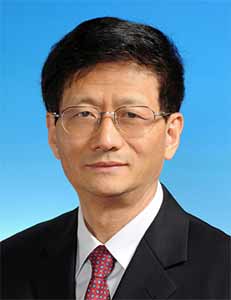
a report on statements by Meng Jianzhu, Politburo member and chair of the Central Political Legal Committee on the importance of the judicial reforms; and
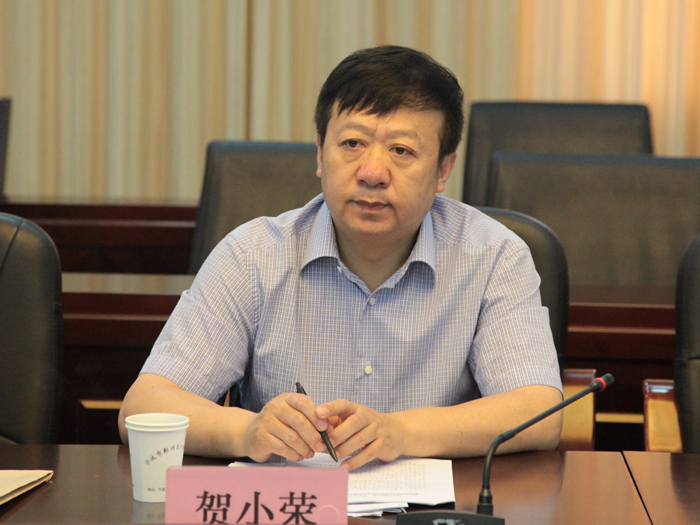
an long explanation by HeXiaorong, the leader of the working group on judicial reform (of the Court’s judicial reform office) on the theory, logic and implementation of the judicial reforms.
Meng Jianzhu
Statement by Meng Jianzhu
The statement by Meng Jianzhu , made after he heard reports on the implementation of judicial reform pilot projects in six areas, stressed that the Central leadership considers the judicial reforms very important and has given a set of policy instructions on the implementation of the reforms. He calls on all involved in various political/legal organs at all levels to implement the reforms.
For anyone who has spent any time in a large organization, his message, although expressed in Chinese political language, will sound familiar:
make sure those at the local level are “on message”;
don’t impose the same method everywhere (不搞一刀切;
ensure enthusiasm about the reforms, otherwise they may fail.
The thinking behind the judicial reforms
He Xiaorong
A long article by He Xiaorong published on 16 July in the People’s Court Newspaper and other Court media outlets summarizes the thinking behind the judicial reforms (and what must have been the hundreds of pages of policy papers that underly what has been made public). It is an edited version of a fuller paper, that has been issued on Wechat and perhaps other outlets (and is said to express He’s own thinking). For those seeking to understand the judicial reforms, it deserves close analysis. A flash analysis will follow when time permits.
The Supreme People’s Court Observer contributed another post to the Global Military Justice Reform blog. It commented on an article in the July 9, 2014 edition of the South China Morning Post. The newspaper article quoted several retired PLA officers on the subject of greater transparency for the Chinese military courts, advocating General Xu Caihou (see this earlier post) be tried publicly. The blogpost expressed the view of the Supreme People’s Court Observer that bringing transparency to the Chinese military courts will be a long-term enterprise, and something unlikely to happen in the short term. The analysis in the post listed several possibly relevant factors.
On 9 July, the Supreme People’s Court issued its fourth five year reform plan for the courts, approved by the Party leadership, which sets out 4 broad areas of reform, relating to 8 general areas. An overview has been released on Wechat and other Chinese social media and can be expected to be published very soon in more traditional media. An clear info graphic was published on the Court website and other official media, translated here.
The Court described it as taking first steps towards establishing a judicial system with Chinese characteristics and is intended to roll out reforms announced in the 3rd Plenum decision and the judicial reform decision announced earlier this spring and some of its themes were highlighted in press releases published just after Chinese new year. Many of these issues are ones that have been discussed within the Chinese legal community for many years and draw on international expertise as well. The summary below highlights five of the eight broad areas.
Personnel reforms
Separate administrative and judicial jurisdiction
Improve the operation of the judicial function
Improve the protection of human rights
Increase judicial transparency
Clarify the roles of the four levels of the courts
Improve judicial administration
Promote reforms relating to petitioning
Personnel reforms
The intention of the personnel reforms are to split the treatment of judges from other civil servants, to step away from the traditional model of judges as cadres. This will involve pushing forward the initial reforms being tested to change the personnel management of local courts, and transfer that to the provincial level. This will include:
the establishment of provincial level selection committees, will involve clearance by Party disciplinary and other functions, and retain appointment by the people’s congress.
Personnel reforms will also involve splitting the management of judges from other judicial personnel, such as judicial police and clerks.
Additionally, reforms are intended to the use of judicial headcount, to focus that by increasing the number of judges.
Two other reforms involve establishing new systems for judicial promotions and establishing differing criteria for the recruitment of different types of judges.
Separate administrative and judicial jurisdiction
Reforms in this area include:
taking steps to take certain cases, such as some environmental and commercial cases out the local administrative jurisdictions, so that they can be heard fairly.
Reform some of the lesser known courts, such as the forestry courts, to bring them into the ordinary court system.
Establish a system for circuit tribunals at provincial level to hear difficult cases, and focus on environmental cases.
In areas where there are more intellectual property cases, promote the establishment of intellectual property courts.
Improve the operation of the judicial function
The summary concerning this section admits that having the person who heard the case decide it remains difficult to implement within the Chinese jidicial system, and that despite initial attempts, internal multi-level approvals for deciding cases remains the norm. The intended reforms in this area include:
improving the system of responsibility of the primarily responsible judge and the panel that heard the case.
Changing the system of signing judicial decisions.
Improving the monitoring of judicial performance.
Improving judicial disciplinary procedures.
Importantly, reforms look to change the current relationship between the judge responsible, the tribunal, and others in a position of leadership within the courts, such as the head of the division and court president. There has been a great deal of academic writing about this, in both English and Chinese, as well as articles written by judges serving at various levels. A great deal of thought has gone into this section and implementing these reforms will involve changing long-term patterns of interaction.
Improve the protection of human rights
Reforms in this area are intended to improve the protection of human and property rights, particularly by improving judicial review of the investigation and prosecution stages:
Eliminate the use of illegally obtained evidence.
Improve the role of the defense lawyer and the statement by the advocate for the defendant.
Improve systems for pursuing judicial negligence.
Improve the protection of assets relating to [criminal cases].
Improve reforms in the area of minor crimes, so that those cases are heard more quickly (pilot projects are underway in some areas).
These reforms represent the result of years of discussions within the judiciary, with lawyers, academics, and interactions with members of foreign courts, research into foreign legal systems, and others.
Increase judicial transparency
Reforms in this area build on the initial steps taken late last year and include:
Make the hearing stage more open, by improving the system of announcements and permitting spectators to attend court hearings, increase real time broadcasts of hearings.
Improve the handling of judicial information, so that litigants can determine the status of their case on-line.
Improve the judicial decision database, Judicial Decisions of China.
All of these reforms are good practical proposals. Foreign observers of the Chinese courts would welcome easier access to Chinese court hearings.
A quick comment
Drafting this reform plan has been a tremendous undertaking and its implementation promises to be even more challenging. Some of the reforms discussed above are the subject of pilot projects in various parts of the country, ranging from Guangdong and Shanghai, where the courts have heavy caseloads and face cutting edge cases, to less prosperous inland provinces. Reforms are likely to start with what is most easily implemented and where results can most easily be achieved. What this means for some of the specialized courts, such as the military and maritime courts, will be clarified in time. The extent to which these reforms can change patterns of interaction within the judiciary and between the judiciary and government/Communist Party of many decades standing remains to be seen. It is hoped that the pressure of greater professionalism within the judiciary, and other social and economic forces will eventually result in a judiciary that better serves the needs of all.
The blogpost below was kindly provided by a former Chinese judge, Jianwei “Jerry” Fang, who practices with a New York-based law firm in Hong Kong.
The Bite of China case
As announced in a press conference on 30 April 2014, the Supreme People’s Court (the Court) has started to issue model cases(典型案例) on a monthly basis to guide the lower courts. On June 23, 2014, the Court issued five model cases decided by lower courts, which included one criminal, two civil and two administrative cases. Among those, the civil case concerning copyright infringement, CCTV International vs. Shanghai TuDou Network Technology Co., Ltd. (news report linked here and case description here), has been closely watched by and is of particular interest to practitioners, especially intellectual property lawyers.
Facts:
A Bite of China (舌尖上的中国) is a documentary series on Chinese food produced by China Central Television Station (“CCTV”) that is very famous in China. The series was first broadcast in May 2012 and became a very popular and well-known show in China. CCTV granted the copyright of the documentary series to CCTV International Network Co. Ltd. (“CCTV International”). However, it was found that within a week of the original broadcasting, the show had appeared on the website of TuDou.com, the famous video portal operated by Shanghai TuDou Network Technology Co., Ltd. (“TuDou Network”). After securing the evidence with help from the notary office, CCTV International sued TuDou Network for damages and reasonable costs of RMB 850,000.
Issues:
Is TuDou Network liable for providing storage of the copyrighted video on its site, and if so, how should damages be determined?
Courts:
First instance case heard by Shanghai Minhang District People’s Court; Appeal case heard by Shanghai First Intermediate People’s Court.
Ruling:
The defendant is liable and ordered to pay damages of RMB 240,000 and reasonable costs of RMB 8,000.
Reasoning:
The documentary series is in the category of cinematographic works and works created by a process analogous to cinematography, and is therefore protected by the PRC Copyright Law. The defendant provided an online on-demand link to the show without proper authorization from the copyright owner, which is a typical infringement of copyright though internet broadcasting and therefore he bears liability for infringement. While the defendant argued that the video was uploaded by an internet user, the courts found that the defendant failed to provide evidence to support its argument. The courts reasoned that because that the portal is required to control and manage the information and identity of the uploader, the website has the burden of proof. Since the defendant had deleted the original uploading information on its own, it should bear the adverse legal consequences.
Of note:
This case is a typical copyright infringement through internet sharing. In assessing the damages, the courts considered the copyright type, social recognition of the video, the nature of the infringement action, as well as the internet portal’s operational size, business model and influences, among other factors. The damages of RMB 240,000 can help to compensate the copyright owner, and force internet video portal operators to discipline themselves and manage their business. This case shows the trends of increased protection of intellectual properties, and serves as a warning to other internet video copyright infringers.
Comments:
As the Supreme People’s Court Observer has noted in earlier blogposts, the Court has recently started to publish more systematically model cases as an important supplement to legislation, judicial interpretations and guiding cases (指导案例, but long before this, had been publishing model cases in the Gazette of the Supreme People’s Court (最高人民法院公报).
While model cases are not binding on judges deciding subsequent cases, they will likely influence the decision of judges considering cases of similar type and with similar facts. Most Chinese judges I know would agree with this view. Back in 2006 when I was a junior judge at a trial court in Zhejiang, I wrote an article discussing the possibility of judicial precedent in China in the Chinese academic journal Public Administration & Law (2006-1). In my view, since I left the court to study and to work in private practice, the Chinese judiciary has made a lot of improvement and progress, which I applaud.
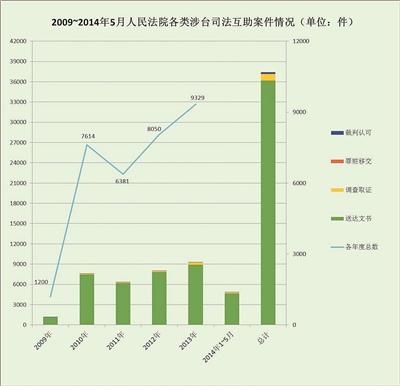
On 20 June, the Supreme People’s Court issued a report on the past 5 years of judicial assistance with Taiwan, featuring three bar charts, a table and 15 model cases, linked here. Judicial assistance between the mainland and Taiwan in 2013 was the subject of a blogpost earlier this year. The execution of two brothers in Taiwan, on the basis of testimony from witnesses on the mainland who were not made available for cross-examination, illustrate vividly some of the Issues related to judicial assistance, as further described here.
Most of the judicial assistance has been in the form of requests for delivery on the mainland of judicial documents from Taiwan (almost 30,000 in the past 5 years), but has also included recognition and enforcement of Taiwan court judgments (270 in the past 5 years), requests for obtaining evidence on the mainland (610).
The model cases summarize the requests made and the assistance provided, rather than the original judgments or rulings in these cases. (Prior blogposts on the topic of model cases are linked here and Mark Cohen’s analysis is found here).
The statistics reflect the closer interactions between the two sides of the Taiwan straits, including the flood of Taiwan investment into the mainland, and cross-straits personal interactions (including cross-straits marriages and crimes committed by Taiwanese on the mainland). I look forward to comments and further analysis from Taiwan lawyers, scholars and others on the significance of these statistics and other related issues.
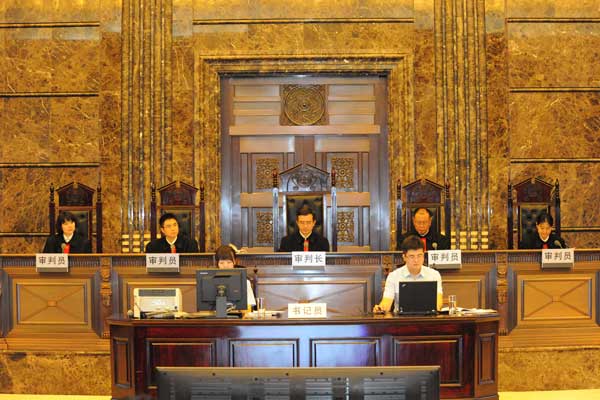
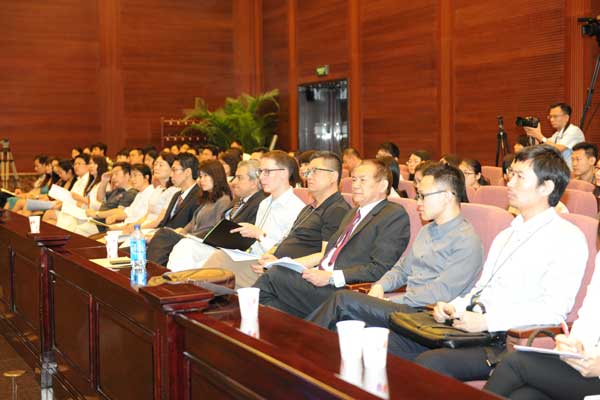
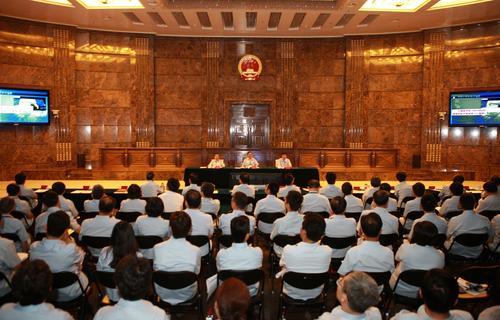
On June 11, the 4th Civil Chamber of the Supreme People’s Court (Court) held a public hearing in the case of Sino-Environment Technology Group vs. Thumb Environmental Technology Group (Thumb Env-Tech). Nils Pelzer [seen in the audience in the photo below], research fellow at the Max Planck Institute Luxembourg and visiting scholar at the KoGuan Law School of Shanghai Jiaotong University, attended the hearing. The Supreme People’s Court Observer made it possible. A slightly amended version of his report follows.
The litigious PRC subsidiary
This hearing was the latest of a series of lawsuits between the parties. The earlier blogpost on this case (linked here) concerned a related lawsuit between the parties but the Fujian Higher Court decision in the current case was not available on-line.
Summary of the facts
Thumb Env-Tech is a Chinese wholly-owned subsidiary of Sino-Environment Tech, a company registered in Singapore (now in liquidation). The Singaporean liquidator (the former judicial manager) had dismissed the former management board of Thumb Env-Tech and appointed the insolvency firm’s own managing partner as the new chairman of the board of directors (and legal representative). The liquidator had also decided to reduce the registered capital of Thumb Env-Tech. However, because Thumb Env-Tech’s old management did not comply with the directives of new management, these measures were not registered with the local Administration of Industry and Commerce (AIC) Bureau.
Thumb Env-Tech’s original management – on behalf of Thumb Env-Tech – sued the parent company in the Fujian Higher People’s Court to pay a capital contribution of RMB 45 million (approximately USD 7.23 million), ignoring both their own removal and the order to implement the capital reduction and challenged the right of the judicial manager (later the liquidator), appointed by the Singapore High Court, to remove the original legal representative and directors. Thumb Env-Tech alleged that the judicial manager had no right to remove the directors and legal representative. Thumb’s new legal representative, on the other hand, filed a motion to withdraw the lawsuit. Sino-Environment Tech put forward the argument because of the lack of power of representation, filing the lawsuit was not the “real declaration of intention” of Thumb Env-Tech.
Surprisingly in the first instance, the Fujian Higher People’s Court decided in favor of Thumb, ordering Sino-Environment Tech to pay the full sum of RMB 45 million. The court reasoned that Sino-Environment Tech was unable to prove that the old management board, which was still officially registered and had used the official company stamp, had no power of representation.
The decision of the Court
On appeal by Sino-Environment Tech, the Court (unanimously) rejected this argument in the second and final instance. The Court decided that while the registration with the AIC was sufficient to file a lawsuit on behalf of the company, things have to be treated differently when it comes to the substantial claim of the subsidiary against its parent company. The aim of the AIC registry is to protect third parties acting in good faith, but this does not apply to the internal relationship between a company and its shareholders. There, the real situation overrides the good-faith protection of the registry.
Even more importantly, the Court expressly recognized the power of the Singaporean liquidator to represent the parent company in liquidation. As far as the foreign liquidator’s powers are concerned, the Court ruled that the law of the place of the registered office of the relevant company is applicable.
Evaluation
This outcome had been expected by both Chinese and foreign legal experts. Not only does it clarify that just possessing a chop and an official registration does not always come along with absolute authority, but it is also a step towards to insolvency rules in China consistent with uniform international insolvency rules in China. Further, if the Court had upheld the ruling of the first instance, this would have basically meant that parent companies might completely lose control over their Chinese subsidiaries. From this point of view, the ruling strengthened the investment environment in China.
From a political perspective, this case might mark the beginning of a more open attitude to grant access to court hearings to foreigners. As reported by Chinese newspapers, this was the first hearing of the Court that foreign diplomats were explicitly invited to attend.
Lastly, the similarities of a hearing of the Court and of Western supreme courts were striking (at least in this case). The proceedings were skilfully led by Judge Luo Dongchuan [chief judge of the 4th Civil Chamber], and the quality of the debate between the Court and the lawyers of both parties was generally very high. It is not only for this reason that the 4th Civil Chamber will probably submit the case as a suggestion for a new guiding case.
On 9 June, the Supreme People’s Court’s Party Committee held a meeting to transmit the latest Party policy on secrecy in the courts, as reported here. It is intended to implement General Secretary Xi Jinping’s policy statement on secrecy and security, within the court system. It appears to be linked to policy issued earlier this spring at the meeting of the National Security Commission (official report here and analyzed here).
President Zhou Qiang stressed the following issues:
maintaining state secrecy and advancing judicial openness, to implement “justice under sunshine” and promote justice and fairness for the people;
dealing with the relationship between secret and non-classified materials, so that secrecy standards are applied properly;
secrecy education and punishment, putting preventative training in place and strict punishment;
the relationship between software and hardware, stressing preventative measures as well as hardware controls.
It does not appear that new secrecy regulations are in the works. Judicial personnel have secrecy obligations under secrecy regulations applicable to the courts (which apparently have not been made public) (but an English translation is found here), as well as set forth in the Judges Law and other sources. Judging by the large number of articles on court websites on this topic, in the age of smartphones (whether iPhones or Xiaomis), it appears increasing difficult for those restrictions to be effectively implemented.
HEALTH WARNING: PLEASE SEE THIS BLOGPOST FOR THE MOST RECENT DEVELOPMENTS.
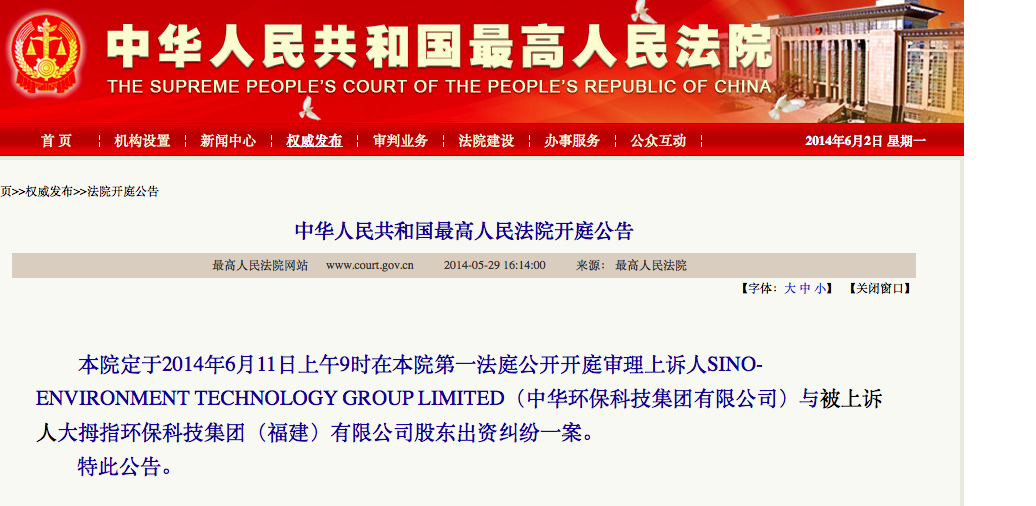
On 11 June 2014, the Supreme People’s Court will hear a shareholders dispute. The facts of the case (described below) are familiar to the Hong Kong and Singapore legal and investment community. They touch on the power of overseas insolvency/bankruptcy professionals to take over assets in China.
The parties to the case are Sino-Environment Technology Group Limited (Sino-Environment Tech) (a company originally listed in on the main board in Singapore (but now in liquidation) and one of its wholly owned subsidiaries, Thumb Env-Tech Group (Fujian) Co., Ltd (Thumb Env-Tech).
The case has all the elements of a China deal gone very, very bad.
What we know
The case was originally brought in the Fuzhou Intermediate Court by Thumb Env-Tech (i.e., the original management group). It challenged the right of the judicial manager (later the liquidator) (appointed by the Singapore High Court) to remove the original legal representative and directors. Thumb Env-Tech alleged that the judicial manager had no right to remove the directors and legal representative and it was arbitrarily implementing an order of a Singapore court, violating China’s judicial sovereignty. The Fuzhou Intermediate Court rejected Thumb Env-Tech’s claim, determining that it was not a proper party.Thumb Env-Tech appealed to the Fujian Higher People’s Court. The decision can be found here, on the court’s website. The Fujian Higher People’s Court rejected Thumb Env-Tech’s appeal, stating that the case is not a simple matter of private rights but involves issues of public policy, and that Article 119 of the Civil Procedure Law did not permit Thumb Env-Tech to bring the case. Thumb Env-Tech has brought a petition to have the case reviewed by the Court. (summary from the Fujian Higher Court decision)
Sino-Environment Technology Group Limited was a listed Singapore company that was principally engaged in the provision of environmental protection and waste recovery through its subsidiaries in PRC with over SG$165 million debt. Its liquidators investigated SG$84 million worth of suspicious transactions undertaken by the group, taking steps to secure control over the company’s PRC subsidiaries by removing all existing legal representatives and directors of the PRC subsidiaries and commencing legal proceedings against them, securing the company’s cash held with a PRC bank and assessing and defending legal proceedings. (from the liquidator’s website)
Morgan Stanley sold $US 109 million in Sino-Environment Technology Group Limited convertible bonds. The company defaulted on repayment of the bonds. (from a first press report and a second press report.)
Related litigation in the Hong Kong courts can be found here.
What will the outcome be?
We will wait the outcome of this case in the Court. It is a “typical case” in its own way, because there are many cases in which foreign companies with Chinese subsidiaries, some of them listed, get into financial difficulties. It is part of international insolvency practice that bankruptcy trustees/judicial managers/administrators/liquidators appointed by foreign courts will take over control of subsidiaries in China. Chinese law and practice do not make this an easy process. This a classic example of why Chinese legal experts, as well foreign governments, Taiwan, and Hong Kong need to persuade the Chinese government that it is important for China that it become an active part of the international legal framework governing bankruptcy (insolvency) proceedings.
The Supreme People’s Court Observer contributed a post to the Global Military Justice Reform blog. It looks at the improvements that Chinese military experts see as necessary to improve military law as a part of the government’s plans for reforming and modernizing China’s national defense establishment and People’s Liberation Army. The post sets out the issues involved.
In late April, the Supreme People’s Court, the Supreme People’s Procuratorate, and three central government agencies issued a document focusing on medical-related disputes and crimes committed within China’s medical system, along with four typical cases(典型案例). (I flagged the importance of the issue of medical disputes and crimes in a post late last year and have discussed typical cases here.) The document:
provides an recent example of the Court issuing policy documents;
shows how the Court implements Party/government policy relating to an important social issue;
illustrates the stresses in the Chinese medical system; and
highlights the inadequacies in medical legislation.
Why was this document issued?
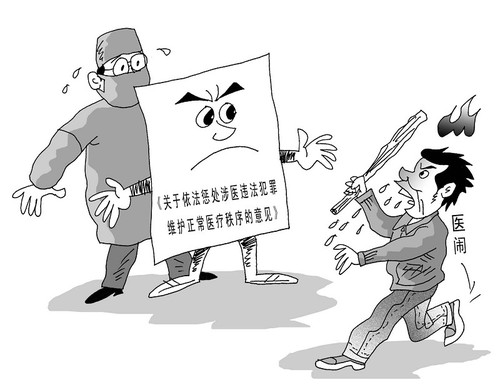
The document was issued to deal with the increasing number of disputes and especially the violence in the Chinese medical system, that have been reported and explained by a variety of sources, including the Lancet, BloombergBusinessweek, and the Atlantic. The Chinese press (also academics outside of China and foreign press) has run many stories on “medical troublemakers” (医闹) –either disgruntled patients or their families or people especially hired to make trouble in a hospital to embarrass the hospital to making a large settlement. Why? As Wan Xin, a member of the Council of the Chinese Medical Law Association is quoted in a Xinhua press release as saying: “if you make little trouble, you get little money, make big trouble, you get big money, if you don’t make trouble, you don’t get money” (小闹小给钱, 大闹给大钱, 不闹不给钱).
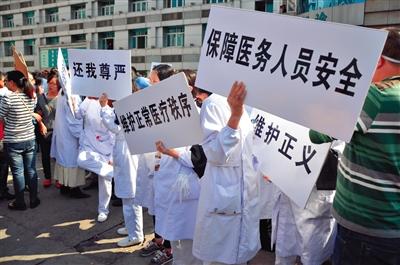
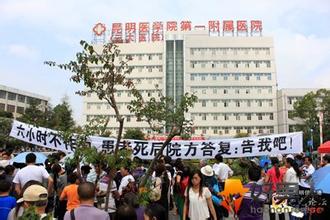
Heilongjiang medical workers protestProtest outside one of Kunming’s main hospitals
The Court issues policy documents
The document, clunkily named “Opinion on strictly punishing according to law illegal and criminal acts relating to the medical system and upholding normal medical order” (关于依法惩处涉医违法犯罪维护正常医疗秩序的意见) (the Opinion), was issued by the following government agencies in addition to the Court:
Supreme People’s Procuratorate;
Ministry of Public Security
Ministry of Justice;
State Commission on Health and Family Planning.
The Opinion is what in Chinese is called a normative document(规范性文件). As I discussed in an earlier blogpost, the Court often issues them (and has done so for many years). They contain legal rules and policy statements and have different titles from judicial interpretations, in this case “Opinion”.
This document, for example, does not fit the legal definition of a judicial interpretation because it is issued with three State Council ministries/commissions, that is three agencies not authorized to issue judicial interpretations. The rationale for this practice is that officials of the administrative organ involved will comply only if their administrative organ jointly issues it with the Court and requires compliance of its subordinates, which in this matter includes the hospitals and other parts of the medical system, the police, and the people’s mediation committees. Normative documents also address issues, such as this one, where the law is unsettled and are also on the political agenda.
What the Opinion says and does not say
The substance of the Opinion is in two sections.
Section 2 describes six sets of offenses commonly committed, how they should be punished and what different parts of the justice system should do. Those offenses are:
Attacking or intentionally harming medical personnel and damaging property;
In medical institutions, setting up shrines, funeral wreaths and burning paper money or placing a corpse in public spaces;
Restricting the freedom of medical personnel (e.g. by preventing them from leaving their workplace)
Insulting medical workers,
Bringing weapons, explosives, radioactive materials etc. into medical institutions; and
Instigating others (including family members) to commit crimes against medical personnel.
Section 3 focuses on preventing medical related disputes and improving the way they are resolved. In particular, the health authorities are directed to improve the quality of medical services, their own monitoring of medical institutions, the compliance of medical institutions with medical legislation and medical codes, improve the protection of patient’s right to privacy, right to know, right to choose, and other rights, and push the establishment of better channels of communication with patients. The Opinion calls for a three track system for resolving medical disputes:
medical institutions should establish departments to receive and deal with complaints;
otherwise, medical disputes should be mediated through three party mediation;
if mediation does not work, the courts should deal with the cases in a timely manner.
The Opinion does not call for improving legal rules dealing with medical issues. (But see more about this below.)
The Court implementing Party/government’s policy
Disputes involving the medical system have increased in number and severity in the last few years. Violent crimes committed by patients and/or their families have increased, capturing national attention. In the Third Plenum Decision, the Central Committee called on the government to address the underlying issues:
Reform of the medical and health care system shall be deepened. The comprehensive reform of medical security, medical services, public health, drug supply and regulatory system shall be pushed forward in a coordinated manner…Efforts shall be made to improve the work system linking people’s mediation, administrative mediation and judicial mediation, and set up a comprehensive mechanism for mediating, handling and resolving conflicts and disputes.
Therefore improving medical security and medical dispute resolution have been high on the agenda of the Central Committee Political Legal Committee. The Opinion and related articles were published on the website of the Central Political Legal Committee and the Chairman of the Central Political Legal Committee has been involved in initiatives implementing the Opinion, particularly the mediation of medical disputes.
Protecting medical institutions from troublemakers
Inadequacies in medical legislation and dispute resolution
The Opinion does not address the inadequacies in existing medical malpractice legislation. (This has been the topic of several law review articles in English (also in medical academic literature) and many more articles in Chinese, including on Chinese social media. Although the Tort Liability Law contains basic principles, the law itself and its related judicial interpretation do not have sufficiently detailed rules on issues such as:
cause of action;
liability of different parties;
expert opinion;
determination of causation;
issues of proof; and
determination of damages.
Therefore, these cases drag on in the courts, and Wan Xin noted that a wait of two or three years to resolve these cases is not unusual. A Beijing judge, writing on social media, noted that medical malpractice cases in his district are “many, difficult, and volatile” (多,难, 激).
The lower courts have to cope with the increase in medical malpractice litigation, because patients are increasingly aware that litigation may result in a more favorable settlement than mediation. Some local courts have issued court rules to deal with some of these issues. Some of the outstanding questions are:
when will the Court issue a more detailed judicial interpretation on medical malpractice and how will it strike a balance between the rights of patients and the medical system?
Can a effective dispute resolution system be devised which can put the “medical troublemakers” out of business?
Do foreign medical/legal systems have expertise in medical malpractice that may be suitably transferred to the complex Chinese medical/legal system?
In a press conference on 30 April, the Supreme People’s Court (the Court) announced that it will more systematically use model (typical) cases (典型案例) to guide the lower courts. The Court is increasingly using model/typical cases. My recent blogpost explains what model cases are, which courts issue them and the authority of model cases.
One of the initiatives the Court highlighted in its October 2013 judicial reform plan is “expanding fully the important role of leading cases and cases for reference.” because its leadership considers model cases an important supplement to legislation, judicial interpretations, and “guiding cases” (a special category of cases so designated by the Court). Mark Cohen, of chinaipr.com, has blogged on the Court’s use of model cases in the area of intellectual property law.
The Court will issue at least five model/typical cases on a monthly basis, selected from cases submitted by the lower courts. The cases can be accessed through the Court’s Cases in Chinese Courts portal. The ones on the website are currently limited to those issued in 2013 and 2014. Unfortunately, a search functions appears lacking. Despite the limitations, it is a further development in the use of case law “with Chinese characteristics.”
The Supreme People’s Court Observer contributed a post to the Global Military Justice Reform blog (a fascinating new blog that highlights military justice issues worldwide). The post highlights reasons given by Chinese military law experts for having General Gu’s trial closed to the public and possible reasons that Chinese military courts have a stealth presence on the internet (although more transparent than 20 years ago).








 Supreme People's Court Monitor
You must be logged in to post a comment.