Tag Archives: Chinese judicial reform

Some Observations on the Judicial Reform Process

This post is the written and English-language version of a speech I first delivered in Chinese at the annual meeting of the Shanghai Judicial Think Tank Society (Think Tank Society, 上海司法智库学会, sponsored by the Shanghai Higher People’s Court) on November 30, 2024, held at Shanghai Jiaotong University.  (The official report on the meeting is available here.) The views are my own and should not be attributed to the Shanghai Higher People’s Court or the Think Tank Society. I would like to express my appreciation to Dean Jiang Huiling(蒋惠岭)and Professor Luo Tianxuan (罗恬漩) of Tongji University for the kind invitation to participate in the meeting.  Further acknowledgments can be found at the end of this post.

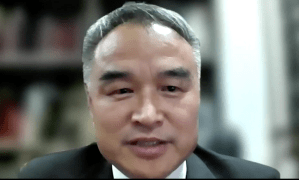
the author giving the presentation on which this post is based

Front-line judges often tell the author that “judicial reform is a failure,” although the author does not take their words literally. It is their way of expressing dissatisfaction with aspects of the design and implementation of judicial reform. The official view is that judicial reform is a success, and the basic structure (四梁八柱) of judicial reforms has been constructed in the past 10 years, although work continues to be needed in specific areas. The author is not prepared to say simply that judicial reform is a success or failure, particularly when significant gaps in information prevent the author from making a comprehensive, objective, and informed assessment. Although the author has only been a minor player in the complicated drama of drafting, implementing, and internally evaluating judicial reform in the last ten years, she considers herself fortunate to have the opportunity to monitor it closely and know personally many involved.

Within the limits of this short essay, the author focuses on the “front-end” and “back-end” of the judicial reform process. Her focus is on the process of deriving reforms that fit courts with widely different resources, and internal and external environments. The author roots her comments in the highly complex reality of the Chinese courts and with an international perspective.

Front-end Issues

The author considers that the “front-end” of judicial reform is most important–the drafting of judicial reform plans. She considers four aspects particularly important for the overall success of judicial reforms: evaluating local innovations; pilot projects and foreign mechanisms or experience; improving centrally designed mechanisms; and enabling greater stakeholder input into the judicial reform process. Each has separate and common challenges.

The author turns first to local innovations, pilot projects and foreign mechanisms or experience.  Pilot projects are undertaken to “test drive” a possible reform while local innovations, draw on local wisdom and institutions to experiment with a new mechanism. She discusses these together because when reformers consider whether these specific experiences are suitable to be promoted nationally, the challenges are similar.

Family trial reforms (家事审判改革) provide a good example because they involve the above three aspects–evaluating foreign experience, domestic innovations, and pilot projects. In the case of family trial reforms, the relevant reform leaders were able to travel overseas to observe family courts and the ecosystem surrounding them and brought foreign experts to China to discuss specific issues and the related institutions needed to make family trial reforms successful.

Given the geopolitical changes of recent years, this type of onsite research is not as easy to accomplish. Foreign experience is particularly challenging to consider in the context of judicial reform. The first issue is understanding the foreign experience accurately, because written materials may not be comprehensive and fail to explain the institutional infrastructure on which the success of the mechanism is based. International travel to experience that mechanism may not be as feasible as previously, given constricted budgets. A third issue is the issue of “moving the foreign plant to Chinese soil,” to consider whether the mechanism will work as anticipated, given that related institutions operate in a different environment from those abroad.

Next to a pair of related mechanisms–pilot projects, which are undertaken to “test drive” a possible reform, and local innovations, which often draw on local wisdom and institutions to experiment with a new mechanism. The author discusses them together because they share a common challenge when reformers consider whether these two specific experiences are suitable to be promoted nationally. A pilot project approved by the Supreme People’s Court is likely to enjoy more resources, guidance from the Supreme People’s Court and possibly the Legislative Affairs Commission of the National People’s Congress (if delegation legislation is involved), support from local court leaders, as well as relevant institutions outside the courts.

The piloting of family trial reforms in recent years provides a good example.  A research team based at Xiamen University* assessing those reforms found large disparities in whether those reforms were successful or even implemented, depending on many factors, such as whether the court was in an urban or rural area, the commitment of supporting organizations, whether local court leaders were committed to the reform and the case burden of individual judges. Pilot courts in urban areas could liaise with psychological counselors and mediators trained to resolve family disputes to achieve better outcomes. Rural judges generally did not have such resources available. The research team found that when judges were overburdened with cases, they would revert to usual practice, following reform practice only when needed for court news releases.

Should judicial reformers have anticipated the gap between rural and urban courts, and the cultural differences in different geographies, particularly in rural areas? Now that these gaps are known, what should be done to improve outcomes for rural as well as urban families? Perhaps special arrangements can be considered to support court teams hearing family matters in rural courts, as is done in some other jurisdictions, such as Australia, but that requires further research and analysis. [Family trial reforms are listed in point 6 of the Sixth Five-Year Reform Outline, issued in December 2024].

Next, on the phenomenon of centrally designed measures implemented with apparently limited input from affected persons. One recent example of this is the recently revised trial quality management indicator system (审判质量管理指标体系). Although the official view is that the relevant departments had engaged sufficient research and input from experts (充分调研论证) and one-half year of piloting the new trial quality management indicator system, from the fact that after nine months of official implementation of the system, “in order to reduce the burden on the lower courts (续深化给基层减负工作)” the number of indicators was reduced from 26 to 18 strongly suggests that after the system was fully implemented, the negative reaction from lower court judges was very strong. Had the relevant departments done a more representative survey of the views of lower court judges on this, the embarrassment of reversing themselves within several months could have been avoided.

Reforms designed without involving the personnel directly affected, without stakeholder input, are not likely to meet their goals. It is unlikely that a small team of persons working in Beijing have sufficient evidence, data, and analysis to reflect the varied types of judicial work and the complex environment in which judges work. It is unclear which type of courts piloted the new indicators and whether the piloted courts considered it prudent to provide responses that the relevant departments sought. This author surmises that it could make sense to have different sets of indicators for urban and rural courts, instead of having a single standard for all, but making that recommendation would require more data and analysis than this author has available. The author has heard lower court judges describe this reform as another example of “building a cart behind closed doors (闭门造车).”

Back-end Issues

The crucial part of the “back-end” of judicial reform is analyzing the results of a reform, or more likely the multiple reforms that have been launched and considering whether further continuity is needed in the form of measures to sustain the reform or to compensate for problems that become apparent. The current judicial system contains many such unfinished judicial reforms. One example of an unfinished judicial reform is the role of the judges assistant (法官助理).* [The reform is now listed in point 41 of the Sixth Five-Year Reform Outline].  Law and Supreme People’s Court guidelines have not defined clearly the scope of a judicial assistant’s work. This lack of clarity has an impact on the operation of the entire judicial system. Reforms themselves need continuity.

Conclusion

It is a truism that Chinese judicial reform is a highly difficult and complex matter, as the brief discussion above has signaled. The development of a modernized judiciary depends on cultivating judicial reform specialists possessing the entire package of skills required to evolve and implement judicial reforms appropriate for all Chinese courts, whether they are urban or rural, large or small, specialized or general. These specialists need to combine deep local knowledge with that of international “best practices.” Reformers need to be able to focus on front-end and back-end matters, including accurately evaluating foreign experience, pilot projects, local innovations, and incomplete reforms. They also need to involve stakeholder input to the extent possible, so that judicial reform measures most closely fit the complex needs of the Chinese judicial system.

The author hopes that these views are useful as a whole or in part.

______________________________________

*The two examples of uncompleted judicial reforms mentioned above draw on the research and experience of Zeng Yuhang (曾宇航, STL 4L student, on family trial reform) and Xue Ye (薛偞, 2023 graduate of STL, on judicial assistant reform).

Many thanks also to Yuan Ye (袁野), PhD student at Peking University Law  School (and 2022 graduate of STL) for transforming PowerPoint slides written in 洋式中文 into standard Chinese.
Update on the Supreme People’s Court’s Judicial Reform Office

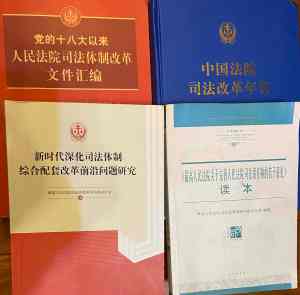
four judicial reform books edited by the Judicial Reform Office

Although no formal announcement has been made in the Chinese press (of which I am aware), it appears that sometime during the last six months, more likely before early June (2023), the Supreme People’s Court (SPC)’s Judicial Reform Office, or more formally the office of the SPC’s leading small group for judicial reform (最高人民法院司法改革领导小组办公室) ceased to exist as a separate entity.  Its work has been assumed by the Research Office.    The leading small group that the Judicial Reform Office supported appears to have been disbanded as well. This post provides some comments on the office, some fragments concerning its history, an explanation of the nature of the office and leading small groups, and evidence for reaching the conclusion that the office no longer exists.

Over the past 10 years, this blog has discussed or cited statements or documents issued, reports drafted, and books published by the Supreme People’s Court (SPC)’s Judicial Reform Office.  As is visible from the photo above, I have a collection of books edited by that office, many of which I have not yet cited in this blog or my other writings. Some books contain documents, others set out authorized commentary,  and others are collections of analytical essays for the most part written by lower court judges.  I had intended to draw on some of these materials when writing something more detailed about the drafting of judicial reform measures, setting out my understanding of the drafting process.  A number of our Peking University School of Transnational Law students have interned in the Judicial Reform Office.  I will now need to wait until I am able to gather enough information about how the new system operates before writing a current and historical description.  

The offices of leading small groups are not permanently established, although this one had been in existence for almost twenty years. It is not unusual for them to be abolished and their duties assumed by permanent institutions. The temporary nature of the office may explain why published structure charts of the SPC have never mentioned the Judicial Reform Office.  The SPC has other such offices, but this one appears to be the most well-known.   Leading small group offices exist in analogous form at the local level as well. 

For those who are not aware of the system of “leading small groups,” many exist throughout the Chinese Party and government system to deal with cross-institutional matters, often involving participants from multiple Party and/or state institutions.  There seems to be a growing English language scholarly literature on multi-institutional leading small groups, mostly behind publishers’ paywalls, but this detailed summary of leading small groups and affiliated offices by Alice Miller is helpful to those without university library access.  The summary explains that “leading small group general offices have dedicated office space, a roster of personnel, and an operating budget for administrative expenses. Although they cannot implement anything on their own, they can levy work on other offices.”   My forthcoming (“neverending”) article has a description of the SPC’s Judicial Reform Office levying work on (assigning work to) other SPC offices, divisions, and institutions. 

The Judicial Reform Leading Small Group and its supporting office were established in 2006.  Although I have not been able to find the document approving its establishment, I assume that it was established to draw together a team of people to focus on judicial reform matters and to coordinate matters across multiple SPC entities,  with the lower courts, and with the related Party bureaucracies. The Judicial Reform Leading Small Group had a predecessor entity entitled the SPC Judicial Reform Research Leading Small Group (最高人民法院司法改革研究领导小组). The China Institute of Applied Jurisprudence provided institutional support for the predecessor entity.  I assume that the establishment of the SPC’s Judicial Reform Leading Small Group and its predecessor are linked to the 2003 establishment of the Party’s Central Judicial System Reform Leading Small Group (中央司法体制改革领导小组), which has (had?) members from multiple Party and state institutions. That Leading Small Group also has (had) an affiliated office (中央司法体制改革领导小组办公室).  I have not seen public mention of the Party’s Central Judicial System Reform Leading Small Group in the past year or more, so I assume it has been disbanded and its functions subsumed by some part of the Central Political-Legal Committee/Commission.

Prior to 2003, judicial reform research at the SPC was conducted and coordinated by the Research Office.  That office often deals with SPC cross-institutional matters, such as the transition to the Civil Code. So this development appears to be an instance of the SPC either going back to the “good old days” or as a former SPC judge  recently wrote about the end of a piloted judicial reform, “restoring the original condition (恢复原状).” 

 During the March 2023 meeting of the National People’s Congress, He Fan, previously mentioned on this blog,  spoke to the press about judicial reform, as a responsible person of the Judicial Reform Office (最高人民法院司法改革领导小组办公室负责人). In September of this year, public statements concerning judicial reform (in this case, the termination of the piloted reform of the four levels of the courts) were issued by a responsible person of the Research Office.  A related document issued in June (2023) did not mention the Judicial Reform Office or the Judicial Reform Leading Small Group.  When He Fan spoke at Fudan University Law School in September, he was described as a vice director of the Research Office and the former responsible person of the Judicial Reform Office (最高人民法院研究室副主任、原司法改革办公室负责人何帆博士).  So I surmise from this that sometime between March and June, the Judicial Reform Office was abolished and its responsibilities and personnel were transferred to the Research Office. 

I will be monitoring this change (to the extent possible).   Questions that come to mind include the following.  What will being located in the Research Office mean for judicial reform matters?    Will the staff take on additional tasks in addition to judicial reform matters? What will this mean for the analysis of the impact of prior judicial reforms?   What will this mean for the drafting of the sixth judicial reform plan outline?  Will this mean more or fewer staff resources?  When the plan is issued, will we on the outside of the Chinese court system notice the impact of this bureaucratic change?  And as several highly knowledgeable persons have asked me in recent weeks, how should the judicial reforms of the last ten years be objectively assessed?

_________________________________________

Many thanks to the knowledgeable persons who contributed to this blogpost. Those with additional information or corrections should contact me. My apologies to my patient followers for the long gap between blogposts. but I have spent much of the last two months revising my “endless” long article for publication, as it needed to be updated to reflect recent changes.  This change requires an additional update. I plan to do several more analytical blogposts in the upcoming months, but use more of my time putting together my research, as highlighted earlier this year.  

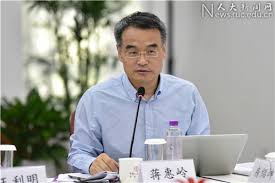
Dean Jiang Huiling (蒋惠岭) on the Last 10 Years of Judicial Reform

Dean Jiang Huiling (蒋惠岭院长)

As the readers of this blog know, Tongji University Law School Dean Jiang Huiling worked at the Supreme People’s Court for over 30 years, and for over 25 of those years, he was involved in judicial reform. He has the most comprehensive and deep understanding of the importance, challenges, and multiple implications of reforming China’s court system.

On 11 January 2023, Dean Jiang spoke on the last 10 years of judicial reform to my judicial reform class at the School of Transnational Law, colleagues and students from Tongji University, and some other visitors.  This very delayed blogpost summarizes his presentation and responses to questions from the audience. The references to “we” in the summary are his, as are the unattributed quotations.

Presentation Outline

A. Roadmap of [the last ]10 Years of Judicial Reform
B. Four Fundamental Reforms
C. Judicial Organizations Reform
D. Procedural Justice Reform
E. Diversified Dispute Resolution
F. Judicial Democracy

G. Other Reforms

H. General Observations

A. Roadmap of Chinese Judicial Reform

The focus of his presentation was the last ten years of judicial reform (2013-2023), which included two five-year judicial reform plans. He first provided some historical background to the most recent two judicial reform plans, speaking about earlier judicial reform plans from a participant’s perspective.

1. Earlier judicial reform plans

Many Chinese scholars and some foreign scholars consider that those earlier ones were working method reforms, focusing on efficiency and other matters-they say is it not real judicial reform. He disagrees but says that it was only with the reforms of the last 10 years that structural (radical) reforms were made.

  • The first judicial reform plan (starting in 1999)–Dean Jiang was involved in drafting it.  The principal focus was making the public and judicial professionals aware of the nature of a judicial system.
  • The second 5-year judicial reform plan: Setting the tone of the judicial system–procedural justice, professionalization and other basic elements of a judicial system.
  • The third 5-year judicial reform plan: in 2002 the Central Government [中央] discussed structural judicial reforms, and although the environment was very helpful, after preparing detailed plans (in which Dean Jiang was involved), the government and the SPC gave up those structural or radical reforms.

2. The Last Two Judicial Reform Plans

  • The fourth 5-year judicial reform plan (from 2013): Radical change of the judicial structure, organization, and nature of the legal profession.  In response to my question as to why was the political leadership willing to do these reforms, Dean Jiang said that it was there had already been 15 years of judicial reform, of reforms to working methods, but it did not solve severe basic problems of judicial independence [it will be evident in this account what he means by this], fairness, and local protectionism. It is 穷则变塔–if there are no other options, then that is what needs to be done, and reflects what Chinese scholars had been calling for.  As to the nature of the legal profession, he meant treating judges and prosecutors differently, not simply as civil servants.
  • The fifth 5-year judicial reform plan (from 2019): comprehensive and supplementary reform and “Zhengfa” (政法 political-legal) reforms. (See his explanation in last year’s presentation).

3. Summary of the characteristics of judicial reform in the past ten years-

“It’s a new time….”

  • Breadth: From the judiciary to other related areas
  • Depth: From judicial system reform to broader systematic innovation
  • Goal: From a fair, efficient, and authoritative judicial system to basic values of judicial system systems–touching on basic values such as independence, professionalization, and public confidence
  • Method: From branch-driven to Central Committee-driven–by this he means that previously, reforms were undertaken by institutions separately, but now the reforms are driven by the Central Committee [Central political leadership]
  • Nature: Chinese style and self-owned brand

B. Four Fundamental Reforms

Dean Jiang focused on four fundamental reforms, giving a quick summary and some comments.  I will supplement with scattered comments, some links to some English-language academic articles, and some of my own blogposts.

  1. Judicial Personnel Management System Reform

This is one of the most important reforms. Although the Central Government had sought to improve the quality of judicial personnel (judges and prosecutors) for a long time, they had been treated as ordinary civil servants with ranking.  Now they are managed as professional civil servants.  He noted that when he was in Taiwan in 2011, Taiwan had done something similar.  (The reform is not complete, and the SPC’s website and casual conversation among judges and legal professionals reflect this).

(For those interested in the quota judge system, please see this article by Hong Kong University Faculty of Law Dean Fu Hualing and Zhongshan University Professor Sun Ying. )

2. Judicial Responsibility and Accountability System Reform (司法责任制)

He quoted President Xi Jinping’s description of it as “牛鼻子工程”–the nose of the cow project–crucially important. He noted that it is right to punish ethical violations and intentionally wrong judgments. Although this reform provides for more· internal Independence, it comes with strict restrictions and supervision.  Jurists, prosecutors legal scholars, and others disagree with this approach.  They argue that the reason for continued corruption, miscarriages of justice, and unfairness lies in the lack of reform elsewhere, The focus on judicial responsibility is a politician’s wisdom.  Under that system, supervision is more important, and that is the reason for defining “four types of cases.”

See my earlier blogpost on the “four types of cases” and Straton Papagianneas’s article on the use of automated methods of supervision.  

3. Professional Guarantee Reform: Salary, Rankings, Selection, Training, Disciplinary Reform

He spoke only briefly on this, saying these were needed so that judges were treated as judges.

4. Judicial Administration at the Provincial Level–

Delocalizing the Chinese judiciary–local protectionism was criticized by legal scholars and those within the judiciary [not to mention litigants and their lawyers] for many years. Judicial protectionism was terrible for fairness. Officials now characterize judicial power as a central power.

Chinese and foreign scholars consider the first and fourth most important.

See this earlier blogpost on problems with the court funding reform.

C. Judicial Organization Reform

These reforms are more technical and less fundamental.

1. Branch Courts of the Supreme People’s Court (Circuit Courts)

Six Branches in the country.  The country is large but only one Supreme Court in Beijing exists. They were established to deal with trans-provincial cases, so that cases involving parties from different provinces, especially when the local government or its entities are a defendant,  are heard fairly.  He favored the scholars’ proposal of making the circuit courts into a separate tier (or quasi-tier), but that idea was not accepted.

Note my earlier research on the caseload of the SPC Circuit Courts, which found that most cases that these courts considered were applications for retrial, most in administrative cases.  This has now changed with the reform to the four levels of the Chinese courts, as discussed here.  See this article by the deputy chief of the SPC administrative division and two colleagues.

2. Specialized Courts

IPR Courts
Financial Courts
Internet Courts……

He noted that the Internet Court is not officially recognized as a specialized court by the Organic Law of the People’s Courts, but is an innovative action by the Chinese government.

See also Georgetown Law Professor Mark Jia’s article on China’s specialized courts. 

3. Transregional Court Systems

“It’s another interesting invention in China.” Virtually all courts in China are based on the corresponding administrative area, so a county court will be established in a county, emphasizing the localized nature of the courts.  So in 2015, the Central Government established the following two courts:

  • Beijing Fourth Intermediate Court
  • Shanghai Third Intermediate Court

Under the situation that judicial appointments and budgets have been transferred to the provincial level, this reform may not be so useful. It is his suggestion that China establishes transregional courts beyond the provincial level. This overlaps with the circuit courts.  It is a scholar’s view.

5. Internal Organs of Courts

This one has many Chinese characteristics.

This involves the five-eight-ten test.  If you have under 50 personnel in your court, you can establish up to give internal organs in your court. If you have between 50-150 personnel, you can establish eight internal organs, and if more than that, you can establish 10 internal organs. This means that it is possible to save some quota (headcount) for personnel [linked to the headcount system of the organizational departments–see here].  But it also pushes local courts in the direction of professional, rather than bureaucratic management.

D. Procedural Justice Reform

This is considered a “technical” reform but touches upon fairness, and what President Xi Jinping says about making each person feel fairness in every case.

  1. Criminal Justice Reforms

Both inquisitorial and adversarial systems have the same standards of procedural justice. But in China, traditionally 公检法都是一条龙, the public security, procuratorate, and courts are a production line.  “We have a long history in China with this.” They consult with one another and sometimes other bodies coordinate them. Which is the center?  In this round of reforms, the Central Government pointed out that the trial, the hearing should be the center in criminal justice. It’s very difficult and the reform is not finished. But we are moving in the right direction.

2. Accesss to Justice

Case filing reforms, making it easier for a party to file a case.

3.  Simplification of procedure

For judicial efficiency, enabling more cases to be closed in a short period of time, the following reforms were made:

  • Sole judge and One Judge Panels
  • Small claims

4. Functions of the four levels of the courts

“An old item of reform but a new action taken in recent years.”

“Cylinder or Cone”?

Traditionally the Supreme People’s Court could hear a case within the jurisdiction of a local court. But this is not good for professionalism.  So now, the reform is to have the higher courts focus on legal issues and more important issues, that is for the court system to be shaped more like a cone.

See my two blogposts on this reform.

E. Diversified Dispute Resolution

ADR–in China called Diversified Dispute Resolution. This is an efficiency issue.  It is also important for Chinese state governance. The courts are a beneficiary of these developments because they resolve more cases.

1. One-stop Litigation Service
2. One-stop Dispute Resolution Service
3. Judicial Platform and Governmental Platform
4. Judicial Confirmation of Mediation Settlements

–we learned from the United States and other countries in designing this. In the US, courts approve a settlement, while in China, we have a confirmation of mediation settlement procedure.
5. Arbitration–In China, we have over 260 arbitration commissions, almost one for each city, with CIETAC, Beijing Arbitration Commission, Shanghai International Arbitration Center, and the Shenzhen Court of International Arbitration being the most prominent. We have learned from overseas in arbitration.

F. Judicial Democracy

1. People’s Congress Supervision

This sometimes makes courts anxious.  The president of a court does an annual report and the people’s congress votes on it. If it does not pass by much or does not pass, the court president and the court feel embarrassed. It has happened. What happens if the report does not pass? After two or three months, the court president has an opportunity to report again. It is a type of facilitation.

See my recent blogpost related to people’s congress supervision.

2. Peoples Accessors (Lay Judges) System

–although the terminology in Chinese is similar to a jury, it is actually more similar to the lay judge system in Europe.  It has a long history in China (not as long as Europe), and changed in the last 20 years. Now the people’s congress appoints them on the recommendation of the people’s court.

3. Judicial Transparency: Written Judgements, and Live Broadcast of Hearings

4. Media Supervision

Very different from people’s congress supervision and he spoke about the rise of commentary on the courts through social media platforms.

G. Other Reforms

1. Constitutionality Review

The Chinese courts do not do that, it is a function of the National People’s Congress. They have established a committee. This is a big progress, although some scholars think this should be given to a constitutional commission or court, or to the courts. He is not sure which is better. The NPC Standing Committee has recently published its annual report on this.  These contain legal judgments. But how should these legal judgments be made? Should they follow some procedures? The legislature is trying to reflect people’s views. The standard between the courts (black-letter rules) and people’s views is different. He hopes there will be some improvement.

2. Judicial interpretation

The SPC and Supreme People’s Procuratorate both have interpretative power within their area of competence. This is always criticized by NPC deputies, the staff of the NPC, and some scholars because the content is abstract and looks similar to legislation, but it plays an important role in unifying the application of law in the whole country. The judges love it. Without interpretations of law, given the brief provisions of law, it gives judges great discretion, so there is a risk of inconsistent application of law. He is sure judicial interpretations will be there for another decade.

3. Guiding Case System

Justice Xiao Yang found another way of interpreting the law-through cases.

4. Prosecution system

The procuratorate disappeared in the former Soviet Union but in China, it is still here. It has found a new way of life with public interest litigation, supervising administrative, civil, and criminal litigation, enabling them to oversee the executive.

5. Ministry of Justice

The State Council’s Legal Affairs Office has been merged into the Ministry of Justice. And everyone knows that President Xi chairs the Rule of Law Commission and that secretariat is located in the Ministry of Justice.

6. Public Legal Service

The Central Government just issued a reform plan.

7. Legal Profession and Pre-career Training

It is another technical but important reform for the future of the legal profession. We followed the civil law countries in planning pre-career training.  I hope we can insist on two years of legal training.

H. Some General Observations

1. The first 5 years vs. the second 5 years–very different. The first five years of reforms are structural or system reform, like the identity of the judges or prosecutors, delocalization…But the second five-year reforms–comprehensive, supplementary reforms–the four fundamental reforms have finished, and we go on to the next. But those reforms and others are not finalized–it is not possible within four or five years to fundamentally change a judicial system. This reform plan is continuing the former plan, plus supplementary reforms. Unfortunately, the Central Government has invested less. This is linked to Covid-19, the unsatisfactory international environment, and the economy—many negative factors.
2. From judicial reform to “Political and legal (政法) reform”–from judicial (司法) to political-legal reform, including reforms to the people’s congress system. The comprehensive, supplementary reforms must fit into the political-legal reforms
3. Step-by-step reform: Waiting for or creating satisfactory conditions for some reforms–only a few provinces have finished the financial reforms, less than half. Reasons– now few meetings to coordinate with other branches on this.
4. How to deal with the halfway reforms and progressing with the Comprehensive supplementary reforms–there should be some evaluation–but there are no formal critical objective evaluations published.  How to deal with the halfway reforms.
5. Yes and no to Politics-Driven Reform–the nationwide judicial reforms must be driven by political power. No comprehensive effect is possible without the use of political power. There should be more legal elements in this process.
6. On the Track of Rule of law–how to keep judicial reform on the track of the rule of law.–#5 of Xi Jinping rule of law thought is putting state governance on the track of the rule of law. That will take all legal professionals, foreign scholars, the international community, and internal incentives.  This is what is needed to keep judicial reforms on the track of the rule of law.

In the next five or ten years, the judicial reforms will not stop. The pace might be slower. The country has so many difficulties. We hope that the rule of law will help the development of this great country.

He concluded the main part of his presentation by cautioning that these are his views, as a scholar.

____________________________________

In response to the question concerning which reform is the most important and what obstacles it faces, Dean Jiang said that two are the most important–the centralization of judicial power and the professionalization of judges, so that judges are sufficiently qualified to exercise greater judicial power. Time is a challenge.

A question from one of my students–what about using contract judges to supplement the shortage of judges?  A: In UK, they are called part-time judges.  But in China, Chinese judges must have 政法专项编制 (political-legal specialized headcount)–in China we have not changed our minds on this–we are concerned about corruption. Perhaps in the next 10 years, we will have part-time judges, more likely borrowed from the executive. Professional ethics is very important.

A second question from one of my students, concerning the constitutionality of the quota judge reform–removing the title of judge from 70,000-80,000 personnel. Dean Jiang said it was a good question and would have been challenging if done in Europe. The Central Government leadership decided, saying that many people were not doing judicial work, but were in the General Office, Research Department, etc.  People thought about the legality or constitutionality of this. We didn’t use the word “removal,” but “suspension,” you keep the title of “judge,” but no longer do judicial work.  Dean Jiang himself was affected by this reform. He was appointed as a senior judge by the NPC Standing Committee but was working in the Judicial Reform Office. Approximately 360 judges were appointed as quota judges by the SPC. He was not one of them, not a 员额制法官, but still enjoyed the title of “senior judge,” (of the bureau-chief ranking 正局级). If all those judges had continued to be judges, it would have been a disaster for judicial reform, it would have slowed things down. It was a balancing, at the edge of legality/constitutionality. The second question that the student asked was about the accountability of judicial assistants under the judicial responsibility system.  Dean Jiang said the reason is that they are involved in judicial work and are future judges.

Another question from the audience related to reforms such as abolishing the Procuratorate and moving the prosecution function to the Ministry of Justice (like many other jurisdictions)–unlikely and why the enforcement bureau remains in the courts, when the enforcement function is elsewhere in many jurisdictions. Dean Jiang said many court presidents would welcome that, and the proposal has been made, but during the 16th Party Congress, it was decided that it was not appropriate to do so. A question was raised about military courts–he noted that they are considered specialized courts, and under the reforms moved from being under the General Political Department to being directly under the Central Military Commission (through its Political-Legal Commission).


Dean Jiang Huiling on Chinese Judicial Reform

On 7 January 2022, Dean of Tongji University’s School of Law and Professor Jiang Huiling gave a guest lecture in my School of Transnational Law class.  We were honored to hear Dean Jiang provide his unique perspective and insights on over 20 years of Chinese judicial reform and his insights on future developments. He has been involved with Chinese judicial reform starting from the first plan in 1999 (see also more about his background here).  This blogpost summarizes his presentation. I have inserted my occasional comments in italics. If a point is not more fully elaborated, it means he did not do so.

He spoke on the following six topics:

1. Brief History of Chinese Judicial Reform
2. How Judicial Reform Actions  Are Taken
3. From the 4th to the 5th Judicial Reform Plan
4. Strategic Move: From Judicial Reform to “Zhengfa” (政法) Reform
5. Technical Measures: Rule of Law
6. Future Direction

1. Brief History

Dean Jiang went briskly through the history of judicial reform, commenting that in the first judicial reform plan, the focus was on raising public and professional awareness about the judiciary。 The second one, in which the Central Government greatly supported the SPC to undertake work mechanism (工作机制) reforms, not touching on structural reforms such as the status of judicial personnel. He noted that there was great progress during the second judicial reform plan. He called the third judicial reform plan a test before the New Era, and said that a decision had been taken to de-localize the judiciary and change the status of the judges and prosecutors, but at the end, there wasn’t internal confidence that the legal profession and society would accept such changes.  He called the fourth judicial reform plan a structural, systematic, and radical change to the judicial system, especially the decision that judges would not be treated as ordinary civil servants.  Dean Jiang characterized the fifth judicial reform plan as comprehensive and supplementary, and part of the Zhengfa reforms (as he further explained in the latter part of his presentation).

What were the lessons learned?

  • Right (科学) concept of the judicial system (universal and with Chinese characteristics)–that the legal profession and the leading party accepted the value of the rule of law and the importance of the judiciary;
  • Theoretical preparation–although he thought scholars had not done enough;
  • Consensus for change–the judiciary is regarded as and is a bureaucracy–there is that consensus among both court leaders, who are legal professionals and with a Party role, and ordinary judges, who are legal professionals;
  • Common achievements of human civilization–that means learning from other countries–China had done so not only in science and technology but also in law and democracy. Chinese judicial  reformers had benefited from the open policy–he himself was an example; and
  • Critical role of strong leadership–legal professionals could not initiate fundamental changes themselves–it needed court and political leadership to do so–he quoted General Secretary Xi Jinping on the ability to do what could not have been done before.

2. How Judicial Reform Actions are Taken

Dean Jiang rapidly made the following six points:

  1. Judicial awareness and enlightenment;
  2. Negative case matters;
  3. Reform for branches and reform for all (parochialism);
  4. Top-down design and comprehensive reform–the court system is part of the political system and reform has to be done by the Central Government;
  5.  Coordination with other departments–in China, unlike in other countries, some matters require coordination with other departments, such as the Ministry of Finance;
  6. A group of devoted experts–both within the judiciary and among academics.

3. From the 4th to the 5th Judicial Reform Plan

Dean Jiang mentioned that the two plans are connected, but that significant differences exist in the value or orientation of the two plans. The fourth one made radical (revolutionary) changes to the judicial system. The fifth one is a new phase, and comes after the completion of the fourth one, which made the following fundamental changes:

  1. Structural changes–delocalizing the judicial system
  2. Status of the judges and prosecutors
  3. Changes to the internal operation of the judiciary
  4. Improvements to the guarantees for judges and prosecutors.

Although these reforms are not completed, these were the focus of their work in the judicial reform office of the SPC and of the Central Government.

The 4th judicial reform plan focused on the following:

1. Separation of administrative region and judicial jurisdiction area–delocalization, as Xi Jinping said, the judicial power is a central power, uniform application of law, so that the law is not applied in favor of one locality;
2. Judiciary-centered litigation system–“in the real world in China, the judiciary does not always have the final say”–and in the past the public security and prosecutors had the final say rather than the judges. The reform to have personnel and financing of courts at the provincial level is part of this reform;
3. Optimization of internal power allocation–as a court is a bureaucracy with different entities with different functions, and the leaders have different functions from ordinary judges;
4. Operation of hearing and adjudicatory power
5. Judicial transparency;
6. Judicial personnel–this is basic but very important; and
7. Independence of the court–this is basic but very important.

The 5th judicial reform plan:

  1. Party’s leadership 
  2. Work for the country’s overall task and situationsubject of one of my forthcoming articles
  3. Litigation service–treat litigants properly and give them judicial services– the courts have public funds to pay for legal representation if people do not meet the standard for legal aid
  4. Judicial transparency–“always on the way”
  5. Responsibility-based judicial operation
  6. Court’s organization and function–reforms in that area (he referred to the recent repositioning of the four levels of the court system, among others)
  7. Procedural system
  8. Enforcement reform
  9. Court personnel system reform–better training of judges
  10. Smart court–using technology

The bolding above reflects his stress on those points in his presentation.

Dean Jiang mentioned that the Central Government put the court system into a bigger picture, but that the prior reforms were needed to make the judicial system more professional.  It is for this reason that the Central Government mentions the phrase “judicial reform” much less than before.

The bigger picture is involving the court system more in the development of the whole country. This reflects a change in China’s overall policy, and we Chinese legal professionals need to understand this.

Comparing the 4th and 5th Reform Plans:

  • Similar, but different;
  • Duplicated, but deepening and supplementary;
  • To those unfinished tasks, less emphasis

He said these should be seen in the context of the national plan for achieving the rule of law, and from 2035, China will have achieved rule of law and be a modernized, democratic country–the second 15-year plan will be about rule of law.  He thinks that the timing is insufficient.

4. Strategic Move: From Judicial Reform to “Zhengfa” (政法) Reform

1. Before 2012, judicial work mechanism reform
2. From 2013,Judicial system reform
3. From 2017,Comprehensive supplementary reform of the judicial system
4. From 2019, Promoting Comprehensive
Reform in Zhengfa Area
5. From 2020,Xi Jinping rule of law thoughts

On point 4 above, that relates to a comprehensive document adopted in 2019 [Implementing Opinion On the Comprehensive Deepening Reforms of the Political-Legal Sector 关于政法领域全面深化改革的实施意见, not publicly available but mentioned previously on this blog], of which judicial reform plays only a small part.  From 2020, Xi Jinping rule of law thoughts plays an important guiding role in the role of law. He said all law students and legal professionals should read it because it will have an important impact on the building of rule of law in China.

Structure of the new arrangement:

  • Breadth: From the judiciary to other related areas
  • Depth: From judicial system reform to broader systematic innovation–the latter means is moving from judicial system reform to areas previously little discussed, such as Party leadership and the role of the Political-Legal Commission, and the relationship between the Party and the law.
  • Goal: From fair, efficient, and authoritative judicial system to modernization of Zhengfa work system and capability—that is, that the judicial system is to be part of a modernized governance system and governance capability [国家治理体系和治理能力现代化–from the Decision of the 4th Plenum of the 19th Party Congress]. That is the goal for the next 30 years. It means the rule of law in the future will have a major part to play as part of modernized governance, and the courts will have an even more important role to play in supporting this modernized state governance (this is in my draft article). It may not be apparent from the English words, but it is a change.
  • Method: From branch-driven to Central Committee-driven–how to get there? He says this wording is not quite accurate as the 4th Judicial Reform Plan was also Central Committee driven, but because the Central Government put the project of the rule of law into the modernization of state governance, it has a different method for treating reform in the legal area, but he thinks that change of method is only an improvement.
  • Nature: Chinese style and self-owned brand–when you read English language literature on building a fair and independent judicial system from abroad you will see many common points. In the current arrangement–in the Zhengfa reforms, Chinese characteristics have a great deal of weight and also in the reconstruction of the legal system. Although China has learned a great deal from other countries, China has to go on its own way, since it has its own history, political situation and historical stage and there is a change in the international situation. China has changed its position in the world. He is getting accustomed to this new way of judicial reform and it will be more difficult for foreigners to understand it.

The change of emphasis can be seen from the VIP (very important research projects of 2021), which are all more general than before:

No. 67. Practice and Experiences of the Party Comprehensively Promote Law-based governance
No. 68. Socialist Legal Theory with Chinese Characteristics
No. 69. Spirit of Socialist Rule of Law
No. 70. Constitution-centered Socialist Legal System with Chinese Characteristics
No. 71. Promoting Comprehensive
Reform in Zhengfa Area

Dean Jiang described the 2019 document mentioned above as containing the following areas of reform.

Seven Areas of Zhengfa Reform:

  1. Party’s leadership of the Zhengfa work–that is the Chinese situation
  2. Deepening reforms of Zhengfa institutions–not only the courts and the prosecutors, but changing the overall structure of Zhengfa institutions
  3. Deepening reform of systems of law implementation–we combined  Legislative Affairs Office (of the State Council 法制办) into the Ministry of Justice [MOJ]–that’s an important change
  4. Deepening reform of social governance system–the Zhengfa Wei important for social governance–one of the most popular words is “governance“–how to support social stability, social development; innovative spirit, people’s lives;
  5.  Public Zhengfa service system–public legal service is part of Zhengfa service–all the political-legal organs will work together to provide efficient high-quality services for the people-人民为中心–Xi Jinping says all our work needs to be people-centered;
  6. Zhengfa profession management reform–no major change here
  7. Application of IT technology–no major change here–continued application of IT in the Zhengfa area

These are seven areas of Zhengfa reform, based on the prior judicial reforms, but now going to a new stage. Governance is a crucial word.

5. Technical Measures

This is what he has devoted his life to before.

  • Law is a profession, and the judicial system is the carrier of law and justice.
  • Law is also science of law.
  • Rule of law is one of the most technical way of state governance.
  • Rule of law will have no efficacy without the joint efforts of other institutions.

He listed 10 legal issues for consideration for reference and research, as these are the most important topics:

  1. Structural reform: local judicial power, or central judicial power–at the present time, the Central Government cannot manage all those 200,000+ judges and prosecutors, and at first stage, the provincial level is taking that over, but he is not sure of the final judicial model
  2.  Organizational reform: bureaucratic or judicial, especially the internal organs–this is a more technical reform, including internal and external organs, different tiers of the court and branches of the judiciary, including the procuracy;
  3. Functions of the four tiers of court:  their role and function–cylinder, or cone (his metaphor of 20 years ago)–should the SPC concentrate on judicial interpretations and a small number of cases, and does not need 400 judges–this relates to the pilot program of late last year on the repositioning of the four levels of the Chinese court; the local courts will focus on factual issues;
  4.  Personnel reform: Profession, or ordinary public servant–this is still an ongoing issue, and in his view, some continental European countries have not resolved this issue either. Although there are improvements, judges and prosecutors feel that it is not sufficient, given their new role in society, and the importance of their work. He agrees, having been a former judge.
  5.  Procedural reform: Court-centered litigation system, fair trial, simplification of procedure–how to make things fairer, and given the more than 10% annual increase in cases, a big burden on judges in particular, how to simplify procedure. This links to the recent amendments to the Civil Procedure Law, which focuses on simplification of procedures and giving online procedures the same status as offline.
  6.  Adjudication committee: advisory, or adjudication–there is a great deal of discussion about it–it is the highest decision-making body in a court (see this blogpost).
  7. Judicial responsibility system: The hearing officer makes the decision, and decision-maker takes the responsibility–司法责任制–this is another tricky one–this is required by the Central Government, a step forward towards the rule of law, instead of having a judge’s boss approve his decision (because the court is bureaucracy)–for China, this is a step towards the rule of law, but there is still a long way to go.
  8.  Supervision over “four types of cases”–that means for most cases, judges take responsibility for their cases, but for difficult, controversial, and possibly having an impact on social stability–because junior judges have different capacities from the more senior–for those four types of cases, the court president and senior court leaders are involved to oversee or supervise (see translation of guidance here, commentary to come)–he has not found useful academic papers on this point;
  9.  ADR (Diversified dispute resolution): this is a traditional topic–optimizing the allocation of resources of dispute resolution
  10. Judicial administration: local government loses its administrative power, but what internal administration;
  11. Judicial democracy: lay judge system–different from common law jury (but China can learn from the common law jury–having them focus on factual rather legal issues)–the law has changed, but academic work is insufficient.
  12. Judicial transparency–this is an old issue, to make the judiciary more transparent to the parties and the public.

These are the major issues in the next five years. These technical legal issues are very interesting and need legal scholars to look at them to support the Zhengfa reforms.

6. Future Direction

  1. Xi Jinping rule of law thoughts–inevitable guideline–some of political and strategic, but it provides some guidelines for basic principles;
  2.  Rule of law-driven first;
  3. Politics driven and guarantee–politics should be a consideration but it should not be unbalanced.  Political role of the rule of law-leading the legislative institutions.  Guarantee means guaranteeing the executive implementation of law, supporting the judiciary, and being a model of a law-abiding citizen; This will be very important in putting judicial reform forward;
  4. To complete those halfway reforms–judicial personnel reforms;
  5.  More rethought and theoretical guide–scholars criticize the judiciary for having an insufficient theoretical basis;
  6.  Dealing with the other judicial civilizations–we never stopped, especially in technical areas, and for our legal professionals, that has never stopped. We need to work together for all of humanity.

Supreme People’s Court’s New Vision for the Chinese courts

Screenshot 2020-05-02 at 6.35.07 PM
Publicity related to the document analyzed below

The month of April saw the Supreme People’s Court (SPC) issue many judicial policy documents, consistent with the commitment made in January 2020 to Party leadership to better serve the Party and state.

To the outside observer, a document issued on 1 April appears to signal the way that the Chinese judicial system will develop in the post-19th Chinese Communist Party (Party) Congress Fourth Plenum New Era.  The document is entitled Opinions of the Supreme People’s Court on Thoroughly Implementing the Spirit of the Fourth Plenum of the 19th Party Congress to Advance the Modernization of the Judicial System and Judicial Capacity (最高人民法院关于人民法院贯彻落实党的十九届四中全会精神推进审判体系和审判能力现代化的意见) (Implementing the 4th Plenum of 19th Party Congress Opinions). It implements “Implementing Opinions on Comprehensively Deepening Reform in the Political-Legal Field” (the text of this January 2019 document 关于政法领域全面深化改革的实施意见 has not been issued publicly) and “The Fifth Five-Year Reform Outline of the People’s Court (2019-2023) and obviously, the Decision of the 4th Plenum of the 19th Party Congress (4th Plenum Decision). The fact that the first document has not been issued publicly means that outside observers can identify its implications only through summaries in the press and implementing documents. The Party’s regulations on transparency (explained here) do not cover documents of this sort.

The Implementing the 4th Plenum of the 19th Party Congress Opinion is a framework document in which the Supreme People’s Court (SPC) identifies principles and goals for the Chinese judicial system and judicial capacity after the 4th Plenum of the 19th Party Congress. This blogpost will identify some of them and their link to the 4th Plenum, with related comments in italics. I expect that the SPC will issue specific judicial policy documents and judicial interpretations, as appropriate, to implement specific measures.

New Era Governance

The document needs to be seen as part of the larger picture for China’s governance set out in the 4th Plenum Decision.  Section 1 states that  “modernization of the judicial system and judicial capacity is an important part of the modernization of the national governance system and governance capability” and is needed, among other matters, to provide judicial services and guarantees for societal and economic development. One aspect of the importance of its judicial services is the fact that there were 28 million cases in the Chinese courts in 2018, most of them civil and commercial.

Political correctness

Several sections relate to political correctness.  This is linked to the clear requirement in the 4th Plenum Decision,  under the topic “perfecting the comprehensive leadership of the Party  (健全党的全面领导制度.)”  The 4th Plenum Decision also requires implementing the ideological responsibility system integrating socialist core values into law and social governance. This document, therefore, contains corresponding provisions.

Party leadership

Consistent with last year’s National People’s Congress report and other documents, this document states that the most important goal is to uphold and implement the Party’s absolute leadership of the courts and persist in putting the Party’s political construction first. It restates tasks for the courts, some of which were earlier flagged on this blog:

  • effectively implementing the Party’s leadership in all areas and aspects of the work of the people’s courts and ensuring the independent and fair exercise of judicial power under the leadership of the Party.  Related language is found in the 4th Plenum Decision. This requirement is found in the latest judicial reform plan and elsewhere, including judicial training (as discussed here);
  • Improve the system for implementing major decisions of the Party Center (完善党中央重大决策落实机制) (found in the 4th Plenum Decision and documents thereafter);
  • strictly implementing the [Party] system of reporting and seeking approval for major matters [also known as requests for instructions](严格落实重大事项请示报告制度)(the Party regulations on reporting and seeking approval for major matters) (mentioned here);
  • strengthening improvements from political inspection (see my blogpost on the inspection of the SPC) and judicial inspection (强化政治巡视和司法巡查整改) (discussed in my forthcoming article) (related content found in the 4th Plenum Decision. Judicial inspection is an old institution repurposed in the new era);
  • implementing the Party’s reporting and inspection system (督察落实情况报告制度, mentioned in the 4th Plenum report and thereafter).

As mentioned in a recent blogpost, this means implementing Party principles concerning the appointment of personnel, particularly those in a leadership position. These trends are linked to broader policies related to civil servants (this recent academic paper by Holly Snape has good insights).

Socialist Core Values and the Ideological Responsibility System

Section 5 focuses on socialist core values and the ideological responsibility system, both of which the 4th Plenum Decision stressed.

  • On the ideological responsibility system, this (authoritative) article (the author was then at the Party’s Central Compilation and Translation Bureau), unfortunately behind the publisher’s high paywall), sets forth an authoritative explanation of this concept in Xi Jinping New Era Governance that some of us need. The author defines the ideological responsibility system as follows:  it “is part of the political reforms and aimed at maintaining and improving the loyalty of the Bureaucracy, as well as maintaining their ideological unification…Under the current Xi administration, the CCP wants its cadres to be politically reliable, professional and competent, morally self-regulated, and preferably trusted by the people…
  • Resolutely prevent and oppose the eroding influence of Western mistaken thinking (坚决防范抵制西方错误思潮侵蚀影响).  This phrase has evolved from the one used several years ago and mentioned on this blog: “resolutely opposing erosion by the mistaken Western rule of law viewpoint” (坚决抵制西方错误法治观点侵蚀).  Related language appears in the 4th Plenum Decision: have a clear-cut stand opposing various types of erroneous views (旗帜鲜明反对和抵制各种错误观点 ). This observer surmises that this phrase appeared in the 2019 Party document mentioned above. This does not create obstacles to Chinese judges continuing to consider useful “Western” legal concepts and mechanisms and the SPC continuing to have exchanges and cooperation projects with major “Western” jurisdictions.
  • Implement socialist core values in the work of the courts. This has multiple aspects and continues an ongoing theme, including in judicial interpretations–see my 2018 blogpost). Some high-level conferences organized by the Case Research Institute of the National Judicial College have been on the subject of promoting socialist core values through cases.

Practically oriented

The more practically oriented sections (4, 6-8) reveal priority areas of SPC leadership concern. Those particularly relate to economic development, social stability, judicial reform, and technological upgrading, all topics found in the 4th Plenum Decision., while the section on public health emergency management relates to Party decisions and Xi Jinping speeches during the Covid pandemic.

These sections mention short, medium, and long-term areas of concern and development.

Section 4 of the document lists some of the priority matters relating to economic development facing the SPC and the lower courts, many of them mentioned in this year’s judicial interpretation list or recently announced judicial reforms. A curated version (translation is modified Google translate):

  •  Improve risk monitoring and the early warning mechanism in financial trials,  properly hearing financial disputes, and actively preventing and resolving financial risks (therefore we have seen the establishment of the Shanghai Financial Court and specialized financial tribunals in certain major cities. More detailed observations on this will come in the future);
  • fully implement the environmental public interest litigation system, improve the environmental remediation system, improve the environmental protection injunction system, improve the jurisdiction provisions in environmental cases. (The 4th Plenum Decision had a section on environmental protection and a July 2019 press conference linked to the fifth anniversary of SPC’s Environmental and Natural Resources Division mentioned these measures.)
  • Use evaluation indicators such as “enforcing contracts” and “handling bankruptcy”,  to improve trial management, mechanism, quality, and efficiency to create a stable, fair, transparent, and predictable legal business environment. (This is linked again to the 4th Plenum Decision and China’s ranking on the World Bank’s Ease of Doing Business scorecard).
  • Intensify the review of the legality of administrative actions, strengthen the substantive resolution of administrative disputes (also linked to the strengthening of administration by law in the 4th Plenum Decision, therefore also on the 2020 judicial interpretation agenda).
  • Strengthen the judicial protection of property rights. See earlier blogposts on this.
  • Formulate judicial interpretations for cases of infringement of trade secrets, and continuously improve the level of judicial protection of intellectual property rights (IPR). (Improving trade secrets protection is mentioned in the 4th Plenum Decision. Also see Mark Cohen’s recent blogpost on this).
  • Formulate judicial interpretations of punitive damages for intellectual property rights, promote the establishment of a tort damages compensation system that reflects the market value of IPR (IPR is stressed in the 4th Plenum Decision and punitive damages in IPR cases is mentioned. Also see Mark Cohen’s blog on this.  This also relates to evidentiary issues in IPR cases).
  • Mediation and diversified dispute resolution (including giving non-litigation methods of dispute resolution priority, improving the separation of disputes and the creation of one-stop dispute resolution and litigation service that is efficient and low cost) is mentioned in this document as well.  It is unclear what this means for the development of a commercial mediation system in China.  Local courts have been working on better cooperation with institutions that can mediate specialized disputes, such as the Shanghai Financial Court’s arrangements with the Shanghai Stock Exchange and other institutions. The provisions here derive from language in the 4th Plenum Decision on improving an effective system in the new situation for the correct handling of internal contradictions among the people (完善正确处理新形势下人民内部矛盾有效机制) as well as the Fengqiao Experience. Xi Jinping has mentioned the Fengqiao Experience since 2013, if not earlier. The phrase about internal contradictions appears to derive from the 1959 Mao essay, On the Correct Handling of Contradictions Among the People.
  • Promote capacity building for foreign-related commercial and maritime trials, equally protect the legitimate rights and interests of Chinese and foreign parties in accordance with law, improve the diversified dispute resolution mechanism for international commercial disputes, serve the joint construction of the “Belt and Road” and the construction of free trade pilot zones and free trade ports ( The 4th Plenum Decision promotes a high-quality Belt & Road Initiative, so these measures implement the 4th Plenum Decision. Also, see my earlier blogpost on this.  To better improve diversified dispute resolution in cross-border cases, China needs to work on institutional arrangements enabling it to ratify the Singapore Mediation Convention. Those are many and complex, as I had a chance to learn in December, 2019. One matter that would assist foreign parties litigating in the Chinese courts (and Chinese parties litigating outside of China) would be for China to accede to the Hague Convention Abolishing the Requirement of Legalisation for Foreign Public Documents.  The SPC’s new evidence rules reduce the scope of documents that a foreign litigant (or domestic litigant providing foreign evidence) must notarize and legalize, but it is a troublesome and expensive process.
  • Improve the adjudication mechanism involving Hong Kong, Macao and Taiwan, build a centralized and professional trial system, explore and improve the diversified settlement mechanism for [civil/commercial] disputes involving Hong Kong, Macao and Taiwan. (The centralized system seems to be analogous to foreign-related cases. The intent is to have more competent judges consider these. Another issue is parallel proceedings in these cross-border cases. These issues deserve further analysis.)
  • Deepen the international judicial exchange and cooperation mechanism, participate in the reform of the global governance system and formulate rules of international law, and contribute more Chinese wisdom to the maintenance of the multilateral trading system and the international rule of law. (See my earlier blogpost on this).

Public health emergency management

Section 6 relates to the role of the courts in the public health emergency management system, in the short and long terms.  It mentions the courts providing judicial services to the joint prevention and control system, preventing mass events, and group prevention and control (群防群治工作机制, an old system to which Xi Jinping has given new meaning during the pandemic. That section mentions shorter-term issues, such as punishing the manufacturing and sale of fakes during the pandemic and longer-term issues, such as the courts being involved in improving the legal system in the area of public health.

Judicial Reform

Section 7 highlights some of the tasks in the current judicial reform plan. Those include:

  • Deepening the judicial responsibility system, for judges hearing cases solely or in a collegial panel, the members of a judicial committee, and the supervision of judicial power.  As mentioned on this blog several times, judges are concerned about the scope of the judicial responsibility system, and recent cases that have appeared in the Chinese press would only amplify those concerns. I have more on this in a forthcoming book chapter.
  • Improving the disciplinary mechanism for judges. The forthcoming book chapter is on this. The SPC is working on related regulations.
  • Promoting the improvement of the policies relating to the selection of judges level by level. The controls on the number of “quota judges,” judges with the title of “judge,” in many courts, means that some number of qualified personnel have become judges assistants. It has created a fair amount of frustration.  Another issue is that the new policies mean it takes longer for judges to be promoted, but at the moment, most judges need to retire at 60, so that the pool of judges eligible to be promoted eventually to the SPC will shrink. We can expect related policies issued in the medium term.
  • Improving the working mechanism of the circuit courts and promote the Supreme People’s Court’s Intellectual Property Court (SPCIPC) and the China International Commercial Court (CICC). Promote the strengthening of the organization system of intellectual property courts, and improve the specialized trial system so that it complies with the principles for the judicial protection of IPR. (It is understood that the circuit courts are hearing most SPC cases.  But it still leaves unanswered what the role of the SPC in hearing cases is.  Should it best focus on considering a smaller number of cases more thoroughly, as other supreme courts do? The SPCIPC and CICC both have captured SPC leadership attention (and the attention of the outside world). It is clear that the SPC has provided much more support to the SPCIPC than the CICC (most obviously the SPCIPC operates full time, while the CICC does not). China’s IPR enforcement system is a topic of worldwide concern (the Phase 1 Trade Agreement and the United States Trade Representative Office’s recent 301 Report both evidence this), so it is likely that this means the SPC leadership will focus more on intellectual property issues.
  • Deeply promote the reform of the trial-centered criminal justice system (this is a continuation of reforms initiated in the previous round of judicial reforms).  This topic requires a separate analysis, to consider the impact of the National Supervision Commission, among other issues.
  • Improve and deepen the judicial transparency mechanism including promoting the transparency of judgment documents, court hearings, trial process information, and execution information. See my earlier blogpost and Mark Cohen’s more recent one on his concerns in the area of intellectual property law.  Professor He Haibo has done important empirical work on judicial transparency.

Technology

Section 8 relates to technology and implementing the courts’ five-year plan on informatization (人民法院信息化建设五年发展规划).  It mentions promoting AI, big data, cloud computing, blockchain, and 5G. Litigants should know that the SPC is promoting online case filing, litigation, mediation, judicial blockchain, and the mobile micro-court.  A reality check is needed for China’s online litigation publicity.  One is provided by a popular Wechat article published last month “A month of online court hearings, judges and lawyers have all gone crazy” 云庭审上线一个月,法官律师都疯了Technology is an important area of SPC leadership concern, as it sees it as an area in which China can take the lead.

Take-aways?

What is the impact of this vision and program for the Chinese courts, for litigants (in China or elsewhere), and for others, including judiciaries in other countries and jurisdictions. Is this a “China model” for courts, as raised by some? It does not appear to be so, but rather an outline for the courts to be conveyed within China, rooted in the Chinese political, cultural, and social environment of 2020, which will change along with Party priorities and events.  Some aspects described above are common to judiciaries around the world, such as the trend towards greater online justice.  Will it deliver the results it promises?

________________________________________

Many thanks to certain anonymous readers for their insightful comments on earlier versions of this blogpost. They are not responsible for any errors or “erroneous views.”

Judicial reform post-19th Party Congress


download-2
Judge Jiang speaking at an academic conference


Senior Judge Jiang Huiling heads the Supreme People’s Court (SPC)’s China Institute of Applied Jurisprudence (the Institute). He recently published two articles in the Chinese legal and professional press (the first of which was published in the Central Political-Legal Committee’s (authoritative) Legal Daily) signaling the phraseology and goals for judicial reform after the 19th Party Congress. As the operation of the Chinese judiciary has an important impact both domestically and internationally (as well as in greater China), post-19th Party Congress judicial reform goals are important.

For those who are not familiar with the Institute, it is the SPC’s in-house think tank. The Institute works on a broad variety of issues, particularly those linked with judicial reforms. Like think tanks elsewhere in the world, the Institute trains post-doctorate fellows and has its own staff. Judge Jiang is among a group of senior judges at the SPC who combines an international perspective (he studied at the University of Montreal, and has been a visiting scholar at Yale Law School, University of Sydney, and Academia Sinica) with profound experience in and understanding about the Chinese court system and how it can be reformed, given its complex bureaucratic nature and the environment in which it operates.

From his articles, it is clear that the new phraseology is “deepen the reform of the judicial system with comprehensive integrated reforms” (深化司法体制改革综合配套改革). The language is found deep in Xi Jinping’s 19th Communist Party Congress Report.

Background for these further reforms

Judge Jiang mentioned that during the summer of 2017, the senior political leadership approved further judicial reform measures (including written instructions from Xi Jinping to the Central Political-Legal Committee, designating Shanghai to take the lead in piloting them, initiating a series of reforms from early November. The Outline of the 4th Five Year Judicial Reform Plan required Central approval for major reforms, so this approval should not be surprising.  The beginning of this round of judicial reforms was also first piloted in Shanghai, so piloting these further reforms in Shanghai (as further described in this report) is also to be expected and it seems likely that piloting of reforms will continue in other places.

Eleven further reforms & some comments

Judge Jiang sees these further reforms as intended to implement the previous judicial reforms and classifies them into eleven broad areas.  The SPC has undertaken research (designating lower courts to do so) in many of these areas (with the results to be released to the public in some form).  It appears that those designing judicial reforms have realized that many judicial reforms are linked to deeper issues relating to the Chinese system.

I summarize Judge Jiang’s list and add some of my own comments or queries in italics (which should not be attributed to him):

  1. Optimize how judicial power is allocated within the courts, including the authority to adjudicate and to administer, splitting enforcement authority from hearing cases, allocating authority within offices/divisions of the court, and reallocate the functions of higher and lower courts.  The way that courts have been administered has for many years followed the (traditional) Party/state administrative model.  Some reforms have been implemented in recent years, but it is unclear how much will it be possible to change this, given long-standing patterns of interaction within a court and between higher and lower courts, as well as current incentives/performance indicators.  This appears to be linked to point 19, 24, and other provisions of the Outline of the 4th Five Year Judicial Reform Plan .
  2. Reform judicial administration–what should the model be–centralized administration by the SPC or local administration by each court?  Judge Jiang suggests China could consider models already in place outside of China. This is linked to point 62 of the Outline of the 4th Five Year Judicial Reform Plan. 
  3. Improve personnel administration, such as selection of judges, retirement, rotation of positions, discipline/punishment, retirement/resignation, education/training, headcount administration, internal institutions, etc.  The current model derives from the principle of “the Party manages cadres”  and is linked to basic aspects of the Chinese system such as the official ranking system (官本位) and hukou (户口).  Many of the matters mentioned (such as resignation, discipline, selection and headcount administration) are now controlled or operated by Party institutions–what flexibility will there be for the courts to innovate?  The judicial reforms do anticipate a separate career track for judges (and prosecutors), but it is apparent that the “devil is in the details.”  If there is to be cross-jurisdictional rotation of positions, what happens to the schooling of dependents and other practical matters linked with the hukou [household registration] system? An increasing number of legal professionals and judges are women. What impact would a cross-jurisdictional rotation of positions have on women judges? How can lawyers and others outside the system be fit into the official ranking system?  Under the current system, more senior judges are senior cadres, often less involved with hearing cases because of their administrative responsibilities.  Will later retirement for judges mean more judges in the courtroom?  The retirement issue has been under discussion for some years–see this 2015 blogpost for further background.
  4. Reform the system of how judges are “cultivated” (法官养成机制), in particular, look to the practice of other civil law jurisdictions (including Taiwan) in establishing a two year judicial training system, rather than the current practice of entirely selecting judges from within and having them learn on the job, and increase training for serving judges. He mentions improving the system of recruiting lawyers and law professors to the judiciary. (This is related to points 50 and 52 of the Outline of the 4th Five Year Judicial Reform Plan. The two-year training program proposal had been mentioned by Huang Yongwei, president of the National Judicial College, over two years ago.  It is linked to judicial education policy documents issued to implement the 4th Five Year Judicial Reform Outline, highlighted in this 2015 blogpost).  What might be the content of this training program?  From the previous policy documents we know it will include ideological, ethical, and professional training, but what will that mean in practice?  There have been ongoing exchanges between the Chinese judiciary and the Singapore Judicial College–  will the “beneficial experience” of Chinese judges in Singapore have any effect on the Chinese model?
  5. Improve judicial evaluation, i.e. benchmarking of how the Chinese judiciary is doing.  Judge Jiang suggests looking to domestic analytical frameworks (by the China Academy of Social Sciences and others), as well as international ones, including the Global Framework for Court Excellence and the World Justice Project,  but says there are issues with data and disconnect with Chinese judicial reality.  This relates to point 51 and others in the 4th Five Year Judicial Reform Plan. Benchmarking judicial performance remains an ongoing issue, with most Chinese courts in campaign mode to achieve high case closing rates in the run-up to the New Year.
  6. Better use of technology in the judiciary, not only big data but also use of electronic files, judicial “artificial intelligence.” For lawyers involved in cross-border cases, query when this will also imply the use of apostilles rather than the current system of notarization and consularization, as well as a more timely integration of other Chinese court procedures with those prevalent in the outside world. Pilot projects are underway in some areas regarding electronic files.
  7. Improve litigation, including “trial-centered criminal justice reforms,” pre-trial procedures, more detailed evidence rules, separating petitioning from litigation, and the use of people’s assessors. Creating a “trial-centered criminal justice system” at the same time that expedited procedures/Chinese style plea bargaining is being promoted raises many related issues as was recently discussed at a recent conference that I attended, and separating petitioning from litigation requires improvement of legal aid to the poor and better procedures for considering litigation-related petitions (see these earlier blogposts).
  8. Improve the use of diversified dispute resolution, to involve resources from other social and national resources and the market to resolve disputes, leaving only those most appropriate to be resolved by the courts. This relates to point 46 of the Outline of the 4th Five Year Judicial Reform Plan and related measures described in a 2016 SPC policy document, described here.
  9. Speed up the formation of a legal profession, including reform to legal education, examinations, etc., which Judge Jiang sees as long-term issues.  From my own observations in the courts, remarks by serving judges, practicing lawyers, and interactions with recent Chinese law school graduates, reforms to legal education are needed, as is some flexibility in the career path for Chinese legal academics, which stresses a Ph.D. and academic achievements, rather than any experience outside academia.
  10. Establish a rule of law (法治) culture and environment.  This, of course, is critical. However, the difficulty of doing so was most recently illustrated in the recent clearing of “low end population” from Beijing and related legal analysis (such as this article, originally published on a Chinese scholarly site.
  11. Improve judicial administration generally, including methods of enforcing the law, legislative drafting, etc.  Reforms of a grander scale appear to this observer to be difficult to implement, particularly at this stage.

Finally, Judge Jiang says these are the broad outlines of judicial reform, but they are subject to adjustment along the way.