Category Archives: Family Law

Some Observations on the Judicial Reform Process

This post is the written and English-language version of a speech I first delivered in Chinese at the annual meeting of the Shanghai Judicial Think Tank Society (Think Tank Society, 上海司法智库学会, sponsored by the Shanghai Higher People’s Court) on November 30, 2024, held at Shanghai Jiaotong University.  (The official report on the meeting is available here.) The views are my own and should not be attributed to the Shanghai Higher People’s Court or the Think Tank Society. I would like to express my appreciation to Dean Jiang Huiling(蒋惠岭)and Professor Luo Tianxuan (罗恬漩) of Tongji University for the kind invitation to participate in the meeting.  Further acknowledgments can be found at the end of this post.

the author giving the presentation on which this post is based

Front-line judges often tell the author that “judicial reform is a failure,” although the author does not take their words literally. It is their way of expressing dissatisfaction with aspects of the design and implementation of judicial reform. The official view is that judicial reform is a success, and the basic structure (四梁八柱) of judicial reforms has been constructed in the past 10 years, although work continues to be needed in specific areas. The author is not prepared to say simply that judicial reform is a success or failure, particularly when significant gaps in information prevent the author from making a comprehensive, objective, and informed assessment. Although the author has only been a minor player in the complicated drama of drafting, implementing, and internally evaluating judicial reform in the last ten years, she considers herself fortunate to have the opportunity to monitor it closely and know personally many involved.

Within the limits of this short essay, the author focuses on the “front-end” and “back-end” of the judicial reform process. Her focus is on the process of deriving reforms that fit courts with widely different resources, and internal and external environments. The author roots her comments in the highly complex reality of the Chinese courts and with an international perspective.

Front-end Issues

The author considers that the “front-end” of judicial reform is most important–the drafting of judicial reform plans. She considers four aspects particularly important for the overall success of judicial reforms: evaluating local innovations; pilot projects and foreign mechanisms or experience; improving centrally designed mechanisms; and enabling greater stakeholder input into the judicial reform process. Each has separate and common challenges.

The author turns first to local innovations, pilot projects and foreign mechanisms or experience.  Pilot projects are undertaken to “test drive” a possible reform while local innovations, draw on local wisdom and institutions to experiment with a new mechanism. She discusses these together because when reformers consider whether these specific experiences are suitable to be promoted nationally, the challenges are similar.

Family trial reforms (家事审判改革) provide a good example because they involve the above three aspects–evaluating foreign experience, domestic innovations, and pilot projects. In the case of family trial reforms, the relevant reform leaders were able to travel overseas to observe family courts and the ecosystem surrounding them and brought foreign experts to China to discuss specific issues and the related institutions needed to make family trial reforms successful.

Given the geopolitical changes of recent years, this type of onsite research is not as easy to accomplish. Foreign experience is particularly challenging to consider in the context of judicial reform. The first issue is understanding the foreign experience accurately, because written materials may not be comprehensive and fail to explain the institutional infrastructure on which the success of the mechanism is based. International travel to experience that mechanism may not be as feasible as previously, given constricted budgets. A third issue is the issue of “moving the foreign plant to Chinese soil,” to consider whether the mechanism will work as anticipated, given that related institutions operate in a different environment from those abroad.

Next to a pair of related mechanisms–pilot projects, which are undertaken to “test drive” a possible reform, and local innovations, which often draw on local wisdom and institutions to experiment with a new mechanism. The author discusses them together because they share a common challenge when reformers consider whether these two specific experiences are suitable to be promoted nationally. A pilot project approved by the Supreme People’s Court is likely to enjoy more resources, guidance from the Supreme People’s Court and possibly the Legislative Affairs Commission of the National People’s Congress (if delegation legislation is involved), support from local court leaders, as well as relevant institutions outside the courts.

The piloting of family trial reforms in recent years provides a good example.  A research team based at Xiamen University* assessing those reforms found large disparities in whether those reforms were successful or even implemented, depending on many factors, such as whether the court was in an urban or rural area, the commitment of supporting organizations, whether local court leaders were committed to the reform and the case burden of individual judges. Pilot courts in urban areas could liaise with psychological counselors and mediators trained to resolve family disputes to achieve better outcomes. Rural judges generally did not have such resources available. The research team found that when judges were overburdened with cases, they would revert to usual practice, following reform practice only when needed for court news releases.

Should judicial reformers have anticipated the gap between rural and urban courts, and the cultural differences in different geographies, particularly in rural areas? Now that these gaps are known, what should be done to improve outcomes for rural as well as urban families? Perhaps special arrangements can be considered to support court teams hearing family matters in rural courts, as is done in some other jurisdictions, such as Australia, but that requires further research and analysis. [Family trial reforms are listed in point 6 of the Sixth Five-Year Reform Outline, issued in December 2024].

Next, on the phenomenon of centrally designed measures implemented with apparently limited input from affected persons. One recent example of this is the recently revised trial quality management indicator system (审判质量管理指标体系). Although the official view is that the relevant departments had engaged sufficient research and input from experts (充分调研论证) and one-half year of piloting the new trial quality management indicator system, from the fact that after nine months of official implementation of the system, “in order to reduce the burden on the lower courts (续深化给基层减负工作)” the number of indicators was reduced from 26 to 18 strongly suggests that after the system was fully implemented, the negative reaction from lower court judges was very strong. Had the relevant departments done a more representative survey of the views of lower court judges on this, the embarrassment of reversing themselves within several months could have been avoided.

Reforms designed without involving the personnel directly affected, without stakeholder input, are not likely to meet their goals. It is unlikely that a small team of persons working in Beijing have sufficient evidence, data, and analysis to reflect the varied types of judicial work and the complex environment in which judges work. It is unclear which type of courts piloted the new indicators and whether the piloted courts considered it prudent to provide responses that the relevant departments sought. This author surmises that it could make sense to have different sets of indicators for urban and rural courts, instead of having a single standard for all, but making that recommendation would require more data and analysis than this author has available. The author has heard lower court judges describe this reform as another example of “building a cart behind closed doors (闭门造车).”

Back-end Issues

The crucial part of the “back-end” of judicial reform is analyzing the results of a reform, or more likely the multiple reforms that have been launched and considering whether further continuity is needed in the form of measures to sustain the reform or to compensate for problems that become apparent. The current judicial system contains many such unfinished judicial reforms. One example of an unfinished judicial reform is the role of the judges assistant (法官助理).* [The reform is now listed in point 41 of the Sixth Five-Year Reform Outline].  Law and Supreme People’s Court guidelines have not defined clearly the scope of a judicial assistant’s work. This lack of clarity has an impact on the operation of the entire judicial system. Reforms themselves need continuity.

Conclusion

It is a truism that Chinese judicial reform is a highly difficult and complex matter, as the brief discussion above has signaled. The development of a modernized judiciary depends on cultivating judicial reform specialists possessing the entire package of skills required to evolve and implement judicial reforms appropriate for all Chinese courts, whether they are urban or rural, large or small, specialized or general. These specialists need to combine deep local knowledge with that of international “best practices.” Reformers need to be able to focus on front-end and back-end matters, including accurately evaluating foreign experience, pilot projects, local innovations, and incomplete reforms. They also need to involve stakeholder input to the extent possible, so that judicial reform measures most closely fit the complex needs of the Chinese judicial system.

The author hopes that these views are useful as a whole or in part.

______________________________________

*The two examples of uncompleted judicial reforms mentioned above draw on the research and experience of Zeng Yuhang (曾宇航, STL 4L student, on family trial reform) and Xue Ye (薛偞, 2023 graduate of STL, on judicial assistant reform).

Many thanks also to Yuan Ye (袁野), PhD student at Peking University Law  School (and 2022 graduate of STL) for transforming PowerPoint slides written in 洋式中文 into standard Chinese.
Big data update on contested divorces in China

Recently, the Supreme People’s Court (SPC) Judicial Cases Research Center (最高人民法院司法案例研究院)(affiliated with the National Judicial College) issued a big data report on contested divorces in 2016-17, a follow up to their report of 18 months ago (the charts below are from the report). The report was done in conjunction with the SPC’s big data center. The Judicial Cases Research Center publishes big data reports occasionally, some in the form of this report.

As noted in earlier blogposts, the 4th Judicial Five Year Plan calls for reforms in judicial statistics:

Reform mechanisms for judicial statistics with the idea of “big data, big picture, and big service” as a guide; make a system of standards for judicial statistics that has scientific classifications and complete information, gradually building a model for analysis of empirical evidence that complies with the reality of judicial practice and judicial rules, and establish a national archive of court judgment opinions and a national center for big data on judicial information.

As I discuss in one of my forthcoming articles,  the language quoted above contains no commitment to release to the public any of this new and improved big data, but careful observation has revealed that some of the more detailed big data from the SPC big data center is being published in one of the SPC’s academic journals.

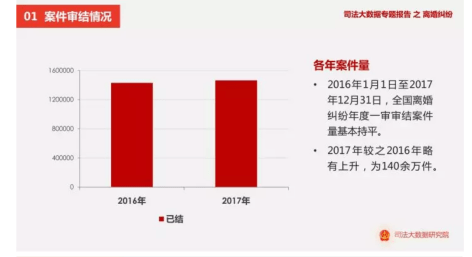
It shows that in 2017, first instance contested divorces exceeded 1,400,00, somewhat more than in 2016.

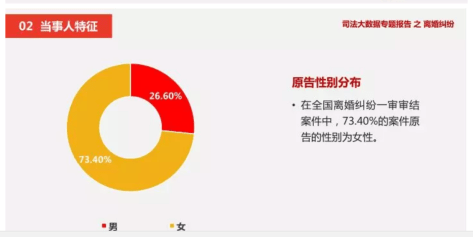
Screen Shot 2018-04-23 at 5.32.27 PMAlmost three quarters (73%)of the plaintiffs in first instance divorce cases were women.Screen Shot 2018-04-23 at 5.39.20 PM
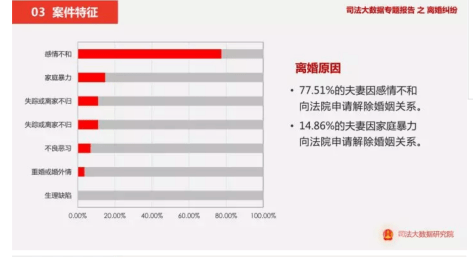
Mostly couples sued for divorce on the basis that they no longer were compatible, and in about 15% of cases domestic violence was alleged.

Screen Shot 2018-04-23 at 5.43.42 PM.png

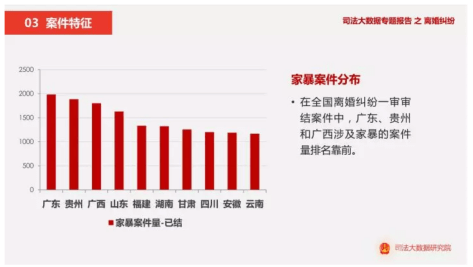
Domestic violence was alleged most often in Guangdong, Guizhou and Guangxi.

Screen Shot 2018-04-23 at 5.44.00 PM.png

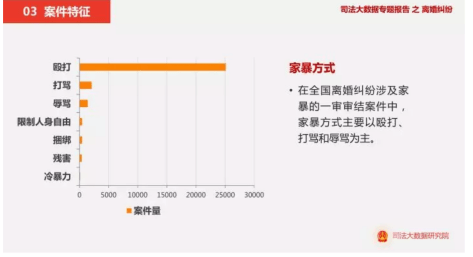
Most of the domestic violence alleged was physical violence.Screen Shot 2018-04-23 at 5.44.43 PM

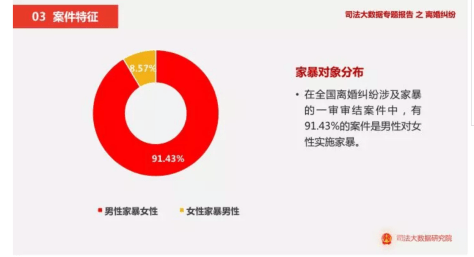
In the first instance divorce cases, 91% of the domestic violence was committed by men on women.

Screen Shot 2018-04-24 at 6.43.33 PM

Welaw Monitor (微律观察) #2

I am traveling at the moment, so my time to review articles published on Wechat is limited.  But below are some links of interest.

Screen Shot 2017-06-17 at 10.04.02 AM
Huazhen (Flower Town) emotional counseling

Oldies but goodies

Several prominent media sources, the South China Morning Post among them, are running articles on China’s clean-up of the financial sector, this one pointing to the government’s focus on privately owned insurance companies.

But those reading Wechat would have known that several years ago, China’s legal analysts had been writing  articles such as “China’s private entrepreneurs are all on their way to jail  or China’s businesspeople are either in jail or on their way to jail. 

China’s Good Samaritan case Peng Yu back in the news-  a backgrounder plus-retired SPC judge Cai Xiaoxue criticizes as does former judge & Peking U Professor Fu Yulin.

Detention Center Law draft

The Ministry of Public Security (MPS) has recently issued its draft Detention Center Law for public comments (link to Chinalawtranslate.com’s translation.  The draft has caused a great deal of comment within China and those concerned about the treatment of fellow human beings in criminal detention in China should read these articles:

The MPS is drafting the Detention Center Law, but the entire legal world is opposed

10 years of calls for separating detention from criminal investigation

Professor Chen Ruihua, defects of the detention system and how it should be reformed

Professor Chen Ruihua–the detention centers should be transferred to the justice authorities

Commercial law

China’s distraught buy online counseling packages, but does China’s consumer protection legislation protect them if there are no standards for counseling?

Party discipline

A Cangzhou court president is under investigation. Is it connected to the strip search of a woman lawyer?

In CCDI hearing procedures, will evidence provided by the accused be considered?  The answer is, the scope is limited

Criminal law

Three SPC judges (likely to have been on the drafting team) unpack the asset recovery regulations (discussed in this January blogpost). It shows they looked to foreign legislation when doing so;

 20 years of bribery prosecutions, with 9 acquittals

SPC on anti-drug day, with white paper and 10 typical cases

Is it rape if the sexual contact comes after the coercion?

Supervision Commission

The first father’s day after being transferred to the Supervision Commission

Labor law

Does “remote working” in China mean the place of employment has changed?

Don’t make these 10 mistakes when terminating employees

Family law issues & property

Leta Hong Fincher’s book Leftover Women discusses the Marriage Law interpretation & home purchases.  This Wechat post sets out a chart with various scenarios related to marriage & home purchase--a very handy reference.

Bankruptcy

10 typical bankruptcy cases from Suqian, Jiangsu Province, including some real estate companies

Chongqing courts borrow concepts of personal bankruptcy from abroad when dealing with private (shadow) borrowing cases

The many inadequacies in China’s non-performing asset legislation

Judiciary

A review of the Party’s work at the SPC since the 18th Party Congress


Welaw Monitor (微律观察) #1

I am tweaking the type of content on the blog, cutting down on the long analytical blogposts.   I will provide links to reports and analysis on court and other legal matters on Wechat. I am concentrating on writing a book and some other related writing and editing projects.

It remains my hope that some followers with the financial wherewithal to do so will consider supporting (in some fashion) the blogs that are enabling the English speaking and reading public to perceive (through translation or bite-sized analysis) the “elephant” that is the Chinese legal system, among them Chinalawtranslate.com and this blog.

Commercial law

14 situations where the corporate veil can be pierced

Criminal law

Public security v. SPC & SPP on what is prostitution–does that include other types of sexual services?

SPC vice president Li Shaoping on drug crimes–relevant sections of Criminal Law should be amended, better evidentiary rules needed for drug crimes, & death penalty standards need to be improved

Hebei lawyer’s collateral appeal statement, alleges torture during residential surveillance, procedural errors (part of China’s innocence project

China’s financial crime trading rules are unclear

Defendant changed his story on appeal but the appeal court ruled he was the killer

25 criminal law case summaries from People’s Justice magazine 

Criminal procedure law

public security does not want the procuratorate supervisors in police stations

A corrupt official’s polygraph problems

Supervision Commission

Its power should be caged

Beijing supervision authorities take someone into custody, will shuanggui be abolished?

Party discipline

On confession writing

10 No nos for Party members using Wechat

Administrative litigation law

SPC issues 10 typical administrative cases, including one involving the Children’s Investment Fund

Those disputing compensation for expropriation of rural land must first apply for a ruling–land is now part of the Harbin Economic and Technical Zone (unpacking of  case #46 of #2 Circuit Court’s case summaries)

Labor law

Important study by the Guangzhou Intermediate Court on labor disputes 2014-16, with many insights & a section devoted to sex discrimination issues

Don’t make these 10 mistakes when terminating employees

Family law

Status report on family court reforms (& difficult issues for judges)

 Why it’s so hard to deal with school bullying in China

How juvenile justice should be improved (the semi-official view)

Judiciary

300 cases in 100 days–a team of young judges & expedited criminal cases

Environmental Law

Procuratorate has brought 79 public interest law suits in Yunnan (press report)

Bankruptcy

Why bankruptcy is so difficult and what needs to improve

Lawyers

 legal qualification system needs changing, the profession needs those with non-law undergraduate training


Supreme People’s Court & big data

On 22 December, the Supreme People’s Court (SPC) posted four big data reports drafted jointly by its Information Center and the Judicial Cases Research Center (affiliated with the National Judicial College).

Screen Shot 2016-12-27 at 7.01.33 AM.png

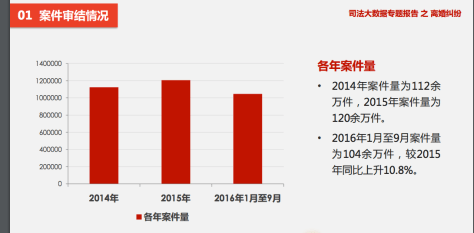
The bar chart above, from the divorce report, shows the number of divorce cases heard in the courts in 2014-September, 2016, stating that the 2016 cases have increased almost 11% over the same time the year before. A subsequent chart shows that domestic violence as the cause for divorce in 27.8% of cases.screen-shot-2016-12-27-at-7-11-32-am

The reports appear to be products of the recently established SPC big data company.  The analysis in the reports is restricted to bullet points, rather the more detailed analytical reports that are found on the websites/Wechat public accounts of courts and lawyers.  (Suggestion to (any) readers from the SPC–  translations of these reports would be a useful addition to the English version of the SPC’s website).

Anyone looking for more than current statistics and basic analysis is advised to search for more detailed analysis done by law firms, local courts, some of the legal media companies, and some of the other divisions of the SPC.  On the topic of divorce, for example, an SPC judge published this analysis earlier this year, generally considered to be the most authoritative summary of the issues in Chinese divorce law.

The 4th Five Year Court Reform Plan (Court Reform Plan) flagged the SPC’s big data company and the stress that the SPC is placing on big data:

22. Deepen reforms of judicial statistics.Reform mechanisms for judicial statistics with the idea of “big data, big picture, and big service” as a guide; make a system of standards for judicial statistics that has scientific classifications and complete information, gradually building a model for analysis of empirical evidence that complies with the reality of judicial practice and judicial rules, and establish a national archive of court judgment opinions and a national center for big data on judicial information. (translation from @Chinalawtranslate)

The Court Reform Plan signals that the stress is on judicial statistics and using big data for internal use rather than for public access, as “complete information” is not provided to the public, with death penalty statistics the best-known example. Although judicial transparency is greater before (especially for those of us with a historical perspective), from time to time SPC media sources reiterate that judicial personnel are required to keep state secrets (as the Judges Law and other legislation require).

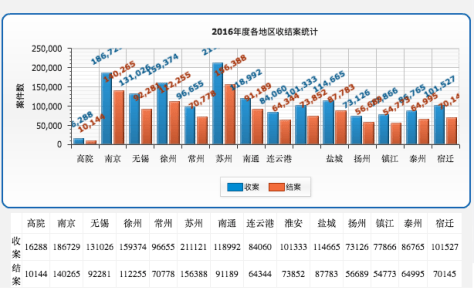
At the moment, transparency of judicial statistics and analysis varies greatly across provinces. Jiangsu Province’s high court, for example, has judicial statistics on its homepage:screen-shot-2016-12-26-at-9-27-32-pm

Many law firms publish big data analysis of specific types of cases in their area of practice, such as this analysis of credit card fraud cases in Guangzhou (22% of the defendants were represented by counsel) and drug cases in Guangzhou (less than 15% represented by counsel). An analysis of drug cases in Guangdong (Jieyang, a center for the  methamphetamine business) by the local court, has important insights into the routinization of criminal justice, the inadequacy of court judgments, and the way that the trial itself and the role of defense counsel (if hired) is marginalized.

Big data analyses can be found in a range of substantive areas, ranging from finance disputes to construction disputes, some by law firms and others by local courts.  My fellow blogger, Mark Cohen, recently highlighted the data analysis provided by IPHouse, a firm started by a former SIPO Commissioner.  They are useful to the lawyer/in-house counsel planning or considering litigation strategy, as well as for policy-makers and academics. Each provides a glimpse of how (and sometimes why)  the Chinese legal system works as it does.


Supreme People’s Court rushes to achieve year end targets

imgres-4The rush towards year end in the Supreme People’s Court (SPC), as in the business world, means a flurry of announcements of important developments, to ensure that the SPC meets its own performance targets.  Among the recent announcements are:

  • reform of the maritime courts, to make them internationally influential (this has both political and legal implications, blogpost to come);
  • approval by central Party authorities of the third round of judicial reform pilots, and the holding of a large scale meeting of representatives from the Leading Group on Judicial Reform with the SPC and Supreme People’s Procuratorate (SPP),  on the focus (personnel reforms) and roll out of these projects.  Jiang Wei,deputy director of the Office of the Central Leading Group for Judicial Reform, spoke along with his SPC and SPP counterparts.  Political legal committee secretaries from the pilot areas attended, along with court and procuratorate officials.
  • Reform of the family court system, announced at a conference held in Guangzhou, attended by Justice Du Wanhua, highlighting that the rush of judges to meet performance targets (closing cases) Iamong other factors) has had a negative effect on children, elderly, disabled, and women.  The SPC likely published typical/model family law cases in November (discussed in this  blogpost)  because pulling together those cases was part of the preparations for the Guangzhou conference;
  • progress report and further plans on improving judicial assistance (separate but related to legal assistance), with the release  of the2014  multi-agency document (Central Political Legal Committee, SPC, SPP, Ministry of Finance, Ministry of Public Security, Ministry of Justice), stating that the central government had allocated 700 million RMB for judicial assistance and local governments  1.7 billion RMB, targeted at financial assistance for victims of crimes and others, with funds allocated to about 80,000 in 2014, (certainly a fraction of what is needed)
  • long pronouncement by Justice Shen Deyong on the “standardization” of the courts, citing the important status and important role of the judiciary in the governance of the country, but the growing contradiction between the needs of the people and  judicial resources and judicial capacity, decrying the lack of “top level design,” and calling for the implementation of related reforms.

This list will be supplemented later this month, as further announcements are made.


Some typical Chinese family law cases in 2015

dd9a8f4c1a39797ea5a7e4843c8a2724 (1)Each month (as highlighted this earlier blogpost), the Supreme People’s Court (SPC) issues typical cases at a press conference. In November, family law cases were the center of attention for a change and were briefly reported by the South China Morning Post.

This month’s typical cases were selected from the Beijing, Shandong, and Henan courts and are aimed at educating the general public rather than legal professionals.  The cases, statistics, and comments from the Supreme People’s judiciary  give a glimpse into the social, economic, and cultural changes that have affected Chinese families over the past 20 years and reflect the differences between rural and big city life.

Statistics

Judicial statistics is one of the areas slated for reform by the Court, which has the potential to improve (or not) the situation for analysts of the Chinese court system.

  • 4,000,000 family law cases have been heard in the past year and 10 months. President Zhou Qiang reported earlier this year that  1,619,000 family law cases were heard in 2014, accounting for about 30% of civil cases, which would mean that over 2 million cases had been heard in the first 10 months of 2015 (assuming the cases are classified the same way in both years).
  • 124981 family law cases have been heard in the Shandong courts this year, constituting about 24% of all civil cases.
  • In the Beijing courts, 38, 619 first instance family law cases were heard in 2014.

Issues for Chinese judges

The press release hinted at some of the difficult issues facing Chinese family law judges nationally, which are many of the same facing their counterparts in Shenzhen:

  • Division of property when spouses divorce, which means both division of family home(s) and family business(es).  Parents often provide some or all of the funds for the home, before marriage, and the controversial rule set out in the #3 Marriage Law Interpretation
  • Child custody;
  • Divorce after a second marriage.

Divorcing spouses are increasingly antagonistic, making it difficult for judges to mediate a settlement, which is the preferred resolution for Chinese judges.

Summaries of some of the 30 typical cases

Must engagement gifts be returned? A case from a rural court in Shandong

Zhang and Zhao were introduced by Zheng, and became engaged. Zhang gave Zhao 40,000 RMB cash, four rings, and other gifts as betrothal gifts (彩礼).  The couple did not marry, and Zhao refused to return the cash and gifts. Zhang sued in the Jining District Court.  At trial, Zhao returned the 4 rings.  The Jining Court ordered Zhao to return the cash but not the gifts.

The SPC commentary noted that although the cash and other items are in form a gift, the legal consequences are different, and according to the #2 Interpretation of the Marriage Law, the gifts must be returned. Article 10 (1) of that interpretation addresses this situation: if the court finds in pleadings a demand for the return of the betrothal gifts given to the other party according to the traditional practices because the parties fail to register their marriage, the people’s court shall uphold the demand.

Concealing property from ex-spouse (Beijing)

Sun and Li divorced in 2004.  The arrangements the couple made were that the wife Li would have custody of the child, the formerly state-owned housing would belong to the wife, and the business, cars, etc. would belong to the husband, who would provide alimony and child support.  In the process of demanding child support from Sun in 2014, Li discovered that Sun had bought property during the marriage, but had concealed that fact from her. She went to court to demand that ownership of the apartment be transferred to her name. Sun said that the apartment was bought when the couple was living apart, he had told her, the divorce settlement provided that the business, cars, etc. belonged to the husband and besides the statute of limitations had lapsed years ago.

The Changping District court decided that because the apartment had been bought during the marriage, it was joint marital property and Sun could not provide credible evidence that Li knew of the property during the marriage.  Therefore the statute of limitations argument failed. The court decided that ownership of the apartment should remain with Sun, but that Li was entitled to half of its market value, or 1,400,000 RMB.  The couple appealed to the #2 Beijing Intermediate Court which upheld the lower court.

The SPC commented that because traditional attitudes of marriage for life have changed, there are more and more divorce cases.  In this case,  because Sun concealed the purchase of the apartment, under Article 47 of the Marriage Law that when the court partitions the property, it could allocate less or no part to Sun.

Does the non-custodial parent of a child born to an unmarried couple have visitation rights? (case from a rural Henan court)

Wang and Chai were introduced and subsequently had a wedding celebration according to local customs, but never formally registered their marriage. They lived together and Chai gave birth to little Wang.  Thereafter the couple separated.  The couple went to the Xun County court to resolve their disagreements about the child.  The court decided that Chai should have custody of the child, until the child is old enough to express her preferences.  A month later Wang went back to court to demand visitation rights.

The Xun County court relied on Art. 38 of the Marriage Law, concerning visitation rights of the non-custodial parent in divorce to decide that the father could visit the child the first Sunday of each month from 9 am to 5 pm.

The SPC commented that visitation rights are a basic legal right of a non-custodial parent to have contact, visit, and live together for short periods, but visitation must be done in a way that does not affect the normal life and studies of the child.

Do the elderly have the right to support from their children? (a Beijing case)

Seventy seven year old Mrs. Liu was in poor health and in financial difficulties.  She sued her two children in Beijing’s Xicheng District Court to require them to provide her support in the amount of 900 RMB monthly.  The daughter said she had no income and the son said his after- tax income was only 6500 RMB and refused.  The court ordered the son to pay 800 RMB per month and the daughter 500 RMB (on the grounds that based on her work history she must have income).

The SPC commented that grown children have the legal duty to support their parents [under the Law on the Protection of the Rights and Interests of the Elderly], but the amount will depend on the elderly person’s cost of living, the health of the elderly person, and life style, and if the elderly person has several persons to look to, the amounts each will need to pay in support will depend on each person’s financial situation.