Tag Archives: NPC Work Report

What’s New in the 2024 Supreme People’s Court report to the National People’s Congress?

Susan Finder and Zhu Xinyue

I. Overview of the 2023 SPC Work Report

Supreme People’s Court (SPC) Work Reports to the National People’s Congress (NPC) appear to the casual reader as much of a muchness. Like all official work reports, it provides a perfectly positioned overview of the previous year’s accomplishments and a high-level summary of 2024 work priorities.

To the attentive reader,  the March 2024 SPC Work Report to the NPC  (2024 SPC Work Report or Report) signals something new and different compared to its predecessor reports.  This much-delayed blogpost flags only some of what is new.  I have italicized many of my comments. (Please contact me if I have not mentioned your area of interest.)

The 2024 SPC Work Report signals that since President Zhang Jun took office, he has vigorously implemented new policies and set new priorities. Accordingly, the Report highlights Zhang Jun era keywords. Conveniently for the reader, they are contained in this single report.  A single phrase or sentence in this report links to one or more SPC documents, initiatives, and guiding/typical cases.

As in previous years, local court cases or innovations are considered accomplishments and heralded on local court WeChat accounts. Last year’s report, in contrast, was President Zhou Qiang’s last and served as an official summary of his accomplishments over the previous five years.

Several phrases in the first paragraph of  the 2024 Work Report (bolded) signal the new themes in this report:

… by focusing on the working theme of “justice and efficiency”, insisting on active justice, deepening and realizing service for the overall situation and justice for the people, we have made solid progress in promoting the modernization of judicial work聚焦“公正与效率”工作主题,坚持能动司法,做深做实为大局服务、为人民司法,推动审判工作现代化迈出坚实步伐…

As the regular reader of this blog could predict, the word “active ( 能动)” and the watchword or keyword  “active justice (能动司法)  can be found throughout the report.

Some statistics

The initial section of the 2024 SPC  Work Report provides overall statistics from the SPC and the entire court system.  The SPC accepted 21,081 cases and concluded 17,855 cases, representing a year-on-year increase of 54.6% and 29.5%, respectively. These numbers reflect the end of the pilot project to reorient the four levels of the Chinese courts and the corresponding increase in retrial applications made to the SPC. It can be anticipated that those numbers will be even higher in the 2024 calendar year. As I have previously written, most of the civil and administrative retrial applications to the SPC are unsuccessful, but it requires SPC judicial time to review them. For Americans, a useful but not entirely appropriate analogy is the petition for certiorari to the Supreme Court.

The report states that courts at all levels accepted 45.574 million cases and concluded 45.268 million cases, with 15.6% and 13.4% yearly increases, respectively.  Most cases in Chinese courts are civil/commercial (60.05%) or enforcement cases (29.34%).  I would be grateful if a reader could provide comparative statistics (from other jurisdictions) on enforcement.  My reaction is that the proportion of enforcement cases is relatively large. See the chart below:

These numbers likely are linked to the poor economy, which from comments by friends in the court system, means an increase in business disputes and business-related crime.  These increases are evident despite policies to reduce the number of disputes entering the courts and resolve cases filed before they reach the hearing stage. Those policies include: resolving cases at their source, resolving others through mediation, (now promoted under the keyword/title of Fengqiao Experience),  and promoting arbitration.  Some judges have remarked privately that it also has to do with the low cost of litigation.

II.  Serve the overall situation effectively and ensure high-quality development and high-level security with active justice

The title of this section combines several watchwords/keywords 提法/关键词, robustly signaling that President Zhang Jun led the drafting of this report.

The ten subsections in this section must be understood as ones that were priority areas for the Chinese courts in 2023. I have selected only a few of the subsections out of the ten:

Assisting the Strengthening of the Construction of the Financial Rule of Law

This subsection in the 2024 SPC Work Report is positioned immediately after the sections on safeguarding national security and social stability, promoting public security governance, and fighting corruption, reflecting its priorities in the SPC’s work. Although both the 2023 and 2024 SPC Work Reports address judicial support for finance, the 2024 SPC Work Report emphasizes strict regulatory enforcement in the banking and securities sectors, both subsumed under the category“financial trials.”

The Chinese courts concluded 3.032 million financial cases, an 8% year-on-year increase, and heard 861 money-laundering cases, involving 1,019 individuals, with increases of 23.5% and 22.2%, respectively. The money-laundering cases are likely linked to the ongoing multi-institutional anti-money-laundering campaign of which the SPC is a participating institution. The Report stresses the importance of “compliance in financial activities, strict punishment for senior management illegalities (高管违法要严罚), and holding intermediaries accountable for negligence.” The report illustrated the last two policies by mentioning a securities false statement case in which senior managers were found liable and an intermediary bore 20% joint and several liability.  Given those signals, it will not be surprising that the Shanghai, Beijing, and Chengdu-Chongqing Financial Courts have made analogous judgments in 2023 and 2024. The allocation of liability in these cases is a current issue. The Report also mentioned two financial law-related judicial suggestions that the SPC issued, rarely, if ever mentioned in the past, linked to last year’s judicial interpretation on judicial suggestions/advice (司法建议).

 Promoting the Development and Growth of the Private Economy in Accordance with Law

This subsection, new in comparison with last year’s report, links to the July 2023 Central Committee and State Council document on promoting the private economy,  focusing on measures contained in a September 2023  policy document and typical cases.  It includes a paragraph discussing the measures in that policy document and highlighting that the courts heard 42 cases of property rights-related wrongful convictions.  The SPC issued 12 typical retrial  cases (civil, criminal, and administrative) involving the rights of private enterprises and private entrepreneurs. Cases of bribery and embezzlement involving non-state employees amounted to 6,779, involving 8,124 individuals, with a year-on-year increase of 26.6%. Although the SPC intends to enhance legal certainty, boosting business confidence and stabilizing expectations, other sources report on profit-oriented law enforcement at the local level, often leading to the jailing of private entrepreneurs and the confiscation of their assets.

III   Safeguarding and Enhancing People’s Livelihood through  Active Justice

The section title above replaces “The Path of Judicial Services for the People With Chinese Characteristics” in the 2023 report.

New themes introduced include “Supporting Guaranteed Delivery of Commercial Housing and Stable Livelihoods,” to deal with issues related to the ongoing crisis involving real estate developers.

  • Safeguarding Housing Rights: The financial collapse of many real estate developers has meant disputes along the real estate development supply chain. A 2023 SPC judicial interpretation prioritizes homebuyer rights, clarifying the order of claim repayment in disputes over unsuccessful delivery of sold commercial housing.
  • Strengthening Housing Pre-sale Supervision: The SPC issued Judicial Suggestion No. 1 to promote contract online signing and pre-registration, enhance pre-sale funds supervision for commercial housing, strengthen pre-sale information inquiries, and warn about home buying risks.  [These suggestions do not seem to have been made public.]
  • Restructuring the Financial Chain of Homebuying: In response to a financial chain rupture of a private real estate enterprise in Hunan Province, a court-facilitated restructuring revitalized 16.8 billion yuan, resolving housing delivery issues for 16,000 households by facilitating the merger and restructuring of 13 related companies.  This type of case was mentioned in a typical case that the SPC issued last year.

IV. Promoting National and Social Governance through Active Justice Which Practically Grasps the Front End and Treats the Disease Before it’s too Late 

As could be anticipated, this section emphasizes judicial suggestions, among other matters.

Deepening the Effective Use of Judicial Suggestions: The Report emphasized judicial suggestions that fill legal gaps and governance deficiencies, mentioning the regulations on comprehensive governance-oriented judicial suggestions, discussed here. This is yet another initiative emphasized by President Zhang Jun. The SPC led with Judicial Suggestions No. 1 to No. 5, and lower courts issued 9,429 suggestions.

V. Ensuring Judicial Justice through Actively Performing Duties 

This section underscores Party leadership within the judicial system, with the primacy of the Party’s political construction. It promotes “strengthening Party nature, emphasizing practical work, and achieving new accomplishments” (“强党性、重实践、建新功”) through solid “learning of ideology” (扎扎实实“学思想”) and outlines the result of “deepening investigation and research and solidifying thematic education”( 大兴调查研究,让主题教育走深走实) and implementing “investigation promoting case handling, and case handling also being investigation” (“调研促进办案、办案也是调研”).

The Report indirectly addresses public concerns about the China Judgements Online database by emphasizing efforts to improve transparency in judicial proceedings (裁判文书上网) and the “People’s Court Case Database”,  such as posting 2.165 million documents online in 2023, with a year-on-year increase of 111.6%, covering a wider range of trial areas and case types, with the SPC and higher courts posting 35,000 documents, a 370% increase. The 2024 Report details measures for the uniform application of legal standards, including 15 judicial interpretations, 13 guiding cases, and 610 typical cases. As discussed here, the “People’s Court Case Database” contains SPC-approved cases, and judges must search this database.   “Legal Response Network (法答网)” (analysis to come) launched on July 1, 2023, facilitates communication among courts and has received 280,000 legal application inquiries, answering 230,000. Insights from this platform have led to the revision or drafting of 27 judicial interpretations and regulatory documents.

More specific selected statistics

Bankruptcy cases: 29,000 bankruptcy cases were concluded, marking a year-on-year increase of 68.8%. Additionally, 1,485 bankruptcy restructuring and settlement cases were concluded. Local court white papers on bankruptcy (link is to the Shanghai court white paper) are an undervalued source of insights on more specific bankruptcy trends, such as the type of companies going bankrupt and the length the companies have been in business. One law firm report on bankruptcy flagged missingness on the SPC’s bankruptcy platform and the rate at which local courts accepted bankruptcy cases.

Foreign-related civil and commercial cases: 24,000 foreign-related civil and commercial cases and 16,000 maritime cases were concluded, representing annual increases of 3.6% and 5.3%. The average trial time decreases by nearly 10 days. 16,000 cases of judicial review of commercial arbitration were concluded, reflecting a 5% year-on-year increase. During this period, 552 arbitration awards were revoked, remaining stable year-on-year, while 69 foreign arbitration awards were recognized and enforced, representing a 16.9% increase. This section mentions a Shanghai Financial Court case in which the court stopped payment on a demand guarantee, although in fact most of such lawsuits are unsuccessful.

Deepening the diversification of dispute resolution: Since 2013, court cases have increased by an average annual rate of 13%, doubling over 10 years. Judges handled an average of 357 cases annually in 2023, up from 187 in 2017.  The courts successfully mediated 11.998 million disputes through people’s mediation, administrative mediation, and industry-specific mediation organizations/institutions, representing a 32% increase year-on-year and accounting for 40.2% of the total civil and administrative cases filed.

Fully leveraging the role of scientific evaluation as a “command baton”: The annual case closure rate was adjusted to the closure rate within the trial period, which reached 97.7% last year, a 2 percentage point increase. A special case cleanup initiative concluded 1,914 lawsuits pending for over three years and 2,455 pending cases involving 6,909 individuals, accounting for 81.3% and 86.8%, respectively, of the total cases.  The title of this section is significant. Judges at all levels of courts feel that “command baton.”

VI. 2024 Work Targets

As readers of this blog could anticipate, the 2024 work arrangements of the courts are focused on the modernization of judicial work, active justice, and other 2023 top keywords. The work arrangements listed here are more general than the types of work plans mentioned in my article.  They are intended to signal to the NPC and general public the overall direction of the SPC’s work in the current year. For the most part, the arrangements are expressed in phrases or single sentences.

Criminal cases: Implement the holistic national security concept, severely punish crimes threatening national security and public safety, promote the normalization of crackdowns on gangs and evil [sometimes used against local entrepreneurs], and severely crack down on telecommunications network fraud, cross-border gambling, and corruption, with harsher punishment for bribery crimes. All if not most of these crimes were flagged during January’s annual Central Political-Legal Work Conference.

Intellectual property and digital rights: Strictly protect intellectual property rights and promote their transformation and application, and serve the development of new productive forces. Justice Tao Kaiyuan published an article in People’s Daily in late March explicating the link between the development of new productive forces and the improvement of intellectual property rights protection. Strengthen personal information protection and improve digital rights protection rules. The latter two presumably imply inter-institutional cooperation.

Bankruptcy and Economic Development: Increase work on hearing bankruptcy cases and give full play to “active rescue” and “timely liquidation”. We can expect to see the courts accepting more bankruptcy cases this year. Deepen the compliance reform for companies involved in criminal cases and continue to optimize the growth of the private economy. Properly handle real estate development and affordable housing contract disputes, and actively serve the new model of real estate development (recent Party/state initiative). Strengthen hearing and enforcement work in “agriculture, rural areas and farmers” (“三农”) to support rural revitalization. The latter is consistent with previous SPC policy.

Ecological and Social Justice: Serve ecological civilization [the environment]  and green and low-carbon development in accordance with the law. Strengthen the protection of the rights of women, children, the elderly, disabled people, etc. (It is unclear whether that will include a better legal infrastructure for sexual harassment cases.) Strengthen administrative trials, supervise and support administrative agencies to administer according to law and strictly enforce the law. Promote judicial advice/suggestions and national and social governance.

Court administration.  Improve the quality and efficiency of court hearings and accelerate the modernization of trial work. Deepen the comprehensive supporting reform of the judicial system and formulate the “Sixth Five-Year Plan” reform outline for the people’s courts. [It is unclear when it will be issued] Comprehensively and accurately implement the judicial responsibility/accountability system (see related documents here), and further implement  “supervision/”review” system  (阅核制) by senior court leaders. That system is one of President Zhang Jun’s initiatives.  Improve the hierarchical selection system for judges and promote the coordinated use of posts and establishments across administrative regions. This seems to be a reform to share judicial headcount. Deepen the “three-in-one” reform of criminal, civil, and administrative cases in intellectual property, environmental resources, and juvenile matters.

Foreign-related and Grassroots Courts: Enhance the foreign-related judicial hearing system (consistent with my observations about the importance of foreign-related matters) and efficiency. Do a good job of “replying to letters and visits“, and strengthen the management of the source of letters and visits.

Grassroots Courts:  Practice the “Fengqiao Experience” in the new era, promote resolving cases at source (诉源治理), provide practical guidance for mediation, and vigorously create “Fengqiao Style People’s Tribunals.” The SPC has issued six groups of related typical cases and the Chinese court media has begun to report on the creation of such people’s tribunals. The Report mentions strengthening relatively weak grassroots courts (相对薄弱基层法院), another initiative by President Zhang Jun. Under this initiative (full text of measures unavailable), 106 relatively weak local courts are targeted for additional support. The SPC has set quotas for each province, as well as a goal of removal from the list within one to three years.

Supervision, Guidance and Digital Courts: Strengthen supervision and guidance (stressed by President Zhang Jun, as mentioned above), deepen trial management, use the “People’s Courts Case Database” and improve the “Legal Response Network 法答网”. [More on this in a later blogpost, but it appears to be an updated version of letters to the 人民司法 (People’s Justice) mailbox)]. Develop a nationwide court “one network” and digital courts (数字法院) to boost efficiency. Note that the term “smart courts” (智慧法院), the subject of books, articles, and PhD dissertations in Chinese and English,  appears to have been dropped.

Court Supervision and Integrity: The final section for the most part repeats principles seen previously, such as improving political, professional, and professional ethical qualities. It flags improving the training of professional trial talents in foreign-related, intellectual property, and other fields and stresses the use of personnel assessment of all court staff.

Finally, I conclude with this extended quotation from the Report:

 the new development of the work of the people’s courts in the new era and new journey is fundamentally due to the leadership of General Secretary Xi Jinping and the scientific guidance of Xi Jinping Thought on Socialism with Chinese Characteristics for a New Era. It has benefited from the effective supervision of the National People’s Congress and its Standing Committee, the strong support of the State Council, the democratic supervision of the National Committee of the Chinese People’s Political Consultative Conference, the supervision of the National Supervision Commission and the Supreme People’s Procuratorate, the democratic supervision and support of various democratic parties, the Federation of Industry and Commerce, people’s organizations and non-party personages, and the enthusiastic concern, support and help of local party and government organs at all levels, deputies to the National People’s Congress, members of the National Committee of the Chinese People’s Political Consultative Conference, all sectors of society and the general public.

________________________________________________________

Many thanks to an anonymous peer reviewer!

References to “I, me or mine” are to Susan Finder rather than Zhu Xinyue. Finally, I’d like to express my appreciation to followers of this blog for their patience.


Happy Niu 🐂Year!


Happy Niu 🐂Year to all blog followers and readers! Best wishes to all for good health, success in work and study, and all else!

In recent weeks I have been focusing on several longer pieces of writing and am still in “focus mode.”

While most of the Supreme People’s Court  (SPC) has been taking a break, based on previous year’s reports, it is likely that the team of people working on drafting President Zhou Qiang’s speech to the National People’s Congress (NPC) are hard at work.  I surmise that they will draw on January’s Central Political-Legal annual work conference, where responsibilities for implementing this year’s major tasks were allocated, and guidance from President Xi was transmitted. At that time, the Party leadership heard work reports from the SPC’s (and Supreme People’s Procuratorate’s) Party Group, so it seems likely that the report to the NPC will draw on that report as well.

Among the content that I expect to be included in the report is:

  • successful transition to the Civil Code, including review  of old judicial interpretations (and other judicial normative documents), canceling and amending old ones;
  • successes in meeting the challenges that Covid-19 meant for the courts, including the increased use of online proceedings;
  • smart courts and informatization;
  • accomplishments of the Supreme People’s Court’s Intellectual Property Court, including its first anti-suit injunction;
  • the issuance, for the first time, of reports on the judicial review of arbitration in 2019 and judicial assistance in civil and commercial matters between the Mainland and Hong Kong.  The full text of the two reports has not yet been released to the public, so I surmise that they will be released during the NPC meeting;
  • In the area of criminal law, likely the effective use of criminal proceedings in the battle against Covid-19;
  • successes in the saohei (organized crime) campaign;
  • successes in the area of environmental law, such as the recent signing of a framework agreement between the SPC and the leading small group on the protection of the Yellow River and the June, 2020 policy document on providing judicial services and guarantees to the protection and high quality development of the Yellow River;
  • furthering of socialist core values, such as the guiding opinion issued on 18 February on integrating those values into judgments (最高人民法院印发《关于深入推进社会主义核心价值观融入裁判文书释法说理的指导意见) and
  • judicial reforms such as the recently approved establishment of the Beijing Financial Court (the Shanghai Financial Court has been very busy since it was established) and the piloting of reforms to separate simple and complicated cases (the SPC recently submitted a midterm report to the NPC Standing Committee on the pilots).

We’ll see next month how accurate the above guesses are. In the meantime, additions or corrections are welcome.

______________________________________

The SPC New Year’s greetings are ©the SPC, found in this short video 

Signals in Supreme People’s Court President Zhou Qiang’s 2018 report to NPC (part 2)

Screen Shot 2018-05-10 at 12.54.58 PMFor those with the ability (or at least the patience) to decode Supreme People’s Court (SPC) President Zhou Qiang’s March, 2018 report to the National People’s Congress, it provides insights into the Chinese courts, economy, and society, and of course politics.  This blogpost will address selected aspects of the second and third parts of the report because of competing time demands.

Report drafting

To most of the world, President Zhou Qiang’s reports to the National People’s Congress (NPC) differ little from year to year.  However to President Zhou Qiang and the team of people tasked with preparing a draft that would not be thrown back in their faces, the challenges in 2018 were more formidable than previously.  This year’s report needed to highlight the SPC’s achievements of the last five years, signal that its work in the next year is harmonized with the post-19th Party Congress New Era, and hit the right notes with NPC delegates, who have in the past voted against court reports in significant numbers.

According to this report, the drafting group, which started work in late October (after the 19th Party Congress),  and as anyone familiar with China today would expect, communicated through Wechat. The high stakes report meant that President Zhou Qiang summoned members for drafting sessions during the Chinese new year holiday. The group submitted 37 drafts to President Zhou Qiang and other senior leaders, and as this blog reported in previous years on this blog, senior court leaders traveled the country to seek the views of NPC delegates and many others.

This means (as I have written before, and I have discussed in greater detail in a forthcoming paper) that the statistics have been specially selected.

The summary below (part 2) is not comprehensive but provides some highlights. It signals that the work of the SPC is perfectly synchronized with national policy.

Judicial protection of human rights

The second section of the speech touched on correction and prevention of “mistaken cases,” a topic mentioned in previous NPC reports, and still an ongoing issue.  Over the past five years,  6747 criminal cases have been reopened and retried. Among the measures the report mentions is:

  • policy documents on preventing mistaken cases;
  • the courts implementing principles of evidence-based judgments; (note that China does not yet have detailed criminal evidence rules, but see Judge Yu Tongzhi‘s remarks at a high profile criminal evidence conference on 19-20 May for the latest thinking of the SPC’s criminal divisions)
  • “no conviction in case of doubt;” (most useful discussions of this are behind academic publishers’ paywalls);
  • strictly implementing the death penalty; (as mentioned in earlier blogposts, there have been calls within China to be more transparent on the numbers, but this  decision likely needs top-level clearance);
  • improving legal aid in criminal cases, piloting in some provinces (including Guangdong) full coverage at all levels; [note Art. 21 of these regulations reveal concern about lawyers stirring up troubles, with language similar to Ministry of Justice regulations (不得恶意炒作案件,对案件进行歪曲、有误导性的宣传和评论);

Courts serve economic policy goals

This section highlighted the SPC’s accomplishments in supporting national economic policy goals.  The statistics are all for the past five years. Many of these topics have been previously discussed on this blog:

  1. Commercial cases:  the Chinese courts heard 16,438,000 first instance cases (in the last five years), up almost 54%;
  2. the SPC promoted bankruptcy trials, including developing a national bankruptcy information platform (limited information available–related blogpost here); issued a policy document on transferring cases from enforcement proceedings to bankruptcy; dealt with zombie enterprises by hearing and closing 12,000 bankruptcy cases (over the last five years); issued a company law judicial interpretation; heard and closed 4,106.000 sales tcontracts and 1,320,000 real estate cases.
  3. The SPC served major economic strategies, through issuing 16 measures related to Chinese companies engaging in foreign trade and investment, and the Belt & Road. It established a coordination mechanism for the Beijing, Hebei, and Tianjin courts (blogpost here).  The northeastern courts have provided judicial services to the region’s rejuvenation (see previous blogposts on some of the many legal and social issues); Guangdong, Fujian, etc. courts have provided services to Free Trade Zones;
  4. In the area of finance-related cases, the courts have prevented and resolved financial risk (a concern of the day) by:
  • issuing a policy document on financial cases (post the 2017 Financial Work Conference, on the Monitor’s to-do list),
  • trying and closing 5,030,000 finance-related cases (including insurance, securities, and financial institution loans),
  • trying and closing 7,059,000 private lending cases, 152,000 internet finance cases;
  • struck at illegal fund-raising etc.  (no statistics).  Expect to see more cases in this area in 2018.

4. SPC has improved judicial protection of entrepreneur’s property rights by issuing 17 policy documents (the number may indicate the depth of the problem) (see related blogposts).

5. SPC has supported national innovation policy through issuing an outline on judicial intellectual property (IP) protection, hearing and closing 683,000 IP cases,  working on strategies to deal with the issue for both Chinese and foreign IP holders that in China, IP infringement is low cost but protecting IP rights is high cost, trying the Jordan case and the Huawei v. IDC case.

6.  In the area of environmental protection, the SPC has issued an interpretation on public interest litigation, and concluded 487,000 environmental civil cases, with 11,000 cases of compensation for ecological environmental damages, 1,383 cases of environmental public interest litigation initiated by the procuracy (one of my students is looking into this), and 252 environmental public interest litigation cases were filed by social organizations.

7. In foreign-related cases, the Chinese courts concluded 75,000 foreign-related commercial and civil cases (note they account for a tiny proportion of cases in the Chinese courts).  Although the SPC says that more and more foreign parties have agreed to settle disputes in the Chinese courts, Professor Vivienne Bath’s research has shown that foreign parties are often dragged into the Chinese courts because of principles in Chinese law leading to parallel proceedings.   The protection of “judicial sovereignty” has multiple implications (some explained in the linked article).  This year, after several years of drafting, the SPC has issued a set of three judicial interpretations on the judicial review of arbitration. Supporting the national strategy of increasing its maritime power, the Chinese courts have heard 72,000 maritime first instance cases.  The SPC describes the maritime courts as effectively safeguarding the country’s maritime security and judicial sovereignty.

9. On foreign judicial exchanges, the SPC has handled 15,000 international judicial assistance cases (in fact both Chinese and foreign practitioners complain about how long assistance takes); and the SPC has used international conferences to promote its international role, particularly vis a vis Belt & Road countries.

Signals in Zhou Qiang’s 2017 NPC Report (Part 1)

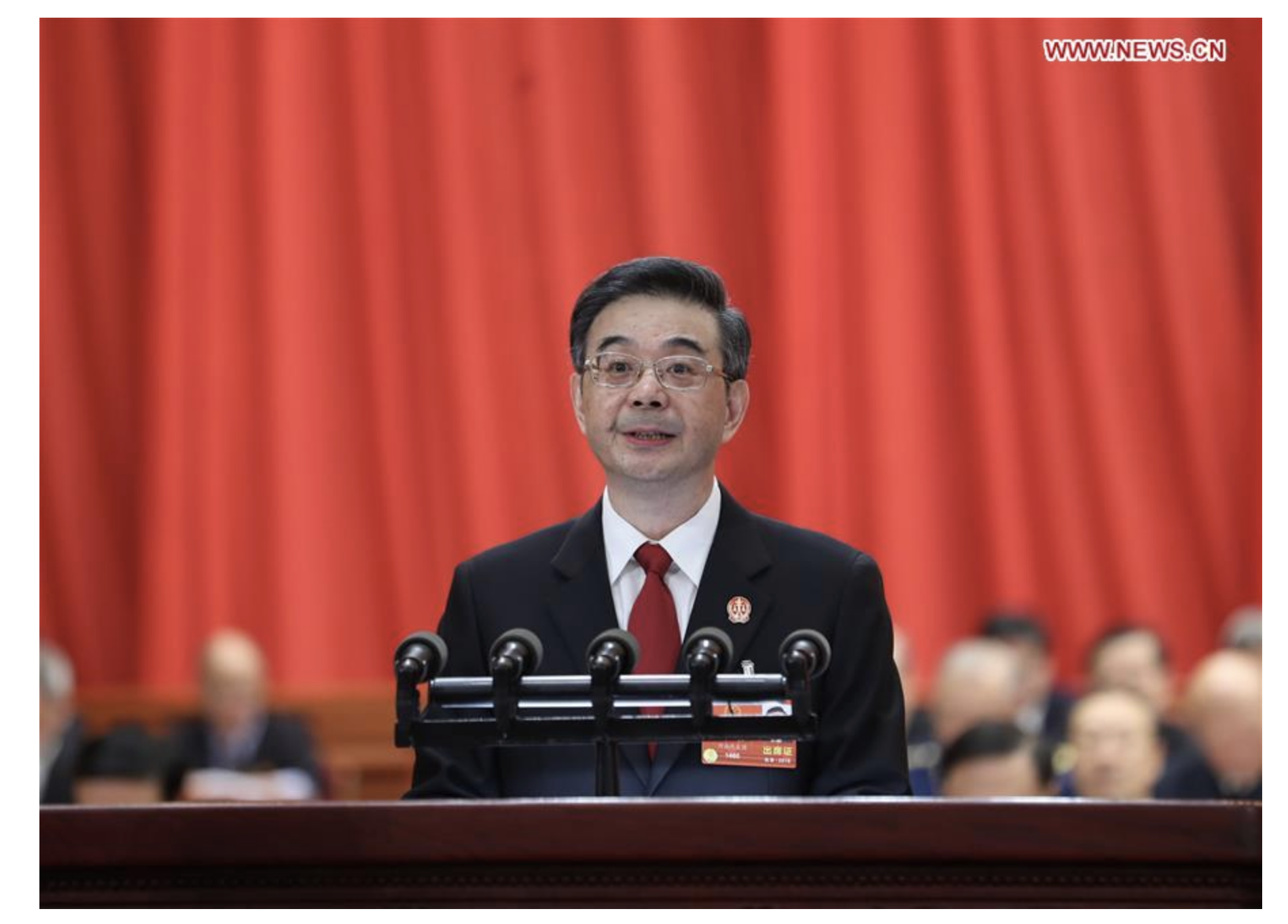
Most people who have commented (outside of China) on Supreme People’s Court (SPC) President Zhou Qiang’s March, 2017 report (on 2016 work) to the National People’s Congress (NPC) didn’t have the patience to read (or listen) much beyond the initial section, which mentions the conviction of Zhou Shifeng as indicating that the courts are doing their part to crack down on state subversion.  It appears to be another in a series of colorless government reports.  But for those with the ability (or at least the patience) to decode this report, it provides insights into the Chinese courts, economy, and society.

imgres-14
©

The report, which went through 34 drafts, is intended to send multiple signals to multiple institutions, particularly the political leadership, in the months before the 19th Party Congress.

According to a report on how the report was drafted, the drafting group (which communicated through a Wechat group to avoid time-consuming bureaucratic procedures) faced the issue of how to summarize the work of the People’s Court in 2016 correctly.  The guidance from President Zhou on the report–it must:

  1. fully embody the upholding of Party leadership, that court functions (审判职) must serve the Party and country’s overall situation;
  2. embody the new spirit of reform, showing the (positive)impact of judicial reform on the courts and show the ordinary people what they have gained;
  3. not avoid the mention of problems, but indicate that they can be resolved through reform.

Underneath these political principles, the operation of a court system with Chinese characteristics is visible.

A partial decoding of the report reveals the points listed below (to be continued in Part 2).

1. Caseload on the rise

The caseload in the Chinese courts continues to rise significantly, at the same time that headcount in the courts is being reduced.  Diversified dispute resolution (the jargon outside of China is alternative dispute resolution) is being stressed.

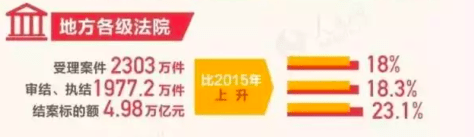
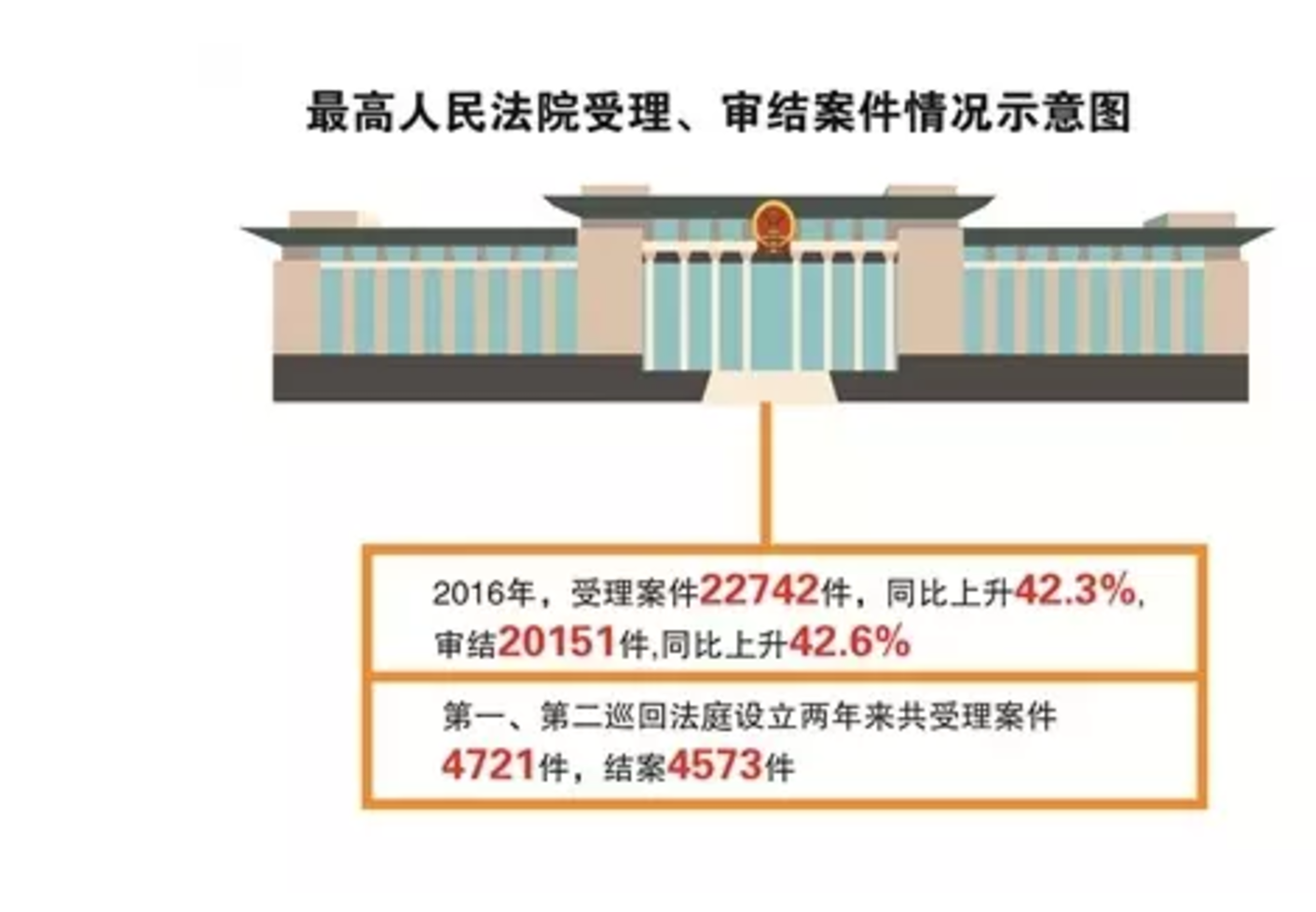
  • SPC itself is dealing with a massive increase in its cases, 42.6% higher than 2016, and that number was significantly higher than 2015.

    Screen Shot 2017-03-16 at 4.07.25 PM.png
    2016, SPC cases accepted 22,742, up 42.3%, concluded 20151, 42.6%, Circuit Cts #1 & 2 accepted 4721 cases in last 2 yrs, resolved 4573 cases


The statistics on the SPC’s caseload are not broken down further, but are understood to be mostly civil, commercial, and administrative.  It appears from a search of one of the case databases that not all of the SPC judgments or rulings have been published (a search of one of the judgment databases showed 6600+, and only some of the death penalty approvals). It seems also that the database does not include SPC cases such as the judicial review of certain foreign and foreign-related arbitration awards.

Although the report does not focus on the reasons for the massive increase in SPC cases, careful observation reveals the following reasons:

  • establishment of the circuit courts, hearing more cases and ruling on applications for retrials;
  • increase in the number of civil and commercial cases with large amounts in dispute;
  • SPC itself has implemented the case registration system; and
  • changes in law giving litigants rights where none previously existed.

The report also mentioned that 29 judicial interpretations were issued (some analyzed on this blog) and that 21 guiding cases were issued.  Model cases and judicial policy documents were not separately set out, although some were listed in the appendix to the SPC report distributed to delegates.

Lower courts

23,030,000 cases accepted by lower courts, up 18%, cases resolved, 19,773,000; amounts in dispute up 23%

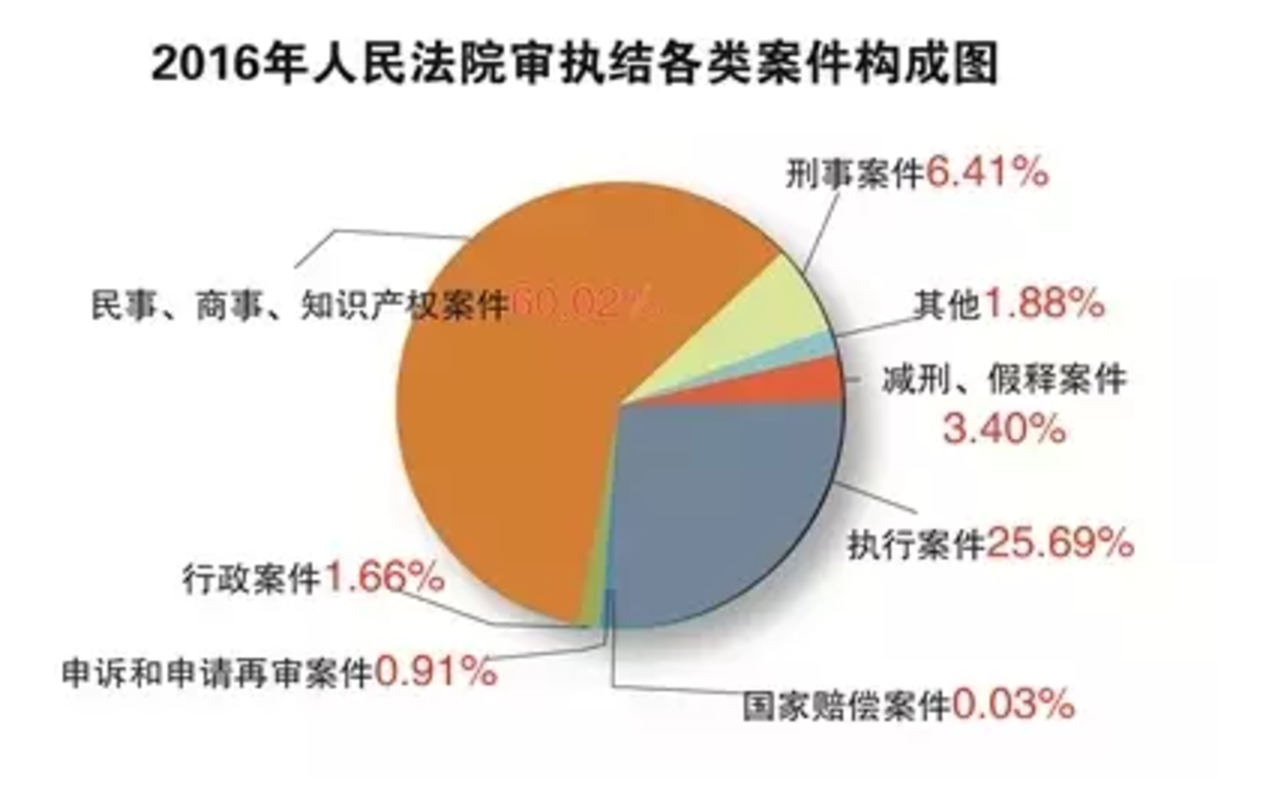
The pie chart below sets out the statistical distribution of cases heard by the Chinese courts:


Screen Shot 2017-03-16 at 9.59.06 PMThe pie chart of cases heard, enforced and closed in 2016 shows:
  • about 60% of those cases were civil, commercial, or intellectual property cases;
  • 6.41% criminal cases,
  • 3.40% parole, sentence reduction cases;
  • almost 26% enforcement cases,
  • .03% state compensation cases,
  • petition or application for retrial, .91%;
  • and 1.66% administrative cases.

Although the stress in Zhou Qiang’s report is placed on law and order, in fact many more cases in the Chinese courts are civil and commercial rather than criminal.

2. Social stability, public order, law & order are major concerns

Criminal cases have a prominent place in the report, although the data reveals a slight increase in the number of cases  (1.5%), involving the conviction of 1,220,000 people, down 1%. (Note that many minor offenses are punished by the police, with no court procedures).

Although the report mentioned the Zhou Shifeng case (state security) and criminal punishment of terrorist and cult crimes, it did not release statistics on the number of cases of any of these crimes heard.  Corruption cases totaled 45,000 cases, involving 63,000 persons.  Violent crimes (murder, robbery, theft) cases 226,000. Drug cases: 118,000, a significant decrease from 2015. 2016 cases of human trafficking and  sexual assault on women and children totaled 5335, while telecommunications fraud cases in 2016 totaled 1726.  Only 213 cases involving schoolyard bullying were heard and the SPC revealed that the drafting of a judicial interpretation on the subject is underway. The report highlighted some of the well-known criminal cases, including the insider trading case against Xu Xiang and the Kuai Bo obscenity cases to illustrate and criminal law-related judicial interpretations to signal that the courts are serving policy needs in punishing crime.

The same section described what has been done in 2016 to correct mistaken cases, highlighting the Nie Shubin case (reheard by Judge Hu Yuteng and colleagues) as an example.  The report revealed that the local courts retried only 1376 criminal petition cases, likely a tiny fraction of the criminal petitions submitted.

3. Maintain economic development

As President Zhou Qiang indicated, the way that the Chinese courts operate is Party/government policy-driven (they must serve the greater situation). Serving the greater situation meant, in 2016, that the Chinese courts heard 4,026,000 first instance commercial cases, a 20.3% increase year on year.  He also mentioned the 3373 bankruptcy cases analyzed in an earlier blogpost. Of those 4 million commercial cases, 1,248,000 involved securities, futures, insurance, and commercial paper and 255,000 real estate cases and 318,000 rural land disputes. Other implications are discussed below.

This section of the report devoted a paragraph to a topic discussed last year on this blog: the courts serving major government strategies, including One Belt One Road, the Yangtze River Belt, and Beijing-Tianjin-Hebei coordinated development.

Green development , intellectual property (IPR), property rights (of private entrepreneurs), serving maritime and major country strategy, socialist core values, judicial solutions to new problems and cross-border assistance also merited mention in this section.

  1. The courts heard 133,000 environmental and natural resources cases, with Fujian, Jiangxi and Guizhou courts designated as experimental environmental courts.  While public interest environmental and procuratorate brought (environmental) cases were mentioned, statistics were not set out.
  2. First instance IPR cases totaled 147,000, with several cities (Nanjing, Suzhou, Wuhan, and Chengdu) establishing IPR divisions to take cases across administrative boundaries. This section mentioned the Jordan trademark case and the IPR courts.
  3. On protection of property rights, the report mentioned some of the documents intended to protect private entrepreneurs discussed on this blog, as well as 10 model cases.
  4. On maritime and cross-border cases, the report mentions the judicial interpretations on maritime jurisdiction (discussed in this blogpost), intended to support the government’s maritime policy, including in the South China Sea.  The Chinese courts heard only 6899 commercial cases involving foreign parties (this means that of the 2016 19,200 civil and commercial cases mentioned by Judge Zhang Yongjian, most must have been civil) and 16,000 maritime cases. The report again mentions making China a maritime judicial center, further explained in my 2016 article.
  5. On the relevance of socialist core values to the courts, that is meant to incorporate socialist core values into law (although they should be understood to have always to be there) and to give the Langya Heroes special protection under China’s evolving defamation law.
  6. Judicial solutions to new issues included internet related issues, including e-commerce cases, internet finance cases, and theft of mobile data; the first surrogacy case, and judicial recommendations to Party and government organizations.
  7. In the section on international cooperation, President Zhou Qiang revealed that fewer than 3000 cases involving mutual judicial assistance were handled. The bureaucratic and lengthy procedures for judicial assistance in commercial cases has long been an issue for lawyers and other legal professional outside of China.  This is likely to change (in the long run, as Chinese courts increasingly seek to obtain evidence from abroad).  US-China dialogue on bankruptcy issues and cooperation with One Belt One Road countries (cases involving these countries are increasing significantly), were also mentioned here.

TO BE CONTINUED


Takeaways from the Supreme People’s Court 2015 work report

20160313104344_51387The Supreme People’s Court (SPC)’s 2015 work report has many takeaways for different audiences.  The apparently formulaic report took five months to draft, involving comments and input by many within and outside of the SPC (this article  describes the process, as did my earlier blogpost), most likely involving clearance by the Central Leading Group on Judicial Reform.  It was drafted to show certain accomplishments, send certain signals–show that judicial reform is on the right path and is successful, particularly that the court leadership and the courts are doing their part to fulfil the tasks set for them by the Party/state leadership.  This year’s report has three sections, rather than the usual two, with one section summarizing judicial reform accomplishments. This post will focus on highlights of the overview of 2015, and leave judicial reforms and tasks for this year for another day.

In a sign that the diminished attention spans have come to China, the SPC has come up with graphic and even musical versions of the report.

Statistics to convey current message

url

This short book, explaining how statistics are used to convey certain messages, was originally published in the 1950’s and translated into Chinese about 10 years ago (and given to me when I was 11 by my parents). It is a useful reference when puzzling out what SPC court statistics are saying and mean, because as this  Wall Street Journal article noted, the categories used in the annual reports often shift from year to year, making comparisons difficult, and breakdowns of specific categories are generally missing. The reason for that is the report (including the statistics) are meant to harmonize with the latest government/Party policies and be on message. The SPC is reforming judicial statistics and seeking to make better use of big data, but the fine details are not in this report.

Takeaway #1–Caseload Up Significantly

e8fade90gw1f1v665qoeqj209i0g4tab


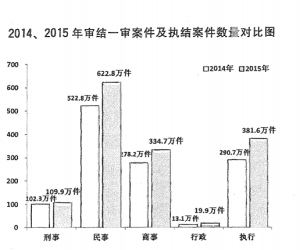
The caseload of all levels of courts were up significantly, primarily because of the docketing reforms implemented last year (mentioned here).  Civil (family, inheritance, private lending) and commercial cases account for most of the growth.

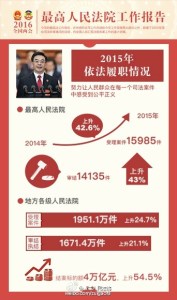
Cases heard at the Supreme People’s Court were up 42.6% compared with 2014 (accepted 15985, concluded 14,135). with most of those heard at headquarters in Beijing rather than the two circuit courts.    The local people’s courts heard 19,511,000, and concluded 16.714 million cases, with large increases  in the amounts in dispute, an increase of 24.7%, 21.1% and 54.5%, respectively. This seems to exclude cases heard in the military courts.

Performance target reforms mean that judges are no longer under enormous pressure to conclude cases by year end (although some local court officials may not been on message).

The bar chart below compares 2014 and 2015 numbers for criminal, civil, commercial, administrative, and enforcement cases respectively.Screen Shot 2016-03-15 at 7.16.13 pm

Criminal and Commercial cases up–Takeaway #2

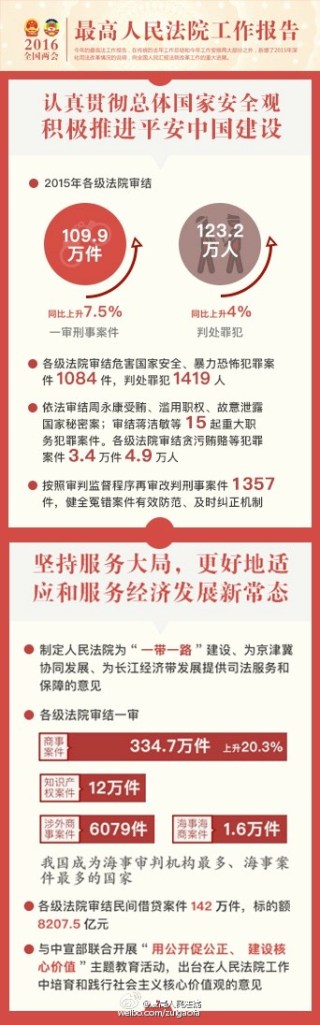
Just briefly on the criminal cases, as the overview graphic of commercial cases is linked to criminal cases-criminal cases are up by 7.5%. Significantly, criminal cases involving refusal to pay wages were up 58%, with last year’s report revealing that 753 persons were convicted, which means that 2015 convictions were close to 1200. a\Analysis of  the statistic of 1419 persons convicted of state security and terrorist crimes can be found here.

e8fade90gw1f1v665sc3uj209i0ugq6mCommercial cases were up 20% (3,347,000, with 120,000 intellectual property cases (up from 110,000 in 2014).  This is likely linked to the new intellectual property courts, but I will cede further analysis on this to my fellow blogger Mark Cohen of Chinaipr.com.  Again, tiny numbers of foreign-related (6079), but up from last year (5804) and Hong Kong, Macau, and Taiwan-related cases.  Cases involving subsidiaries of foreign companies are not in this category–this is a commercial case with a foreign party. The maritime courts heard 16,000 cases, the large increase apparently also attributable to the case registration system.  The language in the speech (making headlines) about making China an international maritime judicial center reflects language in previous speeches Zhou Qiang gave in China (analyzed here), but unnoticed until the NPC report.
Private lending disputes up significantly

The courts heard 1,420,000 private lending disputes, up from 1,045,600 in 2014.  Further background on private lending disputes can be found in my previous articles for the Diplomat. Last year the private lending disputes were categorized with the civil cases, rather than commercial cases.

SPC doing its part for greater government policy

The SPC issued policy documents on One Belt One Road (see this analysis of its implications), the Beijing/Tianjin/Hebei area, and Yangtze River Economic Belt to implement government policies. Those strategic projects are priorities for government.

Takeaway #3 Commercial disputes

Screen Shot 2016-03-15 at 8.33.59 pm

In 2015, 1,053,000 financial disputes were heard and 100,000 insurance disputes, as well as 4238 securities fraud and insider trading cases, compared with 824,000 financial disputes in 2014, a number which included insurance cases.  This speaks to the weakness in the Chinese economy.

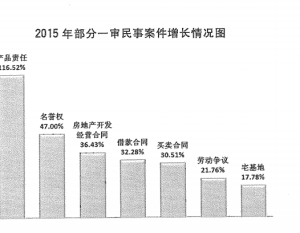
The bar chart to the left illustrates percentage increases in product liability (in 2014 there was also a large increase), reputation, real estate development (see this blogpost), loans, sales contracts, labor (up 21%!), and rural residential land disputes. The report flags 1400 bankruptcy cases and highlights pilot projects.

In another indication of problems with the real estate sector, Zhou Qiang mentioned “mass real estate disputes” and the expert handling by the Jinan court (in coordination with the government) of a large villa project in Jinan that encountered financial difficulties in 2008 (see this description) and led 2000 purchasers to petition in Beijing and even surround the Jinan Party Committee, Shandong Party Committee, and the Central Inspection Group that was on site. In 2014, the Shandong government decided to use “legal thinking” to involve the Jinan intermediate court.

An area for commercial lawyers to monitor is unfair competition and anti-monopoly, where the regulators are working on a stream of regulations. Last year the Chinese courts heard 1802 cases.

Takeaway #4– Big jump in civil disputes

Screen Shot 2016-03-15 at 5.38.32 pm


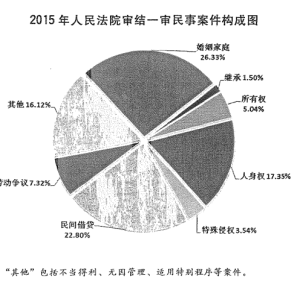
The pie chart on left shows the distribution of first instance civil cases–26% family (1,733,000), 1.5% inheritance, 5% ownership disputes, 17% personal rights (privacy, portrait, reputation), 22.8% private lending, 7.32% labor disputes, including 300,000 migrant worker wage arrears (and other cases related to rural residents rights (拖欠农民工工资等涉农案件 30 万件).  Consumer, education, housing and employment accounted for 720,000 cases.

For environmental cases, 78,000 civil cases were concluded, along with 19,000 criminal cases.


Takeaway #5 Big jump in administrative cases

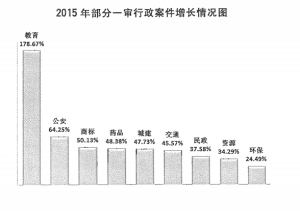
The amendment of the Administrative Litigation Law last year, the docketing reforms, and the decision to push disputes off the streets and into the courtroom has been a large increase in administrative disputes, although the baseline was very low.  In 2015, 241,000 first instance administrative cases were accepted, up 59% from the year before, with 199,000 concluded.  Reforms have been undertaken to move administrative cases outside of the area in which they arise, which is another reason that some persons or entities have been willing to file.  The bar chart has the percentage increase in different types of administrative cases, with an 176% increase in education cases. The remaining categories (from the left are: public security, trademark, pharmaceutical, construction, transportation, energy, and the environment.

(Black & white charts from SPC work report, thanks to Josh Chin of the Wall Street Journal).

Screen Shot 2016-03-15 at 10.51.25 pme8fade90gw1f1v66664yyj209i0tstbr-1

Supreme People’s Court president says court reforms in “deep water area”

566929On 12 March 2015, Zhou Qiang, president of the Supreme People’s Court (Court) delivered his work report to the NPC, putting the best face on where the Chinese courts are and where they’re going. He described court reforms as being in a “deep water area” (深水区)(a high risk area).  This blogpost will highlight issues that other commentators (outside of China) have so far missed:
  • the mismatch between the focus of the work report and the work of the courts;
  • what the work report (on other than criminal cases reveals); and
  • the challenges to the Court leadership in the year ahead.

What is the mismatch?

charts for SPC
© Tiantong & Partners; charts illustrating SPC report

The primary focus of the work report (as always) is law and order, as seen from the perspective of Communist Party leadership, particularly state security related offenses (including terrorism and “splittism”) as well as ordinary crimes.  A big difference in this year’s report is that President Zhou Qiang apologized for previous miscarriages of justice and highlighted efforts to prevent future ones.  Other commentators have already focused on these both of these important developments and and other issues related to the criminal justice system.

2014 cases in chinese courts
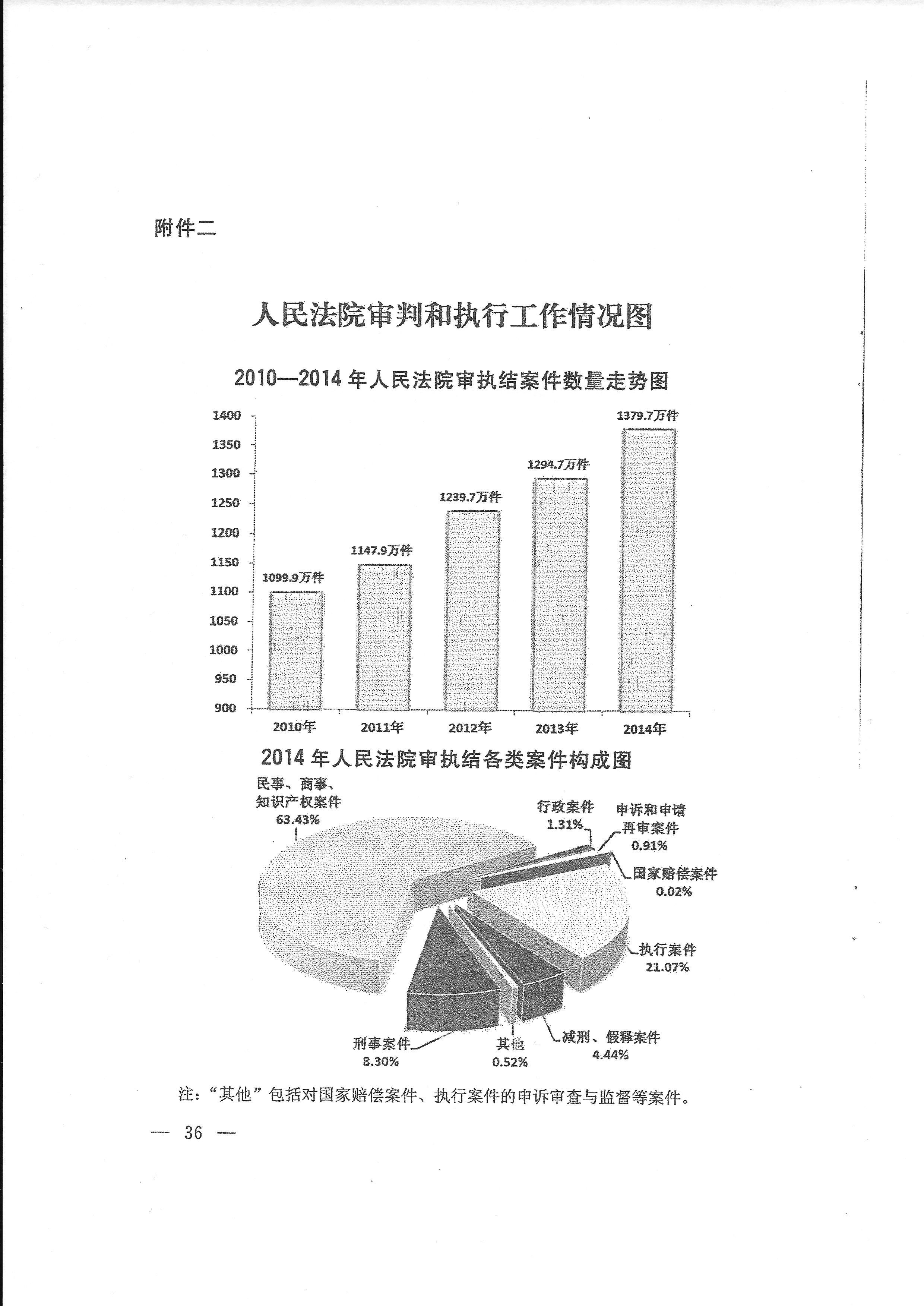
bar chart: 2010-2014 increase in cases resolved by courts (in 10K) Pie chart: civil/commercial/IP; admin; re-trial/govt compens/enforcement/; parole; other/criminal

What the work report reveals is that most cases heard in the Chinese courts are not criminal and that the number of cases heard by the courts is rising.

What are cases are the Chinese courts hearing?

The pie chart (distributed as an attachment to President Zhou Qiang’s report at the NPC), illustrates that over 63% of the cases heard in the Chinese courts are civil cases (including commercial, family law and intellectual property cases), not criminal. Criminal cases (including parole related cases) account for something over 10% of cases (as others have discussed, many minor offenses are handled as administrative, rather than criminal offenses).

A closer look at civil cases in the Chinese courts

 A bit of arithmetic reveals (unfortunately the authors of the Report did not set out a corresponding chart), that 34% of civil cases (2,782,000) in 2014 were commercial cases (up 8.5% year on year), while 66% were what classified as civil cases (in the narrow sense, described below).

Commercial cases:

(These cases are illustrated in the chart to the left that has the ¥ sign.)
1. Finance cases (824,000)(a broad category including various types of loans, credit cards, securities, futures, insurance etc.).
2.  Sales contracts disputes (664,000).
3.Intellectual property (110,000, up 10% year on year)(I  the detailed analysis of this can be found here, by my fellow blogger, Mark Cohen, at the ChinaIPR blog);
4. Corporate disputes (12,000) (shareholder, merger and acquisition, creditor initiated bankruptcy);
5. Maritime cases (12,000).
Foreign-related cases (5804), )these, although a focus of foreign law firms alerts and the press, are a tiny drop in the sea of Chinese civil cases.  Many cases involving foreign companies actually involve their China incorporated subsidiaries.
The number of finance cases suggests a large number of disputes relating to loans by financial institutions.

Civil cases

(These cases are illustrated in the chart that has two people standing next to one another and the pie chart below.)

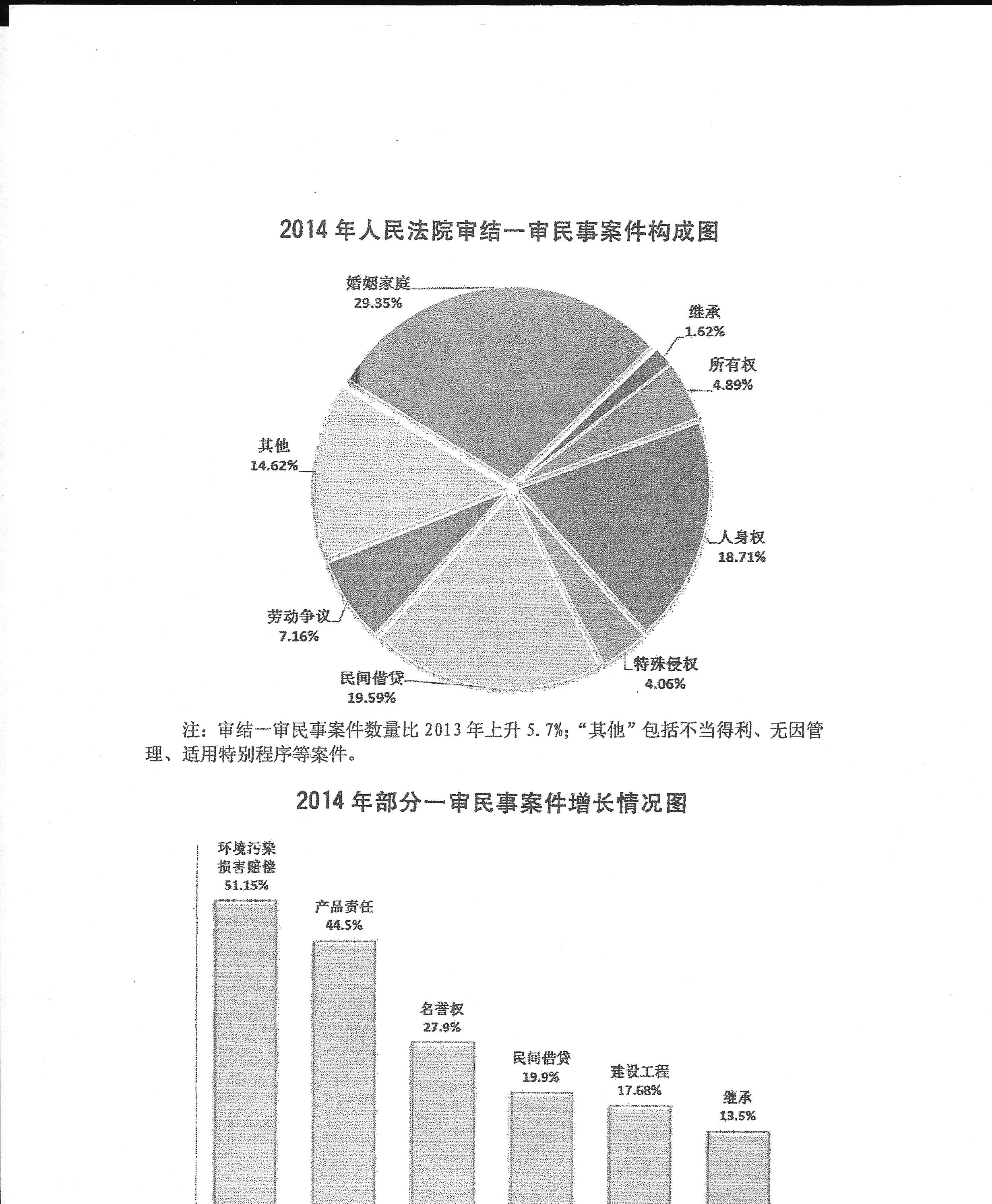
2014 civil cases in the Chinese courts

In 2014,  5,228,000  civil cases were heard in the Chinese courts (up almost 6% year on year):
1.  Family law cases (1,619,000),(this category includes  contested divorces, inheritance, support cases), accounting for about 30% of civil cases. The chart above 13% year on year increase in inheritance cases (showing an increasing number of people have assets worth fighting in court over, and perhaps also inadequate estate planning).
2.  Loan cases not involving financial institutions (between individuals, company and individual, or two companies) (1,045,600), accounting for almost 20% of civil cases. (The categorization has changed, making a year on year comparison not easily possible).
3. Labor cases (374, 324), accounting for 7.16% of all civil cases.  These include appeals from labor arbitration as well as cases that can be directly brought in the courts).
4.  Environmental tort cases (3331) (up 51% year on year).
5. Product liability cases are up 44%, but the base or total number for 2014 is not set out.
6.  Cases involving rights of rural residents (219,00)(rights to rural residential land, transfer of contracted land) migrant laborers seeking unpaid wages).
7.  Construction disputes are up almost 18% (base or total number for 2014 not set out).
These numbers speak to:
1. changes to the Chinese family;
2. a large number of loans that are under the radar of the financial authorities;
3. employees who are increasingly rights conscious;
4. continued litigation risk for foreign companies doing business in China (including through subsidiaries), because as perceived “deep pockets”, Chinese litigants often target them in product liability cases.

Administrative cases

 First instance administrative cases (companies or individuals suing the government) (131,000) continue to be a tiny number, although up 8.3%, and it remains to be seen whether the amended Administrative Litigation Law (Administrative Procedure Law) will lead to an increase in cases.

 Enforcement cases

Enforcement cases (compulsory enforcement of court judgments or orders, arbitral awards, etc) account for 3,430,000, a 14% increase year on year.  This suggests that fewer people (companies) are complying with dispute resolution voluntarily.
10% increase in cases accepted (will be a challenge to the courts if this trend continues because the intent is to cut the number of judges), amount in dispute is up 15%.

Court reforms already in a “deep water area”

Zhou Qiang highlighted that court reforms are already in a “deep water area” (high risk area) and the courts:
  • need to penetrate interest group barriers;
  • have the courage to move their own “cheese”;
  • need to use “the knife” against itself (presumably to cut out corrupt, poorly or non-performing judges);
  • deal with many deep-seated problems;
  • make progress on a long list of reforms:
    • continue and expand pilot reforms on changing the financing and personnel appointments of the local courts to all provinces/directly administered cities;
    • implement hearing-centered litigation reforms;
    • make progress on case filing reforms (to resolve the long term problem of litigants facing obstacles when they file suit);
    • put in place a system with dealing with assets seized and confiscated by the courts (to avoid violation of property rights and further judicial corruption in this process);
    • implement the prohibition against defendants wearing prisoner’s garb in court;
    • further implement judicial reforms related to petitioning;
    • promote alternative dispute resolution, such as arbitration, people’s mediation, administrative mediation etc.
    • continue work on pilot projects on expedited criminal procedures (for minor matters);
    • improve the people’s assessors system.

All of these reforms create tremendous challenges for the courts.  The number of cases accepted by the courts in 2014 (15,651,000) was up about 10%.  The judicial reforms to petitioning and other reforms will channel more disputes into the court system. Planned personnel reforms are leading to an exodus of young judges.  Many of the planned judicial reforms are intended to the way the courts operate internally and interact with other institutions. The 4th Five Year Court Reform Plan sets out target dates for accomplishing certain major judicial reforms.  The salary gap between what an experienced lawyer in private practice in a major law firm and a counterpart in the judiciary is large, leading many talented people to prefer the greater financial benefits and professional flexibility that comes with being a lawyer.

The political leadership has approved the 4th Five Year Court Reform Plan.  Issuing it raises expectations among ordinary people as well as those in legal profession. The pressure is on for the Court leadership to deliver on the promised judicial reforms.