All posts by Supreme People's Court Monitor

Susan Finder has been observing the PRC Supreme People's Court for over 20 years, and was the first person to engage in a close analysis of its operations. She taught Chinese law and other subjects in the Law Department of the City University of Hong Kong, before putting her knowledge to work in the China practice group of Freshfields Bruckhaus Deringer, one of the first international law firms to recognize the importance of the China market. She had the good fortune to study with three of the early pioneers of Chinese legal studies: Jerome Cohen, R. Randle Edwards, and Stanley Lubman and to have many leading practitioners and legal academics among her classmates at Harvard Law School (J.D.) and Columbia Law School (LL.M). Susan Finder speaks and reads (Mandarin) Chinese and Russian and some German.

2025 Year-End Supreme People’s Court Typical Cases

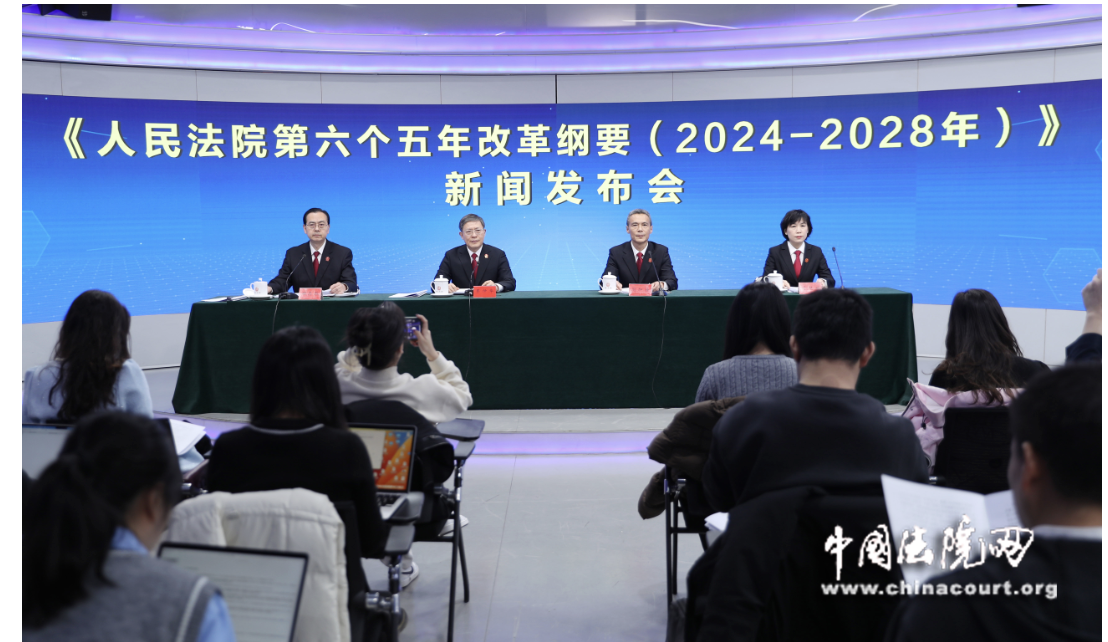
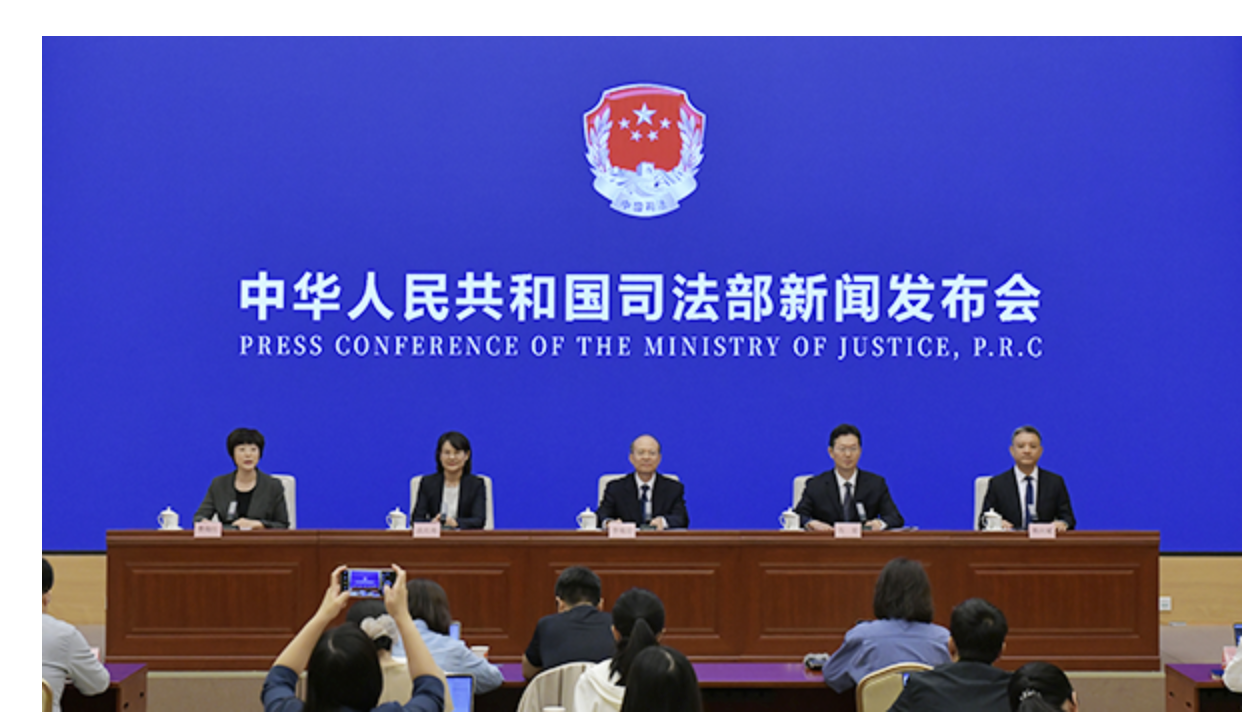
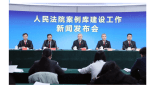
Press conference announcing the joint SPC & SPP administrative public interest litigation typical cases

The Supreme People’s Court (SPC) issued or participated in issuing close to two dozen groups of typical cases from the beginning of November to the end of December, 2025.

These typical cases reflect the latest policies promoted by the SPC and  President Zhang Jun (张军)’s preference for conveying judicial policy through typical cases.   Conveying policy through typical cases is also consistent with the guidance of General Secretary Xi Jinping, who has stressed that “one case is better than a dozen documents (习近平总书记强调, “一个案例胜过一打文件”).  Each group represents an accomplishment for the division, bureau, or office that reviewed and edited (compiled) the cases and, in some cases, negotiated with other institutions to select cases that meet the needs of multiple institutions.   This post highlights some of the trends visible in these latest typical cases, but first provides a Chinese case law system refresher.

1993 collection of SPC Gazette typical cases & judicial interpretations

Quick Chinese case law system refresher

Typical cases are part of the SPC’s dynamic case guidance system. I am including a brief overview of the dynamic Chinese case law system to clarify the role of typical cases, as these two recent articles suggest confusion among journalists, and some of my own students have difficulty understanding the system.   I use the term “dynamic” because the elements of the case guidance system have changed under SPC President Zhang Jun 张军. My sense is that SPC judges in different substantive areas place different emphasis on case guidance as tools in their guidance toolbox, but that is a discussion for a different day and forum.

  1. The most persuasive type of cases in the case guidance system are guiding cases (指导性案例),  which have been approved by the SPC judicial (adjudication) committee.  Former Judge Guo Feng  described guiding cases here as “of  [an] authoritative, normative, exemplary, and uniformly applicable nature. They are de facto binding. The compilation of GCs has specific standards and standardized procedures and needs to meet requirements for high quality….Where a case being adjudicated is, in terms of the basic facts and application of law, similar to a Guiding Case released by the Supreme People’s Court, the court should refer to the “Main Points of the Adjudication” of the relevant Guiding Case in its ruling or judgment.” Judge Guo provides an authoritative explanation of the meaning of “refers to” and related issues in the same article linked above.  This earlier blogpost summarizes the 2020 SPC guidance on similar case search.
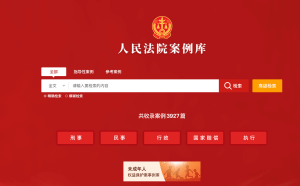
  2. The second most authoritative type of case is the reference case (参考案例).   As I wrote here, “reference cases” are a new type of edited case published in the People’s Court Case Database(人民法院案例库), which launched in early 2024.  The principal drafters of the People’s Court Case Database Work Procedures clarified in an authoritative article that “reference cases”  are “a new type of edited case created by the Case Database system. Their effectiveness is higher than other cases except for guiding cases.”  As of 23 December 2025, the  People’s Court Case Database contains 5216 reference cases.  My earlier post explains the selection process.
  3. Another type of guidance, which some SPC media describe as part of the case database system, is the Court Answers Platform, also translated as the “Judicial Q & A Platform,” which I analyzed in the earlier post.  The official intent, as evidenced in this article in SPC media, is for the People’s Court Database and the Court Answers Platform to be an integrated guidance product. This goal was mentioned in the SPC’s report to the NPC, as well as the latest court reform plan (about which I have a short article on its way to publication).
  4. The type of case guidance with the longest history is the typical (典型 model/exemplary/example) case. Typical cases too, are edited cases and are therefore “compiled.” The SPC Gazette started publishing typical cases in 1985, but I have earlier typical cases in other SPC publications in my research archives.
    As I wrote here, the SPC’s Gazette cases are generally considered to be the most authoritative of the typical cases, but there is no authoritative guidance on the definition or hierarchy of typical cases.  I have more details on typical cases in that article. Typical cases are considered to guide the lower courts as a form of case guidance and policy signaling.  Therefore, Chinese lawyers and in-house counsel also pay attention to typical cases. Typical cases are also used as a form of public legal education (普法, see here and here).
  5.  I am not further discussing the authoritativeness of judgments or rulings, but see my earlier discussion.

The rules derived from these cases are not static.  Provisions from typical cases may be incorporated into meeting minutes (conference summaries 会议纪要), for example,  while on 30 December 2025, the SPC issued a judicial interpretation that drew on questions raised on the Court Answers Platform. It is not unusual for provisions from guiding cases or judicial interpretations to be incorporated into legislation.

Overview of Recent Typical Cases

What the SPC has issued in the last two months of 2025 are typical cases (典型案例). The SPC issued several groups of typical cases with the Supreme People’s Procuratorate (SPP), which serve to harmonize views on specific issues between the two institutions and sometimes with multiple institutions.  The SPC issued several with regulatory/administrative institutions, reflecting a policy trend of recent years. President Zhang Jun highlighted this policy in his 2024 specialized report to the NPC Standing Committee on administrative litigation (I have a draft article that touches on this policy trend).  This year’s year-end typical cases include several groups with the Women’s Federation and one group with the All-China Federation of Trade Unions.

Some groups of cases promote mediation (phrased as promoting the Fengqiao Experience 枫桥经验). (For those with the time to read academic articles, a recent article by Professor Benjamin Liebman and Liu Zeming has an extended discussion of this.

Some typical cases of note:

  1. A group of domestic violence cases 最高法发布2025年中国反家暴典型案例.  Jeremy Daum’s (Yale Law School’s Paul Tsai China Center/Chinalawtranslate.com) analysis of those cases is found here. He said “the release shows a generally positive direction, and was interesting in that the cases were presented as showing compliance with international legal norms.”

2.  Fourth Group of  Civil Cases That Embody Socialist Core Values 最高人民法院发布5起第四批人民法院大力弘扬社会主义核心价值观典型民事案例  These cases appear to be aimed at educating the general public and providing some guidance for less experienced judges on how socialist core values can be applied. Among the cases are: two cases involving employers: a workplace sexual harassment case and an employer that withdrew a job offer after the candidate accepted it and had provided evidence of terminating his previous job; a slip and fall case brought by someone who focused on his phone rather than his step.  The SPC issuing a typical case conveying that workplace sexual harassment is a violation of socialist core values is particularly significant.

For those with a greater interest in socialist core values and court judgments, I wrote a quick summary of the related SPC guiding opinion here and commented that “it can be seen as a part of the ‘socialist core valueization’ of Chinese law and the legal system, and in particular, the judiciary. It is one important piece of how the judiciary is being further transformed in the Xi Jinping era.” A 2024 student note by Liu Zeming in the Columbia Journal of Transnational Law argues that through the project of integrating socialist core values into judgments,  the Party-state is effectively imposing a new conception of what Chinese law is.

3. Typical cases of application of model texts (third batch) (最高法发布示范文本应用典型案例(第三批)). These cases provide examples to the lower courts and public of how courts are using model texts (court forms), a project involving cooperation between the SPC,  Ministry of Justice, and All China Lawyers Association.  Bilingual versions of those forms are behind lawinfoChina.com’s paywall and Chinese versions are available in many places, such as here.    That link leads to a downloadable 900+ page document with the accompanying multi-institutional document and the court forms. The typical cases promote the use of those court forms. An experienced senior judge whom I contacted commented that “these forms are useful for some types of cases, such as traffic accident cases.”

4.  The SPC issued several groups of typical cases with the SPP. The two institutions issued a third group of administrative public interest cases 两高”联合发布第三批行政公益诉讼典型案例 .  The SPC contributed to the drafting of the procuratorate-led public interest litigation law.  Many of the cases involved a local procuracy providing a procuratorial suggestion to an administrative agency to enforce a provision of the law and filing suit when the suggestion was not taken seriously. One of the cases involved a county human resources bureau that did not properly supervise listings on a bureau-sponsored job platform, several of which restricted jobs to men only.  Another group of SPC and SPP typical cases involves corruption cases related to ordinary people (最高人民法院 最高人民检察院联合发布依法惩治群众身边腐败犯罪典型案例).  The cases involve embezzlement, fraud, and misappropriation of funds related to school meals, elderly and disabled person services, medical insurance, etc.  Another group focuses on job-related crimes in the financial sector (最高人民法院、最高人民检察院联合发布依法惩治金融领域职务犯罪典型案例), with cases of corrupt financial regulators and bankers.  The case descriptions provide insights into the many ways corruption can be performed. The fourth group relates to the courts and procuratorate joining forces to substantively resolve administrative disputes, also a policy promoted in recent years.   法检合力法治化实质性化解行政争议典型案例.

4. Typical cases with regulators include: cases with the National Financial Regulatory Administration promoting diversified dispute resolution (particularly mediation) 国家金融监督管理总局; typical cases with the National 最高人民法院联合发布金融领域纠纷多元化解典型案例 and the State Administration of Cultural Heritage 最高人民法院、国家文物局联合发布依法推进文物保护典型案例

5. The SPC issued typical cases with the Women’s Federation as well as with the Women’s Association plus other institutions.  All of these cases relate to women, children, and families. One group of typical cases with the Women’s Federation involving judicial assistance to minors (最高法、全国妇联联合发布保护未成年人权益司法救助典型案例).  The two institutions have jointly issued typical cases several years in a row, previously in time to coincide with Children’s Day. This year, two of the cases involved providing psychological services to the affected minors,  and all involved courts providing financial and other arrangements for minors who lost one or both parents.  It provides a glimpse into the difficulties faced by orphans, particularly in rural areas. The SPC, SPP, Women’s Federation, and Ministry of Justice issued the top 10 cases protecting women’s and children’s rights   Another group of typical cases with the Women’s Federation and Ministry of Justice promotes mediation in family disputes (最高人民法院与全国妇联、司法部联合发布婚姻家庭纠纷调解工作典型案例

6. The SPC issued two groups of typical cases promoting the protection of private enterprise, including one group on private enterprise property rights and retrial cases involving the protection of the rights of private entrepreneurs 最高法发布涉民营企业产权和民营企业家权益保护再审典型案例. Almost 10 years ago, I wrote about a document conveying many of the same points as these typical cases.  Unfortunately, it appears that protecting the rights of private entrepreneurs is an “evergreen” issue for the Chinese courts.

7.  Several groups of typical cases involve labor issues: one involving the evergreen issue of wage arrears of migrant workers (最高人民法院发布人民法院治理欠薪典型执行案例); another issued with the SPP and the All-China Federation of Trade Unions  on using “one letter and two documents”  to protect workers rights (最高法会同全国总工会、最高检联合发布 2025年劳动法律监督“一函两书”典型案例).

  Concluding comment

The primary purpose of these typical cases appears to vary, but all signal “people-centered.”  For the person with patience to wade through the initial political framing, they provide slivers of insight into current judicial policy,  and persistent issues in society, the operation of the judicial system.

The SPC also intends these typical cases to evidence that the SPC is implementing the Opinions of the Central Committee of the Communist Party of China on Strengthening Trial Work in the New Era  中共中央关于加强新时代审判工作的意见, the 2025 Party document guiding the work of the courts, which President Zhang Jun has described as “the major political task for the courts at present and the foreseeable future.”

______________________________________

Many thanks to Yuan Ye, PKU doctoral student, for his comments on this post.  This year, I will continue to focus on writing longer articles and trust that some of the articles stuck in the pipeline will see the light of day.  One hope I have for my own work is that I am able to spend some time inside the SPC, although I am doubtful that it will ever be possible in my lifetime.

Supreme People’s Court’s 2024 Judicial Review of Arbitration Annual Report

On December 28, 2025, the Supreme People’s Court (SPC) issued its 2024 annual report on judicial review of commercial arbitration.   I am attaching the report in both PDF and its original Word format to enable readers outside to download the report easily.  The report includes 16 typical cases (典型案例). This report is Chinese only, and an English version is likely to be forthcoming.

The Chinese courts accepted 19422  judicial review of arbitration cases in 2024,  the vast majority of which were domestic.  Only 121 of those cases involved awards from outside China.  Most of those cases were applications to set aside arbitral awards (11576) ,  5768 cases were applications to confirm the validity of an arbitration agreement.

The number of cases reported to the SPC under its prior reporting system was 28, while 2023 was 29.  Of that number, three were Hong Kong, Macau, and Taiwan awards, while two were foreign awards.

For anyone interested in the role of the SPC in legislation (as I wrote about in my article on how the SPC supports the development of foreign-related rule of law (long/short version), the report mentions that in 2024, the SPC was deeply involved in the work to amend the Arbitration Law (2024年,最高人民法院深度参与《中华人民共和国仲裁法》(以下简称《仲裁法》)立法修订工作).

There is a great deal of interesting information for practitioners and academics, but competing obligations do not permit me to analyze the report in detail at this point.

Supreme People’s Court’s 2022-2024 Maritime Litigation Report

Excerpt from the report. It does not clarify why the SPC accepted larger numbers of maritime cases in 2023 and 2024.

On 18 December 2025, the Supreme People’s Court (SPC) issued a bilingual report on maritime litigation. (The first link is to the webpage on the SPC’s official website from which the report can be downloaded by scanning a QR code. The second link is to a copy of the report downloadable from my website). The report provides insights for those interested in the latest developments concerning the multiple goals of the Chinese maritime courts.

Excerpts from the press release (in machine translation):

From 2022 to 2024, the three levels of maritime courts nationwide accepted 98,726 maritime cases of various types and concluded 97,140 cases. Among these, 71,705 were maritime and commercial cases, with 70,759 concluded; 5,477 were maritime administrative cases, with 5,482 concluded; 21,359 were maritime enforcement cases, with 20,706 concluded; and 185 were maritime criminal cases, with 193 concluded. Of these, 6,823 cases involved foreign parties, and 6,071 were concluded; 1,226 cases involved Hong Kong, Macao, and Taiwan, and 1,134 were concluded. The cases involved 143 countries and regions. Over the three years, the eleven maritime courts seized 2,592 vessels, including 49 foreign vessels and 6 vessels registered in Hong Kong, Macao, and Taiwan; and auctioned 1,376 vessels, including 13 foreign vessels and 2 vessels registered in Hong Kong, Macao, and Taiwan.

…[.W]e will promote the modernization of maritime trials and create a preferred location for resolving international maritime disputes. We will improve the domestic maritime rules system and cooperate with the legislative body [NPC and its Standing Committee] to revise laws and regulations such as the Maritime Law. From 2022 to 2024, we released 33 typical maritime cases and 7 special guiding cases on maritime trials, and added 138 maritime cases to the People’s Court case database [人民法院案例库]. We actively participated in the formulation of international rules; the Beijing Convention on Judicial Sale of Ships was successfully signed, and the Convention on Transferable Documents of Goods is progressing in an orderly manner. We will improve the “one-stop” diversified dispute resolution mechanism for foreign-related maritime disputes, effectively enhancing the attractiveness of international maritime dispute resolution. We will strengthen the goal-oriented approach of substantively resolving conflicts and disputes, and adhere to the principles of “as if I were in litigation” and “settling disputes.” We will improve institutional mechanisms, strengthen talent training, and comprehensively improve the quality and efficiency of trials.

These excerpts illustrate some of the themes in my 2024 article, posts on this blog, and my presentations on the SPC and foreign-related rule of law:

  • the policy goal of making China a preferred location for resolving international [maritime] disputes;
  • the primarily domestic caseload of the maritime courts;
  • the SPC working closely with the National People’s Congress (SPC) in foreign-related rule of law-related areas;
  • although much is made of guiding cases in the academic world, it is apparent that the SPC uses typical cases and Case Database cases as preferred guidance tools;
  • the focus on substantively resolving disputes;
  • the SPC participating directly (or indirectly) in the drafting of international rules;
  • further developments related to the maritime courts hearing criminal cases (as highlighted in SPC documents from 2016);
  • although my article was finalized before sanctions-related cases became a focus of the foreign-related work of the Chinese courts, note that the report mentions several sanctions-related cases.

Some have asked about the status of reports such as this. My understanding is that this report is an official statement of the SPC, reflecting its current policies. It must have been internally approved at a senior level, but as a report, it has no legal effect.

The Amended Arbitration Law and the Supreme People’s Court

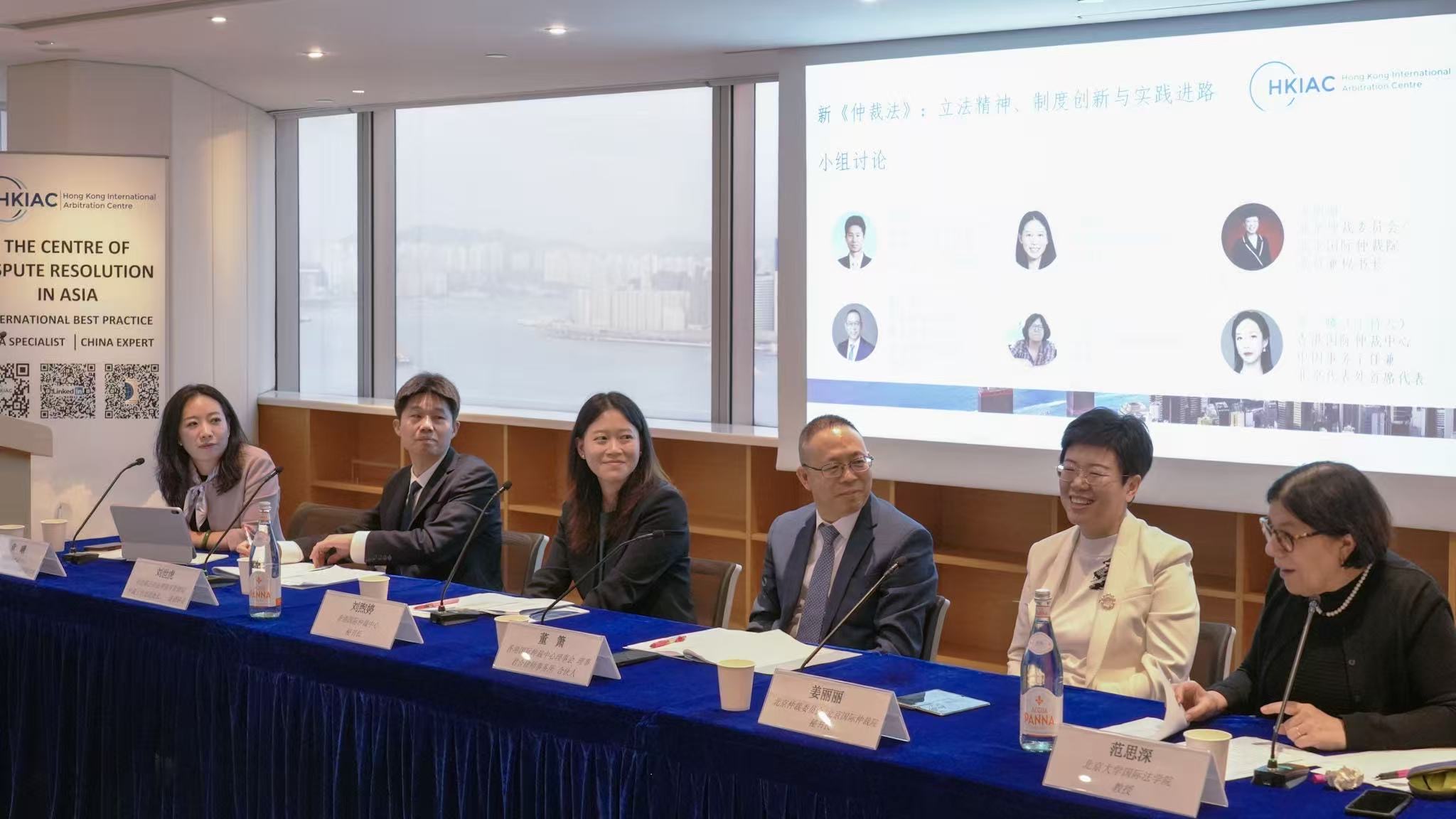
Press conference on the amended Arbitration Law, Judge Shen, second from left

Those involved in Chinese dispute resolution in any way know that the role of the Supreme People’s Court (SPC) in advancing arbitration in China is crucial and irreplaceable. The question on many people’s minds is –what will the SPC do to support the recently amended Arbitration Law?

So I will summarize what is known about the SPC’s next steps in ensuring a smooth transition from the old to the new Arbitration Law and supplement that with some of my own predictions.

What do we know? There have been substantial changes to the Arbitration Law, some of which will have an impact on the courts. Chief Judge of the SPC’s #4 Civil Division Shen Hongyu (沈红雨) told a Ministry of Justice press conference that:

The Supreme People’s Court will conduct thorough research, widely solicit opinions from all sectors, and with the strong support of the Legislative Affairs Commission of the Standing Committee of the National People’s Congress and the Ministry of Justice, comprehensively review existing judicial interpretations and normative documents related to the Arbitration Law to ensure the drafting and formulation of supporting judicial interpretations for the newly revised Arbitration Law, guaranteeing that the revised content of the Arbitration Law is effectively implemented in judicial practice. (最高人民法院将认真调研、广泛听取各界意见,在全面梳理既有仲裁法相关司法解释和规范性文件的基础上,在全国人大法工委、司法部的大力支持下,做好新修订仲裁法配套司法解释的起草制定工作,确保仲裁法修订内容在司法实践中落地落细。)

Judge Shen said a great deal in this one very long sentence. The “thorough research” will involve combing through hundreds of pages of judicial interpretations and other judicial documents linked to the Arbitration Law, relevant sections of the Civil Procedure Law, and its judicial interpretation, plus the current draft interpretation of the foreign-related part.

The work involved, which will be invisible to those of us outside the SPC, will be to determine which interpretations or documents remain valid in whole or in part. If interpretations or documents are partially valid, do they need to be amended to conform to the amended Arbitration Law? Will a transitional document be necessary so that lower court judges (and SPC judges) will be ready to apply the amended law? I expect so, because the changes are significant and lower court judges need to have a reference document to hand so that they can efficiently handle arbitration-related matters, whether they are requests from arbitral tribunals to assist in collecting evidence, or judicial review of arbitration.

My best guess is that the SPC will issue a transitional document or documents in the run-up to March 1, 2026, when the Arbitration Law becomes effective, likely amending previous judicial interpretations or documents to be consistent with the new law and deleting inconsistent provisions, plus a document that clearly sets out the new arrangements, so that lower courts will be well prepared. I further surmise that the SPC will use much of 2026 to design a new comprehensive judicial interpretation to incorporate many of the provisions in the old ones. This is more complicated than it seems.

A new judicial interpretation will touch upon substantive and procedural issues. Some of those procedural issues need to draw on the specialized competence of other specialized institutions within the SPC, such as the case-filing division (tribunal) and the enforcement bureau. In the press conference mentioned above, Judge Shen flagged some of the important issues, such as:

  1. The concept of “the seat” in arbitration
  2. Judicial review of special arbitration (ad hoc arbitration);
  3. Arbitration service of process
  4. Arbitration preservative measures;
  5. Arbitration preservation system
    Those other specialized institutions will need to consider whether any of the new measures in the Arbitration Law require measures related to their work, such as case filing or enforcement procedures. Once their input is received, the institutions that Judge Shen mentioned earlier— the Legislative Affairs Commission of the Standing Committee of the National People’s Congress (Legislative Affairs Commission 法工委) and the Ministry of Justice will review that comprehensive draft carefully. The Ministry of Justice and the Legislative Affairs Commission are sure to give detailed comments for the SPC to consider. The SPC will want to make sure that each provision is operable in practice before it is released. The procedure for drafting such an interpretation is time-consuming and as is said in the law firm world, “requires attention to detail.”

_________________________________________________________________

This post is a slightly revised version of a speech I gave on November 12, 2025, at the opening of the Beijing Arbitration Commission’s Hong Kong Center. My apologies for the long gap between posts.

Supreme People’s Court Biweekly Developments: September 2025

This post highlights judicial interpretations, policy documents, and guiding or typical cases issued since the middle of September (2025).

  1. Judicial interpretations and policy or other judicial documents

For an explanation of judicial interpretations, see this post; for an explanation of policy documents, see these posts or my 2024 article.


Title Type Analysis
Supreme People’s Court Interpretation on Some Issues Related to the Application of the PRC Company Law《最高人民法院关于适用〈中华人民共和国公司法〉若干问题的解释(征求意见稿)》, issued evening of 30 September, open for comment until 20 October Judicial interpretation (draft) Draft interpretation has 90 articles, not yet aware of translation or analysis in English.  SPC has “already engaged in extensive preliminary research and preliminary consultation with experts, scholars, and relevant departments.”  Provisions include ones related to liquidation and dissolution of companies; disregarding legal personality of related companies; 10 draft provisions related to listed companies, including VAM agreements.  This article comments on the General Provisions, more to come.
Opinions On Promoting the High-Quality Development of the International Commercial Court
and Serving and Ensuring High-Level Opening Up, Issued 25 September (关于推进国际商事法庭高质量发展
服务保障高水平对外开放的意见
) link is to text & press release
Policy document

Also known as a “judicial document” ( 司法文件) or “judicial normative

document” (司法规范性文件), “judicial

policy document” or “judicial regulatory documents” 司法政策性文件).

Not yet aware of analysis in English, see quasi-official analysis on the WeChat public account of the SPC’s #4 Civil Division. My own analysis is forthcoming. Provisions include promoting the use of international commercial courts; standardizing translations; further provisions on parallel proceedings; etc.  China Daily report here
Notice on Issuing Matters Concerning the Jurisdiction of First-Instance Civil and Administrative Intellectual Property Cases by Basic-Level People’s Courts 最高人民法院
关于印发基层人民法院管辖第一审知识产权民事、行政案件有关事项的通知
In effect from 1 October
Judicial normative document Not yet aware of analysis in English; the notice designates courts to hear civil and administrative intellectual property cases in the first instance. Note that many courts have limited jurisdiction in civil cases, depending on the amount in dispute. This could be seen as an assessment of the quality of that court. Shanghai and Beijing courts do not have amount in dispute limitations
 

Title Type Analysis
Supreme People’s Court Interpretation on Some Issues Related to the Application of the PRC Company Law《最高人民法院关于适用〈中华人民共和国公司法〉若干问题的解释(征求意见稿)》, issued evening of 30 September, open for comment until 20 October Judicial interpretation (draft) Draft interpretation has 90 articles, not yet aware of translation or analysis in English.  SPC has “already engaged in extensive preliminary research and preliminary consultation with experts, scholars, and relevant departments.”  Provisions include ones related to liquidation and dissolution of companies; disregarding legal personality of related companies; 10 draft provisions related to listed companies, including VAM agreements
On Promoting the High-Quality Development of the International Commercial Court
Opinions on Serving and Ensuring High-Level Opening UpIssued 25 September (关于推进国际商事法庭高质量发展
服务保障高水平对外开放的意见
) link is to text & press release
Policy document

Also known as a “judicial document” ( 司法文件) or “judicial normative

document” (司法规范性文件), “judicial

policy document” or “judicial regulatory documents” 司法政策性文件).

Not yet aware of analysis in English, see quasi-official analysis on the WeChat public account of the SPC’s #4 Civil Division. My own analysis is forthcoming. Provisions include promoting the use of international commercial courts; standardizing translations; further provisions on parallel proceedings; etc.  China Daily report here
Notice on Issuing Matters Concerning the Jurisdiction of First-Instance Civil and Administrative Intellectual Property Cases by Basic-Level People’s Courts 最高人民法院
关于印发基层人民法院管辖第一审知识产权民事、行政案件有关事项的通知
In effect from 1 October
Judicial normative document Not yet aware of analysis in English; the notice designates courts to hear civil and administrative intellectual property cases in the first instance

2.  Typical (典型 example, exemplary, model) cases

For an explanation of typical (model, exemplary, example) cases, see these posts.

Title Type Analysis
Ninth Batch of Cases on the Construction of People’s Tribunals in the New Era (2)新时代人民法庭建设案例(九) Typical cases Subtitle is “Building Fengqiao-style People’s Courts and Strengthening the Guidance of Professional and Industry-Specific Mediation Functions”—related to resolving enterprise-related and labor-related disputes [providing insights into SPC policies on the role of the local courts]
The Supreme People’s Court and the Ministry of Justice jointly issued typical cases on standardizing enterprise-related law enforcement, judicial administrative reconsideration, and administrative litigation最高人民法院、司法部联合发布规范涉企执法司法行政复议、行政诉讼典型案例 Typical cases Cases have multiple targets: promoting the  “Private Economy Promotion Law”, special actions to standardize administrative law enforcement and judicial work involving enterprises, administrative reconsideration and administrative litigation in serving high quality economic and social development
Fifth batch of typical cases involving the construction of the “Belt and Road”第五批涉“一带一路”建设典型案例 Typical cases See my earlier comments on Belt & Road typical cases; SPC states its hope that the cases not only provide exemplary guidance for the Chinese courts, but also provide regulatory guidance for the joint construction of the Belt and Road Initiative with the wisdom of Chinese judicial practice, injecting new legal momentum into promoting a fairer, more open, and more inclusive new international economic order; my own commentary forthcoming

________________________________

I’m focusing on preparing a long article for publication and several other long writing projects, therefore this abbreviated post.

Professor Jerome Cohen

I first met Jerry Cohen  (then Professor Cohen to me!) when I was 20 years old.  At the time, I was a Yale College senior, when “dinosaurs roamed the earth” (1975).  He helped to arrange for me to study Chinese in Taiwan during my last semester of college.  It was then impossible for me to study in Beijing. When I studied at Harvard Law School, I had the good fortune to take all his courses, attend East Asian Legal Studies lunch-time talks, and be a member of the East Asian Legal Studies group.   Many of my then fellow students are my good friends these many years later!   I believe he was responsible for my being a research fellow at the East Asian Legal Studies Center from September 1987 to November 1988.

I am one of his (many) students whose lives he changed–among those were enabling my move to Hong Kong, providing recommendations, supporting my blog, and encouraging my work on the Supreme People’s Court.

The English-reading world seems less aware of the tributes to Jerry in Chinese social media, so I’ll bring attention to some of the articles that have been published on WeChat:

Author Article
this article is a translated excerpt from his memoirs (by Chen Yu-Jie); 逝者|孔杰荣:改革开放初期中外法律交流亲历记 (Those Who Have Passed: Kong Jierong: A Personal Account of Sino-Foreign Legal Exchange in the Early Years of Reform and Opening Up


 Li Qi (李骐), Partner of  JunHe 我所认识的科恩教授 (The Professor Cohen  I Knew)


Yu Ping (虞平) introduction to 法治流變及制度構建:兩岸法律四十年之發展:孔傑榮教授九秩祝壽文集. 缅怀 | 孔杰荣:冰心玉壶,德范长存 (In Memory of Kong Jierong: A Heart as Pure as Ice and a Jade Pot, His Moral Model Lasts Forever

)


Xu Xin (徐昕)the prominent defense counsel 纪念柯恩教授 (In Memory of Professor Cohen)
Peking University Law School Professor Zhang Qianfan (张千帆) 沉舟|中国法治的“不老松”——追忆孔杰荣教授

(originally published in FT Chinese), translation available here

 Fudan University Professor Gao Lingyun (高凌云) 有些人注定不普通——怀念科恩老师
 Liu Guiming (editor in chief of the magazine Democracy and Legal System 民主与法制 刘桂明:这位美国教授,为何往返中国几百次 (Liu Guiming: Why did this American professor travel to and from China hundreds of times?)


China-America Law Review (student-led translation team) Translation of NYU obituary, 中文翻译首发 | 缅怀柯恩:第一位在北京执业的西方律师


Chen Hongyi (Albert Chen), Fu Hualing, and Huang Yue (Andrew Huang)) 陈弘毅 傅华伶 黄岳|孔杰荣教授回忆篇(一)

(Chen Hongyi, Fu Hualing, Huang Yue | Professor Kong Jierong’s Memoirs (Part 1)

)


Lawyers and scholars have also posted tributes to him, while those within the System remember his good deeds privately.

斯人已逝,风范长存.  He still lives on earth in the acts of goodness he performed and in the hearts and lives of those who cherish his memory.

2025 Labor Dispute Interpretation II and the Work of the Supreme People’s Court

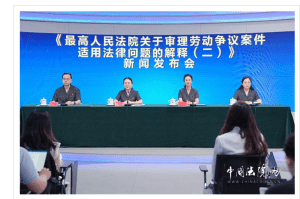
Labor Dispute Interpretation II press conference

The August (2025) Supreme People’s Court (SPC) Judicial Interpretation on Labor Dispute Cases (II)  (Labor Dispute Interpretation II 最高人民法院关于审理劳动争议案件适用法律问题的解释(二) is one of the few SPC judicial interpretations to attract significant public and press attention in and out of China.  As the institution’s usual practice, the SPC also released a set of typical cases.  Rather than duplicate commentary on the substance of the judicial interpretation, which law firms and others are providing, this post focuses on three aspects of this interpretation that provide examples of the work and functioning of the SPC:

  • the link between Labor Dispute Interpretation II and the harmonization of administrative and judicial standards;
  •  Labor Dispute Interpretation II and SPC support for the work of the National People’s Congress (Standing Committee);
  • the role of typical cases (典型案例) (also translated as exemplary or model or representative)

(Each is linked to my ongoing research.)

1.  The harmonization of administrative and judicial standards

During the press conference announcing Labor Dispute Interpretation II, #1 Civil Division Chief Judge Chen Yifang 陈宜芳stated:

在多次征求立法机关、行政机关、有关社会团体等意见,并向社会公开征求意见后,对基本达成共识的问题作出规定…(After repeatedly soliciting opinions from legislative bodies, administrative organs, relevant social groups, and publicly soliciting opinions from society, it [the SPC] has made stipulations for issues on which consensus has been basically reached)

This bureaucratic language needs decoding.  It means that the legal positions taken by the SPC in Labor Dispute Interpretation II represent not only the views of the SPC, but also the relevant institutions regulating labor matters.  What “soliciting opinions from legislative bodies (立法机关)” means is that the SPC drafters sought comments on their draft multiple times from institutions of the National People’s Congress  (NPC) Standing Committee.  The Legislative Work Committee must have been one of the institutions with which the SPC discussed the draft. It is possible that the NPC’s Social Affairs Development Committee also commented. Additionally, the SPC solicited opinions multiple times from administrative agencies (行政机关)-likely referring to the Ministry of Human Resources and Social Security and I surmise other administrative organs, such as the Ministry of Finance and the Ministry of Justice.  “Relevant social groups” is likely to mean the All-China Federation of Trade Unions and the China Association for Small and Medium Enterprises.  If the #1 Civil Division publishes an “understanding and application” article on this interpretation, it will provide more details on the institutions that commented on this interpretation.

This also illustrates one of the principles underlying the SPC’s work on labor law issues, harmonizing administrative and judicial standards, as shown in several policy documents, such as the Opinions of the Ministry of Human Resources and Social Security and the Supreme People’s Court on Strengthening the Building of a Mechanism of Connection between Arbitration and Litigation of Labor and Personnel Disputes  (人力资源社会保障部最高人民法院关于加强劳动人事争议仲裁与诉讼衔接机制建设的意见), which states “standards for application of law in [labor] arbitration and litigation shall be gradually unified” (逐步统一裁审法律适用标准).

It is also consistent with rules governing the drafting of judicial interpretations. Those require the SPC’s Research Office, which reviews drafts before they are submitted to the judicial (adjudication) committee for approval to review whether the draft  “has sufficiently and objectively reflected the major opinions of the parties concerned” (是否充分、客观反映有关方面的主要意见). ”

2.  SPC support for the work of the National People’s Congress Standing Committee

Labor Dispute Resolution II also indirectly illustrates a poorly understood aspect of the SPC’s work–supporting the work of the NPC (and its Standing Committee), including in the NPC’s law enforcement inspection work, which, as the NPC Observer has pointed out, is emphasizing integrating oversight with legislation.  The relevant legislation is the Social Insurance Law, which is now on the legislative agenda.

As could be surmised from the NPC Observer’s overview of NPC Standing Committee law enforcement inspections, it is normal practice for the SPC to report to NPC Standing Committee law enforcement inspection groups.   The one related to Labor Dispute Resolution II was revealed at the November 2024 meeting of the NPC Standing Committee,  when the agenda included the Report of the Law Enforcement Inspection Group of the Standing Committee of the National People’s Congress Regarding the Inspection of the Implementation of the Social Insurance Law of the People’s Republic of China (全国人民代表大会常务委员会执法检查组关于检查《中华人民共和国社会保险法》实施情况的报告).  This report contained one sentence that touched on the SPC.  It stated that at the first meeting of the Law Enforcement Inspection Group, responsible comrades (officials) from the SPC and other relevant institutions reported on the implementation of the Social Insurance Law  (6月4日,执法检查组召开第一次全体会议,王东明副委员长作讲话,部署执法检查工作;人力资源社会保障部、财政部、税务总局、国家医保局、最高人民法院负责同志汇报社会保险法的实施情况).

When preparing Labor Dispute Interpretation II, the drafters would have been aware of the serious problems with implementing the Social Insurance Law.  Some observers anticipate that the provisions in Labor Dispute Interpretation II relating to social insurance signal positions that will be incorporated into amendments to the Social Insurance Law.  If so, that would provide another example of the codification in legislation of a provision in a judicial interpretation (as discussed in my 2024 article).

3. Typical Cases

The SPC often issues a set of typical cases to accompany a judicial interpretation, as highlighted in previous posts, but their role appears to be underappreciated.  Analysis of these cases can be found here and elsewhere. At the SPC’s press conference, following the phrase quoted above, Judge Chen Yifang 陈宜芳 said:

对争议较大的问题将继续加强调研,通过发布典型案例等方式指导司法实践 we will continue to strengthen research on controversial issues and guide judicial practice by publishing typical cases and other means.

This bureaucratic phrase can be decoded to provide additional insights about the work of the SPC.  The first part signals that certain unspecified issues were omitted from the final draft of the interpretation because they were “controversial,” meaning the SPC did not reach a consensus with other institutions on those topics. The second phrase illustrates that the SPC uses typical cases as one of its tools to guide the lower courts, including on “controversial issues.”

Conclusion

The first two aspects provide discrete examples of the nuanced relationships between the SPC and other institutions, particularly the NPC Standing Committee (the subject of one forthcoming article) and administrative agencies (the subject of another forthcoming article), while the third is another example of those nuanced relationships as well as the use the SPC makes of “typical cases” (典型案例).

_______________________________________

Many many thanks to Dr. Ren Rongqing (任容庆) of Meituan’s legal department (and former post-doc at the China Institute of Applied Jurisprudence of the SPC) for her insightful comments on several drafts of this blogpost! A second thank you is due to a highly knowledgeable commentator for his post-publication contribution.


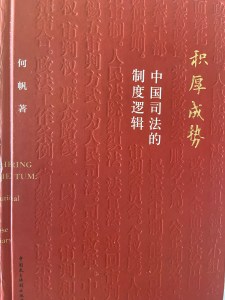
Judge He Fan’s (何帆) Book: Guide to Finding SPC Materials

For those researching the Supreme People’s Court (SPC) and able to read Chinese, Judge He Fan’s 2023 book  (pictured above) 积厚成势——中国司法的制度逻辑 (“Accumulating Strength: The Institutional Logic of Chinese Judiciary”) provides insights available nowhere else, or at least nowhere accessible to most of us outside of the System.  The book, which focuses on the courts (小司法) has a unique background and the writing is unusual for an academic book, for reasons with special characteristics. For those interested in the perspective of domestic reviewers, please see here and here.

Judge He’s Tsinghua Class

The book, which focuses on the court system and judges, draws on the lectures Judge He gave when he taught the class “Chinese Judicial System and Judicial Reform” at Tsinghua University, from the fall of 2014 until the pandemic. His class had an ever-expanding number of students, although he taught it according to a schedule that fit his work schedule– eight four-hour-long sessions over one semester.

The book is divided into twelve lectures, plus an introduction and an afterword.  The afterward provides glimpses of some of the personalities involved in judicial reform. Most of the book focuses on the court system.

  • Lecture 1: How the People’s Court System was formed (pre-Cultural Revolution;
  • Lecture 2: Judicial Reform (Part 1): Force of the  times and historical stages
  • Lecture 3: Judicial Reform (Part 2) Political Logic and Decision-Making Mechanism;
  • Lecture 4: People’s Courts in the Political-Legal System
  • Lecture 5: State Organs of Power and the People’s Courts
  • Lecture 6:  Judicial Hierarchy and the Four Levels Two-Instance System
  • Lecture 7: Specialized Courts and Specialized Tribunals
  • Lecture 8: Trial Organization (1): sole judge, collegial panels, and (state) compensation committees
  • Lecture 9: Trial Organization (2) Judicial (Adjudication) Committees
  •  Lecture 10: Judicial power operation mechanism and the judicial accountability (responsibility) system
  • Lecture 11: Judges System (1): Judges Law and the Quota Judge System
  • Lecture 12: Judges System (2):  Selection of Judges and Career Progression

Selected New Insights

Judge He’s book provides many details that may change what most people outside of China understand about the operation of the SPC and its interactions with other institutions.  The apparently minor details also provide insights to those wanting to decode how the System works.

On the operation of the SPC, for example,  Judge He provides a detailed backstory to the Second Five-Year Judicial Reform Plan Outline, describing the interactions between the SPC and the Party hierarchy.  He states that from 2003, reform measures could no longer be determined by the courts (i.e. the SPC) or the procuratorate (i.e., the SPP) themselves.  Having established that point, he describes the major steps leading to the approval of the Second Five-Year Judicial Reform Plan Outline.

The framework approval was linked to an April, 2003  request for instructions from the Central Political-Legal Committee to the Party Center concerning the promotion of judicial reform. The following month, the Politburo decided to establish a central-level judicial reform leading small group (中央司法体制改革领导小组) to lead judicial reform measures, following which the SPC established the Judicial Reform Research Leading Small Group, headed by SPC President Xiao Yang. Confirming the facts in my earlier blogpost, that leading small group was later renamed the Judicial Reform Leading Small Group. In July, 2004, the Judicial Reform Research Leading Small Group (with SPC Party Group approval) submitted a proposal for judicial reform along with an implementing plan to the central judicial reform leading small group,  for the first time,  systematically describing their proposed reforms.  Those reforms were partially, but not entirely adopted because there was no consensus about some of them, plus a significant number touched on personnel (组织 organization) and administrative matters, but the related analysis was useful for later reforms.  Issues included: SPC regional branches; promoting death penalty approval; differentiated trial levels;  retrial litigation procedures; enforcement structural reforms; labor reeducation; specialized courts; cadre administration; and funding reforms.

At the end of 2004, the Party Center issued its approval of the central judicial reform leading group’s policy document on judicial reform, setting out 35 reform matters, on which basis the SPC issued the Second Five-Year Judicial Reform Plan.   The approval document issued by the Party Center had only some overlap with the SPC’s original proposal.  Judge He’s descriptions of the drafting of the Third, Fourth, and Fifth Five-Year Judicial Reform plans lack such details. It could be surmised that the SPC’s Judicial Reform  Office (linked to the leading small grouop) coordinated ahead of time with the Central Political-Legal Committee to ensure that such mismatches did not occur, but at any rate, those details remain confidential.

Why No Clear Argument?

The casual reader might be mystified as to why Judge He does not set out a clear argument about the institutional logic of China’s judicial system. It contrasts with the writings of Judge Richard Posner, some of whose books Judge He has translated into Chinese.  However, Judge Posner wrote his books when working in a very different system, which does not have such strict demands on writings by judges. I recall seeing relevant regulations that detail these requirements, but they escaped me when writing this post.


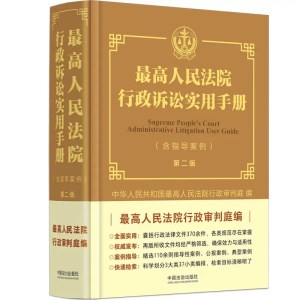
Benchbooks (Judicial Handbooks) for the New Era

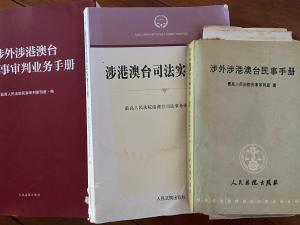
A recent message in the WeChat public account of the Supreme People’s Court (SPC)’s Administrative Division was devoted to promoting its new book,  Supreme People’s Court Administrative Litigation User’s Guide (Administrative Litigation User’s Guide (2nd edition), 最高人民法院行政诉讼实用手册), shown in the photo above.   Had the SPC’s #4 Civil Division had a WeChat public account last year when they published 涉外涉港澳台民商事审判业务手册( Foreign-Related, Hong Kong, Macao and Taiwan Related Commercial Trial Work Guide — “Foreign-Related Judicial Handbook”), I am sure that I would have received a similar message.  I had previously thought that judicial handbooks were a historical artifact of the days before electronic databases.   In my 1993 article, I discussed the phenomenon of judicial handbooks:
..A …problem is presented when the lack of consistency in issuance and authority makes it difficult for the lower courts to know when an interpretation is no longer valid…The [SPC] tries to cure these problems by issuing handbooks for adjudication in various subject areas….The Research Office and other divisions of the Court compile adjudication handbooks such as Sifa Shouce [司法手册] (Judicial Handbook), many of which are internal publications.

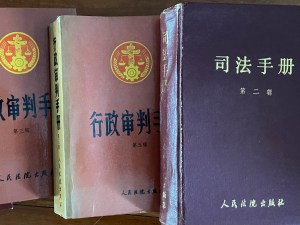
Some of those historical handbooks can be found in my research library of Supreme People’s Court publications–see here and below:

Two Administrative Litigation Judicial Handbooks and the second volume of the Judicial Handbook

Why would specific divisions of the SPC return to the practice of issuing judicial handbooks in printed form?  How does it link with the role of the SPC? What sources have the editors included, and what could students, scholars, and practitioners learn from that?

Official reasons for publishing these print books

The authors of the  Administrative Litigation User’s Guide describe the reasons for publishing the book as follows:

the Supreme People’s Court, on the one hand, provides professional guidance (业务指导) by formulating judicial policies 司法政策), issuing guiding cases, and making judicial replies (司法答复); on the other hand, it strengthens research and collects problems, and formulates judicial interpretations based on the accumulation and maturity of judicial practice. At present, the comprehensive judicial interpretation of the Administrative Litigation Law, the judicial interpretation of administrative agreements, and the judicial interpretation of the appearance of administrative agency heads in court to respond to lawsuits have been formulated and issued…, and there are more and more normative documents and guiding cases related to administrative litigation. In addition, with the increase in the number of administrative cases, more judges have joined the administrative trial team. In the process of gradually becoming familiar with administrative litigation, they urgently need to master the  relevant provisions that have been issued and learn the relevant guiding cases. However, judicial replies are internal in nature, with a large volume and lack of a unified release mechanism. The channels for obtaining them from the outside world are limited, which is time-consuming and laborious.

According to the announcement, the audience for the Administrative Litigation User’s Guide is staff in administrative agencies, judicial practitioners, and researchers of administrative law [students and academics].  The editors note that to provide readers with reference materials and to make the book more practical, they have included guiding cases, SPC Gazette Cases, and typical cases from the last 10 years.

The #4 Civil Division authors/editors say their handbook is urgently needed by front-line judges and as a reference book for judges, arbitrators, lawyers, and other practitioners, and, I would add, to students and scholars seeking to decode the foreign-related and Hong Kong, Macau, and Taiwan-related operations of China’s judiciary.

Legal basis for publishing these books

Publishing these books is linked to Article 10 of the Organic Law of the People’s Courts and related documents, which authorize the SPC to supervise and guide(监督指导) the lower courts.

Comments on the content

Both books contain judicial interpretations and a range of SPC guidance documents such as meeting minutes/conference summaries (会议纪要), notices, and replies to requests for instructions, signaling to the reader that they are important sources of reference for judges and that “soft law” may understate the way that meeting minutes are understood within the Chinese court system.

The authors/editors of the Foreign-Related Handbook included many other types of legal provisions they considered relevant for hearing cross-border cases, such as relevant national legislation, administrative regulations, such as foreign exchange regulations, Chinese versions of international commercial rules (Incoterms, ICC Uniform Rules for Demand Guarantees (URDG 758), ISP 98) ), Hague Conventions to which China has acceeded,  and civil judicial assistance treaties, as well as some of the National People’s Congress Standing Committee decisions related to some of the international conventions.  The #4 Civil Division did not include guiding, typical cases, and other types of cases it issues for reference.  In my view, it was a practical decision that does not imply that those types of cases are irrelevant to judges hearing cross-border commercial cases, but rather that including cases would make the book too long to be published as a single volume.

Comment

The underlying rationale for publishing these judicial handbooks has not changed much in the past 30 years.  Judges responsible for processing cases efficiently and correctly face similar challenges:  sorting out the current legal position on an issue quickly despite the piecemeal way that the SPC develops the law, locating and assessing the validity of historical documents, easily identifying special arrangements, and for cross-border cases, understanding how to correctly implement international conventions, treaties and practices and correspondingly arrangements or related provisions concerning cases involving Hong Kong, Macau and Taiwan parties.

One experienced senior judge in a local court noted that judges are often asked to rotate among divisions (tribunals) periodically.  Senior judges recommend that new joiners read these handbooks to familiarize themselves quickly with a different (and complicated) area of law.

From the left, the 2024 Foreign-Related Handbook, a 2013 Hong Kong, Macau, Taiwan Related Judicial Handbook, and the 1992 Foreign, Hong Kong, Taiwan-Related Civil Matters predecessor volume


 The Supreme People’s Court and the 2025 plan for Promoting the Building of a Powerful Intellectual Property Nation

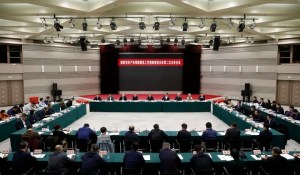
Meeting of the Inter-Ministerial Joint Committee at which the Plan was approved

On 7 May 2025, the  Office of the Inter-Ministerial Joint Conference for the Building of a Powerful Intellectual Property Nation ( Inter-Ministerial IP Office) issued this year’s plan (Chinese /English) for promoting the building of a powerful intellectual property nation. (Many thanks to Adam Wininger and his colleagues affiliated with the China IP Law blog for the English translation of the plan itself.) The Inter-Ministerial IP Office circulated the plan with the following notice:

Notice of the Office of the Inter-Ministerial Joint Conference for the Building of a Powerful Intellectual Property Nationon the Issuance of the 2025 Plan for Promoting the Building of a Powerful Intellectual Property Nation
(National Intellectual Property Joint Office [2025] No. 5)

To all member units of the Inter-Ministerial Joint Conference for the Building of a Powerful Intellectual Property Nation, the Central Political and Legal Affairs Commission, the Cyberspace Administration of China, the State Administration of Taxation, the Financial Regulatory Administration, the China Securities Regulatory Commission, the National International Development Cooperation Agency, the State Administration of State Administration of State Administration of Traditional Chinese Medicine, the National Medical Products Administration, the China Association for Science and Technology, and the National Natural Science Foundation of China:
With the approval of the Inter-Ministerial Joint Conference on Building a Powerful Intellectual Property Nation, the ” 2025 Intellectual Property Rights Promotion Plan ” is now issued. Please organize its implementation conscientiously.

Office of the Inter-Ministerial Joint Conference on Building an a Powerful Intellectual Property Nation
April 29, 2025

The issuance of this plan gives me an opportunity to revisit one aspect of formal interactions between the Supreme People’s Court (SPC) and other institutions that I discussed in this blog post in 2021–inter-ministerial joint conferences.  As I mentioned in the post, the intellectual property inter-ministerial joint conference system is quite transparent.  In contrast to other inter-ministerial joint conferences, it has its own website.  This brief post will highlight a few recent developments before analyzing what the plan means for the SPC.

Development #1–Since 2021, the membership of the joint conference has expanded and its name has changed, linked with the issuance of the Outline for Building a Powerful Intellectual Property Nation (2021-2035).  The Party Center and State Council approved the expansion of the joint conference to 29 members.  Previously, the State Council had approved the expansion of joint conference members.  Perhaps the Party Center (党中央) and State Council approved the notice together because several Party institutions are involved.  This notice on the establishment of the expanded joint conference is likely derived from the official approval, specifying that the joint conference’s responsibilities are to :

coordinate the national efforts to build a strong country in intellectual property rights, and organize the implementation of the strategy of building a strong country in intellectual property rights. Strengthen macro-guidance on the work of building a strong country in intellectual property rights; study major policies and guidelines for strengthening the building of a strong country in intellectual property rights, and formulate an annual promotion plan for the building of a strong country in intellectual property rights; guide, supervise, and inspect the implementation of relevant policies and measures, monitor and evaluate the effectiveness of work; coordinate and resolve major issues in the building of a strong country in intellectual property rights; and complete other matters assigned by the CPC Central Committee and the State Council.

The SPC is a member of the joint conference, which is convened by the head of the National Intellectual Property Administration and the person in charge of copyright work at the Central Propaganda (Publicity) Department. The approval provides that the joint conference has an office located in the National Intellectual Property Administration to administer the work of the Joint Conference.  The head of the National Intellectual Property Administration directs the office, with two deputies, one from that administration and the other from the Central Publicity Department.   Justice Tao Kaiyuan is the designated liaison person from the SPC.   My understanding is that normal liaison work occurs at the staff level, with some staff members of the SPC’s #3 Civil Division meeting with their counterparts at other member institutions to coordinate and promote policies as well as to establish related mechanisms, subject to relevant leadership approval. The plan provides insights into near-term developments in intellectual property law.

Implications for the SPC

The plan allocates 13 specific tasks to the SPC, among which are:

9. Promote the revision of relevant judicial interpretations of the Trademark Law and Copyright Law. (Supreme People’s Court is responsible);…

23. Explore and improve the intellectual property protection rules for new fields and new formats such as big data, artificial intelligence, and blockchain. Improve the intellectual property protection rules in the Internet field. (The Central Propaganda Department, the Central Cyberspace Affairs Commission, the Supreme People’s Court, the Ministry of Industry and Information Technology, the State Administration for Market Regulation, and the National Intellectual Property Administration are responsible for their respective duties)
24. Accelerate the improvement of judicial judgment rules for intellectual property rights in new technologies, new fields, and new formats, and judgment rules for e-commerce platform competition cases, and explore judicial rules for big data competition protection. (Supreme People’s Court is responsible)…

II. Strengthen intellectual property protection
(I) Strengthen judicial protection of intellectual property
30. Issue the “Opinions of the Supreme People’s Court on Serving and Safeguarding Scientific and Technological Innovation with High-quality Trials” and publish typical cases. (The Supreme People’s Court is responsible) [mentioned in this post]
31. Improve the national level intellectual property case appeal mechanism and strengthen the construction of a professional trial system. (The Supreme People’s Court is responsible)
32. Adhere to strict protection, improve and fully implement the punitive compensation system for infringement. Strengthen the overall coordination of batch litigation and increase the crackdown on manufacturers and other sources of infringement. (The Supreme People’s Court is responsible)
33. Formulate the “Interpretation on Several Issues Concerning the Application of Laws in Handling Criminal Cases of Intellectual Property Rights Infringement”. (The Supreme People’s Court and the Supreme People’s Procuratorate are responsible)….

I understand this document to have multiple implications for the SPC.  First, the matters for which the SPC listed are targets that the SPC has agreed with the other constituent institutions, after inter-institutional discussions and coordination at a staff level and related approval within the SPC.  Second, I surmise that the targets are binding on the SPC through inter-institutional agreement, as reported here.  Therefore, the ones that are listed in this document are on the work plan of the SPC for this year and will involve multiple institutions within the SPC.   Third, it can be seen that for some matters, the SPC is solely responsible, while for others, the SPC works with the SPP or multiple institutions.  Third, it is likely that the SPC will be involved in other matters in which the SPC is not listed as a responsible institution. One of many examples is item 45, “continue to strengthen the protection of seed industry intellectual property rights,” for which the Ministry of Agriculture and Rural Affairs is responsible. As I wrote in a recent post, the SPC has a memorandum of understanding with that ministry to improve the protection of seed intellectual property rights.  Finally, this document provides insights into the complex and poorly understood topic of inter-institutional arrangements in China, their operation, and the role of the SPC in them.  As the introductory notice flags, multiple non-members of the inter-ministerial joint committee are notified so that their work can be harmonized with this plan.

_______________________________________________

Many thanks to a knowledgeable person for his comments on an earlier draft of this post.


What’s New in SPC Support for Foreign-Related Rule of Law?

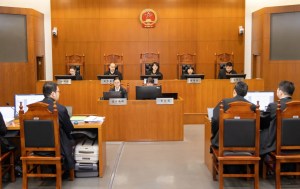
CICC hearing in Shanghai

As most readers of this blog know, developing foreign-related rule of law is a priority for the Chinese government.  President Zhang Jun told Supreme People’s Court (SPC) leaders at the beginning of 2025 that the Party Center places a great deal of importance on the construction (development) of foreign-related rule of law (党中央高度重视涉外法治建设). What does that mean for the SPC?  What has the SPC done lately? This post briefly notes some of those developments.

  1. The SPC’s #4 Civil Division has recently established a WeChat public account entitled 中国涉外商事海事审判,  as a way of better conveying developments to the Chinese professional and academic legal world. The link is to the April 30 report on the China International Commercial Court’s circuit visit to Shanghai on 10-11 April.
  2. The China International Commercial Court (CICC) held a hearing in Shanghai’s #1 Intermediate Court on 10 April in a joint venture shareholder dispute (see the photo above). I could attend because I was scheduled to participate in a workshop at NYU Shanghai on 12 April and several people bound by protocol to remain anonymous helped workshop participants and me with the required formalities.   Many from Shanghai’s “foreign-related” legal community attended the hearing, including several foreign lawyers, senior members from the Shanghai International Arbitration Center, Shanghai Commercial Mediation Center, and academics from Shanghai’s law schools specializing in foreign-related matters.  Official reports on the event included the SPC’s official website, the Shanghai #1 Intermediate People’s Court WeChat account (bilingual), and the #4 Civil Division’s WeChat account. I have my views on the performance of the lawyers, but will withhold them until I know more about the length of time they had for preparation.

Unbeknownst to most, the hearing in Shanghai evidenced that the CICC was implementing part of Article 33 of the sixth judicial reform plan:

Deepen the reform of the circuit trial mechanism. Deepen the reform of the circuit court work mechanism of the Supreme People’s Court, strengthen the functions and roles of the Supreme People’s Court’s trial organs in shifting their focus downward, resolving disputes on the spot, and facilitating litigation for the parties. 强化最高人民法院审判机关重心下移、就地解决纠纷、方便当事人诉讼的功能作用。

Holding a hearing in Shanghai would be considered to be “shifting the focus of the SPC downward,” resolving disputes on the spot, and facilitating litigation for the parties.

  1. The SPC issued 《最高人民法院关于人民法院为西部陆海新通道建设提供司法服务和保障的意见” Opinions of the Supreme People’s Court on the People’s Court Providing Judicial Services and Guarantees for the Construction of the Western Land-Sea New Corridor”  along with related typical cases. An explanation of the Western Land-Sea New Corridor is here.  The document designates the Chongqing High People’s Court to take the lead in establishing a “13+2” judicial cooperation mechanism among thirteen high people’s courts and two intermediate people’s courts along the corridor to cooperate in litigation services, substantive dispute resolution, enforcement linkage, application of law, talent training, etc.
  2. SPC Justice Wang Shumei published an article in China Trial (中国审判)  on foreign related matters in late 2024. Her article is a useful summary of current SPC policy on foreign-related commercial and maritime matters.   One part includes:

improve the rules for jurisdiction over foreign-related cases, and properly handle international conflicts of jurisdiction arising from parallel litigation involving multiple countries in the same dispute in accordance with the law; we must firmly maintain the international order based on international law, actively participate in the formulation of international rules, carry out in-depth international judicial exchanges and cooperation, strengthen confidence in the rule of law, actively explain to the world the concepts, propositions and successful practices of foreign-related rule of law with Chinese characteristics, promote the progress of international rule of law, promote global governance in a more just and reasonable direction, and help build a community with a shared future for mankind.

The above quotation summarizes what has been said in earlier documents: resolving parallel litigation is on the agenda; the Chinese courts should tell China’s story well; the SPC should actively participate in formulating international rules (actively participating in the negotiation of the Hague Judgments Convention as an example), and all is linked to the Chinese government’s vision of global governance and the international legal order.

3.  Typical cases

  1. In late April 2025,  the SPC issued a group of typical cases linked to the Western Land-Sea Corridor and the policy document mentioned above, signaling the importance of mediation, unifying standards, promoting the application of international treaties and conventions, etc.
  2. In March 2025, the SPC issued a second group of typical free trade zone cases第二批服务保障自由贸易试验区建设典型案例
  3. As I mentioned in an earlier post, the SPC issued typical cases protecting the rights and interests of foreign investors.
  4. As mentioned in an earlier post, in March, 2025, the SPC issued procedures to implement the Foreign State Sovereign Immunity Law.

Forthcoming attractions

Among the forthcoming attractions of which I am aware:

  1. The #4 Civil Division is drafting a judicial interpretation of the foreign-related part of the Civil Procedure Law, as reported in official media. Judge Guo Zaiyu, who was one of the judges of the CICC panel hearing the case at the #1 Intermediate People’s Court, chaired a meeting with scholars and experts, hosted by East China University of Political Science and Law, including some (domestic) CICC experts in Shanghai on April 11. I surmise the judicial interpretation will be issued sometime this year and it is unclear whether a draft will be released for public consultation.

2.   As mentioned earlier, the 6th judicial reform five-year plan outline was issued in late December.  Point 12 relates to foreign-related rule of law:

Improve the judicial guarantee mechanism for high-level opening up. Improve the foreign-related trial mechanism, strengthen international commercial trial work, and improve the connection mechanism with international commercial mediation and arbitration. Improve the judicial trial system in which the parties in foreign-related civil legal relations agree on jurisdiction and choose to apply foreign laws in accordance with the law. Improve the mechanism for accurate application of international treaties and international practices, and improve the mechanism for ascertaining foreign laws. Improve the maritime trial mechanism, promote the improvement of the maritime legal system, improve the rules for adjudicating disputes such as ship repair, cross-border logistics, shipping insurance, maritime finance, and compensation for damage to the marine ecological environment, and improve the coordination and linkage mechanism with maritime administrative law enforcement agencies. Improve the mechanism for mutual recognition and enforcement of cross-border arbitration awards and civil and commercial judgments. Improve the judicial protection mechanism for overseas interests and investments. Improve the judicial protection mechanism for overseas Chinese interests. Improve the talent training mechanism for foreign-related trials. Strengthen international exchanges and cooperation in the judicial field, and actively participate in the formulation of international rules.

It appears most of the content here is not new and has been incorporated in the policy documents previously analyzed on this blog. The major exception is the detailed stress on certain maritime case principles.  Why has this paragraph been incorporated in the judicial reform plan outline, when previously this type of content would more likely have appeared in a specialized policy document?  As I will comment in a future article, it is representative of many articles in this judicial reform plan outline, signaling that the Party and SPC leadership attach importance to those matters.

What the 2024 SPC specialized report on administrative litigation work reveals

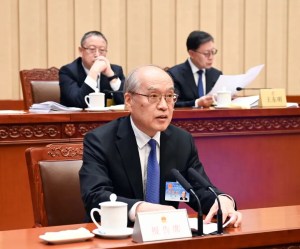
Zhang Jun delivering the specialized report
In November 2024, Supreme People’s Court (SPC) President Zhang Jun delivered a specialized report on the court system’s administrative litigation work (关于人民法院行政审判工作情况的报告) to the National People’s Congress Standing Committee (NPC Standing Committee).  The report showcases the accomplishments of the courts in administrative litigation and related administrative dispute resolution over the past 10 years.  This blog post provides a  detailed summary of the most significant points of the specialized report.  My comments are italicized for the most part.

Why this report?

As I wrote last year, I surmise that the NPC Standing Committee requested the SPC submit a specialized report on administrative litigation to promote (the Chinese phrase is “倒逼 “) significant changes to resolving administrative disputes, that is, disputes between individuals or enterprises and government agencies, by agreeing to report on administrative litigation.   Administrative cases are more sensitive because as  President Zhang Jun reported: “administrative cases are connected to administrative organs on one end and the people on the other, and are directly related to the people’s trust in the Party and the government and their confidence in the socialist rule of law.” The introduction to the report captures the themes of  administrative litigation work of the court system in this excerpt from one anodyne sentence:
New era administrative adjudication work…tried administrative cases impartially and promptly, resolved administrative disputes, supported administration according to law, protected the legitimate rights and interests of citizens, legal persons and other organizations, and supervised administrative organs in performing their duties in accordance with the law, making positive contributions to the integrated construction of a country ruled by law, a government ruled by law, and a society ruled by law.
This group of slogans (提法)signals themes seen in the rest of the report: courts do only part of their work through hearing cases;  they are encouraged to resolve the substance of an administrative dispute; the judiciary supports and supervises administrative agencies; they protect the rights of individuals, legal persons and others; and these all actively contribute to the Party and state’s goal of a country governed by law, a government governed by law, and a society governed by law  (为一体建设法治国家、法治政府、法治社会作出积极贡献).

Overview and drafting

The report covers all types of administrative cases the Chinese courts hear. Underlying this report are hundreds of hours of drafting, soliciting data and comments from related offices and institutions. The Administrative Division of the SPC took the lead in drafting the report and must have solicited contributions from the Intellectual Property Court (Tribunal), #3 Civil Division (intellectual property), and the Natural Resources and Environmental Division.  Administrative divisions of Chinese courts, including the SPC, hear or consider a substantial portion of, but not all, administrative cases and matters.   For intellectual property (including anti-monopoly) and environmental and natural resources cases or matters, the relevant specialized divisions of the SPC (and local counterparts) are responsible.  The report incorporates the SPC’s response to a research report on administrative adjudication work prepared by the NPC Standing Committee’s Supervisory and Judicial Affairs Committee (as it would follow the requirements discussed in this earlier blog post).  In a forthcoming article, I will have more to say about specialized reports as a form of NPC Standing Committee oversight.

 Summary of the Report

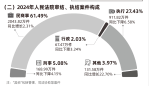
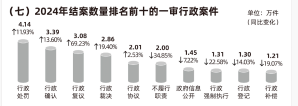
The report’s structure is the usual one for specialized reports: highlights of the accomplishments of the Chinese courts in administrative cases since 2015,  when the SPC last reported to the NPC Standing Committee on the hearing of administrative cases, followed by a summary of outstanding challenges and suggestions to the NPC Standing Committee for future work. A single sentence in the introduction reveals information about the relationship between the Party leadership and the SPC in reporting to the NPC Standing Committee.  “In April 2024, the Party Leadership Group of the Supreme People’s Court submitted a special written report to the Party Center for the first time on the administrative trial work of the people’s courts.”  What this signals is that submitting a written report to the Party Center is now part of the SPC’s procedure in preparing such specialized reports but was not required in 2015, when the SPC last reported to the NPC Standing Committee on administrative litigation. It would have been part of the drafting process of the 2022 specialized report on foreign-related litigation work as well as the 2023 one on environmental and natural resources litigation work. Similar to the foreign-related adjudication report,  the introduction takes an inclusive view of accomplishments: judicial interpretations, policy documents, typical and guiding cases, as well as correctly deciding important cases.  My summary has omitted most case summaries included in the report. The first part of the report provides overall statistics. From 2016 to September 2024, people’s courts at all levels heard a total of 2.421 million first-instance administrative cases and handled 1.841 million administrative non-litigation enforcement cases  (see below for an explanation of these cases) (so many more than foreign-related cases  (384,000 from 2013-2022)).  Administrative cases account for a small proportion of the cases in the Chinese courts. See this excerpt from this year’s SPC report to the NPC, showing that only 2% of the cases in the Chinese courts were administrative. The causes of action that accounted for a relatively high proportion of the concluded first-instance cases were administrative penalties such as fines and administrative detention, administrative confirmation such as social security qualifications or work-related injury recognition, administrative rulings such as confirmation of natural resource ownership, and “non-performance of duties” such as requests for administrative agencies to perform their statutory duties. See this excerpt from the NPC report providing this information as a graph. distribution of 1st instance administrative cases

SPC Accomplishments

 1. Serving the overall situation and promoting high-quality development with fair justice

This section first highlights improving the business environment.  It reiterates one of the themes of the report: “we supervise and correct illegal administrative behaviors that infringe on the legitimate rights and interests of various business entities, and strongly support administrative agencies in performing their regulatory duties and maintaining market order according to law.”  Accomplishments include:
  • issuing typical cases on unified market administrative litigation; hearing 316,000 first-instance administrative cases related to business, such as administrative licenses, administrative agreements, administrative promises, and administrative penalties with an average annual growth of 23.3%.  The report does not explain the high growth rate.
  • serving the innovation-driven development strategy according to law (intellectual property and related issues). This section flags that the courts heard 138,000 first instance intellectual property administrative cases involving intellectual property rights with an average annual growth of 20.3%, also with no explanation. The remainder of this part flags the work of the SPC outside the courtroom (about which I am writing more):
On administrative cases in specialized areas, such as environmental and natural resource protection and real estate expropriation cases: 118,000 first-instance environmental and natural resource administrative cases, with an average annual increase of 14.9%, also without explanation; 425,000 first-instance administrative cases involving house and land expropriation and demolition, with an average annual growth of 8.8%, also with no explanation as to reasons.

2. Justice for the people and safeguarding the well-being of the people with fair justice

This section focuses on cases related to people’s livelihood (“民生”). Again, it reiterates the themes of support vs. supervision and substantive resolution of administrative disputes to maintain social stability.  Useful information in this section:
  1. The number of first-instance administrative cases has increased by an average of 5.3% annually since 2016.
  2. The SPC will improve its mechanisms for dealing with applications for the retrial of administrative cases, including pre-retrial resolution.  It can be surmised that the number of applications for the retrial of administrative cases at the SPC is close to pre-Covid numbers, but statistics are not available. Jiangsu will pilot legal aid in administrative litigation.  This signals the importance of legal advice for both efficient case resolution and better communication with litigants.
  3.  The SPC emphasizes that it supports administrative agencies in punishing illegal acts such as endangering food and drug safety, damaging the ecological environment, and withholding wages for migrant workers.  It also signals that the courts will supervise those  with the occasional [common?]  problem of “heavy penalties for minor offenses” [likely linked to profit-making administration].  The SPC signals that those issues should be handled outside the courtroom, through outreach to law enforcement, to promote fairness and openness, commensurate penalties, and combining penalties with education.
  4.  On the substantive resolution of disputes, the report uses as an example a case handled by the SPC and later provides an example of an analogous case handled by the military courts. For the outside observer, the SPC case provides an example of the SPC’s unique role. The cases involved three brothers surnamed Sun who filed 137 administrative lawsuits and applications for retrials related to social insurance and were long-term petitioners. The original trial court dismissed the cases because the statute of limitations had expired. After review [it is not explained how their case came before the SPC], the SPC took the view that the brothers’ demands were basically reasonable and could be resolved according to the current social security system, although the ruling by the trial court was not wrong.  The SPC notes that the dispute was unresolved and might even intensify. Therefore, mediation was organized together with the administrative authorities, and a package solution was reached. The case demonstrates the importance of substantive resolution of administrative disputes and for litigants, making a fuss to resolve a dispute.
  5. As an example of developing the “Fengqiao Experience” in the new era,  1,966 administrative dispute resolution centers were established.  (At least two have been established in Shenzhen, and I hope that they welcome foreign visitors.)
3. Organic Link Between Law Enforcement and the Judiciary
This section emphasizes that the courts have a statutory duty to supervise government action and that “supervision means support and support means supervision.”  Examples of supervision include:
  1. A limited number of cases (2664) in which courts engaged in an incidental review of normative documents.   That is consistent with academic research.
2.  Court supervision of administrative action by refusing to enforce certain non-litigation enforcement cases.  As explained in this academic article, when administrative agencies apply to courts to enforce an agency decision when the persons involved do not voluntarily fulfil the obligations required, a court will review the legality of the administrative decision.  The report states that 368,000 administrative non-litigation enforcement cases were handled by courts ruling either not to enforce or not to accept the enforcement case, accounting for 20% of the total number of administrative agencies’ applications for enforcement. This number is larger than what I have seen elsewhere. 3.  The SPC, the Supreme People’s Procuratorate, and the Ministry of Justice established a “3+N” working mechanism with the National Development and Reform Commission, the Ministry of Finance, and the Ministry of Natural Resources.  The goal of the mechanism to analyze and evolve measures to deal with frequently arising administrative disputes.  [These disputes are presumably related to housing demolition]. 4.  Eight courts in Beijing have established an administrative law training base for officials using case-based law teaching. Courts in several provinces have established a regular consultation mechanism with administrative agencies. 5. The rate of administrative agency heads appearing in court to respond to lawsuits in the first instance has steadily increased year by year.  For more on this system with Chinese characteristics, see these academic articles for more details. 6. As I wrote last year, the SPC works with the Ministry of Justice (and correspondingly, lower courts do the same with justice authorities) to encourage litigants to seek administrative reconsideration before going to court. 102,000 first-instance cases that have been reviewed after administrative reconsideration were heard. Last year the number of administrative reconsideration cases exceeded administrative litigation cases for the first time.

Administrative Litigation-Related Judicial Reform

This section, among other content, summarizes the administrative litigation reform measures the SPC has undertaken and the expansion of its “guidance toolbox” (监督指导的“工具箱”).  I will have more to say about the SPC’s guidance toolbox in an article to be published later this spring.
  1. The SPC has implemented the arrangements of the Party Center on jurisdiction in administrative cases and has established courts with cross-administrative jurisdiction, such as the Beijing No. 4 Intermediate People’s Court and the Shanghai No. 3 Intermediate People’s Court. See related academic research (but behind the paywall).   The SPC issued procedures on simplified procedures, used in 149,000 first instance cases.  The military courts have implemented administrative litigation–see this summary of the authorizing  notice issued by the Central Military Commmission’s Political-Legal Commission.  However, related information is scarce.
  2. On trial supervision, 1.209 million administrative cases of second instance were heard in accordance with the law, with a retrial rate of 7.2%; 327,000 cases of various types of retrial applications were handled (unclear how many at the SPC), and 1,604 cases of protest by the procuratorate were heard.
  3. I’m personally glad to see the SPC use the phrase “guidance toolbox,” as that is how I have visualized it. That toolbox includes the platforms Court Answers Platform and the People’s Court Case Library, as well as the more traditional guiding and typical cases.
  4. President Zhang Jun thanked the NPC Standing Committee for supporting the administrative litigation work of the courts through promulgating legislation and authorizing pilot projects.

Challenges

  1. Law-based governance needs to be improved. The large number of cases in some areas (unspecified) is not only linked to the interests of ordinary people but also reflects that the link between administrative enforcement and the judiciary needs to be improved. Some judges deal with cases mechanically and are not easily able to resolve administrative disputes from the source by communicating with administrative agencies on solutions to avoid future cases.
  2. The courts need to improve joint efforts to resolve administrative disputes in substance. This is reflected in the high appeal rate and the high rate of application for retrial.  However, some [unnamed] administrative agencies are unwilling to resolve administrative disputes on their own initiative or correct illegal administrative behavior and do not implement court decisions adequately or in a timely manner.  Problems still remain with agency leaders appearing in court.
  3. The smooth connection between pre-litigation mediation, administrative reconsideration, and the administrative litigation of administrative disputes is lacking.
  4. Some disputes involve multiple regulators, and therefore, a plaintiff needs to sue each regulator separately rather than bringing a consolidated procedure.

Improvements Needed

  1. Uphold Party leadership of the judiciary.  This implies local people’s courts regularly reporting to local party committees, informing the government about administrative judicial work in their jurisdictions, closely relying on the leadership of the Party, and actively seeking government support to promote the resolution of complex contradictions and problems involved in administrative cases.  Zhang Jun stated: we must look at these cases from a political perspective and handle them according to  the rule of law, and act “if I were suing.” 
  2. Better serve the high-quality development of the economy and society. This means correcting agencies using administrative power to exclude and restrict market competition and to serve the strategy of constructing a unified national market. On the topic of profit-seeking administration,  it calls for local courts to supervise the illegal use of administrative means to intervene in economic disputes and protect property rights and strengthen judicial supervision of administrative measures such as sealing, seizure, freezing, and administrative compulsory execution. This was mentioned just as “deep-sea fishing”  by administrative agencies came to national attention. Finance, land, and employment administrative cases were highlighted.
  3.  The report reiterates the organic connection between administrative cases and other related procedures such as administrative reconsideration, procuratorate oversight of administrative matters, pre-litigation mediation of administrative disputes, and legalization of petition work.  This includes: improving legal aid for administrative litigation (as mentioned above),  requiring judges to clarify and guide litigants in administrative cases; implementing a pre-trial meeting system and other measures.  This section stresses the role of mediation and emphasizes improving the reasoning of decisions. On the trial quality management indicator system,  the SPC calls for implementing related trial management measures suitable for administrative cases and shifting the focus of trial work from “whether the case is closed” to “whether the dispute is resolved”.  Any reader who has made it thus far in this summary would not be surprised.
  4. On supervision and support,  the SPC has several suggestions:
    1.  regarding areas where analogous cases frequently arise, create an analysis and notification system to report to the local Party Committee cases that administrative agencies lose and their implementation of effective judgments [presumably those that they lose]; report typical cases to administrative agencies, and strengthen coordination.
    2. further promote the increase in the rate of administrative agency leaders appearing in court to respond to lawsuits, encourage administrative agency leaders to “appear in court and speak out.”
    3. On future SPC administrative litigation judicial interpretations and policies, the report mentions the drafting of judicial interpretations and judicial policies such on housing expropriation and compensation on state-owned land; regulatory documents for the review of administrative documents in the course of administrative litigation, and joint trial of civil disputes, and other measures for unifying legal standards in similar cases. Another issue that the SPC is considering is identifying and regulating abusive administrative litigation, similar to other areas of the law.

Concluding Remarks

President Zhang Jun concludes by suggesting the reform of the jurisdiction system of administrative cases, in which intermediate courts hear major and complex cases; basic level courts hear simple cases through centralized jurisdiction (concentrating them in one basic level court); and the role of the mediation system in resolving administrative disputes is improved.  He also suggests amending the Administrative Litigation Law to improve the linkage between administrative reconsideration and administrative litigation and improve alternative methods to resolve administrative disputes.

A Few Comments

This specialized report provides a useful glimpse into Chinese administrative dispute resolution in the New Era.  For the outside observer, many elements of administrative justice/administrative dispute resolution with Chinese characteristics are visible.  Among those, as stressed in the summary above, are the multiple mechanisms for supervising administrative agencies outside the courtroom and the growing importance of mediating administrative disputes.   _______________________________ Many thanks to Professor Chen Tianhao of the Tsinghua University School of Public Policy and Management for his comments on an earlier draft of this blogpost!

Supreme People’s Court Details Foreign State Immunity Procedures

At the end of March, the Supreme People’s Court (SPC) issued procedures to implement China’s Foreign State Immunity Law (the Law) in the form of a  “Notice on Procedural Matters in Civil Cases Involving Foreign State Immunity” (Notice) 关于涉外国国家豁免民事案件相关程序事项的通知. That law has been in force since the beginning of 2024.  Consistent with its practice, the SPC published a press release along with the text of the notice.  The press release, in the form of the head of the SPC’s #4 Civil Division’s answers to reporters’ questions, provides useful background. I surmise that the press release is an edited version of materials submitted to SPC leadership for approval (as described in my 2024 article). I had anticipated that the SPC would do so, after additional research and soliciting comments from both inside and outside the court system but had guessed that a notice would be issued in 2024.  Although the notice does not so state, I surmise that foreign state immunity cases will be considered “important and difficult” and therefore subject to special internal procedures.  See Professor William Dodge’s article for comparisons to US law and comments on the Law.  Professor Huo Zhengxin provides another perspective. This post summarizes the major points of the notice, with my comments.

  1.  The general rule is that foreign governments and their property have immunity, with exceptions as set out in the Foreign State Immunity Law.  The press release usefully makes clear that Article 1 of the Notice requires that a plaintiff filing a civil lawsuits against a foreign state as a defendant or third party, must list in the complaint the specific provisions of the Law the lawsuit is based on, and explain which exception it falls into for the court to review. The court also has the responsibility to clarify (释明) the complaint in the process of receiving the complaint. “Clarify/clarification” here is a term in Chinese Civil Procedure Law, analogous to a judge’s right in other civil legal systems–the “right to ask, suggest to or require the parties to clarify or supplement their ambiguous, insufficient or improper claims, submissions or evidence.” If the plaintiff still fails to set out the legal basis after the court’s clarifications,  the plaintiff should be deemed to not have met the court’s requirements, and the court should reject the case.
  2. For those first instance civil cases that fall into the exceptions to the Foreign State Immunity Law, certain intermediate courts in provincial capitals (or their equivalent in directly administered cities, etc) have jurisdiction, as well as financial and intellectual property courts.  The notice limits the number of courts that can hear foreign state immunity cases (as I had surmised), through centralizing jurisdiction (集中管辖), but permits financial courts and intellectual courts to hear them and requires other courts to transfer cases that they have accepted to ones with jurisdiction.
  3. Article 3 concerns service of process, which must be according to relevant treaties or conventions, or other means not prohibited by the law of the foreign country, or alternatively by diplomatic note (via the Ministry of Foreign Affairs) (Article 17 of the Law).  Service by announcement is prohibited.
  4. The court must serve the complaint and other documents with a translation accompanying the original Chinese.  The foreign government has three months to file a defense. The court has the discretion to permit an extension of time.
  5.  If the foreign state objects to the jurisdiction of the Chinese court, the court shall engage in a comprehensive review ex officio and may hear the views of the parties.  Participation in an objection procedure is not deemed acceptance of Chinese jurisdiction (also Article 6 of the Law).  If the foreign state does not respond or participate in the Chinese proceedings, the Chinese court must proactively review whether the  foreign state has immunity and can hear the views of the parties.  (Article 18 of the Law). The press release provides guidance to lower courts on the review:  first, the people’s court should examine whether the reasons put forward by the foreign country for enjoying jurisdictional immunity are valid; second, if the reasons put forward by the foreign country are not valid, the people’s court should also conduct a comprehensive review on its own initiative, that is, in addition to the reasons, examine whether the foreign country really enjoys jurisdictional immunity and does not fall into the exception to jurisdictional immunity.
  6.  If a court requires a certificate  on factual issues of state behavior from the Ministry of Foreign Affairs (further to Article 19 of the Law), it shall report to the Supreme People’s Court level by level (逐级报)  to consult and request (商请) the Ministry of Foreign Affairs to issue a certificate.  This one sentence conveys the bureaucratic operation of the Chinese court system and the nuances of inter-bureaucracy relations.

An attachment to the notice lists the authorized courts. The SPC has approved some of these courts to establish international commercial tribunals (courts).  It is likely that those tribunals will hear sovereign immunity cases:

  1. Beijing Fourth Intermediate People’s Court (with an international commercial tribunal)
  2. Tianjin No.3 Intermediate People’s Court
  3. Shijiazhuang Intermediate People’s Court of Hebei Province
  4. Taiyuan Intermediate People’s Court of Shanxi Province
  5. Hohhot Intermediate People’s Court of Inner Mongolia Autonomous Region
  6. Shenyang Intermediate People’s Court, Liaoning Province
  7. Changchun Intermediate People’s Court of Jilin Province
  8. Harbin Intermediate People’s Court of Heilongjiang Province
  9. Shanghai No.1 Intermediate People’s Court (with an international commercial tribunal)
  10. Nanjing Intermediate People’s Court of Jiangsu Province (with an international commercial tribunal)
  11. Hangzhou Intermediate People’s Court, Zhejiang Province (with an international commercial tribunal)
  12. Hefei Intermediate People’s Court, Anhui Province
  13. Fuzhou Intermediate People’s Court of Fujian Province
  14. Nanchang Intermediate People’s Court of Jiangxi Province
  15. Jinan Intermediate People’s Court, Shandong Province
  16. Zhengzhou Intermediate People’s Court of Henan Province
  17. Wuhan Intermediate People’s Court, Hubei Province
  18. Changsha Intermediate People’s Court of Hunan Province
  19. Guangzhou Intermediate People’s Court, Guangdong Province
  20. Guangxi Zhuang Autonomous Region Nanning Intermediate People’s Court
  21. Hainan Provincial First Intermediate People’s Court
  22. Chongqing First Intermediate People’s Court
  23. Chengdu Intermediate People’s Court of Sichuan Province
  24. Guiyang Intermediate People’s Court, Guizhou Province
  25. Kunming Intermediate People’s Court, Yunnan Province
  26. Lhasa Intermediate People’s Court of Tibet Autonomous Region
  27. Xi’an Intermediate People’s Court of Shaanxi Province
  28. Lanzhou Intermediate People’s Court of Gansu Province
  29. Xining Intermediate People’s Court of Qinghai Province
  30. Yinchuan Intermediate People’s Court of Ningxia Hui Autonomous Region
  31. Urumqi Intermediate People’s Court, Xinjiang Uygur Autonomous Region

__________________________________

Some Observations on the Judicial Reform Process

This post is the written and English-language version of a speech I first delivered in Chinese at the annual meeting of the Shanghai Judicial Think Tank Society (Think Tank Society, 上海司法智库学会, sponsored by the Shanghai Higher People’s Court) on November 30, 2024, held at Shanghai Jiaotong University.  (The official report on the meeting is available here.) The views are my own and should not be attributed to the Shanghai Higher People’s Court or the Think Tank Society. I would like to express my appreciation to Dean Jiang Huiling(蒋惠岭)and Professor Luo Tianxuan (罗恬漩) of Tongji University for the kind invitation to participate in the meeting.  Further acknowledgments can be found at the end of this post.

the author giving the presentation on which this post is based

Front-line judges often tell the author that “judicial reform is a failure,” although the author does not take their words literally. It is their way of expressing dissatisfaction with aspects of the design and implementation of judicial reform. The official view is that judicial reform is a success, and the basic structure (四梁八柱) of judicial reforms has been constructed in the past 10 years, although work continues to be needed in specific areas. The author is not prepared to say simply that judicial reform is a success or failure, particularly when significant gaps in information prevent the author from making a comprehensive, objective, and informed assessment. Although the author has only been a minor player in the complicated drama of drafting, implementing, and internally evaluating judicial reform in the last ten years, she considers herself fortunate to have the opportunity to monitor it closely and know personally many involved.

Within the limits of this short essay, the author focuses on the “front-end” and “back-end” of the judicial reform process. Her focus is on the process of deriving reforms that fit courts with widely different resources, and internal and external environments. The author roots her comments in the highly complex reality of the Chinese courts and with an international perspective.

Front-end Issues

The author considers that the “front-end” of judicial reform is most important–the drafting of judicial reform plans. She considers four aspects particularly important for the overall success of judicial reforms: evaluating local innovations; pilot projects and foreign mechanisms or experience; improving centrally designed mechanisms; and enabling greater stakeholder input into the judicial reform process. Each has separate and common challenges.

The author turns first to local innovations, pilot projects and foreign mechanisms or experience.  Pilot projects are undertaken to “test drive” a possible reform while local innovations, draw on local wisdom and institutions to experiment with a new mechanism. She discusses these together because when reformers consider whether these specific experiences are suitable to be promoted nationally, the challenges are similar.

Family trial reforms (家事审判改革) provide a good example because they involve the above three aspects–evaluating foreign experience, domestic innovations, and pilot projects. In the case of family trial reforms, the relevant reform leaders were able to travel overseas to observe family courts and the ecosystem surrounding them and brought foreign experts to China to discuss specific issues and the related institutions needed to make family trial reforms successful.

Given the geopolitical changes of recent years, this type of onsite research is not as easy to accomplish. Foreign experience is particularly challenging to consider in the context of judicial reform. The first issue is understanding the foreign experience accurately, because written materials may not be comprehensive and fail to explain the institutional infrastructure on which the success of the mechanism is based. International travel to experience that mechanism may not be as feasible as previously, given constricted budgets. A third issue is the issue of “moving the foreign plant to Chinese soil,” to consider whether the mechanism will work as anticipated, given that related institutions operate in a different environment from those abroad.

Next to a pair of related mechanisms–pilot projects, which are undertaken to “test drive” a possible reform, and local innovations, which often draw on local wisdom and institutions to experiment with a new mechanism. The author discusses them together because they share a common challenge when reformers consider whether these two specific experiences are suitable to be promoted nationally. A pilot project approved by the Supreme People’s Court is likely to enjoy more resources, guidance from the Supreme People’s Court and possibly the Legislative Affairs Commission of the National People’s Congress (if delegation legislation is involved), support from local court leaders, as well as relevant institutions outside the courts.

The piloting of family trial reforms in recent years provides a good example.  A research team based at Xiamen University* assessing those reforms found large disparities in whether those reforms were successful or even implemented, depending on many factors, such as whether the court was in an urban or rural area, the commitment of supporting organizations, whether local court leaders were committed to the reform and the case burden of individual judges. Pilot courts in urban areas could liaise with psychological counselors and mediators trained to resolve family disputes to achieve better outcomes. Rural judges generally did not have such resources available. The research team found that when judges were overburdened with cases, they would revert to usual practice, following reform practice only when needed for court news releases.

Should judicial reformers have anticipated the gap between rural and urban courts, and the cultural differences in different geographies, particularly in rural areas? Now that these gaps are known, what should be done to improve outcomes for rural as well as urban families? Perhaps special arrangements can be considered to support court teams hearing family matters in rural courts, as is done in some other jurisdictions, such as Australia, but that requires further research and analysis. [Family trial reforms are listed in point 6 of the Sixth Five-Year Reform Outline, issued in December 2024].

Next, on the phenomenon of centrally designed measures implemented with apparently limited input from affected persons. One recent example of this is the recently revised trial quality management indicator system (审判质量管理指标体系). Although the official view is that the relevant departments had engaged sufficient research and input from experts (充分调研论证) and one-half year of piloting the new trial quality management indicator system, from the fact that after nine months of official implementation of the system, “in order to reduce the burden on the lower courts (续深化给基层减负工作)” the number of indicators was reduced from 26 to 18 strongly suggests that after the system was fully implemented, the negative reaction from lower court judges was very strong. Had the relevant departments done a more representative survey of the views of lower court judges on this, the embarrassment of reversing themselves within several months could have been avoided.

Reforms designed without involving the personnel directly affected, without stakeholder input, are not likely to meet their goals. It is unlikely that a small team of persons working in Beijing have sufficient evidence, data, and analysis to reflect the varied types of judicial work and the complex environment in which judges work. It is unclear which type of courts piloted the new indicators and whether the piloted courts considered it prudent to provide responses that the relevant departments sought. This author surmises that it could make sense to have different sets of indicators for urban and rural courts, instead of having a single standard for all, but making that recommendation would require more data and analysis than this author has available. The author has heard lower court judges describe this reform as another example of “building a cart behind closed doors (闭门造车).”

Back-end Issues

The crucial part of the “back-end” of judicial reform is analyzing the results of a reform, or more likely the multiple reforms that have been launched and considering whether further continuity is needed in the form of measures to sustain the reform or to compensate for problems that become apparent. The current judicial system contains many such unfinished judicial reforms. One example of an unfinished judicial reform is the role of the judges assistant (法官助理).* [The reform is now listed in point 41 of the Sixth Five-Year Reform Outline].  Law and Supreme People’s Court guidelines have not defined clearly the scope of a judicial assistant’s work. This lack of clarity has an impact on the operation of the entire judicial system. Reforms themselves need continuity.

Conclusion

It is a truism that Chinese judicial reform is a highly difficult and complex matter, as the brief discussion above has signaled. The development of a modernized judiciary depends on cultivating judicial reform specialists possessing the entire package of skills required to evolve and implement judicial reforms appropriate for all Chinese courts, whether they are urban or rural, large or small, specialized or general. These specialists need to combine deep local knowledge with that of international “best practices.” Reformers need to be able to focus on front-end and back-end matters, including accurately evaluating foreign experience, pilot projects, local innovations, and incomplete reforms. They also need to involve stakeholder input to the extent possible, so that judicial reform measures most closely fit the complex needs of the Chinese judicial system.

The author hopes that these views are useful as a whole or in part.

______________________________________

*The two examples of uncompleted judicial reforms mentioned above draw on the research and experience of Zeng Yuhang (曾宇航, STL 4L student, on family trial reform) and Xue Ye (薛偞, 2023 graduate of STL, on judicial assistant reform).

Many thanks also to Yuan Ye (袁野), PhD student at Peking University Law  School (and 2022 graduate of STL) for transforming PowerPoint slides written in 洋式中文 into standard Chinese.

Supreme People’s Court Developments, December 2024-January 2025

from the report on the 2025 Central Political-Legal Work Conference on one of the SPC’s websites

See below a brief summary of recent developments  (or at least the principal recent developments) at the Supreme People’s Court (SPC) in January 2025 (as of January 19, the date of publication of this post) and December 2024.

January 2025

  1. On January 8th, the Party leadership heard the SPC Party Group’s report on the SPC’s work, along with those of other institutions.  I mention the requirement for this report in my 2024 article;

certain phrases (such as “report to a superior on their work” [shuzhi 述职] imply a hierarchical relationship between the SPC and the Central Political-Legal Committee and the Party Center. The fact that the SPC reports to the Party leadership can be seen in public reports on the leadership of the political-legal institutions meeting with Xi Jinping and other senior leaders before the annual sessions of the National People’s Congress and Chinese People’s Political Consultative Congress, although the materials actually submitted to the Party leadership are not publicly accessible.)

2.  January is when many important conferences are held that have an impact on the work of the courts: the Central Political-Legal Work Conference (中央政法工作会议) and the National Conference of Higher Court Presidents (Higher Court Presidents Conference 全国高级法院院长会议),  at which the spirit of the Political-Legal Work Conference is transmitted and the goals for judicial work in 2025 are announced. The SPC has held this conference annually for many years. In the recent historical past (the early 1990’s, for example), the Higher Court Presidents Conference was called the National Court Work Conference.

3. Policy documents: 

a. In early January, the SPC and the All-China Federation of Overseas Chinese (Overseas Chinese Federation 中国侨联权益保障部) issued a joint policy document on the strengthening the judicial protection work of the interests of overseas Chinese and returned overseas Chinese and their families in the New Era (关于加强新时代侨益司法保护工作的意见), and related reference cases.  The document seeks to ease litigation formalities for these groups and promote resolving disputes through mediation, among other matters, such as improving research on Overseas Chinese-related issues, such as through establishing a research base, as has been done with other issues.  The title of this document differs from Zhou Qiang era policy documents, but the goal of providing judicial support for an important national policy goal is the same. 

The SPC’s Research Office led the drafting of this document, in cooperation with the Overseas Chinese Federation.  This responsibility is consistent with the role of the Research Office, which deals with many legal policy and cross-internal institutional matters, such as Hong Kong, Macau, and Taiwan-related issues and the transition to the Civil Code.  It does not hear cases.

This is the first joint policy document between the SPC and Overseas Chinese Federation. Closer cooperation between the two institutions began in 2018, with 30 courts piloting closer cooperation with local Overseas Chinese Federations, and with the 2020 establishment of a “general-to-general” online mediation mechanism (the SPC has established this type of mechanism with the China Securities Regulatory Commission and other institutions).    The policy document is linked to language in recent Party Plenums on protecting the rights of returned Overseas Chinese and Overseas Chinese and their families.

b. Opinions of the Supreme People’s Court on Serving Technological Innovation with High-quality Trial Services 最高人民法院关于以高质量审判服务保障科技创新的意见.  The press conference report is here.  China IP Law Update’s summary in English is here.  If time had permitted, I would discuss the links in this document with the recent Party Plenum and other Party initiatives.

4. Judicial interpretations:

a. The SPC issued its second interpretation of the Marriage and Family Part of the Civil Code, aimed at addressing common troublesome issues facing the courts, such as property division when a cohabiting couple split, many issues relating to divorcing couples, including property division and ownership of a company established by a couple.  To provide further guidance on applying the interpretation, the SPC issued typical cases. This interpretation provides important insights into family law issues in current Chinese society.  

b.  The SPC joined with the Supreme People’s Procuratorate to issue the Interpretation of Several Issues Concerning the Application of Law in Handling Criminal Cases of Attacks on Police Officers (关于办理袭警刑事案件适用法律若干问题的解释).  From the provisions of this interpretation,  the confusion lower-level procuratorates and courts had about the application of Article 277 of the Criminal Law is apparent.

5. Other typical cases issued in January included: one on protecting natural reserves and national parks; another on punishing rural saohei (underworld forces) crimes; protecting the rights and interests of foreign investors; and refusing to pay wages (6200+ cases in the past four years)

6. The SPC established its Judges’ Disciplinary Committee, with President Zhang Jun as the chair.  At the first meeting, he noted that the establishment of a judges’ disciplinary committee and the implementation of a judges’ disciplinary system are political requirements for implementing the decisions and arrangements of the CPC Central Committee.  In 2021, I published a book chapter on Chinese judicial disciplinary developments, available here.

December 2024

December is the end of the year, so the SPC always issues many documents–judicial interpretations, policy documents, guiding and typical cases etc. at year’s end.  2024 was no exception. Among the documents worth noting:

  1. Judicial interpretations and meeting minutes

a. The SPC and the China Securities Regulatory Commission (CSRC) issued meeting minutes (conference summary) on bankruptcy (insolvency)  and reorganization of listed companies.  From the document number, it appears that the SPC took the lead in drafting it and it provides an update to a 2012 conference summary that the SPC issued itself. A DeHeng law firm partner comments here on the meeting minutes. The CSRC is soliciting public comments on Regulatory Guidelines for Listed Companies No. 11 – Matters Related to Bankruptcy and Reorganization of Listed Companies (this link contains the text and an explanation).  

b. On December 25, the SPC issued a Decision on Amending the Supreme People’s Court’s Regulations on Acknowledgement and Execution of Civil Judgments from Taiwan Area Courts, Chinese original 最高人民法院关于修改《最高人民法院关于认可和执行台湾地区法院民事判决的规定》的决定.  An English language summary is available here.  From a quick look, most amendments are procedural or unsurprising. Some reflect amendments to the Civil Procedure Law or codifying court practice. The provision “the people’s court shall make a ruling not to acknowledge a civil judgment if acknowledging it would violate fundamental principles of state laws, such as the one-China principle, or undermine state sovereignty, security, or social public interests” is consistent with analogous provisions and codifies what has been court practice.

2.  Guiding cases: on December 25, the SPC issued six guiding cases on state compensation issues, some of which provide glimpses of problems with prison management; On December 24, the SPC issued the first group of guiding cases on labor issues.

3. Typical cases: The SPC issued many typical cases in December 2024. As I mentioned previously, President Zhang Jun favors using typical cases to guide the lower courts in correctly applying the law.

The SPC issued typical  cases on: the protection of the rights and interests of the elderly; administrative public interest litigation (second group), issued jointly by the SPC and SPP;  “one letter and two books”  labor law supervision, issued jointly by the SPC, the SPP and the All-China Federation of Trade Unions;  wage arrears, issued in cooperation with the All-China Federation of Trade Unions and the Ministry of Human Resources and Social Security;  two groups of financial loan dispute mediation cases, issued by the  State Financial Supervision and Administration Bureau and the SPC, with one case providing a model for dealing with non-performing microloan cases; rights and interests of Taiwan compatriots, linked to the Party’s policy on promoting cross-straits integration and development; crimes involving counterfeit safety production qualification certificates (linked to a policy document issued in July, 2024 that does not appear to be publicly available (关于进一步加强安全生产资格证书涉假案件刑事审判工作的通知)); petty corruption (each case provides insights into the world of official corruption); punishing illegal production, sales, and use of eavesdropping and stealing equipment, with several cases involving the hidden filming (and marketing of those films) of people having sex in hotel rooms; inheritance disputes (first  and second group); criminal punishment of illegal fishing; and traffic accident liability.

3. Policy documents: Guiding Opinions on Improving the Quality and Efficiency of Trial Work and Promoting the Substantial Resolution of Contradictions and Disputes (关于在审判工作中促进提质增效 推动实质性化解矛盾纠纷的指导意见).  This document focuses on civil and administrative disputes, promoting mediation (Fengqiao Experience) and the resolution of the substance of disputes (as discussed here).  I will draw on this document in a forthcoming article.

4. Plans: 

a. the SPC issued the Sixth Five-Year Judicial Reform Outline.  This article links to the text of the Outline and the related press release. I will publish an article later this year providing a summary and analysis of this document. 

b.  the SPC issued the National Court Education and Training Plan (2024-2028).  I analyzed the previous two plans here and here.  Training of judges handling foreign-related matters receives special attention (see my earlier analysis).

5.  National People’s Committee (NPC) Standing Committee’s Recording & Review:  SPC judicial interpretations and other judicial documents must be filed with the NPC Standing Committee. At the end of 2023, the NPC SC adopted a decision strengthening the recording and review mechanism (see the NPC Observer’s analysis). On 22 December 2024, the Legislative Affairs Commission of the NPC Standing Committee gave its view in its annual report on Recording and Review that a July 2024 Supreme People’s Court interpretation that directed lower courts to retroactively apply a new provision in the recently revised Company Law concerning equity transfers,  controversial in the business community,  was inconsistent with the Legislation Law. The Legislative Affairs Commission stated that the “[they] will urge the relevant judicial interpretation-making authorities to take appropriate measures to properly handle the matter.”  The SPC issued a follow-up interpretation two days after the annual report was made public, signaling that the SPC had been previously been informed.  Although the problematic July 2024 interpretation must have been reviewed by the Legislative Affairs Commission in draft form before it was approved by the SPC judicial committee, as required by Article 18 of the SPC’s Judicial Interpretation Work Provisions, it appears that that whichever office of the Legislative Affairs Commission initially reviewed the SPC’s draft and the office responsible for recording and review took different views. 

____________________________________________________

Thank you, subscribers, for your patience.  The blog will transition from being completely researched and written by me (including discussions with knowledgeable persons and experienced judges, for the avoidance of doubt) sometime after Chinese New Year. I plan to involve my research assistants more in analysis and writing, although I have at least one long analytical blogpost that I will complete soon.   I want to focus on consolidating and developing my research in longer pieces.


Update on the People’s Court Case Database

By Susan Finder, with research assistance by Sun Jinping (孙金萍)

What do we know now about the People’s Court Case Database (Case Database, 人民法院案例库) that we did not know when in launched in late February 2024?  What insights do 10 months of operation of this case database provide?  This blogpost provides a consolidated analysis of the Case Database,  incorporating the work procedures for the Case Database (Case Database Work Procedures, 人民法院案例库建设运行工作规程), issued in May 2024, the analysis previously published on this blog in March 2024, and observations of practice, summarizing what the Case Database is, why it was established, some historical background, how cases are incorporated into the database,  comments from local judges on its usability, and my own comments on its significance.

What is the Case Database?

The Case Database (人民法院案例库)  provides a collection of 4338 edited cases (案例) rather than original judgments, rulings, or other judicial documents as collected in China Judgements Online (裁判文书网). According to the Case Database Work Procedures, the Case Database incorporates guiding cases and certain “reference cases” (参考案例) which have been reviewed and approved by the SPC.  The judgments in the reference cases must have come into force and have referential and exemplary value for the trial of similar cases. However, the Case Database Work Procedures do not define “reference cases,” or clearly situate them compared to guiding or typical (exemplary, model) cases.  The “Understanding and Application” article written by the principal drafters of the Case Database Work Procedures clarifies that “reference cases” “are a new type of edited case created by the Case Database system. Their effectiveness is higher than other cases except for guiding cases.” This is consistent with my earlier analysis that the selection process appeared to involve more reviews than typical cases, but fewer approvals than guiding cases. 

To provide an example for this article, I undertook a full-text search of the term “性骚扰“ (sexual harassment). It returned three cases, one guiding case, and two reference cases: Guiding Case No. 181: Zheng v. Honeywell Automation Control (China) Co., Ltd. (dispute over an employment contract);  黄某诉重庆某公司劳动争议案 (Labor Dispute, Huang v. A Chongqing Company); and a dispute over a right to reputation, Gong v. a Beijing Internet Technology Company 龚某某诉北京某网络技术有限公司名誉权纠纷案. (I have posted the full text of the reference cases, for those interested).

The Case Database is accessible from the SPC’s homepage, which is, the last time I checked, not accessible for those with a US IP address. I trust it can be accessed directly through the link provided above. It is intended to be accessible outside of China and appears to be hosted by the same platform as China Judgements Online.  Similar to the China Judgements Online Platform, it requires the user to register and provide personal information.  Even after such information is provided, the login process is not smooth for those without a mainland China identification card. 

Why this New Case Database?

Press conference announcing launch of the case database, including SPC VP Yang, head & deputy head of Research Office, & head of the All China Lawyers Association

The large number of model/typical/exemplary cases that the SPC has issued in the past year makes it clear that President Zhang Jun favors those to guide the lower courts, rather than large numbers of policy documents.  So the decision for the Chinese Courts Case Database to serve as a database for various types of edited and specially selected cases for their persuasive or exemplary value is consistent with the views of President Zhang Jun on the use of cases.  It is also consistent with the views of General Secretary Xi Jinping, who has stressed that “one case is better than a dozen documents (习近平总书记强调, “一个案例胜过一打文件”), 

The SPC has described it as a new public legal service product (公共法律服务产品).  It was launched before the Two Meetings ( National People’s Congress and Chinese People’s Political Consultative Conference meetings) in March (2024) and therefore it was featured in the SPC’s NPC Report.  The principal drafters of the Case Database Work Procedures describe it as useful for promoting the unified application of law and a tool for enhancing resolving disputes at source, that is oriented to both judges and the general public. It is the latest in a series of SPC platforms designed to promote the unified application of law.

The Case Database Work Procedures require a judge to undertake search  when undertaking a similar case search (see my former student’s description of the process). However, the reference case may not be used as the basis of a judgment, but a judge may use it in considering a case and the reasoning of a judgment or ruling, apparently without citation.

Background

The Case Database is yet another product of last year’s thematic education campaign (主题教育).  As described in my article published in US Asia Law Institute’s Perspectives, during the campaign, President Zhang required SPC divisions, offices, circuit courts, and affiliated institutions to undertake research focusing on current significant problems or issues in their area of law or responsibility and write reports proposing practical solutions. One of the problems brought to the surface during that campaign was that [edited] cases issued for guidance (案例指导) were not standardized, timely, comprehensive, or consistent.  Followers of this blog would have known that.

The Case Database Work Procedures provide that the database is the primary responsibility of the Research Office,  also involving other divisions and offices.

  Case Selection Process

The Case Database Work Procedures contains a lengthy section setting out the procedure by which reference cases are incorporated into the Case Database. They can be recommended by lower courts, universities, other institutions, or the general public.  The details of the process for selecting typical [foreign-related] cases contained in my article are consistent with the process described in the Case Database Work Procedures.  It is a bureaucratic process involving multiple levels of review. 

Depending upon the entity that has submitted the case, the proposed edited cases are reviewed by members of the relevant operational division of the SPC.  The Case Database Work Procedures provides that an SPC division (sitting as the professional judges meeting) reviews and discusses a group of cases for proper application of law, reasoning, and ethical orientation (value orientation 价值导向).  If the judges in the relevant operational division consider that certain cases are suitable for inclusion in the database, the division will report the case selectionto the relevant SPC leader for approval.  I surmise that an explanatory report accompanies the selected cases.  The cases are thereafter sent to the Research Office for review. During the review process, the Research Office reviews the format and substance of the selected cases, involving experts in the review.  As part of the formatting process, each case is labeled with a special number (see the attached cases). I surmise the initial approval by the SPC leader is subject to final clearance by the Research Office. Otherwise, the Research Office could be in the awkward position of negating a decision by a leader.  This procedure highlights the unique role of the Research Office at the SPC.

The Case Database Work Procedures also contain a procedure for updating or deleting reference cases that are no longer appropriate.

Case from Beijing Financial Court incorporated into database

The Case Database Work Procedures specify that the application of Case Database cases in the hearing of cases should be incorporated into a judge’s performance evaluation. From the number of WeChat articles on local court websites announcing the good news that one or more of their cases had been incorporated into the database,  it must be useful for court key performance indicators (KPIs).

Comments from judges

I surveyed an unscientific sample of judges on the Case Database, all highly experienced(资深) and located in major cities.  All said that they will refer to the Case Database, as it is required and found helpful when dealing with similar cases. One judge found that access to the database was not convenient. Several judges commented that the number of cases in the database is still small and the cases do not form a whole case group (that is, there are not a sufficient number of cases in a particular area of law), making it difficult for judges to undertake a case comparison.  One judge remarked that the case descriptions are overly abstract, with too many facts about the case omitted. That same judge noted that the names of the parties and case numbers are omitted, making it difficult to track down the original case.  

Comments

As  I wrote earlier, although the SPC describes the Case Database as providing more authoritative, standardized, and comprehensive guidance, with such a small number of cases in the database and such a large number of specialized issues that face Chinese courts daily, as a practical matter it is not a “one-stop platform” for Chinese judges or lawyers.  The insufficient number of details may reflect the designers’ desire to reach ordinary citizens as well as judges.   Although the drafters mentioned that they sought comments on their product, none of the judges I surveyed (from among the busier courts) had commented on the draft version of the product.  So it appears another example of a reform that could have benefited from more input from users, as I discussed in a recent presentation.  In my view, it would also make sense to incorporate SPC-approved typical cases into the database, to make searching easier for judges, lawyers, and others interested in Chinese cases.

I surmise from the procedures in the Case Database Work Procedures that discussing the selection of Case Database cases now occupies a good portion of the work-week of SPC judges. This would be consistent with earlier reforms seeking to focus the work of the SPC on guiding the lower courts.  

The Case Database appears to be reshaping case law with Chinese characteristics.  However, as I wrote earlier,  this also signals the dynamic nature of Chinese judicial policy, as the forms of SPC guidance of the lower courts have further evolved during 2024.  If an updated version of the 2020 rules on similar case search are issued, those would incorporate the Case Database and the Court Answers  Database.

Finally, although one aspect of the Fourth Five-Year Court Reform Plan Outline stressed reducing the administrative-type operation of the courts (去行政化), the establishment and operation of the Case Database evidences that times have changed.


_______________________________________________

Many thanks to an anonymous peer reviewer for reviewing this blogpost.

Guide to Finding Supreme People’s Court Materials: Journals of the Supreme People’s Court

Late last year (2023), some followers asked me to describe some of the principal sources for Supreme People’s Court (SPC) research. I’m doing this in several posts, as few (particularly outside of China) seem to be aware of the range of publicly available publications of the SPC and its many affiliated entities–see here, here, and here for earlier posts. This post was originally titled Academic Journals of the Supreme People’s Court, but I thought that incorporating some other journals made sense. If I’ve omitted any journals, please use the comment function to provide additional information.

Title Sponsoring Entity Content Other Comments
 Supreme People’s Court Gazette (最高人民法院公报) SPC’s General Office Detailed summary of content available here.  On the authority of Bulletin cases, see comments here
Journal of Law Application法律适用 National Judges College Description of its content is available here, but it is not current, the most current information is on WeChat.

It is one of the core academic journals in law.   More focused on specific legal issues than the Journal of Applied Jurisprudence; often includes studies by court research  groups;judges; academics.

In honor of the 500th issue,  their WeChat account published “‘Journal of Law Application’ and I”  posts– insightful short articles from among others, author Prof. Hou Meng of Renmin University & Judge Geng Baojian, head of the Administrative Divison about what the journal means to them.

China Journal of Applied Jurisprudence中国应用法学 China Institute of Applied Jurisprudence 中国应用法学研究所 (research institute attached to the SPC) The sections of the journal vary. The first one most recently related to Xi Jinping rule of law thought; general authoritative interpretation –understanding and application articles; often symposia on specialized issues–personal credit information, corporate compliance; AI See this video interview with deputy editor Ms. Yang Yi. The articles do not represent the views of the SPC but do not contradict them. Leading academics often publish in this journal, as well as some SPC judges.
Digital Law数字法治 New journal, began publication in 2023, sponsored by the People’s Court Press See this article for the contents of the first issue, Wangfangdata has more detailed informatiaon  
人民司法 People’s Justice It was started in 1957, so it is the oldest of the SPC journals, for part of its history, for internal use only (see one example below) Two issues per month, one with discussions of legal issues 人民司法 应用; one issue with cases:  –人民司法 案例 Not an academic journal, more practically oriented; the website is outdated but the WeChat account is current. The articles do not represent the views of the SPC, but do not contradict them.
China Trial 中国审判 Sponsored by the People’s Court Press See the magazine’s website magazine with a glossy cover, not an academic journal, mentioned on this blog here and here.
Old editions of 人民司法 & the Bulletin of the SPC, “from the archives”

Guide to Finding Supreme People’s Court Materials: Selected Journals of SPC Divisions (Consolidated Version)

Late last year, some followers asked me to describe some of the principal sources for Supreme People’s Court’s (SPC) research. I’m doing this in several posts, as few (particularly outside of China) seem to be aware of the range of publicly available publications of the SPC and its many affiliated entities–see here and here for earlier posts. This post summarizes the journals (actually periodic publications–each has an ISBN number) edited and written (at least in part) by the trial divisions and other offices of the SPC.   As far as I know, they are only in printed form, although sometimes some parts of the content can be found on WeChat. That means that those outside of China are rarely aware of their existence.  I assume that they are available through Taobao or Jingdong.  

The readers of these publications are judges and practitioners. The publications are specialized, in contrast to the Supreme People’s Court Gazette, and each one contains normative provisions and guidance related to the specific area of law.

A quick guide to the content listed: the judicial interpretations are normative, of course, and the “understanding and application” articles provide further explanation and background about judicial interpretations and sometimes policy documents. “Leaders’ speeches” are a statement of policy, substantive & political; relevant policy documents (such as the SPC/National Intellectual Property Administration policy document of February, 2023 contain policy and related political signals; the research & local documents are all related to current issues in the relevant area of law; and the typical cases/outstanding judgments provide guidance to judges & are useful reference materials for lawyers/in-house counsel because the results in the cases reflect the views of the Supreme People’s Court. The publications flag new issues facing the judiciary in the specialized area involved and sometimes include analysis of foreign laws or regulations or an account of a foreign court visit or symposium.  Each journal has a slightly different format.  It may be possible to find electronic compilations of these journals on WeChat.

These journals are mostly published by the People’s Court Press (人民法院出版社).   Some journals have local correspondents reporting on local developments.  It can be surmised from how frequently a journal is updated how useful the relevant SPC division sees it as a platform for guidance and publicity of their views.  Cases from these journals can often be seen reposted on WeChat. 

TitleSponsoring InstitutionContentPhoto/Other Comments
行政执法与行政审判 Administrative Law Enforcement and Administrative AdjudicationSPC’s Administrative DivisionA section entitled: Authoritative viewpoint” (#96 contained Administrative Division Deputy Head Liang Fengyun on how to implement XJP Legal Thought in the courts’ administrative trial work); Research on Specialized topics; Theory & practice; Case analysis; One of the six-in-one guidance mechanisms mentioned by the head of the SPC Administrative Division, Geng Baojian
执行工作指导 Guidance on Enforcement Work/ Guide to EnforcementSPC’s Enforcement Bureau 最高人民法院执行居The most recent edition is #84, published in July, 2024.  Some issues contain discussion by enforcement bureau chiefs; hot topics; empirical study; report on pilot reform; analysis of SPC case; analysis of local court cases; resolving enforcement cases at source. 
最高人民法院知识产权法庭审判指导与参考 Supreme People’s Court Intellectual Property Tribunal Trial Guidance and ReferenceSPC’s Intellectual Property Tribunal

Volume #3 contains: SPC IP Court Annual Report 2021; judgment digests summary; typical cases; law & judicial interpretations; judicial scholarship; research report; window on the world; SPC IP Court 2021 Major Events

民事审判指导与参考 Reference and Guide to Civil TrialSPC’s #1 Civil Division (w’ local correspondents)Latest volume is from 2023: special section on people’s tribunal work; special section on resolving disputes at source (诉源治理); special section on family disputes trials; frontier theoretical issues; special section on dowry issues; typical cases on food safety punitive damages; special section on wage arrears; typical cases on agriculture; local case analysis; research report; #1 civil division judicial conferences 
涉外商事海事审判指导 Guide on Foreign-Related Commercial and Maritime Trial


SPC’s #4 Civil Division

Last volume apparently published in 2020, but dated 2018; sections included leaders’ speeches; judicial documents; requests & responses (per Prior Approval system); case analysis; research report; new informationPreviously mentioned on this blog here
司法研究与指导 Judicial Research and GuidanceSPC’s Research Office, but appears not to have been updated for some time.  Zhang Jun was listed as the editor in one of the early volumesincludes leaders’ speeches (policy & guidance); judicial exchanges/cooperation; theory & practice; cases; investigation & researchperhaps the office is focusing on other matters and this journal is therefore not a priority
环保资源审判指导 Guide on Environment and Resource TrialSPC’s Environmental & Natural Resources DivisionSeems to have been rarely updated, perhaps using reports or white papers to show their accomplishmentsfirst volume published in 2015
商事审判指导 Guide on Commercial TrialSPC’s #2 Civil Divisionlatest volume is #57, this has the index for #53 (2021)perhaps the division is focusing on other methods to provide guidance
审判监督指导 Guide on Adjudication SupervisionSPC’s Adjudication Supervision Division#71 published in April, 2024; special section on property-related issues (i.e. private business); outstanding judgments; case analysis; judges’ conference related issues; outstanding judgments; outstanding research reports 
知识产权审判指导 Guide on Intellectual Property TrialSPC’s #3 Civil Division (Intellectual Property)

Content of #41, 2023,  published at the end of 2023: Trial Policy and Spirit: three speeches by SPC leaders (Tao Kaiyuan and Lin Guanghai): Judicial policy document: a joint document issued by the SPC and State Intellectual Property Administration, on strengthening coordination in intellectual property protection; Intellectual Property Week Specialized Issues; Local experience, with two local court guidelines on the application of punitive damages, and one on the hearing of intellectual property small claims; Research reports, all by local courts, one on the protection of new plant varieties, and the other two on competition law issues in the digital and network economy; Typical cases: republishing the third batch of intellectual property protection for new plant variety, and 2021-22 typical cases of mediation of intellectual property disputes;


中国少年司法 Chinese Juvenile JusticeSPC’s Office of Juvenile Tribunal Work 最高人民法院少年法庭工作办公室 (under the Research Office)quarterly; #54, labelled #4 2022 published end 2023;leader’s speeches;   judicial normative documents; local documents & work; selection of prize-winning essays from the 7th National Juvenile Justice Work Conference; typical cases; foreign experience 
立案工作指导 Guide on Case FilingSPC’s Case Filing Division (has local correspondents)2014 volume includes leaders’ speeches; work situation; theory & practice (w’ local court experience); investigation & research (local court experience); experience exchange (also w’local court experience); jurisdiction; model case analysis; understanding and application of judicial interpretation; SPC judicial interpretations & normative documents 
刑事审判参考 Reference to Criminal Trialthe SPC’s five criminal divisions, established in 1999guidance cases (指导案例), not to be confused with guiding cases 指导性案例 that have been approved by the SPC’s judicial committee; legislation & judicial norms, including judicial interpretations;multi-institutional policy documents; difficult issues; frontier theoretical issues; experience exchange (local courts); outstanding judgmentssome compilations of typical cases published can be found on Wechat; this journal mentioned on this blog here, here, and here
金融法治前沿 Frontier(s) of Financial LawCollaboration between the courts and the regulators. The principal members of this collaboration are the SPC’s #2 Civil Division (which focuses on domestic commercial law issues), the legal department of the People’s Bank of China (人民银行条法司), the National Financial Regulatory Administration, related departments of the China Securities Regulatory Commission (CSRC), and the Shanghai, Beijing, and Chengdu-Chongqing Financial Courts. One of the related courts takes responsibility for editing each issue.See detailed description here 
TitleSponsoring InstitutionContentPhoto or Comments
Guide on State Compensation & Judicial Assistance国家赔偿与司法求助办案指导collaboration between the following institutions: NPC Legislative Affairs Commission State Law Office, SPC’s Compensation Committee Office; Supreme People’s Procuratorate #10 Procuratorial Office; Ministry of Justice Administrative Enforcement Coordination and Oversight Bureau; Ministry of Justice Legal Division (司法部条法司#26 dated 2022, but published at the end of 2023, contains: judicial interpretations, “understanding and application” of two of the interpretations; a section on theoretical research, with  some outstanding scholars contributing, including  Yang Lixin and Shen Kui; case analysis; outstanding judgmentsProfessor Shen’s article also appeared in the National Judges College journal Application of Law, linked here

Supreme People’s Court’s 2023 Judicial Review of Arbitration Annual Report

Photo of press conference

The Supreme People’s Court (SPC), along with the Ministry of Justice, held a press conference on 9 September, reported here, to announce the publication of the 2023 annual report of judicial review of commercial arbitration. It was written by the SPC’s #4 Civil Division in collaboration with the Capital University of Economics and Business.  I have attached the report as a PDF to enable readers in the United States and any other jurisdictions where the SPC’s official website is unavailable to download the report. This report is Chinese only, and an English version is understood to be forthcoming. There is a great deal of interesting information for practitioners and academics, but competing obligations do not permit me to analyze the report in detail. The number of cases reported to the SPC under its prior reporting system was reduced enormously (29 in 2023, compared to 350 in 2021, related to an amendment of the 2017 judicial interpretation on reporting procedures ). See the statistics from the report:

Trends in SPC Prior Review of Arbitration, 2020-2023 (yellow), blue columns are the total number of judicial review of arbitration cases


An infographic summarizing the results is in this report.

For anyone interested in the role of the SPC in legislation (as I wrote about in my article on how the SPC supports the development of foreign-related rule of law (long/short version), the report has a section describing in detail the SPC’s contribution to the drafting of amendments to the Civil Procedure Law, amendments to Arbitration Law, the drafting of Foreign State Immunity Law, etc.)

Supreme People’s Court’s New Court Answers Platform

By  Susan Finder and Zeng Yuhang (曾宇航) , 4L student, Peking University School of Transnational Law 

As mentioned in two recent blogposts, and as readers may be aware, the Supreme People’s Court (SPC) launched a new internal platform, the Court Answers Database (法答网, “Answers Database”) in July 2023 (last year’s announcement), to provide authoritative answers on legal questions to overworked lower court judges. It is one of President Zhang Jun’s case law initiatives, reflecting his work at the Supreme People’s Procuratorate (SPP). Although not widely known,  the SPP launched an analogous database for procurators in 2018 entitled 检答网 (Procurator Answers Database), which appears to be operating.

As of early September 2024, the SPC has published nine groups of Answers Database questions and responses in the People’s Court Daily (about which more is said below): first; second; third; fourth; fifth; sixth; seventh; eighth; ninth. One question and answer is translated below.

The Answers Database, together with the new SPC case database 人民法院案例库 (People’s Courts Case Database, “Case Database”), has become a key focus for the SPC under President Zhang Jun to unify how judges apply the law (known in Chinese as unified legal application 统一法律适用).

What’s new?

Slogan of the Answers Database: “If you have questions, find the Answers Database”

The Answers Database is a platform for judges in lower courts to seek guidance on legal issues by asking questions and obtaining answers from other judges. Seen another way, it is an online platform to strengthen guidance by the SPC (its firm guiding hand)  in particular, but also by provincial courts, and to a lesser extent by intermediate courts.

The question-and-answer process is described in the next section. The Research Office of the SPC is responsible for overseeing the overall operation of the Answers Database. As of August 29, 2024, the Answers Database has received over 650,000 inquiries and provided more than 550,000 responses.  During this year’s report to the National People’s Congress, President Zhang Jun revealed the Answers Database had received 280,000 inquiries, answering 230,000.  That means the number of inquiries has more than doubled since the early spring. 

 As to the nature of the answers and how they are used, from the beginning, the SPC has emphasized that the answers provided are non-binding and intended for reference only. We comment more on this below.

From the publicity materials so far and the experience of one of the authors, it appears that the stress on using the Answers Database varies from judge to judge, court leader to leader, and by substantive area. At the late August 2024  Supreme People’s Court Judges’ Forum (最高人民法院法官讲坛), the head of the SPC’s Research Office describes it as a “rich or treasure mine” (宝矿,福矿) to be mined.  The senior judge from the SPC’s #2 Civil Division mentioned at the Forum that they are using queries posted on the Answers Database as sources of information in drafting a new version of the judicial interpretation of the Company Law, and other reports stress the usefulness of the Answers Database in drafting or amending other judicial interpretations and other SPC documents. A vice president of the Judicial College said that they would integrate queries and responses into judicial training materials.

Another use for the Answers Database is when judges hear cases on related topics that are discussed by specialized judges committee meetings. We understand that judges may choose to include Answers Database responses to similar issues as an attachment to their trial or review report  (审理报告 or 审查报告 (for retrial cases), analogous to a bench memorandum (see the linked blogpost for an explanation of these reports) at their discretion, but again, for internal discussion and reference purposes only.

At the forum mentioned above, the judges mentioned they have implemented a requirement for cases submitted for review by senior court leaders (阅核) or the specialized judges meeting (专业法官会) to include a report summarizing preliminary research conducted in both the Case Database and the Answers Database. This aligns with a related SPC policy described below. (For a review of the case discussion process, see this description by Yuan Ye, one of my former students now a PhD student at Peking University.

According to a handbook on the Answers Database published by a provincial court, some responses are designated as “premium answers” and “high-frequency answers”. As mentioned above, the SPC has published nine batches of these selected premium answers in the People’s Court Daily (although it is understood that the number of premium answers in the database is significantly higher than those published). It is understood that the Research Office is responsible for designating responses as “premium.” After initial selection, the relevant substantive SPC divisions will be asked to conduct a secondary review. They could advise the Research Office if the question has been answered improperly and suggest adjustments. Additionally, SPC divisions and departments could recommend questions and answers. 

Some Answers Are More Important Than Others

The published answers carry significant weight among legal professionals, who assume that a high level of review has been conducted within the SPC of those cases. Practitioners view the published responses as likely to significantly influence court decisions in similar cases. For example, after the ninth batch of answers related to company buyback rights was published (see the translation below), many top law firms issued legal alerts outlining the potential major impacts. In an SPC publicity video, the dean of Tsinghua Law School suggested that the publicized questions and answers will be useful for legal education.  Based on our observations of the Answers Database over the past year plus, the impact of the published responses is considerable.  Some judges queried mentioned that responding to queries takes a significant amount of time.

How does the Answers Database operate?

As for how the Answers Database operates, based on the handbook mentioned above and the authors’ understanding,  inquirers—both judges and judge assistants (responses could only be written by the judges)—to submit questions when encountering complex legal issues during a case. They should fill out the form which covers the subject matter, relevant laws, personal statements (optional–meaning how the judge thinks the question should be approached) etc. 

Based on our inquiries, questions can only be submitted to the next higher court. judges are also permitted to ask questions across different departments. For instance, a judge handling civil cases can ask a question related to enforcement to a judge in the Enforcement Department.

After finishing the form,  inquiring judges should obtain approval from their leadership to submit their inquiries. At this point court leaders may resolve these questions through meeting with relevant judges or their superiors. Once received by the relevant court, questions will be routed to relevant departments based on the subject matter. Division heads then assign specific judges to formulate responses, which may be discussed at a professional judges’ meeting. The response, especially at the SPC level undergoes review by senior leadership —first by the deputy division chief and finally by the division chief. SPC sources mention that such review sometimes can be quite robust – the answers should be rewritten and some complicated questions will be presented to the specialized judges committee of that division for further discussion before final approval by the division head.  It is understood that courts have been given targets of a quota of questions that must be answered. That means that senior judges in higher courts are required to respond to these questions in addition to their usual work.

It appears that the SPC leadership intends the Answers Database to make an impact on the Case Database. An SPC publicity video and related article mention the concept of “database integration (库网融合),” meaning the Answers Database needs to be deeply integrated with the Case Database. For example, if the specific legal issues are covered by the frequently asked and premium questions,  the Research Office spokesperson said that efforts should be made to find the relevant real cases and add them to the Case Database. As discussed in a previous blogpost, cases in the People’s Courts Case Database are highly persuasive.

Comments 

The Answers Database illustrates multiple aspects of the unique operation of the SPC and Chinese court system in its current evolution. 

One aspect is dynamic policies.  The new importance of the Answers Database means that the forms of SPC guidance of the lower courts have further evolved in the last year. As a result, an updated version of the rules on similar case search issued in 2020 is likely to incorporate the Answers Database as well as the People’s Courts Case Database.

A second aspect is better enabling the SPC (or higher courts) to identify legal issues about which lower court judges are unclear and clarify them through responses, judicial interpretations, or other judicial documents, rather than through judgments or rulings on appeal.

Although one aspect of the Fourth Five-Year Court Reform Plan Outline stressed reducing the administrative-type operation of the courts (去行政化), times have changed.  The Answers Database appears to be a “lite” version of the request for instructions system, described here,  also as flagged by a senior Beijing judge in the recent SPC video mentioned earlier and related article. He commented that the Answers Database is similar to the request for instructions(请示) system but offers a more streamlined approach – unlike traditional inquiries, which may demand more time to respond, the Answers Database allows judges to quickly pose questions to higher courts and receive feedback quickly. Speed may not necessarily be positive.  On requests for instructions, as  I wrote previously,  fifteen or more years ago, there had been proposals even within  the SPC for the system to be “proceduralized” or “judicialized,” but the Answers Database illustrates the bureaucratic aspects of the Chinese court system. This development reflects the greater importance of Chinese characteristics in judicial reform, as Dean Jiang Huiling mentioned in 2022.

Although the Answers Database focuses on answering abstract legal questions rather than particular disputes, the boundary between questions related to a specific case and abstract legal questions is fuzzy. People using this database comment that many questions are presented in a way tailored to the specific facts of a case.  Moreover, the research and drafting of responses are done without arguments submitted by opposing counsel and likely under great time pressure. The litigation process is likely to generate arguments or sub-issues that the judges may not have considered.  From the description above, it appears that reponses (that litigants are not necessarily aware of) will have an impact on how courts decide cases.  Again, it throws into question the appeal system.  However, we acknowledge a viewpoint likely to be held by many Chinese judges, that, unlike requests for instruction, the Answers Database will promote the unification of the application of law because these responses are public (within the court system).

Finally, the expanding number of queries may reflect front-line judges’ anxiety about the evolving judicial responsibility/accountability system, which the most recent Party Plenum has mentioned will be further strengthened.  Obtaining an authoritative response from a higher-level court reduces the possibility that a judge may make an error, as well as the possibility of reversal on appeal.

_______________________

 Batch #9, Question #2

How should the nature of the equity repurchase right and its exercise period in the “value adjustment mechanism (‘betting agreement’)” be determined?

Answer to question: Equity repurchase clauses are often stipulated in “value adjustment mechanism agreements”. For example, if the target company is not listed before X month X day of X year or the annual net profit does not reach XX million yuan, the investor has the right to require shareholders or actual controllers to repurchase the equity held by the investor at X price. In judicial practice, there is a great deal of controversy over the nature and exercise period of the above equity repurchase right. Some people believe that the investor’s request for equity repurchase is a creditor’s right and is subject to the statute of limitations. Others believe that the investor’s request for equity repurchase is a formative right and is subject to reasonable period restrictions.

We believe that the essence of this issue is how to understand the nature of the investor’s right to request the major shareholder or actual controller to repurchase the equity. Regarding the agreement in the equity valuation adjustment agreement that the investor has the right to request the major shareholder or actual controller to repurchase the equity, according to the contract interpretation rules established in Article 142, paragraph 1 of the Civil Code, in addition to understanding the words used in the agreement, the agreement should also be understood in combination with relevant clauses, the nature and purpose of the behavior, customs and the principle of good faith. From the purpose of the agreement between the two parties, in fact, when the conditions (not listed or profit not meeting the target) are met, the investor can either request the other party to repurchase and then “get rid of” the equity itself, or continue to hold the equity without requesting the other party to repurchase. Because the investor has the space to choose independently when exercising this right, it is more in line with the commercial expectations of the parties to limit it to a reasonable period. Specifically: 1. If the parties agree on the period for the investor to request the other party to repurchase, for example, the investor can decide whether to repurchase within 3 months from the date of determining that it is not listed, from the perspective of respecting the free will of the parties, the agreement should be recognized. If an investor requests the other party to repurchase beyond the three-month period, it can be regarded as giving up the right to repurchase or choosing to continue to hold the equity, and the People’s Court will not support its repurchase request. If the investor requests the other party to repurchase within the three months, the limitation period should be calculated from the day after the request. 2. If the parties have not agreed on the period within which the investor requests the other party to repurchase, then the right should be exercised within a reasonable period. In order to stabilize the business expectations of the company’s operations, it is appropriate to determine the reasonable period in the trial work not to exceed 6 months. The limitation period starts from the day after the request is made within 6 months.

Consultant : Meng Gaofei, Commercial Tribunal (Bankruptcy Tribunal) of the Shanghai High People’s Court

Q&A expert : Du Jun from the First Civil Court of the Supreme People’s Court

_______________________________________

The authors express their appreciation to an anonymous peer reviewer for his careful review of an earlier draft of this post and several other knowledgeable anonymous persons for sharing their insights.