Supreme People’s Court’s environmental public interest litigation regulations

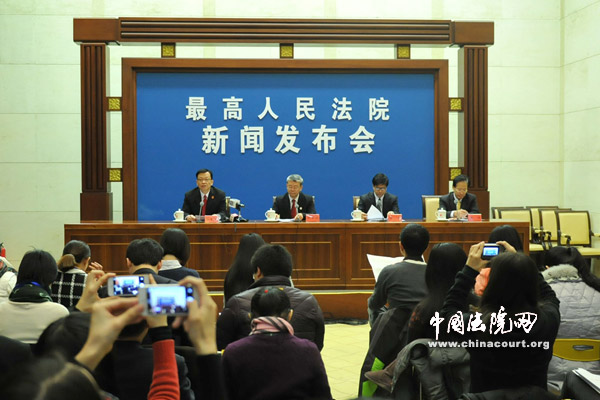
543296On the afternoon of 6 January, the Supreme People’s Court (the Court) issued its first judicial interpretation of the year (法释〔2015〕1号), its long-anticipated environmental public interest litigation interpretation at a press conference, at which  officials from the Ministry of Civil Affairs and Ministry of Environmental Protection, as well as the Court’s spokesman appeared.

1. Resources

The text of the interpretation is found here, with a translation available here (many thanks to the team at Chinalawtranslate).  as well as a notice jointly issued by the Court, the Ministry of Environmental Protection, and the Ministry of Civil Affairs (the translation of the notice (now in progress, is available here).   The Court published the text of the press conference, the video of which is available on the national court website.

2.  A Head’s Up

Barbara Finamore of the Natural Resources Defense Council and I are drafting commentary on the interpretation in tandem.  My blogpost will summarize the highlights of the  interpretation, the legal and policy background, as well as my assessment of what can be expected. A draft of the interpretation was issued for public comment in October.  From the brief summary of the major differences available here, it is clear that the public comment period provided very useful input.

Monitor’s 2014 Year-end Report

imagesIn 2014, the Supreme People’s Court Monitor had almost 17,000 page views, from 122 countries (regions), primarily from:

  • United States;
  • Hong Kong;
  • Mainland China.

with the United Kingdom, Germany, and Australia trailing closely. Visitors came from almost all of China’s neighbors, including:

Laos, Cambodia, Vietnam, Mongolia, Kazakhstan, Myanmar, Nepal, Pakistan, India, Bhutan, Russia, and Tajikistan.

Like my sister blog, China IPR, my followers include academics, journalists, government officials and attorneys (both in private practice and with NGOs).  I am honored to have my blog listed as a  Chinese law resource by Harvard and Yale Law Schools, Oxford Bodleian Library as well as many other universities.

Supreme People’s Court overhauls judicial performance indicators

351916247
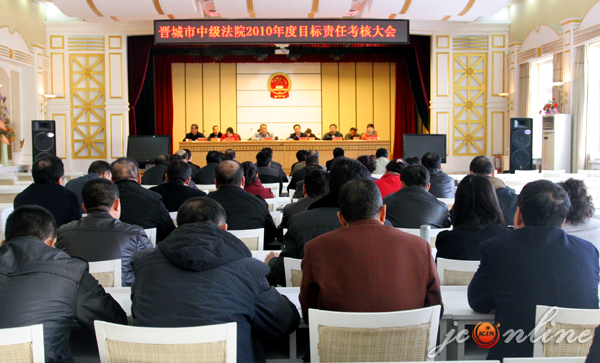
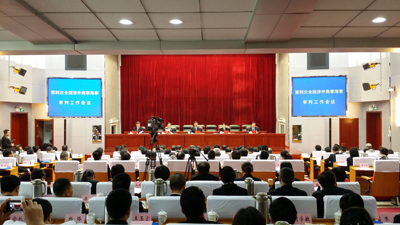
Jincheng Shanxi court evaluation meeting

The 27 December headline story in the People’s Court Daily and the national court website is the decision by the Party Committee of the Supreme People’s Court (the Court), issued to the entire court system, to:

  • cancel court performance rankings;
  • Except for those targets for resolving cases that according to law are compulsory, the remaining targets should become reference data for analyzing judicial operations.
  • oppose the practice of avoiding accepting cases at year end with the excuse that it would bring down the court’s case resolution index.

This is the result of its own fieldwork, as well as criticism from the lower courts, NPC delegates, academics, and lawyers. Chinese courts avoid accepting new cases close to year end if the case will not be resolved until the next year, because these cases will pull down a court’s performance indicators, even though the rights of litigants can be sacrificed.

Chinese and foreign academics have highlighted the negative consequences of judicial performance performance targets for many years.

He Fan, a Court judge on the staff of the research office, while applauding the change, pointed out in his blog that despite the change of policy by the Court, some lower court judges remain under pressure by local court leadership to work overtime to resolve cases.

What indicators will replace them?

The reports do not link to the underlying Court document and so it remains unclear what performance indicators will replace the ones that have been abolished, or which indicators fall into the second category.  The judicial reforms anticipate having a smaller number of judges handling an increasing number of cases.  If judges find the new performance evaluation system unacceptable, this may lead to an even greater outflow of judges than is already occurring.

New circuit courts opening soon in Shenzhen and Shenyang

Chinese press reports have revealed that the Supreme People’s Court (Court) will establish pilot circuit courts (巡回法庭) in Shenzhen and Shenyang by year’s end.  According to Chinese social media, Judge Liu Guixiang will head the Shenzhen circuit court, which has now been officially confirmed.  The vice presidents in Shenzhen will be Zhou Fan, formerly deputy head of the #4 civil division and Kong Xiangjun, formerly deputy head of the #3 civil division.  Hu Yunteng will head the Shenyang circuit court, while the vice presidents will be Zheng Xuelin, who now heads the environmental division and Yu Zhengping of the trial supervision tribunal.

The Central Leading Group for Judicial Reform approved their establishment in early December.  Although documents have not yet been released describing their location, jurisdiction or the personnel appointed, press reports pinpoint the former site of the Shenzhen Intermediate Court on Hongling Road as the location of the Shenzhen circuit court, with jurisdiction over administrative and major commercial trans-provincial cases arising in Guangdong, Guangxi, and Hainan. According to press reports, the Court issued a notice to judges inviting applications for the circuit courts.

On 30 December, the Court announced that the circuit courts will start taking cases from the beginning of 2015.

New regulations in China on classifying state secrets

I have published an article in the Diplomat concerning the State Secrecy Bureau’s March, 2014 Interim Provisions on Management of State Secrets Classification(国家秘密定密管理暂行规定) (and their implications), with a longer version to follow. The text of the regulations is linked here) and our English translation is linked here (Classification regulations translation).

Many thanks to those who commented on the draft article!


Where is the Supreme People’s Court headed with judicial committee reform?

55e15ba4755d55f74efa66a505224312Judicial (also called adjudication) committees are the unseen force behind the panel of three judges hearing a case in a Chinese court.  The decision a judicial committee makes binds the panel that heard the case.  Although this has not been mentioned, judicial committees must have approved the original decisions in a number of cases recently revealed to have mistaken, such as:

  • the 1996 execution of Huugjilt, in Inner Mongolia;
  • The 1995 conviction of Tian Weidong, Chen Jianying and others in Hangzhou, Zhejiang.

For this reason, judicial committees are important to anyone involved with or concerned with the Chinese courts, whether as a lawyer, litigant, or representative of a foreign or international organization, NGO, or government.

The Third and Fourth Plenum Decisions both mentioned judicial committee reform but without any details.  The Court has revealed the direction of its thinking on this topic in two recent articles published this month (December, 2014) on the national court website.

What are judicial committees?

Throughout the history of the PRC, court legislation has stated that these committees “practice democratic centralism” and that their task is to “sum up judicial experience and to discuss important or difficult cases or other issues relating to judicial work.”

The reason that the panel that hears the case must follow the decision of the judicial committee is that judicial committees are designated as the “highest judicial organ” within a court and implement the principle of democratic centralism. They decide cases that are too difficult or important for an individual judge or judicial panel to decide, to ensure the optimal substantive result (as seen from the institutional perspective of the courts.  Judicial committees have long been criticized by the academic community both inside and outside of China, and some judges have written about their drawbacks as well.

Judicial committees operate under 2010 regulations that I analyzed in an earlier article (Reforming judicial committees).  (According to those rules, major cases such as death sentences must be approved by a court’s judicial committee, so judicial committees must have been involved in the mistaken cases mentioned above).  (For those interested learning more about  the operations of the judicial committee of a local court, I highly recommend the study linked here).

The state of judicial committee reform policy

For over a year, the Supreme People’s Court (which itself has a judicial committee) has apparently been exploring where it wants to go with its policies towards judicial committees.  Both the Third and Fourth Plenum Decisions signalled that some reform of the judicial committee system was on the agenda:

  • Reform the trial committee system, perfect case handling responsibility systems for presiding judges and collegiate benches, let those hearing the case judge, and those judging the case be responsible.
  • Clarify the duties of all levels within judicial organs and complete internal mechanisms for supervision and check. Internal personnel of judicial organs must not violate provisions to interfere with other personnel’s handling of cases, establish recording and accountability systems for internal personnel looking into cases. Improve case handling responsibility systems for presiding judges, collegial panels, … to implement a system where the person handling the cases bears responsibility.

Issues with judicial committees

Wang Bin, a judge on the Nanjing Intermediate Court commented on some of the issues she has observed with judicial committees in an article published in early December in the People’s Court Daily:

1. The judicial committee inserts a  “subjective filter” between the judges who try cases and the judicial committee that decides the case, “making it difficult to guarantee the objectivity and accuracy of the results of the judgment.”

2.Judicial committees decide cases in conference, which involves a wide range and large number of cases. Although the 2010 regulations require the judges that heard the case to prepare a written report, Judge Wang notes that judicial committee members have neither the opportunity nor the time and energy to learn more about the specific circumstances of each case.  The committee has a large number of members (court president, vice presidents,division heads and some specialist committee members, and the local procurator), which means each case receives limited discussion time and and the views of defense counsel are not properly considered.

3. The members of the judicial committee include heads of the criminal, civil, and administrative divisions of a court, but with the greater complexity of Chinese legislation and the cases coming before the courts, and the fact that each member of the committee receives one vote, it is difficult to ensure that the resulting decision will be fair and appropriate.

Judicial committee reform

The solutions that she suggests are in line with (and more pointed than) those suggested by  President Zhou Qiang, whose remarks need to be appropriate for the wide range of Chinese courts.

1. Judicial committees should provide a macro-level guidance to judges. Given the increase in a broad range of litigation, judicial committees should use their authority to select typical cases, summarize best practices, and issue normative documents.

2. Judicial committees should reduce the number of actual cases that they decide.  Judge Wang suggests (as have others), that the standard under which cases are submitted to the judicial committee are too vague, and more specific guidance should be drafted. Cases in which evidence is disputed should not be submitted to a judicial committee.

3. Judge Wang recommends that criminal cases that judicial committees discuss should be limited to ones in which the evidence is clear, and most cases should be decided by the panel that has heard the case. In death penalty cases, a vote of 2/3 of judicial committee members should be required (rather than a simple majority), because this is more consistent with national death penalty policy.

4. The members of the judicial committee should be selected for their professional competence rather than their administrative rank.

5. Judge Wang suggests the decision making process should be changed, so that members are required to state their view and rationale before voting.

6.  Judge Wang advocates that the procurator not be a member of the judicial committee.  In her view, this violates the principle of independence of the judiciary and interferes with justice.

President Zhou Qiang links judicial committee reforms to principles of judicial responsibility, suggesting that judicial committee meetings be recorded and judicial committee members assume responsibility for their decisions.

We can expect these judicial committee reforms to take firmer shape in the medium term.  While President Zhou Qiang mentioned that the Court will take the lead in implementing some of these judicial committee reforms, according to recent press reports, these will also be incorporated into some of the local pilot projects.


 

Supreme People’s Court, CSRC, SAIC, and PBOC tighten the regulatory net

e8fade90gw1ek1l57pt9jj2050050t8sOn 19 December 2014, the Supreme People’s Court (Court) and China Securities Regulatory Commission (CSRC) announced that they were linking their blacklists and regulatory systems, following the arrangements the Court has made with other regulators since it established its judgment debtor database in October, 2013.  One of the major issues for the court system in having judgments enforced is interdepartmental regulatory silos that enable judgment debtors to avoid enforcement against their assets.

As of today, the Court’s database includes over 100,000 companies and almost 700,000 individuals. The goal is to tighten the net around non-compliant companies and individuals.  This initiative of the Court and CSRC is related to the State Council policy document issued in February, 2014,  on registered capital reform, in particular, the requirement that government departments improve interdepartmental sharing of information. Additionally, the Court names and shames one corporate and individual judgment debtor each day on social media.

The arrangement with the CSRC will involve the Court linking its system with the CSRC’s database of almost 700,000 entries concerning individuals and companies that have committed securities violations, and to prevent judgment debtors from accessing the capital markets.

Other arrangements the Court has made include:

  • an October, 2014, arrangement with the State Administration of Industry and Commerce (SAIC), which links  the SAIC’s credit information disclosure system (corporate disclosure system), described here, with the Court’s database (and requires SAIC cooperation in enforcing judgements);
  • a November, 2013  arrangement with the People’s Bank of China, directed at preventing judgment debtors from obtaining loans or financing through the banking system.

A search through the Court’s database is useful to a variety of users:

  • Lawyers, financiers and others engaged in due diligence on Chinese companies and individuals;
  • Companies, Chinese or foreign, contemplating doing business with a Chinese company or individual; and
  • Scholars and students researching the local operation of the Chinese economy and court system.

What you should know about foreign-related cases in the Chinese courts post 4th Plenum

u=480061365,753895882&fm=11&gp=0

The integration of China with the outside world through investment, trading, shipping, and licensing, inevitably (in some cases) leads to litigation in a Chinese courtroom (even if a contract has an arbitration clause), as companies large and small have found out.  Some recent examples are listed below:

The Supreme People’s Court (Court) recently held its 4th National Work Conference on Foreign-Related Commercial and Maritime Adjudication (4th National Work Conference) in early November, shortly after the 4th Plenum. This is a conference that the Court organizes occasionally for judges hearing  commercial and maritime cases involving foreign parties. The Court uses work conferences to transmit the latest central legal policy, harmonize court practices consistent with those policies, and find out what the latest difficult legal issues are. (This is a practice similar to other Party/government agencies).

The 4th National Work Conference highlighted some of the provisions of the 4th Plenum:

  • Vigorously participate in the formulation of international norms;
  • Strengthen our country’s discourse power and influence in international legal affairs;
  • Strengthen law enforcement and judicial cooperation between the mainland, Hong Kong, Macau and Taiwan;
  • perfect our country’s judicial assistance systems;
  • ensure that the courtroom hearings play a decisive role.

Additionally, the Court emphasized other principles  such as —

  • vigorously asserting jurisdiction (which is also asserted vis a vis the Hong Kong courts–see this commentary on a Hong Kong divorce case), which deserves closer attention in Hong Kong;
  • Correctly applying international treaties and governing law principles.
  • Safeguarding national rights and interests.

Some background if you need it

“Foreign-related” is a concept of many years standing that means that a foreign element is involved, because of a party’s nationality, location of the property disputed, or other factors (as explained here).The concept of “foreign-related” further relates to other important questions, such as selecting arbitration outside of China and foreign governing law.

Following national work conferences, the Court  often issues follow-up “Conference Summaries” to guide the lower courts on the agreed upon approach to new or contentious issues. These do not have the status of a judicial interpretation but courts refer to them when deciding cases. According to Court rules, courts can cite judicial interpretations (but not Conference Summaries).  It doesn’t seem that the Conference Summary has yet been issued.

Status update on foreign-related cases in the Chinese courts

In China, 203 intermediate and 204 basic level courts have jurisdiction over first instance foreign-related cases.  In the period 2010-end June 2014, the Chinese courts heard 287,262 first and second instance cases foreign-related maritime and commercial cases, an increase of 41% over the previous period. The cases are mostly heard by courts in coastal areas, but as foreign investment goes inland, disputes inevitably follow.

Head’s up for the foreign legal community

Following the Work Conference, Judge Luo Dongchuan, head of the #4 Civil Tribunal of the Court, was interviewed by Legal Daily. Judge Luo mentioned many important future legal developments, highlighted below.

1. Reforms relating to four important practical issues

  • Establishing an electronic platform for service of legal process outside of the jurisdiction (intended to mean Hong Kong, Macau, Taiwan, as well as foreign countries);
  • Investigating and obtaining evidence (this is likely linked to current anti-corruption efforts by the Chinese government to pursue (and retrieve assets from) corrupt officials who have settled overseas)
  • Determining foreign law, through establishing a database of experts (Chinese and foreign).
  • Restricting parties to litigation from leaving China (Chinese legislation on these procedures is difficult to parse (see my earlier article on this subject and another related one).

2. Maritime court related reforms

  •  The Court is considering establishing maritime circuit courts, to deal with disputes arising inland arising from logistics cases in the maritime courts.
  • The Court intends to promote the maritime courts and a forum for hearing cases involving maritime pollution from on-shore sources (the largest source of maritime pollution China).
  • The Court is looking into reforming the maritime court’s jurisdiction, so that it will have jurisdiction over civil, criminal, and civil maritime cases.

3. Recognition of foreign court judgments

Judge Luo mentioned that the Court is researching the recognition and enforcement of foreign court judgments involving property.  (This appears to be at an early stage.)

3. Arbitration related reforms

Judge Luo emphasized that the Court supports arbitration.

Because arbitration is so important, the Chinese courts will try to uphold the validity of vague [poorly drafted!] arbitration clauses.

A new judicial interpretation on the judicial review of arbitration-related issues will go into the Court’s judicial interpretation drafting plan in 2015.

The Court intends to reform jurisdiction in judicial review of arbitration issues, to consolidate them in specialized courts, expanding the pilot projects underway in Guangdong, Inner Mongolia, and elsewhere (as designated by the Court.  Earlier this year, the Guangdong Higher People’s Court published a report on its experience so far.

4. Electronic platform

The Court is considering establishing an electronic platform for foreign-related cases.  This may relate to making litigation procedures for parties more transparent.

 Some unsolicited suggestions for the Supreme People’s Court

Consider the following:

  • Overhaul the Court’s English language platform, so that it provides useful official information for the foreign reader who does not know Chinese;
  • Issue more draft judicial opinions for public comment and give the public (foreign and Chinese) a more sensible time period to comment, particularly for draft regulations relating to any of the issues discussed above. The issues mentioned above are very important to the foreign business and legal community.  The current 30 day time period extremely short by international standards.  Given the opportunity, international and foreign organizations and law firms will comment, but it takes time for translation and busy lawyers and other legal professionals to make comments.
  • Consider what can be done to make the Chinese courts a more user-friendly forum for international commercial disputes.  For example, consider what is needed for China to become a party to the Hague Convention on the Legalization of Foreign Public Documents (which will involve reforms by multiple government departments) and other related conventions.  The current system of legalization of foreign evidence is difficult for foreign parties and puts the Chinese system behind the 107 countries in the world that are signatories).

Comment now on China’s draft Anti-Domestic Violence Law

Unknown-2After at least 15 years of pressure by women’s groups, lawyers, and publicity in China, as well as by the international community, the draft Anti-Domestic Violence was issued by China’s State Council Legislative Affairs Office on November 25. It follows many years of academic and professional exchanges and international conferences on domestic violence legislation.  The timing may be to coincide with the UN’s Days of Activism Against Gender Violence.

The comment period is one month.  The draft is available here.  An English translation of the draft and official explantion has been prepared by Chinalawtranslate.com (thank you to the team). The translation of the draft is available here and the explanation here. The draft contains important content, including:

  • definition of domestic violence;
  • establish a domestic violence reporting system
  • protection orders;
  • requirements for courts in matters involving domestic violence;
  • local government establishment of domestic violence shelters.
  • Unmarried couples are not covered by the draft law (but by other legislation).  (Drafts of local legislation have also started with this position.  In Shenzhen, the Procuratorate advised against this, as mentioned in this earlier blogpost).

Comments may be made electronically at: fjtbl@chinalaw.gov. cn; or by mail at: Box 2067, Beijing, PRC 100035, attention Anti-Domestic Violence Law Consultation; (北京市2067信箱(邮政编码:100035),请在信封上注明“反家庭暴力法征求意见).

After the State Council finalizes the draft, it will submit it to the National People’s Congress (NPC), for further discussion and possibly more public consultation.  It appears passage of the law will come in 2015.  Once its passed, further legislation will be needed, including a judicial interpretation by the Supreme People’s Court, to address the evidentiary and other issues in the law.  Earlier posts on domestic violence are linked here, there, and there.  Local governments have started drafting their own legislation, including Shenzhen and Guangdong.

The Supreme People’s Court speaks out on reforming China’s death penalty

The top story in the Supreme People’s Court Wechat Feed of 23 November–how China should reform the use of the death penalty. Over the weekend, a conference was held by China’s Academy of Social Sciences on the death penalty, which brought in the Supreme People’s Court, Supreme People’s Procuratorate, and other government departments, as well as experts from Tsinghua University, China University of Political Sciences and Law, and others. Among the topics discussed was China and the world.

Hu Yunteng, head of the Court’s Research Office said that death penalty reform needs to focus on how to use legislative and judicial measures to reform the death penalty, with further work needed on the following:

  • Reducing the number of crimes that carry the death penalty.
  • Reducing the judicial use of the death penalty.
  • Amending substantive law to reduce its use.
  • Amending procedural law to control its use.
  • Adopting a hearing centered procedure in death penalty review cases.  This includes making use of the important role of lawyers in the death penalty review process and providing legal assistance to those who need it. (This development was highlighted in this blogpost).

Judge Hu stated that the death penalty will be retained, but the goal is for the death penalty to be applied 100% correctly and to avoid mistaken cases.

Foreign and international organizations have been working with Chinese counterparts on death penalty reforms for a number of years.  In China, law reform efforts may involve a long incubation period.

The world awaits the results of the hard work needed to implement these reforms.


The Supreme People’s Court Observer and China’s National Climate Change Plan 2014-2020

From the NRDC website
(From the NRDC website)

The Supreme People’s Court Observer recently worked with Barbara Finamore, Senior Attorney and Asia Director of the Natural Resources Defense Council (NRDC), in analyzing an crucial development concerning China’s climate change plans,  the National Development and Reform Commission (NDRC)’s  National Climate Change Plan for 2014-2020 (National Climate Change Plan).  (For those readers who are not familiar with the NRDC, it is one of the US’s leading non-governmental environmental organizations and has worked with Chinese government, academic, and non-profit organizations for about 20 years.

The National Climate Change Plan,  approved by the State Council, was issued in late September but released in early November. Among the many goals identified by the NDRC are the development and expansion of climate change-related policy and legislation. It is likely that the Chinese courts will need to handle climate change-related litigation some time in the future.

The National Climate Change Plan also encourages Chinese entities to cooperate with international organizations (including the World Bank and Asian Development Bank) and foreign countries in considering foreign experience that can be adapted to the situation in China.  It is likely that climate change innovations that are successful in China will be promoted  overseas.

Our blogpost, where we analyze the latest climate change developments in  their international and domestic Chinese context, is linked here. Thank you Barbara, for giving me this opportunity!

Making China Law Bloglists Around the World

Thank you to Dan Harris, of the China Law Blog, and Mark Cohen, of the China IPR blog for pointing out that Carli Spina of the Harvard Law School library has listed the Supreme People’s Court Monitor among its recommended China law resources.

I am honored that the following institutions have listed my blog among their resources:

  • Congressional Executive Commission on China
  • US-Asia Law Institute (New York University)
  • Harvard Law School Law Library
  • Tulane University Law School Law Library
  • Oxford University’s Bodleian Library
  • University of Glasgow Chinese Studies
  • University of Leiden Chinese Studies
  • University of Sydney Law Library.

谢谢!


Tianjin’s environmental crisis and the courts

Tianjin's air pollutionTianjin’s environmental problems are well documented, as this presentation by a (Nankai University) Tianjin based professor of environmental sciences describes. Chinese pollution statistics list Tianjin as one of the top 10-15 polluted Chinese cities.  In the past few days, the national court website carried a report by the Tianjin higher people’s court on environmental cases, likely meant to help the Supreme People’s Court (Court) as it increases judicial resources on the environment and natural resources, and to fulfill  objectives set out in the Court’s July, 2014 policy document on environmental cases, Opinions of the Supreme People’s Court on Comprehensively Strengthening Judicial Work Related to Environmental Resources to Provide Effective Judicial Safeguards to Promote the Construction of an Ecological Civilization.  The Tianjin court identified three major problems:

Disconnect between the number of cases and the polluted environment

  • As of June, 2014, the courts had only accepted 43 criminal pollution cases, most of which arose in the last 3 months of last year, with two new ones this year, and no cases from 2011-until the middle of 2012.
  • There have been only 2 environmental administrative cases (appeals from administrative review decisions by the environmental protection authorities) so far in 2014.
  • There have been a tiny number of civil cases. The Tianjin courts have not accepted any public interest environmental civil suits.

Many difficulties with environmental cases

The Tianjin judges listed the following difficulties:

  • Obtaining evidence.
  • Obtaining evidence sufficient to document the causal link between the acts of the polluter and the pollution.
  • Obtaining competent technical evaluation.
  • Because much of the evidence in criminal cases comes from the enforcement arm of the environmental protection departments, but their evidentiary requirements are different from those demanded in criminal proceedings, the evidence they provide often cannot be used in court, because it has not been handled properly.
  • The environmental protection departments are often unable to supply evidence of causation as well as harm caused by pollution.
  • The environmental protection departments fail to provide historical data about pollution over time.
  • People petitioning about pollution.

Personnel inadequately trained

The study found that the judges assigned to the environmental panels lacked sufficient training.

The solution identified by Tianjin judges

  • More training on environmental law for judges.
  • Establish environmental courts only when conditions are suitable.
  • Involve more environmental specialists as people’s assessors to fill the technical expertise gaps.
  • Establish better liaison channels with other authorities, including environmental protection agencies and the procuratorate.
Tianjin pollution
Tianjin pollution

What can be done to improve the situation?

It appears that a critical issue in environmental criminal prosecutions is a problem with evidence.  The Supreme People’s Court Observer has the following suggestions:

1) if the Tianjin court has identified a prevalent problem, that  local environmental protection bureaus need further training on how to work with the prosecutors and the courts to prepare evidence that will hold up in court, this is an area in which training can help.  If expertise lies within the Ministry of Environmental Protection, the Supreme People’s Procuratorate and Supreme People’s Court should create a training session for local environmental protection bureau officials that can be duplicated in each province. If foreign expertise is needed, perhaps the US Environmental Protection Agency or other foreign governments, international organizations, or environmental NGOs can add this to their exchange agenda.

2) Rather than see ordinary citizens as a problem, local courts can work with local Bureau of Civil Affairs to train local environmental NGOs on the type of evidence needed to document environmental pollution cases. Some of these local NGOs include retired engineers and others with technical expertise.

Updated with further analysis: What does the 4th Plenum mean for death penalty reviews?

video interview in a death penalty review case

In a  press report in Southern Weekend last month (summarized in this report), the Supreme People’s Court (the Court) revealed that  an important legal reform related to death penalty reviews is forthcoming–institutionalizing legal representation in death penalty reviews.  This development, and others still in the works, are likely linked to the following provisions in the 4th Plenum Decision:

  • For appeals from dissatisfaction with effective judgments or decisions of judicial organs, gradually implement a system of lawyer representation. Bring appellants unable to hire a lawyer within the scope of legal aid.
  • Advance systemic reform in litigation with trial at the center;
  • complete effective guards against unjust, false and wrongfully decided cases.
  • bring about a system of lifetime responsibility for case quality and wrongful cases accountability system.

The Southern Weekend report has now been more fully summarized by the Duihua Foundation.

(This reform caught my attention because because I raised this issue when conducting an interview at the Supreme People’s Court in the early 1990’s, when researching my 1993 Supreme People’s Court article in the Journal of Chinese Law.)

Some background on death penalty review in the Court

As many others have described, death penalty review is carried out solely within the Court (in contrast to the period that I wrote my article) in an administrative procedure (my article describes the procedure at the time, and other articles describe the current process). The Southern Weekend article describes it as taking place in an unmarked office building away from  Court headquarters, guarded by a member of the Armed Police.

The Court has increased the number of criminal tribunals from two (when I wrote about this procedure 20 years ago in my article) to five tribunals, but the Court has not issued regulations setting out their jurisdiction.  According to the Southern Weekend reporters, four of the tribunals, which review cases based on geography and subject matter, have about 70 staff (both judges and support staff), while one has about 50 staff and reviews cases only on a subject matter basis. According to Southern Weekend, there is some flexibility in the jurisdiction of the criminal tribunals.(See this report for a translation of Southern Weekend’s chart.)

Institutionalizing legal representation in death penalty reviews

The Southern Weekend article reported that a senior member of the one of the criminal tribunals had revealed that the Court has drafted regulations on institutionalizing legal representation in death penalty review and it is hoped that they will be issued before year end.  According to the article, the draft regulations are entitled:

死刑复核案件听取辩护律师意见的若干规定 (Regulations on Considering the Views of Defense Lawyers in Death Penalty Review Cases).

This reform was flagged in Article 240 of the 2012 Criminal Procedure Law:

When the Supreme People’s Court reviews a death case, it should examine the defendant; if the defense attorney requests, it should hear the opinion of the defense attorney.

Article 42 of the 2012 Supreme People’s Court interpretation of the Criminal Procedure Law provides:

When the SPC performs final review of a death penalty case and the defendant has not retained a defender, the legal aid organization shall be notified to appoint a lawyer to provide him a defense.

A statement of principle in an a Court interpretation does not translate immediately into systemic reform.  It is apparent from the Southern Weekend article, a 2013 article on the Court’s website, and other sources that the mechanism for doing so is being considered within the Court and that local justice bureaus are implementing regulatory changes.

In the Southern Weekend article, a Court judge pointed out what the academics and defense lawyers have been saying, that many persons sentenced to death are from the bottom of society and do not have a lawyer defending them. (It appears from this interview with the President of the Zhejiang Higher People’s Court that Zhejiang has been taking the lead in working with the justice authorities to have legal aid provided to criminal defendants.)

In an article earlier this year in the Legal Daily (organ of the Communist Party Central Political Legal Committee), Professor Liu Wenren of the Law Institute, China Academy of Social Sciences emphasized the necessity of involving lawyers in the death penalty review process.  A Chinese lawyer has established a website for death penalty review lawyers, highlighting cases where legal representation has been effective.  Jiangsu province justice department has implemented  regulations on giving defense lawyers rights in death penalty review cases.

It is unclear what provisions will be contained in these regulations, but it is hoped that they include a provision for legal aid as well as rights for lawyers to review the case file.

Changing the form of death penalty review: when will the time come for this reform?

It appears that the Court is considering changing the form of death penalty review to a hearing-centered procedure.  (Dean Zhao Bingzhi of Beijing Normal University, College of Criminal Law Science, Professor Liu Wenren, and  others have been advocating this for some years (see this in this 2012 interview with Professor Zhao in Legal Daily).) Movement on this issue can be seen from the following:

  • In June, 2013, the Court held its first hearing in a death penalty review case, reported here. In July, 2013, Legal Daily published a follow-up article in which it was suggested that more hearings will take place.
  • In 2013, the Court website published an article (written by a Jiangxi judge) on deficiencies in the death penalty review procedure, suggesting that a hearing procedure be adopted.
  • In July, 2014, the China Law Society held a training session for defense lawyers in death penalty cases, at which four of the five criminal tribunal heads spoke.

The Supreme People’s Court Observer understands these developments to be linked to the goal in the 4th Plenum Decision of bringing about a system of lifetime responsibility for case quality and a wrongful cases accountability system. Going to a hearing procedure for death penalty review cases in which defendants have legal representation would go far to “complete effective guards against unjust, false and wrongfully decided cases” and at the same time would better protect the hundreds of Court judges who will bear lifetime responsibility for their decisions in death penalty cases.

If there are errors in the above analysis, please use the comment function.

Those further interested in this important topic can refer to one or more of the many articles, books, and reports in English (and Chinese).  In contrast to the early 90’s, death penalty review in China has now attracted the attention of major scholars and international organizations.

A lesson in Plenumology

4th plenum voting
4th plenum voting

The skills of a Kremlinologist (the Supreme Court Observer first learned these skills when reading Pravda and other Communist Party of the Soviet Union publications as a Russian Studies major) are needed to unpack what a Plenum Communique and a Plenum Decision mean for the Chinese legal system. (For those who haven’t heard the term “Kremlinologist,” the Wikipedia article gives a good summary).

The Plenum Communique  (now nearly forgotten) is a set of high level bullet points.  The 4th Plenum Decision, released late on 28 October, is something akin to a memorandum of understanding (MOU), for those who have spent time in the world of commercial law or business.  The 4th Plenum Decision cannot be implemented by itself–for many issues it requires complex bureaucratic arrangements, as well as framework legislation and detailed rules (akin to the sets of contracts that are needed for a business deal).  So evaluating how the 4th Plenum Communique or Decision will affect the real world of Chinese law requires the same analytical skills as  taking a deal’s high level bullet points or MOU and predicting how a business will operate.

Evaluating a Plenum decision requires analytical sifting of the standard language from the operative provisions.  Those provisions are often single phrases, and have behind them years of research and policy analysis within the institutions involved, as well as Chinese universities and think tanks.

The Supreme People’s Court Observer will take this opportunity to evaluate discrete provisions in the 4th Plenum Decision in future blogposts, as time permits.

Supreme People’s Court’s new policy on protecting the rights of the military and military personnel

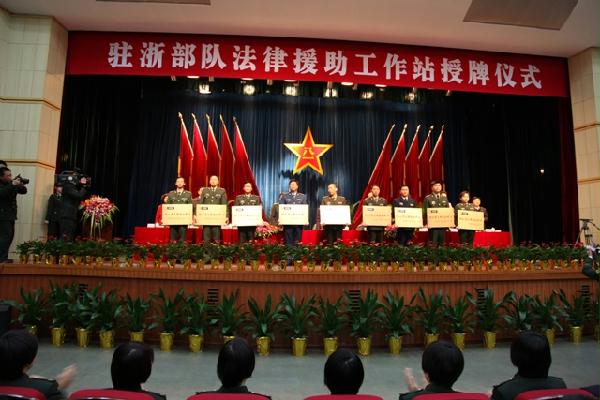
Conference on legal assistance to Zhejiang troops

The details of how the 4th Plenum Decision is being implemented by the Supreme People’s Court are gradually being made known. This blogpost looks at one discrete (and specialized) area, relating to national defense and the military in the civilian courts.

On 31 October, the Supreme People’s Court issued its Opinion on Expanding Capacity in  Safeguarding the Interests of National Defense, Guaranteeing the Rights and Interests of Military Personnel, and Military Dependents (关于进一步发挥职能作用维护国防利益和军人军属合法权益的意见)(The Opinion) (linked here, with comments by a spokesman here).

The sixteen point policy is intended as a comprehensive statement of judicial policy on these issues to be implemented by the lower courts in furtherance of the goals set by the 4th Plenum Decision.

The Opinion draws on some of the documents and addresses some of the social and regulatory issues described in earlier blogposts.

It is intended to implement the following provisions in the 4th Plenum Decision (among others):

  • Safeguard the interests of national defense.
  • Guarantee the lawful rights and interests of soldiers.
  • Strengthen legal services in the area of the people’s livelihood. Perfect legal aid systems, broaden the scope of aid.

Several points from the Opinion are highlighted below,  as well as questions that the Opinion raises (and some of the underlying issues) .

Some Points in the Opinion

1. The Opinion directs the lower courts to improve case filing and jurisdiction in cases related to the military.  The Opinon cites  the three principal judicial interpretations on civil and criminal jurisdiction in military cases, and encourages lower courts to establish special case filing counters for the military.

Why special counters for the military rather than the handicapped, for example, or other disadvantaged groups?

2. The Opinion directs lower courts to provide judicial and legal assistance to military parties.  The Opinion explains that Judicial assistance means exempting or reducing court fees for poor military families in civil cases  known as as “involving the interests of ordinary people” (more about these in an earlier blogpost) such as:

  • support payments (to the elderly);
  • child support;
  • compensation payments (to the disabled or families of the deceased).

The Opinion directs lower courts to take the initiative to assist soldiers and military dependents who qualify in receiving legal aid.  What this means is that courts should reach out to  local justice bureaus.  In some provinces, such as Zhejiang, the provincial judicial bureau has worked with the local military district to establish legal aid centers for military personnel and their dependents, under which local law firms have concluded agreements to provide legal advice (see this report).

How does the provision of legal aid to military personnel and their dependents compare to legal aid provided to other persons in poverty?

3.  Do a better job of trying military cases.  This refers to both criminal and civil cases.

Most of the criminal cases mentioned were detailed in this earlier blogpost.

Among the new principles to be implemented in civil cases are:

  • supporting core military enterprises and military industrial companies. (依法为军队核心产业、军工企业的科学发展提供司法支持).

Government policy seeks to have more private sector involvement in military and military industrial companies.

What does this mean when commercial disputes arise– how will the interests of each party be weighed?

4.  Establish a “green channel” for military related cases (this was mocked earlier this year), by giving priority to military-related cases in docketing, trial and enforcement.  Part of this means directing lower courts to  gather evidence if military parties have difficulty obtaining evidence.

What if it is the non-military party that has that difficulty, either in a commercial or family law case?

5. The Opinion directs the lower courts to work under the united leadership and support of the Party committee and political-legal committee on these issues and to work with other related departments to deal with military related cases.

What does that mean if the approach adopted by the Party committee or political-legal committee favors one party over another?

Other points include:

  • Establishing mechanisms for resolving disputes involving the military.
  • Improving enforcement of military-related orders and decisions.
  • Improving judicial service related to the military
  • Courts should work closely with the military.
  • Explore capturing statistics on military related cases.
  • Incorporating work in military-related cases in judicial performance evaluation.
  • Working with the military courts on military-related cases.

Some of the underlying issues

As identified in earlier blogposts, some of the underlying problems causing an increase in military-related cases in the civilian courts appear to be :

  •  an increase in civil unrest involving civilians and military;
  • unresolved civil disputes involving the military and its personnel
  • criminal cases involving civilians and military that have not been prosecuted because of evidentiary issues.
  • separate operations of the military and civilian justice systems;
  • difficulties in coordinating across bureaucratic systems.
  • performance indicators for officials within the (civilian) legal system, relating to the  percentage of closed cases or other success rates.

The Opinion and the 4th Plenum

What does the Opinion mean for principles in the 4th Plenum such as:

guaranteeing judicial fairness, exercising judicial power independently according law, raising judicial credibility and striving to have the people feel that every judicial case is fair and just?


4th Plenum and What Ruling the Military According to Law means

rule of/by law under construction

The Supreme People’s Court Observer contributed a brief blogpost to the Global Military Justice Reform blog on what the 4th Plenum Decision means for Chinese military law, linked here.The Global Military Justice Reform blog, based at Yale Law School, looks at military justice issues all over the world, including the jurisdiction of military courts, command control of military courts and other parts of the military justice system and is highly recommended!

4th Plenum and the Supreme People’s Court

4th plenum voting
4th plenum voting

According to the Wechat postings of one of its members, the judicial reform office of the Supreme People’s Court has been working overtime for months to prepare for the 4th Plenum.  It appears, at least from the initial 4th Plenum communiqué, that the hard work has paid off.  We will know more about the leadership’s plans for legal reforms when the full decision is released.  Four quick questions about the communique are set out below (to be supplemented as time permits).

Some questions for the Supreme People’s Court and the judiciary:

1.The communique stressed the need for improving the quality of legislation, including incorporating more public consultation and experts.  Will this reduce the need for judicial interpretations? What will this mean for the drafting of judicial interpretations?  Will the Supreme People’s Court require public consultation for its own judicial interpretations?  The release this month of drafts for public comment of the environmental public interest litigation regulations and the trademark validity administrative case rules are a step in the right direction.

2. The communique called for greater judicial transparency, as was highlighted in the Court’s 4th Five Year Reform Plan.  In its press releases to the domestic audience, the Supreme People’s Court has mentioned the visits it has hosted of the foreign press, foreign diplomats, and ordinary citizens, and of analogous events at the local level.  When can we look forward to easier access by all (foreign or domestic) to proceedings in the Chinese courts (at least in non-sensitive cases)?

3.  The communique indicated approval by the leadership of the establishment of circuit courts that cross administrative lines, a concept mentioned in the 4th Five Year Reform Plan (see this earlier blogpost).  It also reflects the use in China of foreign legal concepts or frameworks (as is frequently stressed, a reference and not as a transplant).

4.  It also called for an end to “interference” by leading cadres in specific court cases.  How will this long-standing practice will be curbed?  In recent weeks, articles have appeared in the legal press on changes to the Party Political Legal Committees. Will those changes imply less involvement in actual cases? And what is the distinction between “interference” and “leadership”?


Supreme People’s Court’s prescription for the disease of judicial corruption

Basic level judges and flying money

In a build up to the National Day holiday (and since), the Supreme People’s Court (the Court) has focused some of its attention on combating the disease of judicial corruption.  The prescription is in the form of three types of Communist Party documents. This blogpost highlights the prescription and speculates on the timing.

The herbs in this traditional prescription comes in the form of:

  •  Six model (typical) cases of violations of the Communist Party’s Eight Point Regulations by court officials ( “cadres and police”/干警)).  (An earlier blogpost analyzed seven earlier model cases that the Court issued.  The six (relatively minor) cases included:
    • a Guizhou county court spending over 500,000 RMB on a trip to Hainan at public expense, lavish banqueting, and abuse of bonuses;
    • leadership of a Shaoguan (Guangdong) court, that caused the death of their dinner guest, an official of a county court, from alcohol poisoning;
    • vice president of a Hunan county court, who used a court vehicle to take his daughter to school;
    • the head of the disciplinary department of a Hancheng (Shaanxi) court caught by a reporter playing video games during work hours;
  • Holiday rules on what not to do during the Mid-Autumn Festival and National Day holidays.  The Central Commission for Disciplinary Inspection (at various levels) issued notices distributed to the courts forbidding officials “gifting” moon cakes, shopping vouchers, “red packets”, and touring at public expense,
  • A document, linked here, providing policy guidance to the disciplinary departments of the courts in rooting corruption out of the courts. The head of these departments is Zhang Jiannan, who is the Communist Party’s Central Commission for Discipline Inspection’s  (CCDI’s) chief representative in the Supreme People’s Court, and directs the disciplinary departments of the lower courts. The document is again focused on anti-corruption efforts within the courts.  It directs the disciplinary departments to focus on discipline, report to the local Party disciplinary authorities as well as the disciplinary department of the higher courts, participate in major court internal meetings,  improve the operation of disciplinary inspectors (described below). It directs disciplinary officials to participate in important meetings, drafting of important documents, and clear personnel appointments. The disciplinary officials are directed to implement the Party Constitution as well as 2008 regulations on supervision work in the courts.

Some background

The background for these documents is the Communist Party’s Central Committee’s five year anti-corruption plan (analyzed here).  Following that:

  • the Court’s Party Committee  issued a June, 2014 document on Party discipline:
  • the Court dispatched teams of its own disciplinary inspectors(最高人民法院司法巡查组) to Henan, Ningxia, Fujian and Anhui in May and September.  These disciplinary inspectors are the Court’s counterpart to  the CCDI’s  inspection teams, which at the central level called Central Inspection Groups (中央巡视组) (“CIG”).  These CIGs  uncover corruption and other abuses, under which semi-retired high ranking officials are dispatched to provinces, ministries and SOEs for disciplinary inspection. The political background for these inspection teams is analyzed in this article. These inspection teams have operated in the courts for a number of years and operate according to these rules.
  • The Communist Party Central Committee’s Political Legal Committee issued three batches of “typical cases” of violations of law and Party discipline among the “political legal departments,” (each linked here) which included a substantial number of judges, including Liu Yong of the Supreme People’s Court, removed for suspicion of having taken about 2 million yuan in bribes (about $330,000).

 The timing

The timing for the release of these recent documents appears to be linked to the upcoming Fourth Plenum of the 18th Chinese Communist Party Central Committee, on the rule of law. Part of the agenda, according to reports, is the role of the judiciary, curbing corruption and announcing forthcoming judicial reforms.

A traditional prescription

This prescription for curing the courts of corruption uses the traditional cure of Party discipline rather than judicial ethical models more commonly used in other jurisdictions. The Chinese judiciary has looked at approaches to judicial ethics in other jurisdictions, including Germany, the US, and Hong Kong.  Elements of this prescription, such as having disciplinary officials participate in important meetings and the drafting of important documents appear to be inconsistent with some of the goals in the judicial reform plan of having the judges who heard cases decide them.

Will the prescription be effective?

The current prescription is a variation of what has been prescribed before.  The Court needs to show the political leadership that it is it doing what it can to combat corruption in the courts and is implementing anti-corruption initiatives.  The anti-corruption drive is being led by the CCDI, using Party channels and methods.

Corruption prevents or at least complicates efforts to establish and operate a court system that meets the needs of ordinary people. It appears that the Court leadership is under no illusions about what goes on in the court system.  However, the Court leadership can only work within the current system and with current personnel.  Will the broader anti-corruption campaign lead to a change in China’s social and business culture, of which the judiciary is a part?  Or do these latest initiatives not go to the core of the problem?  换汤不换药?

Congratulations, Professor Allen!

Professor Ronald Allen

On 30 September John Henry Wigmore Professor of Law Ronald Allen  of Northwestern University School of Law was one of 100 foreign experts to be awarded China’s Friendship Award in the Great Hall of the People for his work with the Academy of Social Sciences, the China University of Political Science and Law and Supreme People’s Court on evidence law and related issues.  The national court website ran a story on Court Vice President Shen Deyong’s meeting with Professor Allen, at which Judge Shen thanked Professor Allen for his work on behalf of the Supreme People’s Court.  Judge Shen commented on the importance of evidence law. He also noted that although China’s court reform must be based on China’s situation, it can draw on foreign law methods and experience, including that of common law systems.  Well done Professor Allen!

A blog discussing China's highest court