I am honored to have contributed a short essay to the New York University School of Law’s U.S. Asia Law Institute Perspectives blog, entitled New Directions for the Supreme People’s Court? Many thanks to those who contributed to this essay in any way. Special thanks are due to the many Chinese judges (and other court staff) with whom I have had shorter or longer conversations since the border reopened earlier this year, the people who commented on earlier drafts of the essay, and Katherine Wilhelm for her skillful editing!
For those who are not familiar with my long-term interest in the Supreme People’s Court, as the 2021 essay begins, “some say it is my fate in life (缘分) to research China’s Supreme People’s Court (SPC). I was set on this unlikely path in the late 1980s, when I was introduced to a series of Chinese judges who were open enough to meet with a young American and answer my many questions about the epic changes just beginning at their courts. One meeting led to another, and eventually enabled me to write my 1993 article, “The Supreme People’s Court of the People’s Republic of China,” [available here] the first systematic study of the court by a scholar from inside or outside of China.
At the end of September (2023) the Supreme People’s Court (SPC) issued its fourth group of Belt & Road (BRI) Typical /Model /Exemplary ) (this post will use the translation “typical”) Cases (第四批涉“一带一路”建设典型案例) (see an alternative link in case the official website is unavailable). An English translation is available here. Along with the cases, the SPC issued a press release in the form of answers by a responsible person of the SPC’s #4 Civil Division to a reporter’s questions (为高质量共建“一带一路”提供有力司法服务和保障——最高人民法院民四庭负责人就发布第四批涉“一带一路”建设典型案例相关问题答记者问).
“For the avoidance of doubt,” the points made by these typical cases (please see last year’s blogpost for a refresher on typical cases) apply to all types of foreign-related cases, whether or not they involve the BRI in some way. Including “BRI” in the title highlights that these cases contribute to supporting the BRI (on the 10th anniversary of the strategy) and developing (“constructing” 建设) “foreign-related rule of law.” I’ll make several quick points about the cases and derive some useful information from the press release.
1. Typical cases
This group of 12 typical cases includes:
three cases relating to letters of credit and demand guarantees (#3 Jiangsu Puhua Co., Ltd. v. Bank of East Asia (China) Co., Ltd. Shanghai Branch; #4 China Power Construction Group Shandong Electric Power Construction Co., Ltd. v. GMR KAMALANGA Energy Ltd., et al (the SPC case was mentioned in this blogpost; and #5 Union of Arab and French Banks (UBAF) (Hong Kong) Ltd. [UBAF (Hong Kong) Ltd.] and Bank of China Co., Ltd. Henan Branch);
Two cases involving professional services-related issues (#6 Fusheng (Tianjin) Financial Leasing Co., Ltd. v. Grant Thornton AG (a tort case) and #8 Tianwei New Energy Holdings Co., Ltd. v. Davis Polk & Wardwell LLP (contract dispute));
Enforcement of a foreign (Singapore) court judgment (#12, enforcement application by Shuang Lin Construction Pte. Ltd. ). The SPC and the Singapore Supreme Court have a related memorandum so it is unsurprising that a case involving an application to enforce a Singapore judgment was selected. See this 2023 factsheet with a listing of the other Singapore agreements with the SPC);
Enforcement of foreign and Hong Kong arbitral awards (#10, China Small and Medium Enterprises Investment Co., Ltd. v. Russian Sakhalin Seafood Co., Ltd. & Oriental International Economic and Technical Cooperation Company, objection to enforcement case)( #11 Noble Resources International Pte. Ltd.’s application for recognition and enforcement of the Hong Kong International Arbitration Center arbitration award);
One case involving the Convention on the International Sale of Goods (CISG), #1, Exportextil Countertrade SA) and Nantong Meinite Medical Products Co., Ltd;
One case involving financial derivatives (#9, Standard Chartered Bank (China) Co., Ltd. v. Zhangjiakou United Petrochemical Co., Ltd.) ;
One equity transfer-related case (#7, a China International Commercial Court case), Zhang Moumou and Xie Moumou v. Shenzhen Aoxinlong Investment Co., Ltd;
One treaty interpretation case (#2, Nippon Property & Casualty Insurance (China) Co., Ltd. Shanghai Branch and others and Robinson Global Logistics (Dalian) Co., Ltd).
The press release ties the work of the SPC to the January 2018 Party Central Committee and State Council General Office policy document on BRI dispute resolution (summarized here and discussed further in my “neverending article”) and flags that the SPC has conscientiously implemented the decisions and arrangements of the Party Central Committee. The one-year gap between the third and fourth groups of typical BRI cases signals that the SPC leadership considers this a priority area. The phrase at the beginning of the press release (“providing powerful judicial services and guarantees (safeguards) for high-quality joint construction of the “Belt and Road”) signals the continuing importance of providing judicial “services and safeguards” for major national strategies, including the BRI, whether in the form of a document or typical cases.
3. Takeaways From the Press Release
a. CICC and other international commercial courts
The press release mentions the China International Commercial Court (CICC), its expert committee, and the establishment of local international commercial courts. The CICC has accepted a total of 27 international commercial cases, 17 of which have been concluded. A judgment was posted in July on the Chinese version of the CICC website but has yet to be translated.
Although the CICC is often linked to the BRI, the cases that the CICC has accepted include parties from jurisdictions that are not participating in the BRI, such as the United States. Among the typical cases released this time, one is a CICC case. The press release notes that the SPC will revise the CICC-related judicial interpretations to reflect the amendments to the foreign-related section of the Civil Procedure Law.
The BRI-related services and safeguards policy documents, about which I have previously written (and about which I have more to say in the neverending article) served as the policy framework for establishing local international commercial courts. The SPC has approved twelve local courts in Suzhou, Beijing, Chengdu, Xiamen, Changchun, Quanzhou, Wuxi, Nanning, Hangzhou, Ningbo, Nanjing, and Qingdao as “international commercial courts (tribunals).” It requires some detective work to determine the jurisdiction of each international commercial court.
b. Encouraging mediation and an organic connection between litigation, arbitration and mediation
The SPC reiterates its accomplishments in establishing a “one-stop” diversified resolution mechanism for international commercial disputes to achieve an organic connection between litigation, arbitration, and mediation. As mentioned in the 2022 report, ten international commercial arbitration institutions and two international commercial mediation institutions are part of the SPC’s “one-stop” mechanism.
c. Improving rules in foreign-related commercial cases
On improving the system of applicable rules for foreign-related commercial laws and unifying judicial standards, the spokesperson flagged that the SPC issued the Conference Summary [Meeting Minutes] on Foreign-Related Commercial and Maritime Trial Work (Foreign-Related Commercial & Maritime Law Conference Summary (Chinese and bilingual versions) (see my previous blogpost on the document), setting forth the SPC’s views on 111 issues in foreign-related matters. In my “neverending article,” I describe conference summaries (会议纪要 ) as intermediate documents, issued after courts confront new issues arising from a major policy document or new situation when the approaches of the lower courts need to be harmonized but it is not yet appropriate to issue a judicial interpretation. A book recently published by the drafters of the Foreign-Related Commercial & Maritime Law Conference Summary (《全国法院涉外商事海事审判工作座谈会会议纪要》理解与适用) reveals that after the #4 Civil Division prepared an initial draft, they “broadly sought comments” from relevant SPC departments, relevant State Council ministries and commissions, and selected experts. That means that the document represents a greater consensus of the relevant institutions on the issues addressed than commentators realized.
Additionally, in the past ten years, the SPC has issued guidance on foreign-related matters to the lower courts in the form of judicial interpretations (32), policy documents (9), guiding cases (18), and almost 150 typical cases. These statistics update those set out in the 2022 report.
d. Actively participating in legislation revision
As mentioned in the 2022 report, the SPC has actively participated in the revision of foreign-related laws such as the Civil Procedure Law (to come into effect next 1 January and the Arbitration Law (amendments ongoing, see this blogpost on the SPC’s contribution). My neverending article has a more extended discussion of this.
e. “Forthcoming Attractions”
The press release flags some “forthcoming attractions” related to the SPC’s foreign-related judicial work.
The SPC is (and has been) working on several relevant judicial interpretations (as mentioned in earlier blogposts).
a. Coming soon is the Interpretation on Several Issues Concerning the Application of the “Law of the People’s Republic of China on the Law Applicable to Foreign-Related Civil Relationships” (2) (关于适用〈中华人民共和国涉外民事关系法律适用法〉若干问题的解释(二). The spokesperson revealed that the judicial interpretation had already been approved by the SPC’s judicial committee. It incorporates provisions relating to ascertaining foreign laws.
b. As mentioned above, the SPC will revise the CICC-related judicial interpretations to reflect the amendments to the foreign-related part of the Civil Procedure Law. The press release does not mention amending the comprehensive judicial interpretation of the Civil Procedure Law to reflect those amendments, but I surmise those are also being contemplated.
c. A third judicial interpretation, the “Interpretation on Several Issues Concerning the Application of International Treaties and International Practices in the Trial of Foreign-Related Civil and Commercial Cases”(关于审理涉外民商事案件适用国际条约和国际惯例若干问题的解释) is still in draft. Because the original provisions on the application of international treaties in the General Principles of Civil Law were abolished when the Civil Code was promulgated, leaving the rules for the application of international treaties unclear, the SPC is drafting an interpretation to deal with a group of issues. Those include the application of international treaties, the relationship between party autonomy and the application of international treaties, the choice of application of international treaties that are not in force in China, the application of international practices (two typical cases discuss the application of the Uniform Customs & Practice for Documentary Credits (UCP 600) and public order treaty reservations.
2. Databases on foreign law and expertise on foreign law.
With the support of some CICC expert committee members, one of the SPC’s BRI research databases and foreign law ascertainment service agencies, a foreign (non-mainland Chinese)legal database with legislation, international law documents and other legal information on ten ASEAN countries, seven South Asian countries and the ASEAN international organization has been created. Separately another service provider has created a BRI expert legal database. The 2022 report flagged these developments.
3. Judicial materials and training on foreign-related matters
The Supreme People’s Court is compiling a “Compilation of Common Laws and Regulations in Foreign-related Civil and Commercial Matters” to assist new hires and will increase the training and guidance to improve judicial competence on the application of international treaties. Improving judicial training on foreign-related matters has been an ongoing issue. Post-Covid, a number of training programs for judges and judges assistants on foreign-related matters have been held.
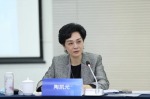
The most recent one was a national program, held at the National Judges College, focused on training senior personnel in foreign-related matters, at which Justice Tao Kaiyuan spoke. Those speaking at the program (from the relevant departments) included representatives from the Central Foreign Affairs Commission, the Legislative Affairs Commission under the National People’s Congress Standing Committee, Ministry of Foreign Affairs, Ministry of Commerce, as well (presumably) senior personnel from the SPC’s #4 Civil Division and the International Cooperation Bureau (which deals with treaty negotiation and judicial assistance matters). Local courts that have run such programs include Beijing (with the assistance of the University of International Business and Economics).
4. Judicial Assistance
China has concluded 171 bilateral judicial assistance treaties with 83 countries and has acceded to nearly 30 related international conventions (no change from October, 2022). In contrast to twenty or even ten years ago, the number of judicial assistance matters dealt with by the Chinese courts has increased. The press release mentions improving the quality and efficiency of international judicial assistance such as better cooperation in the cross-border service of judicial documents, cross-border investigation and evidence collection, ascertainment of foreign law, and recognition and enforcement of foreign (extra-territorial) judgments and arbitral awards. This does not yet mean that it is possible for foreign litigators to take depositions in mainland China for foreign court proceedings. Service of process was an issue in this 2022 case in the Southern District of New York.
four judicial reform books edited by the Judicial Reform Office
Although no formal announcement has been made in the Chinese press (of which I am aware), it appears that sometime during the last six months, more likely before early June (2023), the Supreme People’s Court (SPC)’s Judicial Reform Office, or more formally the office of the SPC’s leading small group for judicial reform (最高人民法院司法改革领导小组办公室) ceased to exist as a separate entity. Its work has been assumed by the Research Office. The leading small group that the Judicial Reform Office supported appears to have been disbanded as well. This post provides some comments on the office, some fragments concerning its history, an explanation of the nature of the office and leading small groups, and evidence for reaching the conclusion that the office no longer exists.
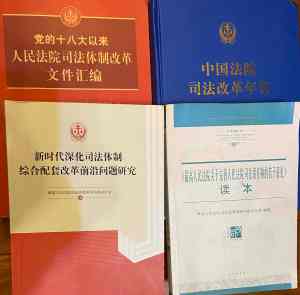
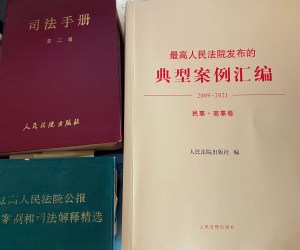
Over the past 10 years, this blog has discussed or cited statements or documents issued, reports drafted, and books published by the Supreme People’s Court (SPC)’s Judicial Reform Office. As is visible from the photo above, I have a collection of books edited by that office, many of which I have not yet cited in this blog or my other writings. Some books contain documents, others set out authorized commentary, and others are collections of analytical essays for the most part written by lower court judges. I had intended to draw on some of these materials when writing something more detailed about the drafting of judicial reform measures, setting out my understanding of the drafting process. A number of our Peking University School of Transnational Law students have interned in the Judicial Reform Office. I will now need to wait until I am able to gather enough information about how the new system operates before writing a current and historical description.
The offices of leading small groups are not permanently established, although this one had been in existence for almost twenty years. It is not unusual for them to be abolished and their duties assumed by permanent institutions. The temporary nature of the office may explain why published structure charts of the SPC have never mentioned the Judicial Reform Office. The SPC has other such offices, but this one appears to be the most well-known. Leading small group offices exist in analogous form at the local level as well.
For those who are not aware of the system of “leading small groups,” many exist throughout the Chinese Party and government system to deal with cross-institutional matters, often involving participants from multiple Party and/or state institutions. There seems to be a growing English language scholarly literature on multi-institutional leading small groups, mostly behind publishers’ paywalls, but this detailed summary of leading small groups and affiliated offices by Alice Miller is helpful to those without university library access. The summary explains that “leading small group general offices have dedicated office space, a roster of personnel, and an operating budget for administrative expenses. Although they cannot implement anything on their own, they can levy work on other offices.” My forthcoming (“neverending”) article has a description of the SPC’s Judicial Reform Office levying work on (assigning work to) other SPC offices, divisions, and institutions.
The Judicial Reform Leading Small Group and its supporting office were established in 2006. Although I have not been able to find the document approving its establishment, I assume that it was established to draw together a team of people to focus on judicial reform matters and to coordinate matters across multiple SPC entities, with the lower courts, and with the related Party bureaucracies. The Judicial Reform Leading Small Group had a predecessor entity entitled the SPC Judicial Reform Research Leading Small Group (最高人民法院司法改革研究领导小组). The China Institute of Applied Jurisprudence provided institutional support for the predecessor entity. I assume that the establishment of the SPC’s Judicial Reform Leading Small Group and its predecessor are linked to the 2003 establishment of the Party’s Central Judicial System Reform Leading Small Group (中央司法体制改革领导小组), which has (had?) members from multiple Party and state institutions. That Leading Small Group also has (had) an affiliated office (中央司法体制改革领导小组办公室). I have not seen public mention of the Party’s Central Judicial System Reform Leading Small Group in the past year or more, so I assume it has been disbanded and its functions subsumed by some part of the Central Political-Legal Committee/Commission.
Prior to 2003, judicial reform research at the SPC was conducted and coordinated by the Research Office. That office often deals with SPC cross-institutional matters, such as the transition to the Civil Code. So this development appears to be an instance of the SPC either going back to the “good old days” or as a former SPC judge recently wrote about the end of a piloted judicial reform, “restoring the original condition (恢复原状).”
During the March 2023 meeting of the National People’s Congress, He Fan, previously mentioned on this blog, spoke to the press about judicial reform, as a responsible person of the Judicial Reform Office (最高人民法院司法改革领导小组办公室负责人). In September of this year, public statements concerning judicial reform (in this case, the termination of the piloted reform of the four levels of the courts) were issued by a responsible person of the Research Office. A related document issued in June (2023) did not mention the Judicial Reform Office or the Judicial Reform Leading Small Group. When He Fan spoke at Fudan University Law School in September, he was described as a vice director of the Research Office and the former responsible person of the Judicial Reform Office (最高人民法院研究室副主任、原司法改革办公室负责人何帆博士). So I surmise from this that sometime between March and June, the Judicial Reform Office was abolished and its responsibilities and personnel were transferred to the Research Office.
I will be monitoring this change (to the extent possible). Questions that come to mind include the following. What will being located in the Research Office mean for judicial reform matters? Will the staff take on additional tasks in addition to judicial reform matters? What will this mean for the analysis of the impact of prior judicial reforms? What will this mean for the drafting of the sixth judicial reform plan outline? Will this mean more or fewer staff resources? When the plan is issued, will we on the outside of the Chinese court system notice the impact of this bureaucratic change? And as several highly knowledgeable persons have asked me in recent weeks, how should the judicial reforms of the last ten years be objectively assessed?
_________________________________________
Many thanks to the knowledgeable persons who contributed to this blogpost. Those with additional information or corrections should contact me. My apologies to my patient followers for the long gap between blogposts. but I have spent much of the last two months revising my “endless” long article for publication, as it needed to be updated to reflect recent changes. This change requires an additional update. I plan to do several more analytical blogposts in the upcoming months, but use more of my time putting together my research, as highlighted earlier this year.
6th Circuit press conference announcing the typical cases
In late May of this year (2023), the Supreme People’s Court (SPC) issued a set of typical cases on resolving real estate and construction disputes at their source provided by the SPC’s #6 Circuit Court (the circuit court covering the northwest provinces and autonomous regions), entitled “Typical Cases of Litigation Source Governance in the field of Real Estate and Construction Projects in the Circuit Courts area (巡回区房地产及建设工程领域诉源治理典型案例). These typical cases have not received their due attention outside the Chinese court system. They are helpful for understanding how the Chinese court system is evolving under the leadership of SPC President Zhang Jun. These ten typical cases are examples of court practices that the SPC has provided to lower courts for guidance. The guidance focuses on two principal areas: how to implement properly the requirements of President Zhang Jun and the SPC’s Party group to serve national and social governance by resolving disputes at their source (linking to the General Secretary’s important instructions and related documents; and second, how to use “active justice” (能动司法) to achieve these objectives.
As I flagged in May of this year, President Zhang Jun has revived the concept of “active justice.” In that same blogpost and in earlier ones, I mentioned that resolving disputes at their source has become an important task for the Chinese courts. The cases weave together these policies in one perfectly designed package.
These cases also tell a story about how active justice and resolving disputes at their source can involve the courts undertaking some functions that should be left to the lawyers.
Typical cases that are not cases
These ten cases are not accounts of specific court cases but rather are examples of exemplary practices. This is not the first time that the SPC has issued “typical cases” that are exemplary practices. Since 2017, the judicial reform leading group of the SPC has issued typical cases that illustrate judicial reform practices that provide useful reference materials for other courts.
Resolving disputes at source
Resolving disputes at source is a Party policy mentioned briefly in the 2019 fourth plenum of the 19th Party Congress decision, the SPC document implementing that Party Congress decision, and the 5th judicial reform plan document. It was further developed in subsequent documents. It links to the Party’s (and SPC’s) diversified dispute resolution policies. An academic article recently published unfortunately does an inadequate job of defining the policy and describing the policy’s development. Moreover, it incorporates some translation errors. Although both authors are affiliated with prominent academic institutions with serious scholars of the Chinese courts, it appears to this reader that they failed to seek the perspective of some persons with a greater historical perspective on SPC developments. It is another instance in which peer review did not catch inadequacies.
According to several SPC press releases and articles related to these cases, the foundational document for recent SPC and other legal institution policies is a February 2021 Central Committee document (never publicly released) entitled Opinions on Strengthening the Governance of Sources of Litigation and Promoting the Resolution of Sources of Contradictions and Disputes” (关于加强诉源治理推动矛盾纠纷源头化解的意见). I surmise that the document includes the phrase “promote basic level social governance” (促进基层社会治理) and likely “national governance.”
Judge Wu Zhaoxiang, deputy head of the #6 Circuit Court (and also deputy head of the SPC’s Research Office, whom I quoted in my book chapter on the drafting of criminal procedure judicial interpretations), explained why they focused on real estate and construction disputes. He said it is because these disputes are important.
Within the jurisdiction of the 6th Circuit, “there are tens of thousands of lawsuits flooding into the courts every year, with huge amounts of ‘real money’ worth billions at every turn. It involves the development of business of tens of thousands of enterprises and the well-being of the people, and it is related to the country’s economic development, financial security, and social stability.” Judge Wu mentioned that some small, medium-sized, and even large real estate companies have encountered difficulties such as in funding, resulting in failure to hand over buildings in time, causing home buyers to stop paying mortgages, which has attracted a great deal of public attention. Many of the construction cases involve unpaid contractors and actual constructors. [“Actual constructors” (实际施工人) refers to companies /other entities that to which contractors have improperly subcontracted, although they may not have the proper certificates, etc. to do so]. The problem of wage arrears to migrant workers has not been completely resolved, and “collective rights protection incidents of migrant workers” still occur from time to time.
Statistics provided in one report bear this out. Shaanxi courts accepted 13,900 construction dispute cases in 2020, 17,800 cases, in 2021 and 18,400 cases in 2022. The Qinghai courts heard more than 8,400 real estate-related cases and 10,300 construction disputes, the Ningxia courts accepted 36,600 cases in the fields of real estate and construction since 2020, and the courts of the Xinjiang Corps accepted 15,300 real estate and construction cases in the past three years. The same report signaled that real estate and construction disputes are on the rise nationally.
Lessons from the cases
The 6th Circuit labeled the ten typical cases with the lessons to be learned (which I have italicized), similarly to the judicial reform typical cases mentioned above. I further describe the first one, because the points in the typical cases repeat one another:
Adhere to the leadership of the Party to build a new pattern of governance of sources of litigation: The exemplary practice was the Shaanxi Party Committee’s Implementing Opinions on Strengthening the Governance of the Sources of Litigation and Promoting the Prevention and Resolution of the Sources of Conflicts and Disputes” (关于加强诉源治理推动矛盾纠纷源头预防化解的实施意见), which apparently assigned to provincial institutions responsibilities related to the goal of promoting the prevention of conflicts and disputes at the source. The SPC identified three specific examples: “optimizing top-level design” and building a pattern of “government-institution linkage” by the provincial Higher People’s Court and Housing and Construction Department jointly issuing a document aimed at promoting mediation of real estate and engineering disputes by creating a database of experts to mediate these disputes; and improving non-litigation mechanisms through a document that the provincial Higher People’s Court and Provincial Construction Cost Association jointly issued to establish a group of experts to mediate construction cost disputes; and third, the Shaanxi Higher People’s Court promoting “active justice” through reviewing typical cases and communicating with the regulators, including providing them with typical cases concerning problems discovered in the course of litigation, issuing compliance advice to large construction companies, and as well as judicial advice to administrative departments.
Track and pay attention to key projects to ensure zero disputes in construction projects;
Work together to solve the “difficulty in obtaining certificates” to solve the difficulties and worries of the masses;
Collaborative linkage revitalizes projects to achieve “three guarantees” to resolve public concerns;
Expanding the scope of notarization to participate in judicial assistance and adding “new troops” to pre-litigation mediation;
Innovate the pre-litigation identification model to promote the quality and efficiency of dispute resolution;
Judicial recommendations are implemented and effective, and targeted policies are implemented for precise governance;
Give full play to the exemplary role of judgments and rulings and promote the resolution of the source of conflicts;
Formulating and issuing compliance management suggestions to help enterprises prevent disputes; and
Do a good job of risk reminders to ensure the healthy development of enterprises.
Comments
SPC Vice President Yang Linping, the head of the #6 Circuit Court, repeatedly used the phrase “active justice (能动司法) in her speech announcing the significance of these cases, which was reprinted as an article published in People’s Justice (人民司法). By doing this she is promoting the new spirit of the SPC leadership under President Zhang Jun. Some of that new spirit is putting a new spin on earlier policies, such as resolving disputes at source by promoting mediation, thereby transmitting the Fengqiao Experience. Active justice is another old policy receiving a new spin. “Active justice” appears to be a flexible concept and since President Zhang Jun has started to mention it, those in various levels of courts and substantive areas have used it, generally without a specific definition. From these cases and other sources, it involves the use of less prominent functions of the courts (such as coordination with administrative authorities and liaison with the local Party committee to resolve the core problems of a dispute. Resolving disputes at source appears to be derived from Chinese medicine philosophy in seeking to resolve the root cause of disputes by using the data, insights, and multiple functions of the courts to that end. It also is a flexible concept.
What is little discussed in articles about “active justice” thus far is why the courts are taking on some of the roles they are. For example, one of the exemplary methods promoted in these cases and praised highly was the courts analyzing and summarizing the compliance management risks of large construction companies as derived from relevant litigation and the courts issuing suggestions for corporate compliance management as well as providing judicial suggestions to administrative agencies on how they might better exercise their regulatory authority.
It occurred to me that in many other jurisdictions (I don’t believe the civil or common law distinction makes a difference), it would be either law firms or events sponsored by bar associations (lawyer associations) that would host events aimed at real estate or construction counsel (in law firms, in-house, or with government) to convey their insights about recent litigation. My initial reaction was that the situation might be different in first-tier areas of China, given that lawyers are better educated in those areas and companies have better counsel, and so the courts might be less “active” in providing advice. I, therefore, checked my initial reaction with a highly experienced judge in a first-tier city. He said that no, courts in his municipality also issue judicial suggestions (link is to a related academic article) to enterprises and administrative agencies requiring them to improve some aspect of their operations. It is part of their work to “serve the greater situation” and courts have performance indicators concerning judicial suggestions/advice. “So we take away a lot of business from lawyers by providing free legal advice.”
Like all Chinese Party and state organs, the Supreme People’s Court (SPC) handles requests for instructions (请示), (also translated as requests for advisory opinions). A request for instructions is a type of document submitted by a subordinate to a superior state or Party organ to request instructions or approval. It is one of many discrete matters that reveals the SPC’s bureaucratic operations.
Requests for instructions are incorporated into the 2012 SPC measures on official documents of the people’s courts (人民法院公文处理办法), which implement the Party and government’s regulations on official documents (党政机关公文处理工作条例) (an English translation of the latter can be found here).
This system has existed for many years and has been controversial for at least 40 years, if not longer. When I wrote about the SPC 30 years ago, I devoted several pages to describing the practices concerning requests for instructions, including telephone requests, as they were understood at the time, and also mentioned controversies about the practice. At the time, I was not aware that old regulations concerning the practice existed.
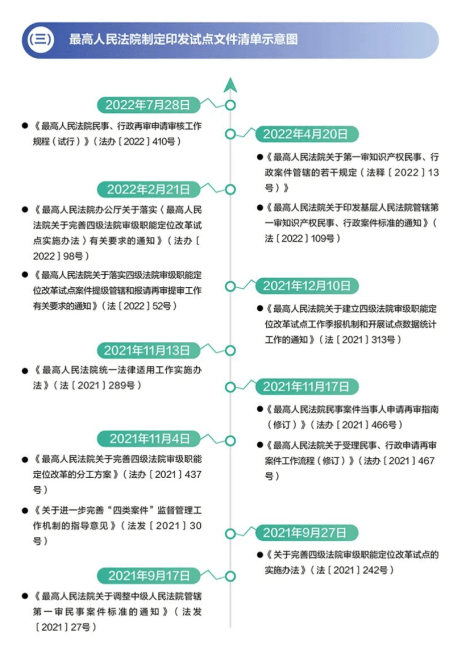
In early June, the SPC released updated procedures on requests for instructions concerning the application of law (Provisions of the Supreme People’s Court on Responding to Requests for Instructions on the Application of Law (Provisions on Requests for Instructions) 最高人民法院关于法律适用问题请示答复的规定), to be implemented from 1 September. The Provisions on Requests for Instructions themselves further reveal some of the details of the SPC’s bureaucratic operations and relate to formal requests, not to informal versions. The Provisions on Requests for Instructions also attach form documents for the lower courts to use, to standardize formats. They are not a judicial interpretation (as can be seen by the document number–fa (法), but a judicial document (司法文件), but the lower courts will implement its provisions. This post will address what is new or different, the matters to which it applies and does not, the Monitor’s views about the reasons for issuing this guidance, and other insights the Provisions provide.
What does it say?
The Provisions on Requests for Instructions apply to requests for instructions on legal issues, not factual issues submitted to the SPC. In general, the requests must be submitted by Higher People’s Court, although for intellectual property cases, first-instance courts may directly submit them to the SPC, which I surmise intended to refer to the SPC’s Intellectual Property Court. These Provisions are related to the reform of the four levels ofthe Chinese courts and are part of larger reforms focusing more of the work of the SPC on questions of law rather than fact and law.
Article 2 defines the scope of cases that can be submitted:
no clear provisions in laws, regulations, judicial interpretations, normative documents, etc., and there are major disputes over the application of law;
a major dispute exists over the understanding of the specific meaning of laws, regulations, judicial interpretations, normative documents, etc.;
Significant changes have taken place in the objective circumstances concerning which judicial interpretations and normative documents were formulated, and the continued application of relevant provisions is obviously contrary to fairness and justice;
Judgment rules for similar cases are obviously not uniform;
Other major disputes over the application of law.
Formalities
The Provisions on Requests for Instructions require the judicial (adjudication) committee of the requesting court to have considered the issue and to provide relevant information about that discussion, consistent with requirements relating to retrial cases, discussed here. Additionally, the court must prepare a package of documents, including a search of prior cases, and a report on the issues and reason for the request, the views of the collegial panel that heard the case, and related reports from the lower court, if the request originated below. The standard form document provides guidance to the lower courts on format.
The SPC’s case filing division is designated as the SPC entity to receive the requests and dispatch them. They are required to review the requests within three days and inform the requesting court whether or not the request is accepted or rejected and whether additional materials are needed.
If the issue relates to a judicial interpretation or a judicial regulatory document (规范性文件) etc., the Provisions on Requests for Instructions require that the matter should be sent to the drafting department, the principal department if relevant, or otherwise the apparently relevant division or office. If the relevant division or office does not want to review it, it can negotiate with the case-filing division to take the matter back and cannot request another division or office to take on the matter without case-filing division clearance. The vice president of the SPC in charge of these matters will resolve any disputes.
The division that takes on the request is required to designate one person to be in charge of the request, which is then to be reviewed collectively, in a professional judges meeting, as provided in a 2017SPC opinion. Several divisions or offices can handle a request together, or views from institutions or experts outside the SPC can be sought if needed. Responses should be in writing and in the name of the SPC itself, but may also be provided over the phone, with a record kept of the response. The requesting court should (must) implement its provisions but not cite the response as the basis for its decision.
The draft response needs to be reviewed by the Research Office before it is submitted to the relevant vice president in charge for approval, and if necessary, the SPC president or judicial committee may consider it. The Provisions on Requests for Instructions impose a two-month deadline on responses, which can be extended.
Transparency is permissive, and if a case is significant, the SPC can request that the case be transferred for a hearing, or otherwise the case be reworked as a guiding case or judicial opinion.
To what cases does it apply?
The procedures apply to ordinary requests for instructions concerning legal issues, but not requests for instructions that may arise when a lower court considers one of the four types of cases. Those cases are those that are politically sensitive, difficult, or involve mass cases. The objective is to protect front-line judges from deciding “Four Types of Cases” autonomously in a way that is considered wrong or inconsistent with policy and legal provisions as well as the court leaders above them. The guidance for those cases authorizes court leaders, in those cases, to seek guidance from higher-level courts on the handling of those cases.
The 2017 Opinion mentioned above also provides for other exceptions for requests for instructions in certain major criminal cases.
These Provisions do not apply to the Prior Reporting of the judicial review of arbitration cases, under a separate judicial interpretation.
Why this guidance?
On why this guidance was issued, I surmise that the SPC leadership has seen many such requests for instructions but judges have delayed responding to them, have forwarded them to other divisions for response, and different parts of the SPC have issued conflicting responses. Additionally, the SPC may have seen many requests involving determinations of facts as well as law. Therefore, I surmise, the SPC leadership charged case-filing and trial management divisions with drafting updated regulations.
Statistics on the number of requests for instructions (either formal or informal) at either the SPC or below are unavailable. A highly experienced Chinese judge commented to me that an important reason for lower court judges to request instructions is to avoid “making mistakes” that may have negative consequences on the individual judges or panel of judges involved or may lead a higher court to reverse the lower court. My own earlier research and that of Professor He Xin found other reasons as well (in the lower-level courts).
What other insights are there?
As I wrote previously, fifteen or more years ago, there had been proposals even within the SPC for the system to be “proceduralized” or “judicialized–see Dean Jiang’s 2007 article. The second judicial reform plan (see the original Chinese and an English translation) under the late SPC President Xiao Yang), called for reform to the system of reporting and seeking approval/request for instructions system. However, times have changed. The SPC leadership is required to seek instructions on certain matters.
The Provisions require a reply database to be established and higher courts to report the replies they have given on an annual basis to the SPC. Presumably, the higher courts will impose the same requirement on the intermediate courts within their jurisdiction. This is part of the SPC leadership’s push to extend its supervision of the many entities within the SPC and the lower courts. At the level of the SPC, this is one part of leadership efforts to impose more uniformity in the application of law by SPC divisions, offices, and circuit courts. It is one aspect of strengthening the firm guiding hand of the SPC.
A fundamental principle of Chinese bureaucracy over the millennia is that a change in leadership brings a change in policy. As we know, Zhang Jun (张军) is now the president of the Supreme People’s Court (SPC), having taken over from Zhou Qiang in March.
I surmise that President Zhang Jun’s long career involving criminal law matters, starting out at the SPC and with hands-on experience working in many of the most important institutions related to the SPC has shaped his view of the role and appropriate operation of the Chinese courts. I will first add to the English language description of President Zhang’s biography before deriving from several recent articles what I view as an evolving new spirit at the SPC.
Although others have compiled his biography, with one in English and many in Chinese, I will tweak the narrative in English, based on the Chinese biographies, and on what I understand to be the importance of the institution in which (I surmise) he had formative experiences.
The Chinese version of his biography linked above states that between 1985-1995, Zhang Jun worked in the SPC’s Research Office’s General Department and Criminal Law Department as a clerk; then as a deputy judge (助理审判员) and deputy head of the Criminal Law Department; and the head of the Criminal Law Department and judge (审判员), with two years spent outside the SPC, 1990-91 at the Central Party School and in 1991-92, was seconded to the Beijing Haidian District People’s Court as the deputy head of the economic crimes group. His early career progression reflects what I wrote 30 years ago, that “graduates from law schools assigned to the Court as clerks are generally required to work for two years in a basic level and in an intermediate court to give them experience “at the grassroots level,” while their positions [at the SPC] are retained.” From 1995-98, he was promoted to be one of the deputy heads of the Research Office.
I emphasize these apparently minor details because, in my view, these were formative experiences that will have an impact on his leadership of the SPC. His early experience reflects the careers of an entire generation of senior legal specialists, most of whom have retired or have been reallocated to pre-retirement roles at the National People’s Congress (NPC) Standing Committee or the Standing Committee of the Chinese People’s Consultative Committee (CPPCC). He would have been assigned to the SPC (although it is not so stated), and the progression of his career. starting out as a clerk reflects the career path for many (back in the day), as I described in my 1993 article. The quota judge reform (discussedhere), has changed the career path for young judicial personnel. The fact that President Zhang started out and spent many years at the SPC’s Research Office means that he is deeply familiar with the making and implementation of judicial policy, particularly criminal law (and procedure) policy. I mean policy broadly.
This gives me an opportunity to flag the role of the SPC’s Research Office. It is a special institution within the SPC, designated as a comprehensive operational department (综合业务部门), which one former staff member described to me as the “Brains” of the SPC. At the time that President Zhang was assigned to the office, the China Institute for Applied Jurisprudence had not yet been established, so applied research would have been done by the Research Office. As can be derived from multiple earlier blogposts, it is closely involved with the drafting of judicial policy and interpretations, as well as Hong Kong and Macau-related and juvenile-related judicial matters. The Research Office is the gatekeeper for reviewing proposals for new or amended judicial interpretations, as well as examining and coordinating the drafting of judicial interpretations. It also acts as the liaison when other central institutions forward their draft legislation and draft judicial interpretations to the SPC for comments, coordinating the SPC’s response with other divisions and offices, with a knowledgeable person noting to me earlier that “the view of the Research Office prevails.” It appears to have an analogous role in the drafting of judicial policy documents. I noted earlier that it has an important role in responding to requests for instructions from the lower courts.
A quotation of SPC Senior Judge Yu Tongzhi (previously mentioned in this blog) from his 2020 book, Ten Lessons on Criminal Practice, is relevant in understanding the thinking of Chinese judges working in the area of criminal law and procedure):
talking politics [讲政治] is a basic quality required of a criminal judge [Talking about politics, in a nutshell, means observing and dealing with problems politically. ]. In the past, we often said that criminal adjudication [trials] was a “knife handle”(刀把子)[tool of the Party], now this slogan is used less, but the function of criminal trials as a “knife handle” has never disappeared and cannot disappear. Of course there is no contradiction with strengthening the protection of human rights. Now Central leaders repeatedly say: the primary responsibility of the entire political-legal system is to safeguard political security, not only criminal adjudication and not only the adjudication work of the courts…
Judges from the SPC down to the local district courts (and the Monitor as well) are observing SPC media for signals of changes in policy. Gradually President Zhang Jun’s priorities will become clear to those of us outside the System and we will see which of Zhou Qiang’s initiatives will remain vibrant. A number of President Zhang Jun’s talks and visits have been made public–the purpose is to inform those in and outside the System of the spirit of the Chinese courts under new leadership. I’ll identify a few articles that twinkle new, amended, or repurposed policies and priorities.
The first article (and in my view, the most important) is the earliest, 抓实公正与效率 (Seize Justice and Efficiency), in which President Zhang Jun transforms General Secretary/President Xi Jinping’s series of speeches during the Two Sessions, the spirit of the annual Central Political-Legal Commission Conference, and suggestions from NPC and CPPCC deputies into more specific measures for the SPC leadership and correspondingly, the entire court system to implement. The ability to do this well is a crucial skill for any SPC President. According to a subsequent report about President Zhang Jun’s speech at the National Judges College, the themes in this article were transformed into a special training course for local senior court leaders.
Among the themes he stressed were: “serving the overall situation, serving people’s justice, and promoting the political foundation of the party’s governance”, which he characterized as the “duties and missions” of the people’s courts. He did not discuss the broader implications of “serving the overall/greater situation (大局服务).” As I have written a great deal on SPC policy documents issued in the past 10 years and I predicted in this 2022 brief article that the SPC will focus more on issuing policy documents, I will be monitoring SPC official media to see whether any change is visible in the way that judicial policy is transmitted.
President Zhang Jun stressed the themes of “fairness (justice) and efficiency (公正与效率). Promoting fairness/justice, he characterized as promoting substantive fairness, while paying attention to procedural fairness. He said “It is necessary to avoid simply [mechanically] ‘handling of cases according to law.’ It is the people who feel fairness and justice, not ourselves, we need to stress procedural justice…People come to the court to solve problems, not to ‘follow the procedure’. ” The theme of combining substantive and procedural justice is not new in China (there is a robust scholarly literature (including in English) discussing it, with a forthcoming related article by Professors Rachel Stern and Benjamin Liebman, Gao Wenwa, and Wu Xiaohan that I recommend (I was privileged to read a pre-publication draft). The fact that President Zhang Jun raised these themes so early means that they will be emphasized during his term in office.
The second theme that he stressed is improving efficiency, but without an overemphasis on efficiency, which he said would lead to more petitioning. He also encouraged judges to engage in the in-depth analysis of judicial big data, put forward judicial suggestions to relevant departments (see a recent paper on this topic), and promote the strengthening and comprehensive management of resolving disputes at source (mentioned in earlier blogposts).
He flagged ‘handling a typical case and promoting a solution for a group,’ so we can expect continued or greater use of typical (model/exemplary) cases (as discussed earlier). Unsurprisingly, President Zhang Jun reminded court leaders of their dual responsibilities (political and professional matters) and reminded them of the requirement to implement the “three regulations,” that is reporting the interference in the handling of cases, and the failure to report interference. It can be surmised that the incompletely implemented judicial reform of Chinese court finances, along with the deterioration of local public finances means that courts are under even more pressure to protect local interests. President Zhang Jun reminded judges that these are needed to promote an incorrupt judiciary and signaled that disciplinary inspection and supervision departments should strengthen supervision. I surmise that the SPC itself will be a target of heightened scrutiny by those institutions, in view of the multiple corruption cases that arose in recent years, especially given the larger number that arose compared to those at the Supreme People’s Procuratorate.
2. 国家法官学院开学第一课——能动司法 (The First Class at the National Judges College–Judicial Activism). Although President Zhang signalled how he thought criminal, civil, and administrative case hearing should be modernized in his speech to newly appointed intermediate and basic level court presidents, the most important message in the speech was about judicial activism (能动司法 but different from Marbury v. Madison–his reference). He said an “active judiciary must strictly perform its duties in accordance with the law. Political effects and social effects extend from legal effects. Sacrificing legal effects to talk about so-called political effects and social effects one-sidedly violates the comprehensive rule of law and loses the legal basis. How can it be good? ” Over 10 years ago, SPC President Wang Shenjun promoted judicial activism (there appears to be a large English-language discussion of this term, mostly behind publishers’ paywalls, but my reading is that President Zhang is repurposing the term. How he is repurposing it remains to be seen.
3. 就是头拱地也要把人民的事办好 “Even if you put your head down, you must do the people’s affairs well.” This article reports on an SPC Party Group related to the ongoing thematic education campaign (主题教育). President Zhang stressed that the courts need to do a better good job in the work of “responding to letters” (把“有信必复”工作做实做好), He said “responding to letters” is a systematic project that requires overall planning and scientific arrangements. He said “‘respond to every letter’ (“有信必复) is to let the people know that the letter has been received and who is handling it in the shortest possible time.” He noted that the petitioning related to litigation, in the final analysis, shows that the courts have not done their work well enough (涉诉信访问题说到底,是法院的工作还有不足).
He reminded his audience that leaders of courts at all levels should take the lead in handling major difficult and complicated cases reflected in letters, promote substantive resolution, and ensure the smooth and orderly development of this work. ”
I take from this that letters and visits work will become much more important in the local courts, with the stress on resolving the underlying issue (linking to the ongoing theme of “resolving disputes at source” and the greater importance of letters and visits (Xinfang) work nationally. It is not likely that court leaders will deal with petitioners in the first instance. Professors He Xin and Feng Yuxin wrote about veteran petitioners in this 2018 article (behind the paywall again). The experience of some friends who are working or have worked in local courts is that petitioners can be very strategic in the way they petition, with keen sensibilities about how to extract the maximum benefits from petitioning. Now retired Justice Hu Yunteng wrote about how to best handle administrative litigation-related petitioning at the #2 Court, explained here. From this recent article in People’s Daily, it appears that the Shenzhen Intermediate Court has led the way in litigation-related petitioning reform, investing much more staff time (I surmise including judges) and creating a platform for responding to visits, calls, and letters from the public, with a 100% rate of responses to calls.
4. 办公室不是清水衙门 “the office isn’t a clear water yamen.” This phrase is a contrast to what I wrote about the SPC 30 years ago. In my 1993 article, I quoted a graduate of a prominent Beijing law school, who told me he and his classmates were reluctant to be assigned to the SPC, and labelled it a “clear water yamen” for the low salary, meager fringe benefits, shabby housing, and rigid internal discipline.” President Zhang warned that judges and judicial personnel face the risk of being “hunted” [sought for improper benefits] in different forms. They must always “adhere to the moral integrity and self-discipline”, keep vigilant…and do not want to be corrupt. “The three regulations [mentioned above, about reporting improper interference] must be strictly enforced.” President Zhang has mentioned team rectification (队伍整顿) several times, linked to the thematic education campaign.
5. 承继人民司法优良传统 以审判工作现代化服务保障中国式现代化 ‘Inheriting the fine traditions of the people’s judiciary, guaranteeing Chinese-style modernization with the modernization of trial work”-this article is an account with his meeting with the old cadres of the SPC. I derive a sense of the new spirit concerning judicial reform from this article. President Zhang said ” a full assessment of the implementation of the judicial reforms undertaken in recent years should be undertaken, the positive aspects should be summarized, and those that have encountered problems in implementation should be deeply improved” (对近些年的司法改革实施情况做一个全面的评估,好的方面要总结,落实中的问题要深化完善). From this, I surmise that we will not see major judicial reforms (see Dean Jiang Huiling’s analysis), but more limited measures to improve the implementation of previous measures and the assessment will be for internal use only, as one for external use (the judicial reform white paper) has already been issued.
This article has flagged only some of the work and priorities of the Chinese courts under President Zhang Jun, in the short time he has been in office. There are many areas of law for which I have not seen related reports. For those matters discussed above, how the work is implemented and priorities are implemented in practice over the next years as well as the impact of these priorities remain to be seen.
_________________________
Many thanks to my anonymous peer reviewers for reviewing a draft of this blogpost.
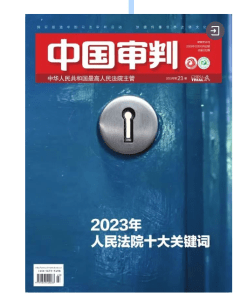
In March of this year, Supreme People’s Court (SPC) Vice President Justice Tao Kaiyuan released, by the standards applicable to senior SPC leaders, forthright public comments about the state of Chinese international commercial dispute resolution and her proposed solutions in an article in the SPC’s glossy journal China Trial (中国审判 ). Based on the article, she appears to continue to have responsibility for the #4 Civil Division, the one focusing on cross-border commercial matters and arbitration. I summarize her comments below. My comments on her assessment are in italics.
Her overall assessment is that there is much to be done to make China a preferred destination for international commercial dispute resolution, as the political leadership would like. I agree and would add that Chinese institutions could improve their soft power in specific, discrete ways by “making reference to the beneficial experience of foreign institutions” (对世界上的优秀法治文明成果要积极吸收借鉴) or considering some new ideas. Why it is so difficult merits extended discussion (elsewhere). It appears to require some legal and institutional flexibility, openness to outsiders and outside practices, and practical thinking about how those ideas or practices could adapted to the Chinese environment. It seems these qualities are in short supply these days when the emphasis is on self-reliance and in judicial reform, “Chinese style and self-owned brand.” Justice Tao draws on the beneficial international experience of several SPC judges to make a suggestion that implies greater institutional flexibility. She does not address the possible legal obstacles, but what is important is the signal that she is considering ideas other than the tried and true.
China’s legal infrastructure lags behind the trend of international developments
Justice Tao points to what the international community has done in harmonizing international commercial legal rules through the New York Convention [Convention on the Recognition and Enforcement of Foreign Arbitral Awards], Singapore Convention on Mediation, Hague Judgments Convention, and the Mauritius Convention, as well as the related Model Laws. She notes that China has only ratified and implemented the New York Convention, while the other conventions have not been ratified or lack supporting measures. The Civil Procedure Law and Arbitration Law are being revised, and commercial mediation and investment arbitration legislation are absent.
While I will leave the analysis of the current amendments to the Civil Procedure Law to those who have greater expertise than I, I believe neither the amendments nor the latest socialist education campaign will sway litigants who have selected the New York, English, Hong Kong, or Singapore courts for dispute resolution. It is difficult to know whether issues lie in the original draft proposed by the SPC or have resulted from comments from the NPC’s Legislative Affairs Commission or other institutions involved in commenting on the draft before it was made public.
She recommends “promoting” the revision of the Arbitration Law to incorporate more elements from the Model Law, specify the seat of arbitration, and accelerate the efficiency of the enforcement of arbitral awards. It is not clear what she means by the latter and she may be just expressing a general concern with efficiency.
On the Arbitration Law, it is not apparent whether there has been any progress since I last wrote about the SPC’s contribution to the complicated amendment process in December of last year. From press reports of discussions of the draft and related training sessions, it appears that work is continuing behind the scenes until major points of disagreement are resolved. Other than the summary of the statement that Justice Tao made to the Chinese People’s Political Consultative Conference (CPPCC)’s Committee on Social and Legal Affairs last year, we do not know what views the SPC expressed and the bases for those views. That being said, this is not usual when it relates to the SPC contributing to the drafting or amendment of legislation. As I wrote then, it appears from her summary that views from several different divisions and offices of the SPC are reflected in what she said, including the #4 civil division (responsible for international arbitration matters), #3 civil division (intellectual property and anti-monopoly), and the enforcement bureau.
On the Singapore Mediation Convention and Chinese commercial mediation legislation, this is the second official signal I have seen from the SPC that such a law is needed–the one seen earlier was in the SPC’s Specialized Report on Foreign-Related adjudication work. Drafting such legislation would be within the bureaucratic authority of the Ministry of Justice. It is understood that the Ministry of Justice is communicating with the Ministry of Commerce, to draw on the technical expertise that resides with the Chinese negotiator of the Singapore Mediation Convention and the UNCITRAL Model Law on International Commercial Mediation and International Settlement Agreements Resulting from Mediation and those who worked to support the Chinese negotiator. This 2021 article by Professor Jiang Lili of the China University of Political Science and Law on mediation legislation challenges does not give positive signals about an internationalized commercial mediation law, but that may predate the ongoing communications. Justice Tao flags researching the feasibility of ratifying the Hague Judgments Convention and the “Singapore Mediation Convention”. A team at the Chinese Academy of Social Sciences has already undertaken detailed research on what would be required for China to ratify the Singapore Mediation Convention. I am not aware of serious research related to the possible ratification of the Hague Judgments Convention. Mr. Wen Xiantao of the Ministry of Commerce has recently published a comparison of the New York, Singapore Mediation Convention, and Hague Judgments Convention.
On investment arbitration legislation, Justice Tao suggests that a mechanism should be put in place to enable the recognition and enforcement of Washington Convention (ICSID) awards. She does not detail the mechanics. That means that she has recognized the issue and it may mean others are considering how it could be most easily done.
2. Chinese international commercial dispute resolution institutions lack sufficient voice and are not competitive enough
She points to international commercial courts elsewhere in the world and to international long-term contracts and high-value transactions still mainly being based on the application of Anglo-American law, the dominance of dispute resolution (China-related, presumably) still being in the hands of the United States and the West, and the competitiveness of Chinese institutions being insufficient. Involvement in litigation or arbitration she finds not conducive to the protection of China’s relevant sovereignty, security, development interests and overseas interests. I have heard and read this often and would not expect Justice Tao to state otherwise.
I do not take Justice Tao’s comments as a scientific assessment of where arbitration cases involving Chinese parties are being heard. My own unscientific sample based on inquiries with senior lawyers at major Chinese and international law firms indicates a preference for Hong Kong International Arbitration Centre (HKIAC), Singapore International Arbitration Centre, and ICC International Court of Arbitration clauses, depending on the location of the project. I see a preference in major transactions for English law rather than New York law, reflected in the involvement of the “magic circle” [English] law firms and some of the “red circle” firms representing major SOEs in major arbitration or litigation. She does not specify what she means by “international long-term contracts”–possibly the FIDIC set of construction contracts. On the competitiveness of Chinese institutions, prior to Covid, Chinese institutions were actively marketing themselves, and this practice is starting to come back this year. Chinese dispute resolution institutions might want to do a better job of listening to issues raised by users. This practice seems to be usual among the leading international arbitration institutions, but in my experience, Chinese arbitration institutions have not sufficiently borrowed this practice.
3. Improvements needed with the China International Commercial Court (CICC)
Justice Tao says that the CICC cannot play its intended role because it lacks full-time judges, full-time staff, and its own budget. (I had flagged this in 2018), but such matters are not usually made public. The fact that she mentions this signals deep frustration. The significant number of staff that the SPC borrows from the lower courts also suggests that other central institutions are benefiting from greater headcount in preference to the SPC. Justice Tao also proposes that Hong Kong and Macau part-time judges be permitted to join the CICC.
Whether such judges would meet the requirements set by the Organic Law of the People’s Courts and the Judges Law does not seem to be clear. What is important is the signal that she is considering new ideas. It appears that Justice Tao is looking to the beneficial experience of SPCjudges as part-time judges with United Nations institutions.
____________________________________________
Many thanks to the highly knowledgeable peer reviewers, who commented on several earlier drafts of this article.
The Supreme People’s Court Monitor will soon have its 10th birthday. It has transformed my life in many ways. But sorting through 10 years of blogposts and many other materials relating to the Supreme People’s Court (SPC) I have gathered over the past 30 years, takes time. So I plan to post only occasionally from now on and focus my efforts on putting together something on the SPC that is readable and understandable to those outside of China, and that my readers inside the System (体制) consider an accurate analysis of a dynamic, extremely complicated institution.
For those students and others who cite this blog in their writings (see Bluebook, OSCOLA, and 法学引注手册) and might be concerned that this blog is not “peer-reviewed,” please check the particular blogpost. You may find that I have thanked one or more anonymous peer reviewers (anonymous to the reader, not to me).
As the readers of this blog know, Tongji University Law School Dean Jiang Huiling worked at the Supreme People’s Court for over 30 years, and for over 25 of those years, he was involved in judicial reform. He has the most comprehensive and deep understanding of the importance, challenges, and multiple implications of reforming China’s court system.
On 11 January 2023, Dean Jiang spoke on the last 10 years of judicial reform to my judicial reform class at the School of Transnational Law, colleagues and students from Tongji University, and some other visitors. This very delayed blogpost summarizes his presentation and responses to questions from the audience. The references to “we” in the summary are his, as are the unattributed quotations.
Presentation Outline
A. Roadmap of [the last ]10 Years of Judicial Reform
B. Four Fundamental Reforms
C. Judicial Organizations Reform
D. Procedural Justice Reform
E. Diversified Dispute Resolution
F. Judicial Democracy
G. Other Reforms
H. General Observations
A. Roadmap of Chinese Judicial Reform
The focus of his presentation was the last ten years of judicial reform (2013-2023), which included two five-year judicial reform plans. He first provided some historical background to the most recent two judicial reform plans, speaking about earlier judicial reform plans from a participant’s perspective.
1. Earlier judicial reform plans
Many Chinese scholars and some foreign scholars consider that those earlier ones were working method reforms, focusing on efficiency and other matters-they say is it not real judicial reform. He disagrees but says that it was only with the reforms of the last 10 years that structural (radical) reforms were made.
The first judicial reform plan (starting in 1999)–Dean Jiang was involved in drafting it. The principal focus was making the public and judicial professionals aware of the nature of a judicial system.
The second 5-year judicial reform plan: Setting the tone of the judicial system–procedural justice, professionalization and other basic elements of a judicial system.
The third 5-year judicial reform plan: in 2002 the Central Government [中央] discussed structural judicial reforms, and although the environment was very helpful, after preparing detailed plans (in which Dean Jiang was involved), the government and the SPC gave up those structural or radical reforms.
2. The Last Two Judicial Reform Plans
The fourth 5-year judicial reform plan (from 2013): Radical change of the judicial structure, organization, and nature of the legal profession. In response to my question as to why was the political leadership willing to do these reforms, Dean Jiang said that it was there had already been 15 years of judicial reform, of reforms to working methods, but it did not solve severe basic problems of judicial independence [it will be evident in this account what he means by this], fairness, and local protectionism. It is 穷则变塔–if there are no other options, then that is what needs to be done, and reflects what Chinese scholars had been calling for. As to the nature of the legal profession, he meant treating judges and prosecutors differently, not simply as civil servants.
The fifth 5-year judicial reform plan (from 2019): comprehensive and supplementary reform and “Zhengfa” (政法 political-legal) reforms. (See his explanation in last year’s presentation).
3. Summary of the characteristics of judicial reform in the past ten years-
“It’s a new time….”
Breadth: From the judiciary to other related areas
Depth: From judicial system reform to broader systematic innovation
Goal: From a fair, efficient, and authoritative judicial system to basic values of judicial system systems–touching on basic values such as independence, professionalization, and public confidence
Method: From branch-driven to Central Committee-driven–by this he means that previously, reforms were undertaken by institutions separately, but now the reforms are driven by the Central Committee [Central political leadership]
Nature: Chinese style and self-owned brand
B. Four Fundamental Reforms
Dean Jiang focused on four fundamental reforms, giving a quick summary and some comments. I will supplement with scattered comments, some links to some English-language academic articles, and some of my own blogposts.
Judicial Personnel Management System Reform
This is one of the most important reforms. Although the Central Government had sought to improve the quality of judicial personnel (judges and prosecutors) for a long time, they had been treated as ordinary civil servants with ranking. Now they are managed as professional civil servants. He noted that when he was in Taiwan in 2011, Taiwan had done something similar. (The reform is not complete, and the SPC’s website and casual conversation among judges and legal professionals reflect this).
(For those interested in the quota judge system, please see this article by Hong Kong University Faculty of Law Dean Fu Hualing and Zhongshan University Professor Sun Ying. )
2. Judicial Responsibility and Accountability System Reform (司法责任制)
He quoted President Xi Jinping’s description of it as “牛鼻子工程”–the nose of the cow project–crucially important. He noted that it is right to punish ethical violations and intentionally wrong judgments. Although this reform provides for more· internal Independence, it comes with strict restrictions and supervision. Jurists, prosecutors legal scholars, and others disagree with this approach. They argue that the reason for continued corruption, miscarriages of justice, and unfairness lies in the lack of reform elsewhere, The focus on judicial responsibility is a politician’s wisdom. Under that system, supervision is more important, and that is the reason for defining “four types of cases.”
See my earlier blogpost on the “four types of cases” and Straton Papagianneas’s article on the use of automated methods of supervision.
3. Professional Guarantee Reform: Salary, Rankings, Selection, Training, Disciplinary Reform
He spoke only briefly on this, saying these were needed so that judges were treated as judges.
4. Judicial Administration at the Provincial Level–
Delocalizing the Chinese judiciary–local protectionism was criticized by legal scholars and those within the judiciary [not to mention litigants and their lawyers] for many years. Judicial protectionism was terrible for fairness. Officials now characterize judicial power as a central power.
Chinese and foreign scholars consider the first and fourth most important.
See this earlier blogpost on problems with the court funding reform.
C. Judicial Organization Reform
These reforms are more technical and less fundamental.
1. Branch Courts of the Supreme People’s Court (Circuit Courts)
Six Branches in the country. The country is large but only one Supreme Court in Beijing exists. They were established to deal with trans-provincial cases, so that cases involving parties from different provinces, especially when the local government or its entities are a defendant, are heard fairly. He favored the scholars’ proposal of making the circuit courts into a separate tier (or quasi-tier), but that idea was not accepted.
Note my earlier research on the caseload of the SPC Circuit Courts, which found that most cases that these courts considered were applications for retrial, most in administrative cases. This has now changed with the reform to the four levels of the Chinese courts, as discussed here. See this article by the deputy chief of the SPC administrative division and two colleagues.
2. Specialized Courts
IPR Courts
Financial Courts
Internet Courts……
He noted that the Internet Court is not officially recognized as a specialized court by the Organic Law of the People’s Courts, but is an innovative action by the Chinese government.
See also Georgetown Law Professor Mark Jia’s article on China’s specialized courts.
3. Transregional Court Systems
“It’s another interesting invention in China.” Virtually all courts in China are based on the corresponding administrative area, so a county court will be established in a county, emphasizing the localized nature of the courts. So in 2015, the Central Government established the following two courts:
Beijing Fourth Intermediate Court
Shanghai Third Intermediate Court
Under the situation that judicial appointments and budgets have been transferred to the provincial level, this reform may not be so useful. It is his suggestion that China establishes transregional courts beyond the provincial level. This overlaps with the circuit courts. It is a scholar’s view.
5. Internal Organs of Courts
This one has many Chinese characteristics.
This involves the five-eight-ten test. If you have under 50 personnel in your court, you can establish up to give internal organs in your court. If you have between 50-150 personnel, you can establish eight internal organs, and if more than that, you can establish 10 internal organs. This means that it is possible to save some quota (headcount) for personnel [linked to the headcount system of the organizational departments–see here]. But it also pushes local courts in the direction of professional, rather than bureaucratic management.
D. Procedural Justice Reform
This is considered a “technical” reform but touches upon fairness, and what President Xi Jinping says about making each person feel fairness in every case.
Criminal Justice Reforms
Both inquisitorial and adversarial systems have the same standards of procedural justice. But in China, traditionally 公检法都是一条龙, the public security, procuratorate, and courts are a production line. “We have a long history in China with this.” They consult with one another and sometimes other bodies coordinate them. Which is the center? In this round of reforms, the Central Government pointed out that the trial, the hearing should be the center in criminal justice. It’s very difficult and the reform is not finished. But we are moving in the right direction.
2. Accesss to Justice
Case filing reforms, making it easier for a party to file a case.
3. Simplification of procedure
For judicial efficiency, enabling more cases to be closed in a short period of time, the following reforms were made:
Sole judge and One Judge Panels
Small claims
4. Functions of the four levels of the courts
“An old item of reform but a new action taken in recent years.”
“Cylinder or Cone”?
Traditionally the Supreme People’s Court could hear a case within the jurisdiction of a local court. But this is not good for professionalism. So now, the reform is to have the higher courts focus on legal issues and more important issues, that is for the court system to be shaped more like a cone.
ADR–in China called Diversified Dispute Resolution. This is an efficiency issue. It is also important for Chinese state governance. The courts are a beneficiary of these developments because they resolve more cases.
1. One-stop Litigation Service
2. One-stop Dispute Resolution Service
3. Judicial Platform and Governmental Platform
4. Judicial Confirmation of Mediation Settlements
–we learned from the United States and other countries in designing this. In the US, courts approve a settlement, while in China, we have a confirmation of mediation settlement procedure.
5. Arbitration–In China, we have over 260 arbitration commissions, almost one for each city, with CIETAC, Beijing Arbitration Commission, Shanghai International Arbitration Center, and the Shenzhen Court of International Arbitration being the most prominent. We have learned from overseas in arbitration.
F. Judicial Democracy
1. People’s Congress Supervision
This sometimes makes courts anxious. The president of a court does an annual report and the people’s congress votes on it. If it does not pass by much or does not pass, the court president and the court feel embarrassed. It has happened. What happens if the report does not pass? After two or three months, the court president has an opportunity to report again. It is a type of facilitation.
See my recent blogpost related to people’s congress supervision.
2. Peoples Accessors (Lay Judges) System
–although the terminology in Chinese is similar to a jury, it is actually more similar to the lay judge system in Europe. It has a long history in China (not as long as Europe), and changed in the last 20 years. Now the people’s congress appoints them on the recommendation of the people’s court.
3. Judicial Transparency: Written Judgements, and Live Broadcast of Hearings
4. Media Supervision
Very different from people’s congress supervision and he spoke about the rise of commentary on the courts through social media platforms.
G. Other Reforms
1. Constitutionality Review
The Chinese courts do not do that, it is a function of the National People’s Congress. They have established a committee. This is a big progress, although some scholars think this should be given to a constitutional commission or court, or to the courts. He is not sure which is better. The NPC Standing Committee has recently published its annual report on this. These contain legal judgments. But how should these legal judgments be made? Should they follow some procedures? The legislature is trying to reflect people’s views. The standard between the courts (black-letter rules) and people’s views is different. He hopes there will be some improvement.
2. Judicial interpretation
The SPC and Supreme People’s Procuratorate both have interpretative power within their area of competence. This is always criticized by NPC deputies, the staff of the NPC, and some scholars because the content is abstract and looks similar to legislation, but it plays an important role in unifying the application of law in the whole country. The judges love it. Without interpretations of law, given the brief provisions of law, it gives judges great discretion, so there is a risk of inconsistent application of law. He is sure judicial interpretations will be there for another decade.
3. Guiding Case System
Justice Xiao Yang found another way of interpreting the law-through cases.
4. Prosecution system
The procuratorate disappeared in the former Soviet Union but in China, it is still here. It has found a new way of life with public interest litigation, supervising administrative, civil, and criminal litigation, enabling them to oversee the executive.
5. Ministry of Justice
The State Council’s Legal Affairs Office has been merged into the Ministry of Justice. And everyone knows that President Xi chairs the Rule of Law Commission and that secretariat is located in the Ministry of Justice.
6. Public Legal Service
The Central Government just issued a reform plan.
7. Legal Profession and Pre-career Training
It is another technical but important reform for the future of the legal profession. We followed the civil law countries in planning pre-career training. I hope we can insist on two years of legal training.
H. Some General Observations
1. The first 5 years vs. the second 5 years–very different. The first five years of reforms are structural or system reform, like the identity of the judges or prosecutors, delocalization…But the second five-year reforms–comprehensive, supplementary reforms–the four fundamental reforms have finished, and we go on to the next. But those reforms and others are not finalized–it is not possible within four or five years to fundamentally change a judicial system. This reform plan is continuing the former plan, plus supplementary reforms. Unfortunately, the Central Government has invested less. This is linked to Covid-19, the unsatisfactory international environment, and the economy—many negative factors.
2. From judicial reform to “Political and legal (政法) reform”–from judicial (司法) to political-legal reform, including reforms to the people’s congress system. The comprehensive, supplementary reforms must fit into the political-legal reforms
3. Step-by-step reform: Waiting for or creating satisfactory conditions for some reforms–only a few provinces have finished the financial reforms, less than half. Reasons– now few meetings to coordinate with other branches on this.
4. How to deal with the halfway reforms and progressing with the Comprehensive supplementary reforms–there should be some evaluation–but there are no formal critical objective evaluations published. How to deal with the halfway reforms.
5. Yes and no to Politics-Driven Reform–the nationwide judicial reforms must be driven by political power. No comprehensive effect is possible without the use of political power. There should be more legal elements in this process.
6. On the Track of Rule of law–how to keep judicial reform on the track of the rule of law.–#5 of Xi Jinping rule of law thought is putting state governance on the track of the rule of law. That will take all legal professionals, foreign scholars, the international community, and internal incentives. This is what is needed to keep judicial reforms on the track of the rule of law.
In the next five or ten years, the judicial reforms will not stop. The pace might be slower. The country has so many difficulties. We hope that the rule of law will help the development of this great country.
He concluded the main part of his presentation by cautioning that these are his views, as a scholar.
____________________________________
In response to the question concerning which reform is the most important and what obstacles it faces, Dean Jiang said that two are the most important–the centralization of judicial power and the professionalization of judges, so that judges are sufficiently qualified to exercise greater judicial power. Time is a challenge.
A question from one of my students–what about using contract judges to supplement the shortage of judges? A: In UK, they are called part-time judges. But in China, Chinese judges must have 政法专项编制 (political-legal specialized headcount)–in China we have not changed our minds on this–we are concerned about corruption. Perhaps in the next 10 years, we will have part-time judges, more likely borrowed from the executive. Professional ethics is very important.
A second question from one of my students, concerning the constitutionality of the quota judge reform–removing the title of judge from 70,000-80,000 personnel. Dean Jiang said it was a good question and would have been challenging if done in Europe. The Central Government leadership decided, saying that many people were not doing judicial work, but were in the General Office, Research Department, etc. People thought about the legality or constitutionality of this. We didn’t use the word “removal,” but “suspension,” you keep the title of “judge,” but no longer do judicial work. Dean Jiang himself was affected by this reform. He was appointed as a senior judge by the NPC Standing Committee but was working in the Judicial Reform Office. Approximately 360 judges were appointed as quota judges by the SPC. He was not one of them, not a 员额制法官, but still enjoyed the title of “senior judge,” (of the bureau-chief ranking 正局级). If all those judges had continued to be judges, it would have been a disaster for judicial reform, it would have slowed things down. It was a balancing, at the edge of legality/constitutionality. The second question that the student asked was about the accountability of judicial assistants under the judicial responsibility system. Dean Jiang said the reason is that they are involved in judicial work and are future judges.
Another question from the audience related to reforms such as abolishing the Procuratorate and moving the prosecution function to the Ministry of Justice (like many other jurisdictions)–unlikely and why the enforcement bureau remains in the courts, when the enforcement function is elsewhere in many jurisdictions. Dean Jiang said many court presidents would welcome that, and the proposal has been made, but during the 16th Party Congress, it was decided that it was not appropriate to do so. A question was raised about military courts–he noted that they are considered specialized courts, and under the reforms moved from being under the General Political Department to being directly under the Central Military Commission (through its Political-Legal Commission).
By Susan Finder with initial research assistance by Zhu Xinyue
President Zhou Qiang delivering the report
The Supreme People’s Court’s (SPC) October 2022 specialized report on foreign-related adjudication work (最高人民法院关于人民法院涉外审判工作情况的报告) provides an overview of the SPC’s and the lower courts’ work related to foreign-related matters over the past 10 years. This blogpost uses the term “adjudication work” to encompass the multiple functions of the SPC (see my U.S.-Asia Law Institute article for a refresher) as well as the lower courts. (My previous blogpost gives a detailed explanation of the significance of specialized reports of the SPC and other institutions to the NPC Standing Committee). The report is intended to showcase the SPC’s work in supporting Xi Jinping era fundamental changes in foreign policy, or as the concluding section words it, “vigorously serving the greater situation of the Party and State’s external policy work” (积极服务党和国家对外工作大局). An analysis of the content of this specialized report provides insights into the role of the SPC and its relationships with other Central institutions as well as the current and evolving concept of “foreign-related rule of law” (涉外法治). Concerning the link between “foreign-related rule of law” and the foreign-related adjudication work of the people’s courts, as President Zhou Qiang said: “the foreign-related adjudication work of the people’s courts is an important part of foreign-related rule of law work (人民法院涉外审判工作是涉外法治工作的重要组成部分).”
I surmise that the NPC Standing Committee requested the SPC submit a specialized report on the SPC’s foreign-related work because the political leadership is prioritizing developing China’s foreign-related body of law and takes the view that SPC expertise is needed to that end. As in any legal system, issues that come before the Chinese courts highlight the gaps in current legislation (broadly defined).
1. Overview of the Report
The report covers all areas of SPC work–criminal, civil and commercial, maritime, intellectual property, administrative, and other areas, as well as the recognition and enforcement of foreign judgments, recognition and enforcement of foreign arbitral awards, and other forms of international judicial assistance. Because cases involving Hong Kong, Macau, and Taiwan are considered by reference to the principles for foreign-related cases, the report provides highlights of those developments as well.
Following some background material, this blogpost follows the structure of the report and therefore the blogpost is much longer than usual. A more comprehensive analysis of many aspects is found in my “never-ending article,” currently on its meandering way to publication.
2. Drafting of the Specialized Report
Because most of the cases involving foreign-related matters tend to be in the commercial area generally (incorporating maritime, recognition and enforcement of foreign judgments and arbitral awards), it is likely that the #4 Civil Division took the lead in drafting the report, worked closely with the International Cooperation Bureau, and involved other divisions and offices of the SPC as needed, including those working on criminal law issues. Although this report appears to be just another anodyne official report, what underlies it is likely to be hundreds of hours of drafting, soliciting data and comments from related offices, including the Research Office (with a department in charge of Hong Kong and Macau issues), comments from the vice president in charge of the #4 Division (it now appears to be Justice Tao Kaiyuan), President Zhou Qiang’s office, and the NPC Standing Committee itself. It is unclear whether the Ministry of Foreign Affairs and the Ministry of Comments also provided input. It incorporated the SPC’s response to a research report on foreign-related adjudication work prepared by the NPC Standing Committee’s Supervisory and Judicial Affairs Committee (mentioned in the previous blogpost).
3. Summary of the Report
The report highlights the SPC’s work in foreign-related cases in support of related policies. The structure of the report is the usual one for such reports–a long list of accomplishments, followed by a summary of outstanding challenges and suggestions to the NPC Standing Committee for future work. It reveals some previously unknown developments and clearly sets out the official conceptual structure underpinning the SPC’s foreign-related adjudication work and therefore China’s “foreign-related rule of law.” The report takes an inclusive view of accomplishments: judicial interpretations, policy documents, typical and guiding cases, as well as correctly deciding important cases. This blogpost decodes the details in the report, with brief comments and links to some of my earlier blogposts.
a. Selected Statistics
The report provides selected statistics. As I have said when I have spoken on the Belt & Road and the SPC, the number of foreign-related cases heard in the Chinese courts has increased substantially over the past ten years, but even now they constitute a tiny percentage of cases heard in the Chinese courts. The report reveals some of the challenges, as seen officially.
From 2013 to June 2022, Chinese courts heard a total of 384,000 foreign-related (including Hong Kong, Macau, and Taiwan-related) cases. These numbers are tiny compared to the large number of cases accepted by the Chinese courts annually. For example, in 2021, that number reached over 33 million cases. The number of first-instance foreign-related civil and commercial cases nationwide increased from 14,800 in 2013 to 27,300 in 2021. The SPC has not released more detailed statistics about the types of civil and commercial cases or foreign-related cases in other areas of law, such as criminal cases.
b. Protecting China’s National Security and Sovereignty
As is usual with SPC official reports and documents, matters relating to national security and sovereignty take a prominent place. The SPC reiterates that its foreign-related adjudication work serves the domestic and external greater situations. This section highlights two areas of service in protection of national security and sovereignty:
protecting China’s investments abroad. Cases so classified include infrastructure-related cases, trade cases, and shipping cases. The principal accomplishment is issuing a judicial interpretation on the hearing of independent letter of guarantee (demand guarantee) disputes and unifying the rules governing such disputes. These developments, which have come through several SPC cases (discussed here) and the end 2021 Conference Summary, have been flaggedonthisblog. A long-pending China International Commercial Court (CICC) case may provide additional guidance.
c. Creating a Legalized International Business Environment
This section is relatively long and highlights much of the SPC’s foreign-related adjudication work in the past 10 years. The focus is on international commercial dispute resolution rather than intellectual property disputes. i. Foreign investment: The courts have supported the revised Foreign Investment Law and Implementing Regulations with two interpretations (including one on the application of the Foreign Investment Law, mentioned here), as well as a policy of centralizing the hearing of such cases, seeking to ensure greater competency. ii. Pilot free trade zones and ports: The courts have supported these policies through several services and safeguards opinions (one general one, discussed in my book chapter, as well as ones on Lingang, Hainan, and new zones in Beijing). The SPC also issued related typical cases and encouraged local courts to establish additional measures to support national free trade zone policy. iii. The courts have supported national policies supporting a competitive market order, and to that end have issued regulations on bankruptcy, normative documents on improving the business environment (including services and safeguards opinions and a conference summary), and established financial courts (see Mark Jia’s related article). iv. Supported national policy concerning economic development and COVID-19 pandemic control (I have a related article that will be published in Italian). The SPC promulgated four guiding opinions (policy documents) on the trial of civil cases related to the Covid-19 pandemic, one of which focused on foreign-related commercial and maritime cases. This document was included in UNCITRAL’s CLOUT database.
v. Respecting international conventions and international practices (customs or usage, by which is meant trade/commercial practices or usages). As mentioned here, the SPC is drafting a judicial interpretation on the application of international conventions and treaties and international practices and has issued related typical cases. vi. Application of (foreign (non-mainland) governing law. Since 2013, the courts have applied foreign law in 542 cases. My draft article discusses related issues briefly. vii. Cross-border recognition and enforcement of judgments: Since 2013, the courts nationwide have considered 7,313 cases of applications for recognition and enforcement of civil and commercial judgments from foreign courts. My draft article discusses the evolution of this policy. The report mentions the enforcement of Chinese judgments abroad.
d. Serving national maritime policy
The report underlines that the SPC’s maritime adjudication work directly serves foreign trade shipping and marine development to maintain national [judicial] sovereignty and related national interests. The report mentions that the SPC issued judicial interpretations on maritime litigation jurisdiction, and issued judicial interpretations for hearing cases of compensation for damage to marine natural resources and ecological environment. The SPC and the Supreme People’s Procuratorate issued regulations on handling public interest litigation cases on marine natural resources and ecological environment, and released related typical cases. The report mentions China’s work on becoming an international maritime justice center (See my article in the Diplomat). Related accomplishments include the SPC expanding the network of maritime courts and their dispatched tribunals and the report highlights that more parties without a jurisdictional link with China have chosen the jurisdiction of the Chinese maritime courts (for a different view from the official one, see Professor Vivienne Bath’s research on parallel litigation involving the Chinese maritime courts).
e. Improving international commercial dispute resolution mechanisms to serve high-quality development of the BRI
According to the report, the SPC is implementing the deployment of the political leadership in this area. Those include:
the CICC and related developments, including: the CICC’s bilingual website, the CICC’s expert committee; two BRI Services and Safeguards Opinions, and typical BRI cases, as well as establishing local international commercial courts. (This blog has discussed these developments in some detail, with more contained in my draft article).
f. Establishing diversified dispute resolution of international commercial disputes
i. The SPC reports that it established a “one-stop” diversified international commercial dispute resolution mechanism, which integrates litigation, arbitration, and mediation. The report mentions the accomplishments of several local courts and the incorporation of arbitration and mediation institutions into the SPC’s (CICC’s (Chinese version)) one-stop platform. ii. Arbitration: The SPC issued judicial interpretations on judicial review of arbitration cases and enforcement of arbitral awards, and introduced a mechanism and reporting system for judicial review of arbitration cases; since 2013, Chinese courts have heard over 110,000 judicial review cases (presumably the vast majority domestic). iii. Mediation: The report describes local developments and accomplishments related to the mediation platform of the people’s courts (see the related white paper).
g. Serving national Hong Kong, Macao and Taiwan policy
On the details of SPC and Greater Bay Area policy, please see my earlier blogpost and presentation at a November, 2022 conference held at the Law Faculty of the University of Hong Kong.
This blogpost summarized earlier developments related to Taiwan. The SPC issued judicial interpretations on the recognition and enforcement of Taiwan civil judgments and arbitration awards. The SPC mentioned that the courts have supported national policy on integrating Hong Kong and Macao into Greater Bay Area policy by supporting [Ministry of Justice led policy] to permit lawyers from Hong Kong and Macao to practice in the Greater Bay Area (note, such lawyers must be Chinese citizens). The courts are also supporting the initiatives related to integrating Hong Kong, Macau, and Taiwan legal professionals (again, foreign professionals registered in these jurisdictions are not included).
f. Improving the quality and credibility of China’s foreign-related adjudication
i. Jurisdiction: the report mentions a notice on jurisdiction on foreign-related cases (flagged in this blogpost) and centralized jurisdiction. ii. Service of process: The SPC amended the judicial interpretation of the Civil Procedure Law to enable more flexible service of process abroad and established a platform with the Ministry of Justice (discussed in this blogpost) to enable more efficient handling of service of process requests from abroad. (There is no mention of greater flexibility in foreign service of process into mainland China.) iii. Determination of foreign law: the SPC established a unified platform for the determination of foreign law (accessible through the CICC website, see the links above), which links to SPC-authorized institutions providing such services. My draft article provides additional details.
iv. Improving cross-border litigation services. This integrates with the SPC’s smart courts policy. One of the major accomplishments mentioned in the SPC’s judicial interpretation on cross-border online litigation. iv. Training foreign-related adjudication talents (涉外审判人才. See my earlier blogpost.
g. Promoting the development of the domestic and foreign-related legal systems
Matters so classified include: vigorously supporting the development of foreign-related legislation (mentioned in this blogpost); application of foreign-related law; and undertaking related research. The foreign-related legislation that the report mentions (Civil Procedure Law and several maritime-related laws), is actually only one small part of what the SPC has done. The application of foreign-related legislation gives the SPC an opportunity to reiterate its accomplishments in issuing judicial interpretations; policy documents; conference summaries; and typical cases. The SPC also mentions its BRI research center and establishing research centers at 15 universities and research institutions.
h. International judicial exchanges to promote the establishment of a community with a shared future of mankind
The SPC includes in this category the following: judicial exchanges in the form of memoranda of understanding and large-scale conferences; international judicial assistance in both civil and criminal matters; participation in the formulation of international rules (negotiating international conventions and bilateral treaties, as mentioned here, as well as providing support to China’s initiatives in various matters, including railway bills of lading (see my student Zhang Huiyu’s article); and “telling China’s rule of law story well.” The latter category includes certain conferences and meetings with foreign judiciaries. I have either been a participant or an observer in some of those “telling China’s rule of law story well” events, such as the CICC international conferences and the 2019 third meeting of the UK-China Joint Judicial Expert Working Group on Commercial Dispute Resolution.
4. Challenges in foreign-related work
The report listed the following challenges: a. Limited ability of some courts to engage in foreign-related adjudication work, as evidenced by the lack of experience of some courts in foreign-related work. When I spoke at a Hong Kong International Arbitration Centre event in October, 2022, my co-panelist Arthur Dong illustrated that with his accounts of how several local courts handled applications for interim measures. b. Ongoing difficult issues: difficulties in service of process, extraterritorial investigation and evidence collection; determining foreign (non-mainland Chinese) law; shortening the trial period for hearing foreign-related cases (also note that at least one CICC case has been outstanding for over two years). c. The “one-stop” diversified international commercial dispute resolution mechanism needs improving and China needs to accelerate the drafting of a commercial mediation law. The need for a commercial mediation law has been discussed within central institutions since at least 2019 (as I have observed). So it seems that the SPC is in line with the view of the Ministry of Commerce that such a law is needed to promote more professional mediation. d. A significant shortage in the number of judicial personnel with foreign-related expertise (discussed here).
5. Future developments
The report emphasized adhering to the leadership of the Party to ensure foreign-related adjudication is politically correct and in line with the deployment of the political leadership. The practical measures (directed towards the NPC Standing Committee) included:
Accelerating the process of amending the foreign-related part of the Civil Procedure Law (this has been accomplished). Incorporating the amendment of the Special Maritime Procedure Law into the [NPC’s] legislative plan; amend the NPC Standing Committee decision establishing the maritime courts, to give maritime courts in coastal cities jurisdiction over certain criminal cases (an issue under discussion since at least 2014);
improving certain matters related to the CICC to resolve certain “bottleneck” issues (unspecified).
At an appropriate time, drafting a commercial mediation law to provide a sufficient legal basis for China’s competitive position in international commercial dispute resolution;
Delegating authority to Guangdong and other courts that hear a large number of cases involving Hong Kong and Macau cases to simplify civil litigation procedures, such as proof concerning the identity of the party and authorization of its representative. (These issues are linked to the fact that China has not yet signed the Hague “Apostille Convention” (see my earlier blogpost) and has not yet created an analogous procedure for Hong Kong and Macau);
Improving training of foreign-related legal personnel through implementing an exchange policy with international institutions. As I have observed, much of the discussion of training foreign-related legal personnel has involved training in China, with minimal foreign involvement.
Concluding comment
As this report has illustrated, the SPC (and the court system) are taking an active part in the evolving project of creating a foreign-related legal system that better reflects both the demands of the political leadership and the practical needs of the users of the Chinese legal system. It should be clear from this analysis that China’s foreign-related rule of law is a work in progress involving a multitude of issues, and that the SPC has a multifaceted and crucial role in its creation.
By Susan Finder, drawing on research by Sun Dongyu (Christopher)
In October 2022, Supreme People’s Court (SPC) President Zhou Qiang delivered a report to the National People’s Congress (NPC) Standing Committee on foreign-related adjudication work since the 18th Party Congress (党的十八大以来人民法院涉外审判工作情况) (Foreign-Related Adjudication Work Report). Under NPC legislation, this type of report is classified as a specialized report (专项报告). In the New Era, the SPC delivers such reports to the NPC Standing Committee annually. Han Xiaowu, the deputy head of the Supervisory and Judicial Affairs Committee of the NPC, in an article reviewing the supervisory powers of the NPC Standing Committee, described listening to and reviewing specialized reports as a significant means by which the NPC Standing Committee exercises its supervision authority over other institutions. The SPC has published a collection of these reports issued since the 18th Party Congress, pictured above.
This blogpost provides a dive into the law and practice of these specialized reports, focusing on reports prepared by the SPC. A subsequent post will focus on the content of the Foreign-Related Adjudication Work Report.
Specialized Reports & the Relationship between the NPC and SPC
Most people with basic knowledge about the operation of the Chinese legal system know that the SPC president delivers a report to the NPC annually, every spring. Less known is that the SPC president also gives specialized reports to the NPC Standing Committee, under the Law on Oversight by Standing Committees of People’s Congresses at Various Levels (People’s Congresses Oversight Law). According to the NPC Observer, that law is scheduled to be updated. The details of NPC Standing Committee supervision of the SPC through specialized reports provide one discrete example of how Party leadership of legal institutions is implemented in practice and the interrelationship among state legal institutions.
The People’s Congresses Oversight Law authorizes the NPC Standing Committee to supervise the SPC, Supreme People’s Procuratorate (SPP), and the government in several ways, one of which is requiring these institutions to provide specialized reports, as set out in the NPC Standing Committee’s annual plan. Han Xiaowu described them as drawn up according to the work deployment of the Party Center ( 中央的工作部署). Articles 8 and 9 of the People’s Congresses’ Oversight Law provide some basic principles concerning the topics of those specialized reports. It is understood that early in the year, the NPC’s Supervisory and Judicial Affairs Committee communicates with the SPC (and analogously with the other institutions that the NPC Standing Committee supervises), to set the topic and timing of the specialized report. It is likely that the SPC’s General Office, which is responsible for inter-institutional liaison, is the entity within the SPC that works out the details with the NPC Standing Committee.
A quick search on Wechat reveals that foreign-related adjudication work was part of the overall supervision plan of the NPC Standing Committee in 2022. It meant that the NPC Standing Committee allocated significant time to investigating how Chinese courts hear foreign-related cases. Official reports on Wechat flag that senior NPC Standing leaders went to certain provinces to investigate how local courts heard foreign-related cases as well as understand local developments relating to juvenile procuratorial work. In the summer of 2022. Cao Jianming, vice chair of the NPC Standing Committee (and former senior SPC leader and procurator-general) visited Jiangsu and Guangdong in the summer of 2022, while Hao Mingjin visited Fujian. In each case, according to bureaucratic protocol, senior leaders of the SPC and SPP accompanied the NPC Standing Committee leaders, who in turn had senior NPC Standing Committee staff in attendance.
These visits (described as research/调研) were consolidated into a report provided to the SPC (non-public), as revealed by the Foreign-Related Adjudication Work Report. It also enabled the NPC Standing Committee leaders to monitor how well the SPC and SPP respectively supervise and guide the lower courts and procuratorates in their work, politically and substantively, monitor local developments and the interaction among local institutions. Cao Jianming told senior leaders in Jiangsu that they must adhere to the guidance of Xi Jinping Thought on Socialism with Chinese Characteristics for a New Era, resolutely implement the decision-making and deployment of the Party Central Committee, the work deployment of the SPC and the requirements of the provincial party committee. Cao reiterated principles for which local court leaders need no reminders–that they must thoroughly study and implement Xi Jinping’s thoughts on the rule of law, deeply understand the significance of foreign-related rule of law work, focus on researching new situations and new problems, improve systems and mechanisms, and continuously improve the level of foreign-related adjudication work.
The People’s Congresses Oversight Law provides further details concerning specialized reports. It requires the NPC Standing Committee to gather some questions to send to the SPC (or other institution providing a report), presumably intended to highlight issues that the NPC Standing Committee requires to be incorporated in the report. The procedure requires the SPC to send its draft report to the relevant specialized NPC committee 20 days before the formal report is delivered. Presumably, Han Xiaowu was involved in the review of the Foreign-Related Adjudication Work Report. If the SPC amends the draft report, it must be submitted to the NPC Standing Committee at least 10 days before that date, so the revised report can be distributed to the members. The head of the institution must deliver the report, which is discussed by members. The results of the discussions of the reports are forwarded to the SPC (or other reporting institutions), which must respond to them. The issues that the NPC Standing Committee raises with the institution providing the specialized report are made public in summary form. What is occasionally made public is the SPC (or other institution’s) response to the comments of NPC Standing Committee members. As I have not seen the SPC’s response to comments on last October’s report, I presume that the SPC has not yet finalized a response to the comments. Presumably, the #4 Civil Division would take the lead in drafting the response, which would be reviewed by the vice president in charge of that division, and likely by the SPC president. The NPC Observer discusses responses to reports in this blogpost.
Those who have been involved with the specialized report process explain that both institutions see benefits in the NPC Standing Committee requiring specialized reports of the SPC. The NPC Standing Committee sees it as an effective way of exercising its supervision (oversight) authority over the SPC, while the SPC sees it as an effective way to display its competence while providing a forum to raise issues that require the involvement of the NPC Standing Committee. It can also be said to be another way in which Party leadership of the courts (and other institutions) is indirectly implemented.
The specialized report procedure is a less understood way in which the NPC and its Standing Committee supervise (监督 oversees) the SPC and implement Party leadership, and provides an example of how the SPC is institutionally both more and less powerful than other apex courts.
Happy Year of the Rabbit to all followers and readers of this blog! As a few followers know, I moved recently. The disruption is the reason I haven’t posted in such a long time. Because of the move, some of my archives from my many years of researching the Supreme People’s Court (SPC), like Rip Van Winkle, have emerged from hibernation. They include:
the address and work number of a now-retired senior SPC judge. He will remain anonymous, as I am concerned there is no statute of limitations for minor violations of 外事纪律 (foreign affairs discipline) by receiving a foreigner in what he considered shabby premises, and being eminently hospitable. I have never had the chance to tell him that he is partly responsible for my interest in the SPC. I recall visiting him in his danwei-supplied housing (宿舍). He lived in a compound of one-story buildings (平房) next to the main SPC building. Thankfully, security was not as difficult as it would be now, and those buildings were demolished long ago. I recall riding my bicycle from Peking University into the one-story building compound to visit him. He must have recommended that I visit the shop of the People’s Court Press (人民法院出版社门市部) (now around the corner from the SPC main building on 正义路) and that simple recommendation was crucial. Among the books that I purchased during that initial visit were the first few volumes of 司法手册. These volumes, edited by the SPC’s Research Office, pre-dated court or other computer databases of legislation and documents. The assortment of SPC and related documents in those volumes led me down the rabbit hole of researching the SPC.
I fell down that rabbit hole in 1992 or 1993, when I pulled those volumes off my bookshelf and tried to make sense of them. At the time, I was focused on understanding how the SPC operated at the time(and did not read legal Chinese as quickly as I do now) and failed to read some of the historical documents included in those volumes. I can see now that these volumes contain documents issued by the SPC and Party institutions unavailable elsewhere, some relating to the Strike Hard Campaign (严打) of the early 1980’s, others relating to post-Cultural Revolution issues, others relating to divorce policy in the 1960’s, with still others linked to special regulations for foreign-related criminal cases.
Another book I came across was a 1993 volume edited by the editors of the SPC’s Gazette, containing typical cases (典型案例), judicial interpretations (司法解释),, and an assortment of SPC documents that the editors considered useful but were not published in the Gazette. The book was published before the SPC issued its rules on judicial interpretation work so some of the documents included in that volume would not be incorporated in an analogous volume today. When I wrote my first article on the SPC, this book was a crucial source for me. SPC typical cases themselves fill several volumes (I have multiple volumes of a 2009-2021 collection of typical cases published by the People’s Court Press).
I have a large collection of name cards given to me by people in the courts and other institutions, including a friend (now deceased) who was enormously helpful when researching my first SPC article. For some reason, I have a half dozen or more name cards from members of the staff of the Legislative Affairs Commission of the Standing Committee of the National People’s Congress. At the time (early 1990’s), I took easy access to people in Party and state institutions for granted and never expected that 30 years later, it would be more rather than less challenging to meet them.
Among the items in my archives are notebooks, with questions that I prepared 30 years ago, to ask a small circle of friends linked to the courts, most as relevant now as then:
What does a 庭长 (division head) do?
What does the Research Office (研究室)do?
Interpretations, litigation, legislation [drafting of judicial interpretations and court rules], administration–which constitutes the bulk of the work of the SPC?
What are opinions (意见)?
Are conference summaries (会议纪要) considered to be interpretations by the courts?
The Supreme People’s Court Monitor published 21 posts in 2022 (including this one), with close to 40,000 page views. The most number of views came from the United States, with three jurisdictions having almost the same number of views:
(Mainland) China;
India; and
Hong Kong (Hong Kong SAR).
The United Kingdom, Germany, and Canada trailed the others by a significant margin. I wish I knew the distribution of my readers in mainland China–from my discussions with Chinese judges this year, it seems I have a significant number of readers in the System (体制), seemingly more than among Chinese academics, with several important exceptions.
Why did I do less blogging in 2022? It can be attributed to focusing on longer academic articles and writing several short ones (one still to be published), as well as preparing for several challenging presentations. The presentation at the China International Commercial Court meeting in August was among those. It was a great pleasure to participate in an in-person event at the University of Hong Kong Faculty of Law this fall. I look forward to doing the same starting in January. I am very pleased that New York University School of Law’s U.S.-Asia Law Institute published my article on decoding the Supreme People’s Court’s Services and Safeguards Opinions and appreciate Katherine Wilhelm’s skillful editing.
Comments and discussions with several good friends, including in and out of the System, have helped me to gain additional insights, restructure and finish writing what I have called the “neverending article.” It will certainly need revising, as I will need to incorporate references to the latest batch of guiding cases and several items of legislation that the National People’s Congress (NPC) Standing Committee is considering. A second draft article will need to be restructured when the NPC Standing Committee promulgates some of that legislation.
Since the blog was founded almost ten years ago:
Page views: approximately 280,000
Jurisdictions: 200?
Posts: 341
A special thank you to my anonymous “peer reviewers”, who have always given forthright, insightful, and helpful comments on draft blogposts.
Justice Tao Kaiyuan, speaking at the Beijing Arbitration Commission
Among the many issues that I am discussing in my “neverending article” is the role of the Supreme People’s Court (SPC) in the complicated process of drafting new legislation and amending existing legislation, as is sometimes revealed in the “Services and Safeguards Opinions” about which I write often. The role of the SPC is for the most part unseen and unnoticed. Because the Arbitration Law is so critically important to dispute resolution between Chinese and non-Chinese parties, this blogpost highlights the SPC’s role in the unfinished process of revising the Arbitration Law and includes some of my own comments on the positions taken by the SPC. I flag one particular issue that in my view would benefit from discussion and analysis by those with international arbitration law expertise.
Justice Tao Kaiyuan participated in a meeting of the Chinese People’s Political Consultative Conference (CPPCC)’s Committee on Social and Legal Affairs on 30 May on the Arbitration Law draft revision (link is to the Chinese original) and provided a summary of some of the work of the SPC and lower courts in “pushing forward the progress of amending the Arbitration Law. ” (Mao Xiaofei of the Chinese Academy of Social Sciences, International Law Institute has kindly shared her translation into English of the Arbitration Law revision, which includes a comparison with the current text.)
The 2020 document Guiding Opinions of the Supreme People’s Court on the People’s Courts Serving and Guaranteeing the Further Opening Up to the Outside World (最高人民法院关于人民法院服务保障进一步扩大对外开放的指导意见) about which I previously wrote, contains the phrase “push forward the progress of amending the Arbitration Law (and several other laws) (推动仲裁法、海商法、海事诉讼特别程序法等国内商事海事法律的修法进程). Additionally, the Annual Report on Judicial Review of Commercial Arbitration (2019), edited by the SPC’s #4 Civil Division (I had a cameo role in improving the English version) also mentions the SPC will support the amendment of the Arbitration Law. Persons whose eyes glaze over when reading official documents would miss this curious phrase. Few persons outside of China have access to the Annual Report.
Xu Liquan, one of the deputy heads of the CPPCC, also spoke at the 30 May meeting discussing the Arbitration Law draft and revealed arbitration statistics I had not previously seen–that Chinese foreign-related enterprises have a dispute rate of up to 10% ( 涉外企业纠纷发生率高达10%) in cross-border transactions, over 90% select arbitration as the dispute resolution method, but a large majority select arbitration outside of China. Mr. Xu did not mention the source of these statistics, but I understand them to be derived from a report by the China Arbitration Institute of the China University of Political Science and Law (CUPL). The report summarizes the China Arbitration Institute’s survey of more than 100 foreign-related enterprises recommended by the State-Owned Assets Supervision and Administration Commission (SASAC). The full report has not yet been made public.
From these statistics, it can be seen that if China wants to be considered a more attractive destination for commercial dispute resolution, improving the Arbitration Law is crucial.
A translation (amended machine translation) of Justice Tao’s remarks (I surmise they are a summary) follows below, along with some of my own comments in italics.
Some background on her remarks, for those who need it: The Ministry of Justice, as the regulator of arbitration institutions, is the institution charged with providing draft amendments to the Arbitration Law to be forwarded to the National People’s Congress Standing Committee. (I myself had the good fortune to be involved in a cameo role in this process as a consultant to the Great Britain China Centre (GBCC) before and during the pandemic. )
The Supreme People’s Court has been actively participating in this work, and supports the revision of an arbitration law that is based on China’s national conditions, draws on international practices, and takes into account the development stage of our country’s arbitration industry.
Justice Tao signals the SPC’s very active involvement in providing input to the Ministry of Justice. It appears from her summary that views from several different divisions and offices of the SPC are reflected in what she said, including the #4 civil division (responsible for international arbitration matters), #3 civil division (intellectual property and anti-monopoly), and the enforcement bureau. I surmise that it will actively involve itself in commenting on the draft of the Arbitration Law when it is considered by the National People’s Congress Standing Committee.
“Drawing on international practices” is a broad term, including the UNCITRAL Model Law and “international practices” of leading courts on arbitration-related issues. On China’s national conditions, although most foreign practitioners are aware of the top 3-5 Chinese arbitration institutions, the vast majority are funded by local governments. The local arbitration institutions have appointed arbitrators sometimes more for their official position than their knowledge of arbitration, and have management and staff with varying levels of competency. Local lawyers prefer the courts, where an appeal is possible if the initial decision is unfavorable.
Regarding further opening up of the domestic arbitration market and allowing overseas arbitration institutions to conduct business in the Mainland. In recent years, the Supreme People’s Court has successively issued a number of judicial documents to support the introduction of foreign arbitration institutions to set up branches to carry out arbitration business in the construction of Lingang New Area of China (Shanghai) Pilot Free Trade Zone, Hainan Free Trade Port and Beijing “two zones” [pilot free trade zone and service trade zone]. In the next step, we will support the opening of the arbitration market in other pilot free trade zones.
I wrote a report on this almost two years ago. There are many practical issues to be ironed out, and Zero Covid plus the unamended Arbitration Law makes it even less likely that a major foreign arbitration institution will agree to commit to opening an office in China that handles cases.
Regarding the reasonable expansion of the scope of arbitration cases. We agree with the suggestion that intellectual property, sports, and anti-monopoly disputes be included in the scope of arbitration, but it depends on the type [of dispute], and only civil and commercial disputes should be submitted to arbitration.
There has been a great deal of discussion in China about the arbitrability of intellectual property, sports, and anti-monopoly disputes, with cases having been heard in the courts. See this detailed discussion of the sports law issues here in an earlier volume of the Beijing Arbitration Commission’s annual volume Commercial Dispute Resolution In China: An Annual Review And Preview by Guo Cai and Jeffrey Benz. On intellectual property issues, a search in Chinese or English will turn up many articles–this one by Baker & McKenzie and this one by the intellectual property firm SIPS are two of many. The arbitrability of antimonopoly disputes in China has been discussed by both practitioners and academics. Another highly disputed issue is the scope of the disputes that are arbitrable, linked to the definition of “civil and commercial” disputes in the areas of intellectual property and anti-monopoly law.
However, we suggest further research on whether the international investment arbitration between the host country and the investor should be regulated by the Arbitration Law. First, international investment arbitration is different from commercial arbitration, and it is suggested to retain the provision that commercial arbitration applies to civil and commercial disputes between equal parties. Second, the investment protection agreement signed by my country provides different solutions to international investment disputes. According to the commercial reservation statement made when our country joined the “Convention on the Recognition and Enforcement of Foreign Arbitral Awards”, the recognition and enforcement of arbitration awards disputed between the host country and investors, the Convention does not apply.
Some of the Belt & Road “Services and Safeguards Opinions” have flagged investment arbitration as an issue of concern. Enabling investment arbitration in China involves a number of interlinked issues. I recommend Professor Chi Manjiao’s recent article on the many complicated issues related to improving Chinese law on investment arbitration.
Regarding the boundary between confidentiality and disclosure of information in the process of judicial review of arbitration. We agree with the suggestion that the advantage of arbitration confidentiality should be maintained in arbitration judicial review cases. It is difficult to make specific provisions in the Arbitration Law drawing the line between confidentiality and transparency, and it is suggested that it can be resolved through judicial interpretation. In judicial practice, judges do not involve facts irrelevant to arbitration judicial review when writing documents. The parties may also request the people’s court not to disclose the judgment documents on the grounds that the case involves personal privacy and commercial secrets. In the future, it may be considered to establish clearer rules to further balance the relationship between arbitration confidentiality and judicial openness.
Drawing the line between confidentiality and transparency is an issue worldwide, so it makes sense to leave this matter to the SPC to provide more detailed rules through a judicial interpretation.
On the protection of the rights and interests of third parties (案外人). The Arbitration Law should protect the legitimate rights and interests of third parties, but the current draft amendment to the Arbitration Law [Article 84] stipulates that the prerequisite for a third party to challenge the subject matter of enforcement is that the enforcement has not yet been completed, and even if the grounds are valid and the People’s Court decides to terminate the enforcement, it still cannot negate the validity of the arbitral award that has harmed his or her legitimate rights and interests, and this situation is particularly prominent when the parties to an arbitration case apply for arbitration in bad faith or sham arbitration. Therefore, it is necessary to introduce a system of application for setting aside an arbitral award by a third party, so as to fundamentally solve the problem that the current system of remedies for third parties in the draft amendment is insufficient to adequately protect their lawful rights and interests.
This is the section that I hope will attract discussion by those highly knowledgeable about arbitration law. Article 84 of the consultation draft of the Arbitration Law gives third parties in [domestic] arbitration enforcement proceedings the right to challenge the subject matter of the enforcement. Justice Tao is taking the view that the remedies for third parties in the draft are insufficient, and third parties should have the right to apply to a court to set aside the arbitral award at the enforcement stage. It appears that Justice Tao was persuaded by the views of the SPC’s Enforcement Bureau, as set forth in an article published a year ago by Judge Shao Changmao, head of one of its offices. Silence by other divisions does not necessarily signal agreement.
In my view, incorporating such a provision in the Arbitration Law could lead to even more challenges to arbitral awards and appears to signal a return to earlier law, in which courts could set aside domestic arbitral awards. It likely reflects the SPC’s concern with stopping sham dispute resolution, whether it is sham litigation (subject to criminal penalties) sham mediation (about which I have written earlier), or sham arbitration. However, it could lead to the “cure being worse than the disease.” The Chinese arbitration community is likely to take the view that this will not be helpful in making China become a more attractive destination for cross-border arbitration.
I surmise that incorporating this provision would make major international arbitration institutions more reluctant to establish case management offices in China. It would mean that Chinese courts could set aside their awards, which they could not do if the award was considered to have been made outside the mainland. I look forward to further discussion by the international arbitration community on the appropriateness of incorporating such a provision in the Arbitration Law.
Finally, amending the Arbitration Law, from my own brief involvement in the process and discussions with persons involved, is more complex that it appears but is a crucially important matter for the future of Chinese and China-related dispute resolution. Once the law is finalized, the process deserves a study of its own. The final version of the amended Arbitration Law will be an indication of the balance between internationalization (harmonization with international practice) and Chinese characteristics.
_________________________
Many thanks to three anonymous peer reviewers for their comments on earlier drafts of this blogpost.
My apologies to the patient followers of this blog for the long gap between blogposts.
I recently published a short article on the Perspectives blog of the New York University School of Law U.S. -Asia Law Institute, with the same name as this post, linked here. The Perspectives blog has posted a PDF version, and I am reposting it here for the convenience of some blog readers. I have finished a long version of the article which I am now amending. The research on which this article is based draws on discussions with many persons who cannot be thanked by name and others who will be whenever the longer version is published. I particularly appreciate those knowledgeable persons who have shared their insights with me over the many years it has taken to write the longer version.
On August 24 and 25, 2022, the Supreme People’s Court (SPC) held a China International Commercial Court International Commercial Expert Committee (Expert Committee) reappointment ceremony and seminar on cross-border dispute resolution. The SPC reappointed my former colleague, Emeritus Professor Peter Malanczuk and me to the International Commercial Expert Committee (Expert Committee) of the China International Commercial Court (CICC). For those who read Chinese, the CICC website has posted the speeches or articles of those who presented. I’ll summarize the proceedings in slightly more detail than the official English reports. Then I’ll follow separately with a few comments on the ceremony and seminar and my experience as a CICC expert thus far.
Professor Malanczuk and I joined 21 other CICC experts in the hybrid reappointment ceremony, with many residing in Beijing attending in person. All others, including Professor Malanczuk and I, attended online.
President Zhou Qiang and Vice President Tao Kaiyuan of the Supreme People’s Court spoke at the reappointment ceremony, over which Executive Vice President He Rong presided. Senior officials of the Ministry of Foreign Affairs, Ministry of Commerce, National Reform and Development Commission, and China Council for the Advancement of Foreign Trade spoke thereafter. Excerpts from their official speeches are available here.
Representatives of the National People’s Congress and Chinese People’s Political Consultative Conference then spoke, followed by Expert Committee members Professor Zhang Yuejiao, Rimsky Yuen SC (former Secretary for Justice of the Hong Kong Special Administrative Region and Co-Chair of the Hong Kong International Arbitration Centre (HKIAC)), and Sir William Blair, retired head of the London Commercial Court.
Professor Zhang provided an overview of the first four years of CICC, including some of her thoughts and suggestions, She pointed out that due to inadequacies in the mechanism (organizational establishment) [inadequate] budget, and the impact of pandemic controls, the role of the members of the Expert Committee is limited, few opportunities have been created to enable members to interact and the members to interact with CICC judges, and finally, foreign experts have rarely participated. She had a number of suggestions, including that the expertise of members should be better used and that training sessions be organized at which members would speak.
Rimsky Yuen spokeabout the CICC facilitating greater interactions between the Chinese judiciary and judiciaries of other jurisdictions, such as participating in the activities of the Standing Forum of International Commercial Courts. As the Co-Chair of HKIAC, he thanked the SPC for including HKIAC in the One-Stop Diversified Dispute Resolution Mechanism.
Following the reappointment ceremony, the first panel addressed “the Latest Developments and Frontier Issues of International Commercial Courts,” with a mix of Chinese and foreign speakers, including Justice Tao Kaiyuan.
The last group of speakers on the first day, for the most part, Chinese expert committee members, discussed resolving complex commercial disputes. Judge Wang Shumeiprovided a very useful summary of Chinese judicial practice in complex cases.
On the second day, the first session, “Functioning within the “One-stop” Diversified International Commercial Dispute Resolution Mechanism” had presentations from all the members of the CICC’s One-Stop Mechanism.
I spoke as part of the last panel, on civil legal assistance, which was chaired by Professor Lu Song. Judge Shen Hongyu, deputy head of the #4 Civil Division and CICC judge, gave closing observations. I gave an update on trends in civil international judicial assistance and their challenges. Among the many speakers on my panel was Judge Gao Xiaoli, who gave an update on what the SPC is doing in judicial assistance in civil and commercial matters. She included statistics and an explanation of the platform that enables the SPC and Ministry of Justice (the designated Central Authority in most judicial assistance treaties and conventions) to communicate more quickly.
Judge Wang Shumei (head of the #4 Civil Division and CICC judge) and Justice Tao Kaiyuan gave concluding remarks.
Comments
Reappointment ceremony and seminar
I was disappointed that Beijing and central institution Covid-19 restrictions did not permit those of us living outside of mainland China to participate in person. In my view, the in-person event in 2018 was important for all, as well as for me personally. I surmise that for the SPC organizers, it was important that at least some portion of the people from outside China appointed as experts appear in person because it demonstrated to other institutions and the SPC leadership that the foreign/offshore experts valued the appointment. It was also an opportunity for people to connect, albeit briefly. So the experts could meet other experts, the CICC judges, and others attending the ceremony on that hot August morning in Beijing. For me personally, it was an opportunity to experience a high-level official event on-site, observe the dynamics, and connect with others. A Zoom event cannot substitute for an in-person meeting but in the current circumstances, it was the only alternative.
The reappointment ceremony and seminar had takeaways for the careful observer. The speeches of the officials of the “relevant central institutions” (有关中央部门) as actually delivered appeared to reflect the official discourse of the institution involved. I surmise some of the discourse may have been less sharp if the person anticipated he would see the foreign experts in person. Justice Tao Kaiyuan’s presentation sent needed signals about the ongoing importance of openness, the role of the CICC in integrating China with international practice, and the role of CICC expert committee members as bridges to the international commercial world.
Of course, I found the presentations and comments by SPC judges particularly significant. As for the other seminar presentations, the ones I found most interesting were the ones in which I learned something new and did not require me to use my homemade “useful content detector” to find the nuggets of insights inside layers of slogans. There were quite a few, but not all, that fit that bill.
The Chinese versions of my and other speakers’ papers were published on the Chinese version of the CICC website under “最新资讯 and are accessible from the landing page. It is unclear to me why the English versions are hidden under “Research Articles.”
On the topic of my own presentation, my suggestion that China (mainland) accede to the Hague Convention Abolishing the Requirement of Legalization for Foreign Public Documents (Apostille Convention) was reported in the official press.
Some thoughts on my own experience on the CICC Expert Committee thus far
I will not repeat the comments I made over a year ago on my blog about the CICC. I would echo the sentiments that several Expert Committee members expressed at the seminar, that four years is not long in the development of a judicial institution, particularly when it coincides with a global pandemic. I would add that it has also coincided with important reforms to the institution of which it is a part.
When I spoke at the SPC in 2019, I made a number of modest suggestions concerning the Expert Committee (some previously mentioned on this blog), such as using the Expert Committee as a bridge between the SPC and the international legal world, to assist persons engaged in judicial interpretation drafting or judicial reform to understand better a foreign legal provision or mechanism that they were considering, or for the experts to be invited to speak at a judicial training session. These suggestions require those doing the actual work of administering the Expert Committee to make this resource known within the large bureaucratic institution of the SPC. It is possible that this proposal was lost or forgotten. Another possibility is that those responsible are more accustomed to dealing with routine bureaucratic matters rather than anything out of the ordinary.
Following up on my proposal (some of which were echoed by Professor Zhang in her remarks) means dealing with the concept and reality of “内外有别” (there are differences between the insiders and outsiders, often used to distinguish the foreign from the domestic) and the bureaucratic foreign affairs system if the Expert Committee member is foreign. I had also suggested inviting Expert Committee members visiting Beijing to present at the SPC, as this would have helped demonstrate the varied types of expertise among Expert Committee members, but the pandemic has mooted this suggestion, at least for the foreseeable future. This seminar should have compensated, in part.
As for my personal involvement with Expert Committee matters, I have been involved in some translation reviews for the SPC, as my social media followers would know, and have commented on some draft judicial interpretations and other draft rules.
My view is that with any institutional change in China, taking the long view and continuing communications with thoughtful people in the System are crucial. I echo my friend Jeremy Daum’s comments of a year ago, published on his blog:
regardless of how actively we [the United States] pursue opportunities to engage with China on legal reform, China will continue to learn from the US. Active collaboration and exchanges merely gives us an opportunity to better ensure that our own system is correctly understood, and an opportunity to learn from what is happening in China. As mentioned above, it also helps us better understand China itself, both the problems it is addressing and the goals it is working towards.
Legal exchanges of course also inform China and help them understand us. Mutual understanding is a valuable goal in its own right, but we further learn about ourselves (and about others) from hearing their perceptions of our own legal system fed back to us.
I hope I can be considered to have done something positive for better understanding and engagement through this blog and my involvement with the CICC.
Finally, I want to take some time to focus on my longer writing projects, particularly consolidating almost ten years of blogposts and almost that many years of interviews into something more accessible. For that reason, I will post to my blog going forward about once a month going forward. If any readers have written articles (in either Chinese or English) related to the SPC, especially its operations, please feel free to email them to: supremepeoplescourtmonitor@gmail.com or send them via social media.
On 30 August 2022, Supreme People’s Court (SPC) President Zhou Qiang (President Zhou) delivered the SPC’s interim report to the National People’s Congress Standing Committee (NPCSC), on the pilot to reorient the four levels of the Chinese courts ( 四级法院审级职能定位改革试点情况的中期报告). The interim report is required by last year’s authorization by the NPCSC. That authorization was reported here (by the NPC Observer). My November 2021 analysis of the background of the reform, including political leadership approval, and the impact of this reform on the SPC can be found here. At the time, I did not address the impact of the reform on the lower courts.
The NPCSC published comments by some of the members, including some former SPC judges (and justices). A summary of the interim report along with related materials that the SPC released, which I surmise were attachments to President Zhou’s report, selected comments by NPCSC members, and my analysis follow below. I welcome any corrections or criticisms of the analysis.
Progress of the Pilot
Although the NPCSC delegated authority to the SPC for this two-year pilot program, the delegation was not a hands-off one. President Zhou mentioned that the NPC NPC Supervisory and Judicial Affairs Committee and the NPCSC’s Legislative Affairs Commission heard numerous reports and engaged in supervision (perhaps better translated as oversight or monitoring). What that means in practice is not specified, but it is understood to be the usual practice. So perhaps the NPCSC delegation to the SPC or other entities to engage in pilot projects plus supervision can be better understood to be a “delegation plus a continuous monitoring process,” with the interim report stage a chance for the SPC to put its best face on the results so far, and a larger number of NPCSC members to provide comments. I look forward to the NPC Observer or others looking into this aspect of the work of the NPCSC.
Pilot Measures Issued By the SPC
The SPC issued the above graphic to illustrate the number of documents released to implement the pilot reform.
Several of the more specific ones have not been made public. As I wrote in my 2018 book chapter, there is no legal requirement for certain types of court guidance to be made public:
February 2022 SPC requirements concerning cases that should be transferred to a higher level court for hearing and reporting of work in case transfer and retrial;
November 2021 SPC work processes for civil and administrative retrial cases;
28 July 2022 SPC work procedures for reviewing applications for civil and administrative retrial;
December 2021 requirements on statistical reporting for the pilot reforms;
November 2021 work allocation for the reform.
Local courts also issued measures to implement the reforms, with the Shanghai Higher People’s Court announcing a kick-off meeting last fall. However, the measures mentioned in the kick-off meeting are not publicly available.
Impact on the SPC Itself
The impact of the reform on the SPC is more dramatic than I predicted in my November 2021 article. A related question, not mentioned in President Zhou’s report, is the implications for the circuit courts.
Chart #1, 1 October 2020 to 30 June 2021, applications for administrative & civil retrial cases accepted by the SPC–15506 1 October 2021 to 30 May 2022 2275; Chart #2: The retrial cases accounting 63.93% of civil & administrative cases accepted by the SPC pre-reform, 19.36% afterward
The statistics released by the SPC do not reveal the relative proportion of administrative vs. civil retrial applications that the SPC received before and after the pilot reform. According to my earlier research, the larger proportion of the retrial applications had been administrative cases, heard primarily in the circuit courts, with many cases focusing on the amount of compensation given by local governments in real estate requisition cases. These tend to be cases in which parties are not represented by counsel, although some circuit courts have determined that it is best to work with local justice bureaus to enable unrepresented parties (usually petitioners who go to the litigation service center) to have counsel. Most of my students who have interned in SPC circuit courts have spent time in the litigation service centers and accompanied judges who meet with petitioners. That does not seem to be the case for students who have interned at SPC headquarters.
Among the materials released by the SPC is this flow chart illustrating the progress of an application for retrial to the SPC. I surmise that it outlines the process in one of the internal documents mentioned above.
Flow chart for the progress of retrial application cases through the SPC
President Zhou introduced the work that the SPC had done because it was hearing far fewer retrial cases:
Heard 625 retrial cases (civil and administrative);
Concluded 2712 civil and administrative second instance cases;
Issued 25 judicial interpretations and three batches of guiding cases;
Held seven cross-disciplinary professional judges meetings, in which differences in views among different divisions in the SPC were resolved (as set out in these regulations); and
Reviewed 162 local court guidance and 219 guidance cases, under the filing system mentioned here.
He did not mention the larger number of judicial policy documents that the SPC has issued, except in very general language, although it is in fact an important part of the reform.
President Zhou also did not mention the implications so far on the work of the circuit courts. As I wrote earlier, most of the cases heard in the circuit courts have been administrative cases, with a much smaller number of appeals from the higher people’s courts. I also mentioned then that circuit courts seek to guide and supervise the lower courts in their circuit through circuit guidance, typical cases (several volumes have been published by different circuits), and conferences. Although the primary purpose of the circuit courts was to have been hearing cases involving cross-provincial interests, the circuit court reform has not thus far been so implemented. Judges assigned to the circuit xourts have found themselves busy with administrative retrial application case processing, feeling themselves to be “judicial migrant workers” (司法民工).
Impact on the lower courts
A relatively small number of cases had been pushed downwards to the lower courts and more cases had been raised to higher-level courts. Among the cases that had been transferred to a higher level, “23.70% of the cases involve major national interests and social and public interests,” 33.96% of the cases are relatively new and complex within their jurisdictions, and 34.91% of the cases have guiding significance. These cases involve issues such as the confirmation of data rights, unfair competition on the Internet, and the validity of education and training contracts under the “double reduction” policy. The SPC has transferred some retrial cases to the higher people’s courts.
Higher people’s courts had actively sought the support of the organizational (Party organization组织) and establishment ( headcount control 编制) departments.
In the pilot areas, higher and intermediate people’s courts have strengthened the guidance of lower-level courts through special training, typical cases, trial guidelines, etc. Basic-level people’s courts have sought to separate complex and simple cases and likely sought to promote the use of mediation to resolve cases.
President Zhou admitted that there are issues with related policies, including:
unclear standards for determining “major cases;”
poor information sharing, coordination, harmonization of procedures between upper and lower level courts;
work assessment systems have not been adjusted to deal with the new caseload because of the reform;
filing fees have not been reformed.
Comments by NPCSC Delegates
Several of the NPCSC delegates are former SPC Justices, including Jiang Bixin and Jing Hanchao (also deputy secretary general of the Central Political Legal Committee). Some of their comments included the following:
there are many judicial reforms, with some conflicts between them so research is needed to coordinate them better. (This is a point I made when I spoke at the SPC in 2018);
the Civil Procedure Law and Administrative Litigation Law will need to be amended;
court fees need to be increased;
better coordination is needed to ensure sufficient headcount at the local level.
There was no transcript of the comments so we cannot know whether sharper comments were not reported.
Some thoughts about this judicial reform
This report and this reform encapsulate at least some of the complexities of reforming the courts. Judicial reform is an enormously complicated project because the implementation of one reform and especially the partial implementation of a reform, particularly the crucial ones, have the ability to have a profound impact on linked and later reforms. The reforms relate to the state of the law as it is and to detailed measures intended to be piloted. It is unclear whether the relatively small team of persons working at the SPC on judicial reform matters has the capacity to draft guidance in sufficient detail to ensure that the reforms implemented are those intended. It is unclear whether the team uses some of the project management and data collection tools that are often used to this end elsewhere in the world.
So one aspect of the reform is the evolution of the SPC into a “supreme court with Chinese characteristics,” the intent being for a significant part of the SPC’s work to focus on “unifying the application of law” through issuing judicial interpretations, quasi-binding guidance such as conference summaries (meeting minutes), judicial policy documents, seeking to resolve differences of opinions on issues that cross divisional boundaries, etc., reviewing certain judicial review of arbitration cases, and hearing fewer, but more important cases, and fewer retrial cases. That means that the lower courts, from the higher courts will need to be the ones to hear large numbers of cases.
2. The second important aspect of the reform is reshaping the work of the lower courts, to distinguish the work of different levels of the courts from one another, particularly to make appeals more important. Many supporting measures are needed to make this a success. It appears that some supporting measures are weaker than they should be, and other infrastructure is only partially in place. This blogpost can only mention a few. Moreover, It is unclear how much “market input” the drafters solicited in the drafting process. As in anything, the devil is in the details.
a. Regarding “supporting measures,” among the most crucial ones are the lower courts having sufficient personnel and financing (and preferably flexibility in adjusting both to deal with change). One of the reforms in the 2015-19 Fourth Five-Year Judicial Reform Plan Outline was to reform the control of funding and personnel so that they would be controlled on the provincial level rather than locally. This reform was approved by the political leadership. Local court headcount is not controlled centrally, nor does the Ministry of Finance control court funding. It seems for a number of complex bureaucratic reasons, discussed variously earlier on this blog, in a 2017 article by Tsinghua University Political Science Professor Yu Xiaohong, and in a 2021 article in the SPC journal People’s Justice (人民司法) on court funding by a senior SPC official, that these reforms were only partially successful. That is why pilot higher people’s courts actively sought out those in charge of headcount, to see to ensure that they could have enough judicial personnel to implement the reform properly.
Although President Zhou did not mention court financing directly, the court funding situation that was described in the 2021 article as grim (严峻) cannot have improved, with the financial crisis that local governments are facing with the drop in local government revenues and the cost of Covid-19 testing.
b. The report also shed light on the state of the legal infrastructure supporting the basic level courts. For example, judicial reforms have created the role of judges assistant, but their specific authority remains unclear and the career path to becoming a judge is unclear. As a consequence, there is a serious brain drain among experienced judicial assistants, as I wrote earlier, and as discussed in this recent article in People’s Justice. Another issue frequently mentioned by local judges is the “one size fits all” judicial evaluation system, including performance indicators that penalize a judge whose judgments are appealed.
c. For retrial cases, highly flexible standards in the law and judicial interpretations make it easy for a party to initiate a retrial application, but amending the Civil Procedure Law and Administrative Litigation Law are major projects, with little change expected in the very short term.
c. An additional issue mentioned by some of the judges involved in piloting this reform is problems with judicial training and legal education, although it seems unlikely that this ranks as highly as adequate funding, headcount, and evaluation. Judge Huang Xiangqing of the Shanghai Higher People’s Court commented that new joiners to the court system are unfamiliar with evidence rules, and on-the-job training is needed to get young court staff familiar with the handling of evidence. I have heard analogous comments from others in the court system. Judicial training in the New Era further emphasizes ideological training (as I wrote earlier), but junior judges and the parties that appear before them may better benefit from consolidated instruction in evidence law and other basic judicial knowledge and skills. More practical subjects and skills training are not favored as much at many Chinese law schools, because hiring and promotion tend to be based on publications.
I welcome further comments and corrections, especially from those in the pilot courts.
_____________________________________
Many thanks to an anonymous peer reviewer for providing detailed comments on several earlier drafts of this blogpost.
The SPC Unified Market Opinion reveals a great deal about what is on the agenda of the SPC as well as deeper trends in the development of the Chinese courts in the New Era. A summary of what the SPC’s Unified Market Opinion covers and reveals follows, with some comments on what it says about larger trends.
I. What Does the SPC’s Unified Market Opinion Cover?
The SPC Unified Market Opinion covers many aspects of the work of the courts. only some of which are discussed in this overly long blogpost. Therefore the SPC’s Research Office took the lead in drafting it, along with the #2 Civil Division, focusing on domestic commercial matters and the #3 Civil Division, focusing on intellectual property matters. For that reason, representatives from those offices spoke at the press conference, along with Justice Yang Wanming, who must have been the SPC leader responsible. However, it is clear from the document that many other entities within the SPC contributed to the drafting, particularly the #4 Civil Division, which focuses on cross-border commercial matters, including arbitration, maritime, trade and investment issues. The International Cooperation Bureau, which has substantive responsibilities in addition to its duties under China’s foreign affairs system clearly contributed to it as well.
It is consistent with other judicial services and safeguards opinions for the document to serve as a “package” for judicial measures, broadly understood. Many of the measures are not new to the regular reader of SPC documents, indicating that the problem is important and the related issue has not gone away.
In the SPC’s bureaucratic language contained in the SPC’s press release, the document “coordinates the precise efforts in all areas of the judiciary” (统筹司法各领域精准发力” ). In plain language, it means that measures across all relevant areas of law for which the SPC is involved are incorporated. It also means that different types of measures are included in the package, including relevant administrative matters.
The function of coordinating with Party and state institutions, about which I wrote last year is described in the press release as “coordinating all forces to implement comprehensive policies 统筹各方力量综合施策.” Oddly enough, at least one well-known Chinese scholar who has written about the Chinese courts doubted that this is a judicial function. From these points, it can be seen that this document is a multifunctional tool.
II. What is On the SPC’s Agenda?
For those of us seeking to monitor what is on the SPC’s judicial interpretation agenda since the SPC stopped publishing its annual agenda, the SPC Unified Market Opinion has a great deal of useful information. The document also flags forthcoming judicial policies and related administrative matters that the SPC leadership has approved and a great deal of guidance for the lower courts. For cross-border matters, because I am more familiar with the SPC’s judicial policies, I will go into greater detail. In several other areas, I will flag forthcoming judicial interpretations and other important matters.
A. Cross-border commercial matters
As relates to cross-border commercial matters, Articles 5 and 16 of the SPC Unified Market Opinions signal many matters to the careful reader.
Judicial interpretations on the ascertainment of laws and application of international treaties and international practice and possibly others are on the agenda. I surmise that they are at an early stage because it says “research shall be conducted.” It would not be surprising if one or more of the SPC’s Belt & Road Research Bases would be tasked with providing research. If that is so, given the usual gap between academic research and the requirements of the Chinese courts, it will be some time before drafts of these judicial interpretations are circulating within the court system and among selected experts.
Another topic on the judicial interpretation agenda, seemingly again at an early stage, is one on jurisdiction over foreign-related civil and commercial cases tried by the courts of first instance. I surmise that this is linked to last year’s reforms to the four levels of the Chinese courts and is likely to involve centralized jurisdiction over cross-border cases (foreign and Hong Kong, Macau and Taiwan), as has been the trend thus far.
One sentence flags developments related to service of process and possibly collection of evidence, although the latter is not specifically mentioned. It calls for judicial assistance to be strengthened [improved], foreign-related service mechanisms to be improved, and work to commence on a unified electronic platform for the service of process abroad. As mentioned earlier, Greater Bay Area policy documents have included this. Chinese Civil Procedure Law permits electronic service of process from China, although no mention is made of being more flexible in the service of process from abroad to China. The latter matter would involve the Ministry of Justice, which is designated as the Central Authority under the relevant Hague Conventions.
Another early stage project is “promoting the construction of a system for the extraterritorial application of Chinese laws to legally protect the lawful rights and interests of enterprises and citizens that go global.” So I believe that we will eventually see more Chinese legislation providing for extraterritorial jurisdiction (or what is called in Chinese discourse, “longarm jurisdiction”), and likely eventually judicial interpretations. This language suggests that the SPC takes the view that its expertise is needed in the drafting of such legislation because its judges would be able to thoroughly consider what type of system will not cause further decoupling of interactions between China and the outside world.
There is language about improving the operation of the China International Commercial Court, the expert committee, and the affiliated one-stop platform. It appears from the language that some procedural rules are needed.
Article 5 has a long reminder to lower court judges on “correctly applying” foreign investment law, foreign (non-mainland Chinese) law, international treaties and practice, as well as equally treating domestic and foreign-funded companies. So it appears that additional training is needed for lower court judges if the Chinese courts are to become a preferred jurisdiction for international commercial dispute resolution, as the political leadership would like the Chinese courts to be.
Article 16 focuses on improving the connection between domestic laws and international rules., highlighting improving domestic rules as well as foreign-related ones (as addressed in at least one blogpost last year). Much of Chinese legislation is domestically focused and is inconsistent with international practice. The Construction Law’s prohibition on subcontracting is one example, that often arises in dispute resolution in BRI projects. As this article explains, Chinese general contractors often subcontract part of their projects to other Chinese companies in Chinese law-governed contracts (regardless of the requirements of local law), in violation of Chinese law. It also mentions modernizing China’s foreign-related adjudication system and capacity, which I understand to be a signal that the SPC would like to see changes to the foreign-related section of the Civil Procedure Law as well as resources allocated to the training of judges hearing foreign-related cases (see last year’s blogpost for further details).
Two of the model cases concern foreign-related matters–one on foreign investment law, the other on maritime law, the latter signaling the accomplishments of the Chinese courts in resolving disputes at source and mediating to conclusion a dispute with a foreign arbitration clause.
B. Other Areas of Law
When read together, the other provisions of the SPC Unified Market Opinion can be seen as an assessment of the state of legality and the economy after ten years of documents issued by the political leadership as well as SPC (and other institutions). The impact of multiple campaigns, regulatory and otherwise, and the grip of government on the economy is visible. Many new and forthcoming developments are visible as well, such as the implementation of Chinese government undertakings concerning climate change and the challenge of new forms of employment.
Abuse of Administrative and Prosecutorial Power
Articles 3 and 4, entitled “helping the implementation of unified market entry” and “enhancing equal protection of property rights” provide guidance to lower courts on trying cases related to abuses of administrative power that harm business, the misuse of administrative power to exclude or restrict competition. property, and the abuse of prosecutorial power that transforms a business dispute into a criminal case. The language “it is imperative to improve the mechanism for petition and retrial, etc. of enterprise-related property right cases and refine the mechanism for effective prevention and correction of wrongful convictions” signals that the many documents issued to protect the interests of private entrepreneurs have not been effective and that the campaign (now normalized) to sweep out organized crime and get rid of evil (saohei 扫黑除恶) has likely resulted in another group of persons wrongfully convicted. That section and one of the model cases also signal that the protection of private property rights in criminal cases continues to be a problem.
Bankruptcy
Article 6 focuses on bankruptcy (insolvency) law. In addition to a long list of guidance, it mentions the SPC facilitating (推动) amendments to the Bankruptcy Law and legislation on individual bankruptcy. SPC President Zhou Qiang has received delegations from the NPC working on the drafting of the Bankruptcy Law several times, and it is likely that staff-level interactions occur much more often.
Another matter to note in that article is the establishment of the normalized “government-court interaction” coordination mechanism (常态化“府院联动”协调机制). SPC judges who have spoken about this mention that the coordination mechanism faces many barriers, but it is a fact that in the Chinese context, bankruptcy cannot proceed without the assistance of local governments.
Quickly mentioned
Article 7 is on enforcement, and mentions that the SPC will cooperate (presumably with the NPC Standing Committee and its Legislative Affairs Commission) on efforts relating to the Civil Compulsory Enforcement Law and amend or otherwise issue a judicial interpretation to enforce it.
Article 8 is on unifying the urban and rural land markets. In addition to a great deal of guidance, it mentions that to adapt to the adjustments of land supply policies, the standards for the hearing cases involving disputes over the assignment and transfer of the right to use state-owned land shall be unified. It does not specify the form that the unification will take.
Article 9 relates to the securities and financial markets. In addition to a great deal of guidance, it mentions that the SPC will improve rules (审 理规则) for hearing new types of cases: private equity investment, entrusted wealth management, asset securitization, and cross-border financial asset transactions, among others. It flags that the SPC will research legal issues concerning digital currency and mobile payment (I surmise possibly looking to the academic sector for initial research),
Article 10 focuses on the unification of the data and technical market, flagging that judicial safeguards will be provided for the data element market driven by data and the SPC will focus on improving judicial protection of data property rights.
Article 11 relates to energy and the environment. Those focusing on these issues would be able to write an entire article on this article–I would only mention that the SPC plans to research judicial policy support for achieving the target of carbon peaking and carbon neutrality.
Article 12 focuses on the judiciary and business environment, mentioning work on establishing an indicator system consistent with China’s national conditions and international standards; issuing judicial interpretations and judicial policies providing services and safeguards for the business environment, and cooperating with relevant functional departments (unspecified有关职能部门), in promulgating an implementation plan for building a business environment under the rule of law.
Article 13 is devoted to creating a good faith transaction environment. At least three points to be noted: the issuance of the judicial interpretation of the Contract Part of the Civil Code, work on deep integration of socialist core values with the work of the courts; and exploring paths for better integrating the social credit system with the work of the courts.
Article 14 focuses on regional market integration and Article 15 on improving the linkage of rules between the mainland, Hong Kong, Macau, (and mentioned less, Taiwan). The last blogpost explored Greater Bay Area judicial policy in depth.
Article 18 focuses on labor issues, reminding judges that employment discrimination cases should be tried properly but not mentioning the drafting of a judicial interpretation. It flags that the SPC will do research related to a judicial interpretation concerning labor disputes of employees in new business forms.
Article 20 focuses on providing better protection for the consumer. It mentions improving e rules for hearing cases involving online consumption, mechanisms for trying consumer disputes, work on establishing a collective litigation system for consumer cases plus a related public interest litigation system and cooperation mechanism with consumer protection authorities.
Article 21 is a long paragraph on anti-monopoly law, so much in this area can be anticipated. It mentions “strengthening” judicial regulation over monopoly by platform enterprises, improving rules for making judgments in competition cases and eventually issuing a judicial interpretation on anti-monopoly civil litigation. The article on intellectual property law, Article 19, appears to be a summary of current policies.
Article 22, on supervising and supporting market regulators also deserves standalone analysis. It mentions amending and improving the judicial interpretations relating to public disclosure of government information and cooperating with the procuratorate to push market regulatory departments to improve their regulatory system through administrative public interest litigation cases and judicial recommendations. The courts will communicate and cooperate more with the market regulators to unify administrative and judicial rules.
Article 23 focuses on criminal and other violations of market order. On the agenda in this area is a future judicial interpretation on hearing tax-related criminal cases. It also mentions intensifying the punishment of tax evasion by making use of dual contracts and by high-net-worth individuals in culture and entertainment fields. As could be anticipated the judiciary will collaborate with the taxation and public security authorities on tax matters.
Article 24 summarizes SPC policy in support of epidemic prevention and the economy. I have a forthcoming short article on this topic.
Implications for the Courts
The concluding section (Articles 25-29) of the SPC Unified Market Opinion focuses on the courts themselves. The message from the SPC is that this document is important and that lower court leaders should regard it as an important political task. This section summarizes recent litigation-related reforms, SPC efforts to unify the application of law, smart courts, and diversified dispute resolution.
III. What Does It Signify About Larger Trends?
I surmise that the SPC issued this document in July so that it could be included in its forthcoming mid-term report to the NPC Standing Committee about the piloting of the reforms to the four levels of the courts. That reform means a shift in focus of the work of the SPC, especially SPC headquarters, to judicial policy, judicial interpretations, and guidance of the lower courts as well as reducing the number of cases the SPC considers. It is meant to illustrate to the members of the NPC Standing Committee the many contributions the SPC makes when focused on judicial policy, interpretations, and guidance of the lower courts. For that reason, it also appears designed “to welcome” the upcoming 20th Party Congress by showing the relevance of the SPC and the court system to promoting the development of the economy and socialist rule of law (with Chinese characteristics).
Assuming that the mid-term report is approved and the reform of the four levels of the Chinese courts continues to be implemented, we will see more of such relatively comprehensive judicial services and safeguards opinions promoting the multiple functions of the Chinese courts. These will strengthen the centralizing role of the SPC, or as I have mentioned often in this blog, strengthen the firm guiding hand of the SPC.
This report contains useful information for legal professionals in Hong Kong, Macao, and those beyond as it reveals issues and concerns in the area of civil and commercial law as relations between the mainland and the two SARs become closer through the GBA Strategy. For reasons of time, I am focusing my comments on the first two sections but the rest of the report merits analysis as well. My comments are in italics.
I. Political background
The opening sentence of the report states that the development of the Greater Bay Area is a national strategy personally devised, personally planned, and personally driven by President Xi Jinping. The report sets out how the judicial functions of the courts serve and safeguard the construction of the GBA. The opening paragraph sets out some of the basic principles that the SPC is implementing, including “promoting the convergence (linkage) of judicial legal rules, deepening judicial exchanges and cooperation among Guangdong, Hong Kong and Macao (在推进粤港澳司法法律规则衔接,深化粤港澳司法交流合作).
The first sentence frames the political importance of the report and the work of the SPC supporting the GBA Strategy.
The SPC has issued many “judicial services and safeguards” documents setting out the role of the courts in supporting and promoting national strategies. Understanding these documents is important for understanding current issues in the Chinese courts as related to that strategy, as well as the future direction of judicial policy and related measures. This blog has analyzed quite a few of those“judicial services and safeguards” documents. Of those many posts, GBA-related “judicial services and safeguards” documents are mentioned here and there. The report sets out a list in the following section.
Section III will briefly address the judicial legal rules linkage and judicial exchanges and cooperation policies.
II. Mechanisms for implementing the GBA national strategy through the courts
The mechanism is “horizontal coordination and vertical implementation.” The SPC established a GBA special working small group (专项工作小组) jointly composed of relevant SPC departments and the Guangdong Higher People’s Court (Guangdong High Court) The Guangdong High Court is the institution that has principal responsibility. It has involved all levels of the (mainland) Chinese courts.
It is the normal working practice of the SPC and other central institutions to establish working small groups to achieve important tasks that link across institutions. It appears that a significant part of the GBA strategy involves implementing reforms within the mainland. It is not clear whether there are discussions among the Guangdong High Court and HKSAR and Macao SAR authorities on specific matters affecting the two SARs. One assumes that to be the case.
The SPC has focused on promoting judicial cooperation mechanisms between the Mainland and Hong Kong and Macau, signed Discussion Minutes” (会谈纪要) with Hong Kong and Macau on strengthening judicial and legal exchanges and cooperation (full text here), and instructed the Guangdong High Court and the Hong Kong Department of Justice (HK DOJ) to sign a “Guangdong-Hong Kong-Macao Greater Bay Area Legal Exchange and Mutual Cooperation Arrangement” (粤港澳大湾区法律交流与互鉴框架安排).
It appears that the SPC is taking the lead on more major matters involving interactions with Hong Kong and Macao. I have not been able to find all of the documents mentioned, however. It appears that this legal exchange and mutual cooperation agreement (dated 2019) should be added to the list of arrangements about which I wrote last year. I have not been able to identify the full text of this arrangement and would welcome a citation. Judge Si Yanli mentioned the Meeting Minutes and Mutual Cooperation Arrangement in her article published earlier this year.
To implement “wherever the Party Center’s policy decisions are deployed, the judicial services of the people’s courts will be there” (党中央的决策部署到哪里,司法服务就跟进到哪里), the SPC issued the following documents:
Opinion Concerning the Provision of Judicial Services and Safeguards for the Construction of the Guangdong, Hong Kong, and Macao Greater Bay Area 关于为粤港澳大湾区建设提供司法服务和保障的意见》I have not been able to locate this document.
The Guangdong High Court, taking the lead in implementing GBA judicial policy, has issued a number of operational plans and assembled a list of reform measures. The operational plan includes: 1. three-year operational plan for promoting the construction of the GBA (推进粤港澳大湾区建设三年行动方案);
2. Three-Year Action Plan to Support Shenzhen in Building an Experimental Demonstration Zone for Socialism with Chinese Characteristics(支持深圳建设中国特色社会主义先行示范区三年行动方案)
3. A list plus ledger of 46 reform measures “清单+台账”方式推动46项改革举措
Other measures that GBA-area local people’s courts have taken:
centralized trial of foreign-related, Hong Kong, Macao and Taiwan civil and commercial cases (this is a theme in professionalizing the hearing of foreign-related cases);
Trying out a trial model of “professional judges + Hong Kong and Macao jurors + industry experts”; (it is not clear how much this is actually happening in the Covid era, with strict border controls still ongoing);
Accumulate practical experience that can be promoted and replicated elsewhere such as the centralized jurisdiction of Hong Kong and Macao-related cases, separation of complicated and simple cases, and expanded application of laws.
The Higher People’s Court of Guangdong Province has released 60 typical cases of cross-border disputes in the Guangdong-Hong Kong-Macao Greater Bay Area for three consecutive years, providing professional and clear legal guidance for parties in the three places. See my earlier blogpost on SPC typical cases.
The Shenzhen Intermediate People’s Court established the first administrative trial center in the Mainland to implement centralized jurisdiction of administrative cases and took the lead in exploring the transfer of some administrative cases involving Hong Kong and Macao to the jurisdiction of grassroots courts. The People’s Court of the Guangdong-Macao Deep Cooperation Zone in Hengqin was inaugurated,
This last list of matters is highlighting the accomplishments of the GBA courts in implementing judicial reform, especially in mechanisms that can be replicated elsewhere in the Chinese court system.
III. Judicial Legal Rules Convergence and Judicial Exchanges and Cooperation Policies
Section 3 of the report addresses this topic, focusing primarily on what is termed judicial exchanges and cooperation policies (司法交流合作), mentioning that the SPC concluded three arrangements and one judicial assistance document (司法协助文件) with the HKSAR and two arrangements with the Macao SAR. Because I have previously written about this topic in severalearlier blogposts, I will instead focus on the topic of judicial legal rules convergence (linkage, 司法法律规则衔接). The report mentions very little about this.
As mentioned above, Judge Si Yanli published an article earlier this year (2022) in China Law Review(Research into Difficult Issues of Legal Rules Convergence in the Greater Bay Area, Focusing on the Diversified Dispute Resolution Mechanism as an Entry Point中国法律评论, 粤港澳大湾区法律规则衔接疑难问题研究——以多元化纠纷解决机制为切入点 ) with very useful insights for understanding what is meant by judicial legal rules convergence (linkage) and the areas of law that are under consideration. What she discusses in her article are not official statements of policy.
Among the many suggestions for rule convergence in her article are the following: concluding civil and commercial judicial assistance agreements between (or among) Guangdong, Hong Kong and Macao. Among the areas she suggests a GBA judicial assistance agreement would be useful is the service of process and creating a mechanism bringing the entire process online. She also suggests that the three jurisdictions cooperate in areas of law outside of the arrangements that have been reached, such as inheritance and intellectual property. She also suggests that Hong Kong and Macao invested entities in the GBA be able to choose Hong Kong or Macao law for contracts and Hong Kong or Macao arbitral institutions for arbitration. Note that an article on the website of the Hong Kong Department of Justice mentions that this is being piloted.
Judge Si very usefully proposes a GBA agreement on the enforcement of mediation agreements that would draw on the Singapore MediationConvention, discussing the many obstacles in the way of that occurring, including gaps in Chinese (mainland) mediation legislation. Hong Kong official media has reported on work on GBA mediation platform, with ongoing work on mutual recognition of qualifications, accreditation, and mediator code of conduct.
————-
As I have previously commented, the judicial (and more broadly, the legal) aspects of the GBA merit more attention than they have received thus far. But understanding the documents of the GBA has its challenges. As mentioned previously, some documents have not yet been made public. The larger challenge in understanding them for local Hong Kong (and I assume Macao students) is that it requires the reader to be familiar with the language of (mainland) Chinese official documents.
The GBA is likely to have an impact on the careers of at least some students in the GBA area law schools, including my own students at the Peking University School of Transnational Law (in Shenzhen), as well as in Hong Kong’s and Macao’s three law schools, so I look forward to some group of students taking up the challenge.
SPC list of winners of the Ram City Cup for judicial reform essays
This post is a lengthy summary/incomplete translation of an article entitled 省级统管后法院经费保障机制再造 (Reconstruction of the Court’s Funding Guarantee Mechanism after Provincial Administration)by Fan Lisi (范丽思), a judge of the Wuhou People’s Court, Chengdu, Sichuan Province. Judge Fan was one of the first prize winners in the 2020 “Ram City Cup” competition for articles on judicial reform, administered by the Supreme People’s Court (SPC)’s judicial reform office. People’s Justice (人民司法) published her article in 2021. Many thanks to Guo Ran, a current Tufts student, and Tina Chen ( 陈雨茗), an Oxford undergraduate for assisting with the translation/summary. I have included some explanations in square brackets []. I have omitted most of the charts/graphics. I welcome corrections to the summary/abridged translation and comments.
Based on her review of data from multiple provinces/directly administered cities, the author shows that the reform of funding the courts at the provincial level (cited as one of the successes of the judicial reforms in several English language academic articles) has been a failure. The reforms make the local courts even more dependent on local financing. She explains why that happened.
I surmise that 2022 will be an even more challenging year for court budgets in many areas, as provincial/local budgets are under greater stress because of testing for Covid-19, decreased income from land sales, and less tax revenue because of lockdown-related downturns in business activity.
She looks at other court financing models abroad and discusses a topic I have rarely seen mentioned in the academic literature about the Chinese courts (certainly in English–I don’t claim to be as familiar with the Chinese academic literature)–separating the judicial and administrative functions. I have had discussions with several persons previously affiliated with the SPC on this issue. She proposes that the SPC establish a finance committee and that local courts establish counterpart institutions. Drawing on her research on Chinese court funding and that of other jurisdictions, she proposes a new model. I cannot claim any expertise on this and will not comment on the practicability of her proposal.
Introduction
The role of the people’s courts in national governance has changed. Judicial authority has transformed into a central power from a local power [司法事权属性已由地方事权转变为中央事权]. The transformation of the courts’ functions requires a mechanism for guaranteeing funding that matches the operation of judicial power. The provincial unified administration reform in 2014 saw the beginning of the current funding guarantee mechanism reform. [This reform was part of the 4th Five-Year Judicial Reform Plan]. But after five years of pilot practice, the provincial unified administration has not achieved its established goals of “de-localization,” “de-administratization” [去行政化] and “balanced judicial supply power (均衡司法供给力).” It is necessary to reflect on the reasons for the failure of the provincial unified management reform, clarify the theoretical components [应然内涵] of the court funding guarantee mechanism, identify the situational variables affecting the choice of reform tools, and “reload “the reform toolbox. Based on provincial unified management, China should build a court funding guarantee mechanism that follows judicial principles [规律] and financial management principles, so as to effectively solve the problem of financial resources for the operation of the judiciary and assist in constructing modern social governance in China based on the rule of law.
Number
Problems that the Reform aimed to resolve
Solution provided by the Reform
Underlying judicial value
1
Who is paying (the money)?
The source of funding is raised to the provincial level of administration, altering from local finance departments to provincial finance departments.
To allow the courts to gain independence economically from local governments, removing localized variants and guarantee judicial independence.
2
Who is responsible for the distribution and management of the money?
The main body of funding is raised to the provincial level. Funding used to be distributed and managed by local financial departments is now subject to provincial financial departments.
To eliminate regional differences within the same province, and to realize the standardization of judicial services through standardizing financing capacity of the courts.
3
How is the total amount of funding determined?
Fixed-base budget: The reform uses the total amount of funds before as the “base;” the base will only be raised but not reduced.
Institutionally secure the “guaranteed amount” of legal funding, overcome the problem of arbitrariness in determining the total amount of funding in the previous years, and establish a benign dynamic growth mechanism of funding
4
To whom is the power of reviewing budgets vested in:
Governmental budgeting department with limited power to review: provincial finance departments delegate the power to conduct initial review of budgets to provincial courts. They will then sum up the subordinate courts’ budgets and conduct initial review of their reasonableness and compliance. Then the provincial finance department will submit them among other departmental budgets to the provincial People’s Congress.
Develop the court’s function of funding management, make use of the higher court’s knowledge of the lower courts, and enable the higher courts to fully participate in the lower courts’ budget filing, review, and coordination processes
I. Benchmarking review: Evaluating the practical effectiveness of provincial unified management
The provincial unified management of court funding attempts to centralize the administration of court funding at the provincial level. Cout funding was previously an obligation of local government on the same administrative level as the local court. The reform aims to break the previous local court fund management pattern, reshaping the relationship between courts, administrative agencies, and Party and government agencies, which has had an impact on the autonomy and fairness of the local courts.
To analyze the success of this reform, the author selected the 2019 and 2020 budget and final accounts data of 1,535 basic-level courts (data from 14 provincial-level jurisdictions: Tianjin, Jiangsu, Guangxi, Hunan, Jiangxi, Inner Mongolia, Guizhou, Hebei, Shaanxi, Shanghai, Guangdong, Beijing, Shanxi, Yunnan. She reviewed the following data:
basic-level court department’s budget,
final accounts public statement, and
people’s courts’ financial statistics analysis system
and analyzed key indicators such as :
source of funding,
average cost of each case
average public expenditure per case, and t
growth rate of case-handling operational funds, etc.
A. The reform has not eliminated local court dependence on government at the same level
The study presented the following findings:
(1) Shifting the source of court funding has not completely freed the local courts from depending on local governments.
The current judicial reform centered on withdrawing court funding from the government-led horizontal model of bureaucracy and removing the function of allocating or transferring funds from governments on the same administrative level through institutional reforms, which in turn removes the possibility of the judiciaries colluding with governments on the same administrative level to solicit funding. After the transformation into provincial unified management, the judiciaries’ funding will mainly be composed of provincial finance; governments on the same administrative level will cease to allocate funds to the judiciary.
By examining the funding income structure of the sample courts in 2020, the study found that, out of 741 courts that have been reformed, 249 still relied on funding from governments on the same administrative level, which comprised 43.22% of the courts’ total funding.
In the case of some local courts in Shanxi and Hebei province, the percentage could even reach 87%. Funding from government on the same administrative level compensates for the lack of funding for:
labor costs;
office administration;
facilities procurement; and
general maintenance,
Labor costs are the largest proportion, at 63.05%.
From the above data, it is clear that nearly 33.6% of local courts have not yet completely detached from local governments financially, even after the reform.
B. Raising the funding guarantee to the provincial level has not significantly improved unequal financial supply capacity
Balanced judicial finance is the necessary condition for standardized judicial services. One of the objectives of the provincial unified management reform was to ensure that the public has equal access to judicial services of equivalent quality and quantity within a province, by arranging courts’ funds on a provincial level.
The equalization of financing provision capacity is a sensitive indicator. In order to obtain a concrete observation of this indicator, the author has selected “public expenditure per case” and “cost per case” to reflect, respectively, the ability to finance “administrative affairs” and “enforcement of courts’ decision”….
Suppose we reflect on the tools adopted by the provincial unified management plan. In that case, we could explore the problems in tool selection and application with the existing reform and establish useful precedents for a new funding guarantee mechanism.
C. The policy requirement of a guaranteed minimum funding does not necessarily produce a sustainable dynamic increase in the courts’ funds.
In “Framework Opinions on Several Issues of Judicial System Reform Pilot” (referred to as “Framework Opinions”) issued by the Central Leadership in 2014, it was stated that after the implementation of the provincial unified management reform the total amount of funding must not decrease, however, this minimum requirement does not suggest a sustainable increase in funding. Among the sample courts, 711 courts experienced growth in the number of cases heard in 2018.
Through comparing and analyzing the growth rate of cases heard and the growth of overall funding in handling cases, it was found that in 66.67% of the courts the growth rate of overall case funding was lower than the growth rate of cases heard; among them, 55.13% of the courts even had a decrease in case funding when the number of cases heard had increased; the courts that been reformed had a comparative advantage in terms of the increase of funding in cases. Among the 237 courts that saw equivalent or higher growth in case funding than cases heard, there was almost a fifty-fifty division between reformed and unreformed courts. (See the figure below)
D. The power of provincial courts to manage funds continues to be marginalized.
Under the institutional framework of “One Government, One Committee and Two Courts”, [government, the supervision commission, the courts and procuratorate] judicial independence manifests in the division of labor rather than independent authority from the government.
However, a mode of leading and being led, managing and being managed is formed between the local courts and government on the same administrative level, through the mediation of the fiscal relationship. The provincial unified management reform hopes to rebalance the power constraints between the provincial court and governmental departments, through the practice of restoring an interactive relationship between the courts and government, by developing the courts’ own financial management capacity and transferring the power to manage funds from government to the courts.
But the four management models developed in the process of promoting the reform have been found to be problematic in their own respects: the direct management model (adopted by 57.15% of the reformed courts) tends to marginalize the managing power of provincial courts, and local courts will communicate directly with provincial fiscal departments; in the assisted-management model (adopted by 38.1% of the reformed courts), although the provincial courts are involved in the management process, their role is reduced to that of a megaphone, with no substantial power of their own; the model of entrusting municipal management of court funds does not achieve the reform objective of transferring the fund management power to the provincial courts; the trusteeship model, in which the provincial treasury delegates the daily management of funds to the provincial courts, is only an expedient measure to fill up the absence of the provincial government’s financial management capacity. It is also worth noting that only one province has adopted this model.
Therefore, it can be concluded that the provincial courts have not taken up the power of allocating funds as the reform expected, and have again ended up being marginalized in fund management.
II. real-world problems: dissecting the failure of provincial management reforms
Reason 1: lack of capacity to financially supply at the provincial level inhibits the local courts from becoming financially independent from local governments
The ideal plan, according to the provincial unified management reform is that the local courts should be funded only by the provincial treasury. This is a completely novel expenditure for the provincial budget and can only be financed through increased provincial revenue. However, a comparative analysis of the increase in the courts’ budget against the incremental revenue increase at the provincial level suggests that almost all provincial-level finances are unable to satisfy such a large increase in funding demand: Tianjin, Guizhou, Beijing, and 10 other regions have experienced a reduction in provincial-level revenues compared to the previous year, and it is simply impossible to spare funding for local courts when existing provincial needs remain difficult to satisfy.
Jiangxi, Yunnan, and Guangdong Province have less than 1.8 billion Yuan of increase in revenue to finance their own budgets, which is far less than the funding needs of local and provincial courts. Even in economically developed regions such as Shanghai and Beijing, budgets were further contracted compared to the previous year, with arranged courts’ budget revenue accounting for less than 2% of the provincial budget. The same lack of financial supply capacity can be observed. (See Table 2)
The lack of financial supply capacity on the provincial level has forced the courts to continue fundraising with the local governments. In the process of fundraising, the local courts will now have to communicate on the one hand with the provincial finance department for more funding, and on the other hand with the local government to compensate for the lack. Having to communicate simultaneously on two administrative levels increases the costs of fundraising for the courts. A further difficulty since the reform lies in the fact that, facing the funding applications from the local courts, the local government can decline their requests using the reform as a legitimate excuse, by saying that the courts have now “completed the provincial unified management reform”, increasing difficulties in fundraising, and potentially deepening local courts’ dependence on local governments.
Reason 2:
The reform asked for formal unified management on the provincial level, while failing to bring about substantial unity in expenses, resulting in the continued imbalance of financial supply capacity within provinces. Firstly, provincial unified management suggests standardization, however, in reality, local standard in labor and public funds still persists, while the funding for case-handling remains insufficiently supplemented. Secondly, the reform also demands unity in expenses, i.e. the amount of funding from provincial expenditure to the local courts should be standardized. But the reality is that the provincial finance department simply required local governments to report the total funding allocated to local courts before the reform, and use this figure as a criterion to budget for local courts for the year. Some provinces with limited capacity to guarantee funding even require the local finance departments to transfer this amount upward, before the provincial finance department then transfers the funding to the courts, so as to achieve formal unified management. Provincial finances in this process did not take effective means to coordinate and adjust the funding budgets to balance the substantial expenditure, and the status quo of having huge gaps in financial capacity among the courts within provinces has not been significantly improved.
Reason 3:
There is a tension between the self-expansionary nature of court funding and the principle of necessity, which prevented court funding from increasing alongside the expansion in courts’ capacity to handle cases. The idea of public finance in principal-agent theory conceptualizes the government as a “trust fund” established to serve the public interest of society, whilst recognizing that the government’s natural tendency of self-expansion may create excessive demand for financial power. Therefore, in order to curb the government’s urge to abuse public finance, budgeting should follow the principle of necessity.
The courts, however, while budgeting for their own expenditures, tend to be self-expansionary: justice is the highest normative value of judicial activities; when justice and economic efficiency are in tension, cost-effectiveness has to come second. Fair and just judicial activities must be backed up by adequate and stable financial resources. However, when reviewing court budgets, finance departments usually follow the principle of necessity and reject the demands to increase budgets alongside the expansion of judicial activities, while the courts themselves have no effective means to reject this practice.
Reason 4: The absence of legislation and policies leads to the lack of legitimacy in the expansion of courts’ power to manage funds
It was clearly stated in “Framework Opinions” that it aims at “the establishment of a provincial unified management mechanism”, i.e. the department responsible for managing courts’ funding is the provincial finance department. The revised budget law in 2018 defines the budget as “public actions involving revenue and expenditure”. The statute did not specify for the normative standard of judicial actions involving revenue and expenditure, which suggests that the state has recognized, on a legislative and policy level, the subordinate status of the court budget in relation to the total public budget. The relationship between the finance department and the courts constitutes a de facto managing-and-managed relationship. Although having provincial courts participating in the management of funds allows for the decision-makers to make informed decisions, the whole process is made difficult due to the lack of legitimacy in the expansion of power.
III. Theoretical reflection on the reform’s “toolbox”
A. The normative components and theoretical toolbox of the court funding guarantee mechanism
Before introducing a theory to transform the court funding guarantee mechanism, it is necessary to clarify its normative outlook. The author examined changes in the PRC’s court funding guarantee system since 1949 and its counterparts in Japan, the U.K., and the United States. She concluded that the court funding guarantee mechanism must determine four core issues in varying political and economic environments: the source of funding, the court funding administrator, the method of ascertaining court budgets, and the authority to review court budgets.
1. The source of funding, or who pays the money
Judicial services maintain social order and justice through the resolution of specific disputes. It is both a private product that protects the legal interests of individuals and a public product that provides legal services to the state. Therefore, when ascertaining the source of funding, there are two available sources, namely, the state and the litigating parties. In cases where the state provides court funding, two sources are available–central government finance and local government finance–depending on the financial condition of each government.
Due to the centralized nature of unitary states, central government finance tends to be the funding provider in unitary states such as Japan and the United Kingdom. On the other hand, the federal countries tend to fund the court through local government finance. For example, the U.S. state courts are financed by state funds. Some other courts are also funded by the litigating parties. The British civil courts, for example, are funded by the case acceptance fee. Although China is a unitary state, Chinese local courts have historically been funded by local government finance because of the country’s vast territory, significant regional differences, and limited central financial resources.
2. The court funding administrator, or who manages and distributes funding
Generally speaking, whoever pays for the funds naturally controls the allocation and management of the funds, so the funding provider is usually the guarantor of court funding. The central government finance is guaranteed by the central government, and the local government finance is guaranteed by local governments. This one-to-one correspondence is particularly prominent during the historical variations of China’s court funding mechanism.
To prevent undue government interference in judicial fairness, many countries have enacted laws or other institutional arrangements that grant the court funding administrator a high degree of independence from the government that provides court funding. For example, in Japan, the Supreme Court is mainly responsible for funding management; the United Kingdom and the United States have set up an independent judicial administrative department for this purpose. Depending on the funding provider and its dynamic interaction with the court, the author identified four main administrators of court funding–the central government, the local government, the Department of Judicial Administration, and the courts.
3. The method of ascertaining court budgets, or how to determine the total amount of funding
Figuring out the quantity of budgetary funds helps the judiciary to secure the resources necessary for it. To ascertain court budgets, there are three methods to choose from: “fixed amount method”, “fixed percentage method”, and “incremental budget increase method”. The four periods of China’s funding guarantee model all rely on the fixed amount method or its modifications, as it is operationally the easiest; the fixed percentage method is more often used in Latin American countries. However, it is not accepted by the mainstream because one cannot quantitatively test and justify the set percentage; the incremental budget increase method, which is the most responsive to the needs of the courts, is used in the United States and the United Kingdom.
4. The authority to review court budgets, or who has the power to review and revise the court budget during budget declaration and approval
Depending on the level of detail that the executive branch reviews court budgets, there are three types of budget review authority: “government departmental review”, “independent review”, and “government departmental review with limited power”. In the government departmental review model, the court budget is a sub-system of the government budget. The government finance department has the strongest scrutiny and involvement in the courts’ budget. In the independent review model, the courts are relatively independent, and the finance department has the weakest scrutiny of the court budgets. The court budget is filed, reviewed, and revised within the court system or by an independent judicial funding management authority. The government has no substantive right to review or revise the court budgets. In the “government departmental review with limited power” model, the court has a say and could participate in the budget review process, but the ultimate review power still lies within the finance department. The model is a compromise between the first two models, but is essentially more inclined to the government departmental review model.
Summary: By comparing the application of the four major types of guarantee tools during various reform periods and in different political entities, the author concluded that the choice of reform tools in the “toolbox” is closely related to the national financial situation, political institutions and the role and function of judicial power in society. The reform plan of court funding guarantee should fully consider the influence of situational variables including political, economic and judicial power. It should also accurately identify the role and function of courts in the national governance structure. To fill the reform “toolbox,” it should choose the appropriate combination of the above 13 tools.
B. Reflections on the problems with the existing reform
Having clarified the reform’s normative outlook and theoretical toolbox, it is necessary to reflect on the tools adopted by the provincial unified management plan. In this way, we could explore the problems in tool selection and application with the existing reform and set up useful precedents for a new funding guarantee mechanism.
1. Confusions in tool selection: the unclear boundary between judicial authority and administrative authority in the judiciary
The unclear boundary between judicial authority and administrative authority in the judiciary has led to the inappropriate mixing of reform tools for judicial funding and judicial administrative funding. Judicial authority refers to the court’s authority to try and legal supervision on behalf of the state, while the administrative authority in the judiciary refers to the power to manage personnel, property, technical equipment and other administrative affairs of the judiciary for the purpose of supporting judicial authority.
The two kinds of authority are essentially different in forms, functions, and substantive contents. The operation of judicial authority should follow the judicial principles and stress judicial independence; the administrative authority in the judiciary should follow administrative principles and stress subordination within the administrative hierarchy. However, in the provincial unified management reform, the two authorities have been confused as the same court functions. The funds for case handling and court facilities, which represent the operating costs of judicial power, and the personnel and public expenditure funds, which represent the operating costs of administrative affairs, are placed in the same guarantee model. The choice of various reform tools has failed to differentiate between the operation of the two powers.
2. Reflection on the choice of tools: the court’s role and function remain unclear, resulting in the deviation of tool choices from the reform’s values
Historical changes in the court’s funding mechanism have shown a continued evolution of the court’s functions. The court’s role in society and the state determines the Party’s policy arrangement of court funding: if the court serves to resolve specific cases and disputes within its jurisdiction, then the court exercises local affairs; as the judicial responsibility should match with the court’s power of finance, the court should be financed by local government. If the court serves to promote the rule of law in social governance at the national level, then the court should be financed by the central government.
Since the founding of the PRC, the court’s role has shifted from a means to an end to an end in itself; from “a political means to realize revolutionary goals” to “a manifestation of value in improving the political system.” The court’s function has been elevated to the level of “providing the foundation of the rule of law for national development.
Accordingly, the court should be funded by the central government. The provincial unified management plan has been aware of the public service provision function of judicial products. It has also established values such as“de-localization” and “ameliorating the regional divergence in financial supply capability.” Nevertheless, since it still viewed the court’s main role as the settler of specific disputes, the source, and management of court funding remained on a provincial level after the reform, which partially contradicted the reform’s goal of de-localization.
3. Reflection on the application of tools: the insufficiency of financial resources hindered the intended application of tools
The foremost issue of funding reform is to figure out “where the money comes from.” As the leading reformer, the court did not control economic resources. Therefore, when faced with significant financial supply shortages on a provincial level, the reformers sought to avoid the risk of failed reforms. They came up with a compromised but effective method: the courts on each administrative level cooperated with local finances to determine a base amount of funding, which must be no less than the pre-reform amount. The local governments on the same administrative level would then transfer the funding to the provincial treasury, which would then distribute funding to local courts through transfer payments.
This process formally satisfies the requirements of provincial unified management and that the court funding remains no less that the current level. It also seems to push forward the reform. However, the local governments on the same administrative level remained deftly as the actual source of funding. The provincial courts were deprived of the possibility to coordinate the arrangement of provincial funds. The end result of the reform completely deviated from its original intention of shifting the main body of funding guarantee up to the provincial level.
4. Reflection on the implementation of tools: insufficient political resources leads to the lack of internal motivation to enact and push forward the reform tools
The court funding guarantee mechanism reform seems to be a reform within the judiciary. However, because China’s court funding system is decentralized and deeply intertwined with politics, the reform would not only involve a reconfiguration of legal institutions and their respective functions. It would also require adjustments to China’s contemporary legal principles. In practice, both the local financial departments and the provincial financial departments held a passively cooperative attitude toward the reform initiatives, resulting in the initiatives’ weak implementation nationwide compared with other reforms of the judicial system.
IV. Tool Re-selection: the remaking of the court guarantee mechanism around “separation of the judicial and administrative authorities”
Having reflected on the reform toolbox, the author concluded that the new funding guarantee mechanism should abide by the principle of “separation of the judicial and administrative authorities.” Accordingly, it should apply different funding guarantee mechanisms for judicial and administrative fundings in the judiciary. It should also re-select the source of funding, the funding guarantee administrator, and the reviewer of judicial funding budgets. The reform should also establish a dynamic growth mechanism for court funding centered on the average cost per case.
A. A general change of plan: from single-center provincial unified management to a unified management model based on the judicial-administrative separation
Xi Jinping pointed out that “the judicial power is fundamentally a central governmental affair.” According to the principle that the administrative power should match with the financial expediture responsibility [根据事权与财政支出责任匹配的原则], the main body in charge of judicial expenditure should be the central government. The judicial funding should thus be included in the central government budget and managed by the central government management mechanism yet to be established.
On the other hand, as the judicial administration includes judicial personnel, property, legal infrastructure construction and maintenance, and party and political-administrative affairs, it manifests interactions between the local courts and governments. Compared with judicial power, judicial administrative power demonstrates a clear local feature. Therefore, it should continue with the provincial unified management model, with its funding mainly provided by provincial finance and supplemented by the transfer payment from a national and provincial level.
B. Changing the source of judicial funding: establishing a special fund for judicial activities to guarantee stable funding
The central government finance should collect the litigation fee revenue from all courts nationwide and set up a special fund for judicial expense for case-handling. It should also establish five basic rules to fully implement the “separation of revenue and expenditure” requirement – unified revenue collection and expenditure, earmarking, limitation on carryover and balance surplus, managing surplus/shortage, and auditing and supervision – which would, in principle, prohibit mixing judicial funds with administrative funds. In this way, it provides a stable source of revenue for the central finance to guarantee court case-handling expenditure:
Firstly, litigation fees are capital costs charged by the courts in providing judicial products and services to the litigating parties. Its main purpose is to compensate for the material costs of service provision. Therefore, the use of litigation fee revenue to compensate for the cost of case-handling is justified and reasonable. Secondly, the analysis of the sample courts’ financial data shows that the total litigation fee revenue in 2019 was 27,830 billion Yuan, and the total expenditure on case handling and equipment was 22.266 billion yuan. The litigation fees exceed the court’s case-handling expenditure by 0.25 times, so it is realistic to compensate the case-handling cost with the litigation fee revenue.
In addition, it is necessary to clarify that the use of litigation fee income as a source of financial guarantee for central finance does not violate the principle of “separation of revenue and expediture.” Nor does it mean a rollback to the “revenue generation era” at the cost of litigating parties.
Although the litigation fee is collected by the court, it goes directly into the central treasury. The central treasury is responsible for both the management and expediture of litigation fees after collection, not the courts themselves. This solution is thus in line with the principle of “separation of revenue and expenditure.”
Additionally, through reasonable institutional arrangements, the funding distribution is not linked to the local courts’ amounts of litigation fee revenue. The courts at all levels thus lose the original motive to increase allocated funds by generating more litigation fee revenues.
C. Reforming the court funding administrator: setting up an independent professional institution responsible for the management and allocation of funds.
The Supreme People’s Court should set up a judicial fund management committee. The committee should consist of professionals in charge of managing the judicial funds, which should include financial budget management experts, personnel assigned by the Ministry of Finance, and audit experts.
Specifically, the committee should: communicate on behalf of the Supreme People’s Court with the central finance department and the National People’s Congress and its Standing Committee; collaborate with the Ministry of Finance to design a set of regulations on judicial fund management and budget filing; be responsible for the budget collection and review of lower courts; be responsible for the budget declaration and responding the questioning of higher administrative institutions; assume internal supervision responsibilities; establish a special inspection system that regularly monitors the exercise of judicial funding.
The provincial courts should set up funding management committees that consist of budgeting, auditing, accounting and other professionals as well as the personnel appointed from the provincial finance departments. The committee should be specifically responsible for communicating with the funding management committee of the Supreme People’s Court, managing and allocating the judicial funds below the provincial level, communicating with the provincial finances, and managing and allocating the judicial administrative funds below the provincial level.
D. Changing the method of determining judicial funding budget: establishing a dynamic budget adjustment mechanism around the average cost per case.
The early stage of the reform: the average cost per case varies from place to place; some courts’ case-handling expenses are intertwined with public expediture of varying amounts; the court financial personnel varies in their professionality; and some financial data lack credibility. To solve the problems, the total amount of funding can be temporarily determined as the sum of the previous year’s case-handling and equipment expenses. The funding can float with the growth or decline in the number of cases handled in the next years.
Trial run phase: Strictly enforce the absolute one-way barrier [单向绝对壁垒] between judicial and administrative funding; constructing IT infrastructure [信息化建设] under the supervision of the Supreme People’s Court, so that the quality control of data information could improve.
Formal operation phase: After 3 to 5 years trial run, the judicial funding should have basically eliminated administrative funding, and the quality of data should have been effectively guaranteed. Then, the government would collect historical funding statistics and local development indicators and determine key elements such as “the average cost per case,” “the proportion of case categories,” “case growth expectation,” and “local economic development indicators.” In this way, the government could construct a system of indicators and a dynamic funding adjustment mechanism around the average cost per case.
E. Inheriting and improving the budgetary framework [预算权归属工作]: establishing a judicial budget system led by the judicial fund management committee.
As a legal basis to modify the court budget status in the existing budgetary model is lacking, the court funding reform must be restrained by the governmental sector budget model. Both judicial and administrative funding should also follow the basic principles in the current budget law. However, the Supreme People’s Court judicial funding management committee and provincial court judicial funding management committees could participate in the design, review, and auditing of budget rules. The committees could set up institutional arrangements such as restricting the finance departments’ right to delete or edit court budgets during the review process. In this way, it could effectively exclude undue interference from the administrative branch.
Conclusion
The funding guarantee proposal based on “the separation of judicial and administrative funding” is a problem-oriented one. It also reflects the strategies adopted by the provincial unified management reform. By transferring the litigation fee to the newly established judicial funds in the central government, the proposal could provide sufficient and stable financial resources for the centralized provision of judicial funding; by decoupling judicial funding from provincial finance, the proposal could reduce the provincial financial burden and effectively alleviate funding shortages; by establishing a dynamic adjustment mechanism for judicial funding, which centers around the average cost per case, the proposal could effectively balance the judicial financial supply capacity nationwide; by establishing judicial funding management committees and other professional organizations to participate in the funding management, the proposal could provide an institutional basis for empowering the courts. The funding guarantee model attempts to solve various problems faced by the current reform from the real-world application perspective and thus has a strong practical value.
You must be logged in to post a comment.