Category Archives: judicial interpretations

The Amended Arbitration Law and the Supreme People’s Court

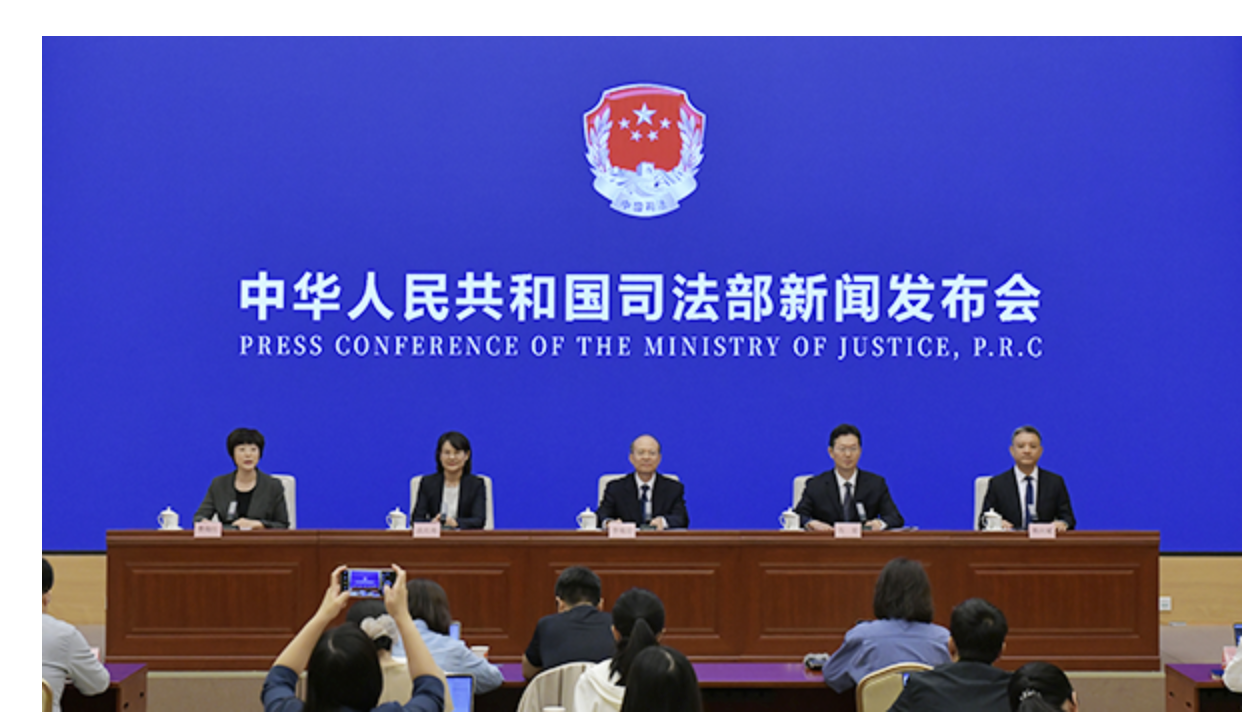
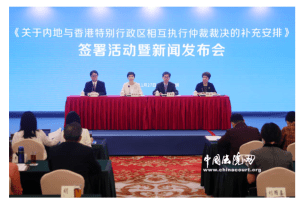
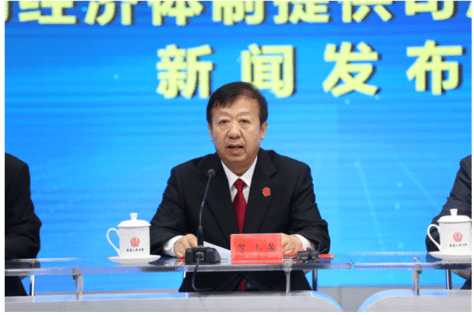
Press conference on the amended Arbitration Law, Judge Shen, second from left

Those involved in Chinese dispute resolution in any way know that the role of the Supreme People’s Court (SPC) in advancing arbitration in China is crucial and irreplaceable. The question on many people’s minds is –what will the SPC do to support the recently amended Arbitration Law?

So I will summarize what is known about the SPC’s next steps in ensuring a smooth transition from the old to the new Arbitration Law and supplement that with some of my own predictions.

What do we know? There have been substantial changes to the Arbitration Law, some of which will have an impact on the courts. Chief Judge of the SPC’s #4 Civil Division Shen Hongyu (沈红雨) told a Ministry of Justice press conference that:

The Supreme People’s Court will conduct thorough research, widely solicit opinions from all sectors, and with the strong support of the Legislative Affairs Commission of the Standing Committee of the National People’s Congress and the Ministry of Justice, comprehensively review existing judicial interpretations and normative documents related to the Arbitration Law to ensure the drafting and formulation of supporting judicial interpretations for the newly revised Arbitration Law, guaranteeing that the revised content of the Arbitration Law is effectively implemented in judicial practice. (最高人民法院将认真调研、广泛听取各界意见,在全面梳理既有仲裁法相关司法解释和规范性文件的基础上,在全国人大法工委、司法部的大力支持下,做好新修订仲裁法配套司法解释的起草制定工作,确保仲裁法修订内容在司法实践中落地落细。)

Judge Shen said a great deal in this one very long sentence. The “thorough research” will involve combing through hundreds of pages of judicial interpretations and other judicial documents linked to the Arbitration Law, relevant sections of the Civil Procedure Law, and its judicial interpretation, plus the current draft interpretation of the foreign-related part.

The work involved, which will be invisible to those of us outside the SPC, will be to determine which interpretations or documents remain valid in whole or in part. If interpretations or documents are partially valid, do they need to be amended to conform to the amended Arbitration Law? Will a transitional document be necessary so that lower court judges (and SPC judges) will be ready to apply the amended law? I expect so, because the changes are significant and lower court judges need to have a reference document to hand so that they can efficiently handle arbitration-related matters, whether they are requests from arbitral tribunals to assist in collecting evidence, or judicial review of arbitration.

My best guess is that the SPC will issue a transitional document or documents in the run-up to March 1, 2026, when the Arbitration Law becomes effective, likely amending previous judicial interpretations or documents to be consistent with the new law and deleting inconsistent provisions, plus a document that clearly sets out the new arrangements, so that lower courts will be well prepared. I further surmise that the SPC will use much of 2026 to design a new comprehensive judicial interpretation to incorporate many of the provisions in the old ones. This is more complicated than it seems.

A new judicial interpretation will touch upon substantive and procedural issues. Some of those procedural issues need to draw on the specialized competence of other specialized institutions within the SPC, such as the case-filing division (tribunal) and the enforcement bureau. In the press conference mentioned above, Judge Shen flagged some of the important issues, such as:

  1. The concept of “the seat” in arbitration
  2. Judicial review of special arbitration (ad hoc arbitration);
  3. Arbitration service of process
  4. Arbitration preservative measures;
  5. Arbitration preservation system
    Those other specialized institutions will need to consider whether any of the new measures in the Arbitration Law require measures related to their work, such as case filing or enforcement procedures. Once their input is received, the institutions that Judge Shen mentioned earlier— the Legislative Affairs Commission of the Standing Committee of the National People’s Congress (Legislative Affairs Commission 法工委) and the Ministry of Justice will review that comprehensive draft carefully. The Ministry of Justice and the Legislative Affairs Commission are sure to give detailed comments for the SPC to consider. The SPC will want to make sure that each provision is operable in practice before it is released. The procedure for drafting such an interpretation is time-consuming and as is said in the law firm world, “requires attention to detail.”

_________________________________________________________________

This post is a slightly revised version of a speech I gave on November 12, 2025, at the opening of the Beijing Arbitration Commission’s Hong Kong Center. My apologies for the long gap between posts.

Supreme People’s Court Biweekly Developments: September 2025

This post highlights judicial interpretations, policy documents, and guiding or typical cases issued since the middle of September (2025).

  1. Judicial interpretations and policy or other judicial documents

For an explanation of judicial interpretations, see this post; for an explanation of policy documents, see these posts or my 2024 article.


Title Type Analysis
Supreme People’s Court Interpretation on Some Issues Related to the Application of the PRC Company Law《最高人民法院关于适用〈中华人民共和国公司法〉若干问题的解释(征求意见稿)》, issued evening of 30 September, open for comment until 20 October Judicial interpretation (draft) Draft interpretation has 90 articles, not yet aware of translation or analysis in English.  SPC has “already engaged in extensive preliminary research and preliminary consultation with experts, scholars, and relevant departments.”  Provisions include ones related to liquidation and dissolution of companies; disregarding legal personality of related companies; 10 draft provisions related to listed companies, including VAM agreements.  This article comments on the General Provisions, more to come.
Opinions On Promoting the High-Quality Development of the International Commercial Court
and Serving and Ensuring High-Level Opening Up, Issued 25 September (关于推进国际商事法庭高质量发展
服务保障高水平对外开放的意见
) link is to text & press release
Policy document

Also known as a “judicial document” ( 司法文件) or “judicial normative

document” (司法规范性文件), “judicial

policy document” or “judicial regulatory documents” 司法政策性文件).

Not yet aware of analysis in English, see quasi-official analysis on the WeChat public account of the SPC’s #4 Civil Division. My own analysis is forthcoming. Provisions include promoting the use of international commercial courts; standardizing translations; further provisions on parallel proceedings; etc.  China Daily report here
Notice on Issuing Matters Concerning the Jurisdiction of First-Instance Civil and Administrative Intellectual Property Cases by Basic-Level People’s Courts 最高人民法院
关于印发基层人民法院管辖第一审知识产权民事、行政案件有关事项的通知
In effect from 1 October
Judicial normative document Not yet aware of analysis in English; the notice designates courts to hear civil and administrative intellectual property cases in the first instance. Note that many courts have limited jurisdiction in civil cases, depending on the amount in dispute. This could be seen as an assessment of the quality of that court. Shanghai and Beijing courts do not have amount in dispute limitations
 

Title Type Analysis
Supreme People’s Court Interpretation on Some Issues Related to the Application of the PRC Company Law《最高人民法院关于适用〈中华人民共和国公司法〉若干问题的解释(征求意见稿)》, issued evening of 30 September, open for comment until 20 October Judicial interpretation (draft) Draft interpretation has 90 articles, not yet aware of translation or analysis in English.  SPC has “already engaged in extensive preliminary research and preliminary consultation with experts, scholars, and relevant departments.”  Provisions include ones related to liquidation and dissolution of companies; disregarding legal personality of related companies; 10 draft provisions related to listed companies, including VAM agreements
On Promoting the High-Quality Development of the International Commercial Court
Opinions on Serving and Ensuring High-Level Opening UpIssued 25 September (关于推进国际商事法庭高质量发展
服务保障高水平对外开放的意见
) link is to text & press release
Policy document

Also known as a “judicial document” ( 司法文件) or “judicial normative

document” (司法规范性文件), “judicial

policy document” or “judicial regulatory documents” 司法政策性文件).

Not yet aware of analysis in English, see quasi-official analysis on the WeChat public account of the SPC’s #4 Civil Division. My own analysis is forthcoming. Provisions include promoting the use of international commercial courts; standardizing translations; further provisions on parallel proceedings; etc.  China Daily report here
Notice on Issuing Matters Concerning the Jurisdiction of First-Instance Civil and Administrative Intellectual Property Cases by Basic-Level People’s Courts 最高人民法院
关于印发基层人民法院管辖第一审知识产权民事、行政案件有关事项的通知
In effect from 1 October
Judicial normative document Not yet aware of analysis in English; the notice designates courts to hear civil and administrative intellectual property cases in the first instance

2.  Typical (典型 example, exemplary, model) cases

For an explanation of typical (model, exemplary, example) cases, see these posts.

Title Type Analysis
Ninth Batch of Cases on the Construction of People’s Tribunals in the New Era (2)新时代人民法庭建设案例(九) Typical cases Subtitle is “Building Fengqiao-style People’s Courts and Strengthening the Guidance of Professional and Industry-Specific Mediation Functions”—related to resolving enterprise-related and labor-related disputes [providing insights into SPC policies on the role of the local courts]
The Supreme People’s Court and the Ministry of Justice jointly issued typical cases on standardizing enterprise-related law enforcement, judicial administrative reconsideration, and administrative litigation最高人民法院、司法部联合发布规范涉企执法司法行政复议、行政诉讼典型案例 Typical cases Cases have multiple targets: promoting the  “Private Economy Promotion Law”, special actions to standardize administrative law enforcement and judicial work involving enterprises, administrative reconsideration and administrative litigation in serving high quality economic and social development
Fifth batch of typical cases involving the construction of the “Belt and Road”第五批涉“一带一路”建设典型案例 Typical cases See my earlier comments on Belt & Road typical cases; SPC states its hope that the cases not only provide exemplary guidance for the Chinese courts, but also provide regulatory guidance for the joint construction of the Belt and Road Initiative with the wisdom of Chinese judicial practice, injecting new legal momentum into promoting a fairer, more open, and more inclusive new international economic order; my own commentary forthcoming

________________________________

I’m focusing on preparing a long article for publication and several other long writing projects, therefore this abbreviated post.

Benchbooks (Judicial Handbooks) for the New Era

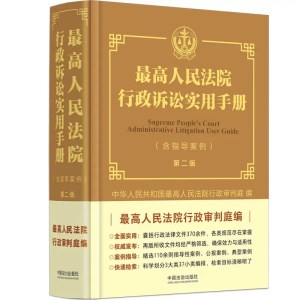
A recent message in the WeChat public account of the Supreme People’s Court (SPC)’s Administrative Division was devoted to promoting its new book,  Supreme People’s Court Administrative Litigation User’s Guide (Administrative Litigation User’s Guide (2nd edition), 最高人民法院行政诉讼实用手册), shown in the photo above.   Had the SPC’s #4 Civil Division had a WeChat public account last year when they published 涉外涉港澳台民商事审判业务手册( Foreign-Related, Hong Kong, Macao and Taiwan Related Commercial Trial Work Guide — “Foreign-Related Judicial Handbook”), I am sure that I would have received a similar message.  I had previously thought that judicial handbooks were a historical artifact of the days before electronic databases.   In my 1993 article, I discussed the phenomenon of judicial handbooks:
..A …problem is presented when the lack of consistency in issuance and authority makes it difficult for the lower courts to know when an interpretation is no longer valid…The [SPC] tries to cure these problems by issuing handbooks for adjudication in various subject areas….The Research Office and other divisions of the Court compile adjudication handbooks such as Sifa Shouce [司法手册] (Judicial Handbook), many of which are internal publications.

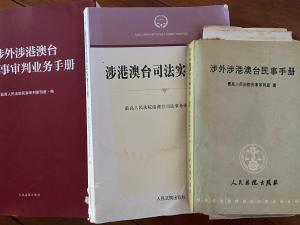
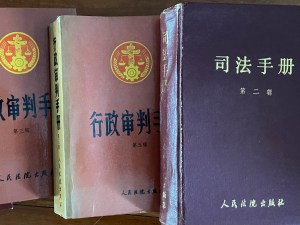
Some of those historical handbooks can be found in my research library of Supreme People’s Court publications–see here and below:

Two Administrative Litigation Judicial Handbooks and the second volume of the Judicial Handbook

Why would specific divisions of the SPC return to the practice of issuing judicial handbooks in printed form?  How does it link with the role of the SPC? What sources have the editors included, and what could students, scholars, and practitioners learn from that?

Official reasons for publishing these print books

The authors of the  Administrative Litigation User’s Guide describe the reasons for publishing the book as follows:

the Supreme People’s Court, on the one hand, provides professional guidance (业务指导) by formulating judicial policies 司法政策), issuing guiding cases, and making judicial replies (司法答复); on the other hand, it strengthens research and collects problems, and formulates judicial interpretations based on the accumulation and maturity of judicial practice. At present, the comprehensive judicial interpretation of the Administrative Litigation Law, the judicial interpretation of administrative agreements, and the judicial interpretation of the appearance of administrative agency heads in court to respond to lawsuits have been formulated and issued…, and there are more and more normative documents and guiding cases related to administrative litigation. In addition, with the increase in the number of administrative cases, more judges have joined the administrative trial team. In the process of gradually becoming familiar with administrative litigation, they urgently need to master the  relevant provisions that have been issued and learn the relevant guiding cases. However, judicial replies are internal in nature, with a large volume and lack of a unified release mechanism. The channels for obtaining them from the outside world are limited, which is time-consuming and laborious.

According to the announcement, the audience for the Administrative Litigation User’s Guide is staff in administrative agencies, judicial practitioners, and researchers of administrative law [students and academics].  The editors note that to provide readers with reference materials and to make the book more practical, they have included guiding cases, SPC Gazette Cases, and typical cases from the last 10 years.

The #4 Civil Division authors/editors say their handbook is urgently needed by front-line judges and as a reference book for judges, arbitrators, lawyers, and other practitioners, and, I would add, to students and scholars seeking to decode the foreign-related and Hong Kong, Macau, and Taiwan-related operations of China’s judiciary.

Legal basis for publishing these books

Publishing these books is linked to Article 10 of the Organic Law of the People’s Courts and related documents, which authorize the SPC to supervise and guide(监督指导) the lower courts.

Comments on the content

Both books contain judicial interpretations and a range of SPC guidance documents such as meeting minutes/conference summaries (会议纪要), notices, and replies to requests for instructions, signaling to the reader that they are important sources of reference for judges and that “soft law” may understate the way that meeting minutes are understood within the Chinese court system.

The authors/editors of the Foreign-Related Handbook included many other types of legal provisions they considered relevant for hearing cross-border cases, such as relevant national legislation, administrative regulations, such as foreign exchange regulations, Chinese versions of international commercial rules (Incoterms, ICC Uniform Rules for Demand Guarantees (URDG 758), ISP 98) ), Hague Conventions to which China has acceeded,  and civil judicial assistance treaties, as well as some of the National People’s Congress Standing Committee decisions related to some of the international conventions.  The #4 Civil Division did not include guiding, typical cases, and other types of cases it issues for reference.  In my view, it was a practical decision that does not imply that those types of cases are irrelevant to judges hearing cross-border commercial cases, but rather that including cases would make the book too long to be published as a single volume.

Comment

The underlying rationale for publishing these judicial handbooks has not changed much in the past 30 years.  Judges responsible for processing cases efficiently and correctly face similar challenges:  sorting out the current legal position on an issue quickly despite the piecemeal way that the SPC develops the law, locating and assessing the validity of historical documents, easily identifying special arrangements, and for cross-border cases, understanding how to correctly implement international conventions, treaties and practices and correspondingly arrangements or related provisions concerning cases involving Hong Kong, Macau and Taiwan parties.

One experienced senior judge in a local court noted that judges are often asked to rotate among divisions (tribunals) periodically.  Senior judges recommend that new joiners read these handbooks to familiarize themselves quickly with a different (and complicated) area of law.

From the left, the 2024 Foreign-Related Handbook, a 2013 Hong Kong, Macau, Taiwan Related Judicial Handbook, and the 1992 Foreign, Hong Kong, Taiwan-Related Civil Matters predecessor volume


Supreme People’s Court Developments, December 2024-January 2025

from the report on the 2025 Central Political-Legal Work Conference on one of the SPC’s websites

See below a brief summary of recent developments  (or at least the principal recent developments) at the Supreme People’s Court (SPC) in January 2025 (as of January 19, the date of publication of this post) and December 2024.

January 2025

  1. On January 8th, the Party leadership heard the SPC Party Group’s report on the SPC’s work, along with those of other institutions.  I mention the requirement for this report in my 2024 article;

certain phrases (such as “report to a superior on their work” [shuzhi 述职] imply a hierarchical relationship between the SPC and the Central Political-Legal Committee and the Party Center. The fact that the SPC reports to the Party leadership can be seen in public reports on the leadership of the political-legal institutions meeting with Xi Jinping and other senior leaders before the annual sessions of the National People’s Congress and Chinese People’s Political Consultative Congress, although the materials actually submitted to the Party leadership are not publicly accessible.)

2.  January is when many important conferences are held that have an impact on the work of the courts: the Central Political-Legal Work Conference (中央政法工作会议) and the National Conference of Higher Court Presidents (Higher Court Presidents Conference 全国高级法院院长会议),  at which the spirit of the Political-Legal Work Conference is transmitted and the goals for judicial work in 2025 are announced. The SPC has held this conference annually for many years. In the recent historical past (the early 1990’s, for example), the Higher Court Presidents Conference was called the National Court Work Conference.

3. Policy documents: 

a. In early January, the SPC and the All-China Federation of Overseas Chinese (Overseas Chinese Federation 中国侨联权益保障部) issued a joint policy document on the strengthening the judicial protection work of the interests of overseas Chinese and returned overseas Chinese and their families in the New Era (关于加强新时代侨益司法保护工作的意见), and related reference cases.  The document seeks to ease litigation formalities for these groups and promote resolving disputes through mediation, among other matters, such as improving research on Overseas Chinese-related issues, such as through establishing a research base, as has been done with other issues.  The title of this document differs from Zhou Qiang era policy documents, but the goal of providing judicial support for an important national policy goal is the same. 

The SPC’s Research Office led the drafting of this document, in cooperation with the Overseas Chinese Federation.  This responsibility is consistent with the role of the Research Office, which deals with many legal policy and cross-internal institutional matters, such as Hong Kong, Macau, and Taiwan-related issues and the transition to the Civil Code.  It does not hear cases.

This is the first joint policy document between the SPC and Overseas Chinese Federation. Closer cooperation between the two institutions began in 2018, with 30 courts piloting closer cooperation with local Overseas Chinese Federations, and with the 2020 establishment of a “general-to-general” online mediation mechanism (the SPC has established this type of mechanism with the China Securities Regulatory Commission and other institutions).    The policy document is linked to language in recent Party Plenums on protecting the rights of returned Overseas Chinese and Overseas Chinese and their families.

b. Opinions of the Supreme People’s Court on Serving Technological Innovation with High-quality Trial Services 最高人民法院关于以高质量审判服务保障科技创新的意见.  The press conference report is here.  China IP Law Update’s summary in English is here.  If time had permitted, I would discuss the links in this document with the recent Party Plenum and other Party initiatives.

4. Judicial interpretations:

a. The SPC issued its second interpretation of the Marriage and Family Part of the Civil Code, aimed at addressing common troublesome issues facing the courts, such as property division when a cohabiting couple split, many issues relating to divorcing couples, including property division and ownership of a company established by a couple.  To provide further guidance on applying the interpretation, the SPC issued typical cases. This interpretation provides important insights into family law issues in current Chinese society.  

b.  The SPC joined with the Supreme People’s Procuratorate to issue the Interpretation of Several Issues Concerning the Application of Law in Handling Criminal Cases of Attacks on Police Officers (关于办理袭警刑事案件适用法律若干问题的解释).  From the provisions of this interpretation,  the confusion lower-level procuratorates and courts had about the application of Article 277 of the Criminal Law is apparent.

5. Other typical cases issued in January included: one on protecting natural reserves and national parks; another on punishing rural saohei (underworld forces) crimes; protecting the rights and interests of foreign investors; and refusing to pay wages (6200+ cases in the past four years)

6. The SPC established its Judges’ Disciplinary Committee, with President Zhang Jun as the chair.  At the first meeting, he noted that the establishment of a judges’ disciplinary committee and the implementation of a judges’ disciplinary system are political requirements for implementing the decisions and arrangements of the CPC Central Committee.  In 2021, I published a book chapter on Chinese judicial disciplinary developments, available here.

December 2024

December is the end of the year, so the SPC always issues many documents–judicial interpretations, policy documents, guiding and typical cases etc. at year’s end.  2024 was no exception. Among the documents worth noting:

  1. Judicial interpretations and meeting minutes

a. The SPC and the China Securities Regulatory Commission (CSRC) issued meeting minutes (conference summary) on bankruptcy (insolvency)  and reorganization of listed companies.  From the document number, it appears that the SPC took the lead in drafting it and it provides an update to a 2012 conference summary that the SPC issued itself. A DeHeng law firm partner comments here on the meeting minutes. The CSRC is soliciting public comments on Regulatory Guidelines for Listed Companies No. 11 – Matters Related to Bankruptcy and Reorganization of Listed Companies (this link contains the text and an explanation).  

b. On December 25, the SPC issued a Decision on Amending the Supreme People’s Court’s Regulations on Acknowledgement and Execution of Civil Judgments from Taiwan Area Courts, Chinese original 最高人民法院关于修改《最高人民法院关于认可和执行台湾地区法院民事判决的规定》的决定.  An English language summary is available here.  From a quick look, most amendments are procedural or unsurprising. Some reflect amendments to the Civil Procedure Law or codifying court practice. The provision “the people’s court shall make a ruling not to acknowledge a civil judgment if acknowledging it would violate fundamental principles of state laws, such as the one-China principle, or undermine state sovereignty, security, or social public interests” is consistent with analogous provisions and codifies what has been court practice.

2.  Guiding cases: on December 25, the SPC issued six guiding cases on state compensation issues, some of which provide glimpses of problems with prison management; On December 24, the SPC issued the first group of guiding cases on labor issues.

3. Typical cases: The SPC issued many typical cases in December 2024. As I mentioned previously, President Zhang Jun favors using typical cases to guide the lower courts in correctly applying the law.

The SPC issued typical  cases on: the protection of the rights and interests of the elderly; administrative public interest litigation (second group), issued jointly by the SPC and SPP;  “one letter and two books”  labor law supervision, issued jointly by the SPC, the SPP and the All-China Federation of Trade Unions;  wage arrears, issued in cooperation with the All-China Federation of Trade Unions and the Ministry of Human Resources and Social Security;  two groups of financial loan dispute mediation cases, issued by the  State Financial Supervision and Administration Bureau and the SPC, with one case providing a model for dealing with non-performing microloan cases; rights and interests of Taiwan compatriots, linked to the Party’s policy on promoting cross-straits integration and development; crimes involving counterfeit safety production qualification certificates (linked to a policy document issued in July, 2024 that does not appear to be publicly available (关于进一步加强安全生产资格证书涉假案件刑事审判工作的通知)); petty corruption (each case provides insights into the world of official corruption); punishing illegal production, sales, and use of eavesdropping and stealing equipment, with several cases involving the hidden filming (and marketing of those films) of people having sex in hotel rooms; inheritance disputes (first  and second group); criminal punishment of illegal fishing; and traffic accident liability.

3. Policy documents: Guiding Opinions on Improving the Quality and Efficiency of Trial Work and Promoting the Substantial Resolution of Contradictions and Disputes (关于在审判工作中促进提质增效 推动实质性化解矛盾纠纷的指导意见).  This document focuses on civil and administrative disputes, promoting mediation (Fengqiao Experience) and the resolution of the substance of disputes (as discussed here).  I will draw on this document in a forthcoming article.

4. Plans: 

a. the SPC issued the Sixth Five-Year Judicial Reform Outline.  This article links to the text of the Outline and the related press release. I will publish an article later this year providing a summary and analysis of this document. 

b.  the SPC issued the National Court Education and Training Plan (2024-2028).  I analyzed the previous two plans here and here.  Training of judges handling foreign-related matters receives special attention (see my earlier analysis).

5.  National People’s Committee (NPC) Standing Committee’s Recording & Review:  SPC judicial interpretations and other judicial documents must be filed with the NPC Standing Committee. At the end of 2023, the NPC SC adopted a decision strengthening the recording and review mechanism (see the NPC Observer’s analysis). On 22 December 2024, the Legislative Affairs Commission of the NPC Standing Committee gave its view in its annual report on Recording and Review that a July 2024 Supreme People’s Court interpretation that directed lower courts to retroactively apply a new provision in the recently revised Company Law concerning equity transfers,  controversial in the business community,  was inconsistent with the Legislation Law. The Legislative Affairs Commission stated that the “[they] will urge the relevant judicial interpretation-making authorities to take appropriate measures to properly handle the matter.”  The SPC issued a follow-up interpretation two days after the annual report was made public, signaling that the SPC had been previously been informed.  Although the problematic July 2024 interpretation must have been reviewed by the Legislative Affairs Commission in draft form before it was approved by the SPC judicial committee, as required by Article 18 of the SPC’s Judicial Interpretation Work Provisions, it appears that that whichever office of the Legislative Affairs Commission initially reviewed the SPC’s draft and the office responsible for recording and review took different views. 

____________________________________________________

Thank you, subscribers, for your patience.  The blog will transition from being completely researched and written by me (including discussions with knowledgeable persons and experienced judges, for the avoidance of doubt) sometime after Chinese New Year. I plan to involve my research assistants more in analysis and writing, although I have at least one long analytical blogpost that I will complete soon.   I want to focus on consolidating and developing my research in longer pieces.


Guide to Supreme People’s Court Materials (2)–“Understanding & Application” Publications

Understanding and Application Publications in several forms

Late last year, some followers asked me to describe the principal sources for Supreme People’s Court’s (SPC) research. This is the second of several posts,  as few (particularly outside of China) seem to be aware of the range of publicly available publications of the SPC and its many affiliated entities.  The second set of publications I’ll introduce contains the phrase  “understanding and application” (理解与适用).

What are “understanding and application” publications?

The understanding and application publications explain and provide further background to the following types of SPC documents:

  • SPC interpretations (司法解释), either drafted only by the SPC or with the Supreme People’s Procuratorate (SPP);
  • SPC meeting minutes (conference summaries) (会议纪要); and
  • SPC (or SPC and SPP) policy documents entitled Opinion (意见).

The authors of “understanding and application” publications are principally the drafters of the documents in question. In China, the audience of these publications are judges in that substantive area, lawyers, and possibly in-house counsel.  For some unknown reason, academics, including law students, are less familiar with these publications. However, these publications are relevant to researching, writing, and peer-reviewing articles or reports on topics that focus on any of these documents.

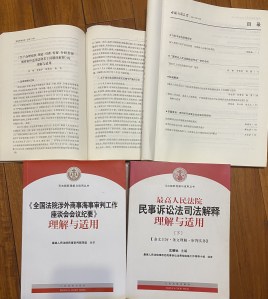
The publications are often issued as articles in one of the SPC’s online or print publications, listed below. The understanding and application of the most lengthy document are published as books,  such as the two-volume books on the understanding and application of the judicial interpretation of the Civil Procedure Law (in the photo above) and separately, the Criminal Procedure Law. Books can be searched on the People’s Court Press website.

The content usually includes details on the drafting history of the document, policy background, and the meaning of the clauses.  If an “understanding and application” publication is in book form, it generally provides commentary on each article.  Sometimes an understanding and application publication discusses the competing views related to a particular clause in a document, such as the understanding and application publication on the 2019 Minutes of the National Court Work Conference for Civil and Commercial Trials (全国法院民商事审判工作会议纪要).

The analogous publication for the National Symposium on Foreign-Related Commercial and Maritime Trial Work incorporates some model cases and discusses relevant non-Chinese legislation and case law, in addition to relevant Chinese legislation, the views of relevant institutions, and court practice. For example, on the scope of the phrase “外国法院” (foreign court) in that book, the authors mention that when the Ministry of Foreign Affairs was consulted on the draft of that document, it took the view that “foreign” did not include courts of international organizations such as European Union’s Unified Patent Court. It mentions during the negotiation of the Hague Judgments Convention, the recognition and enforcement of the judgments of such courts was controversial so that in China, the recognition and enforcement of the judgments of such courts await further research.

Understanding and application articles are published in one of the following places:

  1. the SPC  official website (court.gov.cn), the Chinese courts website (chinacourt.org), and sometimes the China International Commercial Court website (cicc.court.gov.cn);
  2. the SPC journal Renmin Sifa 人 民司法 [People’s Justice];
  3.  the National Judges College’s academic journal Falv Shiyong 法律适用 [Application of Law]; and
  4. journals of specialized SPC divisions (such as Reference to Criminal Trial, the journal of the five criminal divisions, 刑事审判参考, previously mentioned here).

These articles are often republished on the websites or WeChat accounts of lower courts and sometimes other institutions and can be searched on the Internet or through WeChat search.

Additional examples:

《全国法院毒品案件审判工作会议纪要》的理解与适用 (the Understanding and Application of the Meeting Minutes of the National Courts Symposium on the Trial of Drug-Related Crimes ), published in  Falv Shiyong 法律适用 [Application of Law, the National Judges College’s academic journal]–explaining the 2022 Meeting Minutes of the National Courts Symposium on the Trial of Drug-Related Crimes (the Kunming Meeting) 全国法院毒品案件审判工作会议纪要.  On the drafting history of the document, for example,  before the conference, the article states that the drafters (from the SPC’s #5 Criminal Division) solicited comments from relevant SPC divisions/chambers, various high people’s courts, the Supreme People’s Procuratorate, the Ministry of Public Security and relevant experts and scholars. The draft was further amended based on comments at the conference, including from other institutions that attended the symposium, and subsequently comments were solicited from relevant divisions of the SPC, the SPP, the Ministry of Public Security, the General Administration of Customs, the Ministry of Agriculture and Rural Affairs, and the Legislative Affairs Commission of the Standing Committee of the National People’s Congress.

最高法解释起草者谈《关于办理组织、强迫、引诱、容留、介绍卖淫刑事案件适用法律若干问题的解释》的理解与适用 (The Understanding and Application of the [2017] “Supreme People’s Court, Supreme People’s Procuratorate Interpretation on Several Issues Concerning the Application of Law in Handling Criminal Cases of Organizing, Compelling, Enticing, Sheltering, and Brokering Prostitution,” published originally in Reference to Criminal Trial #115, but republished on a WeChat public account of a local public security bureau. The section on the interpretation’s drafting history reveals that in the course of drafting, the #4 Criminal Division held discussions with the Public Security Bureau (治安局) of the Ministry of Public Security, some provincial public security bureaus and some city and county public security organs’ public security departments many times, as well as with experts. The Legislative Affairs Commission of the National People’s Congress later held a coordination meeting (协调会) with relevant ministries and commissions, indicating that the relevant authorities had differing views on the draft’s content. When those issues were resolved, the SPP agreed to the draft and to issue the interpretation jointly, after which the judicial committee of the SPC and the procuratorial committee of the SPP approved the issuance of the interpretation.

One small example of the relevance of these articles and books to scholarship is the recent draft article, posted on SSRN:  From Visibility to Shadows: The Impact of Police Discretion on Prostitution in Response to Legal Changes, which considers the impact of police discretion on prostitution regulation in China, following the issuance of the 2017  judicial interpretation discussed above. The authors describe the judicial interpretation several times as “an external policy change (a change in judicial interpretation) that was outside the police’s influence.”  However, a review of the legislative history described above reveals that the drafting of the interpretation heavily involved the Ministry of Public Security and local level public security bureaus.  It can be surmised that neither the authors nor the workshop commentators on the draft article were aware of the possible relevance of “understanding and application” articles. This post seeks to draw the attention of both scholars and practitioners to these publications so that advocates and authors can refer to these publications as appropriate and commentators will know of their existence.


The Supreme People’s Court’s ongoing contribution to developing foreign-related rule of law (涉外法治)

Press conference announcing the judicial interpretation on the application of international treaties & international practices

What is the Supreme People’s Court’s (SPC’s) contribution to developing the national strategy of “foreign-related rule of law (涉外法治)”?  My forthcoming article in China Law & Society Review sets out a broad framework for understanding what it is, but inevitably, like all academic works, the specific details will be out of date as soon as it is published. It can only be current as of the last time I was able to make substantial amendments, that is, in November 2023.  The slow process of finalizing the article (particularly the references) meant that I could incorporate references to the Tenth Politburo Study Session on Foreign-Related Rule of Law.  Since then, the SPC has continued to contribute to the national strategy of developing foreign-related rule of law. This blogpost flags those recent developments without duplicating what others have already written.  The recent developments include the SPC issuing the following since October, 2023:

  • judicial interpretations;
  • typical cases; and 
  • other judicial normative documents.
  1.  Judicial Interpretations

A September 2023 press release issued along with the fourth group of Belt & Road typical cases (为高质量共建“一带一路”提供有力司法服务和保障——最高人民法院民四庭负责人就发布第四批涉“一带一路”建设典型案例相关问题答记者问) flagged all of these judicial interpretations,. They were described in this October 2023 blogpost as “forthcoming attractions.”

  • December 2023, Decision of the Supreme People’s Court to Amend the Provisions of the Supreme People’s Court on Several Issues Concerning the Establishment of International Commercial Courts(2023).  This LinkedIn post explains the significance of the amendments–primarily to update China International Commercial Court rules to reflect the amended Civil Procedure Law and new provisions on the finding of foreign law in the second interpretation on the application of law to foreign-related civil relations.
  • December 2023, Interpretation by the Supreme People’s Court of Several Issues Concerning the Application of International
    Treaties and International Practices in the Trial of Foreign-Related Civil and Commercial Cases.  The SPC held a press conference (see the photo above) and also issued a related press release (translation here) as well as typical cases (see below).  Justice Wang Shumei (previously the head of the #4 Civil Division) highlighted that this interpretation was needed because the previous provisions on the application of international treaties in the General Principles of Civil Law were abolished when the Civil Code was promulgated, leaving the rules for the application of international treaties unclear.  This LinkedIn post summarizes its content.
  • November 2023 Interpretation of the Supreme People’s Court on Several Issues Concerning the Application of the Law of the
    People’s Republic of China on the Application of Laws to Foreign-Related Civil Relations (II).  As this LinkedIn post details, the focus of the interpretation is on the ascertainment of foreign law.  How to ascertain foreign law has been an outstanding issue, as reflected in articles by SPC judges and several judicial policy documents over the past 10 years.  A paper (Chinese original here) written by CICC expert Xiao Yongping for the 2022 China International Commercial Court appointment ceremony, reviewing cases involving the ascertainment of foreign law flags some of the problems:  “a lack of rules over proof by professional institutions in China has spawned a range of drawbacks, including the vague criteria for determining the admissibility of the opinions of professional institutions, the omission of analysis and reasoning of proof opinions in judgments, and the unclear rules over which party should bear the fees for proof.”

    The interpretation specifies that the burden is on the parties to provide the content of the chosen law if they have a choice-of-law agreement, but it falls to the court to ascertain foreign law if the parties lack a choice-of-law agreement. Other provisions are intended to change the practice of Chinese courts deciding that they cannot ascertain foreign law and it is preferable to apply Chinese law instead. Please see this Library of Congress article for further details.

typical cases

Typical cases are a type of SPC soft law.  They are a tool by which the SPC seeks to unify the judgment (adjudication) standards of the Chinese courts.  They are a means by which the SPC seeks to harmonize the decisions of the Chinese courts to be consistent with SPC policy (or said another way, strengthen the firm guiding hand of the SPC). That guidance can relate to substantive or procedural issues, because the issues that come before the Chinese courts far outpace the infrastructure of existing law, including judicial interpretations.  The number of typical cases relating to arbitration matters therefore also signals that China’s Arbitration Law is insufficient for the current needs of the Chinese courts. Additionally, given the role of the SPC in social governance, typical cases also enable the SPC to do its part to further the latest Party policy, in this instance, the development (construction) of foreign-related rule of law. As highlighted several times on this blog, SPC President Zhang Jun appears to favor using typical cases to guide the lower courts and I expect this website (currently down) is the one that will be repurposed to make various types of typical cases more easily available.

Other judicial normative documents

The document that can be so classified is the  December, 2023  Work Guidelines of the Supreme People’s Court for the One-Stop Diversified International Commercial Dispute Resolution Platform (for Trial Implementation) (One-Stop Platform Guidelines).  Since the China International Commercial Court was established, the SPC has stressed (and the academic world far more!) the innovation of the “One-Stop Platform.”  This new document draws together SPC and lower court experience and thinking on how a “One-Stop Platform” should operate in the Chinese context.  Among other innovations, it has detailed provisions concerning neutral evaluation.  The incorporation of neutral evaluation into the One-Stop Platform Guidelines shows that the SPC (and the Chinese judicial system more generally) continues to make reference to “beneficial foreign/international experience.” 

Concluding Comments

As flagged in several press conferences or press releases issued in recent months, the issuance of these judicial interpretations, typical cases, and other judicial normative documents is linked to the importance the Party leadership places on developing foreign-related rule of law, as illustrated by the November 2023 Politburo study session. As shown by my 1993 article on the SPC, foreign-related matters were historically at the margins of its work.  One old-timer described the #4 Civil Division (the division handling foreign-related civil and commercial matters) to me as “小众“–niche–with a relatively small number of judges and responsible for a more limited range of issues, in comparison to the other SPC civil divisions.

These recent SPC documents taken together, provide insights into the important role of the SPC in developing Chinese law, in this case, foreign-related law–because many important provisions are missing from National People’s Congress (+ its Standing Committee) legislation, it falls to the SPC, through judicial interpretations, typical cases, and documents such as Meeting Minutes/Conference Summaries to fill in the gaps that enable the courts and the Chinese legal system to operate. It should be clear that the SPC is providing some of the basic building blocks for the construction (development) of foreign-related rule of law.
Happy Year of the Dragon to all readers and followers!


New Judicial Interpretation on Judicial Suggestions (Advice)

New standardized format for judicial advice/suggestions

In November 2023, the Supreme People’s Court (SPC) issued a judicial interpretation intended to encourage and standardize the way that the courts issue judicial suggestions (advice) (司法建议), entitled Provisions of the SPC on Several Issues Concerning Comprehensive Judicial Advice Work (Judicial Advice Work Judicial Interpretation) (最高人民法院关于综合治理类司法建议工作若干问题的规定).   For those in jurisdictions in which the SPC’s official website is inaccessible, see this link.  When a translation becomes available, I will post it. As a judicial interpretation, its provisions are binding on the lower courts, unlike its predecessor 2012 and 2007 documents.   Judicial suggestions (advice), the subject of this recent law review article (with detailed historical background),  and promoted in these model cases about which I wrote this summer, are often issued in the context of litigation or after a court reviews a group of disputes.   As illustrated by those model cases, it is a function being reinvigorated under President Zhang Jun. It is mentioned briefly in the Civil Procedure and Administrative Litigation Laws but not in the Organic Law of the People’s Courts.   Now, as in the era of the Wang Shengjun presidency of the SPC, it is linked to active justice. It is also linked with resolving disputes at source, and the courts participating in social governance.  As previously mentioned, resolving disputes at source appears to be derived from Chinese medicine philosophy in seeking to resolve the root cause of disputes by using the data, insights, and multiple functions of the courts to that end.  For those interested in comparisons and the possible impact of President Zhang Jun’s Supreme People’s Procuratorate (SPP) experience on the SPC, the Supreme People’s Procuratorate updated its regulations on procuratorial suggestions in 2018.   It is yet another function of the Chinese courts that has its roots in the Soviet system.

This quick blogpost flags what is new, the issues to which the new judicial interpretation responds, and places the interpretation in its larger context.

What is New?

The Judicial Advice Judicial Interpretation recasts its content in the language of Xi Jinping New Era political-legal jargon, in contrast to its predecessor document, which dates from 2012 and reflects the political-legal jargon of the period.  However, in my view, that would be insufficient to merit a judicial interpretation. Given that judicial advice of a particular type has become a priority under President Zhang Jun, the judicial interpretation is intended to guide other divisions and entities within the SPC and the lower courts to provide judicial advice that better reflects SPC leadership priorities.  It therefore:

  • addresses judicial advice work on “comprehensive” matters, that is outstanding problems in the field of social governance that cause frequent conflicts and disputes and affect economic and social development and the protection of the people’s rights and interests. It should propose improvements and improvements to the relevant competent authorities or other relevant units.
  • specifies that when judicial advice is submitted to a government authority, it shall generally be submitted to the competent authority at the same level within the jurisdiction of the court, and not issued to an authority at a bureaucratic level above the court issuing the advice.  The judicial interpretation does not permit cross-jurisdictional judicial advice.  If the issues require measures to be taken by a relevant authority in another place,  the court in question must report the matter to the corresponding superior people’s court for decision. This was  stressed by several local judges whom I contacted.  I note that according to a report that the Shanghai Financial Court in the summer of 2023,  issued 35 items of judicial advice, including to certain central departments (People’s Bank of China and the State Administration of State-Owned Assets, but presumably that court coordinated with the SPC when doing so;  
  • it requires the court to contact the entity that is proposed to receive the advice, to listen to their views;
  • imposes a two-month deadline for the entity receiving the advice to respond (and the advising court to chase up the advised);
  • more strongly stresses the “principle of necessity,” i.e., is it necessary to issue this judicial advice, to avoid judicial advice being issued for its own sake (or more properly, to meet  internal performance indicators of courts);
  • requires judicial advice to be discussed and approved by a court’s judicial committee, rather than the responsible court leader, as in the 2012 document;
  • specifies when judicial advice should be copied (抄送) to superior institutions;
  • does not specifically cancel the 2012 document, but provides that the provisions in interpretation supersede ones in the earlier document if they are inconsistent. 
  • requires a court to report on its judicial suggestions as part of its report to the corresponding people’s congress; and
  • standardizes format.

There is no requirement of greater transparency but some local courts have posted some information about their judicial advice. The Shanghai Maritime Court is one court that posts judicial advice and responses, some other courts issue more limited information.

Surmising from the article published by the drafters of the interpretation recently in the SPC journal Journal of Applied Jurisprudence (the understanding and application), all of whom are affiliated with the SPC’s Research Office, that office took the lead in drafting this interpretation.  It is to be expected that the Research Office took the lead because it often deals with cross-institutional issues.

Ongoing issues

I derive the comments in this section from Ms. Dou Xiaohong’s recent article in the National Judges College academic journal Journal of Law Application (法律适用). She did a deep dive into several thousand items of judicial advice issued in province “S” over the  last several years and a more limited number from other provinces and did some cross-jurisdiction comparison.  Some of the comparisons work better than others, but it does not take away from the main focus of the article. She works in the Research Office of the Sichuan Provincial Higher People’s Court so “S” likely refers to Sichuan.  Presumably, the drafters of the judicial interpretation were aware of her article.  She characterizes judicial advice as a form of soft law governance.  She found (among other points):

  • most judicial advice related to a single case or similar cases, with comprehensive advice accounting for 14%, with most case suggestions relating to typos and omissions in documents (performative judicial advice);
  • almost half of the judicial advice “disappears” (is ignored by the recipient of the advice;
  • staff of the recipient administrative departments that the author surveyed were unaware that the recipient department was obliged to respond;
  • Under the current pressure of cases, it is difficult for judges to have “extra” time and energy to allocate to giving judicial advice.

Ms. Dou makes a number of suggestions, not all of which the drafters of the judicial interpretation incorporated:

  • incorporate better reporting to the relevant people’s congress
  • incorporate a “comply or explain” principle;
  • involve the supervision/Party disciplinary authorities if the matter involves the violation of law or discipline;
  • promote greater transparency of judicial advice by the courts and the recipients of the advice, so that there is greater awareness of judicial advice.

Greater significance

The promotion of higher quality judicial advice (suggestions) through the issuance of this judicial interpretation is another example of the development of the Chinese courts in the Xi Jinping New Era, post the 2019 Zhengfa (political-legal) reforms, stressing the role of the courts in social governance.  Unlike some of the other aspects of “active justice,” judicial advice has its roots in legislation, although it is not mentioned in the Organic Law of the People’s Courts.  This interpretation highlights a function of the Chinese courts that has existed for many years but has more recently become more important to SPC leadership.  Transparency concerning judicial advice is uneven throughout the courts, and it is unclear the extent to which the SPC itself provides judicial suggestions. Lower court practice appears to vary. It appears from Ms. Dou’s article that many lower court judges are more focused on closing cases than issuing soft law judicial advice and providing advice for the sake of meeting a performance target.  However, it may also depend on the subject of the judicial advice and whether the recipient perceives the advice provided by the courts as useful, as some local judges have mentioned to me that well-targeted judicial advice has led to inter-institutional discussions.  The requirement of  “listening to the views” of the entity that is to receive the advice (i.e. receiving their assent) is likely to result in fewer items of judicial advice issued, as courts are likely to consider the procedure too troublesome.  However, we will need to wait for the revamped performance indicators under discussion to be released to understand better what the longer-term implications of this judicial interpretation are likely to be.

_____________________________

Many thanks to those who commented on an earlier draft of this blogpost.


New Group of Supreme People’s Court Belt & Road Typical Cases

At the end of September (2023) the Supreme People’s Court (SPC) issued its fourth group of Belt & Road (BRI) Typical /Model /Exemplary ) (this post will use the translation “typical”) Cases (第四批涉“一带一路”建设典型案例) (see an alternative link in case the official website is unavailable).  An English translation is available here.  Along with the cases, the SPC issued a press release in the form of answers by a responsible person of the SPC’s #4 Civil Division to a reporter’s questions (为高质量共建“一带一路”提供有力司法服务和保障——最高人民法院民四庭负责人就发布第四批涉“一带一路”建设典型案例相关问题答记者问).

“For the avoidance of doubt,” the points made by these typical cases (please see last year’s blogpost for a refresher on typical cases) apply to all types of foreign-related cases, whether or not they involve the BRI in some way.  Including “BRI” in the title highlights that these cases contribute to supporting the BRI (on the 10th anniversary of the strategy) and developing (“constructing” 建设) “foreign-related rule of law.” I’ll make several quick points about the cases and derive some useful information from the press release.

1.  Typical cases

This group of 12 typical cases includes:

  1. three cases relating to letters of credit and demand guarantees (#3 Jiangsu Puhua Co., Ltd. v. Bank of East Asia (China) Co., Ltd. Shanghai Branch; #4 China Power Construction Group Shandong Electric Power Construction Co., Ltd. v. GMR KAMALANGA Energy Ltd., et al (the SPC case was mentioned in this blogpost; and #5 Union of Arab and French Banks (UBAF) (Hong Kong) Ltd. [UBAF (Hong Kong) Ltd.] and Bank of China Co., Ltd. Henan Branch);
  2. Two cases involving professional services-related issues (#6 Fusheng (Tianjin) Financial Leasing Co., Ltd. v. Grant Thornton AG (a tort case) and #8 Tianwei New Energy Holdings Co., Ltd. v. Davis Polk & Wardwell LLP (contract dispute));
  3. Enforcement of a foreign  (Singapore) court judgment (#12, enforcement application by Shuang Lin Construction Pte. Ltd. ). The SPC and the Singapore Supreme Court have a related memorandum so it is unsurprising that a case involving an application to enforce a Singapore judgment was selected. See this 2023 factsheet with a listing of the other Singapore agreements with the SPC);
  4. Enforcement of foreign and Hong Kong arbitral awards  (#10, China Small and Medium Enterprises Investment Co., Ltd. v.  Russian Sakhalin Seafood Co., Ltd. & Oriental International Economic and Technical Cooperation Company, objection to enforcement case)( #11 Noble Resources International Pte. Ltd.’s application for recognition and enforcement of the Hong Kong International Arbitration Center arbitration award);
  5. One case involving the Convention on the International Sale of Goods (CISG), #1, Exportextil Countertrade SA) and Nantong Meinite Medical Products Co., Ltd;
  6. One case involving financial derivatives (#9, Standard Chartered Bank (China) Co., Ltd. v. Zhangjiakou United Petrochemical Co., Ltd.) ;
  7. One equity transfer-related case (#7, a China International Commercial Court case), Zhang Moumou and Xie Moumou v. Shenzhen Aoxinlong Investment Co., Ltd;
  8. One treaty interpretation case (#2, Nippon Property & Casualty Insurance (China) Co., Ltd. Shanghai Branch and others and Robinson Global Logistics (Dalian) Co., Ltd).

A 2022 blogpost explains the selection process. I’ll leave the discussion of the implications of these cases to the law firms, some scholars, and some other websites and focus on the takeaways from the press release. The press release updates last year’s report on the SPC’s work in foreign-related cases in support of related policies.

2. Political importance

The press release ties the work of the SPC to the January 2018 Party Central Committee and State Council General Office policy document on BRI dispute resolution (summarized here and discussed further in my “neverending article”) and flags that the SPC has conscientiously implemented the decisions and arrangements of the Party Central Committee.  The one-year gap between the third and fourth groups of typical BRI cases signals that the SPC leadership considers this a priority area. The phrase at the beginning of the press release (“providing powerful judicial services and guarantees (safeguards) for high-quality joint construction of the “Belt and Road”)  signals the continuing importance of providing judicial “services and safeguards” for major national strategies, including the BRI, whether in the form of a document or typical cases.

3. Takeaways From the Press Release

a.  CICC and other international commercial courts

The press release mentions the China International Commercial Court (CICC), its expert committee, and the establishment of local international commercial courts.  The CICC has accepted a total of 27 international commercial cases, 17 of which have been concluded. A judgment was posted in July on the Chinese version of the CICC website but has yet to be translated.

Although the CICC is often linked to the BRI, the cases that the CICC has accepted include parties from jurisdictions that are not participating in the BRI, such as the United States. Among the typical cases released this time, one is a CICC case.  The press release notes that the SPC  will revise the CICC-related judicial interpretations to reflect the amendments to the foreign-related section of the Civil Procedure Law.

The BRI-related services and safeguards policy documents, about which I have previously written (and about which I have more to say in the neverending article) served as the policy framework for establishing local international commercial courts. The SPC has approved twelve local courts in Suzhou, Beijing, Chengdu, Xiamen, Changchun, Quanzhou, Wuxi, Nanning, Hangzhou, Ningbo, Nanjing, and Qingdao as “international commercial courts (tribunals).” It requires some detective work to determine the jurisdiction of each international commercial court.

b. Encouraging mediation and an organic connection between litigation, arbitration and mediation

The  SPC reiterates its accomplishments in establishing a “one-stop” diversified resolution mechanism for international commercial disputes to achieve an organic connection between litigation, arbitration, and mediation.  As mentioned in the 2022 report, ten international commercial arbitration institutions and two international commercial mediation institutions are part of the SPC’s “one-stop” mechanism.

c. Improving rules in foreign-related commercial cases

On improving the system of applicable rules for foreign-related commercial laws and unifying judicial standards, the spokesperson flagged that the SPC issued the Conference Summary [Meeting Minutes] on Foreign-Related Commercial and Maritime Trial Work (Foreign-Related Commercial  & Maritime Law Conference Summary (Chinese and bilingual versions) (see my previous blogpost on the document), setting forth the SPC’s views on 111 issues in foreign-related matters.  In my “neverending article,”  I describe conference summaries (会议纪要 ) as intermediate documents, issued after courts confront new issues arising from a major policy document or new situation when the approaches of the lower courts need to be harmonized but it is not yet appropriate to issue a judicial interpretation.  A book recently published by the drafters of the Foreign-Related Commercial  & Maritime Law Conference Summary (《全国法院涉外商事海事审判工作座谈会会议纪要》理解与适用) reveals that after the #4 Civil Division prepared an initial draft, they “broadly sought comments”  from relevant SPC departments, relevant State Council ministries and commissions, and selected experts. That means that the document represents a greater consensus of the relevant institutions on the issues addressed than commentators realized.

Additionally, in the past ten years, the SPC has issued guidance on foreign-related matters to the lower courts in the form of judicial interpretations (32), policy documents (9), guiding cases (18), and almost 150 typical cases. These statistics update those set out in the 2022 report.

d. Actively participating in legislation revision

As mentioned in the 2022 report, the SPC has actively participated in the revision of foreign-related laws such as the Civil Procedure Law (to come into effect next 1 January and the Arbitration Law (amendments ongoing, see this blogpost on the SPC’s contribution).  My neverending article has a more extended discussion of this.

e.  “Forthcoming Attractions”

The press release flags some “forthcoming attractions” related to the SPC’s foreign-related judicial work.

  1. The SPC is  (and has been) working on several relevant judicial interpretations (as mentioned in earlier blogposts).

a.   Coming soon is the Interpretation on Several Issues Concerning the Application of the “Law of the People’s Republic of China on the Law Applicable to Foreign-Related Civil Relationships” (2) (关于适用〈中华人民共和国涉外民事关系法律适用法〉若干问题的解释(二). The spokesperson revealed that the judicial interpretation had already been approved by the SPC’s judicial committee. It incorporates provisions  relating to ascertaining foreign laws.

b. As mentioned above, the SPC  will revise the CICC-related judicial interpretations to reflect the amendments to the foreign-related part of the Civil Procedure Law. The press release does not mention amending the comprehensive judicial interpretation of the Civil Procedure Law to reflect those amendments, but I surmise those are also being contemplated.

c. A third judicial interpretation, the “Interpretation on Several Issues Concerning the Application of International Treaties and International Practices in the Trial of Foreign-Related Civil and Commercial Cases”(关于审理涉外民商事案件适用国际条约和国际惯例若干问题的解释) is still in draft.  Because the original provisions on the application of international treaties in the General Principles of Civil Law were abolished when the Civil Code was promulgated, leaving the rules for the application of international treaties unclear, the SPC is drafting an interpretation to deal with a group of issues.  Those include the application of international treaties, the relationship between party autonomy and the application of international treaties, the choice of application of international treaties that are not in force in China, the application of international practices (two typical cases discuss the application of the Uniform Customs & Practice for Documentary Credits (UCP 600) and public order treaty reservations.

2. Databases on foreign law and expertise on foreign law.

With the support of some CICC expert committee members, one of the SPC’s BRI research databases and foreign law ascertainment service agencies,  a foreign (non-mainland Chinese)legal database with legislation, international law documents and other legal information on ten ASEAN countries, seven South Asian countries and the ASEAN international organization has been created. Separately another service provider has created a BRI expert legal database.  The 2022 report flagged these developments.

3. Judicial materials and training on foreign-related matters

The Supreme People’s Court is compiling a “Compilation of Common Laws and Regulations in Foreign-related Civil and Commercial Matters” to assist new hires and will increase the training and guidance to improve judicial competence on the application of international treaties. Improving judicial training on foreign-related matters has been an ongoing issue.  Post-Covid, a number of training programs for judges and judges assistants on foreign-related matters have been held.

The most recent one was a national program, held at the National Judges College, focused on training senior personnel in foreign-related matters, at which Justice Tao Kaiyuan spoke.  Those speaking at the program (from the relevant departments) included representatives from the Central Foreign Affairs Commission, the Legislative Affairs Commission under the National People’s Congress Standing Committee, Ministry of Foreign Affairs,  Ministry of Commerce, as well (presumably) senior personnel from the SPC’s #4 Civil Division and the International Cooperation Bureau (which deals with treaty negotiation and  judicial assistance matters). Local courts that have run such programs  include  Beijing (with the assistance of the University of International Business and Economics).

4. Judicial Assistance

China has concluded 171 bilateral judicial assistance treaties with 83 countries and has acceded to nearly 30 related international conventions (no change from October, 2022). In contrast to twenty or even ten years ago, the number of judicial assistance matters dealt with by the Chinese courts has increased.  The press release mentions improving the quality and efficiency of international judicial assistance such as better cooperation in the cross-border service of judicial documents,  cross-border investigation and evidence collection, ascertainment of foreign law, and recognition and enforcement of foreign (extra-territorial) judgments and arbitral awards.  This does not yet mean that it is possible for foreign litigators to take depositions in mainland China for foreign court proceedings. Service of process was an issue in this 2022 case in the Southern District of New York.

Supreme People’s Court’s 2022 Pre-“Two Sessions” Accomplishments

In the period between 1 January and today (2 March 2022), the Supreme People’s Court (SPC) issued quite a few judicial interpretations, judicial documents, and typical cases.  This blogpost focuses on one judicial interpretation; several Greater Bay-related interpretations and documents; and several sets of typical cases issued since the beginning of the year.   Apologies to readers that I do not have time to analyze any of this properly-I am doing the first of many major revisions of an academic article,  for submission.

Judicial interpretations: General Part of the Civil Code

In late February, the SPC issued the Interpretation of the General Part of the Civil Code (最高人民法院关于适用《中华人民共和国民法典》总则编若干问题的解释).  I had previously surmised that it would be finalized before the National People’s Congress (NPC) meeting in March.  It went into effect on 1 March 2022.  An SPC press release is found here, with background information on drafting, mentioning that the drafters had completely accepted the views of the Legislative Work Commission (LAC) in the drafting process, for reasons previously discussed.  I surmise in the meeting rooms in which the draft interpretation was discussed, there was a robust exchange of views. A more recent article, published after this blogpost was originally written), that I recommend to those with an interest (Understanding and Application of the General Part), has more detailed information about the drafting.

As discussed earlier, the drafters solicited views within the court system and among some of the leading Beijing law schools.  The press release highlighted the importance of integrating socialist core values into the interpretation. Commentary by a responsible person of the Research Office of the SPC here. That office led the drafting of the General Part, as flagged in this blogpost. The authoritative person (perhaps Judge Guo Feng, but unknown), mentions the integration of socialist core values into the General Part of the Civil Code, as is required by the ongoing SPC plan and a multi-institutional Party document that has not been made public. The “Understanding and Application of the General Part) was written by Judge Guo Feng, Chen Longye (mentioned here), and Liu Ting, a judge’s assistant, whom I surmise was seconded to the Research Office from the Nantong (Jiangsu) Intermediate People’s Court. Therefore I assume that the authoritative person quoted in the earlier press release was in fact Judge Guo.

The article by Judge Guo and colleagues details the many entities that saw the draft of the  interpretation: relevant entities within the SPC; all the higher people’s court; as well as the Central Publicity Department (中宣部), Central Political-Legal Commission (中政委),the office of the Central Governing the Country According to Law Commission (中央依法治国办), the Supreme People’s Procuratorate (最高人民检察院), Ministry of Public Security (公安部)、Ministry of Justice (民政部)、State Administration of Market Regulation (市场监管总局),  China Law Society (中国法学会), China Academy of Social Sciences (presumably the Law Institute), the All-China Federation of Industry and Commerce, and others. They twice sought comments from the LAC in writing(两次书面征求全国人大常委会法工委的意见)–this means through formal institution to institution communications.

As I wrote in an earlier blogpost, it appears that the SPC is both “serving the greater situation” by implementing in the courts the Party’s plan to integrate socialist core values in plans to legislate and amend legislation(社会主义核心价值观融入法治建设立法修法规划) [the new plan, entitled  关于建立社会主义核心价值观入法入规协调机制的意见(试行)] while at the same time seeking to deal with many of the difficult legal issues that face it.

The General Part covers the following issues: capacity for civil rights and capacity for civil conduct, guardianship, declaration of disappearance and declaration of death, civil legal acts, agency, civil liability, statute of limitations, and supplementary provisions. Professor Wang Liming’s highly authoritative commentary, posted on an SPC Wechat account, is found here.   Professor Yang Lixin has also published an authoritative article. I recommend this version, with red highlighting by now-former SPC judge Xiao Feng of the important points of Professor Wang, Yang, and Shen Weixing, dean of Tsinghua University Law School and Professor Yu Fei of China University of Political Science and Law.

Greater Bay Area Judicial Assistance and Judicial Policy

The SPC issued several Greater Bay related documents since 1 January, listed below, which relate to SPC policy on developing civil judicial assistance with the Hong Kong and Macau Special Administrative Regions:

1.Mutual Assistance Arrangement between the SPC & the Macau SAR in Arbitration Procedures (最高人民法院关于内地与澳门特别行政区就仲裁程序相互协助保全的安排);

Important background found in the press conference, in which Judge Si Yanli and others involved in negotiating the Arrangement spoke. My earlier blogpost explains why Arrangements are approved as judicial interpretations, although they do not fit the formal jurisdiction of one: “Judge Si mentioned that for the Supplementary Arrangement to be effectively implemented on the mainland, it must be transformed into a judicial interpretation.” Those following legal developments in the two SARs should note the following language in the press conference: “the Outline of the Greater Bay Area and the Hengqin Plan both propose to promote the convergence of rules and coordination of mechanisms in the Greater Bay Area of Guangdong, Hong Kong, and Macao. Inter-regional judicial assistance is an important way to reflect Chinese characteristics, highlight the advantages of “two systems” and achieve convergence of legal rules and mechanisms.  《大湾区纲要》《横琴方案》均提出要推进粤港澳大湾区规则衔接、机制对接。区际司法协助是体现中国特色、彰显“两制”优势,实现法律规则衔接、机制对接的重要途径”。This theme is further developed in two January, 2022 policy documents linked below.

2. Arrangement on Reciprocal Recognition and Enforcement of Civil Judgments in Matrimonial and Family Cases by the Courts of the Mainland and of the Hong Kong Special Administrative Region 最高人民法院关于内地与香港特别行政区法院相互认可和执行婚姻家庭民事案件判决的安排. The SPC and Hong Kong Department of Justice held a useful seminar to explain its provisions, at which Judge Si Yanli spoke, among others.  I expect that the law firms focusing on family law matters will follow up with detailed client alerts.

3. Opinions on Supporting and Guaranteeing the Comprehensive Deepening of the Reform and Opening-up of Qianhai Shenzhen-Hong Kong Modern Service Industry Cooperation Zone 关于支持和保障全面深化前海深港现代服务业合作区改革开放的意见, linked to the Central Committee and State Council’s September, 2021 document on Qianhai/Hong Kong and Opinions on Supporting and Guaranteeing the Construction of Hengqin Guangdong-Macao Deep Cooperation Zone 关于支持和保障横琴粤澳深度合作区建设的意见, linked to the Central Committee & State Council’s September document on Hengqin/Macau.  It is unclear to me whether the SPC solicited the views of the two SARs on these documents. As mentioned above, it mentions national policy to achieve convergence of legal rules and mechanisms in the Greater Bay Area and mentions several aspects of that policy that is relevant to dispute resolution.   Among those are (numbers are from the points in the relevant Opinion):

4. Expanding the jurisdiction of the Qianhai court, including permitting it to take cases when the parties have agreed on the jurisdiction of the Qianhai, but there is no connection to the dispute. This appears to be another piloting (the SPC’s Lingang Opinion has a similar provision) of a possible future amendment of the Civil Procedure Law to abolish the closest connection rule for cross-border jurisdiction (see Professor Vivienne Bath’s research on this issue);

5. Work on (加强) establish an inter-regional judicial assistance system with Chinese characteristics, consider an electronic platform for civil and commercial judicial assistance in the Guangdong-Hong Kong-Macao Greater Bay Area;

8. Explore the establishment of a unified qualification recognition system for Hong Kong and Macao mediators to practice in the Guangdong-Hong Kong-Macao Greater Bay Area.  The lawyer qualification system requires that the lawyer be a Chinese citizen, consistent with Chinese legislation. Query whether the same requirement will be imposed on mediators. This would be disadvantageous for Hong Kong mediators who are not Chinese citizens.  

I highly recommend Judge Si Yanli’s recent academic article on Greater Bay judicial assistance issues for those with an interest in this topic.

It is my hope that someone can undertake further analysis of these documents.

SPC Typical Cases

Perhaps because General Secretary Xi Jinping has said “one case is better than a dozen documents (习近平总书记强调, “一个案例胜过一打文件”),  in the run-up to the “Two Meetings,” the SPC has issued quite a few typical cases. Typical cases are intended to guide the courts and the general public.

  1. Nine typical cases on protecting the rights of juveniles 未成年人权益司法保护典型案例, well worth further analysis, with several involving family education orders to parents and one involving failure of a hotel to verify the identity and contact information of a juvenile couple that checked into a hotel room (where they had sex);
  2. Ten typical cases on solid waste pollution人民法院依法审理固体废物污染环境典型案例, seven criminal cases, two civil cases, and one administrative case. Three involve public interest litigation, two by the procuratorate and one by a civil society organization;
  3. The third set of Belt & Road-related cases 最高法发布第三批涉“一带一路”建设典型案例.  The cases are not necessarily specifically connected with the Belt & Road but involve Chinese cross-border commercial, maritime, and arbitration issues.  One China International Commercial Court (CICC) case is included, a case on an infrastructure payment guarantee, as is the Brentwood case.   The SPC’s comments on the CICC case are consistent with my comments published earlier on this blog about the role of CICC in providing soft precedents for the Chinese courts: “the principle of attribution has an exemplary guiding role for the resolution of similar disputes in the future (该归责原则对今后类似纠纷案件的解决具有示范指导作用).”
  4. Accompanying the release of the General Part judicial interpretation was the first set of  Civil Code typical cases The typical cases are not limited to illustrating the General Part but relate to different parts of the Civil Code, also stressing socialist core values.
  5. A first set of typical cases of the courts providing services and safeguards to the free trade zones 人民法院服务保障自由贸易试验区建设典型案例.  The cases are intended to guide the lower courts and general public, and  as the introduction states illustrate the “achievements of the people’s courts in actively creating a business environment that is ruled by law, internationalized, and convenient.”  For those interested, see my earlier article on the SPC and free trade zones, available on
  6. SSRN
  7. The second batch of cases in which the people’s courts promote socialist core values 第二批人民法院大力弘扬社会主义核心价值观典型民事案例.  These cases are worth further analysis for what they show about the treatment of the elderly, among other social issues.

Supreme People’s Court’s 2021 Year-End Accomplishments

Photo from the “look back meeting” described below

Apologies to readers for the long gap between posts–I have been focusing on yet another academic article and am finding that even so-called “short articles” take much longer than anticipated, especially when the topic reveals more and more complexities than were apparent when I submitted the abstract to the journal months ago.

So instead of any involved analysis, I’ll list some of the year-end (from December) accomplishments of the Supreme People’s Court (SPC) with some brief notes. Another aspect of the SPC being a cross between a Party-state organ and a court is that it needs to meet year-end goals and submit year-end reports. The SPC’s judicial reform leading group recently discussed and approved its year-end report (最高人民法院司法改革领导小组2021年工作总结报告).  The judicial reform leading group is headed by President Zhou Qiang. Other members include Justices He Rong, Ma Shizhong (head of the Political Department), He Xiaorong, and Shen Liang. The Judicial Reform Office presumably drafted by the report. It is likely a constituent part of the SPC’s year-end report to go to the Party leadership, before the annual Central Political-Legal Work Conference.

Another aspect of the SPC being a cross between a Party-state organ and a court is that it is inspected by Party inspection groups and is a focal point of campaigns on the education and rectification of political-legal organs.

Among the SPC’s year-end accomplishments are the following.  For the avoidance of doubt, judicial interpretations, judicial documents, and typical cases are all means by which the SPC guides the lower courts. I will have more to say about this topic in the unfinished academic article mentioned above.

Judicial interpretations

  1. Online Mediation Rules of the People’s Courts (人民法院在线调解规则).  Online mediation is an important focus of the SPC, as could be seen from this white paper on Diversified Dispute Resolution from early 2021 and from other efforts of the SPC to promote resolving disputes at their source, as consistent with the deployment of the Party Center (党中央关于“将非诉讼纠纷解决机制挺在前面”的重大部署要求.  The responsible person of the SPC’s Case Filing Division (presumably the head) pointed out that these rules “had created an online diversified dispute resolution model with Chinese characteristics that differed from ADR or ODR” )形成了有别于ADR和ODR的中国特色在线多元纠纷解决模式). His statement appears designed to be more politically correct than accurate. It is clear that the SPC follows government policy in using “diversified dispute resolution” rather than “alternative dispute resolution,” (ADR)  but the English language abbreviation”ODR,” according to my research, is intended to be a general term to capture all sorts of online dispute resolution and not meant to promote one particular model of online dispute resolution. The underlying implication is that “ODR” reflects a “Western” approach. However other (mainland) Chinese government departments use “ODR” without issue.  Additionally, the Hong Kong government uses the term “ODR” to refer to its online dispute resolution platform, eBRAM.
  2. Interpretation of the Supreme People’s Court and the Supreme People’s Procuratorate (SPP) on Several Issues Concerning the Application of Law in Handling Criminal Cases Endangering Food Safety (最高人民法院 最高人民检察院关于办理危害食品安全刑事案件适用法律若干问题的解释). As a joint judicial interpretation, it was approved by the judicial (adjudication) committee of the SPC first and next by the Procuratorial Committee of the SPP.
  3. Several Provisions of the Supreme People’s Court on the Application of Prohibition Order Preservation Measures in Eco-environmental Infringement Cases(最高人民法院关于生态环境侵权案件适用禁止令保全措施的若干规定) –relating to injunctions to stop environmental pollution, either before or after a party has filed suit.  We can expect more and more SPC interpretations and documents related to environmental pollution.
  4. Relevant Provisions of the Supreme People’s Court on Issues concerning Applications for Verification of Arbitration Cases under Judicial Review 最高人民法院关于仲裁司法审查案件报核问题的有关规定. This decision by the SPC updates the 2017 provisions of the same name, adding one article and a clause in another. The new Article 3  requires higher people’s courts to submit draft rulings in judicial review of arbitration matters in domestic arbitration (non-foreign, Hong Kong, Macau or Taiwan-related) if the higher court intends to concur with a lower court ruling that the arbitral award violated social public interest.   The new second clause of Article 4 requires the higher people’s court to submit the matter to the SPC within 15 days.
  5. Several Provisions on the Compulsory Enforcement by People’s Court of Company Shareholding (最高人民法院关于人民法院强制执行股权若干问题的规定). This appeared on the 2019 judicial interpretation agenda, so it has slipped by two years. The provisions apply to enforcing judgments or rulings against shareholder equity in either limited liability companies or companies limited by shares, but not including companies limited by shares that are listed.
  6. Interpretation of the Supreme People’s Court on Several Issues Concerning the Application of Law in the Trial of Disputes over Compensation for Personal Injury in Railway Transport
    最高人民法院关于审理铁路运输人身损害赔偿纠纷案件适用法律若干问题的解释  This interpretation concerns persons injured in railway transport accidents, excluding accidents on passenger trains.

On the “coming attractions” discussed in some earlier blogposts, the SPC’s judicial committee (adjudication committee) spent many hours on 30 December 2021 discussing the draft judicial interpretation of the General Part of the Civil Code.  When I wrote last about the draft of the General Part, I noted that Judge Guo Feng, deputy head of the Research Office,  mentioned that the General Part (1) interpretation is scheduled to be submitted to the SPC’s judicial (adjudication) committee before year-end.  That means that Judge Guo (and likely one or more of the principal drafters) were in the room to discuss the draft article by article.  The judicial committee finally decided to approve the draft “in principle.”  Approval in principle” (原则通过), as discussed here, is not mentioned by the SPC’s 2007 regulations on judicial interpretations but is one of the SPC’s long-established practices. It means that the judicial committee has approved it, subject to some “minor” amendments. Minor amendments are more than typographical errors and relate to specific substantive matters.  So it is likely that after the SPC amends the provisions that the judicial committee  considered needed more work, a quasi-final draft will go back to the National People’s Congress Standing Committee (NPCSC LAC)’s Legislative Affairs Commission  because SPC guidance provides that “liaison with the NPCSC LAC must be timely, and after major revisions to the judicial interpretation draft after consulting with the NPC LAC, the view of the NPCSC LAC  should be solicited again.”  I expect that the draft of the General Part judicial interpretation will be finalized before the National People’s Congress meeting, so that the report can mention this accomplishment.

As I have mentioned many times in the course of 2021, we do not know what was on the SPC’s 2021 judicial interpretation agenda. Those of us outside the System can only hope that the 2022 agenda will be released and that the judicial reform agenda will continue to be released.

Judicial documents (incomplete list)

  1. Provisions of the Supreme People’s Court and the Ministry of Justice on Providing Legal Aid for Defendants in Death Penalty Review Cases 最高人民法院 司法部关于为死刑复核案件被告人依法提供法律援助的规定.  These are joint regulations issued by the two institutions and therefore are classified as “judicial documents,” as discussed here.  These provisions establish a mechanism for the Ministry of Justice to appoint legal aid lawyers to defendants whose cases are being submitted to the SPC for death penalty review.  If a defendant appoints his or her own lawyer), then the legal aid lawyer stops providing services.
  2. Provisions on Judges’ Disciplinary Work Procedures (for Trial Implementation)《法官惩戒工作程序规定(试行).  I will follow up with analysis at some point as I published a book chapter on judicial discipline at the beginning of 2021.  These provisions do not change the conclusion in my chapter.
  3. Opinions on Strengthening the Substantive Trial of Sentence Reduction and Parole Cases (关于加强减刑、假释案件实质化审理的意见).  This is another multiple institution document, intended to tighten up procedures for sentence reduction and parole cases.  They are in part a response to a 2020 tragedy in Beijing, in which a prisoner whose sentence was commuted killed one man and injured two more.  The incident further revealed that the corruption discussed in this 2015 blogpost continues to exist.
  4. Notice of the Supreme People’s Court on Studying and Implementing the “Decision of the Standing Committee of the National People’s Congress on Amending the Civil Procedure Law of the People’s Republic of China.”最高人民法院关于认真学习贯彻《全国人民代表大会常务委员会关于修改〈中华人民共和国民事诉讼法〉的决定》的通知.  This notice and the amended Civil Procedure Law are of practical importance to tens of thousands of Chinese judges and litigants in the Chinese courts, individuals and entities, domestic and foreign.  The notice signals that the SPC is working on amendments to the Civil Procedure Law judicial interpretation (the previous version plus commentary was published in two volumes). This reform relates to the reorienting of four levels of the courts, will increase the number of cases heard with one judge, promotes mediation and smart courts.
  5. and  6. Two Judicial Services and Safeguards Opinions, one on  Providing Judicial Services and Safeguards for Promoting the Development of the West in the New Era and Forming a New Pattern and  Opinions on Providing Judicial Services and Safeguards for Promoting the High-quality Development of the Central Region in the New Era(最高人民法院关于为新时代推进西部大开发形成新格局提供司法服务和保障的意见( and 关于为新时代推动中部地区高质量发展提供司法服务和保障的意见.  Related to these two is a document from November 2021– Conference Summary of the Work Promotion Meeting Serving and Safeguarding Ecological Protection and High-quality Development of the Yellow River Basin.最高人民法院服务保障黄河流域生态保护和高质量发展工作推进会会议纪要.  That document in turn relates to a  2020Judicial Services and Safeguards Opinion. These are part of a large number of documents providing judicial services and safeguards for Party Center strategies and initiatives, particularly related to regional integration.  The article I have temporarily set aside to write this blogpost discusses the purposes and impacts of these documents.  I have previously written about these documents often, such as these quick analyses of their structure and purposes.  Both  Opinions link to Party Center-State Council documents. More analysis to come when I am able to finish the last five pages of the “short academic article” mentioned above.

Reshaping the judiciary

In the fall of 2021, the Party Center launched the second round of the rectification and education of national political-legal organs, with a leading group leading and an office assisting in implementing the campaign. The SPC was one of the focal points (along with other central organs). Just before Christmas, the SPC held a “looking back” meeting to discuss what was revealed and progress made in response.  The SPC established a leading small group and office to handle matters properly.  (For those interested in further details, please see this webpage.) President Zhou Qiang noted in his work report that the SPC has effectively rectified a batch of stubborn diseases (one of the targets of this inspection) and resolutely eliminated a batch of black sheep (literally, a group of horses that harm the masses) (一批害群之马).  The same phrasing is reported from the Ministry of Justice and other political-legal institutions at both the central and local levels. Related to  the rectification and education campaign are several new SPC opinions. Those include one strengthening the judicial responsibility system, and creating a new court team  关于在加快推进司法责任体系改革和建设中进一步加强人民法院队伍建设的意见 and another on enforcement.  The SPC has issued another related opinion found here, on the “four types of cases.”   Perhaps unrelated to stubborn diseases and black sheep is decisions by some SPC judges to continue their careers elsewhere.

Finally

I wish all readers a happy and healthy new year, both “Western” and Chinese.  I also hope that this year brings us, located in and out of mainland China, opportunities to gather together to discuss legal developments in China from different perspectives quietly, without rancor or blame, but with mutual respect.

————————————————————————————————————

I would like to express my appreciation to two anonymous peer reviewers of a previous draft of this blogpost. Special thanks to the person who caught a significant error in the draft.


Update on Civil Code Judicial Interpretations

Judge Guo Feng at a workshop at Tsinghua University

Judge Guo Feng, deputy head of the Supreme People’s Court (SPC)’s Research Office, with the ranking of first level inspector (a senior non-leadership position  ( 一级巡视员spoke in late October at the annual meeting of the China Law Society’s Civil Law Research Group, at which he revealed further information about the SPC’s timetable on issuing further interpretations of the Civil Code, as well as senior SPC leadership’s thinking about judicial interpretations.  Please see this recent blogpost if a refresher about judicial interpretations would be helpful. I have italicized my brief comments.

In his remarks, he revealed the methodological thinking behind the drafting of the Civil Code judicial interpretations.  He expresses a principle that I have heard from others at the SPC–that there is a  palpable line between the SPC’s power of judicial interpretation and the NPC’s legislative power and power of legislative interpretation.  For many in the legal world outside of China (and some inside China based on this and several other recent academic articles), it appears to be an invisible red line. As for what should be the focus of judicial interpretations, I believe that internally they will be able to have a sense, from discussions with colleagues in other divisions, lower court judges and from lawyers, if comments are sought from them:

The first is how to grasp the degree, that is, how to achieve an appropriate degree in the design and expression of the specific content, specific system, and specific clauses of judicial interpretation. The core of moderation is how the judiciary can perform its duties and responsibilities in accurately applying the law, and cannot overstep and covet the legislative authority’s legislation and the power of legislative interpretation.

The second is how to achieve a balance of quantity, that is, in the face of the 1,260 legal provisions in the seven parts of the Civil Code, which ones should be judicially interpreted? What should not be judicially interpreted? Which Parts and which chapters should be the focus  for some judicial interpretations? Furthermore, in each separate judicial interpretation,  how much content and complexity should be in each provision?

Interpretation Agenda & Timetable

Judge Guo mentioned that the Civil Code judicial interpretations on the judicial interpretation agenda include one on the General Part and the Contract Parts of the Civil Code. The General Part Judicial Interpretation (1) draft (最高人民法院关于适用<中华人民共和国民法典>总则编的解释(一)》was discussed this spring. The Contract Part interpretation has been discussed at several other academic conferences in Beijing besides the one described in the earlier blogpost.

Judge Guo mentioned that the General Part (1) interpretation is scheduled to be submitted to the SPC’s judicial (adjudication) committee before year-end and the Contract Part Judicial interpretation is scheduled to be submitted to the judicial (adjudication) committee by the end of the first quarter of 2022.  I surmise that Court President Zhou Qiang wants to include the promulgation (or the upcoming promulgation) of the Contract Part of the Civil Code as one of the SPC’s accomplishments in 2021. So I have my doubts that public comments will be sought on the draft. The Tort and Personality Rights judicial interpretation drafts are still at the research stage.  He also mentioned that they do not plan to issue a comprehensive draft of the Personality Rights Part, but instead be guided by practice, and focus on issuing an interpretation on Article  997 (relating to the right of a party to seek an injunction to stop violations of the person’s personality rights). On the Contract Part judicial interpretation, I had previously said “as to whether this judicial interpretation will be issued by the end of this year, I personally have my doubts. “

Issues Going Forward

Judge Guo mentioned that they are facing issues concerning overlapping provisions in different parts of the judicial interpretations of the Civil Code, such as the provisions in judicial interpretation of the General Part of the Civil Code overlapping with provisions in the judicial interpretation of Contract Part, and overlapping provisions between the Personality Rights Part and the Tort Part.  He says that these issues regarding the planning of the interpretations need to be solved by the academic community and the SPC together. I have my doubts, however, that those in the academic community, unless they have spent time at the SPC, will be able to provide useful advice to the drafters on how to harmonize the different provisions in the judicial interpretations of the Civil Code in a user-friendly way, that enables an overworked basic level court judge (or her judge’s assistant or intern) to quickly and easily find the correct rule.

Finally,  Judge Guo mentioned that the SPC’s judicial committee decided that in the future, it will no longer engage in large and comprehensive judicial interpretations, and will no longer engage in excessively lengthy judicial interpretations, and encourage focused judicial interpretations.  My guess is some persons in the political leadership commented on the long judicial interpretations, of which the SPC has issued quite a few in the past few years.  I imagine that this will be the case until the amended Arbitration and Bankruptcy Laws are promulgated.  Then there will be a demand from the lower courts and the Chinese legal community for comprehensive judicial interpretations that consolidate previous interpretations, to the extent relevant, discard irrelevant provisions, and provide further detail to new provisions.  

___________________________________________

Many thanks to certain anonymous readers of an earlier draft of this blogpost. They are not responsible for any errors or “erroneous views.”

China’s Civil Code to have a Contract Part Judicial Interpretation

photo of workshop

Because the Supreme People’s Court (SPC) has not released its judicial interpretation agenda for 2021 (as previously mentioned), the observer seeking to determine what is on that drafting priority list must rely on occasional reports in the professional and academic press.  Last month, several academic Wechat accounts reported on discussions of a draft of a judicial interpretation of the Contract Part of the Civil Code  民法典合同编司法解释(草案). The one I’m relying upon contains the more detailed report on the discussion, including the names of those discussing the draft on behalf of the SPC.  I’ll flag from this article why this discussion was held, what can be learned from the report on the discussion, and a quick preview of the interpretation itself.  But first, a few words about why this interpretation is needed and what it is intended to do.

Background on judicial interpretations

Through judicial interpretations, the SPC is seeking to “unify court judgments,”  to ensure that court decisions throughout the country and at various levels of courts are more consistent.  This principle is set out in the current and previous judicial reform plans. Establishing a Chinese case law system assists in this, but is insufficient.  As seen from the SPC, judicial interpretations are intended to address issues in which statutory law is either ambiguous or contains a gap, causing judges to misunderstand (the law) and issue decisions inconsistent with legislative intent (see more below).  The SPC  identifies those issues through the multiple stages in the judicial interpretation drafting process.

.Judges, particularly at the basic level, need to issue judgments efficiently in commercial cases. They face a combination of a large number of cases and relatively short deadlines in domestic civil procedure.  Recent reforms to the jurisdiction of the courts will require basic level courts to deal with even more cases.   They cannot assume that most cases will settle, as shown by my own research (concerning certain courts) and those of some others  (in certain courts) . The Contract Part of the Civil Code is not detailed enough for judges to rely upon to decide contract cases efficiently and consistently.  A more active National People’s Congress (NPC)  (and its Standing Committee) is not able to fill in the gap.  Therefore the SPC must be the one to do so.

As I have written before in this blog and in my recent book chapter, the SPC and the NPC, and NPC Standing Committee (NPCSC), most often the NPCSC Legislative Affairs Commission (LAC), communicate during the course of judicial interpretation drafting.  SPC rules require that a judicial interpretation draft be submitted to the relevant committees of the NPC or relevant department of the NPCSC to solicit their views before the final draft is submitted to the SPC judicial (adjudication) committee. Additional relevant guidance cited in my chapter reminds drafters that “liaison with the NPCSC LAC must be timely, and after major revisions to the judicial interpretation draft after consulting with the NPC LAC, the view of the NPCSC LAC  should be solicited again.”  Therefore the views of the two institutions are harmonized before the judicial interpretation is finalized by judicial committee approval.

Broad Consultation of Opinions

As I wrote in my recent book chapter, discussions of draft judicial interpretations by specialists are a regular part of the SPC’s judicial interpretation drafting process.  I described this as “broad consultation outside the gated community.”  The reason workshops are organized is to solicit the views of experts on specialized or technical subject matter. Those invited for these meetings tend to be senior academics, either from the country’s major universities or CASS, as was the case here.

The workshop was held at Renmin University, while a second similar workshop was held at CASS.  Participants included experts from the NPC LAC,  Renmin, Peking and Tsinghua Universities, China University of Political Science and Law,  China Academy of Social Sciences, Jilin University, Beijing Institute of Technology, Central University of Finance and Economics, University of International Business and Economics among others.

The normal practice is for SPC drafters to assess the views given by those experts at the workshops and consider whether they should be adopted or further taken into consideration. Professor Wang Liming, who is a member of the China International Commercial Court expert committee, was one of the leaders who spoke.

It can be determined from the workshop report which personnel at the SPC were involved in drafting and what the issues are.  As to personnel, Justice Liu Guixiang spoke at the beginning of the workshop, which means he is the most senior SPC judge responsible for the draft interpretation. Justice Liu is a full-time member of the judicial committee with vice-ministerial rank. Others from the SPC who spoke included Judge Guo Feng, deputy head of the Research Office,  Chen Longye, head of the civil section of the Research Office, Jiang Jiadi, a staff member of the same section, Judge Lin Wenxue, head of the #2 Civil Division (responsible for domestic commercial issues) and Judge Zeng Hongwei, a judge in the #2 Civil Division.  The #2 Civil Division hears appeals and retrials (再审) (and applications for retrial), unlike the Research Office, and therefore sees first hand some of the issues arising in the lower courts.  I surmise that Chen, Jiang and Zeng are the ones who are shouldering the bulk of the drafting work.  Judges Guo and Lin would have many other responsibilities.  The persons primarily involved in drafting discussed their parts of the interpretation.

Preview of the Interpretation

The first chapter of the draft interpretation is “General Provisions,” in which Chen Longye of the Research Office took the lead.  Judge Zeng Hongwei took the lead in discussing the second chapter on contract establishment. Issues included:

  •  contract interpretation;
  • trade practices;
  • application of non-contractual obligations;
  •  contract formation;
  • contract terms;
  • form of the contract; and
  • agency contracts,

Chapters 3 and 4 of the draft relate to the validity of and the performance of contract. Also, the #2 Civil Division took the lead in drafting because Judges Lin Wenxue and  Zeng Hongwei spoke.  From the discussion, it appears that the controversial questions were the oldies but goodies, the ones that occur in practice:

  • contract validity and  the obligation to report for approval;
  • defective contracts;
  • contracts in violation of mandatory provisions;
  • consequences of validity;
  • signing related issues, involving corporate seals and individual fingerprints;
  •  debtor’s right of defense in the transfer of creditor’s rights;
  • repayment of debts, debts by shares, joint debts, indivisible debts;
  • contract performance by a third party or to a third party or repayment by a third party;
  • Repayment by third parties; and
  • changes in circumstances.

Chapters 5 and 6 concern preservation of contract (保全), contract modification and transfer.  Judge Guo Feng and Jiang Jiadi of the  Research Office took the lead.  Issues included:

  • scope of rights,
  • scope of rights exclusive to the debtor
  •  right of subrogation
  • right of cancellation in “contract preservation;”
  • Contract modification and transfer;
  • role of a third party in the litigation of the creditor’s rights and debt transfer disputes,

Chapters 7 and 8 relate to  “Termination of Contract Rights and Obligations, Liability for Breach of Contract”.   Chen Longye took the lead in discussing the following issues, among others:

  • liability for compensation for contractual obligations after the breach;
  •  termination and its consequences;
  • the timing of termination;
  • determination of losses due to breach of contract;
  • liquidated damages, deposits, delay in receipt; and
  • force majeure.

When will the Interpretation be Issued?

As to whether this judicial interpretation will be issued by the end of this year, I personally have my doubts.  I have not found any reports of discussion of this draft in the lower courts or with the NPCSC LAC.  These steps are a usual part of judicial interpretation drafting.  Contract law is fundamental to business.  Those in SPC leadership are unlikely to approve this interpretation unless they think it meets the target of dealing with the unclear issues that lower courts and practitioners frequently encounter in practice.  The scope of consultation is unknown, such as whether some lawyers or companies will be consulted, or whether the entire draft will be issued for public comment. It is also unknown whether selected foreign contract law specialists have or will be approached for their comments.  We have to wait for further developments.

___________________________________________

Many thanks to certain anonymous readers for their insightful comments on earlier versions of this blogpost. They are not responsible for any errors or “erroneous views.”

Update on judicial interpretations

One of the most important functions (职能) of the Supreme People’s Court (SPC) is issuing judicial interpretations (司法解释), which it issues for the most part unconnected with a specific “case or controversy” but rather drawing on many cases that have previously arisen in the lower courts. They are a critically important way that the SPC unifies the application of law. The extent to which SPC judicial interpretations are binding is one of several fundamental uncertainties attaching to this function, as the National People’s Congress (NPC) Standing Committee is authorized to review them and may require amendments to them or more, and it is unclear how much they bind institutions outside the court system.  But what can be said is that they are critically important to the operation of the Chinese legal system, The SPC, particularly its headquarters in Beijing,  focuses on judicial interpretation work for reasons connected with the slow pace and abstract language of Chinese legislation, although Chinese (and foreign) scholars, lawyers and other commentators sometimes criticize the SPC’s expansive reading of laws. 

About one month ago (in June 2021), the SPC updated its 2007 Judicial Interpretation Work Provisions (JI Work Provisions) in this decision  关于修改《最高人民法院关于司法解释工作的规定》的决定).  [See a refresher on the legislative basis of judicial interpretations, if needed.] The JI Work Provisions describe the types of judicial interpretations the SPC can issue, which institutions can propose drafting judicial interpretations, the drafting process, the promulgation process, the filing process, etc. The update was a minimally invasive one, adding to Article 6  a new category of documents, now classified as judicial interpretations–rules (规则). Rules are defined in a new paragraph of Article 6, as follows: “The judicial interpretations regulating the trial practices of people’s courts shall adopt the format of “Rules”–the intention being that when the SPC issues court rules, they should be in the form of 规则. That means that from now on there are five types of judicial interpretations:

The amendments underwhelm this observer, who had read many SPC documents signaling that many changes were needed. Two of those are Article 26 of the 2019 Fifth Five-Year Judicial Reform Plan Outline and Article 2 (3) of the  2020 Opinions of the Supreme People’s Court on Improving the Work Mechanism for Unifying the Standards for Application of Law (Opinion on Improving the Work Mechanism) :

#26 Improve mechanisms for the uniform application of law. Strengthen and regulate work on judicial interpretations, complete mechanisms for researching, initiating, drafting, debating, reviewing, publishing, cleaning up, and canceling judicial interpretations, to improve centralized management and report review mechanisms….

Article 2 (3) of the Opinion on Improving the Work Mechanism:

Judicial interpretation is an important part of the socialist judicial system with the Chinese characteristics and an important duty of the Supreme People’s Court. For special issues of application of laws in judicial work, especially the unspecific and unclear provisions of the laws which result in difficulty in understanding and enforcement, changes in circumstances which result in different understanding of the basis for handling cases, different standards used for rulings of specific cases in same type and other relevant issues, the Supreme People ’s Court shall strengthen investigation and study and formulate judicial interpretations in a timely manner strictly in accordance with the law. In respect of the judicial interpretations involving the interests of the people or major and complicated issues, public comments shall be solicited openly. It is imperative to further standardize the procedures for formulation of judicial interpretations, improve the mechanism for research, project initiation, draft, argumentation, review, promulgation, clearing and repeal and improve centralized management and record-filing review mechanism.

The question is, why after all this language about providing more details about judicial interpretation procedures, did the SPC leave the rules unchanged, except for adding one new category of judicial interpretations? The SPC’s press conference announcing the 2020 Opinion on Improving the Work Mechanism does not shed any light on this question.   

I surmise that the SPC leadership decided that it was most prudent to leave the regulations unchanged because it is best to leave maximum flexibility in the drafting process. The language in the documents above on improving judicial interpretation procedures remains significant as reminders to the SPC Research Office and others involved in the judicial interpretation drafting process. The Research Office is the gatekeeper for reviewing proposals, as well as examining and coordinating the drafting of judicial interpretations. It also acts as the liaison when other central institutions forward their draft legislation and  draft judicial interpretations to the SPC for comments, coordinating the SPC’s response with other divisions and offices, with a knowledgeable person noting that “the view of the Research Office prevails.”

The SPC liaises with the NPC Legislative Affairs Commission during the judicial interpretation drafting process to harmonize the views of the institutions. In an article published on 21 July 2021 by China University of Political Science and Law Professor Luo Xiang on appraisals by administrative institutions in criminal cases, he compared an article in the Criminal Procedure Law judicial interpretation issued for comment with the final version, noting that “the Office for Criminal Law of the Legislative Affairs Commission of the National People’s Congress clearly held a negative attitude [to the language of the article in the original draft] “(全国人大法工委刑法室则明确持否定态度).

As I understand the language in the two documents quoted above, they serve as further reminders that the Research Office staff should review the package of documents that come before them before the documents are forwarded to the SPC Judicial Committee (Adjudication Committee) for consideration with these factors in mind (among others):

  • is it clear that the divisions (tribunals) involved have done sufficient research and investigation about the issues that arise in practice;
  • is it sufficiently comprehensive, with the right amount of discretion given to the lower courts and accommodate varying judicial competence, economic and social development; and
  • does it incorporate the views of relevant internal and external stakeholders?

On the topic of flexibility in procedures, take the example of public consultation. As I mentioned in January,  the Regulations on JI Work Provisons do not specify a minimum (or maximum) time period for soliciting opinions from the public. 

Reviewing the comment periods for some of the other judicial interpretations and other judicial documents for which comments were solicited in 2020, the deadlines appear to vary significantly.  I surmise that the deadline is set by the team in charge of drafting the judicial interpretation. In November 2020, the SPC solicited public comments on proposed amendments to its judicial interpretations related to the taking of security for 18 days, while comment periods for other judicial interpretations and judicial documents seem to be often one month and sometimes two months

It appears many judicial interpretations do not involve public consultation. Consulting the public is optional, unlike consulting internal and other official stakeholders. Article 17 of the JI Work Provisions requires approval by two SPC leaders–the vice president in charge of that type of issue, plus either the court president or the executive vice president (currently Justice He Rong). As I wrote in my recently published book chapter, a review of SPC judicial interpretation public consultations reveals that few, if any, have been in the area of criminal law or criminal procedure law. One experienced SPC judge gave his view of why that was so:

It’s the SPC’s bureaucratic nature! It thinks that the power to draft interpretations is with it and it is completely within its ability to draft good judicial interpretations. So therefore no democratic procedure has been formed to broadly consult different parts of society during the drafting process. The practice always has been internal consultation, generally consulting gongjianfasi [公检法司] [public security, procuratorate, courts, and administration of justice], and experts, the various divisions and offices of the SPC, and then it is submitted and approved. If timing is rushed, one or two experts will be consulted.

My book chapter, describing what I called “gated community” procedures,  explores other reasons as well.

Another topic mentioned by the documents cited above is project approval or initiation, also discussed in further detail in my book chapter. Since 2018, the SPC has provided the domestic and international professional world with more transparency about its judicial interpretation agenda by making public the document by which the SPC leadership gave project approval (立项) to proposals for drafting judicial interpretations. The SPC has a yearly plan for drafting judicial interpretations, as set out in the JI Work Provisions, analogous to the National People’s Congress (NPC)’s legislative plans. It should be noted that the JI Work Provisions do not require the project approval document to be made public. This year, the judicial interpretation agenda has not [yet] been released. It is unclear whether it is a matter that was overlooked in the flood of other documents issued or for some other reason.


The Supreme People’s Court & the Development of Chinese International Commercial Law

I am very honored to have been the first keynote speaker of the webinar “Deals and Disputes: China, Hong Kong, and Commercial Law” held on May 18-21 (2021).   The webinar was organized by the University of Pittsburgh, with its School of Law’s Center for International Legal Education working together with its Asian Studies Center. Many thanks to Professors Ronald Brand and James Cook for the kind invitation.   For those who missed it, the recording of my presentation is now available on the Youtube channel of the Center for International Legal Education.

I spoke on the Supreme People’s Court (SPC) and the Development of Chinese International Commercial Law (as I defined it).  My presentation synthesizes many points that I have made separately on this blog and should be useful to students or others seeking to understand several aspects of the work of the SPC.   Many thanks to Professor Pamela Bookman and Mary Buck Young for taking the time to make insightful comments on earlier drafts of my Powerpoint slides. Special thanks to (one of) my research assistants, Yuan Ye, for his work in transforming SPC statistics into a more understandable form and translating them into English.

Supreme People’s Court Solicits Comments on Court Online Procedures

On 21 January, the Supreme People’s Court (SPC) issued  for public comment regulations on online hearings, applicable to civil (commercial), administrative and enforcement cases, and certain criminal cases, entitled Regulations on Some Issues Related to People’s Courts Handling Cases Online (English translation available at Chinatranslate.com) 关于人民法院在线办理案件若干问题的规定(征求意见稿). This topic is likely to be of interest to foreign and foreign-invested users of the Chinese court system (although they are a tiny minority of users). Judging by the number of articles in the English-language professional media on China’s internet and online courts, the draft may also attract comments from interested professionals outside of China. One issue I would hope is clarified is whether they apply to cross-border cases (cases involving jurisdictions outside of (mainland) China, as my quick reading is that the draft is unclear.  (Corrections welcome!) .

It is likely that the SPC’s Judicial Reform Office took primary responsibility for drafting the regulations because the email and physical mail address for comments is directed to that office.  The deadline for comments is 5 February.  I surmise the 16 day comment period  is linked to the upcoming Chinese new year’s (spring festival) holiday, rather than disinterest in receiving comments from foreign, foreign-invested, or foreign-related institutions or individuals.  In the experience I have had personally or been aware of through other foreign institutions involved in commenting on draft interpretations, SPC judges have taken comments from foreign Chambers of Commerce in China, foreign-invested companies, and foreign professional bodies seriously. Some of the foreign Chambers of Commerce, for example, have legal committees, but it would take some time for them to organize a translation of the draft and assemble comments from committee members.

The SPC regulations on judicial interpretation work do not specify a minimum (or maximum) time period for soliciting opinions from the public.  Reviewing the comment periods for some of the other judicial interpretations and other judicial documents for which comments were solicited in 2020, the deadlines appear to vary significantly.  I surmise that the deadline is set by the team in charge of drafting the judicial interpretation (or other judicial document). In November, the SPC solicited public comments on proposed amendments to its judicial interpretations related to the taking of security for 18 days, while comment periods for other judicial interpretations and judicial documents seem to be often one month and sometimes two months

Where comments were solicited on judicial interpretations and other judicial documents in the area of intellectual property law, the general public, including the foreign public, seems to be given more time to make comments.  That may reflect the international nature of intellectual property law and long-term interactions between intellectual property specialists at the SPC and foreign intellectual property judges and other foreign experts knowledgeable about China’s intellectual property system. As Mark Cohen commented when the SPC’s Intellectual Property Court was established: [a specialist intellectual property appellate court] “has been a focus of much discussion between US and Chinese experts over 20 or more years, notably between the SPC and former CAFC [Court of Appeals for the Federal Circuit] Chief Judge Rader, former USPTO [United States Patent and Trademark Office] Director Kappos and others (including the author/owner of this blog {Mark Cohen]).”

I surmise that the persons soliciting comments would accept comments submitted after the formal deadline. That has been my own experience, but  in relation to another area of law.  To be safe, those planning to submit comments after the deadline are advised to contact the persons whose emails are listed in the notice, to ensure that their comments will in fact be read and considered. 

Supreme People’s Court’s 2020 Accomplishments in Transitioning to the Civil Code


photo of a meeting of the SPC’s judicial committee. I surmise a screen for viewing presentations is not visible.

On 30 and 31 December 2020, the Supreme People’s Court (SPC) delivered  its first batches of documents designed to ensure a seamless transition to the Civil Code on 1 January 2021, about which I wrote last recently and in November, 2020. Several SPC leaders spoke at a press conference on the morning of 30 December 2020 to announce the issuance of these documents, with Justice He Rong taking the lead.  Justice He Rong also gave highlights of items on the SPC’s agenda on the transition to the Civil Code for 2021, but those details will be forthcoming in a subsequent blogpost.

I correctly predicted that the SPC judicial committee would meet one or more times before year-end and we readers of SPC media will see one or more long catalogues of cancelled and amended judicial interpretations and other judicial normative documents published on or before 1 January 2021.

We can  see the results of the long hours of work of unknown numbers of people, particularly within the SPC, the National People’s Congress Legislative Affairs Commission (NPC LAC), and  many “relevant departments” in drafting these judicial interpretations.  Justice He Rong mentioned the timely guidance of the (NPC LAC) (我们得到了全国人大常委会法工委的及时指导),  support and coordination from the Supreme People’s Procuratorate, and support and help from central state organs and academics and the public.  Timely guidance from the NPC LAC signals (as mentioned previously), that SPC staff spent unknown numbers of hours  ensuring that these judicial interpretations were properly harmonized. 

It is unclear to me whether those of us outside the system will ever learn about the amount of work involved. I surmise the responsibility of delivering this timely and properly  depended on the project management skills of the Research Office.  If foreigners could give recommendations to SPC leaders concerning “models of socialist labor (动模范),” I would recommend it to all involved in the transition to the Civil Code. 

Given the very general provisions of the Civil Code, these judicial interpretations (and more to come) are crucial for the operation of the Chinese legal system, despite theoretical questions about their binding nature beyond the court system.

As of 1 January 2021, the following judicial interpretations and other normative documents implementing the Civil Code have been issued (the English titles below are rough translations).  I will link to English translations as they become available. Unless otherwise noted, a document is a judicial interpretation. Among the many aspects of the drafting process, per the SPC’s relevant five year plan, socialist core values have been incorporated into the judicial interpretations.

The judicial interpretations 

Scattered comments are in italics. Where judicial interpretations have numbering , for example (1), it suggests that the drafters anticipate further comprehensive interpretations as the greater situation (大局) evolves:

  1. Decision on invalidating certain judicial interpretations and judicial normative documents (关于废止部分司法解释及相关规范性文件的决定). It canceled 116 of them, some of which I recall reviewing for my 1993 article;
  2. Regulations on timing application  of the Civil Code (

    关于适用《中华人民共和国民法典》时间效力的若干规定).  These rules relate to application of Civil Code for disputes etc. that arose pre-Civil Code. Although the general rule is that the then current law and judicial interpretations will be applied, for some types of cases  the Civil Code will be applied. (If it better protects a party’s rights and interests, upholds social and public order, and promotes socialist core values). Chart with explanation linked here.

  3. Interpretation on the application of the marriage and family part of the Civil Code (1) (最高人民法院关于适用《中华人民共和国民法典》婚姻家庭编的解释(一)). Note article 1 links ongoing domestic violence to the term “abuse” in the Civil Code. Chart with judicial interpretation, Civil Code, and prior judicial interpretation linked here
  4. Interpretation on the application of law to labor disputes (1) 最高人民法院关于审理劳动争议案件适用法律问题的解释(一).  

  5.  Interpretation on the application of law to construction contracts (1)(最高人民法院关于审理建设工程施工合同纠纷案件适用法律问题的解释(一));
  6. Interpretation on the application of law to the property (rights in rem) part of the Civil Code] (1) (最高人民法院关于适用《中华人民共和国民法典》物权编的解释(一)). Rules relate both to immovable (real) and movable property, and authority of both courts and arbitral institutions;
  7. Interpretation on the application of law to the inheritance part of the Civil Code (1) (最高人民法院关于适用《中华人民共和国民法典》继承编的解释(一)). Chart with judicial interpretation, Civil Code, and prior judicial interpretation linked here
  8. Interpretation regarding the system of taking security) ( 关于适用
    《中华人民共和国民法典》有关担保制度的解释). This is a comprehensive interpretation on secured interests (besides mortgages, guarantees, liens, pledges, it also has content concerning factoring, finance leasing, and retention of title, as well as the giving of security by companies. It specifies that independent (demand) guarantees continue to be governed by the 2016 judicial interpretation on that topic. Those latter regulations are crucial to BRI infrastructure projects, as mentioned in this blogpost.
  9. Decision on amending the interpretation on the application of the Trade Union Law and 27 other civil law related judicial interpretations  related to civil-related judicial work (关于修改《最高人民法院关于在民事审判工作中适用〈中华人民共和国工会法〉若干问题的解释》等二十七件民事类司法解释的决定);
  10. Decision on amending the judicial interpretation on the hearing of patent tort disputes and 18 other intellectual property-related judicial interpretations (关于修改《最高人民法院关于审理侵犯专利权纠纷案件应用法律若干问题的解释(二)》等十八件知识产权类司法解释的决定);
  11. Decision on amending the “SPC Provisions on some issues concerning people’s courts seizing goods being shipped by rail” and 18 other enforcement-type judicial interpretations (关于修改
    《最高人民法院关于人民法院扣押铁路运输货物若干问题的规定》等十八件执行类司法解释的决定)。 Comparison chart linked here;
  12. Decision on amending the “Official Reply of the Supreme People’s Court on Whether the Right to Use of Allotted State-Owned Land of a Bankrupt Enterprise Shall Be Classified as Insolvent Property” and 29 other commercial-type judicial interpretations (最高人民法院关于修改《最高人民法院关于破产企业国有划拨土地使用权应否列入破产财产等问题的批复》等二十九件商事类司法解释的决定)
  13. Decision on amending the “Provisions of the Supreme People’s Court about Several Issues Concerning the Civil Mediation Work of the People’s Courts” and 19 other civil procedure-related judicial interpretations (最高人民法院关于修改《最高人民法院关于人民法院民事调解工作若干问题的规定》等十九件民事诉讼类司法解释的决定);
  14. Notice that certain guiding cases are not to be further used for reference (最高人民法院关于部分指导性案例不再参照的通知). This is a judicial normative document, not a judicial interpretation.
  15. SPC issues amended “regulations on civil causes of action” (最高人民法院印发修改后的《民事案件案由规定》).  This is a judicial normative document, not a judicial interpretation. This link contains both the decision itself to amend the causes of action and the amended causes of action. Compensation for sexual harassment is listed (#372), but detailed provisions on the elements have not yet been issued.

As for the review of local level judicial guidance documents for consistency with the Civil Code, mentioned in the November blogpost, the Shanghai Higher People’s Court has reported that it has met its performance goal.  Another blogpost will discuss new SPC guidance(that I  flagged a year and a half ago, in the current judicial reform program) directed towards reining in local court guidance, or as seen another way, strengthening the SPC’s firm guiding hand!

Civil Code & Supreme People’s Court update

Merry Christmas to all blog readers who celebrate!

The Supreme People’s Court media outlets posted a brief article on 23 December updating the court system and legal professionals on progress towards seamless transition to the Civil Code on 1 January, about which I wrote last month, by reporting on a . From that notice, it appears that the staff of the SPC’s Research Office (which coordinates judicial interpretations and is in charge of guiding cases) and other staff members of the SPC’s Leading Small Group for Implementing Civil Code Work 民法典贯彻实施工作领导小组 (Leading Small Group) will have long nights of work until the end of the year.

The notice reported on a recent meeting chaired by Justice He Rong. She is the executive vice president (and deputy Party Secretary of the SPC) and led a meeting of the entire Leading Small Group and the SPC’s judicial committee to review the work of the committee.The decision was to “approve in principle” decisions concerning canceling and amending 591 judicial interpretations and related judicial normative documents (judicial documents) and 139 guiding cases. “Approval in principle” (原则通过), as discussed here, is not mentioned by the SPC’s 2007 regulations on judicial interpretations but is one of the SPC’s long-established practices. It means that the judicial committee has approved it, subject to some “minor” amendments. Minor amendments are more than typographical errors and relate to specific substantive matters.

Justice He reminded meeting participants that the smooth transition to the Civil Code was highly valued by General Secretary Xi Jinping, so that it was part of the SPC’s political responsibility to complete the work properly and timely.   But the focus of this blogpost is again on the practicalities, rather than the political aspects of this project.

Although it was said to be Justice He’s guidance, I surmise that it was the drafters’ thinking to  take this comprehensive cleanup as an opportunity to focus on making the Civil Code easy for users to apply, and strive to build a clear, concise, and highly targeted judicial interpretation system. I read from the language of this notice that the drafters plan to issue more comprehensive judicial interpretations on broad areas of law (such as the one on taking security that is has been issued for comment) rather than ones relating to specific questions of law. 

The judicial committee decided to cancel 116 judicial interpretations and other judicial documents, and approved in principle amendments to 14 other general judicial interpretations and other judicial documents, and another 111 judicial interpretations and judicial documents in the areas of:

  1. civil law (27),
  2. commercial law (29);
  3. intellectual property law (18);
  4. civil procedure law (19); and 
  5. enforcement procedures (18).

So it seems likely the SPC judicial committee will meet one or more times before year end and we readers of SPC media will see one or more long catalogue of cancelled and amended judicial interpretations and other judicial normative documents published on or before 1 January 2021. I hope the hard work of the team involved over many months is properly acknowledged.

Arrangements and the Supreme People’s Court

SPC Press conference following the Supplemental Arrangement signing, Judge Si 2nd from left

On 27 November, the Supreme People’s Court and the Hong Kong SAR Government held a ceremony in Shenzhen at which the two sides signed the Supplemental Arrangement Concerning Mutual Enforcement of Arbitral Awards between the Mainland and the Hong Kong Special Administrative Region” (the Supplemental Arrangement (关于内地与香港特别行政区相互执行仲裁裁决的补充安排). It supplements the original Arrangement Concerning Mutual Enforcement of Arbitral Awards between the Mainland and the HKSAR which was signed on 21 June 1999 and came into effect on 1 February 2000 (1999 Arrangement). The SPC also issued 10 related typical cases (典型案例) in both Chinese and English versions, the first time the SPC has done so for an arrangement.

SPC arrangements with the Hong Kong SAR are considered  judicial assistance documents.  As Hong Kong is part of China (one country-two systems),  the view is that judicial assistance between the Mainland and Hong Kong can be broader and closer (and so differs from international judicial assistance).

After the Supplemental Arrangement becomes fully effective, it will ease the implementation of a number of arbitration-related matters between the Hong Kong SAR and the (mainland) Chinese courts.  Herbert Smith Freehills and other law firms and barristers’ chambers) have published insightful summaries of the Supplemental Arrangement. 

This blogpost discusses some issues related to SPC arrangements (with the Hong Kong and Macao SARs), drawing on the remarks made by Judge Si Yanli, one of the deputy heads of the SPC’s Research Office at the press conference following the ceremony.  The Research Office is a unique institution of the SPC.  It does not directly hear cases, but is often involved in a broad range of issues.  A 1995 SPC document describes it as a  “comprehensive operational department.”

Judge Si is responsible for handling Hong Kong and Macau related matters , who would have headed the team negotiating with the HKSAR Department of Justice on these arrangement Judge Si is well-known to the Hong Kong international arbitration community.  She has spoken at Hong Kong Arbitration Week events in recent years, impressing all who have heard her speak with her insightful presentations.

Legal Framework for Arrangements

The legal framework for this arrangement, and the other previous ones concluded between the two jurisdictions is Article 95 of the Hong Kong Basic Law:

Article 95
The Hong Kong Special Administrative Region may, through consultations and in accordance with law, maintain juridical relations with the judicial organs of other parts of the country, and they may render assistance to each other.

Fitting Arrangements into the Chinese legal landscape

A single sentence in Judge Si’s press conference called attention to a procedure that is rarely discussed, at least in English–fitting arrangements into the Chinese legal landscape.  Judge Si mentioned that for the Supplementary Arrangement to be effectively implemented on the mainland, it must be transformed into a judicial interpretation. Although Judge Si did not set out the reasons that the SPC does so, it is understood that if implemented in this way,  judges in local Chinese courts who need to implement an arrangement can issue rulings or judgments  that cite the relevant provisions of an arrangement that have been transformed into a judicial interpretation.  

The effective implementation of the Supplementary Arrangement in the Mainland needs to be transformed into judicial interpretation, and for its effective implementation in Hong Kong, it needs to be transformed into local legislation. In the Mainland, on November 9, the 1815th meeting of the judicial committee of the SPC passed the “Supplementary Arrangement” and agreed to transform it into a judicial interpretation;补充安排》在内地的生效实施需要转化为司法解释,在香港的生效实施需要转化为本地立法。在内地,11月9日,最高人民法院审判委员第1815次会议已审议通过《补充安排》,并同意将其转化为司法解释;

Drafting 

The drafting of the Supplemental Arrangement involved input from relevant authorities, among them the Legislative Affairs Commission (LAC) of the National People’s Congress.  That is clear from this statement in Judge Si’s press conference. 

The successful signing of the “Supplementary Arrangement” is due to  the strong guidance of the Legislative Affairs Commission, of the Standing Committee of the National People’s Congress, the Hong Kong Basic Law Committee, the Hong Kong and Macao Affairs Office of the State Council and other relevant central authorities, as well as the strong support of the judicial and legal circles in the two places.《补充安排》的成功签署离不开全国人大常委会法制工作委员会、香港基本法委员会,国务院港澳事务办公室等中央有关部门的大力指导以及两地司法法律界的有力支持.

Soliciting views from relevant authorities is usual practice when the SPC drafts judicial interpretations. In this way the judicial interpretation that the SPC issues draws on specialist knowledge in the relevant authorities and enables the judicial interpretation to reflect a harmonized approach.  As to the importance of the SPC consulting the LAC of the National People’s Congress, that institution will review the final version of a judicial interpretation after the judicial committee of the SPC approves it and files it with the Standing Committee of the National People’s Congress. Again, it enables the judicial interpretation to reflect an approach harmonized between the SPC and the LAC.

Further thoughts

As the Chinese court system evolves to become increasingly integrated with international treaties and conventions, we are likely to see aspects of international conventions or bilateral judicial cooperation documents converted into or implemented through judicial interpretations, and the strong guidance of the LAC, the Ministry of Foreign Affairs, and other relevant central authorities making it possible.

Judicial services & guarantees to aid China’s economy

Justice He Xiaorong at the press conference

I am going to experiment with a shorter format, starting with this blogpost.

On 22 July, the Supreme People’s Court (SPC) held a news conference with the National Development and Reform Commission (NDRC) to announce their latest policy document providing judicial services and guarantees to accelerate the socialist market system in the New Era (为加快完善社会主义市场经济体制提供司法保障).  Justice He Xiaorong appears to be the SPC senior official in charge of the #1 Civil Division. From his appearance at the press conference, Zheng Xuelin, the head of the #1 Civil Division, must have taken the lead in drafting this document, but the subject matter reflects input from many divisions of the SPC, although none of them are mentioned. Wang Renfei, head of the NDRC’s Division of Economic Reform, also appeared at the press conference.  It is linked to a May, 2020 document of the Central Committee and State Council on improving the market economy in the New Era.

These policy documents that provide judicial services and guarantees are one of the hallmarks of the SPC in the New Era, as General Secretary Xi Jinping has called on the SPC to provide judicial services and guarantees to the important policy initiatives and strategies of the Party and state. Since Xi Jinping became General Secretary, at the annual Central Political-Legal Work Conference, he has given instructions to the political-legal institutions that the judicial organs provide “judicial services and guarantees” for major Party and government policies. For that reason, the SPC has increased the number of policy documents in which it has provided services and guarantees to the work of the Party and state. Consistent with Xi Jinping’s instructions, Party leadership, in the most recent inspection of the SPC, requested that the SPC strengthen its “services and guarantees” to the work of the Party and state.   This latest policy document has 29 articles, covering the topics of:

  • judicial protection of market entities, especially small entities;
  • judicial protection of property rights;
  • establishing a fair, just, and orderly competitive market system;
  • a legalized business environment suitable for high-quality economic development;
  • judicial protection of people’s livelihood;
  • improve foreign-related guarantees; and
  • one-stop diversified dispute resolution with Chinese characteristics.

There are a few new provisions, but most of the provisions are a repackaging of current or previous issues, many of which had been mentioned in a recent SPC New Era policy document and discussed on this blog. Some, while not new, send welcome signals.  The careful reader can pull out of the bureaucratic language of this document ongoing issues facing the Chinese courts and even some initiatives not previously mentioned.  An unscientific selection below follows:

  1. Judicial protection of market entities

This section repeats principles or raises issues such as:

  • parties being treated equally; protecting the individual and property rights of entrepreneurs (an ongoing issue–see this 2016 blogpost);
  • Absorb and transform beneficial international/foreign experience –this document uses the language “beneficial experience from legal systems with mature market entities” (吸收借鉴国际成熟市场主体法律制度的有益经验). This phrase is repeated elsewhere in the document. As I wrote in 2017–“a careful review of official statements, publications, and actions by the SPC and its affiliated institutions, as well as research by individual SPC judges [and teams of SPC judges] shows an intense interest in how the rest of the world deals with some of the challenges facing the Chinese judiciary coupled with a recognition that any possible foreign model or provision will need to fit the political, cultural, economic, and institutional reality of China, and that certain poisonous ideas must not be transplanted.”  This continues to be true (given the gaping holes in Chinese legislation, as seen from the perspective of Chinese judges), including a careful review of relevant US law.
  • Abuses by senior leaders in SOEs, causing loss of state assets (and likely benefiting private pockets), as seen in this phrase: “further clarify the relationship between state-owned property owners and agents, properly handle cases of loss of state-owned assets due to insider control, related transactions, and illegal guarantees by legal representatives, and pursue directors in accordance with the law. Supervisors and senior managers violate their legal responsibilities and obligations of loyalty and diligence. Promote state-owned enterprises to improve their internal supervision systems and internal control mechanisms, standardize  the positioning of powers and responsibilities and exercise methods, and improve the modern corporate system with Chinese characteristics.”
  • Improve the protection for small investors (relates to ongoing initiatives by the Shanghai Financial Court) and is connected with the most recent conference summary on bond disputes (全国法院审理债券纠纷案件座谈会纪要).  It mentions a forthcoming judicial interpretation on group securities litigation, apparently mentioned for the first time (及时出台证券纠纷代表人诉讼司法解释).  The Shanghai Financial Court has issued pilot regulations that will be considered by the SPC.
  • Exiting the market, the goal to be applicable to all sorts of legal and natural persons (signaling further developments relating to individual bankruptcy), establishing a better cooperative mechanism with government on bankruptcy (not new).

2. Judicial protection of property rights

Many of these have been discussed on this blog previously:

Better protection for property rights of private enterprises (discussed two years ago at the beginning of the anti-organized crime campaign).  It again mentions prevent the abuse of public power to infringe private property rights such as illegally sealing up, seizing, and freezing property rights of private enterprises;

Improving the hearing of cases involving land and real property condemnation (as this blogpost discussed, an underlying problem is the failure of related government departments to comply with legal requirements);

One article (#11) is devoted to improving intellectual property rights protection, but it does not flag anything not previously mentioned.

3.  Establishing a competitive market system

Article 12 re-emphasizes a concept basic to a market (oriented) economy–respect for the voluntariness and spirit of contract (尊重合同自愿和契约精神).

One provision in this section has attracted the greatest amount of attention–reducing the allowable interest rate for private lending, signaling a reversal of the provisions in the 2015 interpretation on private lending, which the document states will be amended soon.  The other provision that is repeated here (first mentioned three years ago), is stopping SOEs from using their easy access to bank capital to on-lend funds on the private market, for greater profit than their core businesses 规范、遏制国有企业贷款通道业务,引导其回归实体经济).

This section signals that the SPC will be working on more detailed provisions on taking security as a result of the Civil Code (进一步研究细化让与担保的制度规则和裁判标准).

4. legalized business environment suitable for high-quality economic development

Among the provisions mentioned here is better coordination between the financial regulators and the courts  (and legal oversight by the courts) (主动加强与金融监管机构的沟通协调,支持、促进金融监管机构依法履职,加强金融风险行政处置与司法审判的衔接,协助做好金融风险预警预防和化解工作).

5. judicial protection of people’s livelihood

This section mentions improving judicial protection for the consumer, better personal data protection, and improving protections for workers in new types of enterprises (i.e., working under algorithms).

6. Foreign-related commercial issues

Two new bits of information in this section are: the mention of exploring the establishment of a judicial review system for international investment arbitration (探索建立健全国际投资仲裁领域的司法审查机制 and issuing guidance on the recognition and enforcement of foreign commercial arbitration awards (适时出台涉外国民商事判决承认与执行的规范指引). This may evidence an expected increase in foreign arbitral awards sought to be enforced in China, in light of the (expected) increased number of Belt and Road Initiative related disputes.

7. One-stop diversified dispute resolution

This section repeats many of the current buzzwords (as discussed in my May blogpost), such as “resolving disputes from the source,” the “Fengqiao Experience,” giving mediation priority, and linking litigation with mediation.  However, as mentioned in earlier blogposts, some aspects of better mediation of disputes requires deeper reforms, such as changing incentives or evaluation of SOE executives.

Supreme People’s Court’s 2020 judicial interpretation agenda

Screenshot 2020-04-02 at 2.21.48 PM

On 17 March 2020, the Supreme People’s Court (SPC)’s General Office issued a document (English translation here) setting out a list of 49 judicial interpretation projects for which the SPC judicial  committee gave project approval.  This document sets out the responsibilities of various divisions and offices of the Supreme People’s Court (SPC) in undertaking an important part of the SPC’s work, promulgating judicial interpretations for 2020. As discussed in two blogposts in 2018 and two blogposts in 2019, the SPC has a yearly plan for drafting judicial interpretations, as set out in its 2007 regulations on judicial interpretation work. The plan is analogous to the legislative plans of the National People’s Congress (NPC) and its Standing Committee.

Judicial interpretations are binding on the SPC itself and the lower courts, and fill in some of the interstices of Chinese law (further explained here).  One of my articles in the production pipeline provides more details about the drafting process in one area of law.  It is one of the more controversial powers of the SPC, where the gap between the views of the academics, lawyers and those inside the system is particularly large.  I have my views on it as well, but that is a topic for another day and perhaps another article.

“Project approval” is an initial procedure used by regulatory authorities of all types, Party and state, to approve projects. For the SPC, it reflects one of the “planned economy” aspects of the way it operates. This is the third year that the SPC has made this list public, and it is a concrete step forward in increasing the SPC’s transparency. I’m grateful to Chinalawtranslate.com for translating the list so quickly. Of those projects, 38  with an end of 2020 deadline and 11 have a deadline set for the first half of 2021.   Some brief comments (some longer than others) follow below. Please see my previous blogposts commenting on the 2018 and 2019 agendas. Mark Cohen of Berkeley Law School (and Chinaipr.com) has already commented on the projects in the area of intellectual property law, so for those I will link to his comments.

As I commented previously, close observation reveals that some interpretations were listed previously, indicating that drafts were not ready for approval last year. Some of the reasons for slippage are likely to be:

  • the issues turn out to be more complicated than anticipated (substantively, procedurally or institutionally);
  • judges have less time to work on judicial interpretation drafting, with an increased caseload and document study;
  • many experienced SPC judges have been dispatched to circuit courts, leaving fewer at headquarters to work on judicial interpretations; and
  • timing may also be a factor. The SPC wants judicial interpretations to be in place for some time, and if the greater environment is not conducive for issuing the interpretation, or additional issues are seen, it will be postponed.

If an SPC division or office is listed as responsible, it means it is on its work agenda for that year.  (I surmise) the head (or heads) of the related responsible divisions or offices need to provide an explanation for slippage.

The 2007 SPC regulations on judicial interpretation work do not require drafts to be made public, but comments may be solicited from society if related to the interests of the general public (masses) or if it is a major difficult issue,  as decided by the executive vice president or president of the SPC, after an initial review by the SPC vice president in charge of that particular area of law (涉及人民群众切身利益或者重大疑难问题的司法解释,经分管院领导审批后报常务副院长或者院长决定,可以向社会公开征求意见). This procedure provides yet another glimpse into the bureaucratic nature (官本位) of the SPC.

Type 1 (to be completed before the end of 2020)

1. Interpretation of Several Issues on the Application of Law in Cases of Pre-trial Preservation of Assets. Responsibility: Case Filing Division. The deadline for this has been postponed for several years in a row. It was included in the 2019 and 2018 lists. This interpretation will provide more detailed rules for pre-filing injunctions, for non-intellectual property (IP) cases.

2. Provisions on Several Issues Relating to Preventing and Punishing Fake, Malicious, and Frivolous Litigation (关于防范和惩治虚假诉讼、恶意诉讼及无理缠诉若干问题的规定).  Responsibility of the Case Filing Division, Research Office. Again, it previously had a deadline of 2019. The Research Office has been added as a responsible party.  The Research Office is a unique institution at the SPC–further comments on that at some later date.

3. Decision on Revising the “SPC and SPP Interpretation on the Application of Law in Handling Cases of Criminal Endangerment of Food Safety,” Responsibility of the 1st Criminal Division, and similarly previously had a 2018 and 2019 deadline.

4. SPC, SPP Interpretation on Several Issues on the Application of Law in Handling Cases of Criminal Corruption (2). Responsibility of the #2 Criminal Division

5. SPC and SPP Interpretation on Several Issues on the Application of Law in Handling Cases of Criminal Dereliction of Duty (2) Responsibility of the #2 Criminal Division.  Previously with an end of 2019 deadline.  For those wishing to understand some of the issues delaying this interpretation, see this recent article (in Chinese) by Professor He Jiahong of Renmin University Law School.

6. Decision on Revising the “SPC Interpretation on the Specific Application of Law in Criminal Cases of Money Laundering” (New Item) Responsibility of the #3 Criminal Division. I surmise that this is directly linked to the Financial Action Task Force (FATF) mutual evaluation report of China, issued in 2019.

7. Interpretation on Specific Issues on the Application of Law in Handling Criminal Cases of Loan Fraud (New Item). Responsibility: #3 Criminal Division.  This means that lower court judges frequently encounter issues with this.

8. Interpretation on Several Issues Regarding the Application of Law in Handling Criminal Cases of Endangering Tax Collection and Management: Responsibility: #4 Criminal Division

9. Interpretation of Several Issues on the Application of Law in Cases of Administrative Crimes (New Item)

To be handled by: 4th Criminal Division

10. Interpretation of Several Issues on the Application of Law for Restricting Commutation during the Reprieve Period for a Suspended Death Sentence. Responsibility: #5 Criminal Division

11. Interpretation of Several Issues on the Application of Law in Hearing Cases of Objections to Enforcement: Responsibility: #1 Civil Division.

12. Decision to Revise the “SPC Provisions on Several Issues on the Application of Law in Hearing Civil Cases of Private Lending (New Item) Responsibility: 1st Civil Division. Likely this needs to be amended to incorporate new policies regarding “professional” lenders(see the related SPC policy document Opinions on Several Issues Regarding the Handling of Criminal Cases of Illegal Lending translated here on Chinalawtranslate.com).

13. Interpretation on Several Issues on the Application of Law in Handling Cases of the Acquisition, Management and Disposition of Non-performing Assets by Financial Asset Management Companies

To be handled by: 2nd Civil Division

14. Provisions on Transformation of Preservation Measures for Debtors’ Assets after Acceptance of Bankruptcy Applications (New Item) Responsibility: 2nd Civil Division. Likely linked to the policy of encouraging certain enforcement cases to be transferred to the bankruptcy division before all assets are dissipated, mentioned in this blogpost.

15. Interpretation on Several Issues of Applicable Law in Hearing Cases of Disputes Over Security (New Item) Responsibility: 2nd Civil Division. This refers to disputes over guarantees, pledges, mortgages, and other types of security over assets, likely incorporating new principles (this article discusses the draft) set out in the SPC’s 2019 Conference Summary on Civil and Commercial Work.

16. Provisions on Evidence in Intellectual Property Rights Proceedings Responsibility: #3rd Civil Division, #1 Civil Division, Research Office, Intellectual Property Court.  Mark Cohen’s comments seen here.

17. Interpretation of Several Issues on the Application of Law in Patent Authorization Confirmation Cases Responsibility: 3rd Civil Division, Intellectual Property Court. Mark Cohen’s comments seen here.

18. Interpretation of Several Questions on the Application of Law in Hearing Cases of Disputes regarding Infringement of Trade Secrets: #3 Civil Division, #1 Criminal Division, Intellectual Property Court. Mark Cohen’s comments seen here.

19. Provisions on Several Issues on the Application of Law in Cases of Disputes over Pharmaceutical Patent Linkage(New Item) be handled by: 3rd Civil Division, Case Filing Division, Intellectual Property Court. Mark Cohen’s comments seen here.

20. Interpretation on Several Issues Regarding the Application of Law in Hearing Disputes over Ship Crews’ Labor Service Contracts Responsibility: #4 Civil Division

21. Interpretation on Several Issues Regarding the Application of Law in Hearing Cases of Disputes over Forestry Rights. Responsibility: Environmental Division

22. Interpretation on Several Issues Regarding the Application of Law in Hearing Environmental Tort Disputes (2)(New Item)  Responsibility: Environmental Division

23. Provisions on Several Issues Regarding the Application of Law in Hearing Administrative Cases of Compensation for Rural Collective Land Expropriation (New Item) Responsibility: Administrative Division.  There are many cases on this.

24. Provisions on Several Issues Regarding the Application of Law in Hearing Cases of Administrative Compensation. Responsibility: Administrative Division

25. Provisions on Several Issues on the Application of Law in Cases of Hearing Civil Controversies during Administrative Litigation.Responsibility: Administrative Division

26. Interpretation on Several Issues Regarding the Application of Law in Hearing Retrials of Cases Involving Disputes over Apparent Agency. Responsibility: Trial Supervision Division

27. Interpretation on Several Issues Concerning the Application of Law in Handling Cases of Share Equity Enforcement. Responsibility: Enforcement Bureau

28. Decision on Amending the “Supreme People’s Court’s Several Provisions on Publishing the List of Information on Judgment Defaulters”(New Item) Responsibility: Enforcement Bureau.  I surmise that some of the issues published in responses to Zhou Qiang’s mailbox will be incorporated.  Jeremy Daum is likely to have further comments on this draft interpretation.

29. Decision on Amending the “SPC’s Several Provisions on Restricting High Consumption and Related Consumption of Persons Subject to Enforcement”(New Item) Responsibility: Enforcement Bureau. Jeremy Daum is likely to have further comments on this draft interpretation.

30. Interpretation of Several Issues on the Application of Law in Handling Cases Connecting Civil and Criminal Matters

To be handled by: Research Office

31. Interpretation of Several Issues Related to the Application of the “P.R.C. Civil Code” (1) (New Item) Responsibility: Research Office. I surmise this will be a major project of the SPC.

32. Interpretation on the Application of the “P.R.C. Criminal Procedure Law”. Responsibility of the Research Office. Subject of my forthcoming article.

33. Decision Regarding Several Issues on Judicial Technology Work. Responsibility: Research Office, Trial Management Office, Judicial Equipment Administration Bureau

34. Provisions on Several Issues Regarding the People’s Courts’ Forensic Evaluations. Responsibility: Research Office, Trial Management Office, Judicial Equipment Administration Bureau

35. Interpretation on Several Issues Regarding the Application of Law in Labor Dispute Cases Involving Hong Kong, Macao and Taiwan Compatriots (New Item) Responsibility: Research Office. The Research Office has departments focusing on Hong Kong and Macao and Taiwan related issues. I surmise the #1 Civil Division will also be involved, as one of their responsibilities is labor issues.

36. Provisions on Several Issues Concerning the People’s Court’s Disclosure of Trial Processes Online。 Responsibility: Trial Management Office

37. Provisions on the Application of Law in Hearing Cases of Civil Disputes Arising from Monopolistic Conduct (2)(New Item)

To be handled by: Intellectual Property Court, #3 Civil Division

38. Work on Cleaning up Judicial Interpretations Related to Civil Code Responsibility: Research Office and Relevant Divisions. Likely to be a big task, determining which existing judicial interpretations having provisions inconsistent with the Civil Code (and the principles in the forthcoming judicial interpretation).

Type 2 (To be completed in the first half of 2021)

1. Provisions on Several Issues Regarding the Specific Application of Law in Hearing Cases of National Defense Patent Disputes (New Item) Responsibility: #3 Civil Division, Intellectual Property Court.  Likely to be because of the policies related to Civil and Military Integration (Chinese article here), English analysis of related issues, seen here. I surmise the Legal Department of the Central Military Commission

2. Interpretation of Several Issues Regarding the Application of Law on Punitive Damages for Intellectual Property Infringements: Responsibility: 3# Civil Division, Intellectual Property Court.

3. Interpretation of Several Issues Regarding the Application of Law in Hearing Civil Cases of Unfair Competition(New Item)

To be handled by: 3rd Civil Division, Intellectual Property Court. Mark Cohen’s comments seen here.

4. Provisions Regarding Several Issues in the Trial Procedures for Administrative Cases. Responsibility: Administrative Division

5. Provisions on Several Issues Regarding the Review of Normative Documents below the Rules Level as Part of Administrative Litigation. Responsibility: Administrative Division.

6. Provisions on Several Issues Regarding the Application of Law in Hearing Administrative Cases Involving Higher Education(New Item) Responsibility: Administrative Division.  There are many cases in this area.

7. Provisions on Standards for Changing Judgments in Retrial of Criminal Cases(New Item) Responsibility: Trial Supervision Division. Related research has been undertaken for some time, as described in my forthcoming article.

8. Interpretation on How to Determine “Heinous Circumstances” as Used in the First Paragraph of Article 50 of the Criminal Law [Involving limits on commutation of suspended death sentences](New Item).Responsibility: Trial Supervision Division

9. Provisions on Several Issues Regarding the Application of Law in Hearing Cases of Third Party Opposition. Responsibility: Research Office

10. Interpretation on Several Issues Regarding the Application of Law in Hearing Disputes over Personal Information Rights. Responsibility: Research Office

11. Provisions on Issues of the Specific Application of Law in Hearing Cases of Disputes over the Rights in New Varieties of Plants(New Item) To be handled by: Intellectual Property Court, 3rd Civil Division. Mark Cohen’s comments seen here.