The latest buzz within the Chinese international commercial legal community on Belt & Road related legal developments appears not to have surmounted the Great Wall of the Chinese language. The buzz is that a comprehensive judicial interpretation relating to arbitration is on route to promulgation.
On 4 December the Supreme People’s Court (SPC) issued a news release that its judicial committee had approved a judicial interpretation on judicial review of arbitration in principle, entitled Provisions on Some Issues Related to the Trial of the Judicial Review of Arbitration (Judicial Review of Arbitration Interpretation) (最高人民法院关于审理仲裁司法审查案件若干问题的规定). “Approval in principle” (原则通过) is not mentioned by the SPC’s 2007 regulations on judicial interpretations but is one of the SPC’s long-established practices. It means that the judicial committee has approved it, subject to some “minor” amendments. Minor amendments are more than typographical errors and relate to specific substantive matters. However, the news release did not specify what those “minor” issues were or set a deadline for issuing the interpretation. In December of last year (2016), the SPC’s judicial committee also approved in principle the #4 Company Law interpretation, but that interpretation was not formally issued until August of this year. This observer surmises (without any basis in facts or rumors) that the interpretation will be promulgated before Chinese new year so it can be one of the 2017 accomplishments of the SPC’s #4 Civil Division (but then again, that may be overly optimistic.
The new interpretation will focus on the issues that courts frequently encounter when arbitration-related cases come before them, dealing with gaps in current judicial interpretations (and likely the outdated Arbitration Law, (The Arbitration Law is also the subject of discussions among practitioners, academics, and others.) The interpretation will incorporate new provisions on the types of cases, case acceptance, jurisdiction, procedure, the application of law and other questions. It appears that it will incorporate the provisions described in the Notice concerning some questions regarding the centralized handling of judicial review of arbitration cases (the subject of the last blogpost). It is hoped that the new interpretation will provide for a hearing procedure when cases involving the SPC’s prior approval procedure.
For those not familiar with the intricacies of China’s judicial review of arbitration issues, a 1995 SPC circular sets out a prior approval procedure, requiring local court rulings to refuse to enforce foreign-related/”greater China”/foreign arbitration awards to be submitted for eventual review by the SPC. It is currently an internal administrative type procedure, with no explicit option of a hearing.
The SPC announcement described the drafting of the Judicial Review of Arbitration Interpretation as having begun in 2016. This blog reported in late 2014 that Judge Luo Dongchuan, then head of the SPC’s #4 Civil Division, mentioned that a new judicial interpretation on the judicial review of arbitration-related issues will go into the Court’s judicial interpretation drafting plan in 2015 and that the SPC intends to reform jurisdiction in judicial review of arbitration issues, to consolidate them in specialized courts.
A follow up post will describe the latest buzz on the Belt & Road international commercial tribunal.
_______________________________
If you like this blogpost, please join the East Asian Legal Studies Center of Harvard Law School in supporting the Supreme People’s Court Monitor.
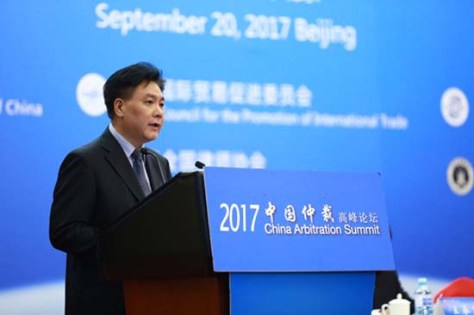
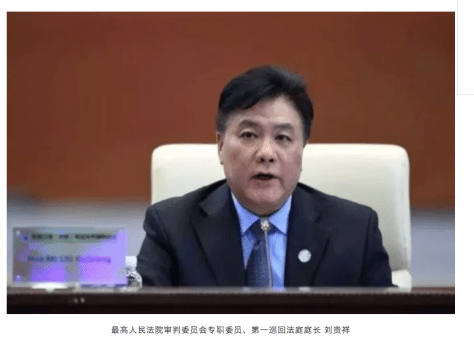
Judge Liu Guixiang speaking at the China Arbitration Summit
At China’s Arbitration Summit in late September, Liu Guixiang, Chief Judge of the #1 Circuit Court, called attention to a notice that the Supreme People’s Court (SPC) issued earlier this year to strengthen judicial review of arbitration. The notice (Notice concerning some questions regarding the centralized handling of judicial review of arbitration cases关于仲裁司法审件归口办理有关问题的通知) is linked to the likely increasing number of cases involving judicial review of arbitration matters, linked to the increasing number of arbitrations involving Chinese parties (and the One Belt One Road initiative) both in China and elsewhere in the world, including Hong Kong International Arbitration Centre. (The notice highlights data collection problems).
The notice, reproduced below, is not an SPC judicial interpretation. Unlike judicial interpretations, notices are not required to be published. It seems that the SPC itself has not officially published it, but several officialwebsites have published it, as have a number of Wechat accounts.
A quick search reveals that the notice drew on a 2014 study by the Guangdong courts summarizing the results of pilot projects (including Shenzhen) that the SPC commissioned, involving cooperation with the now independent Shenzhen Court of International Arbitration. As is usual, Guangdong and Shenzhen have led the way as pilot areas for judicial reform. The study highlighted a list of problems with the way lower courts review arbitration related issues, including lack of consistency in reviewing cases. The study also highlighted problems in tracking case data.
As Judge Liu also mentioned (as has this blog), the SPC is working on a comprehensive judicial interpretation on that subject). That judicial interpretation is still being drafted, with the #4 Civil Division of the SPC taking the lead.
A very rough translation and some comments written in italics follow. (Many thanks to an anonymous and well-informed follower of this blog for bringing the notice to my attention and for some thoughts.) Please call translation glitches/mistakes to my attention.
最高人民法院
关于仲裁司法审查案件归口办理
有关问题的通知
法[2017]152号
Supreme People’s Court
Notice Concerning Some Questions regarding the centralized handling of judicial review of arbitration cases
Fa (2017) #152
各省、自治区、直辖市高级人民法院,解放军军事法院,新疆维吾尔自治区高级人民法院生产建设兵团分院:
To the provincial, autonomous region, directly administered municipality higher people’s courts, People’s Liberation Army Military Court, Production and Construction Corps Branch of the Xinjiang Autonomous Region Higher People’s Court:
To try correctly judicial review of arbitration cases according to law and guarantee a unified yardstick for judicial decision-making, protect the legal rights of parties, promote the healthy and orderly development of arbitration matters and the establishment of a diverse dispute resolution mechanism, we notify the various levels of the people’s court handling judicial review of arbitration cases of the following:
I. The trial divisions (collegial panels) trying foreign-related commercial cases shall be the specialized trial divisions (below, “specialized trial divisions) responsible for undertaking the judicial review of arbitration as set out in this notice.
This means that SPC is requiring trial divisions (or collegial panels, in smaller courts) handling foreign-related commercial matters to be responsible for reviewing the arbitration related matters described in the next paragraph. It is a plus for competency/consistency in arbitration-related matters.
II. In cases in which a party applies to have the validity of an arbitration agreement recognized, cases in which application is made to cancel a domestic arbitration commission’s award, cases in which application is made to recognize (认可) and enforce a Hong Kong SAR or Macau SAR arbitration award, recognize (认可) and enforce a Taiwan area arbitration award, application is made to recognize (承认) and enforce a foreign arbitral award, shall be handled by the specialized trial divisions of each level of court.
This paragraph describes the types of cases covered by the notice–the types of judicial review of arbitration matters and that these cases should be handled by the specialized trial division of each level of court designated in the paragraph I. There is a difference in terminology (bolded above, but not in the original Chinese) when referring to the recognition of arbitral awards from Hong Kong, Macau, and Taiwan as distinguished from foreign arbitral awards, emphasizing that awards from these jurisdictions are considered part of “one country.” Notice that cases involving domestic arbitration awards or disputes over the validity of an arbitration agreement to submit a dispute to domestic arbitration are also to be reviewed by the specialized trial division. A big plus for consistency and competency in judicial review of arbitration matters.
When a specialized trial division, after review, has ruled to recognize and enforce a Hong Kong Special Administrative Region, Macau Special Administrative Region, Taiwan Region arbitration award, recognize and enforce a foreign arbitral award, the enforcement shall be transferred to the enforcement departments for enforcement.
III. When the first instance court makes a ruling which relates to the validity of an arbitration agreement relating not to accept, to reject a filing or objection to jurisdiction, and a party disagrees with the ruling and appeals, the specialized trial division of the second instance court should handle it.
This provision channels appeals relating to arbitration matters to specialists in the second instance courts, again a plus for competency and consistency.
IV. Each level of people’s court should establish a centralized administrative platform for the judicial review of arbitration awards, to strengthen the informatized management and data analysis of cases regarding applications to confirm the validity of an arbitation agreement, cases regarding applications to cancel or enforce arbitration awards of our domestic arbitration institutions, applications to recognize and enforce Hong Kong Special Administrative Region, Macau Special Administrative Region, Taiwan Region arbitration awards, cases regarding applications to recognize and enforce foreign arbitral awards, and cases relating to the judicial review of arbitration such as refusal to accept, reject the filing, or objection to jurisdiction and others relating to the confirmation of the validity of an arbitration agreement; the effective guarantee of the correct application of law and of a unified yardstick for judicial decision-making. The #4 Civil Division of the Supreme People’s Court and the People’s Courts Information Technology Service Center shall be specifically responsible for this work.
IV. This paragraph requires a platform to be established to enable better data collection of arbitration related cases. Data collection appears to be an ongoing issue for the courts. 2015 SPC rules on case file numbers (thank you to Chinalawtranslate.com for this translation), are aimed to create more consistency in filing numbers for cases, and will also be helpful in this process. Inconsistency in case files numbers was identified as a problem in the Guangdong study.) The SPC’s #4 Civil Division (in charge of cross-border civil and commercial matters) and the Information Technology Service Center are the ones responsible for ensuring this platform works. The notice does not require data results to be made public. The legal and professional public (in China and elsewhere in the world) would look forward to regular big data reports on this.
最高人民法院
2017年5月22日
Supreme People’s Court
May 22, 2017
_______________________________________
If you like this blogpost, please join the East Asian Legal Studies Center of Harvard Law School in supporting the Supreme People’s Court Monitor.
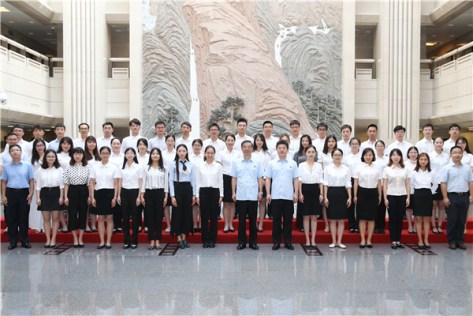
SPC President Zhou Qiang & Political Dept head Xu Jiaxin with 3rd group of interns, including a Peking University School of Transnational Law student
One of the unexpected influences of the United States system on the Chinese courts is the Supreme People’s Court’s (SPC) elite internship program, instituted in 2015. (The German system of requiring law students to intern in courts, too, is an apparent influence). The word of mouth is that the SPC leadership noted that the US Supreme Court clerkships attracted top law students and wanted to do something similar in China.
The program is a small example of “foreign beneficial experience,” about which I wrote about earlier this year. The official position on borrowing/referring to foreign legal models is set out in the 4th Plenum Decision (as I wrote earlier):
Draw from the quintessence of Chinese legal culture, learn from beneficial experiences in rule of law abroad, but we can absolutely not indiscriminately copy foreign rule of law concepts and models.
Outstanding products of rule of law culture in the world shall be actively absorbed and used for reference, but they must be filtered, they must be selectively absorbed and transformed, they may not be swallowed whole and copied (对世界上的优秀法治文明成果,要积极吸收借鉴,也要加以甄别,有选择地吸收和转化,不能囫囵吞枣、照搬照抄).
Unlike Supreme Court clerkships, which are done by recent law graduates, SPC interns are generally required to be students, generally at the master’s or PhD level. The SPC selects several dozen outstanding students (the number seems to vary) to participate in the sixth month program. They must be recommended by their law schools (each runs its own selection process)–see this notice by China University of Political Science and Law. Several of our School of Transnational Law Students are participated. Applications are made to the Political Department of the SPC (it handles personnel matters) rather than to individual judges. The program is part of the SPC’s outreach to educational institutions and efforts to create a more elite judiciary.
While most requirements are in line with internships in most parts of the world and the stress appears to be on outstanding academic qualifications, among the requirements for the program is having a firm political stand (政治立场坚定) (it seems to be standard for internships in Chinese government/or government affiliated institutions) and the application form asks about the political view of family members.
In 2017, preference was given to Beijing area law schools because no housing was provided, and from the lists of accepted interns, it is clear that more Beijing area interns are accepted. As of 2019, however, the SPC provided accommodations. For Beijing based students, it likely means a long commute from the law schools based in the suburbs to be at work in the early morning.
Each intern is assigned a mentor, generally a presiding judge (审判长), therefore judge with long years of experience. Interns are primarily assigned to the substantive/trial divisions (业务部门) of the SPC and also other SPC offices including:
It seems that many were confronted with being assigned to work in areas of law that they had never before encountered, or being involved in work they had never before done. Some worked on judicial interpretation drafting, many sat in on collegiate panel discussions of cases, assisted in case review, and assisted the teams of judges working on death penalty review while many helped their mentors with related research and administrative matters, finding their work reviewed meticulously, and spending long hours along with their (overworked) mentors. Given the highly theoretical orientation of Chinese legal education, particularly at the graduate level, the interns (and their mentors) likely encountered major challenges along the way.
The circuit courts, too are taking interns, although they each seem to have their own requirements. The #2 Circuit takes interns from the law schools in Northeast China, the#6 Circuit Court from the Northwest provinces, the #3 Circuit from law schools within its Circuit, while the #1 Circuit Court has taken interns from the Shenzhen-based law schools (School of Transnational Law and Shenzhen University) as well as law schools in other parts of the country.
As part of its outreach to the academic community, the SPC also has a smaller program for legal scholars, seeking to attract elite academics. That program limited to Chinese nationals from Chinese law schools, who generally should not be over the age of 50! I look forward to the day when the SPC takes note of the “foreign beneficial experience” of the Federal Judicial Center, which has welcomed many Chinese judges over the years as Visiting Fellows. The program has no age restriction. The late Judge Zou Bihua, whom President Xi Jinping praised for guarding “equity and justice and was brave to face tough obstacles in judicial reform, [and] showed his loyalty to the Communist Party of China (CPC) and the people,” had been a Visiting Fellow in 2000. He is one of the foreign judges featured on the Federal Judicial Center’s Visiting Fellows webpage.
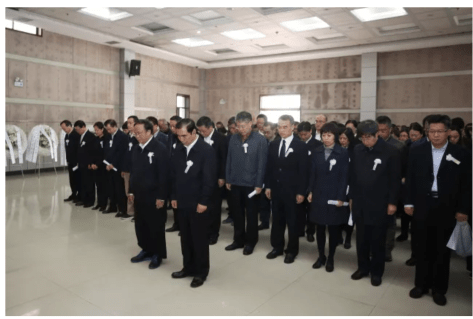
Funeral of Judge Fang Jinggang, #4 Circuit Court, Zhengzhou
from website of Yale’s Paul Tsai China Center
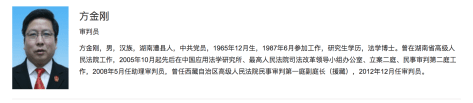
While Party leaders (including Supreme People’s Court (SPC) President Zhou Qiang) were attending the 19th Communist Party Congress, tragedy again struck the Chinese judiciary. Supreme People’s Court (SPC) Judge Fang Jingang, who was working in the #4 Circuit Court in Zhengzhou, succumbed to a heart attack at the age of 51. Joining the dark-suited crowd pictured above (his circuit court colleagues and selected current and former senior personnel from Supreme People’s Court (SPC) headquarters and elsewhere, including his former superior Jing Hanchao, now deputy secretary of the Central Political Legal Committee ) in spirit was a large crowd of former colleagues and friends, located in China and abroad who were unable to attend the funeral in person.
Judge Fang can be considered a symbol of the new generation of elite Chinese judges. He spent many years in the local courts as well as the SPC and also spent time abroad. Like many of his colleagues, he had a PhD, and had worked in Hunan courts before being recruited to the SPC, initially to the Institute of Applied Jurisprudence and SPC’s judicial reform office. While at the Institute and thereafter, he and colleagues translated foreign materials (including severalyear-end reports of the federal judiciary) for internal reference and publication and he continued to research and make use of foreign law. He also spent several months at Yale Law School as a visiting scholar and as a result made friends among the Chinese law academic community in the United States (and continued to keep up with English language news, presumably from foreign sources).
After he returned to China he transferred to the “front line”–to the SPC’s case acceptance division and #2 civil division and was also sent to work in Tibet’s Higher People’s Court for three years under the SPC’s “assist Tibet” program. While at the #2 civil division, he was part of the team of people drafting the #4 Company Law interpretation and has been at the #4 Circuit Court in Zhengzhou since the beginning of this year. He continued to work with his #2 civil division colleagues on the Company Law interpretation and somehow find time to write articles on the interpretation, including one comparing US corporation law with the new Company Law interpretation, the latter published posthumously.
Judge Fang in meeting at 4th Circuit with Columbia Law School Prof. Benjamin Liebman & others, May, 2017
SPC-related media obituaries range from the very official (on the SPC website) to the more personal (this one with quotes from several of his former colleagues). Early indications are that Judge Fang may also become a “model judge” (like Judge Zou Bihua) as SPC President Zhou Qiang and Executive Vice President Shen Deyong have already said that others should learn from Judge Fang. Judge Fang was posthumously awarded the title of “national excellent judge.”
Query whether Judge Fang’s death might indicate that the SPC’s circuit court model is too “lean and mean.” Statistics issued by the SPC in August indicate that almost half of all cases accepted by the SPC in the first half of this year have been accepted by the circuit courts, meaning that circuit court judges are under extreme pressure to deal with cases that are complicated/involving large amounts in dispute on time, and discrete inquiries indicate that many are working weekends and into the night. Like Fang, many of them who were involved in judicial interpretation drafting when working at SPC headquarters continue to provide input to the work of their colleagues at SPC headquarters and are pulled into other research and writing projects. And like Fang, working in a circuit court means that they away from their families.
Judge Fang, center, singing karaoke
When singing karaoke recently, he changed the lyrics of a song to say “live as a fourth circuit person, die as a fourth circuit spirit.” 还说:“生是四巡人,死是四巡鬼”
Judge Liu Guixiang (SPC judicial committee member & head of #1 Circuit Court) speaking at conference
In late September (2017), the Supreme People’s Court (SPC) held a Belt & Road judicial conference with senior judges from 16 jurisdictions in the desert oasis of Dunhuang, famed for its Buddhist caves. As is its custom at its international conferences, the SPC released some information concerning previously unknown cross-border related initiatives, both of which have implications for the international business and legal communities. The English language reports of the conference (in China Daily and related media outlets) missed the implications. A brief article in one of the SPC’s Wechat accounts reveals that:
SPC is drafting a judicial interpretation on the recognition and enforcement of foreign civil & commercial judgments (关于承认和执行外国法院民商事判决若干问题的规定);
SPC is considering establishing a Belt & Road International Commercial Court (literally “Tribunal”) (“一带一路”国际商事法庭). (chief of the SPC’s #4 Civil Division, Judge Zhang Yongjian, must have been speaking of this when he was interviewed during the 2017 National People’s Congress meeting).
Enforcing foreign civil judgments
A recent decision by a Wuhan court to enforce a California default judgment has received worldwide attention, both professional and academic. with some noting nothing had really changed and Professor Donald Clarke correctly wondering whether an instruction had come from on high. With this news from Judge Liu, it is clear that the Wuhan decision is part of the Chinese courts’ rethink of its approach to recognizing and enforcing foreign court judgments.
Judge Liu revealed that the judicial interpretation will set out details regarding the meaning of “reciprocity” and standards for applying it (明确互惠原则具体适用的标准). In another recent article, an SPC judge considered the matter of reciprocity in more detail. Among the issues she mentioned were: 1) China not being a party to the Hague Convention on the Choice of Courts (this obstacle has been removed as China signed the Convention on 12 September 2017 (this article has a good overview); 2) China should actively participate in the drafting of the Hague Convention on the Recognition & Enforcement of Foreign Judgments (this seems to be happening, as this blog has reported). The SPC judge recognized that the current Chinese position has significant limitations and can lead to a great deal of parallel litigation (see Professor Vivienne Bath‘s scholarship on this). The SPC judge also suggested that the standards set out in mutual judicial assistance agreements could be useful in drafting standards for reviewing the recognition and enforcement of foreign judgments.
Belt & Road Commercial Court
Judge Liu also mentioned that the SPC would establish a Belt & Road dispute resolution mechanism and that the SPC was considering a Belt & Road commercial tribunal, to provide the parties of OBOR countries with fair, efficient, and low-cost one-stop legal services. It is clear from discrete developments that the SPC is looking to Singapore’s International Commercial Court and the Dubai’s International Finance Centre Courts (DIFC). One of those discrete developments is the cooperation agreement that the Shanghai Higher People’s Court and Dubai International Finance Centre Court signed in October 2016 (reported here), which must have required the concurrence of the SPC. The other discrete development is the memorandum of understanding on legal and judicial cooperation between the SPC and Singapore Supreme Court, signed in August 2017, relating to mutual recognition and enforcement of monetary judgments, judicial training for judges, and the Belt & Road initiative.
The details of the SPC’s Belt & Road commercial court (tribunal) are yet unclear. Both the DIFC and Singapore International Commercial Court have a panel of international judges, but a similar institution in China would be inconsistent with Chinese legislation. The SPC is clearly interested in promoting mediation to resolve Belt & Road disputes. This interest is visible from the September 2017 International Mediation conference in Hangzhou, at which Judge Long Fei, director of one of the sections in the SPC’s Judicial Reform Office, spoke on the benefits of international commercial mediation.
Perhaps the SPC envisions an institution analogous to the Asian Infrastructure Investment Bank and plans to cooperate more on resolving Belt & Road commercial disputes with UNCITRAL and other international organizations. We will need to see how this further develops.
It is also unclear whether the SPC will issue a draft judicial interpretation or draft regulations on the Belt & Road dispute resolution center for public comment. Although President Zhou Qiang and Executive Vice President Shen Deyong speak of the benefits of judicial transparency, it seems the benefits of public participation in judicial interpretation drafting /rule-making have yet to be fully realized.
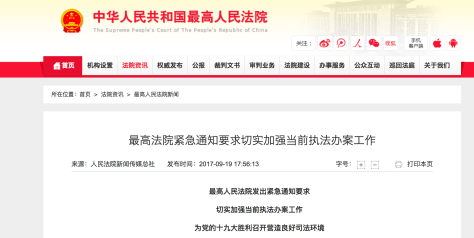
As the days count down to the 19th Party Congress, all Party/government institutions are preparing for it, including the Supreme People’s Court (SPC). On 19 September, the SPC issued an emergency notice (pictured above), calling on the lower courts to strengthening law enforcement work to provide a good judicial environment for the holding of the 19th Party Congress. The SPC, as other Party/government institutions, issue emergency notices from time to time (here’s one from the Ministry of Education), generally linked to a politically significant event. The full text for the SPC notice hasn’t been released (or if it has, it has escaped me). It is meant to send signals to the SPC staff and to the lower courts.
Some of the signals:
improve performance indicator systems (indicating too many courts still have dysfunctional performance indicators);
handle more cases, handle them well, handle them quickly (多办案、办好案、快办案, language better suited to the factory floor);
ensure that the goal of having difficulties in enforcement basically resolved in three years is achieved (again….);
clear up those unresolved cases (要抓好长期未结案件清理,确保依法妥善清理案件)–this is being taken seriously by court leaders, again judges (and their clerks, assistants and interns). The PhDs (and Master’s degree holders) praised by the SPC may feel they are somewhere between a model production worker and a real judge (or clerk.). (Of the SPC quota judges, about 1/3 have PhDs, with over half holding a master’s degree), and PhDs are not unusual in the lower courts, at least in major cities.) An unscientific survey shows judges and their support staff doing more overtime during the pre-19th Party Congress and pre-Golden Week holiday to meet this target;
reminds the lower courts about the case registration reform and reminds judges that cases should be accepted, even towards year end, when courts are concerned about their case closing numbers, especially the number of cases that will be carried over to the next year, and warns them against reporting false closing statistics (坚决杜绝人为抬高立案门槛、拖延立案、年底前提前关门不收案等突出问题), (切实防止虚假报结、强迫撤诉);
reminds courts about another important but controversial judicial reform, implementing the judicial responsibility system (insightful analysis and research from within the courts on this is coming out, see this recent article in the National Judicial College’s journal);
it reminds judges of ways to deal with the increase and cases and reduction in headcount–use diversified dispute resolution, separate simple from complicated cases, and try similar cases together.
The SPC released some year to date (end August) statistics (I’m drilling down on the state of transparency in this area)–close to 16 million newly accepted cases (15.89 million), no breakdown on how cases are categorized, closed cases up to 12.67 million (up 15.7%). This indicates continued high pressure on first instance judges and their assistants. I’m awaiting data on what the vortex of reforms means for retaining high quality judges.
A draft of the first comprehensive overhaul of China’s court law since 1979 (the organic/organizational law of the people’s courts) is now open for public comment (until 4 October). A translation of the draft is available at Chinalawtranslate.com (many thanks to those who made it possible). A translation of the current law is here and an explanation of the amendments has also been published. The draft is significantly longer than the earlier version of the law (66 vs. 40 articles). It retains much of the framework of the old law, incorporates legislative changes as well many of the judicial reforms, particularly since the Third and Fourth Plenums, and leaves some flexibility for future reforms. As with the current law, Communist Party regulations address (and add another layer to) some of the broad issues addressed in the draft law. Some comments:
Drafting process
The drafting process (the explanation has the details) reflects the drafting of much Chinese legislation (further insights about the process from Jamie Horsley here)–several years of soft consultation by the drafters of relevant Party and government authorities, plus one month of public consultations. Among the central Party authorities consulted were: Central Commission for Discipline Inspection, Central Organizational Department (in charge of cadres); Central Staffing Commission (in charge of headcount); Central Political Legal Committee. On the government side: Supreme People’s Court and Procuratorate; State Council Legislative Affairs Office; Ministry of Finance, National People’s Congress Legal Work Committee. Investigations and consultations were also done at a local level.
General Provisions
Some of the dated language from the 1979 version has been deleted (references to the “system of the dictatorship of the proletariat,” “socialist property,” and the “smooth progress of the socialist revolution.” replaced by “lawful rights and interests of legal persons,” and protection of national security and social order. Although the draft court law deletes language that distinguishes among owners of different types of Chinese companies, Chinese criminal law still does (see this chart setting out sentencing guidelines, for example).
Article 10 of the draft incorporates judicial responsibility systems into the law (a prominent feature of the recent judicial reforms), but a topic regarding which dispassionate analysis is hard to find.
The draft contains clear statements about judicial openness and the right of the masses (i.e. ordinary people, that term is alive and well) to know about the work of the courts (according to law).
Organization of the courts
The draft mentions some of the specialized and special courts that have been established over the last thirty years:
Maritime courts, legislation found here; translation of SPC regulations on jurisdiction found here.
Intellectual property courts, legislation found here, a summary of SPC regulations on jurisdiction found here.
The military courts still lack their own legislation (an earlier discussion of this issue is found here).
Article 15 of the draft crystallizes the SPC’s circuit courts (tribunals) into law (SPC regulations on the jurisdiction of those courts found here).
Article 24 gives space for establishing cross-administrative region courts (the time has not yet been ripe for establishing them).
Articles 26 and 27 give courts some flexibility on their internal structure (courts in remote areas with few cases need not establish divisions, while large city courts can have multiple specialized ones. (Earlier blogposts have mentioned establishing bankruptcy divisions, for example.)
Trial Organization
This section of the draft law incorporates the current judicial reforms in several ways, including:
In Articles 30-31, on the operation of collegial panels and requiring the court president to be the presiding judge when s(he) participates in a collegial panel;
Mentioning in Article 32 that the members of the collegial panel are the ones to sign their judgments and dissenting opinions are to be recorded;
Article 34 gives space for eliminating the role of people’s assessors to determine issues of law;
Article 37 incorporates into law previous SPC regulations on judicial interpretations and guiding cases, specifying that they must be approved by the SPC judicial committee;
Article 40 contains provisions imposing liability on members of the adjudication/judicial committee for their comments and their votes. It also incorporates into the law SPC regulations on disclosing the views of the judicial committee in the final judgments, except where the law provides it would be inappropriate;
Article 41 also incorporates into the law the specialized committees mentioned in judicial reform documents (briefly discussed in priorblogposts).
Court Personnel
Article 42 requires court presidents to have legal knowledge and experience. It has long been an issue that court presidents have been appointed more for their political than legal expertise.
It appears that the reform of having judges below the provincial level appointed by the provincial level is not yet in place,
This section of the draft court law incorporates the personnel reforms set out in the judicial reform documents in several ways: quota judge system; selecting higher court judges from the lower courts; the roles of judicial assistants and clerks (changed from the old model); other support personnel in the courts; a new career track for judges, including judicial selection committees; preference to hiring judges with legal qualifications;
Safeguards for the courts’ exercise of authority
Article 56 gives courts the right to refuse to engage in activities that violate their legally prescribed duties (with this end the phenomenon of judges sweeping streets?);
Article 57 relates to reforms relating to enforcement of judgments (and the social credit system);
Article 59 relates to threats to judges’ physical safety and personal dignity, that occur several times a year in China, and have been the subject of SPC regulations;
Scope for further reforms for judicial personnel management (including salary reform!) are included in this section.
Article 60 reiterates the principle that judges may only be transferred, demoted, dismissed according to procedures specified by law (Party procedures to which most judges are subject,are governed by Party rules.)
Article 62 relates to judicial (and judicial personnel training)–some earlierblogposts have shed light on this topic.
Article 64 incorporates into the draft law President Zhou Qiang’s focus on the informatization (including use of the internet and big data) of the Chinese courts.
Etc.
My apologies to readers for the long gap between posts, but several long haul trips from Hong Kong plus teaching have left me no time to post.
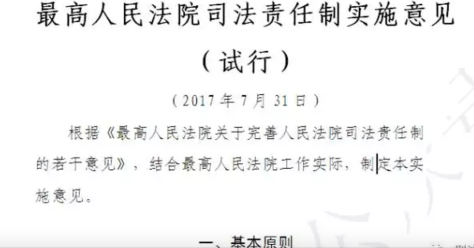
The document establishes operating rules for the SPC after this latest round of court reforms, and therefore sets guidelines for the lower courts. It can be expected that the lower courts will issue corresponding documents. Through the Implementing Opinion, it is possible to see how much autonomy an individual judge/three judge panel has and what matters require approval by senior SPC leaders.
Opinions (as this blog has previously explained) are not judicial interpretations but a type of judicial normative document. A recent Wechat post by an SPC commercial subsidiary, Faxin (法信), described them as judicial guiding documents (司法指导性文件). That is the terminology being used for them in a series of books published by the People’s Court Press. Inconsistent legal terminology is not a new phenomenon.
The basic principles of the Implementing Opinion are said to implement central authorities’ requirements, let those who hear cases bear responsibility, clarify how cases are to be dealt with and put in place the Party group’s responsibility for enforcement (the phrase “Party group” actually is mentioned three times) and case handling. It appears that some provisions memorialize current practice, while others set out new rules.
The Implementing Opinion specifies roles of different personnel and institutions within the SPC such as the court president (and vice presidents), heads of divisions, professional judges committee, judicial committee, presiding judges, judges in charge of cases, clerks, and judicial assistants. It provides guidelines on how cases are to dealt with, from case acceptance, random case assignment, to issuing decisions.
The Implementing Opinion includes the following (selected) provisions:
Details on staffing for judges (one assistant and one clerk in the circuit courts, and some assistants and clerks at headquarters) (Article 3);
those with a leadership role (President/vice president/vice/heads of divisions) should generally be the presiding judge (Article 5), while the judges in collegial panels should change every 2-5 years;
leaders need to hear cases, that are difficult/important/guiding, etc., but specialists are designated to assist them (Article 7);
rules on who will issue judgments, mentioning that the president of the SPC signs the order for the implementation of the death penalty (this was understood to be the case already)(Article 11);
court leaders may not give oral/written instructions concerning a case (except as otherwise provided (i.e. cases that are considered by the judicial committee)(Article 12);
responsibilities of professional judges committees (a committee put into place under the judicial reforms); judicial committee (can be split into specialist civil, criminal, enforcement subcommittees) (role said to have narrowed, but include major/difficult cases affecting national interests & social stability, but also other non-case related duties such as approving judicial interpretations/judicial normative documents, etc., the judicial committees requires views be stated in the judgment (Articles 16-19);
the basic rule is random case assignment, with exceptions for major/difficult cases (Article 26-27), with electronic service of process & documents if agreed (Article 32);
basic rule is online broadcast of SPC court hearings, unless approved by leaders otherwise (Article 33), with requirements concerning the posting of rulings/judgments and other transparency requirements mentioned in the document;
circuit courts are prohibited (in general) from considering requests for instructions (the rule makes sense–it would defeat one of the purposes of having circuit courts (Article 25, this is an example);
Articles 41-43 relate to precedent case review (as suggested in my recent article) and require approval by leaders if the ruling in a case will be inconsistent with prior SPC rulings on the topic (this has been criticized as being inconsistent with judicial autonomy). Approval is required in several other situations, see Article 40 (2-4));
Articles 46-50 set forth rules for a collegiate panel to consider a case and submit it to the division leadership/professional judges committee/judicial committee;
Article 51 requires the judge responsible for the case (承办法官) to draft the decision reached according to the majority view, indicating that the role of responsible judge has administrative overtones. If not so, the judgment would be drafted by one of the judges who agreed with the majority view.
Article 58 retains existing special procedures (including special standards for transparency) for certain criminal cases, such as death penalty cases, cases involving foreigners, overseas Chinese, Hong Kong, Macau, and Taiwanese Chinese.
Article 61 provides the Central Commission for Discipline Inspection (CCDI) representative stationed at the SPC can be a member of the judicial committee (this seems to be analogous to the procedure under law under which a representative from the procuratorate can take part in judicial committee meetings). Additionally, anti-corruption officials stationed in each division can participate in professional judges committee meetings and collegiate panel discussions. Article 61 does not require their views to be adopted. It could be that their views are considered more seriously if discussions relate to matters regarding which they are competent.
Article 64 requires certain types of cases to be submitted for approval to higher levels of the SPC, including cases involving mass incidents, that will have an effect on social stability; difficult and complicated cases that will have a major effect on society; cases that will conflict with prior SPC cases; those that indicate the judge violated the law; death penalty review, major criminal cases, cases involving requests for instructions involving foreigners, overseas Chinese, Hong Kong, Macau, Taiwanese Chinese.
The vision for the reformed SPC remains a court with administrative characteristics (官本位), with concepts derived from other jurisdictions (judge’s assistant would be an example), that enables Party guidance in sensitive cases and its operations to reflect changes in Party/government policy (serving the actual situation), but seeks to be a more professional and accessible institution, hearing cases in a professional manner. It can be surmised that certain provisions from the Implementing Opinion will be incorporated into the revisions of the Organizational Law of the People’s Courts currently being drafted.
I’ve posted several times about law-related Wechat (微信) public accounts. They are an important resource for those trying to understand Chinese legal developments (or their absence) and their implications or impact. For the observer, it enables us to learn about new issues (or aspects of issues) that we didn’t know existed, and (depending on the topic), hear viewpoints other than the official one, or at least read hints of dissenting views. Those with the Wechat app on their smartphone can subscribe to these public accounts but it is also possible to find some these articles through an internet search. Note that the “Mr. Yong” about whom I wrote in 2016 still lurks on Wechat, so articles published may disappear.
Below is an incomplete guide to some useful law-related Wechat public accounts–oriented to my own interests, to be followed up when time permits. Please contact me through the comment function or by email with additional suggestions.
Official accounts
As I’ve written before Party/government authorities use Wechat public accounts to reach out to a public that is moving away from traditional media to their smartphones. SPC policy is encouraging courts to do so. There is some but not complete overlap between articles that appear on an institution’s website and Wechat account. There is complete overlap when more political matters are involved. Even some articles published on institutional public accounts have a “netizen” tone and popular netizen slang and images, such as this one from the Qianhai Court public account.
You’re right, today the little editor wants to tell everyone A BIG! THING! about the Qianhai Court!
Some large institutions (Supreme People’s Court (SPC) and Supreme People’s Procuratorate (SPP)), have affiliated research, publishing and educational institutions, with each having a Wechat public accounts under its auspices. There is some overlap in articles, but others are unique to the Wechat account.
The SPC has its official account: Wechat ID: ch_zgrmfy; People’s Court Daily: Wechat ID: renminfayuanbao; SPC’s research institute, The Institute for Applied Jurisprudence, Wechat ID: fayansuo; National Judicial College’s Wechat ID:falvshiyongzazhi (Wechat version of their magazine, Application of Law (法律适用) & account of its case research institute (司法案例研究院), Wechat ID: sifalyjy. There is also an account on diversified dispute resolution, linked to the Institute for Applied Jurisprudence: 多元化纠纷解决机制 (SIFAADR). The electronic database Faxin (法信) affiliated with People’s Court Press (which itself has a Wechat account: fayuanchubanshe) also has a Wechat account, Legal_information, as do the journals 中国审判 (Id: zhongguoshenpan) and人民司法 (renminsifa). (This list is incomplete).
Officially approved accounts but not official
Some individuals affiliated with legal institutions have Wechat public accounts (presumably with the approval of their institutional leaders), among them: account of a Pudong New area judge, 法眼观察 (fygc20140416)–here is a recent article on the large number of cases in his and 19 other local courts; 法影斑斓 , account of He Fan, judge in the judicial reform office of the SPC, Wechat ID: funnylaw1978; CU检说法 (CU-JIAN), account of a local prosecutor (see an article on prosecutor’s assistants) 稻花蛙声(paddyfrog), recent article on judicial reform as seen from the bottom of the judicial food chain;法治昌明 (fazhichaming), with a recent article on the toxic system of performance appraisals.
Supervision Commission
The two must read accounts for those trying to understand what is happening with the supervision commission pilots:监察委前沿 (jianchaweiqy)and反腐先锋 (recent article on the framework for the supervision commissions published here)
Others, many previously recommended
Arbitration: Wechat ID: cnarb1, account of Lin Yifei, mentioned in an earlier blogpost. I highly recommend it to both practitioners and others interested in arbitration.
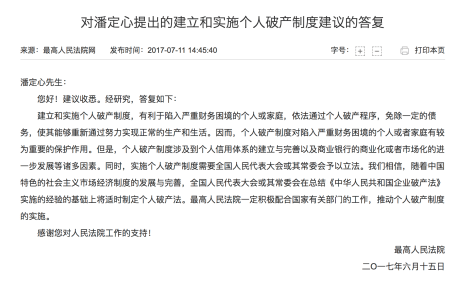
Most readers of this blog are unlikely to know that the Supreme People’s Court (SPC) publishes on its website responses to selected letters to President Zhou Qiang that make suggestions and give opinions. In a July 11 response, the SPC revealed that individual bankruptcy legislation is on its agenda. As I suggest below, actual legislation is likely to come later.
The letter said:
Dear Mr. Pan Dingxin:
We received your proposal, and after consideration, we respond as follows:
establishing and implementing an individual bankruptcy system is beneficial for those individuals or households who have fallen into serious financial distress to exempt some of their debts and enable them again through their hard work to achieve normal business and living conditions. Because of this, it has an important function to protect individuals and households that have fallen into financial difficulties. However an individual bankruptcy system relates to the establishment and improvement of an individual credit system and commercialization of commercial banks or their further marketization and other factors. At the same time, the implementation of an individual bankruptcy system requires the National People’s Congress or its Standing Committee to legislate. We believe that with development and improvement of the socialist market economic, the National People’s Congress or its Standing Committee will promulgate an individual bankruptcy law on the basis of the experience with the “PRC Enterprise Bankruptcy Law.” The Supreme People’s Court will definitely actively support the work of the relevant departments of the state, and promote the implementation of an individual bankruptcy system.
Thank you for your support of the work of the Supreme People’s Court!
Supreme People’s Court
June 15, 2017
Few are aware that Shenzhen has been working on draft individual bankruptcy legislation for several years now, looking to Hong Kong’s experience and legislation, described in a recent report as a “complete” individual bankruptcy system (“完善的个人破产制度”). The process has been going on for so long that the team (designated by the local people’s congress and lawyers association) and headed by a Shenzhen law firm partner published a book one year ago with its proposed draft and explanations.
Although Professor Tian Feilong of Beihang University’s Law School has been recently widely quoted for his statement about Hong Kong’s legal system undergoing “nationalisation,” this is an example, known to those closer to the the world of practice, that Hong Kong’s legal system is also seen as a source of legal concepts and systems that can possibly be borrowed. The drafting team looked at Hong Kong (among other jurisdictions) and others in China have proposed the same as well.
Shenzhen’s municipal intermediate court has completed an (award-winning) study on judicial aspects of individual bankruptcy shared with the relevant judges at the SPC.
If recent practice is any guide, individual bankruptcy legislation will be piloted in Shenzhen and other regions before nationwide legislation is proposed, and it will be possible to observe the possible interaction between those rules and the government’s social credit system. So national individual bankruptcy legislation appears to be some years off.
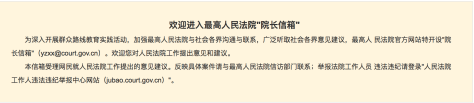
As to why the SPC has a letter to the court president function, the answer is on the SPC website: it is to further develop the mass education and practice campaign (mentioned in this blogpost four years ago) and listen to the opinions and suggestions of all parts of society (the masses). Listening to the opinion and suggestions of society are also required of him as a senior Party leader, by recently updated regulations. The regulations are the latest expression of long-standing Party principles.
In February, 2017, the Supreme People’s Court (SPC) issued its second judicial transparency white paper, giving the official version of what the SPC has done to respond to public demands for greater transparency about the Chinese judicial system. But what are the voices from the world of practice saying? One of the issues (for a small but vocal group, foreign litigants) is inconsistent and non-transparent formalities requirements.

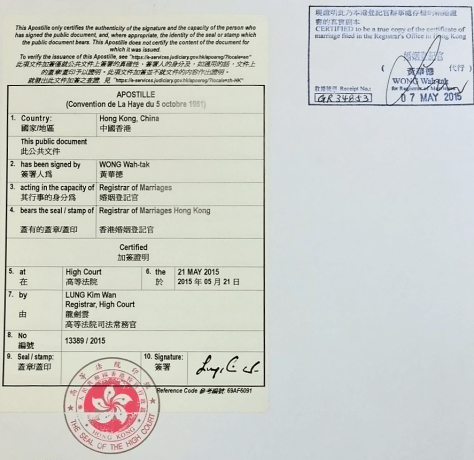
Chinese civil procedure legislation requires a foreign litigant to notarize and legalize corporate documents, powers of attorney & other documents. It is a time consuming and costly process, with some jurisdictions providing documents that do not meet the expectation of Chinese courts. China is not yet a signatory to the Hague Convention Abolishing the Requirement of Legalisation for Foreign Public Documents (Hague Legalization Convention) which substitutes the faster and cheaper apostille process (note that Hague Legalization Convention continues to be applicable to Hong Kong and Macau under the terms of the joint declarations and Basic Laws for each Special Administrative Region (SAR)). About one year ago, a Ministry of Justice official published a Wechat article discussing the benefits of the Hague Legalization Convention (as well as the issues facing China in implementing it).
While this article addresses issues faced by foreign plaintiffs seeking to challenge Trademark Review and Adjudication Board decisions in the Beijing Intellectual Property Court (Beijing IP Court), according to other practitioners (who have asked not to be identified), these problems with inconsistent (and non-transparent) requirements concerning legalizing foreign corporate documentation are not limited to the Beijing IP Court, but face foreign parties appealing from intermediate courts to provincial high courts elsewhere in China. These requirements can have the effect of cutting off a party’s ability to bring an appeal, for example.
What is the solution? The long-term solution, of course, is for China to become a signatory to the Hague Legalization Convention. In the meantime, Chinese courts should be more transparent about their formalities requirements. These requirements affect all foreign parties, whether they are from One Belt, One Road (OBOR) countries or not. If China is seeking to become an international maritime judicial center or hear more OBOR commercial cases, the Chinese courts need to become more user friendly. Courts with significant numbers of foreign cases (Beijing, Shanghai, Shenzhen….) can consider reaching out to the foreign chambers of commerce, many of which have legal committees, to understand in greater detail what specific problems foreign litigants face (and convey their views to foreign audiences). Resolving this issue can create some goodwill with the foreign business community with relatively little effort.
I recently published an article in the Tsinghua China Law Review on Chinese case law in practice, building on severalblogposts I had previously written and articles by fellow bloggers Jeremy Daum and Mark Cohen. Many thanks are due to the persons who shared their experience and observations with me. A special thank you is due to the persons who provided detailed comments on earlier drafts.
HK’s Secretary of Justice shaking hands with SPC Justice Shen Deyong
In all legal arrangements, the devil is in the details. Important details concerning how the Hong Kong and mainland legal systems interact are found in a series of arrangements on mutual legal assistance between mainland China and Hong Kong. An “arrangement,” for those not familiar with Hong Kong/mainland legal jargon, is a quasi-treaty document between Hong Kong and the mainland. The mainland is looking to conclude further arrangements, including in the area of criminal law. According to 29 June report by Xinhua News:
Chinese mainland and Hong Kong are expected to confirm further judicial assistance arrangements, including those regarding criminal proceedings.
Shen [Deyong, Supreme People’s Court (SPC) executive vice president] said in an interview with Xinhua that the two sides will carry out further negotiations on judicial assistance in civil and commercial cases and will take effective measures to deal with the assistance issues in criminal cases, so the assistance arrangements cover all judicial realms between the two sides.
It appears that Justice Shen is repeating what he told Hong Kong’s Secretary of Justice Rimsky Yuen in April, 2017.
Strengthen law enforcement and judicial cooperation between the mainland, Hong Kong, Macau and Taiwan,jointly attack crossborder unlawful and criminal activities.
Likely taking the lead in negotiating these arrangements is the Hong Kong Department of Justice (Hong Kong DOJ)’s International Law Division (and I assume others as well) and its mainland interlocutors. I assume that a team from the Supreme People’s Court (SPC)’s Hong Kong and Macau Affairs office is among the negotiators on the other side of the table (with a team from the Supreme People’s Procuratorate involved with negotiations on criminal matters. The Hong Kong DOJ’s website lists five mutual legal assistance arrangements, with the most recent one, signed on 20 June 2017, on the Reciprocal Recognition and Enforcement of Civil Judgments in Matrimonial and Family Cases, not yet in force. The paper that the Hong Kong DOJ filed with the Legislative Council sets out details of the arrangement, including its scope.
This latest arrangement relates to one of many pressing practical legal issues between Hong Kong and the mainland, the large percentage of “cross-boundary marriages.” According to the Hong Kong DOJ’s consultation paper on the arrangement (the SPC did not issue a similar paper), cross-boundary marriages increased from 32% to 37% during 2009-2014 and 20-30% of divorce cases filed in Hong Kong’s family court during 2010-14 related to marriages that took place on the mainland.
This arrangement involved creative lawyering on both sides, because it involves incorporating principles from several Hague Convention to which mainland China is not a party:
Recognition of Divorces and Legal Separations (1970), applicable to Hong Kong, but not the mainland;
The Hague Convention on the Civil Aspects of International Child Abduction (1980), applicable to Hong Kong, but not the mainland;
International Recovery of Child Support and Other Forms of Family Maintenance (2007), not applicable to either Hong Kong or the mainland.
Many of the previous arrangements reflected Hague Conventions to which the mainland was already a party.
Commercial lawyers should note that according to an April, 2017 statement by Hong Kong’s Secretary of Justice Rimsky Yuen, it was agreed in the form of 2016 meeting minutes to prioritize an arrangement for reciprocal judgment enforcement in civil and commercial matters involving situations other than the presence of choice of court agreements. A consultation paper has not yet been issued for that arrangement. I surmise that the arrangement will reflect the draft Hague Convention on the Recognition and Enforcement of Foreign Judgments. Hong Kong’s DOJ has at least one representative participating in China’s delegation. Several senior SPC judges are also on the delegation. (The other two arrangements mentioned have already been concluded.) It can be seen from this visual from a Chinese court’s Wechat public account, that the end of 2017 has been set as the deadline for concluding that arrangement.
Arrangements involving criminal matters are much more difficult to conclude, although several prominent commentators in Hong Kong this year have called for a rendition arrangement to be concluded. Among those include Grenville Cross, former director of public prosecutions in Hong Kong and Regina Ip, former Secretary for Security. The issues have been discussed since the late 1990’s. This 2005 paper submitted to the Legislative Council sets out some of the basic principles that could go into a future rendition arrangements:
double criminality;
issue of death penalty;
non-extradition for political offenses;
fair trial;
double jeopardy;
habeus corpus.
There have been academic articles on many of these topics.
It appears that the increased pressure on Hong Kong relating to the rendition arrangement is related to the drafting by the mainland’s Ministry of Justice of an International Criminal Justice Assistance Law. (No drafts have yet been released.) Fellow blogger NPC Observer notes that although the law is intended as a comprehensive statute covering all areas of international criminal justice assistance, including the mutual recognition and enforcement of criminal judgments, official discourse labels it an anti-corruption law, likely designed specifically to hunt fugitive corrupt officials overseas. So it appears also to be linked to Operation Skynet and the Central Anti-Corruption Coordination Group.
The status of negotiations on a rendition arrangement or other arrangements related to criminal justice are unknown. What is known is that there have been instances, including earlier this year, in which certain mainland authorities have dispensed with the niceties of official liaison. Would having an arrangement improve matters, as Grenville Cross argues, or will “extraordinary” rendition continue to occur?
It appears that upholding an important part of Hong Kong’s rule of law, as evidenced by arrangements between Hong Kong and the mainland depends on the professionalism of Rimsky Yuen, the Secretary of Justice, his Department of Justice colleagues and their mainland interlocutors. As he told Justice Shen and others at a meeting between the SPC and Department of Justice in April, 2017:
Cooperation [on criminal cases] is significant, but considering the difference of the two legal systems, we face challenges in civil, commercial and criminal cooperation. It will still take some time.
Finally, paraphrasing the Guardian, analyzing the Supreme People’s Court takes time and costs money. If you like the Monitor, please make a contribution (details here.)
I am traveling at the moment, so my time to review articles published on Wechat is limited. But below are some links of interest.
Huazhen (Flower Town) emotional counseling
Oldies but goodies
Several prominent media sources, the South China Morning Post among them, are running articles on China’s clean-up of the financial sector, this one pointing to the government’s focus on privately owned insurance companies.
The Ministry of Public Security (MPS) has recently issued its draft Detention Center Law for public comments (link to Chinalawtranslate.com’s translation. The draft has caused a great deal of comment within China and those concerned about the treatment of fellow human beings in criminal detention in China should read these articles:
I am tweaking the type of content on the blog, cutting down on the long analytical blogposts. I will provide links to reports and analysis on court and other legal matters on Wechat. I am concentrating on writing a book and some other related writing and editing projects.
It remains my hope that some followers with the financial wherewithal to do so will consider supporting (in some fashion) the blogs that are enabling the English speaking and reading public to perceive (through translation or bite-sized analysis) the “elephant” that is the Chinese legal system, among them Chinalawtranslate.com and this blog.
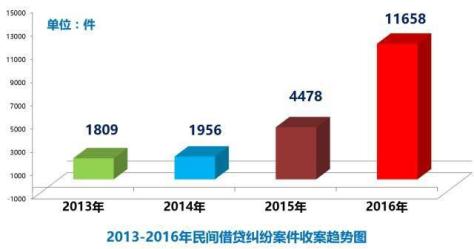
Supreme People’s Court (SPC) President Zhou Qiang’s report to the National People’s Congress in March of this year omitted data on private lending disputes. In 2016, Zhou Qiang stated that the courts dealt with approximately 1.5 million cases, up 41% from the year before. According to a widely cited study issued in November, 2016, private lending disputes were the leading type of civil dispute in the Chinese courts in 2011-2015. Data on private lending disputes in 2016 seems to be missing from year end reports by many local courts, although the the SPC is promoting the use of big data. The report discussed below is an exception to the general trend this year. Beijing’s Chaoyang District Court, one the busiest basic level court in China, recently published a report on private lending cases.
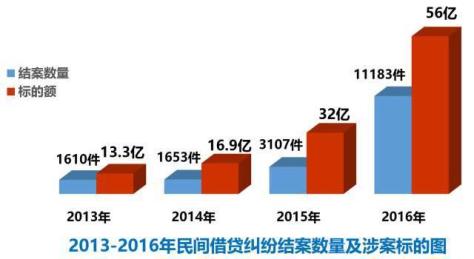
Data from Beijing’s Chaoyang District, numbers of cases accepted, 2013-2016:
2013-16, number of private lending cases accepted
The court noted that the year on year growth rate for private lending cases was 8.1% (2013-2014), 128.9% (2014-2015), 160.3% (2015-2016), with 2016 cases over five times the number in 2013. In the first four months of 2017, the Chaoyang court accepted 8777 new cases. The court expects the number of private lending cases to increase substantially during 2017.
2013-16 cases , amounts in dispute, in units of 100 million RMB
Cases involving large amounts in dispute are on the rise: in 2013, 21 cases involved more than 10 million RMB, 31 in 2014, 61 in 2015 and 95 in 2016, with one case in 2016 involving 96 million RMB. Total amounts in dispute in 2016 were over 821 million USD.
Comments by court researchers:
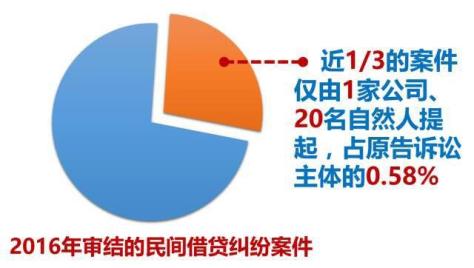
Almost 1/3 of the cases involved one company.
Many of the cases involve P2P platforms (no specific numbers supplied);
because insufficient information is supplied, courts have problems serving process;
many platforms circumvent the restrictions on the rate of interest by imposing intermediary fees;
the loan agreements are badly drafted, making it difficult for judges to decide these cases;
Few cases were settled and over 20% were default judgments.
Comment
Failing to release judicial statistics about private lending on a national level does not send positive signals about the state of judicial transparency, but does indicate the way that the SPC needs to serve government strategies. These statistics, at a local level, do send signals about the state of the economy. Their absence at a national level does not mean the underlying economic concerns have vanished. Further concerns are raised by the fact that the Shanghai Justice Bureau, as of early April, has ordered public notaries to stop notarizing private lending agreements (notarizing an agreement makes court enforcement easier
US 7th Circuit Judge Posner speaking by videolink at National Judicial College (NJC) in 2016
Supreme People’s Court (SPC) President Zhou Qiang has been widely quoted for saying in January of this year that Chinese courts should strengthen ideological work and show the sword to mistaken Western ideas of “constitutional democracy”, “separation of powers” and “judicial independence.” What is not widely known outside China is that the relationship between the Chinese judiciary and some of the major international judiciaries (I’ll use the term “Western”) is more nuanced than it appears. Close observation reveals the following:
high-level summits between major foreign and Chinese judiciaries;
senior Western judges speaking to or providing training to senior Chinese judges;
pilot projects in the Chinese courts involving foreign judiciaries;
SPC journals and media outlets publishing the translation of cases from and reports of major Western judiciaries; and
SPC judges reviewing legislation, institutions, and concepts from other judiciaries in judicial reform.
The official position on borrowing/referring to foreign legal models is set out in the 4th Plenum Decision (as I wrote earlier):
Draw from the quintessence of Chinese legal culture, learn from beneficial experiences in rule of law abroad, but we can absolutely not indiscriminately copy foreign rule of law concepts and models.
President Xi Jinping further elaborated this view on his visit to China University of Political Science and Law on May 3:
China shall actively absorb and refer to successful legal practices worldwide, but they must be filtered, they must be selectively absorbed and transformed, they may not be swallowed whole and copied (对世界上的优秀法治文明成果,要积极吸收借鉴,也要加以甄别,有选择地吸收和转化,不能囫囵吞枣、照搬照抄).
[The Xinhua report on Xi’s visit in English–“China should take successful legal practices worldwide as reference, but not simply copy them” omits the detail found in the Chinese reports.
Some examples of the way the SPC considers the “beneficial legal experiences in the rule of law abroad”:
High level summits (some of which were agreed to on a presidential/head of state level) on commercial legal issues, such as the August, 2016 U.S.-China (or China-U.S.) Judicial Summit
August, 2016 US-China Judicial Dialogue, then Principal Deputy Associate Attorney General William Baer in foreground
“Our three talented and experienced U.S. judges discussed with senior Chinese judges and other experts topics relevant to commercial cases, ranging from case management to evidence, expert witnesses, amicus briefs, the use of precedents and China’s system of “guiding cases.” Speakers from both sides gave presentations that explored complex questions on technical areas of law. The conversations, during the formal meetings and tea breaks, were lively, candid, direct and constructive, highlighting both the similarities in and important differences between the U.S. and Chinese legal and judicial systems. I told our Chinese hosts that the views our judges expressed would be entirely their own, reflecting our separation of powers and the independence of our judiciary. Our judges displayed that independence as they weighed in on a range of issues, such as the role of precedents in interpreting statutes and the challenge of balancing public access to information while safeguarding privacy and protecting trade secrets.
Several of the Chinese participants discussed pending cases in U.S. courts involving Chinese defendants. I [William Baer] believe it was useful for us to air our differences and for our experts to exchange views on technical and sensitive areas of law. At the meeting, it was clear that although we come from different backgrounds and will not always agree, we all recognize the importance of legal reasoning and that increased transparency is a way of earning the public’s trust in the fairness and objectivity of the judicial system.”(from the DOJ website).
2. Training of Chinese judges by foreign judges
Dr. Matthias Keller, presiding judge, Aachen administrative court, teaching at NJC, March, 2017
A number of foreign judiciaries have in place long-term training programs with the Chinese judiciary, with the German judiciary among the pioneers. The National Judicial College (NJC) (affiliated with the SPC) has a long-term program in place with the Germany judiciary, involving the German Judicial Academy, the German Federal Ministry of Justice & Consumer Protection, GIZ (the German international cooperation organization) and other parties, which teaches subsumption and related techniques of applying laws to facts (further explained here). The NJC has published a setof textbooks that apply the subsumption method to Chinese law.
It is likely that close to 10,000 Chinese judges have been trained under the German program. Common sense indicates that the NJC has continued with the program because it is useful to Chinese judges.
A recent example of the German training program is illustrated by the photo above, showing Dr. Matthias Keller, presiding judge of the Aachen administrative court giving a training course on the methodology of the application of law in administrative law to 150 Chinese administrative judges, mostly from intermediate and higher people’s courts.
3. Pilot projects in the Chinese courts involving foreign judiciaries
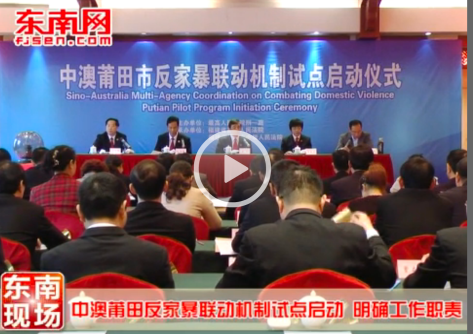
Australian judges have worked with the Australian Human Rights Commission on a ‘Sino-Australia Anti-Domestic Violence Multi-Agency Putian Pilot Program’ in Putian, Fujian Province, involving judges from the SPC, Fujian Higher People’s Court, and Putian Intermediate Court.
4. Publishing the translation of cases and reports from foreign judiciaries.
Some examples in recent months include:
excerpts from Supreme Court decision Padilla v. Kentucky (published 7 February 2017), for those unfamiliar, it relates to plea bargaining and effective counsel);
U.S. Chief Justice Robert’s 2016 year end report on the federal judiciary;
U.S. federal judiciary’s strategic plan, for their takeaways for a Chinese audience;
Summary of a July, 2016 report on cameras in the federal courts;
Summary of the UK’s 2015 Civil Justice Council’s Online Dispute Resolution Advisory Group’s report on Online Dispute Resolution for Low Value Civil Claims.
5. Considering foreign legal concepts in judicial reform
Foreign legal concepts are considered by the SPC in a broad range of areas of legal reform, most of them unknown to foreign observers. Several of the more well known examples include: plea bargaining (see this article by an SPC judge (a comparison with the US “model” is included in Jeremy Daum’s analysis of China’s expedited criminal procedure reform). Last year’s policy document on diversified dispute resolution (previous blogpost here) specifically mentions considering concepts from abroad,On the ongoing amendments to the Judges’ Law (the draft has not yet been released), SPC Vice President Shen Deyong said in late April, “we need to learn from and refer to the successful practices of the management system of the judicial team by jurisdictions abroad, but they must be selectively filtered for Chinese use (要学习借鉴域外法官队伍管理的制度成果,甄别吸收,为我所用)。
Comment
A careful review of official statements, publications, and actions by the SPC and its affiliated institutions, as well as research by individual SPC judges shows an intense interest in how the rest of the world deals with some of the challenges facing the Chinese judiciary coupled with a recognition that any possible foreign model or provision will need to fit the political, cultural, economic, and institutional reality of China, and that certain poisonous ideas must not be transplanted. [Those particularly interested could pore through two publications of the SPC judicial reform office (Guide to the Opinions on Comprehensively Deepening Reforms of People’s Courts and the Guide to the Opinions on Judicial Accountability System of People’s Courts, in which the authors discuss relevant provisions in principal jurisdictions abroad.]
Those who either are most concerned about diluting the Chinese essence of the SPC (or jealous/emotionally bruised) seem to have saved their most poisonous criticism for off-line comments, as I am unable to locate a written version of the nasty comments that a senior Chinese academic shared with me about the over-Westernization of judicial reform or other nasty comments said to have been made about research by certain SPC judges into foreign legal systems. It is hard to know whether the persons involved are motivated by jealousy or a real belief that these measures described above will have a negative effect on the development of the Chinese judiciary. It seems safe to say that the concerns raised in the 19th century on the dilution of the essence of Chinese culture when borrowing from the West seem to be alive and well in the 21st century.
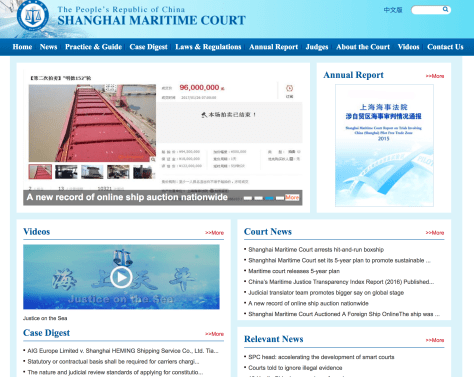
The Supreme People’s Court (SPC) and other Chinese courts have established or upgraded their English language websites to promote better the image of the Chinese courts to the outside world. These websites are linked to policy goals set by the 4th Plenum, 4th Five Year Court Reform Plan, and other related documents. That can be seen from an announcement on the English language version of the Shanghai Maritime Court’s website:
Shanghai Maritime Court established a judicial translator team, aiming at having a bigger say in global judicial disputes and fostering judicial talents with a global vision.
“Establishing a professional translator team for maritime judiciary centers is a goal for building a global maritime judicial center,” said Zhao Hong, president of the Shanghai Maritime Court.
“It is aiming to serve a maritime powerhouse and laying a solid foundation for China’s Belt and Road initiative,” Zhao said.
A quick rating of the soft power of these English language websites follows below.
The SPC English website, while an improvement over the previous version, could be substantially improved.
Too much of the information is out of date, including much of the information on the landing page of the website. The “About” section, which could be useful to foreign courts, diplomats, journalists, researchers, students, etc. has an outdated description of the SPC leadership. In the section on Resources, the SPC white papers are published as separate pages, rather than as one downloadable PDF (as some of the Chinese maritime courts have done). The scheduled hearings section is generally out of date and also provides no information as to how an interested person would attend a hearing. The link to issues of the SPC Gazette only contains the first two pages, rather than the full issue itself. Moreover, the landing page lacks links to other English language court websites.
National Maritime Court site
China Maritime Trial: http://enccmt.court.gov.cn/chinamaritimetrial/index.html, the English language version of the national maritime court website (partial screenshot below), apparent partner to the Foreign Related Commercial website (similar look and feel) seems to be in beta mode.
Again, as with the national court website, the news on most of the landing page appears to be outdated. The white paper page does not enable the user to download a PDF version of the report providing an overview of the first 30 years of the maritime courts. Under the resources tab, under law & regs, are links to translations of SPC judicial interpretations relating to the maritime courts, but it is not apparent to anyone looking at the landing page. These translations are potentially a useful resource to all sorts of foreign readers. Under the resources tab, the cases menu is empty. The judgement tab links to translations of some judgments and rulings by the SPC and maritime courts, but without any headings or indications on the front page of the website. These translations, too, are potentially a useful resource to foreign users. It does have links to the other maritime courts (some of which have English websites, but some of the links are out of date.
National Foreign-Related Commercial Cases Website
China Foreign Related Commercial Trial: http://enccmt.court.gov.cn/ChinaForeignRelatedCommercialTrial/index.html , the English language version of the national foreign-related commercial cases court website (partial screenshot below),apparent partner to the Maritime Courts website (similar look and feel) seems to be in beta mode.
Again, as with the national court website, the news on most of the landing page appears to be outdated. Under the About tab is a list of courts that can accept foreign-related cases, but information about the jurisdiction of each court is missing. Under the Media Center, most of the information under Updates is irrelevant to the courts, the information under International Exchanges is missing, but the Specials has a translation of the SPC’s Belt & Road policy document (although followed by descriptions of the SPC’s cooperation with several Shanghai-area law schools). There is no content under the Resources tab or the Judgement tab. Translations of judicial interpretations related to foreign-related civil and commercial issues and a clearer explanation of how a foreign-related case progresses in China would be useful for the casual foreign user, including those from the Belt & Road countries.
The Shanghai Higher People’s Court website is well organized, and relatively timely, although the litigation guide has little information to guide the foreign litigant, and too much of the information, whether cases or news, is badly edited. The information on jurisdiction is not very helpful for a litigant or counsel, because it does not convey information on the jurisdiction of the Shanghai courts. It appears that translators lacked understanding of who the potential users of the site were, and had English language challenges, unlike the Shanghai maritime court (see more below).
Local Maritime court websites
Several maritime courts have English language websites, with Guangzhou and Shanghai taking the lead in presenting useful and clear information to the foreign user. The Shanghai maritime court website (http://shhsfy.gov.cn/hsfyywwx/hsfyywwx/index.html) does a good job of presenting official information clearly and in a timely manner. The Shanghai maritime court’s bilingual white paper for 2014 and 2015 is downloadable in PDF (under the Annual Report tab), the Court News is relatively timely, The case digests are useful and calendar lists upcoming court hearings (however without information concerning how an interested person could attend them). Unusually for a Chinese court website, the Judges tab has photos of judges other than the senior leadership. The Contact Us tab (unusual for a Chinese court) has only telephone numbers for the court and affiliated tribunals, rather than an email (or Wechat account). Of course the information on the Chinese side of the website is more detailed (under the white paper tab, for example, a detailed analysis of annual judicial statistics can be found), and the laws & regulations tab might usefully set out maritime-related judicial interpretations, but most of the information is well organized and relevant. Similar comments can be made about the Guangzhou maritime court’s website (http://english.gzhsfy.gov.cn/index.php).

Comment
It appears that Judge Zhao Hong, president of the Shanghai Maritime Court (and former SPC #4 Civil Division judge) and her Guangzhou counterpart, Judge Ye Liudong, have a greater sense of what the world outside of China is interested to know about the Chinese courts than many other Chinese senior court judges. The team of judges (and other judicial personnel) under her watchful eye does a good job of keeping the website current and useful.
Most of the court English language websites should be rated “room to improve,” as they fail to convey useful and timely information to foreign users.Those running the website do not seem to have a sense of what the foreign audience wants to know. That could be solved in a couple of ways: looking at some foreign court websites, consulting with a web-development company focusing on the foreign market, or recruiting some foreign lawyers or law students to be a website focus group.
The websites need to convey to a foreign audience a range of useful information worded in accessible language if they are to accomplish their goal of promoting the image of the Chinese courts. One useful piece of information that should be on a Chinese court website is a clear illustration of the steps in a civil or commercial case), aimed at individual or small business litigants. How foreigners can use the Chinese courts to protect their rights, be they related to a contract, property, or employment relationship, is a practical issue both to the hundreds of thousands of foreign residents in China as well as those foreigners with cross-border disputes with a Chinese party.
Petitioners at SPC (used with permission of Natalie Behring)
In recent months, the Supreme People’s Court (SPC) has been issuing one policy document after another to put some substance into the vague language of a “trial-centered” criminal justice system. One of those documents, which the SPC issued recently along with the Supreme People’s Procuratorate and Ministry of Justice, is directed at involving lawyers in the criminal case petitioning system: Opinions on Gradually Implementing Systems For Lawyers’ Representation in Collateral Appeals (Collateral Appeals Opinion). (The document was copied to a surprising number of Party, state, and military institutions, according to this version).
The Collateral Appeals Opinion builds on a single line in item #36 of the SPC’s 4th Court Reform Plan outline: “Promote the establishment of a system for lawyer representation in complaint appeals [collateral appeals] cases.” As some readers may be aware, China has a collateral appeals or criminal case petitioning (刑事申诉) system, giving a convicted person and his or her family a right to petition a court to have the case re-opened and reconsidered under the Criminal Procedure Law’s trial supervision procedures. Criminal defense lawyers are hopeful that this will lead to more involvement by the criminal defense bar, but there are many procedural and financial arrangements still to be worked out.
It seems likely that Judge Hu Yunteng, as a member of the SPC’s judicial committee (as well as others) were involved in the drafting of this policy document. As I discussed in a February, 2017, blogpost, Judge Hu Yunteng and other colleagues on the #2 Circuit Court wrote a research report analyzing criminal collateral appeals petitioners visiting the #2 Circuit Court (第二巡回法庭刑事申诉来访情况分析报告), (which does not seem to have been made public) and in the article summarized in that blogpost, advocated hearing the views of the party’s lawyer if one has been appointed and noted that making contact with the party and his lawyer was an important way to deal with these cases.
But establishing an effective collateral appeal system system involves further issues, as highlighted by one of my students in his class paper (edited).
Criminal petitioning [collateral appeal] lawyers face a dilemma: they don’t have the right to investigate evidence, read case files, or even meet their clients if their clients are now prisoners and not defendants. [Comment–section 9 of the Collateral Appeals Opinion has broad language on improving this–this is a positive step, but will require more specific implementing procedures].
Article 306 of the Chinese Criminal Law, which provides that criminal defense lawyers who encourage defendants or witnesses to change their testimony should be punished criminally. This provision makes criminal defense lawyers extremely unwilling to investigate new evidence by themselves because of the high risk.
According to Chinese Criminal Procedure Law, the petitioning process should be conducted in the court which makes the original judgment. [Comment–the Supreme Peoples Procuratorate and Court media outlets recently have published proposals to have these cases should be considered by procuratorates and courts in other jurisdictions.] However, this court will have strong incentive to have these cases not successfully petitioned because their bonus and assessment are based on correctness rate of effective judgments. [My comment–this is one of the many ways the judicial performance assessment system creates obstacles to justice. So to make this reform effective, this indicator must be abolished.] Combined with the fact that there is no clear rule that needy petitioners should be assigned lawyers, they may either ignore the need for lawyers, or just assign lawyers who have little interest to really petition for their clients in these cases. So in most cases in which petitioners are in poverty, they could only seek the help of private lawyers for free service.
In China there is a saying that if you want to win in petitioning you have to make a big influence to make the government notice your case, and if you want the government to notice on you, you have to use some extreme rather than some “legal” ways to petition. If petitioners hire a lawyer, the lawyer has his/her own professional responsibility standard that he or she has to follow, which may sometimes conflict with the “best interest” of the client.
There a gap between the economic difficulty for ordinary daily life and economic difficulty in seeking legal service. For example, a person may not meet the criteria of economic difficulty because he or she’s earning is above the living standard. However, this person can still not able to afford legal service from a law firm because ordinarily the cost for seeking criminal defense service is above a person’s salary in a whole year. Such gap and seemingly objective standard actually causes a problem and means many people in need cannot receive the aid.
Chinese criminal justice reform–as President Trump says “it’s complicated!”
In August, 2016, I wrote about how non-guiding Chinese cases are guiding the development of Chinese law. I described what I saw as a prevalent practice in the Chinese judiciary that judges search a particular issue to see how other courts have decided a particular issue or the elements to which they have looked when deciding a particular issue. In that blogpost, I questioned whether the Supreme People’s Court (SPC) had noticed this practice. Under a recent SPC policy document that will become effective on 1 May, this prevalent practice will become a required practice. The SPC’s Opinions on Putting a Judicial Responsibility System in Place and Improving Mechanisms for Trial Oversight and Management (Provisional) contains the following phrase:
6. All levels of people’s courts shall give full play to the professional judges’ conferences and adjudication committee’s roles in summarizing trial experience unifying judgment standards; and on the foundation of improving working mechanisms such as consulting similar cases and judgment guidance; a mechanism is to be established requiring the search of similar cases and relevant cases, to ensure a uniform judgment standard for similar cases, and the uniform application of law.
This requires judges to do what many of them have been already doing –searching the case databases for prior cases that raise the same or similar issues and other issues related to the principal one(s). This principle will be applicable to judges hearing all sorts of cases–civil, criminal, administrative, enforcement, and intellectual property. It will not be evident to the reader of a Chinese judgment or ruling that searches have been done because non-guiding cases may not be cited.
Requiring a search of prior and related cases is an important step in the evolution of the Chinese case law system. That system (as I wrote recently), supplements and informs judicial interpretations. Judicial interpretations often take years to be finalized. National legislation (by the National People’s Congress and its Standing Committee) is hopelessly inadequate for the needs of the court system. Case law is needed to fill in the gaps. Judges, who are assuming greater individual responsibility for their decisions, need case law for more specific guidance.
In her remarks in November, 2016 focused on intellectual property, Justice Tao Kaiyuan revealed the thinking of the SPC leadership:
The construction of the case guidance system [Chinese case law] is not to create a new legal source, but to…uncover the broader consensus of the industry, to further refine legal rules and to provide better law for society. It is also expected to lay the foundation for the drafting of judicial interpretations…The function of the intellectual property case guidance system is to enhance the predictability of the judiciary by establishing an intellectual property case guidance system to promote the unity of judicial standards.
You must be logged in to post a comment.